Why in News?
On August 14, 2026, the Ministry of Defence signed two contracts with Tata Advanced Systems Limited and NIBE Private Limited to procure loiter munition systems, munitions and accessories for the Indian Army.
- The Press Information Bureau states that the contracts were signed in New Delhi in the presence of Defence Secretary Rajesh Kumar Singh.
- The official release identifies the procurement category as Buy (Indian) and the route as the Fast Track Procedure.
- The Ministry describes the equipment as intended to enhance the capability of Artillery Regiments and the Army’s overall operational effectiveness.
- The Hindu reports a total of 84 loiter munition systems, 840 munitions and associated accessories, with a stated range of up to 100 km. These quantities and the range appear in the newspaper report, not.
- According to The Hindu, TASL is to supply 54 systems and 540 munitions for ₹1,013.77 crore, while NIBE is to supply 30 systems and 300 munitions for ₹563.36 crore. The two quoted contract values add to.
- A loitering munition combines surveillance, target selection and one-way attack in a single expendable system. Unlike a conventional missile launched at a pre-fixed target, it can remain airborne for a period before an operator commits it.
- For artillery, the important change is not merely greater range. A loitering munition can shorten the sensor-to-shooter chain by linking observation, target confirmation and precision engagement more closely.
- Fast acquisition can close an urgent capability gap, but long-term military value depends on reliable communications, electronic-warfare resilience, training, stocks, maintenance, quality assurance and integration with command networks.
UPSC Relevance
Prelims Relevance
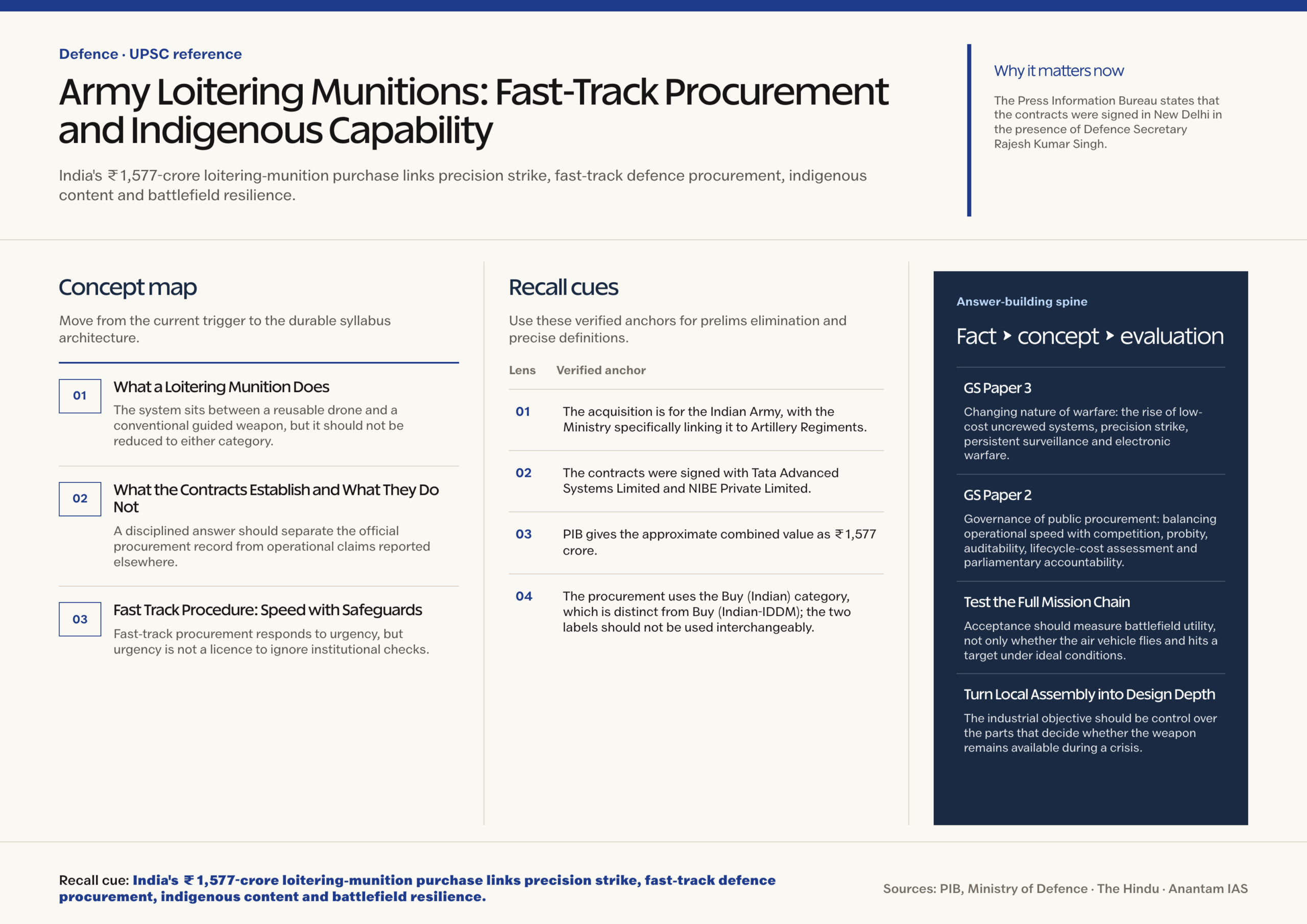
- The acquisition is for the Indian Army, with the Ministry specifically linking it to Artillery Regiments.
- The contracts were signed with Tata Advanced Systems Limited and NIBE Private Limited.
- PIB gives the approximate combined value as ₹1,577 crore.
- The procurement uses the Buy (Indian) category, which is distinct from Buy (Indian-IDDM); the two labels should not be used interchangeably.
- The Fast Track Procedure is designed for urgent operational requirements and compresses acquisition timelines; it does not remove the need for evaluation, contracting, accountability or quality assurance.
- The Hindu reports 84 systems and 840 munitions, divided between TASL and NIBE, and a range of up to 100 km.
Mains Relevance
GS Paper 3
- Changing nature of warfare: the rise of low-cost uncrewed systems, precision strike, persistent surveillance and electronic warfare.
- Internal security and defence preparedness: closing capability gaps while building resilient command, communications and counter-drone ecosystems.
GS Paper 2
- Governance of public procurement: balancing operational speed with competition, probity, auditability, lifecycle-cost assessment and parliamentary accountability.
- Ethics and international humanitarian law: distinction, proportionality, precautions in attack, operator accountability and meaningful human judgement in the use of force.
Essay
- Technology changes the speed of war faster than institutions change the rules of responsibility.
Background and Context
What a Loitering Munition Does
The system sits between a reusable drone and a conventional guided weapon, but it should not be reduced to either category.
- A conventional missile is usually launched against a target already identified. A loitering munition can remain over or near a target area while its sensors and operator search, confirm or update the engagement.
- The air vehicle carries its own warhead and is consumed in the strike. This separates it from a typical reusable ISR drone, whose primary role is intelligence, surveillance and reconnaissance and which is expected to.
- Its operational value comes from combining persistence and precision: a unit may observe a changing situation, delay commitment, or engage a time-sensitive target when authorised.
- Public descriptions often use the phrase ‘kamikaze drone’, but loitering munition is the more precise analytical term because it identifies a weapon category rather than relying on a sensational label.
- Capabilities differ across products. Range, endurance, payload, launch method, recovery options, navigation, data link, terminal guidance and the degree of operator control must be verified for the specific system; none should be inferred from the category.
What the Contracts Establish and What They Do Not
A disciplined answer should separate the official procurement record from operational claims reported elsewhere.
- PIB confirms the signing of contracts, the two companies, approximate aggregate value, Army end user, Buy (Indian) category, Fast Track Procedure and intended support to artillery capability.
- The official release does not publish the model names, detailed performance parameters, individual contract values, delivery calendar, test results or deployment locations. Such details cannot be filled with assumptions about either vendor’s publicly marketed products.
- The Hindu supplies additional reported terms: 84 systems, 840 munitions, up to 100 km range, a 54:30 division of systems, the individual contract amounts and a 12-month delivery window after advance payment.
- The newspaper also says the procurement is intended to bridge a precision-strike gap beyond roughly 40-50 km, where existing capability is largely dependent on BrahMos. That is a reported assessment, not wording in the PIB release.
- The safe analytical conclusion is that the Army is widening its precision-strike options. It is not safe to conclude from the public material that loitering munitions replace missiles, rockets, guns or surveillance platforms; they complement.
Fast Track Procedure: Speed with Safeguards
Fast-track procurement responds to urgency, but urgency is not a licence to ignore institutional checks.
- The Ministry has long described the Fast Track Procedure as a route for urgent operational requirements, including needs arising from an imminent situation or a crisis without prior warning.
- A shorter acquisition cycle can reduce the time between identifying a battlefield gap and fielding equipment. This is especially relevant to fast-changing technologies such as drones, where a slow cycle risks purchasing an already dated configuration.
- Speed creates its own governance risks: narrowly framed requirements can lock in a vendor, compressed trials may miss environmental or electronic-warfare weaknesses, and urgent orders can understate lifecycle costs.
- The sound principle is speed with traceability. Technical evaluation, commercial reasonableness, acceptance testing, cybersecurity review, contract milestones and audit records should remain clear even when stages run concurrently.
- Fast-track purchases should inform, not substitute for, long-range capability planning. Follow-on orders need performance evidence from training and deployment, an updated threat assessment and a sustainable ammunition-stock policy.
Why Indigenous Content Must Be Read Carefully
A procurement category indicates an industrial-policy choice, but true strategic autonomy depends on which parts of the capability are controlled in India.
- The contracts fall under Buy (Indian). This should not be casually rewritten as Buy (Indian-IDDM), a separate category that explicitly foregrounds indigenous design, development and manufacture.
- The Hindu reports 60% overall indigenous content and a minimum 50% indigenous contribution in materials, components and software. Those percentages are useful only alongside a transparent method for calculating and verifying value addition.
- Critical dependence may hide inside a high aggregate percentage. Imported seekers, navigation modules, engines, encrypted data-link components or software libraries can become bottlenecks during a supply disruption even if many structural parts are local.
- A stronger measure of indigenous capability asks whether Indian entities control source code, integration knowledge, testing, repair, upgrades, intellectual property and alternative suppliers for critical sub-systems.
- The two-vendor structure can broaden private-sector capacity and reduce single-supplier dependence. Its benefits will depend on common standards, quality consistency, assured component supply and whether operational units can train and maintain both systems without unnecessary duplication.
Way Forward
Test the Full Mission Chain
- Conduct trials in heat, cold, altitude, dust, rain and contested electromagnetic conditions, including degraded satellite navigation and data links.
- Test the complete chain from target detection and authorisation to launch, handover, strike assessment and safe termination, with representative artillery units.
- Use operational data to track reliability, launch success, mission aborts, communications loss, accuracy and turnaround time without publishing sensitive specifications.
Conclusion
- The ₹1,577-crore procurement is a significant step because it places loitering munitions inside the Army’s artillery modernisation and uses Indian private-sector suppliers under a fast-track route.
- The deeper test is whether rapid purchase becomes durable strategic autonomy : systems that work in a contested environment, trained units that can employ them lawfully, domestic capacity that can sustain and improve them, and procurement records that remain accountable.
UPSC Practice Questions
Prelims MCQ 1
With reference to the Ministry of Defence’s August 2026 procurement of loiter munition systems for the Indian Army, consider the following statements:
- The contracts were signed with Tata Advanced Systems Limited and NIBE Private Limited.
- The procurement was processed under the Buy (Indian) category through the Fast Track Procedure.
- The Ministry’s press release classifies the procurement as Buy (Indian-IDDM).
How many of the above statements are correct?
(a) Only one (b) Only two (c) All three (d) None
Answer: (b) Only two
Explanation:
Statements 1 and 2 are correct. PIB names TASL and NIBE and identifies Buy (Indian) through the Fast Track Procedure. It does not classify these contracts as Buy (Indian-IDDM), which is a distinct procurement category.
Prelims MCQ 2
Which one of the following best distinguishes a loitering munition from a conventional reusable surveillance UAV?
(a) It cannot carry any sensor and depends entirely on ground radar (b) It is designed only to return imagery and must not engage a target (c) It combines surveillance or target search with a warhead and is expended in a one-way strike (d) It necessarily selects and attacks targets without any human involvement
Answer: (c) It combines surveillance or target search with a warhead and is expended in a one-way strike
Explanation:
A loitering munition carries a warhead, can remain in a target area before engagement and is consumed in the strike. It may automate some functions, but the category does not by itself prove fully autonomous target selection.
UPSC Mains Questions
- Loitering munitions compress the sensor-to-shooter chain, but they do not remove the need for layered fires, electronic-warfare resilience and human judgement. Discuss in the context of India’s artillery modernisation. (250 words)
- Fast-track defence procurement must close urgent capability gaps without weakening accountability or long-term self-reliance. Examine the institutional and industrial safeguards required. (250 words)
Sources: PIB, Ministry of Defence and The Hindu.
Frequently Asked Questions
What did the Ministry of Defence sign on August 14, 2026?
The Ministry signed contracts with Tata Advanced Systems Limited and NIBE Private Limited for loiter munition systems, munitions and accessories for the Indian Army. PIB placed the approximate combined cost at ₹1,577 crore and said the equipment would enhance the.
What is a loitering munition?
It is an uncrewed weapon that can remain airborne in or near a target area while searching, observing or waiting for an authorised engagement, then conducts a one-way strike with its onboard warhead. Exact endurance, range, guidance and human-control arrangements.
How is a loitering munition different from a missile and a surveillance drone?
A conventional missile is normally fired at a target identified before launch. A surveillance drone usually gathers information and returns. A loitering munition combines a sensor-enabled search or wait period with an expendable strike, giving forces another option against mobile.
What does the Fast Track Procedure mean in defence procurement?
It is an acquisition route intended to meet urgent operational requirements within a shorter period. Fast track does not mean an absence of scrutiny: technical evaluation, commercial checks, acceptance testing, contract management, quality assurance and auditability remain necessary to protect.
Does Buy (Indian) mean that every component is designed and made in India?
No. Buy (Indian) is a procurement category with indigenous-content conditions, but it is distinct from Buy (Indian-IDDM). Strategic autonomy also depends on who controls design knowledge, software, critical components, testing, repair, upgrades and supply chains, not only the aggregate local-content.
Tell Google you want more of this.
Add Anantam IAS as a preferred sourceOne tap, and this site shows up more often in your own Top Stories, AI Overviews and AI Mode. Remove it any time.