Daily Digest
UPSC · Civil Services Examination
Current Affairs · Saturday, 16 May 2026
Current affairs curated and edited by Anantam IAS faculty — pulled from The Hindu, PIB, IDSA, Foreign Affairs and the ministries. Read, annotate, revise.
Old Rajinder Nagar · Delhi 110005 · anantamias.com
India’s first satellite-tagged Ganges soft-shell turtle released in Kaziranga
Why in News?
India’s first satellite-tagged Ganges soft-shell turtle was released in Kaziranga National Park and Tiger Reserve on May 15, 2026, coinciding with Endangered Species Day. The initiative aims to study the movement ecology, habitat use and conservation requirements of the endangered freshwater turtle species in the Brahmaputra river basin.
UPSC Relevance
Prelims: Ganges soft-shell turtle, Kaziranga National Park, Wildlife Protection Act 1972, IUCN Red List, satellite telemetry, freshwater biodiversity
Mains:
GS III: – biodiversity conservation, wildlife protection, riverine ecosystems, conservation technology, environmental governance
GS I: – geography of biodiversity hotspots and river ecosystems
Background and Context
Freshwater ecosystems are among the most threatened ecological systems globally due to:
- Habitat degradation
- River pollution
- Sand mining
- Damming and hydrological alterations
- Illegal wildlife trade
- Climate change
India is home to rich freshwater turtle diversity, particularly in the Gangetic and Brahmaputra river systems. However, many turtle species face severe population decline because of:
- Hunting for meat and traditional medicine
- Egg collection
- Habitat fragmentation
- River pollution
Assam occupies a particularly important position in freshwater turtle conservation. The Brahmaputra floodplains and wetlands support several rare and threatened turtle species.
Among India’s eight recorded soft-shell turtle species, five occur in the Kaziranga landscape, making the region globally significant for freshwater turtle conservation.
About the Ganges Soft-Shell Turtle
Taxonomic Identity
The Ganges soft-shell turtle is scientifically known as Nilssonia gangetica.
It is a large freshwater turtle species found mainly in:
- Ganga basin
- Brahmaputra basin
- Large rivers
- Reservoirs and wetlands
Distinctive Features
The species can be identified through:
- Soft leathery shell
- Streamlined body adapted for aquatic life
- Arrowhead-shaped markings on the head
Its body structure allows efficient swimming and adaptation to riverine ecosystems.
Ecological Importance
The turtle acts as an important scavenger and predator within freshwater ecosystems.
It contributes to:
- Removal of dead and decaying organic matter
- Nutrient recycling
- Maintenance of aquatic ecological balance
Thus, it plays a role similar to “natural sanitation workers” within river systems.
Conservation Status
IUCN Red List
International Union for Conservation of Nature classifies the species as Endangered on the IUCN Red List.
Wildlife Protection Act, 1972
The species is protected under Schedule I of the Wildlife Protection Act 1972.
Schedule I status provides:
- Highest degree of legal protection
- Strict penalties for hunting and trade
- Priority conservation attention
CITES Protection
Freshwater turtles are also protected under the Convention on International Trade in Endangered Species of Wild Fauna and Flora framework to regulate illegal international wildlife trade.
Satellite Tagging and Its Importance
What is Satellite Tagging?
Satellite tagging involves attaching a small transmitter to an animal to track its movement using satellite-based communication systems.
The technology helps scientists gather real-time information about:
- Seasonal migration
- Habitat preference
- Nesting behaviour
- Feeding grounds
- Breeding areas
- Threat zones
Importance in Turtle Conservation
Freshwater turtles are difficult to study because:
- They spend most of their time underwater
- River systems are dynamic and vast
- Nesting sites are often poorly documented
Satellite telemetry can help identify:
- Critical habitats
- Ecological corridors
- Human-induced threats
- Seasonal movement patterns
Such information is essential for evidence-based conservation planning.
Role of Scientific Institutions
The tagging exercise was conducted by the Wildlife Institute of India in collaboration with:
- Assam Forest Department
- Kaziranga National Park authorities
The project was supported by the National Geographic Society.
Ecological Importance of Kaziranga Landscape
A Riverine Biodiversity Hotspot
Kaziranga National Park and Tiger Reserve is globally known for:
- One-horned rhinoceros
- Tigers
- Elephants
- Wetland ecosystems
However, its riverine biodiversity often receives less attention.
The Brahmaputra river system supports:
- Freshwater turtles
- River dolphins
- Fish diversity
- Migratory birds
Dynamic Floodplain Ecology
Kaziranga’s ecology is shaped by:
- Annual flooding
- Sediment deposition
- Wetland formation
- River channel shifts
These processes create suitable habitats for freshwater turtles.
Threats to Freshwater Turtles in India
Habitat Degradation
River modification through:
- Dams
- Embankments
- Sand mining
- Urbanisation
disrupts turtle nesting and feeding habitats.
Water Pollution
Industrial waste, sewage discharge and agricultural runoff degrade freshwater ecosystems.
Pollution affects: Water quality, Food availability, Reproductive success
Illegal Hunting and Trade
Freshwater turtles are illegally hunted for:
- Consumption, Traditional medicine, International pet trade
India remains vulnerable to transboundary wildlife trafficking networks.
Climate Change
Climate change may alter:
- River flow patterns, Flood cycles, Nesting temperatures
This can affect turtle reproduction and survival.
Fishing Activities
Accidental entanglement in fishing nets is a major threat to aquatic reptiles.
Importance of Freshwater Biodiversity Conservation
Freshwater ecosystems support:
- Drinking water security
- Fisheries
- Agriculture
- Flood regulation
- Nutrient cycling
Despite occupying a small percentage of Earth’s surface, freshwater ecosystems host disproportionately high biodiversity.
However, freshwater species are declining faster than many terrestrial species globally.
Conservation of turtles therefore contributes to:
- River health
- Ecosystem resilience
- Biodiversity sustainability
Government Initiatives and Policy Measures
National Wildlife Action Plan (2017–2031)
The plan emphasises:
- Species recovery programmes
- Landscape-level conservation
- Community participation
- Scientific monitoring
Integrated Development of Wildlife Habitats
This centrally sponsored scheme supports:
- Habitat restoration
- Wildlife monitoring
- Protected area management
Project Dolphin and River Conservation
River conservation initiatives indirectly benefit freshwater turtles through:
- Pollution control
- Habitat protection
- River ecosystem restoration
Use of Technology in Wildlife Conservation
India increasingly uses:
- Satellite telemetry
- Camera traps
- GIS mapping
- Drone surveillance
for wildlife monitoring and conservation planning.
Challenges in Freshwater Turtle Conservation
Limited Ecological Data
Many freshwater turtle species remain poorly studied.
Lack of data affects:
- Population assessment
- Habitat management
- Species recovery planning
Weak River Governance
River conservation remains fragmented across multiple agencies dealing with:
- Irrigation
- Hydropower
- Pollution control
- Fisheries
Integrated river basin management remains inadequate.
Human-Wildlife Interface
Communities dependent on rivers often rely on:
- Fishing
- Sand extraction
- Wetland resources
Balancing conservation and livelihoods remains challenging.
Inadequate Public Awareness
Freshwater turtles receive relatively little conservation attention compared to charismatic mammals.
Way Forward
Strengthening Riverine Habitat Conservation
Conservation efforts should focus on:
- Protecting nesting sites
- Maintaining ecological flows
- Reducing habitat fragmentation
- Restoring wetlands
Expanding Scientific Monitoring
Satellite telemetry and long-term ecological studies should be expanded to other threatened freshwater species.
Integrated River Basin Management
River conservation policies should integrate:
- Biodiversity protection
- Water governance
- Pollution control
- Sustainable livelihoods
Community Participation
Local communities should be involved in:
- Turtle monitoring
- Nest protection
- Anti-poaching efforts
- Sustainable river management
Controlling Illegal Wildlife Trade
Stronger interstate and international coordination is needed to curb illegal turtle trade networks.
Awareness and Education
Educational campaigns can help improve public understanding of:
- Freshwater biodiversity
- Ecological role of turtles
- River ecosystem conservation
Conclusion
The satellite-tagging of the Ganges soft-shell turtle marks an important milestone in India’s freshwater conservation efforts. Beyond symbolic value, the initiative reflects the growing use of science and technology in biodiversity management. Freshwater turtles are vital indicators of river health, and their conservation is closely linked to broader ecological sustainability in the Gangetic and Brahmaputra river systems.
As India faces mounting pressures on its rivers from pollution, infrastructure expansion and climate change, protecting freshwater biodiversity will require integrated governance, scientific research and active community participation. The Kaziranga initiative demonstrates how modern conservation approaches can contribute to preserving fragile aquatic ecosystems for the future.
UPSC Practice Questions
- Consider the following statements regarding the Ganges soft-shell turtle:
I. It is classified as Endangered on the IUCN Red List.
II. It is protected under Schedule I of the Wildlife Protection Act, 1972.
III. It is primarily a marine turtle species found along India’s eastern coast.
Which of the statements given above are correct?
(a) I and II only
(b) II and III only
(c) I and III only
(d) I, II and III
Correct Answer: (a) I and II only
Explanation:
Statements I and II are correct because the Ganges soft-shell turtle is listed as Endangered by the IUCN and protected under Schedule I of the Wildlife Protection Act, 1972.
Statement III is incorrect because it is a freshwater turtle species inhabiting rivers and wetlands.
- With reference to satellite telemetry in wildlife conservation, consider the following statements:
I. It helps track animal movement and habitat use.
II. It can assist in identifying breeding and nesting areas.
III. It is used only for studying migratory birds.
Which of the statements given above are correct?
(a) I and II only
(b) II and III only
(c) I and III only
(d) I, II and III
Correct Answer: (a) I and II only
Explanation:
Satellite telemetry is widely used in wildlife conservation to monitor animal movement, migration and habitat use.
Statement III is incorrect because the technology is used for multiple species including mammals, reptiles and marine animals.
Mains Question:
1.“Conservation of freshwater biodiversity is essential for ecological sustainability and water security.” Analyse in the context of India’s river ecosystems.
2. Discuss the ecological importance of freshwater turtles in river ecosystems. Examine the major threats faced by them in India.
‘We condemn attacks on UAE’, says PM Modi, signs defence cooperation pact
Why in News?
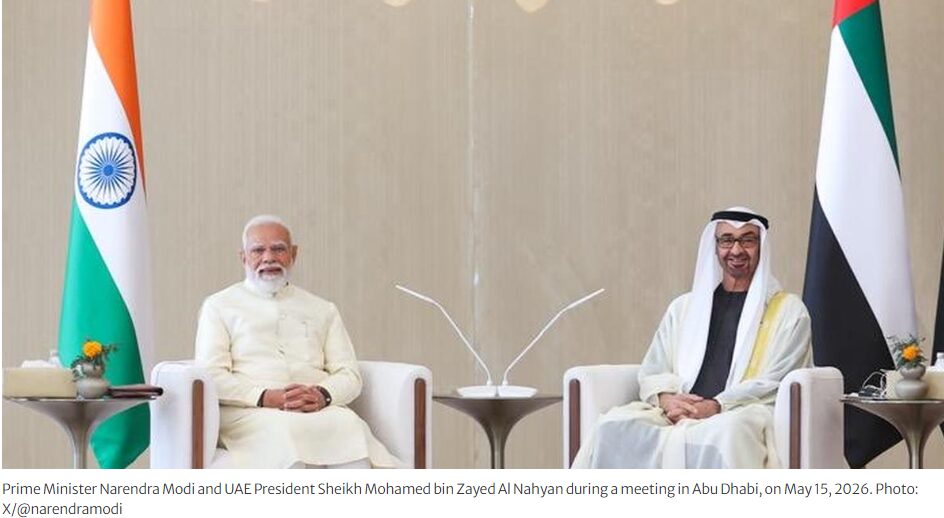
Prime Minister Narendra Modi visited the United Arab Emirates and held talks with UAE President Mohamed bin Zayed Al Nahyan during a brief stopover in Abu Dhabi. India and the UAE signed a Strategic Defence Cooperation Framework and several agreements related to energy security, strategic petroleum reserves, LNG supplies, ship-building and supercomputing cooperation amid rising instability in West Asia following the Iran conflict.
UPSC Relevance
Prelims: India-UAE relations, Strategic Petroleum Reserves, ADNOC, LNG, West Asia, energy security, Chabahar, Indian Ocean geopolitics
Mains:
GS Paper 2 – India and neighbourhood relations, bilateral agreements, West Asia diplomacy, strategic partnerships;
GS Paper 3 – energy security, defence cooperation, critical infrastructure, maritime security;
Essay – strategic autonomy, multipolarity, energy geopolitics
Background and Context
India’s engagement with the United Arab Emirates has evolved significantly over the past decade from a traditional energy-based relationship into a comprehensive strategic partnership.
The UAE is among India’s:
- Largest trading partners
- Major energy suppliers
- Important investment sources
- Key strategic partners in West Asia
The relationship has gained greater geopolitical importance because:
- Nearly 9 million Indians live and work in the Gulf region
- West Asia remains central to India’s energy imports
- Maritime trade routes through the Persian Gulf are critical for India’s economy
- Growing regional instability directly affects India’s strategic interests
The visit also occurred amid escalating tensions in West Asia following the Iran conflict and concerns regarding disruptions in global energy supply chains.
Evolution of India-UAE Relations
From Energy Partnership to Comprehensive Strategic Partnership
India-UAE relations historically revolved around:
- Oil imports
- Indian diaspora
- Remittances
- Trade links
However, since 2015, ties have expanded into:
- Defence cooperation
- Counter-terrorism
- Maritime security
- Technology
- Infrastructure
- Renewable energy
- Investment partnerships
In 2017, the relationship was elevated to a Comprehensive Strategic Partnership.
Growing Economic Engagement
The UAE is one of India’s top trading partners.
Key features include:
- Bilateral trade exceeding $80 billion in recent years
- UAE among major investors in Indian infrastructure
- Strong cooperation in ports, logistics and renewable energy
The India-UAE Comprehensive Economic Partnership Agreement further accelerated trade integration between the two countries.
Strategic Defence Cooperation Framework
Defence Cooperation Expands
The newly concluded Strategic Defence Cooperation Framework marks a major development in India-UAE security relations.
The agreement covers cooperation in:
- Defence manufacturing
- Defence technology
- Military exercises
- Maritime security
- Cybersecurity
- Special operations
- Information sharing
- Secure communications
This reflects the broadening strategic convergence between the two countries.
Importance for India
The agreement strengthens India’s:
- Defence diplomacy in West Asia
- Maritime presence in the Indian Ocean region
- Security cooperation against terrorism and piracy
- Strategic partnerships beyond traditional allies
It also aligns with India’s:
- ‘Make in India’ initiative
- Defence indigenisation goals
- Vision of becoming a defence manufacturing hub
Maritime Security Dimension
The maritime component is particularly important because:
- UAE lies near critical shipping lanes in the Persian Gulf
- India imports a majority of its crude oil through these routes
- West Asian instability can threaten energy transportation
India seeks to strengthen naval interoperability and maritime domain awareness in the Indian Ocean and Arabian Sea region.
Strategic Shift in Gulf Security Dynamics
Traditionally, the UAE military maintained close security cooperation with Pakistan.
The agreement indicates:
- Growing trust in India’s strategic role
- Diversification of Gulf security partnerships
- Changing geopolitical equations in West Asia
This also reflects India’s increasing diplomatic and strategic influence in the Gulf region.
Energy Security and Strategic Petroleum Reserves
Strategic Petroleum Reserves (SPR)
One of the most significant outcomes of the visit was the agreement on expanding India’s Strategic Petroleum Reserves.
The UAE’s Abu Dhabi National Oil Company signed agreements with Indian Strategic Petroleum Reserves Limited for:
- Storage of crude oil in India
- Cooperation on additional storage infrastructure
- Potential oil storage facilities in Fujairah, UAE
What are Strategic Petroleum Reserves?
Strategic Petroleum Reserves are emergency stockpiles of crude oil maintained by governments to:
- Ensure energy security
- Manage supply disruptions
- Stabilise domestic markets during crises
India currently maintains reserves at:
- Visakhapatnam
- Mangaluru
- Padur
Additional facilities are planned in:
- Andhra Pradesh
- Odisha
Importance for India
India imports over 85% of its crude oil requirements, making it highly vulnerable to:
- Geopolitical conflicts
- Supply disruptions
- Oil price volatility
The Iran conflict has reinforced the importance of:
- Diversified energy partnerships
- Long-term supply contracts
- Emergency reserves
LNG and LPG Cooperation
The agreement also includes:
- Long-term LNG supply arrangements
- Cooperation on gas storage infrastructure
Natural gas is increasingly important for India’s:
- Energy transition
- Industrial growth
- Cleaner fuel strategy
India aims to increase the share of natural gas in its energy mix from around 6% to 15%.
India’s Energy Security Challenges
Dependence on West Asia
West Asia remains India’s principal energy supplier.
Major suppliers include:
- Iraq
- Saudi Arabia
- UAE
- Kuwait
Instability in the region can directly affect:
- Inflation
- Trade balance
- Fiscal stability
- Industrial production
Geopolitical Vulnerabilities
Conflicts involving:
- Iran
- Israel
- United States
- Gulf monarchies
can disrupt:
- Strait of Hormuz shipping routes
- Oil supplies
- Insurance costs
- Freight rates
The Strait of Hormuz handles nearly one-fifth of global oil trade, making it strategically critical.
Need for Energy Diversification
India has increasingly pursued:
- Renewable energy expansion
- Diversified import sources
- LNG infrastructure
- Strategic reserves
- International energy partnerships
The UAE partnership fits into this broader strategy.
India’s Strategic Autonomy in West Asia
Balancing Multiple Relationships
India maintains relations simultaneously with:
- Israel
- Iran
- UAE
- Saudi Arabia
- United States
This balancing strategy reflects India’s policy of strategic autonomy.
India seeks to:
- Avoid entanglement in regional rivalries
- Protect energy interests
- Safeguard diaspora welfare
- Maintain independent foreign policy choices
Diplomatic Significance of Modi’s Statement
Prime Minister Modi’s condemnation of attacks on the UAE reflects:
- India’s concern regarding regional escalation
- Support for stability in Gulf monarchies
- Desire to prevent wider conflict affecting energy markets
At the same time, India has historically maintained relations with Iran due to:
- Chabahar Port
- Connectivity to Central Asia
- Energy cooperation
Balancing these competing relationships remains a major foreign policy challenge.
Technology and Infrastructure Cooperation
Ship-Building Cooperation
India and the UAE also signed agreements related to ship-building cooperation.
This aligns with India’s goals of:
- Expanding maritime infrastructure
- Developing domestic ship-building capacity
- Enhancing blue economy initiatives
Supercomputer and Technology Collaboration
The agreement on supercomputer hubs reflects emerging cooperation in:
- Digital infrastructure
- Artificial intelligence
- High-performance computing
- Technology partnerships
Such collaboration is increasingly important in:
- Defence systems
- Climate modelling
- Data processing
- Cybersecurity
Challenges and Concerns
Geopolitical Instability
Escalating tensions in West Asia pose risks to:
- Energy imports
- Maritime trade
- Indian diaspora safety
Dependence on Imported Energy
Despite diversification efforts, India remains heavily dependent on imported hydrocarbons.
This creates long-term strategic vulnerabilities.
Strategic Competition in West Asia
The region remains a theatre of competition involving:
- United States
- China
- Russia
- Regional powers
India must carefully navigate these rivalries without compromising strategic autonomy.
Technology Dependence
Defence and energy partnerships may still involve dependence on foreign technologies and supply chains.
Regional Security Risks
Any prolonged conflict in the Gulf could:
- Raise oil prices sharply
- Trigger inflation
- Slow economic growth globally
Way Forward
Strengthening Energy Security
India should continue:
- Expanding strategic petroleum reserves
- Diversifying energy suppliers
- Investing in renewable energy
- Increasing domestic energy resilience
Deepening Strategic Partnerships
India must strengthen strategic ties with Gulf countries while preserving balanced relations across West Asia.
Enhancing Maritime Security
India should expand:
- Naval cooperation
- Maritime domain awareness
- Anti-piracy operations
- Indian Ocean partnerships
Accelerating Clean Energy Transition
Reducing excessive hydrocarbon dependence requires:
- Solar energy expansion
- Green hydrogen development
- Natural gas infrastructure
- Electric mobility
Building Technological Capacity
Technology cooperation should prioritise:
- Indigenous manufacturing
- Cybersecurity capabilities
- AI infrastructure
- Strategic digital resilience
Protecting Indian Diaspora
Given the large Indian population in the Gulf, contingency planning for:
- Evacuation
- Labour security
- Consular support
remains essential during regional crises.
Conclusion
The India-UAE agreements signify the growing strategic depth of bilateral relations extending far beyond traditional energy trade. Defence cooperation, maritime security, technology partnerships and strategic petroleum reserves now form key pillars of the relationship.
The visit also underscores the centrality of West Asia to India’s energy security and foreign policy. As geopolitical instability intensifies in the region, India faces the complex challenge of balancing strategic autonomy, energy dependence and security partnerships. Strengthening diversified partnerships while building domestic resilience will remain essential for safeguarding India’s long-term national interests.
UPSC Practice Questions
- Consider the following statements regarding Strategic Petroleum Reserves (SPR):
I. Strategic Petroleum Reserves are emergency stockpiles maintained to manage supply disruptions.
II. India imports more than 80% of its crude oil requirements.
III. The Strait of Hormuz is strategically important for India’s energy security.
Which of the statements given above are correct?
(a) I and II only
(b) II and III only
(c) I and III only
(d) I, II and III
Correct Answer: (d) I, II and III
Explanation:
All three statements are correct. India is heavily dependent on imported crude oil, much of which passes through the Strait of Hormuz. Strategic Petroleum Reserves help mitigate supply disruptions during geopolitical crises.
- With reference to India-UAE relations, consider the following statements:
I. India and the UAE signed a Comprehensive Economic Partnership Agreement (CEPA) in 2022.
II. The UAE is among India’s major energy suppliers and trading partners.
III. India’s engagement with the UAE is limited only to energy cooperation.
Which of the statements given above are correct?
(a) I and II only
(b) II and III only
(c) I and III only
(d) I, II and III
Correct Answer: (a) I and II only
Explanation:
Statements I and II are correct. India and the UAE signed CEPA in 2022 and maintain strong trade and energy ties.
Statement III is incorrect because bilateral relations also include defence, maritime security, technology and investment cooperation.
Mains Questions:
- “Strategic autonomy in foreign policy is becoming increasingly difficult in a geopolitically polarised world.” Discuss in the context of India’s engagement with West Asia.
- Examine the significance of the India-UAE strategic partnership in the context of India’s energy security and West Asia policy.
Bhojshala-Kamal Maula complex declared as temple by Madhya Pradesh High Court
Why in News?
The Madhya Pradesh High Court has declared the disputed Bhojshala-Kamal Maula complex in Dhar as a temple dedicated to goddess Vagdevi (Saraswati), while dismissing the claims of the Muslim community over the site. The court also quashed the 2003 ASI arrangement permitting Friday prayers and relied upon principles evolved in the Ayodhya Ram Janmabhoomi-Babri Masjid Verdict.
UPSC Relevance
Prelims: ASI, Ancient Monuments and Archaeological Sites and Remains Act 1958, Article 25, Article 26, protected monuments, carbon dating, palaeography
Mains:
GS Paper 1 – Indian heritage and culture, conservation of heritage sites
GS Paper 2 – secularism, religious rights, judiciary, constitutional morality, governance of religious institutions;
Essay – religion and constitutionalism, heritage and identity
Background and Context
The Bhojshala-Kamal Maula complex located in Dhar district of Madhya Pradesh has been a site of religious and historical contestation for decades.
The dispute primarily concerns:
- The religious character of the structure
- Rights of worship
- Ownership and management of the monument
The site has historically been claimed by:
- Hindus, who regard it as a temple dedicated to goddess Saraswati
- Muslims, who consider it the Kamal Maula mosque
- Certain Jain groups, who also raised claims recently
The complex is a protected monument under the Archaeological Survey of India (ASI).
For years, a shared arrangement existed under a 2003 ASI order:
- Hindus performed puja on Tuesdays and Basant Panchami
- Muslims offered namaz on Fridays
The High Court judgment has now fundamentally altered this arrangement.
Historical Significance of Bhojshala
Connection with Raja Bhoja
The Bhojshala is associated with Raja Bhoja, the famous 11th-century ruler of the Paramara dynasty.
Raja Bhoja is remembered for:
- Patronage of Sanskrit learning
- Temple construction
- Contributions to literature and architecture
The term “Bhojshala” is often interpreted as:
A centre of learning established under Raja Bhoja.
Association with Goddess Saraswati
Hindu groups believe that the site originally housed:
- A temple of goddess Saraswati (Vagdevi)
- A centre for Sanskrit education
Historical references mention the existence of:
- Sculptures
- Pillars with Sanskrit inscriptions
- Temple-style architecture
The idol of goddess Saraswati associated with the site was reportedly taken to the United Kingdom during colonial times and is presently housed in a museum in London.
Archaeological and Architectural Importance
The monument contains:
- Pillared halls
- Carved stone structures
- Sanskrit inscriptions
- Islamic architectural additions
This reflects layers of historical transformation over centuries.
The site is considered architecturally significant because it displays:
- Medieval temple architecture
- Reused structural elements
- Syncretic historical layers
Legal and Constitutional Dimensions
Ancient Monuments and Archaeological Sites and Remains Act, 1958
The court held that the site is a protected monument under the Ancient Monuments and Archaeological Sites and Remains Act 1958.
The Act provides for:
- Protection of ancient monuments
- Preservation of archaeological heritage
- Regulation of religious access where applicable
The ASI is empowered to:
- Maintain protected monuments
- Regulate public access
- Ensure conservation
Article 25 and Religious Freedom
Article 25 guarantees:
- Freedom of conscience
- Freedom to profess, practice and propagate religion
However, these rights are subject to:
- Public order
- Morality
- Health
The dispute involved balancing competing religious claims over the same site.
Article 26 and Religious Denominations
Article 26 grants religious denominations the right to manage their own affairs in matters of religion.
The case raised questions regarding:
- Whether the site retained temple character
- Rights of communities over protected monuments
- State regulation of religious spaces
Key Findings of the High Court
Declaration of Religious Character
The High Court declared that:
- The religious character of the disputed structure is that of a Bhojshala temple dedicated to goddess Saraswati
The court therefore permitted Hindu worship at the site.
Quashing of 2003 ASI Arrangement
The court struck down the 2003 ASI order that allowed:
- Friday namaz by Muslims
- Limited Hindu worship access
The judgment effectively ended the earlier shared-use arrangement.
Reliance on Ayodhya Principles
The court stated that it drew guidance from principles evolved in the Ayodhya judgment.
The Ayodhya verdict had emphasised:
- Historical evidence
- Archaeological findings
- Longstanding patterns of worship
- Balancing constitutional rights
Directions Regarding Saraswati Idol
The court directed the Union government to make efforts to:
- Bring back the Saraswati idol from London
- Re-establish it at Bhojshala
This touches upon broader debates regarding:
- Repatriation of cultural artefacts
- Colonial-era removal of heritage objects
Role of Archaeological Survey of India (ASI)
Court-Ordered Scientific Survey
The dispute involved a scientific survey conducted by the Archaeological Survey of India.
The survey reportedly used:
- Carbon dating
- Palaeography
- XRF spot analysis
- Compositional testing
Scientific Evidence and Heritage Litigation
The court accepted the ASI findings as:
- Fair
- Scientific
- Impartial
The judgment noted that:
- Videography was conducted
- Representatives from all parties were present during the survey
This reflects the increasing use of scientific archaeology in heritage and religious disputes.
Repatriation of Cultural Artefacts
Saraswati Idol Issue
The judgment’s direction regarding the Saraswati idol raises the larger issue of repatriation of cultural heritage objects.
India has increasingly sought the return of:
- Sculptures
- Antiquities
- Temple idols
- Artefacts taken during colonial rule
Recent years have seen successful repatriation efforts involving:
- United States
- Australia
- United Kingdom
International Conventions
India is a signatory to:
UNESCO Convention 1970
The convention seeks to:
- Prevent illicit trade in cultural property
- Facilitate return of stolen artefacts
Broader Constitutional and Social Issues
Heritage and Religious Identity
The dispute reflects how historical monuments can become sites of:
- Identity politics
- Religious mobilisation
- Competing historical narratives
Such disputes often involve tensions between:
- Archaeological interpretation
- Faith-based claims
- Constitutional secularism
Judiciary and Religious Disputes
Courts increasingly play a central role in resolving:
- Temple-mosque disputes
- Religious access issues
- Heritage claims
This raises debates regarding:
- Judicial capacity in interpreting history
- Role of evidence in faith disputes
- Limits of judicial intervention
Shared Heritage and Pluralism
India’s medieval heritage often reflects:
- Multiple historical layers
- Syncretic traditions
- Adaptive reuse of structures
Managing such sites requires balancing:
- Religious sensitivities
- Constitutional rights
- Conservation needs
Challenges and Concerns
Potential Social Tensions
Religious site disputes can trigger:
- Communal polarisation
- Public unrest
- Political mobilisation
Balancing Faith and Archaeology
Courts must navigate the difficult relationship between:
- Historical evidence
- Archaeological interpretation
- Faith-based belief systems
Preservation versus Religious Use
Increased religious activity at protected monuments may create challenges for:
- Conservation
- Visitor regulation
- Structural preservation
Judicialisation of Historical Disputes
There are concerns that more historical disputes may increasingly move into courts, potentially affecting social harmony.
Management of Protected Monuments
Balancing:
- ASI conservation responsibilities
- Religious access
- Tourism
- Security
remains administratively complex.
Way Forward
Strengthening Scientific Heritage Conservation
Archaeological investigations should remain:
- Transparent
- Evidence-based
- Professionally supervised
to preserve public trust.
Promoting Dialogue and Reconciliation
Community dialogue mechanisms can help reduce tensions surrounding disputed heritage sites.
Balanced Heritage Management
Protected monuments with religious significance require integrated management frameworks balancing:
- Conservation
- Worship rights
- Public access
Repatriation of Cultural Heritage
India should continue diplomatic and legal efforts for:
- Return of stolen antiquities
- Recovery of temple idols
- Protection of heritage assets abroad
Preserving Constitutional Secularism
State institutions must ensure that:
- Religious freedom
- Rule of law
- Equality before law
remain protected while addressing historical disputes.
Strengthening ASI Capacity
The ASI requires:
- Better funding
- Modern scientific tools
- Conservation experts
- Improved site management systems
Conclusion
The Bhojshala-Kamal Maula judgment marks another significant development in the intersection of faith, history, archaeology and constitutional law in India. The case demonstrates how historical monuments continue to shape contemporary debates on identity, heritage and religious rights.
While the judgment resolves one legal dispute, it also raises broader questions regarding management of shared heritage spaces, the role of scientific evidence in religious claims, and the challenge of preserving constitutional harmony in a diverse society. Going forward, India’s approach must balance historical justice, conservation priorities and social cohesion within the framework of constitutional values.
UPSC Practice Questions
- Consider the following statements regarding the Ancient Monuments and Archaeological Sites and Remains Act, 1958:
I. It provides for protection and preservation of ancient monuments in India.
II. The Archaeological Survey of India is responsible for implementing the Act.
III. All protected monuments under the Act are prohibited from religious use.
Which of the statements given above are correct?
(a) I and II only
(b) II and III only
(c) I and III only
(d) I, II and III
Correct Answer: (a) I and II only
Explanation:
Statements I and II are correct because the AMASR Act provides for conservation of protected monuments and is administered by the ASI.
Statement III is incorrect because certain protected monuments continue to permit regulated religious practices.
- With reference to the Archaeological Survey of India (ASI), consider the following statements:
I. It functions under the Ministry of Culture.
II. It is responsible for conservation of centrally protected monuments.
III. It was established after independence.
Which of the statements given above are correct?
(a) I and II only
(b) II and III only
(c) I and III only
(d) I, II and III
Correct Answer: (a) I and II only
Explanation:
Statements I and II are correct. The ASI functions under the Ministry of Culture and manages centrally protected monuments.
Statement III is incorrect because ASI was established in 1861 during British rule.
Mains Questions:
- Examine the role of archaeology, scientific evidence and constitutional principles in resolving heritage-related disputes in India.
- Discuss the constitutional and heritage-related issues involved in disputes concerning religious claims over historical monuments in India.
Trump–Xi Summit 2025: Has the USA–China Rivalry Ended, or Just Entered a New Phase?
GS Paper 2 | International Relations | GS Paper 3 | Global Economy & Technology
Why in News?
US President Donald Trump and Chinese President Xi Jinping held a high-profile bilateral summit recently, with Trump declaring that the two countries had “settled many problems.” The meeting produced headline announcements — China’s agreement to buy 200 Boeing aircraft, imports of American soyabeans and beef, and limited relaxation of chip export restrictions for select Chinese firms. Trump also used the term “G2” to describe the US–China relationship, suggesting a possible co-management of global affairs by the two powers.
Yet, underneath the diplomatic optics, analysts widely agree that the summit has not resolved the fundamental rivalry between Washington and Beijing — a rivalry that is structural, multi-dimensional and increasingly civilisational in character.
Background: Why USA–China Rivalry Is Structural, Not Episodic
Unlike conventional diplomatic disputes that arise from specific misunderstandings and can be resolved through negotiation, the US–China rivalry is rooted in competing visions of global order. It is simultaneously a trade war, a technology war, a military competition, an ideological contest, and a struggle for rule-making authority in international institutions.
The post-Cold War era was defined by American unipolarity. China’s rapid economic rise, powered by its integration into global supply chains, has fundamentally altered that equation. Today, the US sees China not as a competitor to be managed but as a systemic rival whose rise threatens American primacy.
Trade War — From Tariff Battles to Economic Weaponisation
The most visible front of the rivalry is trade. The US has long accused China of unfair trade practices — forced technology transfer, intellectual property theft, state subsidies, currency manipulation and non-reciprocal market access. The Trump administration responded with sweeping tariffs on Chinese goods in its first term.
The recent summit produced visible trade concessions. China agreeing to purchase 200 Boeing aircraft — its first major such order in nearly a decade — was presented as a significant win. But analysts point out that this does not address the structural asymmetry that defines the trade relationship: American dependence on Chinese manufacturing, and Chinese dependence on American markets and technology.
Key Takeaway: The contest is no longer about trade deficits. It is about who controls global supply chains — from semiconductors to pharmaceuticals to critical minerals.
UPSC Relevance: GS3 — Protectionism, trade blocs, supply chain economics; GS2 — bilateral relations, multilateral trade.
Technology War — Semiconductors, AI and the Battle for the 21st Century
The most consequential theatre of US–China rivalry today is the semiconductor and artificial intelligence domain. Chips are to the 21st century what oil was to the 20th — the foundational resource of economic and military power.
The US has imposed sweeping export controls on advanced semiconductors and chip-making equipment to China, citing national security. These controls target China’s ability to develop AI for military applications, surveillance systems, guided munitions and advanced computing.
China, in response, has accelerated its own domestic semiconductor programme and deployed critical mineral export controls as a counter-leverage tool.
The summit produced only limited movement — US officials confirmed that 10 Chinese firms were cleared to purchase Nvidia’s second-most advanced chip, but this represents a narrow relaxation, not a reversal of tech-war policy.
| Domain | US Concern | China’s Objective |
|---|---|---|
| Advanced chips | China AI/military leap | Self-sufficiency in semiconductors |
| AI models | Computational superiority | Global AI leadership by 2030 |
| Quantum computing | Defence applications | Strategic technological parity |
| Telecom (5G/6G) | Huawei’s global reach | Standard-setting authority |
Key Takeaway: The chip war is not about commerce — it is about which power will write the rules of the AI age.
Rare Earths — China’s Strategic Counter-Weapon
China dominates a significant share of global rare earth mining and processing — minerals essential for electric vehicles, wind turbines, guided missiles, fighter jets, smartphones, magnets and battery systems.
Following US semiconductor export controls, China responded by imposing export restrictions on several rare earth elements and processing technologies. This created immediate anxiety in American defence and clean-energy industries.
The summit left this issue unresolved. It was reported to be a key concern for American businesses, but no clear commitment from China on relaxing rare earth controls emerged.
Analogy for UPSC Essay/GS2: America controls the software of 21st-century power (chips, AI, financial systems). China controls a significant portion of the hardware inputs (rare earths, manufacturing). Both are trying to reduce their mutual vulnerabilities — but cannot fully succeed without economic disruption.
Taiwan — The Most Dangerous Flashpoint
Taiwan remains the single most explosive issue in US–China relations. Beijing considers Taiwan an integral part of Chinese territory and has not ruled out force to achieve reunification. The US maintains a policy of strategic ambiguity — neither formally recognising Taiwan’s independence nor pledging to defend it militarily — while continuing to supply arms to Taipei.
China’s opposition to US arms sales to Taiwan was again voiced at the summit. The issue remains unresolved.
Why Taiwan is also an economic issue: Taiwan is home to TSMC (Taiwan Semiconductor Manufacturing Company), which produces a dominant share of the world’s most advanced chips. A military crisis around Taiwan would not only be a geopolitical catastrophe but also a global economic rupture — disrupting smartphones, automobiles, AI infrastructure and defence systems worldwide.
Video Line (adaptable for essay): If Ukraine shook the global energy market, Taiwan could shatter the global technology market.
UPSC Angle: One China Policy, strategic ambiguity doctrine, QUAD, Indo-Pacific security architecture, semiconductor supply chain vulnerability.
South China Sea and Indo-Pacific Rivalry
China claims approximately 90% of the South China Sea on the basis of the “nine-dash line,” a claim rejected by the Permanent Court of Arbitration in 2016. It has built artificial islands, installed military infrastructure and asserted control over maritime zones claimed by Vietnam, the Philippines, Malaysia and Brunei.
The US counters this through Freedom of Navigation Operations (FONOPs) and its network of alliances — QUAD (with India, Japan, Australia), AUKUS (with UK and Australia) and bilateral security treaties.
India’s Stakes:
- India’s trade transits Indo-Pacific sea lanes
- QUAD is a direct response to Chinese maritime expansion
- India’s Act East Policy targets Southeast Asia — a region increasingly pressured by Chinese influence
- Maritime balance in the Indian Ocean directly affects India’s security environment
Military Competition — A New Arms Race in Asia
China has undertaken the most rapid military modernisation of any major power in the post-Cold War era. Its navy has grown to become the world’s largest by number of vessels. It has developed anti-ship ballistic missiles (the “carrier killers”), hypersonic glide vehicles, cyber warfare units, space-based assets and an expanding nuclear arsenal.
The US concern is A2/AD — Anti-Access/Area Denial — China’s ability to prevent American military forces from operating freely near its coastline and in the Western Pacific.
| Domain | US Concern | China’s Strategic Goal |
|---|---|---|
| Naval power | Chinese Pacific expansion | Push US from first island chain |
| Missiles | Anti-ship missile threat | Deny US carrier strike groups access |
| Nuclear | Arsenal expansion | Achieve strategic deterrence parity |
| Space | Satellite vulnerability | Military-space capability |
| Cyber | Infrastructure espionage | Information domain dominance |
Ideological Confrontation — Liberal Democracy vs Authoritarian Capitalism
Beyond hard power, there is a civilisational and ideological dimension to the rivalry. The US champions the liberal international order — grounded in democratic governance, rule of law, free press and individual rights. China presents the “Beijing Consensus” — a model of state-led development, political stability and civilisational nationalism, encapsulated in Xi Jinping’s vision of “national rejuvenation.”
This ideological divide shapes everything from human rights diplomacy to internet governance to global media narratives. China has invested in information infrastructure, media influence and digital diplomacy to present its model as an alternative — particularly to the Global South.
China’s human rights record — particularly regarding the Uyghur Muslim minority in Xinjiang, the erosion of democratic freedoms in Hong Kong and restrictions in Tibet — remains a persistent source of US criticism. China dismisses these as interference in its internal affairs.
The “G2” Remark — Why India Is Uncomfortable
Perhaps the most geopolitically significant moment of the summit was Trump’s use of the term “G2” — implying that the US and China are the world’s two indispensable powers who together can manage global affairs.
This framing deeply discomfits India and other major powers for several reasons:
| Country/Group | Concern with G2 Framework |
|---|---|
| India | Asia’s future should not be decided by two powers alone |
| Japan | Security concerns; exclusion from strategic conversation |
| EU | Fear of transatlantic marginalisation |
| ASEAN | Pressure to choose sides |
| Global South | Loss of multipolarity; reduced bargaining power |
For India, a G2 world represents strategic exclusion — a return to a bipolar order in which New Delhi has less room to manoeuvre. India’s foreign policy has historically prized strategic autonomy, and a US–China condominium undermines precisely that.
Supply Chains — Decoupling, De-risking and India’s Opportunity
The post-COVID era accelerated Western recognition that excessive dependence on China-centric supply chains is a strategic vulnerability. The US shifted from talk of “decoupling” to the more calibrated concept of “de-risking.”
| Concept | Meaning |
|---|---|
| Decoupling | Complete severance of economic ties with China |
| De-risking | Reducing excessive dependence without full break |
| Friend-shoring | Shifting production to allied/trusted countries |
| China+1 | Retain China operations but build alternate capacity |
India’s Opportunity: India is a primary beneficiary of the China+1 strategy. Through:
- Production Linked Incentive (PLI) Scheme — electronics, pharmaceuticals, textiles
- Semiconductor Mission — building chip design and fabrication capacity
- Make in India — manufacturing scale-up
- Defence Manufacturing — import substitution and export ambition
However, India must urgently address gaps in logistics infrastructure, labour law flexibility, land acquisition processes and regulatory predictability to fully capture this opportunity.
Climate Change — The Necessary Cooperation
Despite their rivalry, the US and China are the world’s two largest greenhouse gas emitters. Global climate action is impossible without their cooperation.
They have previously cooperated through the US–China climate accord that helped enable the Paris Agreement. But the Trump administration’s scepticism of multilateral climate commitments, combined with ongoing rivalry, has made climate cooperation increasingly difficult.
China argues that historical responsibility for cumulative emissions lies primarily with developed nations. The US demands that China — now the world’s largest annual emitter — accelerate its transition timeline.
Essay/GS3 angle: The US–China rivalry creates a structural impediment to global climate governance — the collective action problem is compounded by great-power competition.
Global South, BRI and the Infrastructure Contest
China’s Belt and Road Initiative (BRI) has extended its economic and political influence across Asia, Africa and Latin America through infrastructure loans, port development, railway construction and industrial parks.
The US and its allies have responded with alternative frameworks — the G7’s Partnership for Global Infrastructure and Investment (PGII), the Quad’s infrastructure initiatives and bilateral development finance.
India’s immediate neighbourhood reflects this competition most directly:
| Country | Chinese Strategic Footprint |
|---|---|
| Sri Lanka | Hambantota port (99-year lease) |
| Pakistan | China-Pakistan Economic Corridor (CPEC) |
| Maldives | Growing maritime influence |
| Nepal | Infrastructure and trade dependency |
| Bangladesh | Port and industrial investment |
For India, this is not merely an economic question — it is a strategic encirclement concern.
Why the Summit Still Matters — Even Without Resolution
Despite leaving most structural issues unresolved, the Trump–Xi summit served an important purpose: managing the risk of accidental escalation.
When the world’s two most powerful militaries are operating in close proximity across the Taiwan Strait, the South China Sea and the Indo-Pacific, direct communication between leaders reduces the chance of miscalculation.
| Area | Possible Outcome from Summit |
|---|---|
| Trade | Boeing, soyabean, beef deals |
| Technology | Limited Nvidia chip relaxation |
| Diplomacy | Direct Trump–Xi communication channel |
| Financial markets | Reduced uncertainty, temporary stabilisation |
| Issue | Status After Summit |
|---|---|
| Taiwan | Unresolved |
| Rare earth export controls | Unclear |
| Semiconductor war | Still active |
| South China Sea | Unresolved |
| Human rights | Unresolved |
| AI competition | Unresolved |
| Supply chain rivalry | Continuing |
India’s Strategic Calculus
India occupies a uniquely complex position in the US–China rivalry:
- India has unresolved border disputes with China (LAC; post-Galwan tensions)
- India is a QUAD member, aligning with the US-led Indo-Pacific architecture
- India maintains strategic autonomy and has not joined Western sanctions on Russia
- India benefits from supply-chain de-risking but risks becoming a pawn in great-power rivalry
- India is uncomfortable with G2 but must manage relations with both powers simultaneously
India’s optimal strategy is to maximise its economic leverage from de-risking, deepen defence and technology ties with the US and its allies, while avoiding formal alliance commitments that would constrain its foreign policy flexibility.
Conclusion: Deals Cannot Dissolve Structural Rivalry
The Trump–Xi summit may calm financial markets and produce some trade-level agreements. But it cannot resolve what is fundamentally a contest for the architecture of the 21st-century world order — who writes the rules of trade, technology, finance, AI and global governance.
China seeks a multipolar world in which American dominance is reduced and Chinese civilisational power is recognised. The US seeks to preserve its primacy and prevent the emergence of a peer competitor capable of challenging the liberal international order.
Between these two visions, there is no easy diplomatic compromise — only managed competition, periodic deals, and an ongoing struggle whose outcome will shape the world that emerging powers like India inherit.
For UPSC Essay: “The 21st century’s defining contest is not between capitalism and communism, as the 20th century’s was. It is between two variants of capitalism — one rooted in democratic pluralism, the other in authoritarian state power — each seeking to write the world’s rules.”
Quick Revision: Key Concepts and Terms
| Term | Meaning |
|---|---|
| Strategic ambiguity | US policy on Taiwan — neither confirming nor denying military defence |
| De-risking | Reducing supply-chain dependence on China without full decoupling |
| A2/AD | Anti-Access/Area Denial — China’s strategy to push US forces away from its coast |
| G2 | Informal term for US–China co-management of global affairs |
| QUAD | US, India, Japan, Australia strategic grouping |
| AUKUS | US, UK, Australia security pact; nuclear submarine deal |
| BRI | Belt and Road Initiative — China’s global infrastructure diplomacy |
| PGII | Partnership for Global Infrastructure and Investment (G7 alternative to BRI) |
| Friend-shoring | Shifting supply chains to politically allied countries |
| Rare earths | Critical minerals dominated by China; essential for defence and clean energy |
Golden Gate for India: Iran urges India to continue Chabahar Investments
Why in News?
Iran has urged India to continue investing in the strategically significant Chabahar Port despite the challenges posed by US sanctions. The US sanctions waiver for Iran’s Chabahar port expired in April 2026, jeopardising India’s long-term connectivity project.
| UPSC Relevance: GS-2 International Relations: Bilateral Relations Prelims: Chabahar Port: Location & Significance |
Chabahar Port:
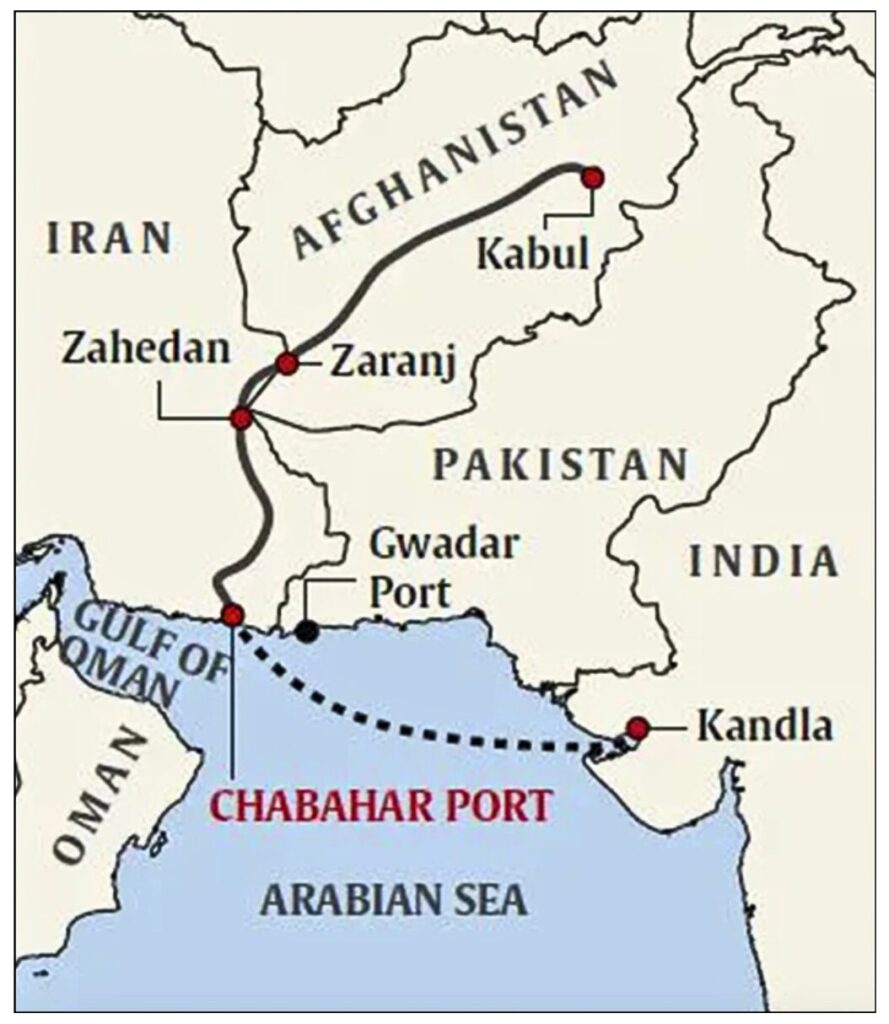
- Chabahar Port is located on the Makran Coast in the Sistan-Baluchestan Province of Iran. It lies on the Gulf of Oman, near the mouth of the Arabian Sea. It is situated west of Iran’s border with Pakistan.
- Key Features: It is Iran’s first deep-water port. It is the only Iranian port with direct access to the Indian Ocean.
- The port consists mainly of Shahid Beheshti Terminal and Shahid Kalantari Terminal.
India-Iran Agreement:
- In 2024, India signed a 10-year agreement with Iran for operating the Shahid Beheshti Terminal.
- India committed around $120 million for infrastructure development and a $250 million credit line for related projects. The project is being developed by India Ports Global Limited.
Strategic importance of Chabahar:
- Access to Afghanistan and Central Asia: The port allows India to bypass Pakistan for trade with Afghanistan, Central Asia, Russia and Europe through multimodal corridors. Pakistan has historically denied India direct overland access to Afghanistan. Thus, Chabahar reduces India’s dependence on Pakistan-based transit routes.
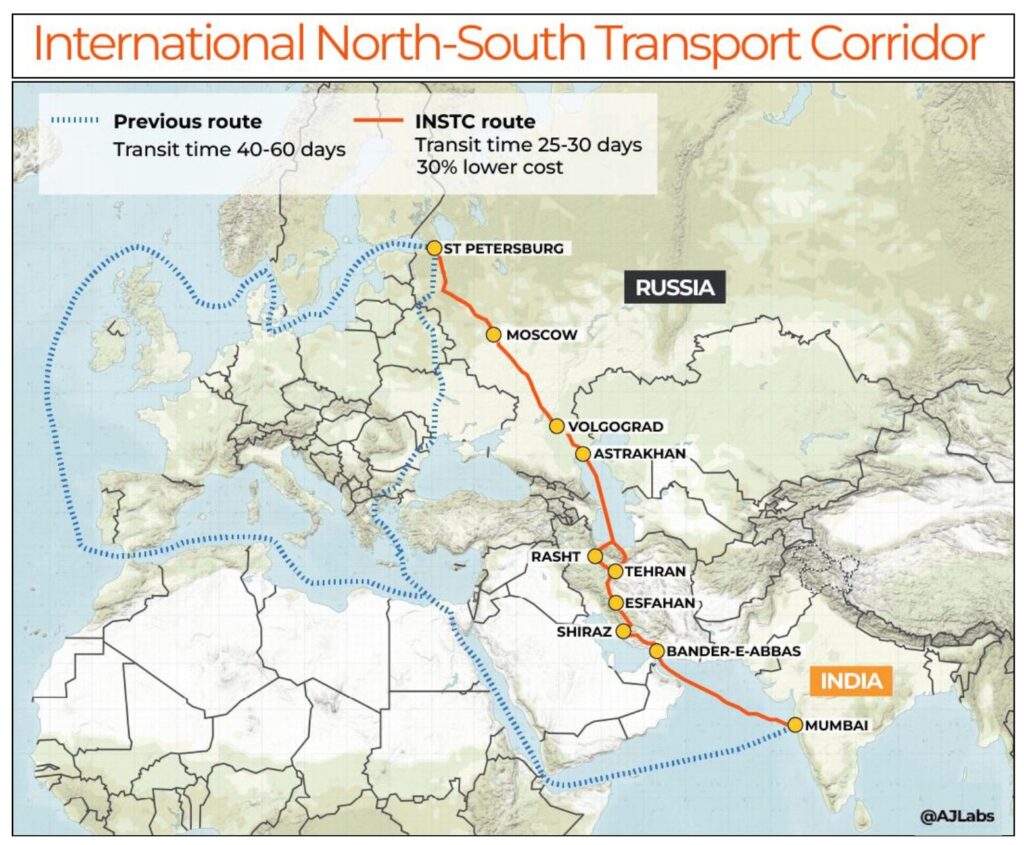
- Key Node in the International North-South Transport Corridor (INSTC): Chabahar is an important component of the International North-South Transport Corridor. INSTC connects India, Iran, Central Asia, Russia and Europe through sea routes, railways and road networks. It is estimated to be nearly 40% shorter and around 30% cheaper than the traditional Red Sea-Suez Canal route. The corridor can significantly reduce logistics costs and delivery time for Indian exports.
- Counterbalance to Gwadar Port and Chinese Influence: Chabahar is often viewed as India’s strategic response to Gwadar Port (developed by China in Pakistan), China’s Belt and Road Initiative (BRI) and China-Pakistan Economic Corridor (CPEC). Thus, Chabahar strengthens India’s geopolitical footprint in the region.
- Energy Security and Trade Diversification: The corridor enables India to improve connectivity with energy-rich countries such as Turkmenistan, Azerbaijan and Kazakhstan. It also supports diversification of trade routes amid global disruptions in the Red Sea and the Strait of Hormuz.
- Strategic Maritime Significance: The port lies near the strategically crucial Strait of Hormuz, through which a major share of global oil trade passes. It is important for maritime trade monitoring and enhancing India’s presence in the western Indian Ocean region.
Importance of the port for Iran:
- For Iran, Chabahar serves as:
- A gateway to Central Asia
- A major economic development project for its underdeveloped southeastern region
- A means to reduce the impact of Western sanctions.
- Iran also seeks to transform Chabahar into a free trade zone, transit and logistics hub and regional commercial gateway.
Challenges in developing Chabahar Port:
- US Sanctions on Iran: The biggest challenge remains the sanctions imposed by the United States on Iran. This leads to financing difficulties, banking restrictions, hesitation among investors and delays in infrastructure development.
- Delays in Railway Connectivity: Key railway projects remain incomplete: Chabahar-Zahedan line and Rasht-Astara line. These are essential for integrating the port with the INSTC network. Without efficient hinterland connectivity, the port’s commercial potential remains limited.
- Banking and Payment Constraints: Iran’s restricted access to the global financial system, including limitations related to SWIFT transactions, complicates trade settlements, credit transfers and international investment flows.
Despite substantial potential, cargo handling has remained below capacity due to sanctions, connectivity bottlenecks and limited commercial integration.
Security concerns associated with Chabahar Port:
- Terrorism and Insurgency: The region surrounding Chabahar is vulnerable to instability due to extremist groups, sectarian violence and cross-border insurgency. Threats emerge from areas influenced by the Islamic State, Tehrik-i-Taliban Pakistan.
- Instability in Afghanistan: Political uncertainty in Afghanistan affects regional trade routes, infrastructure safety and long-term investments. The return of the Taliban has created uncertainties regarding security and transit guarantees.
- Narcotics Trafficking: The region lies near the “Golden Crescent”, a major illicit drug-production zone involving Afghanistan, Iran and Pakistan. This creates challenges related to smuggling, organised crime and port security.
Chabahar port is like a golden gate for India to access Central Asia, the Caucasus and then Europe. Its success will depend on India’s ability to navigate geopolitical rivalries, security challenges, and sanctions pressures.
UPSC PYQ 2017
Q. What is the importance of developing Chabahar Port by India?
(a) India’s trade with African countries will enormously increase.
(b) India’s relations with oil-producing Arab countries will be strengthened.
(c) India will not depend on Pakistan for access to Afghanistan and Central Asia.
(d) Pakistan will facilitate and protect the installation of a gas pipeline between Iraq and India.
Answer: (c)
What triggered the powerful thunderstorms in Uttar Pradesh that killed over 100?
What Triggered the Deadly Thunderstorms in Uttar Pradesh?
Why in News?
More than 100 people lost their lives in severe thunderstorms that struck several districts of Uttar Pradesh in May 2026. The event, associated with intense dust storms locally referred to as ‘Andhi’, brought extremely high wind speeds, lightning, rain and hailstorms. The scale of destruction renewed attention on India’s growing vulnerability to extreme weather events, disaster preparedness, climate resilience and early warning systems.
UPSC Relevance
Prelims: Thunderstorms, western disturbances, pre-monsoon weather phenomena, IMD, disaster management, climate change, lightning, extreme weather events.
Mains:
GS I — Physical Geography, Climatology, Disaster Management;
GS III — Environment, Climate Change, Disaster Preparedness, Governance and Institutional Capacity.
Background and Context
Pre-monsoon thunderstorms are a recurring weather phenomenon in northern India, especially during April and May. These storms are commonly experienced across Uttar Pradesh, Bihar, Rajasthan, Delhi, Haryana and Madhya Pradesh.
In meteorological literature, such dust storms accompanied by strong winds and lightning are often called “Andhi”. While many of these events are moderate, some become extremely destructive due to specific atmospheric conditions.
The 2026 thunderstorms were unusually severe because:
- Wind speeds crossed 100 kmph in several districts and reportedly reached nearly 130 kmph in some areas.
- Large-scale destruction occurred across multiple districts simultaneously.
- Lightning strikes, collapsing structures, uprooted trees and flying debris caused widespread casualties.
- The event resembled the deadly thunderstorm episodes of 2018 in north India.
The disaster once again highlighted the increasing frequency and intensity of extreme weather events in India.
Understanding Thunderstorms
What is a Thunderstorm?
A thunderstorm is a weather system characterised by:
- Rapid upward movement of warm moist air
- Formation of cumulonimbus clouds
- Lightning and thunder
- Heavy rainfall or hail
- Strong gusty winds
Thunderstorms develop when atmospheric instability allows warm air near the Earth’s surface to rise rapidly and interact with cooler air above.
What is an “Andhi”?
“Andhi” refers to intense dust storms that occur mainly in northwestern and northern India during the pre-monsoon season.
These storms are usually associated with:
- Dry surface conditions
- Strong convective activity
- Dust-laden winds
- Sudden fall in visibility
- Thunder and lightning
Such storms are common in the Indo-Gangetic plains and adjoining semi-arid regions.
Meteorological Factors Behind the 2026 Thunderstorms
Intense Surface Heating
Large parts of Uttar Pradesh witnessed temperatures exceeding 45°C before the storm event.
Excessive surface heating caused:
- Rapid warming of air near the surface
- Increased convection
- Development of unstable atmospheric conditions
Hot air rises quickly, creating the vertical motion necessary for thunderstorm formation.
Moisture Incursion from the Bay of Bengal
Strong southeasterly winds transported moisture from the Bay of Bengal deep into northern India.
This created a combination of:
- Hot surface temperatures
- High humidity
- Moist unstable air masses
Moisture acts as “fuel” for thunderstorms because rising moist air releases latent heat, strengthening convection.
Role of Western Disturbances
Western Disturbances are extra-tropical weather systems originating near the Mediterranean region and moving eastwards towards India.
They generally bring:
- Rainfall in north India
- Snowfall in the Himalayas
- Cooler upper atmospheric conditions
During this event, western disturbances created cool and dry air in the upper atmosphere, while the lower atmosphere remained warm and moist.
This sharp temperature contrast generated severe atmospheric instability.
Atmospheric Instability
Atmospheric instability occurs when warm moist air near the ground rises rapidly through cooler air above.
This process leads to:
- Formation of towering cumulonimbus clouds
- Violent air currents
- Strong downdrafts
- Thunderstorms and lightning
The Indian Meteorological Department (IMD) described the situation as a “classic triggering mechanism” for severe thunderstorms.
Why Were the Thunderstorms More Destructive This Time?
Extremely High Wind Speeds
Most pre-monsoon thunderstorms produce wind speeds between 40 and 60 kmph.
However, during this event:
- Several districts recorded wind speeds above 100 kmph
- Some areas witnessed winds touching 130 kmph
- Trees, electric poles and weak structures collapsed
Such winds convert loose objects into dangerous projectiles.
Simultaneous Multi-District Impact
Unlike localised storms, this event affected many districts simultaneously.
This increased:
- Human exposure
- Infrastructure damage
- Pressure on disaster response systems
Lightning Fatalities
Lightning remains one of India’s major weather-related killers.
According to the National Crime Records Bureau (NCRB), lightning causes thousands of deaths annually in India.
Factors increasing lightning vulnerability include:
- Outdoor agricultural work
- Lack of lightning-safe shelters
- Poor awareness regarding safety measures
Weak Rural Infrastructure
Many casualties occurred because of:
- Weak housing structures
- Falling walls and trees
- Poor-quality electrical infrastructure
- Limited disaster-resilient construction
Climate Change and Extreme Weather Events
Increasing Frequency of Extreme Events
Scientific studies indicate that climate change is intensifying extreme weather events globally.
Warmer temperatures increase:
- Atmospheric moisture-holding capacity
- Energy available for storms
- Frequency of intense rainfall and convective events
India has witnessed rising incidents of:
- Heatwaves
- Cloudbursts
- Cyclones
- Urban flooding
- Severe thunderstorms
Urbanisation and Land Use Change
Rapid urbanisation contributes to weather-related vulnerabilities.
Factors include:
- Loss of vegetation cover
- Heat island effect
- Unplanned settlements
- Encroachment on natural drainage systems
These conditions amplify the impact of storms and heavy rainfall.
India’s Forecasting and Disaster Management Mechanisms
Role of the India Meteorological Department (IMD)
The IMD is India’s nodal agency for weather forecasting.
It issues:
- Short-range forecasts
- Nowcasts
- Thunderstorm alerts
- Heatwave warnings
- Cyclone warnings
The IMD has significantly improved its forecasting capacity through:
- Doppler Weather Radars
- Satellite monitoring
- Automatic weather stations
- Numerical weather prediction models
What are Nowcasts?
Nowcasting refers to short-duration weather forecasting, generally for the next few hours.
It is particularly useful for:
- Thunderstorms
- Lightning events
- Localised rainfall
- Dust storms
Forecasting Challenges
Although forecasting capacity has improved, severe thunderstorms remain difficult to predict precisely because:
- They develop rapidly
- Their intensity changes quickly
- Local atmospheric conditions vary significantly
- Wind speed estimation remains challenging
In this case, IMD forecasts underestimated the peak wind intensity in some districts.
Institutional and Policy Dimensions
Disaster Management Framework in India
India’s disaster management architecture is governed by:
- Disaster Management Act, 2005
- National Disaster Management Authority (NDMA)
- State Disaster Management Authorities (SDMAs)
- District Disaster Management Authorities
NDMA Guidelines on Thunderstorms and Lightning
The NDMA has issued guidelines for:
- Lightning safety
- Public awareness
- Early warning dissemination
- Community preparedness
However, implementation remains uneven across States.
Need for Localised Preparedness
Unlike cyclones, thunderstorms are highly localised and dispersed.
Therefore:
- Mass evacuation is generally not feasible
- Community-level preparedness becomes critical
- Rapid communication systems are essential
Social and Economic Impact
Impact on Agriculture
Thunderstorms and hailstorms damage:
- Standing crops
- Orchards
- Livestock
- Rural infrastructure
Pre-monsoon storms are particularly harmful because they coincide with harvesting and sowing transitions.
Impact on Vulnerable Communities
The poor are disproportionately affected because they often live in:
- Weak housing structures
- Informal settlements
- Disaster-prone regions
Daily wage workers and farmers also suffer income disruptions.
Infrastructure Damage
Strong winds damage:
- Power lines
- Transport infrastructure
- Communication systems
- Public utilities
This disrupts economic activity and emergency response.
Challenges
Forecast Communication Gap
Even when forecasts are issued, last-mile dissemination often remains weak.
Many people in vulnerable areas do not receive timely warnings.
Lack of Public Awareness
A large section of the population remains unaware of lightning and thunderstorm safety protocols.
Unsafe behaviour during storms increases fatalities.
Weak Rural Infrastructure
Poorly constructed houses, electricity poles and public infrastructure increase vulnerability during high-wind events.
Climate Adaptation Deficit
India’s adaptation planning still focuses heavily on floods and cyclones, while localised extreme weather events such as thunderstorms receive relatively less attention.
Coordination Challenges
Multiple agencies are involved in forecasting, disaster response and relief operations.
Coordination gaps can delay emergency response.
Way Forward
Strengthening Early Warning Systems
India should further improve high-resolution weather forecasting using advanced radar systems, artificial intelligence and real-time atmospheric monitoring.
More accurate district-level and block-level forecasts can reduce casualties.
Improving Last-Mile Communication
Weather alerts should reach citizens through:
- Mobile-based alerts
- Regional language messaging
- Community radio
- Local administration networks
Warning systems must be accessible to rural populations.
Community-Based Disaster Preparedness
Schools, Panchayats and local bodies should conduct regular awareness programmes on:
- Lightning safety
- Shelter practices
- Emergency response
- Disaster preparedness
Community participation improves resilience.
Climate-Resilient Infrastructure
Public infrastructure and housing should be designed to withstand extreme weather events.
This includes:
- Stronger electricity infrastructure
- Storm-resistant construction
- Improved urban planning
Integrating Climate Adaptation into Governance
State governments should integrate thunderstorm risk into climate adaptation and disaster management plans.
District-level vulnerability mapping can help identify high-risk regions.
Expanding Research and Data Collection
India needs more research on:
- Changing thunderstorm patterns
- Climate change linkages
- Lightning hotspots
- Convective weather systems
Scientific understanding is essential for better preparedness.
Conclusion
The devastating thunderstorms in Uttar Pradesh demonstrate how extreme weather events are becoming increasingly intense and destructive in a warming world. While India has significantly improved its forecasting and disaster management capabilities, the growing frequency of climate-linked disasters demands stronger preparedness, resilient infrastructure and effective last-mile communication.
Managing such disasters requires a combination of scientific forecasting, community awareness, climate adaptation and institutional coordination. As climate variability increases, building resilience against localised extreme weather events will become a critical component of India’s disaster governance framework.
Prelims Practice Questions
- Consider the following statements regarding Western Disturbances:
- They originate in the Mediterranean region.
- They generally move from west to east.
- They are responsible for winter rainfall in northwestern India.
Which of the statements given above are correct?
(a) 1 and 2 only
(b) 2 and 3 only
(c) 1 and 3 only
(d) 1, 2 and 3
Correct Answer: (d) 1, 2 and 3
Explanation: Western Disturbances are extra-tropical weather systems originating near the Mediterranean region. They move eastwards and bring winter rainfall to northwestern India and snowfall in the Himalayas.
- Which of the following conditions is most conducive for the formation of severe thunderstorms?
(a) Cool dry air near the surface and warm air above
(b) Warm moist air near the surface and cool dry air above
(c) Uniform atmospheric temperature at all levels
(d) Absence of moisture in the lower atmosphere
Correct Answer: (b) Warm moist air near the surface and cool dry air above
Explanation: Severe thunderstorms form when warm moist air rises rapidly through cooler dry air above, creating atmospheric instability and strong convection.
Mains Practice Questions
- Climate change is increasing the intensity and frequency of localised extreme weather events in India. Examine this statement with reference to thunderstorms, lightning and heatwaves.
- Discuss the meteorological factors responsible for severe pre-monsoon thunderstorms in northern India. How can India strengthen preparedness against such extreme weather events?
New Ebola outbreak in Congo
Why in News?
The Democratic Republic of the Congo has confirmed a fresh outbreak of Ebola Virus Disease (EVD) with over 60 deaths recorded so far.
The outbreak has raised global concern because preliminary investigations suggest the virus may belong to a non-Zaire strain of Ebola, against which currently approved vaccines may not provide protection.
| UPSC Relevance: GS-3 Science and Technology: Biology and Biotechnology Prelims: Ebola Virus Disease (key facts) |
Ebola Virus Disease (EVD):
- Ebola Virus Disease is a severe, highly infectious, and often fatal viral haemorrhagic fever caused by viruses belonging to the genus Ebolavirus.
- The disease was first identified in 1976 near the Ebola River in the present-day Democratic Republic of the Congo.
- Major Ebola Virus Species: WHO identifies three major Ebola virus species responsible for large outbreaks:
- Zaire ebolavirus: Most deadly strain. Responsible for major outbreaks in Congo and West Africa
- Sudan ebolavirus: Causes outbreaks mainly in Uganda and Sudan
- Bundibugyo ebolavirus.
Key Features of Ebola:
- Ebola is a zoonotic disease, meaning it spreads from animals to humans. Fruit bats are considered the most likely natural reservoir hosts.
- Human transmission occurs through:
- Direct contact with blood or bodily fluids
- Contaminated needles or surfaces
- Contact with infected animals or dead bodies
- Incubation Period: Typically 2-21 days
- Symptoms: Fever, Weakness, Muscle pain, Diarrhoea, can escalate to Internal and external bleeding and multi-organ failure.
- Fatality Rate: Ebola has an average case fatality rate of around 25–90%, depending on the virus strain and healthcare response.
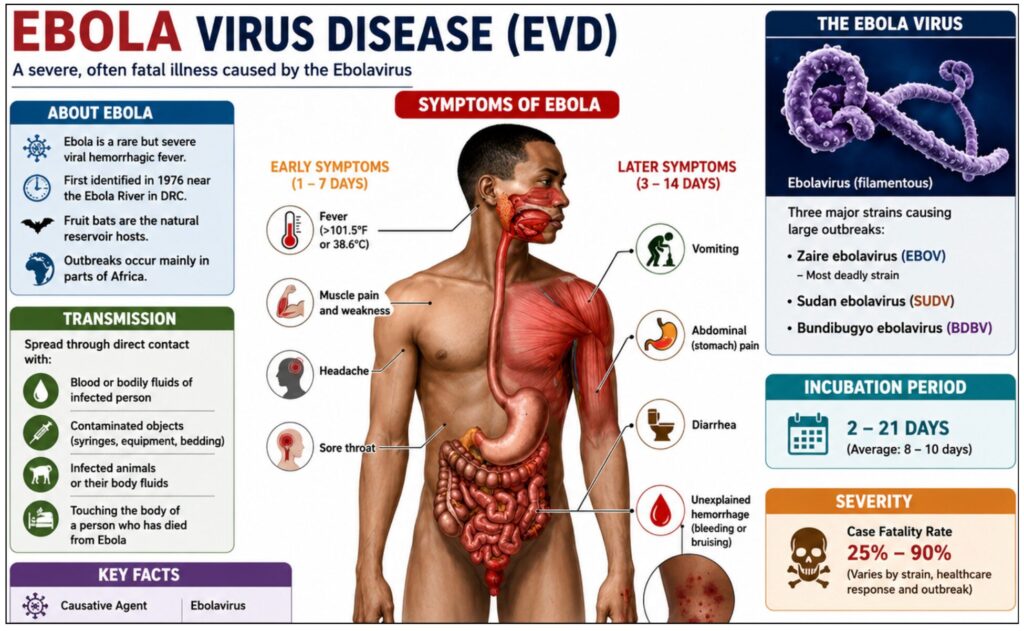
Ebola Vaccines and Treatment:
- Ervebo Vaccine: Ervebo is the world’s first licensed Ebola vaccine.
- Developed Against: Zaire ebolavirus
- Limitation: Not approved for protection against the Sudan virus and Bundibugyo virus.
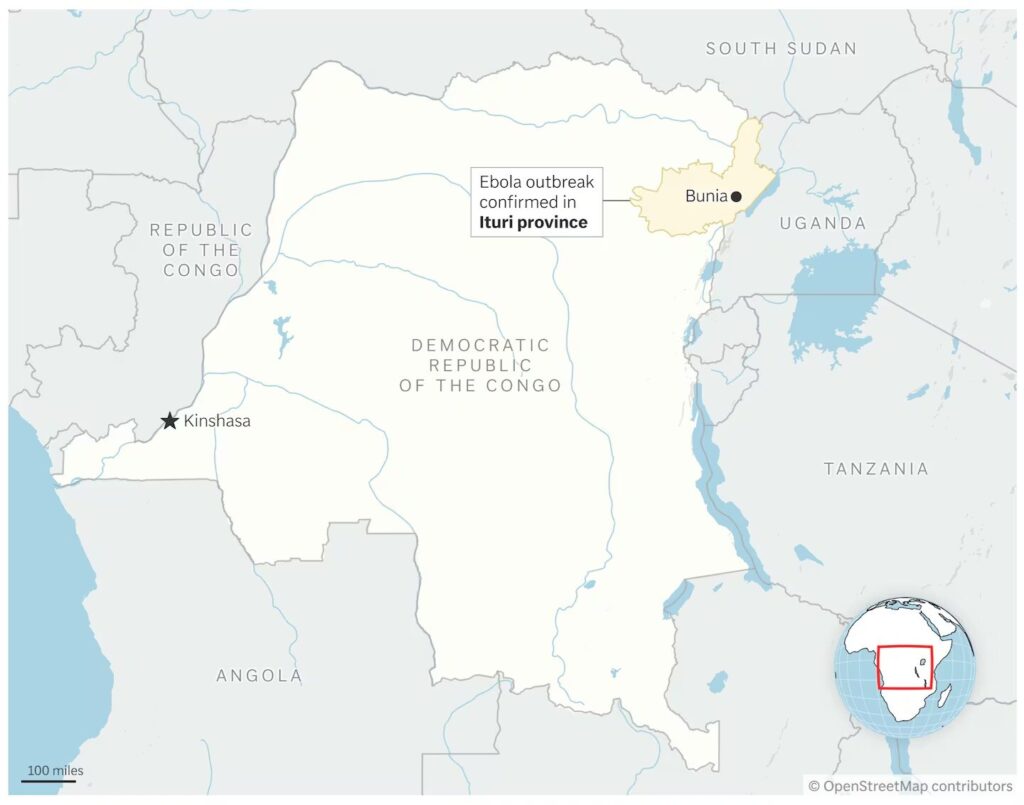
Preliminary findings from the current outbreak indicate that it may involve the Bundibugyo or Sudan strain rather than the Zaire strain. A non-Zaire outbreak could complicate containment efforts.
Currently, there is no Ebola outbreak in India. However, India remains alert because international travel can spread infectious diseases rapidly. India had earlier issued travel advisories and screening measures during the West African Ebola outbreak of 2014-16.
UPSC PYQ 2015
Q. Among the following, which were frequently mentioned in the news for the outbreak of Ebola virus recently?
(a) Syria and Jordan
(b) Guinea, Sierra Leone and Liberia
(c) Philippines and Papua New Guinea
(d) Jamaica, Haiti and Surinam
Answer: (b)
Source: https://anantamias.com/current-affairs/new-ebola-outbreak-in-congo/
CBI launches AI-powered Notice Verification System ABHAY
Why in News?
The Central Bureau of Investigation (CBI) has launched ABHAY (AI-Based Helpbot for Authentication of Your Notice), an AI-powered real-time notice verification system aimed at protecting citizens from rising cyber fraud and digital arrest scams.
The initiative enables citizens to verify whether notices purportedly issued by the CBI are genuine or fake through the official CBI website.
| UPSC Relevance: GS-3 Science and Technology: CyberSecurity, Artificial Intelligence Prelims: ABHAY Helpbot, Digital Arrest, Indian Cyber Crime Coordination Centre (I4C) |
What is ABHAY?
- ABHAY is an AI-enabled helpbot developed by the CBI for real-time authentication of official notices issued in the name of the agency.
- It is designed to help citizens verify suspicious summons, notices, or communications that fraudsters use during cyber scams.
Key Features of ABHAY:
- Real-Time Verification: Citizens can instantly verify whether a notice is genuinely issued by the CBI. The system uses AI tools to analyse uploaded notices and compare them with official records and formats.
- QR Code Integration: The official CBI notices will carry a QR code that can be scanned for authenticity verification.
- 24×7 Accessibility: The service is available continuously through the CBI portal.
- OTP-Based User Verification: Users verify themselves using a mobile OTP before uploading suspicious notices.
The system places the power of verification directly in citizens’ hands, reducing panic and manipulation by fraudsters.
How does ABHAY Work?
The verification process involves the following steps:
- Visit the official CBI website.
- Click on the ABHAY logo/helpbot.
- Complete mobile OTP verification.
- Upload a scanned copy or image of the notice received.
- The AI system analyses the document.
Within minutes, the system informs the user whether the notice is genuine or fraudulent.
What is a Digital Arrest Scam?
- A “digital arrest” is a cyber fraud technique where criminals impersonate police, CBI, ED, customs officials, or judges to intimidate victims.
- The scammers falsely claim that the victim is linked to money laundering, drug trafficking, illegal parcels, tax evasion, or cybercrime investigations.
- Victims are then threatened with arrest, asset seizure, or imprisonment unless they comply with instructions.
- The fraudsters send fake legal notices, use forged government logos, conduct fake video interrogations and pressure victims to transfer money to “safe accounts.”
Importantly, “digital arrest” has no legal basis under Indian law.
Challenges and Concerns:
- Digital Literacy Gap: Many citizens, especially elderly populations, may still struggle to use verification systems effectively.
- Evolving Scam Techniques: Cybercriminals continuously adapt and may develop more sophisticated forged documents.
- Limited Awareness: The success of ABHAY depends heavily on public awareness campaigns.
- Dependence on Internet Access: Citizens in rural and low-connectivity areas may face difficulties accessing the platform.
Growing threat of Cyber Frauds in India:
- According to the Indian Cyber Crime Coordination Centre (I4C), India may lose over ₹1.2 lakh crore annually due to cyber fraud if the trend continues.
- Digital arrest scams particularly target senior citizens, students, NRIs, professionals, and financially vulnerable individuals.
Government Measures against Cyber Frauds:
India has undertaken several initiatives to tackle cybercrime:
- Institutional Measures
- Indian Cyber Crime Coordination Centre (I4C)
- National Cyber Crime Reporting Portal
- Cyber Crime Helpline Number: 1930
- Technological Measures
- AI-based fraud detection
- Blocking of suspicious SIM cards and mule bank accounts
- Digital fraud monitoring systems
- Legal Measures
- Information Technology Act, 2000
- Bharatiya Nyaya Sanhita (BNS) provisions relating to cybercrime
- CERT-In cybersecurity advisories.
ABHAY represents a proactive institutional response to AI-enabled cybercrime. It reduces dependency on intermediaries and empowers ordinary citizens to verify claims independently. It demonstrates how AI can support law enforcement beyond surveillance and investigation.
Source: https://anantamias.com/current-affairs/cbi-launches-ai-powered-notice-verification-system-abhay/
BRICS Members reaffirm support for an Independent Palestinian State
Why in News?
The recent BRICS Foreign Ministers’ Meeting held in New Delhi reaffirmed support for the creation of an independent and viable State of Palestine based on the pre-1967 borders, with East Jerusalem as its capital.
However, the meeting failed to produce a formal Joint Statement due to differences among member countries over the ongoing conflicts in West Asia, especially the Iran-Israel-U.S. tensions.
| UPSC Relevance: GS-2 International Relations: International Organisations, West Asia Prelims: Israel-Palestine Issue: Two-state solution |
Major Highlights:
- The BRICS foreign ministers reaffirmed:
- Support for a two-state solution.
- Recognition of Palestine within the internationally recognised 1967 borders.
- Support for East Jerusalem as the capital of a future Palestinian state.
- Backing for full UN membership for Palestine.
- Need for Gaza and the West Bank to remain an inseparable part of Palestinian territory.
- The statement emphasised that Palestine and Israel should co-exist side by side in peace and security in accordance with international law and relevant UN resolutions. The formulation closely follows earlier international diplomatic frameworks, including the UN Security Council Resolutions, UN General Assembly resolutions and the Arab Peace Initiative.
What is the Two-State Solution?
- The Two-State Solution refers to the proposal for an independent State of Israel and an independent State of Palestine coexisting peacefully side by side.
- The proposed Palestinian state would include the West Bank, the Gaza Strip, and East Jerusalem (as capital).
What are the 1967 Borders?
- The phrase refers to the boundaries existing before the 1967 Six-Day War.
- During the war, Israel captured the West Bank, East Jerusalem, the Gaza Strip, the Golan Heights and the Sinai Peninsula.
- The internationally discussed peace formula broadly supports Israeli withdrawal from the occupied Palestinian territories captured in 1967 in exchange for peace and recognition.
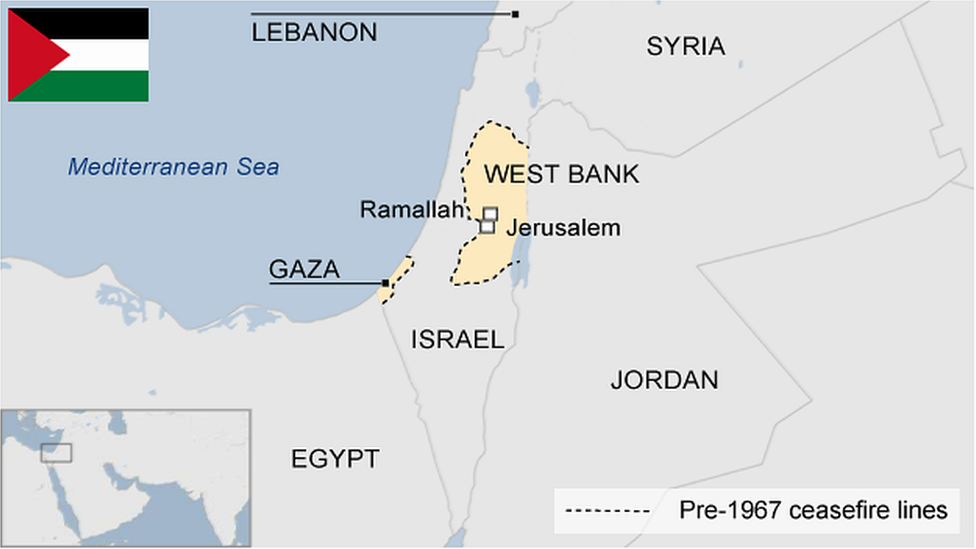
Why is East Jerusalem Important?
- Religious Importance: East Jerusalem contains Al-Aqsa Mosque, the Dome of the Rock and the Western Wall. It is sacred to Muslims, Jews and Christians.
- Political Importance: Palestinians seek East Jerusalem as the capital of a future Palestinian state. Israel considers Jerusalem its “undivided capital.” This remains one of the most contentious issues in the conflict.
India’s Position on Palestine:
- India traditionally supported the Palestinian cause and was among the first non-Arab countries to recognise the Palestine Liberation Organisation (PLO).
- At the same time, India has significantly deepened ties with Israel in Defence, Agriculture, Technology and Counter-terrorism.
The BRICS foreign ministers’ reaffirmation of support for an independent Palestinian state reflects continued global backing for the two-state solution despite worsening regional tensions.
At the same time, the inability of BRICS to issue a joint statement exposes the internal geopolitical divisions within the expanded grouping.
5th-Generation Combat Aircraft Testing Centre
Why in News?
The foundation stone for the Core Integration & Flight Testing Centre (CIFTC) was laid at Puttaparthi, Sri Sathya Sai District, Andhra Pradesh, to fast-track the development of Fifth-Generation Advanced Medium Combat Aircraft (AMCA) and other future indigenous platforms.
| UPSC Relevance: GS-3 Science and Technology: Defence Technology Prelims: Advanced Medium Combat Aircraft (AMCA) |
Advanced Medium Combat Aircraft (AMCA):
- The Advanced Medium Combat Aircraft (AMCA) is India’s indigenous 5th-generation (classified as 5.5-gen) stealth multirole combat aircraft.
- Being designed by the Aeronautical Development Agency (ADA), an autonomous body under DRDO.
- Missions: Air supremacy, ground strike, SEAD (Suppression of Enemy Air Defences), and Electronic Warfare. Intended to eventually replace the Sukhoi Su-30MKI as the IAF’s primary air superiority platform.
AMCA is intended to strengthen the Indian Air Force’s future combat capability and reduce dependence on imported fighter aircraft.
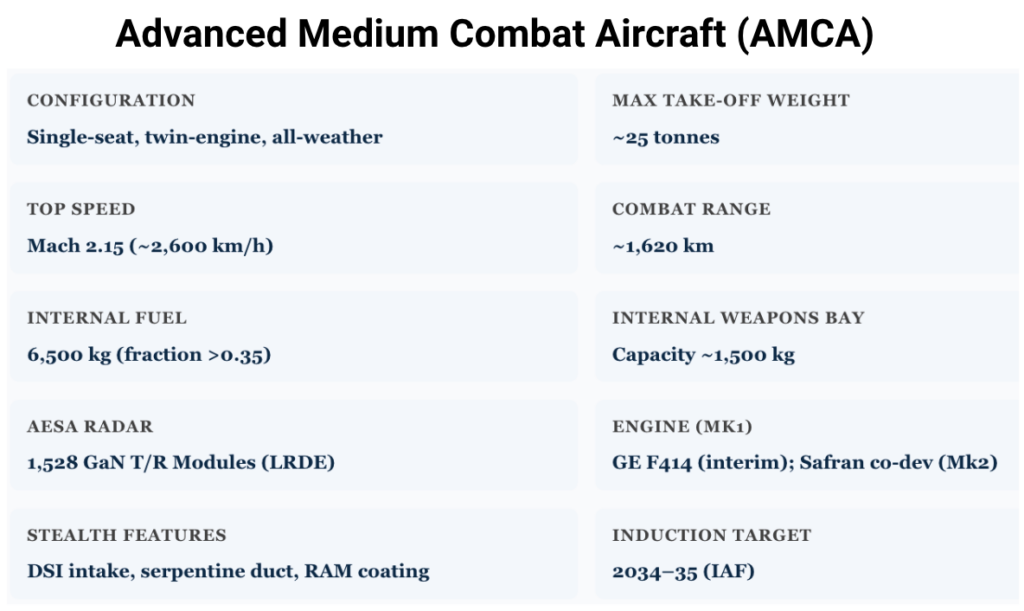
Core Integration & Flight Testing Centre:
- The CIFTC is the single most critical infrastructure investment in the AMCA programme.
- Location: Puttaparthi, Sri Sathya Sai District, Andhra Pradesh
- Spread over ~650 acres, it will serve as India’s national hub for aircraft integration, validation, flight testing, and certification.
The AMCA prototypes will be designed and assembled at ADA’s Bengaluru facility, then transferred to this Puttaparthi centre for final integration and flight trials. This would place India in the elite club of nations that develop and fly 5th-gen aircraft indigenously.
Significance:
- Indigenous Testing Capability: The facility will enable Aircraft integration, Systems validation, Flight testing, simulation, and certification. This reduces reliance on foreign testing infrastructure.
- Strategic / Security Dimension:
- India joins the exclusive club of nations (US, Russia, China) capable of designing and testing a 5th-gen combat aircraft indigenously.
- The AMCA will address the IAF’s critical capability gap created by the cancellation of the Indo-Russian FGFA project in 2019. Advanced stealth (low RCS), supercruise, AESA radar, and internal weapons make it a force multiplier in contested airspace.
- Technology & Innovation:
- AMCA’s AESA radar uses Gallium Nitride (GaN) TRMs with a Vivaldi antenna design, offering superior bandwidth and low probability of intercept.
- The engine co-development agreement with France’s Safran (announced in 2025) under ‘Horizon 2047’ provides full IPR transfer to India’s Gas Turbine Research Establishment (GTRE).
- Economic Dimension (Aatmanirbhar Bharat): CIFTC and associated projects are expected to generate 7,500+ direct jobs and catalyse a broader high-tech industrial ecosystem. Local institutions (engineering colleges and ITIs) are positioned as integral supply-chain partners.
The establishment of the Core Integration & Flight Testing Centre marks a major milestone in India’s aerospace and defence modernisation journey.
UPSC PYQ 2024
Q. Consider the following aircraft:
1. Rafael
2. MiG-29
3. Tejas MK-1
How many of the above are considered fifth-generation fighter aircraft?
(a) Only one
(b) Only two
(c) All three
(d) None
Answer: (d)
Source: https://anantamias.com/current-affairs/5th-generation-combat-aircraft-testing-centre/