Daily Digest
UPSC · Civil Services Examination
Current Affairs · Tuesday, 2 September 2025
Current affairs curated and edited by Anantam IAS faculty — pulled from The Hindu, PIB, IDSA, Foreign Affairs and the ministries. Read, annotate, revise.
Old Rajinder Nagar · Delhi 110005 · anantamias.com
Fiscal Deficit Target


Why in news:
India’s GDP growth for Q1 of FY2025 (April–June 2025) was reported at 7.8%, which significantly exceeded the RBI’s earlier estimate of 6.5%, sparking debate on economic momentum, data accuracy, and sectoral performance. Despite a slowdown in several high-frequency indicators, manufacturing and services showed unexpected resilience, prompting both optimism and skepticism about India’s growth trajectory.
UPSC Relevance:
Topic: Government Budgeting.
UPSC PYQ 2018:
Consider the following statements :
- The Fiscal Responsibility and Budget Management (FRBM) Review Committee Report has recommended a debt to GDP ratio of 60% for the general (combined) government by 2023, comprising 40% for the Central Government and 20% for the State Governments.
- The Central Government has domestic liabilities of 21% of GDP as compared to that of 49% of GDP of the State Governments.
- As per the Constitution of India, it is mandatory for a State to take the Central Government’s consent for raising any loan if the former owes any outstanding liabilities to the latter.
Which of the statements given above is/are correct ?
A 1 only
B 2 and 3 only
C 1 and 3 only
D 1, 2 and 3
UPSC PYQ 2013:
Q: What are the reasons for introduction of Fiscal responsibility and Budget Management (FRBM) act, 2003? Discuss critically its salient features and their effectiveness.
What is Fiscal Deficit:
Fiscal deficit refers to the shortfall in the budget and the amount of borrowing the government may need. Factors that cause an increase in the deficit include government spending, economic downturns, or a shortfall in revenue collection.
Fiscal Deficit = (Revenue Expenditure – Revenue Receipts) + Capital Expenditure – (Recoveries of loans + other Receipts)
FRBM Act 2003:
- The FRBM framework mandates the Central Government to limit the Fiscal Deficit upto three per cent of Gross Domestic Product by 31st March, 2021.
- It further provides that the Central Government shall endeavour to limit the General Government Debt to 60 percent of GDP and the Central Government Debt to 40 per cent of GDP, by 31st March, 2025.
- This document contains the Macroeconomic Framework Statement and Medium term Fiscal Policy cum Fiscal Policy Strategy Statement. They provide an assessment of the growth prospects of the economy and strategies of the Government in the forthcoming financial year relating to taxation, expenditure, market borrowings and other liabilities.
- A Statement of deviation explaining the reasons for deviation from the fiscal targets mentioned in Section 4 and compliance obligations under Section 7(3)(b) of the FRBM Act, 2003 on the Central Government, has also been included.
4 Documents mandated by the act to be laid before parliament:
1) MACRO-ECONOMIC FRAMEWORK STATEMENT:
- It is presented to Parliament along with Annual Financial Statement.
- It contains an assessment of the growth prospects of the economy along with the statement of specific underlying assumptions.
- It also contains an assessment regarding the GDP growth rate, the domestic economy and the stability of the external sector of the economy, fiscal balance of the Central Government and the external sector balance of the economy.
2) FISCAL POLICY STRATEGY STATEMENT
- It is presented to Parliament along with Annual Financial Statement.
- It contains the policies of the Central Government for the forthcoming financial years relating to taxation, expenditure, market borrowings and other liabilities, lending and investments, pricing of administered goods and services, securities and description of other activities such as underwriting and guarantees which have potential budgetary implications.
- Strategic priorities of the Central government for the coming financial year.
- Key fiscal measures and rationale for any major deviation in pertaining to taxation, subsidy, expenditure etc.
3) MEDIUM TERM FISCAL POLICY STATEMENT
- It is presented to Parliament along with Annual Financial Statement.
- It sets forth a three-year rolling target for five specific fiscal indicators in relation to GDP at market prices, namely (i) Revenue Deficit, (ii) Fiscal Deficit, (iii) Effective Revenue Deficit (iv) Tax to GDP ratio and (v) Total outstanding Central Government Liabilities at the end of the year.
- It will look into sustainability of use of capital receipts including market borrowings for generating productive assets.
4) MEDIUM TERM EXPENDITURE FRAMEWORK
- It is presented before the Parliament, in the immediately following session of Parliament in which the Annual Financial statement is presented.
- It sets forth a three year rolling target for prescribed expenditure indicators with assumptions and risks involved.
- Expenditure commitment of major policy changes involving new service, new instruments of service, new schemes and programmes. Explicit contingent liabilitiies, which are in the form of stipulated annuity payments over a multi-year time frame.
Amended Targets:
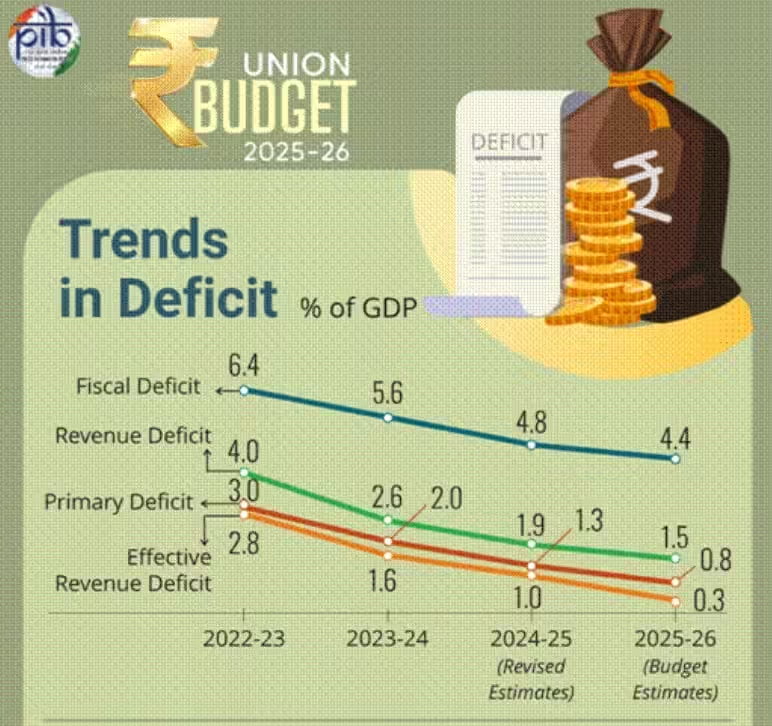
- The GOI 2018 amendment set targets to reduce General Government Debt (Centre + States, excluding inter- governmental liabilities) to 60% of GDP and Central Government Debt to 40% by FY 2024-25.
- Fiscal Deficit(FD) target:- 4.5% of GDP by 2025-26.
Source: https://anantamias.com/current-affairs/fiscal-deficit-target/
SCO

Why in News?
The members of the Shanghai Cooperation Organisation “strongly condemned” terrorism in all its forms and manifestations, including the Pahal-gam attack and the attacks on Jaffar Express and Khuzdar in Pakistan in Tianjin summit.
UPSC Relevance
Questions are often asked about regional blocks and international groupings in Prelims.
PYQ
2023 Prelims
Consider the following statements about G-20:
- The G-20 group was originally established as a platform for the Finance Ministers and Central Bank Governors to discuss international economic and financial issues.
- Digital public infrastructure is one of India’s G-20 priorities.
Which of the statements given above is/are correct?
(a) 1 only
(b) 2 only
(c) Both 1 and 2
(d) Neither 1 nor 2
Outcomes from the Shanghai Cooperation Organisation (SCO) Summit in Tianjin
- Counter-Terrorism: The Tianjin Declaration, adopted by all members, including India, Pakistan, and Russia, strongly condemned terrorism in all its forms, specifically mentioning attacks in Pakistan (Pahalgam, Jaffar Express, and Khuzdar). The declaration called for an end to “cross-border movement” of terrorists and reiterated the commitment to fighting against terrorism, separatism, and extremism. It also stressed the inadmissibility of using these groups for “mercenary purposes.”
- Prime Minister Narendra Modi asked whether “open support” of terrorism by some countries was acceptable, as he spoke at the summit meeting of the heads of state of the SCO on Monday. He said, “We must jointly oppose terrorism in all its forms and colours.”
- Global Governance and Economy:
- The member states opposed “unilateral coercive measures, including those of an economic nature,” a possible reference to U.S. tariffs.
- Chinese President Xi Jinping criticized “bullying behaviour” and “cold war mentality” in the global order, advocating for fairness, justice, and multilateralism.
- China’s Foreign Minister Wang Yi announced the Global Governance Initiative (GGI), proposed by President Xi, which aims to support the UN’s central role and encourage countries to reform the global governance system.
Global governance does not imply a single world government, but a complex network of actors—including states, international organizations (like the United Nations and World Trade Organization), non-governmental organizations, businesses, and civil society—that work together to manage global challenges. It is exercised through both formal systems (such as international treaties or institutions) and informal arrangements (like guidelines or ad hoc coalitions)
- The SCO decided to establish an SCO development bank, a long-term goal of Beijing.
- The declaration also welcomed a UN General Assembly resolution to combat Nazism, neo-Nazism, and other forms of racism and xenophobia.
- Regional and International Issues:
- Gaza and West Asia: The SCO expressed “deep concern” over the humanitarian situation in Gaza and strongly condemned actions leading to civilian casualties. The declaration stated that a “comprehensive and just settlement” of the Palestinian issue is the only way to ensure peace in West Asia.
- Iran: Member states, including India, strongly condemned the military strikes by Israel and the U.S. against Iran in June. They reaffirmed the importance of UN Security Council resolution 2231, which includes lifting sanctions on Iran’s nuclear program.
United Nations Security Council Resolution 2231 was a 20 July 2015 resolution endorsing the Joint Comprehensive Plan of Action on the nuclear program of Iran. It sets out an inspection process and schedule while also preparing for the removal of United Nations sanctions against Iran.
- Afghanistan: The declaration noted the political situation in Afghanistan, reiterating that lasting peace and stability can only be achieved through an “inclusive government with broad participation of representatives of all ethno-political groups.”
- Organizational and Financial Developments:
- The SCO merged its “dialogue partner” and “observer” statuses into a single “partner” status.
- Laos was accepted as a partner country, bringing the total number of partners to 17 and the total strength of the grouping to 27 (10 members and 17 partners).
- All member states, except India, reaffirmed their support for China’s Belt and Road Initiative (BRI).
- President Xi pledged a ¥2 billion grant to member countries this year and an additional ¥10 billion loan to member banks of the SCO Interbank Consortium over the next three years.
- Pakistan and Armenia announced the establishment of diplomatic relations during the summit.
About SCO
The Shanghai Cooperation Organization (SCO) is a key intergovernmental international organization focused on regional stability, cooperation, and development across Eurasia.
Establishment and Historical Background
- The SCO was officially established on June 15, 2001 in Shanghai by Kazakhstan, China, Kyrgyzstan, Russia, Tajikistan, and Uzbekistan.
- It evolved from the Shanghai Five mechanism (1996), with Uzbekistan joining as the sixth founding member.
- The SCO Charter was signed in 2002 in St. Petersburg, coming into force on September 19, 2003.
Goals and Core Principles
- Strengthen mutual trust, friendship, and good-neighborliness among member states.
- Promote effective cooperation in politics, economics, science & technology, culture, education, energy, transport, tourism, environmental protection, and more.
- Ensure and maintain regional peace, security, and stability.
- Advance a democratic, fair, and rational international order.
- The “Shanghai Spirit” embodies mutual trust, benefit, equality, consultation, cultural respect, and common development.
Organizational Structure
- Council of Heads of States (CHS): The top decision-making body, meets annually to decide important issues.
- Council of Heads of Government (CHG): Meets annually for strategic and budgetary decisions, focusing on economic and multilateral cooperation.
- Additional Councils: Regular meetings among ministers and officials in foreign affairs, national defense, security, economy, culture, health, education, transport, emergency, science & tech, agriculture, judiciary, tourism, energy, poverty alleviation, sports, etc..
- Council of National Coordinators: Manages coordination among member states for daily functioning.
Two Standing Bodies of SCO
- Secretariat: Based in Beijing, China.
- Regional Anti-Terrorist Structure (RATS): Based in Tashkent, Uzbekistan, focuses on combating terrorism, separatism, and extremism.
- The SCO Secretary General and RATS Executive Committee Director are appointed for three-year terms.
Membership and Participation
- Member States (10): Belarus, India, Iran, Kazakhstan, China, Kyrgyzstan, Pakistan, Russia, Tajikistan, Uzbekistan.
- Observer States (2): Afghanistan and Mongolia.
- Dialogue Partners (15): Azerbaijan, Armenia, Bahrain, Egypt, Cambodia, Qatar, Kuwait, Maldives, Myanmar, Nepal, UAE, Saudi Arabia, Turkey, Sri Lanka and Laos (latest).
NOTE : Now onwards all the observer and dialogue states shall be known just as ‘Partner’.
Initiatives and Expansion
- SCO-Afghanistan Contact Group: Established in 2005 to facilitate peace and cooperation.
- Economic Integration: Programs for trade and free movement, including an emerging SCO Development Bank.
- Regular summits and development strategies aim at increasing intra-SCO trade and regional development.
Decision Making
- SCO decisions are reached by consensus, generally requiring unanimity among all member states.
- Russia and China play influential roles, but all states participate in setting direction and policy.
- Official languages: Russian and Chinese.