Why in news:
India’s GDP growth for Q1 of FY2025 (April–June 2025) was reported at 7.8%, which significantly exceeded the RBI’s earlier estimate of 6.5%, sparking debate on economic momentum, data accuracy, and sectoral performance. Despite a slowdown in several high-frequency indicators, manufacturing and services showed unexpected resilience, prompting both optimism and skepticism about India’s growth trajectory.
UPSC Relevance:
Topic: Government Budgeting.
UPSC PYQ 2018:
Consider the following statements :
- The Fiscal Responsibility and Budget Management (FRBM) Review Committee Report has recommended a debt to GDP ratio of 60% for the general (combined) government by 2023, comprising 40% for the Central Government and 20% for the State Governments.
- The Central Government has domestic liabilities of 21% of GDP as compared to that of 49% of GDP of the State Governments.
- As per the Constitution of India, it is mandatory for a State to take the Central Government’s consent for raising any loan if the former owes any outstanding liabilities to the latter.
Which of the statements given above is/are correct ?
A 1 only
B 2 and 3 only
C 1 and 3 only
D 1, 2 and 3
UPSC PYQ 2013:
Q: What are the reasons for introduction of Fiscal responsibility and Budget Management (FRBM) act, 2003? Discuss critically its salient features and their effectiveness.
What is Fiscal Deficit:
Fiscal deficit refers to the shortfall in the budget and the amount of borrowing the government may need. Factors that cause an increase in the deficit include government spending, economic downturns, or a shortfall in revenue collection.
Fiscal Deficit = (Revenue Expenditure – Revenue Receipts) + Capital Expenditure – (Recoveries of loans + other Receipts)
FRBM Act 2003:
- The FRBM framework mandates the Central Government to limit the Fiscal Deficit upto three per cent of Gross Domestic Product by 31st March, 2021.
- It further provides that the Central Government shall endeavour to limit the General Government Debt to 60 percent of GDP and the Central Government Debt to 40 per cent of GDP, by 31st March, 2025.
- This document contains the Macroeconomic Framework Statement and Medium term Fiscal Policy cum Fiscal Policy Strategy Statement. They provide an assessment of the growth prospects of the economy and strategies of the Government in the forthcoming financial year relating to taxation, expenditure, market borrowings and other liabilities.
- A Statement of deviation explaining the reasons for deviation from the fiscal targets mentioned in Section 4 and compliance obligations under Section 7(3)(b) of the FRBM Act, 2003 on the Central Government, has also been included.
4 Documents mandated by the act to be laid before parliament:
1) MACRO-ECONOMIC FRAMEWORK STATEMENT:
- It is presented to Parliament along with Annual Financial Statement.
- It contains an assessment of the growth prospects of the economy along with the statement of specific underlying assumptions.
- It also contains an assessment regarding the GDP growth rate, the domestic economy and the stability of the external sector of the economy, fiscal balance of the Central Government and the external sector balance of the economy.
2) FISCAL POLICY STRATEGY STATEMENT
- It is presented to Parliament along with Annual Financial Statement.
- It contains the policies of the Central Government for the forthcoming financial years relating to taxation, expenditure, market borrowings and other liabilities, lending and investments, pricing of administered goods and services, securities and description of other activities such as underwriting and guarantees which have potential budgetary implications.
- Strategic priorities of the Central government for the coming financial year.
- Key fiscal measures and rationale for any major deviation in pertaining to taxation, subsidy, expenditure etc.
3) MEDIUM TERM FISCAL POLICY STATEMENT
- It is presented to Parliament along with Annual Financial Statement.
- It sets forth a three-year rolling target for five specific fiscal indicators in relation to GDP at market prices, namely (i) Revenue Deficit, (ii) Fiscal Deficit, (iii) Effective Revenue Deficit (iv) Tax to GDP ratio and (v) Total outstanding Central Government Liabilities at the end of the year.
- It will look into sustainability of use of capital receipts including market borrowings for generating productive assets.
4) MEDIUM TERM EXPENDITURE FRAMEWORK
- It is presented before the Parliament, in the immediately following session of Parliament in which the Annual Financial statement is presented.
- It sets forth a three year rolling target for prescribed expenditure indicators with assumptions and risks involved.
- Expenditure commitment of major policy changes involving new service, new instruments of service, new schemes and programmes. Explicit contingent liabilitiies, which are in the form of stipulated annuity payments over a multi-year time frame.
Amended Targets:
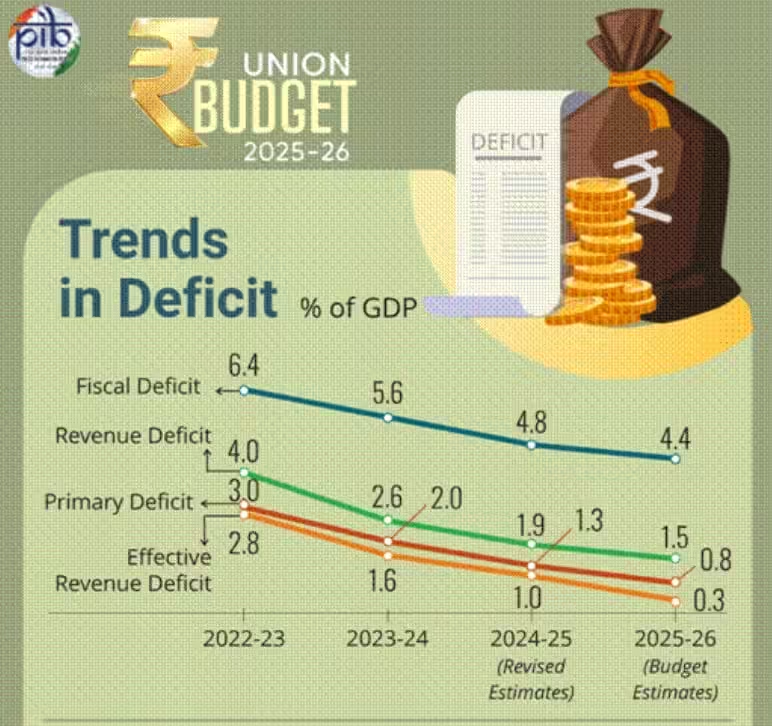
- The GOI 2018 amendment set targets to reduce General Government Debt (Centre + States, excluding inter- governmental liabilities) to 60% of GDP and Central Government Debt to 40% by FY 2024-25.
- Fiscal Deficit(FD) target:- 4.5% of GDP by 2025-26.
Tell Google you want more of this.
Add Anantam IAS as a preferred sourceOne tap, and this site shows up more often in your own Top Stories, AI Overviews and AI Mode. Remove it any time.