Daily Digest
UPSC · Civil Services Examination
Current Affairs · Sunday, 21 June 2026
Current affairs curated and edited by Anantam IAS faculty — pulled from The Hindu, PIB, IDSA, Foreign Affairs and the ministries. Read, annotate, revise.
Old Rajinder Nagar · Delhi 110005 · anantamias.com
US-Iran Agreement: What the 14-point MoU Means for the Strait of Hormuz and India
Why in News?
Washington and Tehran have released the text of a concrete 14-point Memorandum of Understanding the so-called Islamabad MoU signed on 17 June 2026 that ends active hostilities, reopens the Strait of Hormuz to commercial shipping and opens a 60-day window to negotiate a final, UN-endorsed nuclear settlement. This is the detailed, clause-by-clause text that follows the broad peace framework announced earlier in June.
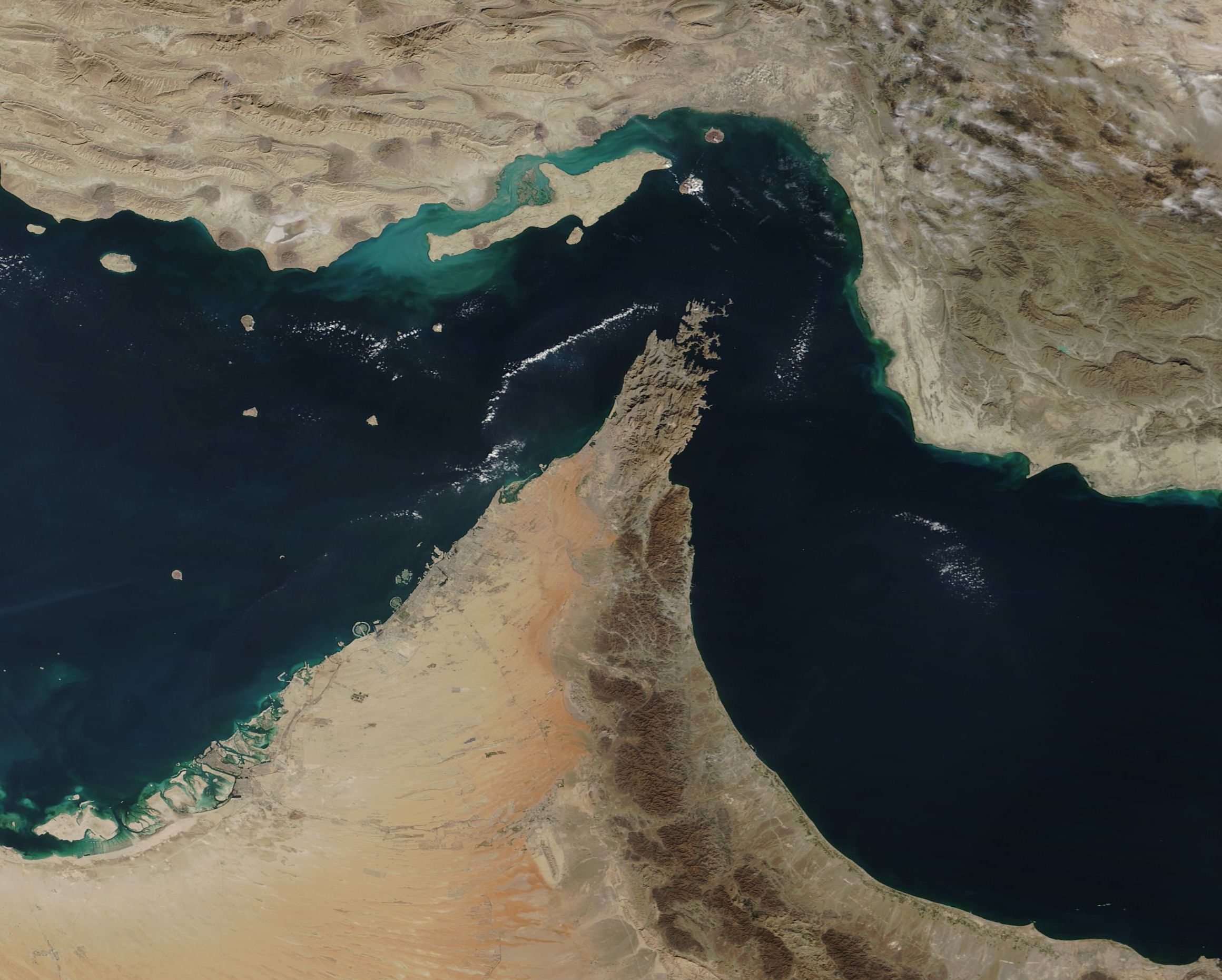
The agreement matters far beyond West Asia. The Strait of Hormuz carries roughly one-fifth of the world’s oil, and its reopening has already pulled Brent crude back from a wartime peak near $119 a barrel to around $80 directly easing the import bill of an India that buys nearly 88% of its crude from abroad.
- Iran agrees to let commercial vessels transit the Strait of Hormuz free of charge for 60 days, with safe passage ensured through demining and removal of technical obstacles.
- The United States begins removing its naval blockade immediately on signing, with full removal within 30 days and traffic expected back to pre-conflict levels.
- The US Treasury will issue waivers for the export of Iranian crude, petroleum products and derivatives, plus associated banking, insurance and transportation services.
- Both sides set a 60-day technical window to down-blend Iran’s near-bomb-grade highly enriched uranium under IAEA supervision, with Iran pledging never to acquire nuclear weapons.
- The MoU was signed at 17 June 2026 with facilitation credited across Pakistan, Oman, Qatar and Switzerland; follow-up talks to convert it into a lasting deal were slated for Switzerland.
The development matters in the context of:
- Why this matters for energy security: about 20 million barrels a day nearly 20% of global petroleum liquids and a quarter of seaborne oil pass through Hormuz, so any disruption transmits straight into Indian fuel and inflation.
- Why this matters for India’s diplomacy: New Delhi must balance ties with Iran (Chabahar, connectivity), the Gulf Arab states, Israel and the United States all at once a textbook test of strategic autonomy.
- Why this matters for the economy: each $10-a-barrel move in crude shifts India’s annual import cost by roughly $14-16 billion and feeds the current account deficit, the rupee and retail inflation.
UPSC Relevance
Prelims Relevance
- Islamabad Memorandum of Understanding (US-Iran), signed 17 June 2026
- Strait of Hormuz a chokepoint between Iran and Oman/UAE, linking the Persian Gulf to the Gulf of Oman
- Hormuz carries ~20 million barrels/day, ~20% of world petroleum liquids and ~25% of seaborne oil trade
- ~20% of global LNG (Qatar, UAE exports) transits the Strait
- Highly enriched uranium (HEU) and down-blending; IAEA as the UN nuclear watchdog
- India imports ~88% of its crude; about half comes from the Middle East
- Chabahar Port (Iran) and the International North-South Transport Corridor (INSTC)
- Brent and WTI as the two global crude benchmarks
- Force majeure clause invoked by Gulf exporters during the disruption
Mains Relevance
GS Paper 2
- Effect of a US-Iran detente on India’s West Asia policy and its balancing among Iran, the Gulf, Israel and the US.
- Role of regional mediators (Pakistan, Oman, Qatar, Switzerland) and the limits of the IAEA-led nuclear verification model.
GS Paper 3
- Energy security and chokepoint vulnerability: how Hormuz disruption transmits to India’s crude/LNG bill, rupee, current account deficit and inflation, and the case for supply diversification.
Essay
- Peace is not the absence of war but the management of dependence energy chokepoints and the fragility of globalisation.
- Strategic autonomy in a multipolar world: choosing partners without choosing sides.
Background and Context
From framework to fine print: what the 14-point MoU actually commits
The earlier announcement was a promise; the Islamabad MoU is the contract, with dated, conditional steps.
- It is a 14-point interim instrument an MoU, not a treaty governing an immediate halt to hostilities, interim economic measures and a structured negotiation path.
- The headline trade-off: Iran reopens Hormuz and accepts nuclear monitoring; the US lifts the blockade and grants sanctions waivers on oil and finance.
- Crucially, most reliefs are time-bound the free-transit and many waiver provisions run for 60 days, designed to expire unless a final deal is reached.
- A 60-day clock runs to convert the interim understanding into a final settlement to be endorsed by the UN; follow-up talks were set for Switzerland.
The Strait of Hormuz clauses
The navigation terms are the operational heart of the deal and the part markets watch.
- Iran will allow commercial vessels to transit Hormuz with no charge for 60 days, and undertakes to ensure safe passage.
- Safe passage includes active demining and the removal of technical obstacles so that traffic returns to pre-conflict levels.
- The US starts removing its naval blockade on signing, with full removal within 30 days.
- Even so, normalisation lags the text: major shipping lines were slow to resume transits and war-risk insurance premiums stayed elevated.
Sanctions relief and the nuclear bargain
The economic carrots and nuclear guardrails are explicitly linked and reversible.
- The US Treasury will issue waivers for Iranian crude, petroleum products and derivatives, plus banking, insurance and transportation a meaningful, if interim, return to oil markets.
- Reports point to phased access to frozen Iranian assets as an additional incentive tied to compliance.
- On the nuclear side, the agreed minimum methodology is to down-blend near-bomb-grade highly enriched uranium with lower-grade material under IAEA supervision.
- Iran reaffirms it will never acquire nuclear weapons; the 60-day technical talks must settle how to freeze, down-blend and verify its programme going forward.
Why Hormuz is a global jugular and India's most exposed artery
The geography explains the price swings: there is no easy alternative route.
- Roughly 20 million barrels a day about 20% of global petroleum liquids and a quarter of seaborne oil cross the Strait between Iran and Oman/UAE.
- Almost 20% of global LNG chiefly from Qatar and the UAE also transits Hormuz, with no spare bypass capacity.
- Asia is the destination: China and India together take about 44% of Hormuz crude exports, so the chokepoint sits on India’s lifeline.
- India imports nearly 88% of its crude and around half from the Middle East, leaving little buffer if the Strait closes.
The oil-price and import-bill arithmetic for India
The deal’s biggest near-term gift to India is a calmer crude market.
- Brent retreated from a wartime spike near $119 a barrel to about $80 roughly 36% off the peak as Hormuz reopened and force majeure declarations lifted.
- Every $10-a-barrel swing alters India’s annual import cost by an estimated $14-16 billion and nudges the current account deficit.
- A cheaper barrel eases pressure on the rupee, which had weakened toward the 95-to-a-dollar zone during the conflict, and on fuel-driven inflation.
- Iranian barrels returning to market add supply, but India had already leaned on discounted Russian crude to cushion the war shock.
India's diplomatic and connectivity stakes
Beyond oil, the deal reshapes corridors India has long invested in.
- Sanctions relief could revive momentum on the Chabahar Port and the INSTC, India’s bypass route to Afghanistan and Central Asia that avoids Pakistan.
- New Delhi must keep equilibrium across Iran, the Gulf, Israel and the United States a live test of strategic autonomy.
- A durable West Asia calm protects the roughly 9 million Indians in the Gulf and their remittances, plus energy and trade links.
- Persistent uncertainty the Switzerland follow-up talks reportedly stalled means India cannot treat the relief as permanent and must keep diversifying supply.
Way Forward
Diversify and store
- Deepen sourcing beyond Hormuz US, Latin American, West African and Russian grades and accelerate filling the Strategic Petroleum Reserves.
- Expand the domestic SPR footprint and crude shipping/insurance capacity to blunt the next chokepoint shock.
Hedge the price and the rupee
- Use oil hedging, rupee-settlement arrangements and refiner term contracts to smooth volatility in the import bill.
- Pair this with the structural cut in oil demand via biofuels, EVs and renewables to lower long-run exposure.
Bank the diplomatic opening
- Reactivate Chabahar and INSTC projects if Iran sanctions ease, while keeping Gulf and Israeli partnerships intact.
- Stay engaged with the IAEA verification track and back a UN-endorsed final deal that locks in freedom of navigation.
Conclusion
The Islamabad MoU is best read as a ceasefire with a price tag: Iran trades open sea lanes and nuclear transparency for oil and financial oxygen, and the world gets a calmer Strait of Hormuz. For India, the immediate dividend is a softer crude market, a steadier rupee and a lighter import bill all of which buy fiscal room.
But the deal’s reversibility its 60-day clocks, stalled follow-up talks and elevated insurance is the real lesson. India’s structural vulnerability to a single waterway does not disappear because diplomacy paused a war. The durable answer lies less in any one agreement and more in supply diversification, strategic reserves and a foreign policy supple enough to keep every West Asian partner onside.
UPSC Practice Questions
Prelims MCQ 1
With reference to the 2026 US-Iran Memorandum of Understanding, consider the following statements:
- It commits Iran to allow commercial vessels to transit the Strait of Hormuz free of charge for a fixed interim period.
- It provides for the down-blending of Iran’s highly enriched uranium under IAEA supervision.
- It is a legally binding treaty ratified by the UN Security Council before its signing.
How many of the above statements are correct?
(a) Only one (b) Only two (c) All three (d) None
Answer: (b) Only two
Explanation:
Statements 1 and 2 are correct: free 60-day transit and IAEA-supervised down-blending are core clauses. Statement 3 is wrong it is an interim MoU, not a UNSC-ratified treaty; a final deal is to be UN-endorsed later.
Prelims MCQ 2
The Strait of Hormuz connects which two water bodies?
(a) The Red Sea and the Gulf of Aden (b) The Persian Gulf and the Gulf of Oman (c) The Mediterranean Sea and the Red Sea (d) The Arabian Sea and the Bay of Bengal
Answer: (b) The Persian Gulf and the Gulf of Oman
Explanation:
The Strait of Hormuz links the Persian Gulf to the Gulf of Oman (and onward the Arabian Sea), lying between Iran to the north and Oman/UAE to the south. The Red Sea-Gulf of Aden link is the Bab-el-Mandeb.
UPSC Mains Questions
- The Strait of Hormuz is a single point of failure in India’s energy security. Examine how the 2026 US-Iran agreement affects India’s crude and LNG supply, and outline measures to reduce New Delhi’s exposure to maritime chokepoints. (250 words)
- A US-Iran detente forces India to balance Iran, the Gulf states, Israel and the United States simultaneously. Critically analyse how India can pursue strategic autonomy in West Asia while protecting its energy and diaspora interests. (250 words)
Sources: The Hindu and Indian Express Explained.
Frequently Asked Questions
What is the Islamabad MoU between the US and Iran?
It is a 14-point interim Memorandum of Understanding signed on 17 June 2026 that halts hostilities, reopens the Strait of Hormuz to commercial shipping, grants Iran oil and financial sanctions waivers, and places its highly enriched uranium under IAEA-supervised down-blending. It sets a 60-day window to negotiate a final, UN-endorsed deal.
Why is the Strait of Hormuz so important?
Around 20 million barrels of oil a day nearly 20% of global petroleum liquids and a quarter of seaborne oil trade pass through it, along with roughly 20% of world LNG. It is a narrow chokepoint between Iran and Oman/UAE with no easy bypass, so any disruption spikes global crude prices almost immediately.
How does the agreement affect India’s oil import bill?
By reopening Hormuz and easing supply fears, the deal helped pull Brent crude from a wartime peak near $119 to about $80 a barrel. Since each $10-a-barrel move shifts India’s annual import cost by roughly $14-16 billion, a calmer market eases the import bill, the current account deficit, rupee pressure and fuel inflation.
What does the deal mean for India’s nuclear-monitoring concerns?
The MoU’s nuclear core is the IAEA-supervised down-blending of Iran’s near-bomb-grade uranium and a pledge that Iran will never acquire nuclear weapons, with a 60-day technical talk to finalise verification. India, which backs non-proliferation and a peaceful West Asia, benefits from a verified freeze that lowers the risk of renewed conflict on its energy routes.
Could the agreement help the Chabahar Port and INSTC?
Yes. Sanctions relief on Iran could revive momentum on Chabahar Port and the International North-South Transport Corridor, India’s connectivity route to Afghanistan and Central Asia that bypasses Pakistan. But the relief is interim and reversible, so India must stay cautious about over-committing until a final deal is locked in.
Is the US-Iran deal permanent?
No. It is an interim MoU built on 60-day clocks for free transit, sanctions waivers and nuclear talks designed to expire unless a final settlement is reached. Follow-up negotiations in Switzerland reportedly stalled, war-risk insurance stayed high and shipping lines were slow to return, so India cannot treat the relief as durable.
Source: https://anantamias.com/current-affairs/us-iran-agreement-strait-of-hormuz-india/
India’s Statistical Databases Upgraded: New Base Years for GDP, CPI and IIP
Why in News?
India’s official statistics machinery has rolled out its biggest overhaul in over a decade. The Ministry of Statistics and Programme Implementation (MoSPI) and the National Statistical Office (NSO) have shifted the base years of the country’s three headline indicators — GDP, the Index of Industrial Production (IIP) and the Consumer Price Index (CPI) — so that they reflect a far more recent picture of the economy.
The new series, explained by The Hindu, rebase GDP and IIP to 2022-23 and CPI to 2024, move manufacturing GDP to double deflation, and weave in administrative and big data such as GST records. A companion Hindu editorial called these “essential upgrades” but flagged that frequent, well-documented revisions and transparency must follow.
- GDP base year moves from 2011-12 to 2022-23; the new GDP series was released on 27 February 2026.
- CPI base year shifts to 2024 (from 2012), with the new inflation series released on 12 February 2026.
- IIP base year also moves to 2022-23 (from 2011-12), with the new factory-output series slated for May 2026.
- Double deflation replaces single deflation for the manufacturing sector, deflating outputs and inputs by separate price indices.
- Real administrative databases — GST, e-Vahan (vehicle registrations) and PFMS — plus survey data now feed the estimates.
The development matters in the context of:
- Rebasing periodically resets the reference year so that price-volume weights mirror the current structure of output and consumption rather than a decade-old one.
- MoSPI’s Advisory Committee on National Accounts Statistics (ACNAS), a 26-member body set up in June 2024 under economist Biswanath Goldar, recommended the 2022-23 base and the new data sources.
- The exercise also compresses release timelines and launches the e-Sankhyiki portal for faster data dissemination.
UPSC Relevance
Prelims Relevance
- GDP and IIP new base year is 2022-23; the old base was 2011-12.
- CPI new base year is 2024; the previous CPI base was 2012.
- MoSPI is the nodal ministry; the NSO (which absorbed the erstwhile Central Statistics Office, CSO, and NSSO in 2019) compiles National Accounts.
- Double deflation uses separate price indices for inputs and outputs — now applied to manufacturing GDP.
- IIP measures industrial output; CPI is the headline inflation gauge used by the RBI for its 4% (+/-2%) target.
- ACNAS (Advisory Committee on National Accounts Statistics) advises MoSPI on base year and methodology; chaired by Biswanath Goldar.
- Administrative-data sources folded in include GST, e-Vahan and the PFMS.
- The e-Sankhyiki portal was launched for data dissemination and management.
- Release sequence: CPI 12 Feb 2026, GDP 27 Feb 2026, IIP May 2026.
- Aim of rebasing is improved accuracy, relevance and international comparability of official data.
Mains Relevance
GS Paper 3
- How periodic rebasing of GDP, CPI and IIP affects measured growth, inflation and industrial output, and why it matters for fiscal and monetary policy.
- Significance of double deflation and administrative-data integration (GST, e-Vahan, PFMS) for the accuracy of national income accounting.
GS Paper 2
- Strengthening institutional credibility of official statistics — the role of MoSPI, NSO and expert committees like ACNAS in ensuring transparent, comparable and timely data for governance.
Essay
- What gets measured gets managed — the politics and policy stakes of how a nation counts its growth and inflation.
- Data as public infrastructure: credible statistics as a foundation of democratic accountability.
Background and Context
What rebasing means and why it was overdue
Rebasing resets the reference year against which real growth and price change are measured, so the weights reflect today’s economy.
- An index compares current values to a fixed base year; if that base is stale, the basket of goods and sector weights no longer match how the economy actually produces and consumes.
- GDP and IIP had been anchored to 2011-12 for over a decade; CPI to 2012 — a period before the rise of digital services, renewable energy and post-GST formalisation.
- Structural shifts — new industries, changed consumption baskets and investment behaviour — mean an old base understates fast-growing sectors and overweights declining ones.
- MoSPI’s stated objective is to improve the accuracy, relevance and international comparability of India’s official data.
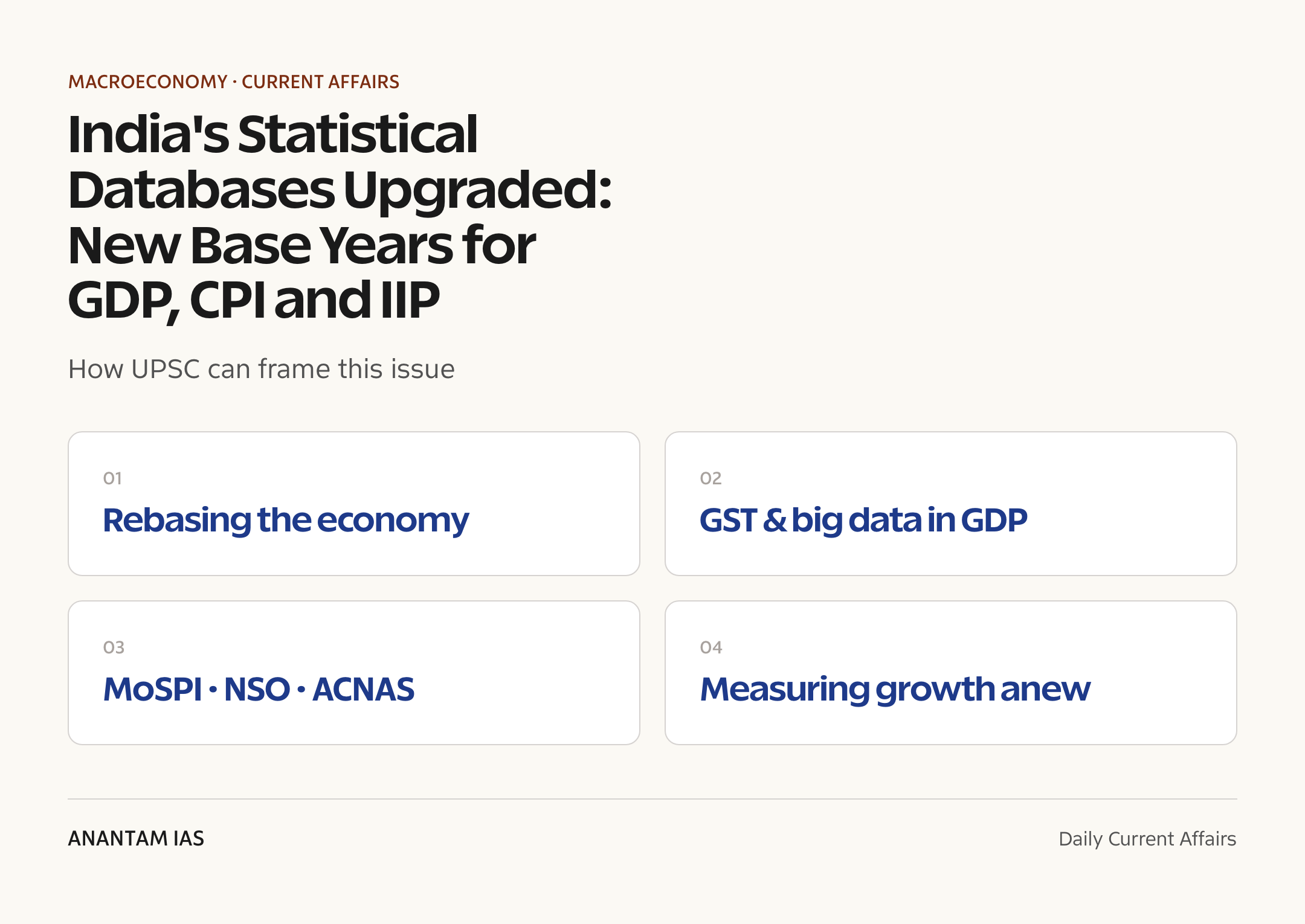
The three new series and their dates
The rollout staggers India’s three flagship indicators across early 2026.
- GDP: base shifts from 2011-12 to 2022-23; the new National Accounts series was released on 27 February 2026.
- CPI: base shifts to 2024; the new retail-inflation series went live on 12 February 2026.
- IIP: base shifts to 2022-23; the new industrial-output series is scheduled for May 2026.
- Under the new GDP series, real growth for FY 2025-26 is estimated near 7.6%, with nominal GDP up about 8.6% — figures that may differ from the old-base estimates.
- Read the foundations in our explainer on Gross Domestic Product (GDP) explained.
Double deflation — a methodological upgrade
The way real manufacturing GDP is computed changes substantively, not just cosmetically.
- Earlier, manufacturing used single deflation — a single price index applied to value-added, which can distort real growth when input and output prices move differently.
- Double deflation deflates outputs and inputs separately using their respective price indices, then takes the difference.
- This better captures the real value-added of manufacturing, especially when raw-material prices diverge sharply from finished-goods prices.
- It aligns India closer with international System of National Accounts (SNA) best practice long urged by economists.
Administrative and big data come into the fold
The new series leans less on periodic surveys alone and more on real-time digital footprints of the economy.
- GST returns offer granular, high-frequency data on turnover across sectors and geographies.
- e-Vahan (vehicle registrations) and the Public Financial Management System (PFMS) provide near real-time activity and expenditure signals.
- Blending these with surveys aims to plug coverage gaps and reduce the lag between an economic event and its appearance in the data.
- MoSPI also launched the e-Sankhyiki portal and shortened publication timelines for annual, quarterly and monthly results.
Institutions behind the numbers
A clear institutional chain decides what gets measured and how.
- MoSPI is the nodal ministry; the NSO — formed in 2019 by merging the Central Statistics Office (CSO) and the National Sample Survey Office — compiles the National Accounts.
- The Advisory Committee on National Accounts Statistics (ACNAS), a 26-member expert body set up in June 2024 under Biswanath Goldar, recommends the base year, new data sources and methodology.
- These bodies sit within a wider statistical architecture that includes the National Statistical Commission and sector ministries supplying source data.
- See how this ties into wider data governance in our note on the National Statistical Commission.
What the editorial flagged
The Hindu welcomed the rebasing but set conditions for it to genuinely strengthen trust.
- Upgrades are essential given how much the economy has changed, but credibility depends on transparent documentation of methods and sources.
- Frequent, predictable revisions and full disclosure of back-series data help users and markets interpret the new numbers.
- Administrative data must be quality-checked — GST and similar databases were built for compliance, not statistics, so coverage and definitional gaps need careful handling.
- An independent, well-resourced statistical system insulated from short-term pressures remains the bedrock of credible data.
Way Forward
Transparency and documentation
- Publish detailed methodology notes, back-series data and the rationale for new data sources so users can reconcile old and new estimates.
- Set a predictable, well-communicated revision calendar to avoid surprise jumps in headline numbers.
Data-quality safeguards
- Validate GST, e-Vahan and PFMS feeds against surveys before they drive headline estimates.
- Strengthen the autonomy and capacity of MoSPI, the NSO and the National Statistical Commission.
Build a culture of using administrative data responsibly — with clear definitions, audit trails and openness to external scrutiny.
Conclusion
Rebasing GDP and IIP to 2022-23 and CPI to 2024, adopting double deflation and folding in GST and administrative data marks the most consequential refresh of India’s statistical core in over a decade. Done well, it gives policymakers, the RBI and markets a sharper, more current read on growth, inflation and industrial output.
The gains hinge on execution. Credible, comparable statistics demand transparent methods, disciplined revisions and an independent statistical system. The rebasing is the easy part; sustaining trust in the numbers is the lasting test.
UPSC Practice Questions
Prelims MCQ 1
With reference to the recent upgrade of India’s statistical databases, consider the following statements:
- The base year for both GDP and the Index of Industrial Production has been revised to 2022-23.
- Double deflation has been adopted for the manufacturing sector in the new GDP series.
- The Consumer Price Index base year has been retained at 2011-12.
How many of the above statements are correct?
(a) Only one (b) Only two (c) All three (d) None
Answer: (b) Only two
Explanation:
Statements 1 and 2 are correct — GDP and IIP move to a 2022-23 base, and manufacturing now uses double deflation. Statement 3 is wrong: the CPI base year was revised to 2024 (from 2012), not retained at 2011-12.
Prelims MCQ 2
Which body recommended the new base year and data sources for India’s National Accounts in the recent revision?
(a) National Statistical Commission (b) Central Statistics Office (c) Advisory Committee on National Accounts Statistics (d) Reserve Bank of India’s Monetary Policy Committee
Answer: (c) Advisory Committee on National Accounts Statistics
Explanation:
The 26-member Advisory Committee on National Accounts Statistics (ACNAS), set up by MoSPI in June 2024 under Biswanath Goldar, advised on the 2022-23 base year, new data sources and compilation methodology. The CSO was merged into the NSO in 2019.
UPSC Mains Questions
- Periodic rebasing of GDP, CPI and IIP is necessary but not sufficient for credible economic statistics. Examine, with reference to India’s recent shift to a 2022-23 base year and the adoption of double deflation. (250 words)
- Integrating administrative and big data such as GST into national income accounting promises timeliness but raises quality concerns. Discuss the opportunities and safeguards needed. (250 words)
Sources: The Hindu and The Hindu (Editorial).
Frequently Asked Questions
What are the new base years for GDP, CPI and IIP?
GDP and the Index of Industrial Production (IIP) have shifted to a base year of 2022-23 (from 2011-12), while the Consumer Price Index (CPI) has moved to a 2024 base (from 2012). The new GDP series was released on 27 February 2026 and the CPI series on 12 February 2026.
What is double deflation and why does it matter?
Double deflation deflates a sector’s outputs and inputs separately, using their own price indices, before taking the difference to get real value-added. The new manufacturing GDP uses it instead of single deflation, giving a more accurate read of real industrial growth when input and output prices diverge.
Why is the base year of an index changed periodically?
An index compares current values against a fixed base year. Over time, the economy’s structure, consumption basket and sector weights change. A stale base year understates fast-growing sectors and overstates declining ones, so rebasing keeps measures of growth and inflation accurate, relevant and internationally comparable.
Which institutions are responsible for these statistics?
MoSPI is the nodal ministry. The National Statistical Office (NSO) — formed in 2019 by merging the Central Statistics Office (CSO) and the National Sample Survey Office — compiles National Accounts. The Advisory Committee on National Accounts Statistics (ACNAS), set up in June 2024, advised on the base year and methodology.
What new data sources feed the revised series?
Alongside surveys, the new series draws on real-time administrative databases — the GST system, e-Vahan (vehicle registrations) and the Public Financial Management System (PFMS). MoSPI also launched the e-Sankhyiki portal and shortened publication timelines to make data faster and more granular.
How does this affect inflation and growth figures?
New base years reset the weights in CPI and GDP, so headline inflation and growth numbers may differ from the old-base series. Under the new GDP series, FY 2025-26 real growth is estimated near 7.6%. Comparisons across the old and new series must be made carefully using the published back-series.
Source: https://anantamias.com/current-affairs/india-statistical-databases-upgrade-gdp-cpi-iip/
Right to Walk on Safe Footpaths: Supreme Court Reads Pedestrian Access into Article 21
Why in News?
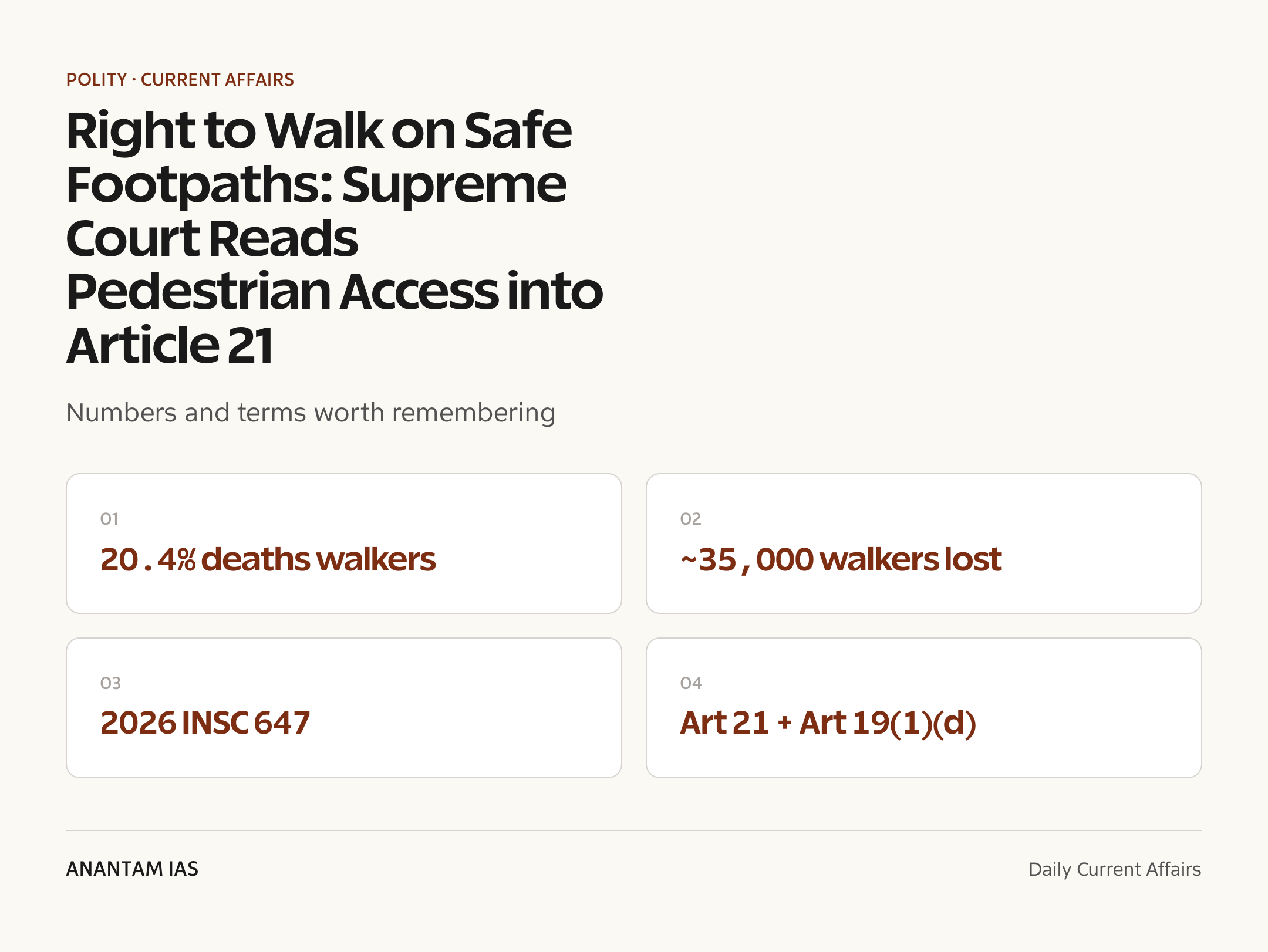
On 19 June 2026, the Supreme Court held that the right to walk on safe, demarcated and obstruction-free footpaths is a fundamental right flowing from Article 21 (right to life and personal liberty) and Article 19(1)(d) (freedom of movement). The ruling came in Maniyar Iliyaz @ Shaik Riyaz v. P. Ayyappan, reported as 2026 INSC 647, decided by a Bench of Justice P.S. Narasimha and Justice Atul S. Chandurkar.
The Court converted the proceedings into a writ petition under Article 32 and asked the Union Ministries handling urban, rural and road-transport affairs to frame a statutory framework and a dedicated regulator for pedestrian infrastructure. The Hindu’s editorial flagged this as a landmark recognition that the pedestrian’s right of way takes precedence over the motorist’s convenience, while the Indian Express explained how citizens may now enforce a restitutionary remedy when footpaths are encroached or absent.
- Right to walk on demarcated footpaths recognised as part of Article 21 and Article 19(1)(d).
- Case: Maniyar Iliyaz @ Shaik Riyaz v. P. Ayyappan, 2026 INSC 647 (19 June 2026); Bench of Justices P.S. Narasimha and Atul S. Chandurkar.
- Proceedings converted into an Article 32 petition; Union Ministries of Housing and Urban Affairs, Rural Development and Road Transport asked to build a statutory regulator.
- Citizens may seek a restitutionary remedy against municipal bodies and authorities under the Specific Relief Act, 1963 (Sections 38-40), distinct from Motor Vehicles Act compensation.
- Pedestrian right of way held to override the privilege of a motorised vehicle on the public way.
The development matters in the context of:
- Footpaths in most Indian cities are encroached by parking, vendors, signage and utility boxes, pushing pedestrians onto carriageways.
- Pedestrians accounted for about 20.4% of India’s road-accident deaths in 2023, roughly 35,000 fatalities out of 1,72,890 total deaths (MoRTH).
- The judgment continues the post-Maneka Gandhi (1978) expansion of Article 21 into a guarantee of dignified, safe living, not bare survival.
UPSC Relevance
Prelims Relevance
- Article 21 — right to life and personal liberty; judicially expanded to cover health, dignity, clean environment and now safe pedestrian access.
- Article 19(1)(d) — freedom to move freely throughout the territory of India.
- Article 32 — right to constitutional remedies; used to convert the matter into a writ petition.
- Maneka Gandhi v. Union of India (1978) — procedure affecting life and liberty must be fair, just and reasonable; foundation of expansive Article 21.
- Olga Tellis v. Bombay Municipal Corporation (1985) — right to livelihood read into Article 21; parallel logic of dignified urban life.
- Specific Relief Act, 1963 (Sections 38-40) — perpetual and mandatory injunctions, basis of the restitutionary remedy.
- Rights of Persons with Disabilities Act, 2016 — mandates accessible public spaces and barrier-free footpaths.
- Case citation format: INSC = Indian Supreme Court neutral citation (here 2026 INSC 647).
Mains Relevance
GS Paper 2
- Judicial expansion of Article 21 as a source of socio-economic and infrastructural rights, and the limits of reading positive duties into fundamental rights.
- Enforceability of welfare directions against municipal bodies and the role of the judiciary in urban governance vis-a-vis the executive.
GS Paper 1
- Urbanisation and its problems: encroachment, poor last-mile mobility, and the marginalisation of pedestrians, the elderly and persons with disabilities in Indian city design.
Essay
- Rights without infrastructure are promises without delivery: the gap between constitutional guarantees and the lived city.
- Designing cities for people, not just vehicles.
Background and Context
What the Court actually held
The ruling locates the pedestrian’s right of way firmly within Part III of the Constitution.
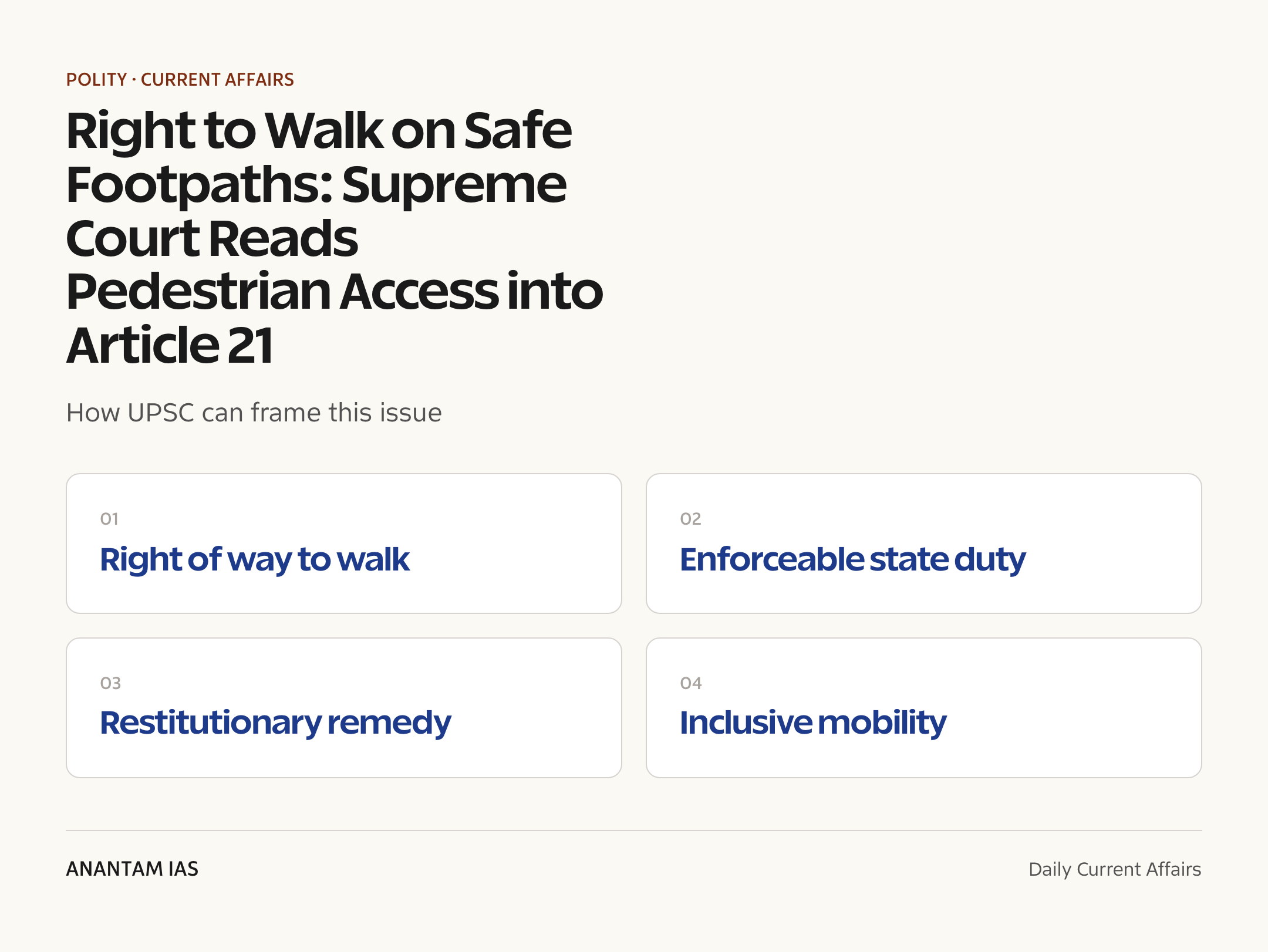
- Safe, demarcated and obstruction-free footpaths are integral to Article 21 and the freedom of movement under Article 19(1)(d).
- The right carries a corresponding state duty on municipalities, development authorities and panchayats to provide and maintain usable footpaths.
- Where footpaths are absent or encroached, a citizen can seek a restitutionary remedy to restore the public way, enforced through injunctions under the Specific Relief Act, 1963.
- The Court clarified that the pedestrian’s right overrides the convenience of motorists, reversing the usual hierarchy of the road.
The Article 21 jurisprudence behind it
The judgment sits in a long line of cases that turned the right to life into a right to dignified life.
- Maneka Gandhi (1978) opened Article 21 to substantive review, requiring any deprivation to be fair, just and reasonable.
- Later rulings read health, clean environment, shelter and livelihood into the right to life, including Olga Tellis (1985) on pavement dwellers’ livelihood.
- Safe mobility now joins this cluster: the ability to move through the city without bodily risk is treated as part of a dignified existence.
- The reasoning converts an aspirational welfare goal into a justiciable, enforceable claim against the state.
Why footpaths are a road-safety emergency
Pedestrians are among the most exposed and least protected users of Indian roads.
- Pedestrians made up roughly 20.4% of road-accident deaths in 2023, around 35,000 lives, the second-highest category after two-wheeler riders (MoRTH).
- India recorded about 4,80,583 accidents and 1,72,890 deaths in 2023, among the highest road-death tolls in the world.
- Missing or blocked footpaths force walkers onto fast carriageways, where the speed differential makes collisions lethal.
- Safe footpaths align with India’s commitment to SDG 11.2 (safe, accessible transport) and the broader goal of halving road deaths.
Accessibility and inclusive urban mobility
A footpath that excludes the wheelchair user or the visually impaired is not truly a footpath.
- The Court stressed that footpaths must be usable by persons with disabilities, the elderly and children.
- This echoes the Rights of Persons with Disabilities Act, 2016, which mandates barrier-free access to public spaces and infrastructure.
- Universal-design features such as tactile paving, ramps, continuous gradients and adequate width become legal expectations, not optional add-ons.
- Walkability also supports public health, lower emissions and equitable access for those who cannot afford private vehicles.
Enforcement, remedies and the proposed regulator
The ruling tries to bridge the familiar gap between fine principles and ground reality.
- Proceedings were converted into an Article 32 petition so the issue can be supervised as a continuing matter.
- The Court asked the Ministries of Housing and Urban Affairs, Rural Development and Road Transport and Highways to design a statutory framework for pedestrian planning.
- It recommended a dedicated regulator to set standards, audit footpaths and enforce maintenance.
- The restitutionary remedy gives individual citizens a direct lever against local bodies that fail to act, beyond writ petitions.
Way Forward
Codify a national pedestrian-rights framework
- Enact the suggested statutory framework with enforceable minimum standards for footpath width, continuity and surface quality.
- Set up the proposed regulator with audit and penalty powers over defaulting urban local bodies.
Reclaim and design for the pedestrian
- Embed complete-streets and universal-design norms in master plans and municipal building bye-laws.
- Balance encroachment removal with vendor rehabilitation so livelihoods and walkability are reconciled, not traded off.
Fund, audit and digitise
- Tie urban-mission grants to footpath audits and pedestrian-death reduction targets.
- Use GIS mapping and citizen-reporting apps to track encroachments and maintenance backlogs transparently.
Conclusion
By reading the right to walk into Articles 21 and 19(1)(d), the Supreme Court has turned a basic civic expectation into an enforceable constitutional duty, placing the pedestrian, long the afterthought of Indian road design, at the centre of urban governance.
The harder task now lies with the executive: a right that depends on demarcated, maintained and accessible footpaths will be real only when budgets, regulators and municipal accountability catch up with the judgment’s promise.
UPSC Practice Questions
Prelims MCQ 1
With reference to the Supreme Court’s 2026 ruling on the right to walk on footpaths, consider the following statements:
- The right was located within Article 21 and Article 19(1)(d) of the Constitution.
- The Court directed that pedestrian rights would override the privilege of a motorised vehicle.
- The judgment created an entirely new fundamental right not derived from any existing Article.
How many of the above statements are correct?
(a) Only one (b) Only two (c) All three (d) None
Answer: (b) Only two
Explanation:
Statements 1 and 2 are correct. The Court read the right into the existing Articles 21 and 19(1)(d) and held that the pedestrian right of way takes precedence over motorists. Statement 3 is wrong: the Court did not create a new free-standing right; it interpreted existing fundamental rights to include safe pedestrian access.
Prelims MCQ 2
The restitutionary remedy recognised by the Supreme Court for the violation of the right to walk on demarcated footpaths is primarily anchored in which of the following?
(a) The Motor Vehicles Act, 1988 (b) The Specific Relief Act, 1963 (c) The Rights of Persons with Disabilities Act, 2016 (d) The Disaster Management Act, 2005
Answer: (b) The Specific Relief Act, 1963
Explanation:
The Court grounded the restitutionary remedy, enforceable against municipal bodies and authorities, in the injunction provisions (Sections 38-40) of the Specific Relief Act, 1963. This remedy is distinct from compensation claims under the Motor Vehicles Act, 1988.
UPSC Mains Questions
- The Supreme Court has read the right to safe, demarcated footpaths into Article 21. Examine how the expansion of Article 21 jurisprudence converts welfare aspirations into enforceable state duties, and discuss the challenges of implementing such rights through municipal governance.
- Indian cities are designed for vehicles, not people. In light of the Supreme Court’s pedestrian-rights ruling, critically analyse the road-safety, accessibility and inclusive-mobility dimensions of urban planning in India and suggest a way forward.
Sources: The Hindu and Indian Express Explained.
Frequently Asked Questions
What did the Supreme Court rule about footpaths in June 2026?
In Maniyar Iliyaz @ Shaik Riyaz v. P. Ayyappan (2026 INSC 647), decided on 19 June 2026, the Court held that the right to walk on safe, demarcated and obstruction-free footpaths is a fundamental right flowing from Article 21 and Article 19(1)(d). It made providing and maintaining usable footpaths an enforceable duty of the state and local bodies.
Which constitutional Articles did the Court rely on?
The Court relied on Article 21, the right to life and personal liberty, and Article 19(1)(d), the freedom to move freely throughout India. It also converted the proceedings into a writ petition under Article 32, the right to constitutional remedies, so the matter could be supervised as a continuing issue.
Did the Court create a brand-new fundamental right?
No. The Court did not invent a new free-standing right. Following the post-Maneka Gandhi (1978) line of cases, it interpreted the existing right to life under Article 21 to include safe, dignified pedestrian movement. This is the same technique used to read health, environment and livelihood into Article 21.
What is the restitutionary remedy for citizens?
If footpaths are absent or encroached, a citizen can seek restoration of the public way through injunctions under the Specific Relief Act, 1963 (Sections 38-40), enforceable against municipal bodies, development authorities and panchayats. This remedy is separate from compensation claims under the Motor Vehicles Act.
Why is footpath safety a serious road-safety issue in India?
Pedestrians made up roughly 20.4% of road-accident deaths in 2023, about 35,000 of the 1,72,890 total fatalities recorded across some 4,80,583 accidents (MoRTH). Missing or blocked footpaths push walkers onto fast carriageways, where collisions with vehicles are far more likely to be fatal.
How does the ruling connect to accessibility and disability rights?
The Court stressed that footpaths must be usable by persons with disabilities, the elderly and children. This reinforces the Rights of Persons with Disabilities Act, 2016, which mandates barrier-free public spaces, making universal-design features such as tactile paving, ramps and adequate width legal expectations rather than optional extras.
Source: https://anantamias.com/current-affairs/right-to-walk-footpaths-supreme-court/
World Bank Approves $1.5 Billion to Back India’s Reform Programmes
Why in News?
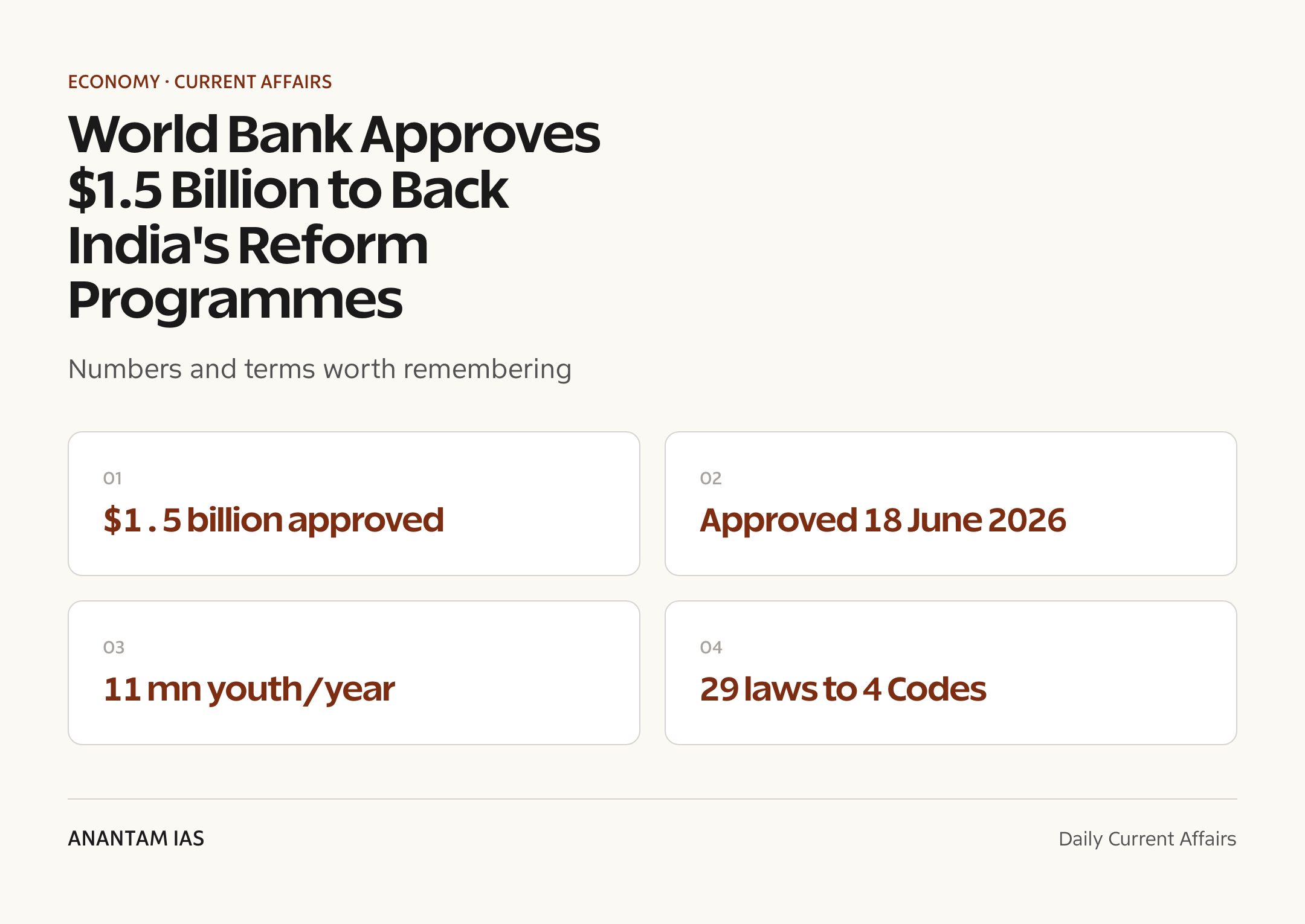
The World Bank’s Board of Executive Directors approved $1.5 billion in financing on 18 June 2026 to support India’s structural reforms, under a single operation called the Boosting Job Creation in the Private Sector Development Policy Financing (DPF) Operation. The Hindu reported the approval as multilateral backing tied directly to India’s reform agenda rather than to a brick-and-mortar project.
This is budget-support lending — a Development Policy Financing operation — where money flows against agreed policy and institutional reforms, not against a road or a power plant. The World Bank said the operation builds on reforms in tax simplification, trade integration and labour law consolidation, aiming to unlock private capital and create jobs for the roughly 11 million youth entering India’s labour market every year over the next two decades.
- $1.5 billion approved on 18 June 2026 via the Boosting Job Creation in the Private Sector DPF Operation.
- It is a Development Policy Financing (DPF) / budget-support loan — disbursed against reforms, not a physical project.
- Reforms backed: Next-Generation GST, simplified tax regime, broader MSME definitions, trade and investment streamlining, and capital mobilisation.
- Anchored on the November 2025 consolidation of 29 labour laws into four Labour Codes and measures to raise women’s formal-sector participation.
- Complements parallel International Finance Corporation (IFC) investments to widen credit access for MSMEs and underserved rural and semi-urban borrowers.
- Johannes Zutt, World Bank Vice President for South Asia, said India is well paced in its reforms agenda to unlock private capital and create jobs.
The development matters in the context of:
- Sits inside the new India Country Partnership Framework (CPF) FY26–31, which centres jobs and private investment.
- India is among the World Bank’s largest borrowers, drawing on the IBRD (middle-income window) rather than the concessional IDA.
- DPF loans count as external commercial borrowing on the government’s books and add to the external-sector liability stock.
- The operation links external multilateral finance to domestic fiscal, ease-of-doing-business and factor-market reforms.
UPSC Relevance
Prelims Relevance
- The World Bank Group (WBG) has five arms: IBRD, IDA, IFC, MIGA and ICSID.
- IBRD lends to middle-income and creditworthy governments; India borrows mainly from IBRD, not concessional IDA.
- IDA provides concessional credits and grants to the poorest countries; India graduated as an IDA borrower in 2014.
- IFC finances the private sector; MIGA provides political-risk guarantees; ICSID settles investment disputes.
- Development Policy Financing (DPF) is budget support disbursed against policy actions, distinct from Investment Project Financing (IPF) tied to specific projects.
- WBG and the IMF are Bretton Woods institutions, both established at the 1944 conference.
- In India, sovereign borrowing from the World Bank is routed through the Department of Economic Affairs (DEA), Ministry of Finance.
- A Country Partnership Framework (CPF) is the World Bank’s medium-term engagement strategy for a borrowing country.
Mains Relevance
GS Paper 3
- Multilateral development finance as a lever for structural reform — how reform-linked DPF lending interacts with fiscal policy, ease of doing business and private-sector job creation.
- External-sector implications of sovereign borrowing from MDBs: debt sustainability, foreign-exchange inflows and the trade-off between external commercial borrowing and reform credibility.
GS Paper 2
- Role and reform of Bretton Woods institutions and the World Bank Group in supporting developing economies; India’s evolving relationship from aid recipient to major borrower and shareholder voice.
Essay
- Reform from within, finance from abroad: the political economy of conditional development lending.
- Jobs, not just growth — financing the demographic dividend before the window closes.
Background and Context
The World Bank Group — five arms, one mission
The institution India borrowed from is one part of a wider Group.
- The World Bank Group (WBG) is a development institution of five agencies, headquartered in Washington, D.C., born of the 1944 Bretton Woods conference alongside the IMF.
- IBRD (International Bank for Reconstruction and Development) — lends at near-market rates to middle-income and creditworthy governments. India’s $1.5 billion DPF flows through this window.
- IDA (International Development Association) — concessional credits and grants for the poorest countries; India was a borrower until graduating in 2014 and is now an IDA donor.
- IFC (International Finance Corporation) — invests in the private sector; here it complements the loan with MSME and rural-credit financing.
- MIGA offers political-risk and credit guarantees; ICSID arbitrates investor-state disputes.
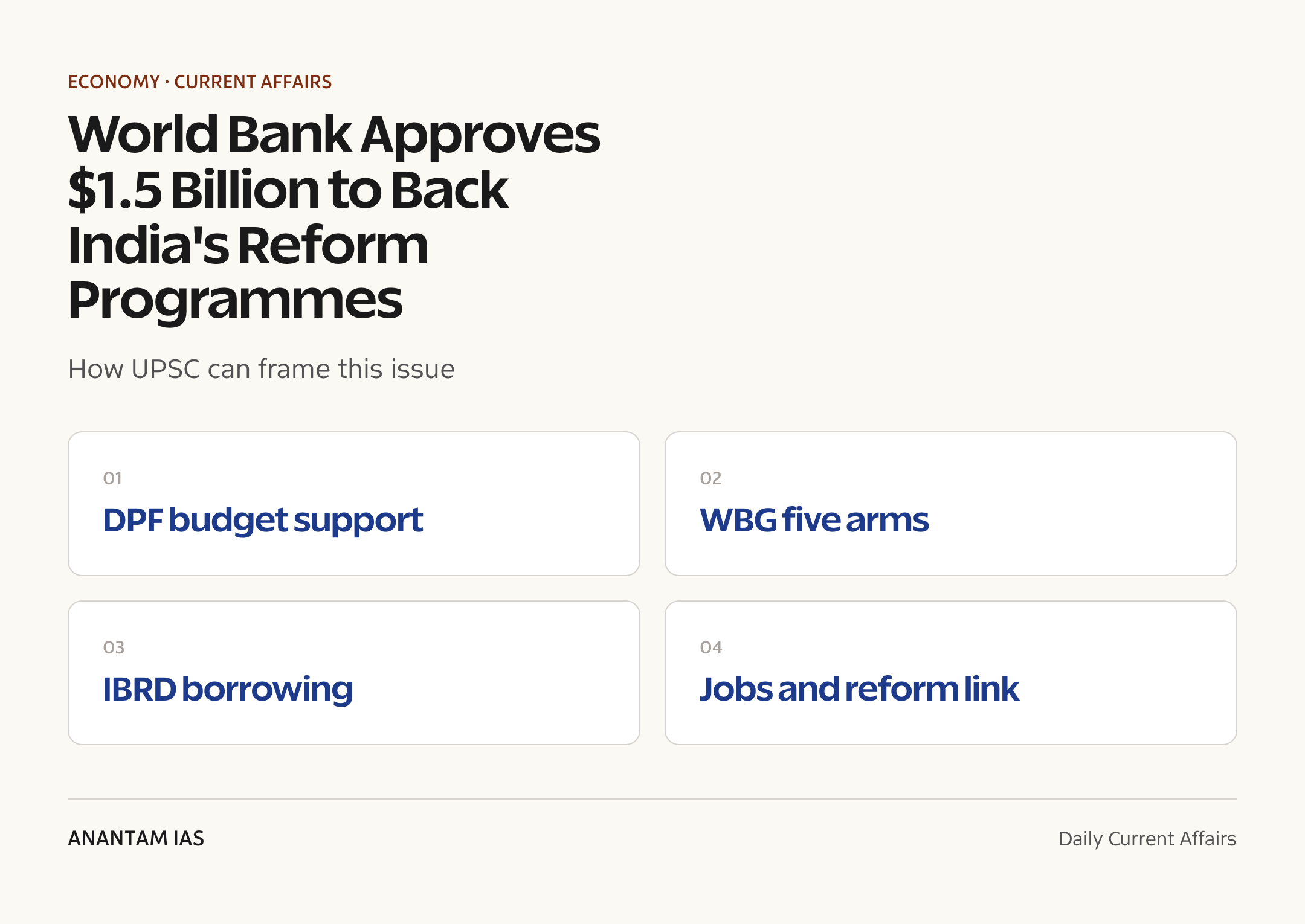
Development Policy Financing vs Investment Project Financing
The form of this loan matters as much as the amount.
- Development Policy Financing (DPF) is fast-disbursing budget support — funds are released against a government’s completed and committed prior actions (policy and institutional reforms).
- It does not finance a specific asset; the money enters the general budget once reform milestones are met.
- Investment Project Financing (IPF), by contrast, funds tangible projects — highways, transmission lines, water systems — disbursed against verified expenditure.
- A Program-for-Results (PforR) instrument links disbursement to delivered results.
- DPF rewards reform credibility, which is why this operation reads as an endorsement of India’s policy direction, not a project cheque.
The reforms being backed
The World Bank tied the financing to a specific reform stack.
- Tax simplification, including the Next-Generation GST rollout, to make compliance smoother, faster and more transparent.
- Broader, more inclusive MSME definitions and easier business compliance to lower entry barriers for entrepreneurs.
- Trade and investment streamlining to deepen integration with global value chains.
- Consolidation of 29 labour laws into four Labour Codes (November 2025) to modernise compliance and ease formal hiring.
- Measures to raise women’s participation in formal employment and to facilitate capital mobilisation for firms.
- This connects to India’s ongoing push on the ease of doing business and factor-market reform.
India's borrowing relationship with multilateral banks
India is now a major client, not a small recipient.
- India is among the largest IBRD borrowers and an active client of the Asian Development Bank (ADB), the AIIB and the New Development Bank (NDB).
- Sovereign loans are negotiated and routed through the Department of Economic Affairs (DEA) in the Finance Ministry.
- This operation sits within the India Country Partnership Framework (CPF) FY26–31, which puts jobs and private investment at the centre of engagement.
- Having graduated from concessional IDA in 2014, India both borrows from IBRD and contributes to IDA as a donor — a dual role few economies hold.
- Multilateral finance brings not just funds but technical assistance, benchmarking and reform discipline.
Fiscal and external-sector implications
A budget-support loan touches both the fisc and the balance of payments.
- DPF proceeds count as external commercial borrowing by the sovereign, adding to the external-debt stock that must be serviced in foreign currency.
- The inflow supports the capital account of the balance of payments and adds to forex reserves at the margin.
- Reform-linked lending strengthens India’s standing with rating agencies and other lenders, lowering the cost of future borrowing.
- The jobs focus targets the demographic dividend — roughly 11 million youth entering the labour force each year — where employability and formalisation are the binding constraints.
- The trade-off: external liabilities and conditionality against cheaper finance, reform momentum and a credibility signal to private capital.
Way Forward
Convert reforms on paper into measurable outcomes
- Track Labour Code implementation, GST simplification and MSME formalisation against jobs and female labour-force participation, not just legislative milestones.
- Use DPF technical assistance to build state-level capacity, since factor-market reforms ultimately play out in states.
Manage the external-sector footprint prudently
- Keep multilateral borrowing within a sustainable external-debt path and match foreign-currency liabilities to productive, growth-raising reforms.
- Blend IBRD funds with IFC private-capital mobilisation to crowd in, rather than crowd out, market financing.
Deepen India's voice in global finance
- Leverage India’s status as a major borrower and IDA donor to push for governance and quota reform across MDBs.
- Coordinate World Bank, ADB, AIIB and NDB lending to avoid duplication and maximise reform impact.
Conclusion
The World Bank’s $1.5 billion is small against India’s budget, but the form is the message: a Development Policy Financing operation rewards a reform stack — Next-Generation GST, four Labour Codes, trade and MSME liberalisation — rather than a single project. It reads as a vote of confidence in India’s direction and a bet on its ability to turn a young population into formal employment.
The real test now lies in execution. Reforms that look clean in a press release must convert into jobs, higher female participation and easier business at the state and district level. Handled well, reform-linked multilateral finance buys India cheaper capital and global credibility; handled loosely, it adds external liabilities without the structural payoff.
UPSC Practice Questions
Prelims MCQ 1
With reference to the World Bank Group, consider the following statements:
- The International Bank for Reconstruction and Development (IBRD) lends primarily to middle-income and creditworthy governments.
- The International Development Association (IDA) provides concessional finance to the poorest member countries.
- The Multilateral Investment Guarantee Agency (MIGA) settles investment disputes between investors and states.
How many of the above statements are correct?
(a) Only one (b) Only two (c) All three (d) None
Answer: (b) Only two
Explanation:
Statements 1 and 2 are correct. Statement 3 is wrong: MIGA provides political-risk and credit-enhancement guarantees, while the settlement of investor-state disputes is done by the International Centre for Settlement of Investment Disputes (ICSID).
Prelims MCQ 2
The ‘Development Policy Financing (DPF)’ instrument of the World Bank is best described as:
(a) A grant tied to the construction of a specific infrastructure project (b) Budget-support finance disbursed against a government’s agreed policy and institutional reforms (c) A guarantee covering political risk for foreign private investors (d) Concessional credit available only to least-developed countries
Answer: (b) Budget-support finance disbursed against a government's agreed policy and institutional reforms
Explanation:
DPF is fast-disbursing budget support released against completed ‘prior actions’ — policy and institutional reforms — not against a physical project (that is Investment Project Financing). It is not a guarantee instrument, and it is available to eligible borrowers including middle-income countries like India.
UPSC Mains Questions
- Reform-linked multilateral lending is increasingly used to support structural change in emerging economies. Examine the merits and risks of the World Bank’s Development Policy Financing model for India, with reference to its fiscal, external-sector and reform-credibility implications. (250 words)
- Discuss how India’s relationship with the World Bank Group has evolved from that of an aid recipient to a major borrower and donor. What does this transition reveal about India’s position in the architecture of global development finance? (250 words)
Source: The Hindu.
Frequently Asked Questions
How much did the World Bank approve and when?
The World Bank’s Board approved $1.5 billion in financing on 18 June 2026 to support India’s structural reforms. It was approved as a single operation, the Boosting Job Creation in the Private Sector Development Policy Financing Operation, with the money flowing as budget support rather than as funding for a specific physical project.
What is Development Policy Financing and how is it different from a project loan?
Development Policy Financing (DPF) is fast-disbursing budget support released once a government completes agreed policy and institutional reforms, called prior actions. It enters the general budget. Investment Project Financing, by contrast, pays for a specific asset such as a highway or power line, disbursed against verified spending. DPF rewards reform, not construction.
Which arm of the World Bank Group lent the money, IBRD or IDA?
India borrows mainly through the International Bank for Reconstruction and Development (IBRD), the Group’s middle-income lending window, since it graduated from the concessional International Development Association (IDA) as a borrower in 2014. India is now an IDA donor, making it both a borrower and a contributor within the same Group.
What reforms is the financing supporting?
The operation backs tax simplification including the Next-Generation GST, broader MSME definitions, easier business compliance, trade and investment streamlining, and capital mobilisation. It is anchored on the November 2025 consolidation of 29 labour laws into four Labour Codes and on measures to raise women’s participation in formal employment.
What are the five arms of the World Bank Group?
The five agencies are the IBRD (lends to middle-income governments), IDA (concessional finance for the poorest countries), IFC (invests in the private sector), MIGA (political-risk and credit guarantees) and ICSID (settles investment disputes). Together they form the World Bank Group, distinct from the IMF, though both are Bretton Woods institutions founded in 1944.
What are the fiscal and external-sector implications for India?
The proceeds count as external commercial borrowing by the sovereign, adding to external debt that must be serviced in foreign currency, while supporting the capital account and forex reserves. The reform-linked nature strengthens India’s credibility with lenders and rating agencies, which can lower the cost of future borrowing, provided the external-debt path stays sustainable.
Source: https://anantamias.com/current-affairs/world-bank-1-5-billion-india-reforms/
India’s Cheapest Power Is Here: Grid Bottlenecks Stranding Renewable Capacity
Why in News?
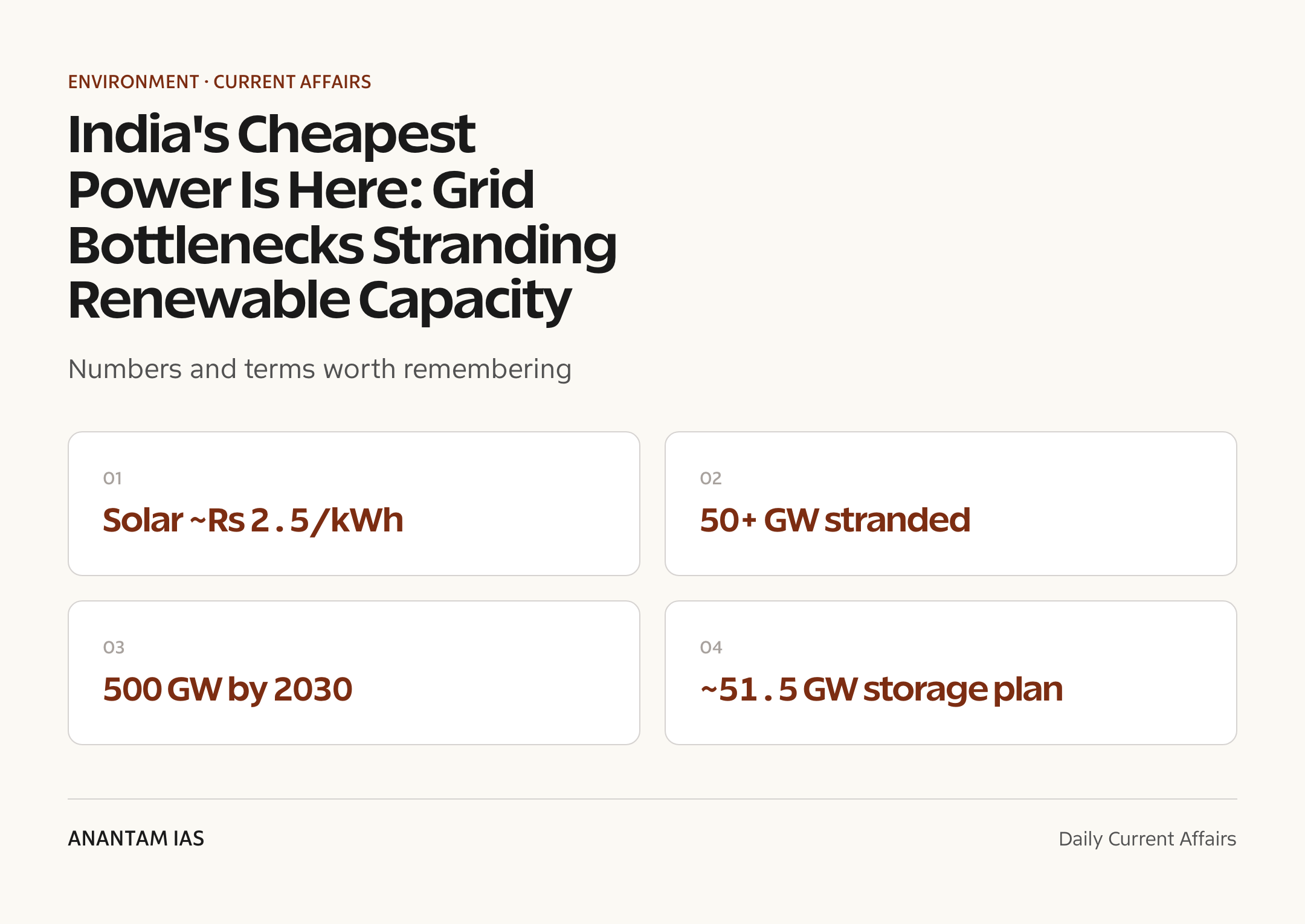
Solar and wind have become India’s cheapest source of new electricity, with utility-scale solar tariffs discovered as low as around Rs 2.5/kWh and solar-plus-storage bids near Rs 2.70/kWh. The Hindu reported that the country is adding record renewable capacity, yet a large share of that cheap power cannot reach consumers because the transmission grid has not kept pace. The mismatch has turned the cost of clean electrons from a generation problem into a wires-and-storage problem.
Industry trackers cited in the reporting estimate that more than 50 GW of commissioned or near-ready renewable capacity is stranded for want of grid connectivity, while curtailment is rising on the inter-state network. The Indian Express explained that the deeper challenge is the speed of electrification needed for climate goals, where grids, storage and flexible supply must scale together rather than generation alone.
- Lowest utility-scale solar tariffs of around Rs 2.48-2.50/kWh make solar the cheapest new power in India; solar-plus-storage bids touch Rs 2.70/kWh.
- Estimated 50+ GW of renewable capacity stranded or delayed by inadequate transmission and connectivity.
- Around 300 GWh of renewable generation was curtailed in Q1 2026, with transmission constraints causing the bulk of inter-state curtailment.
- Record build-out continues: solar reached about 150 GW and wind about 56 GW of installed capacity by early 2026.
- Transmission projects lag at roughly 80% of targets, with about one in four schemes delayed, Rajasthan a key chokepoint.
The development matters in the context of:
- Renewable tariffs have collapsed over a decade, but grid evacuation, storage and flexible thermal operation now decide how much of that cheap power is usable.
- The Central Electricity Authority (CEA) transmission plan maps the wires needed to integrate over 500 GW non-fossil capacity by 2030, including about 51.5 GW of battery storage.
- Variable solar and wind create a duck curve and force thermal back-down, raising curtailment and grid-stability concerns during peak solar hours.
UPSC Relevance
Prelims Relevance
- Green Energy Corridors (GEC): Ministry of Power scheme for intra- and inter-state transmission to evacuate renewable power.
- ISTS charge waiver: inter-state transmission charge waiver for solar, wind, hydro pumped storage and BESS, being phased out for projects commissioned after a cut-off (extended to June 2028 for storage/PSP categories).
- CEA prepared the transmission plan for integrating over 500 GW non-fossil capacity by 2030, envisaging about 51.5 GW of battery storage.
- Grid-India (formerly POSOCO) is the National Load Despatch Centre operator handling real-time grid balancing and curtailment instructions.
- BESS (Battery Energy Storage Systems) and pumped hydro storage (PSP) are the two main grid-scale storage routes for time-shifting solar.
- HTLS conductors (High Temperature Low Sag) enable reconductoring to raise line capacity within the existing right of way.
- Must-run status: solar and wind enjoy priority dispatch, so balancing falls on backing down thermal plants.
- Targets: 500 GW non-fossil by 2030; 50% installed capacity from non-fossil sources; long-term net-zero by 2070.
- Duck curve: the demand-net-of-solar curve that dips at midday and ramps sharply in the evening.
Mains Relevance
GS Paper 3
- Energy security and transition: why cost-competitive renewables alone do not deliver clean power without transmission and storage co-investment.
- Grid integration of variable renewables: must-run dispatch, curtailment, the duck curve and flexible thermal operation as system-level challenges.
GS Paper 3
- Infrastructure and investment: Green Energy Corridors, ISTS waivers, reconductoring with HTLS and Right-of-Way constraints as bottlenecks to a 500 GW grid.
Essay
- Cheap energy is only as useful as the wires and storage that carry it: India’s clean-power paradox.
- Building the grid of tomorrow today: infrastructure as the silent enabler of the energy transition.
Background and Context
Why Solar and Wind Became the Cheapest Power
A decade of falling costs has made variable renewables India’s cheapest new generation.
- Utility-scale solar tariffs discovered as low as around Rs 2.48-2.50/kWh, among the lowest globally, driven by cheap modules, low capital costs and competitive reverse auctions.
- India recorded its highest-ever annual wind addition of about 6 GW in FY2026, alongside solar crossing roughly 150 GW installed.
- Solar-plus-storage bids near Rs 2.70/kWh show round-the-clock clean power is becoming commercially viable.
- The challenge has shifted from making clean power cheap to delivering and timing it through the grid.
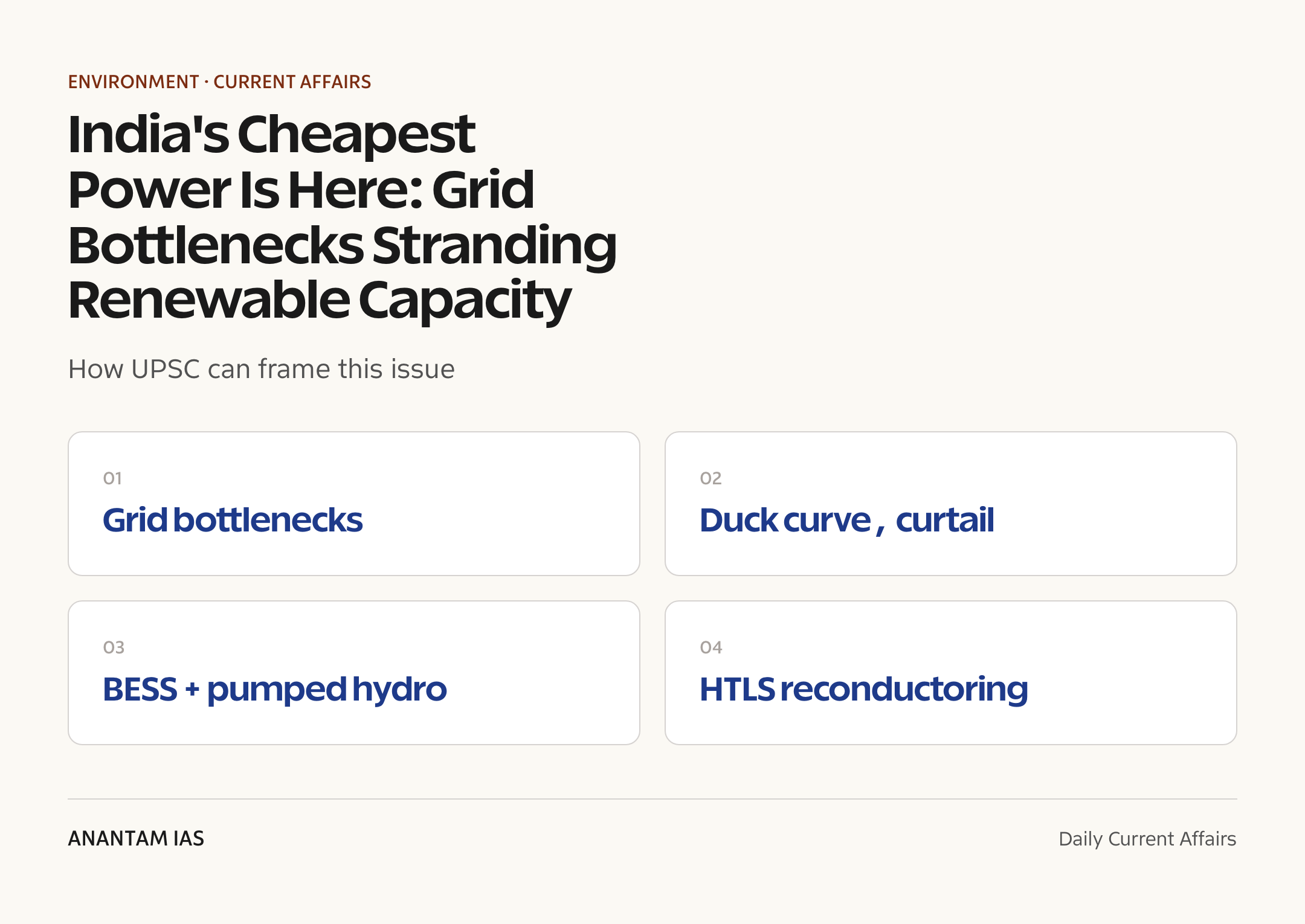
The Grid Bottleneck: Stranded and Curtailed Power
Generation has outrun the wires, stranding capacity and forcing curtailment.
- Industry estimates put over 50 GW of renewable capacity stranded or delayed for want of evacuation infrastructure.
- Around 300 GWh of renewable energy was curtailed in Q1 2026, with transmission constraints responsible for the larger share of inter-state curtailment.
- Rajasthan, a solar-wind hub, sees gigawatts stuck behind connectivity delays and ecological clearances on transmission corridors.
- Transmission build-out lags at roughly 80% of targets, with about a quarter of schemes delayed, stranding investor capital and raising project risk.
Intermittency, Must-Run and the Duck Curve
Variable supply with priority dispatch strains a coal-heavy grid.
- Solar and wind have must-run status, so grid operators balance the system mainly by backing down thermal plants.
- Midday solar floods the grid and evening ramps are steep, producing a deepening duck curve that thermal flexibility must absorb.
- On peak-solar days in 2025, operators backed thermal down to roughly 58% and curtailed close to 10 GW of solar to hold grid frequency.
- The CEA has flagged the need to lower minimum thermal load toward 40% to accommodate renewables and restrict curtailment.
The Policy and Institutional Architecture
Schemes, waivers and operators shape how renewables reach the grid.
- Green Energy Corridors (Ministry of Power) build intra- and inter-state lines for renewable evacuation from resource-rich states.
- The ISTS charge waiver made inter-state renewable power cheaper; its phase-down (with extended windows for storage and pumped hydro) is reshaping project economics.
- CEA authored the transmission roadmap for over 500 GW non-fossil by 2030, including about 51.5 GW of battery storage.
- Grid-India (formerly POSOCO) operates the National Load Despatch Centre, issuing real-time dispatch and curtailment instructions to keep the grid stable.
Storage and Grid Upgrades: The Route to 1,000 GW
Storage, smarter lines and corridor reuse unlock cheap power at scale.
- BESS and pumped hydro storage time-shift midday solar into the evening peak, flattening the duck curve; viability-gap funding and waivers support both.
- Reconductoring with HTLS conductors can raise existing line capacity by roughly 25-50% within the same right of way, sidestepping land acquisition.
- Right-of-Way (RoW) disputes, forest clearances and land costs are core reasons new corridors lag, making corridor reuse attractive.
- Reaching a longer-term ~1,000 GW renewables pathway needs synchronised investment in wires, storage and digital grid management, not generation alone.
Way Forward
Build wires ahead of generation
- Sequence transmission corridors and substations to lead, not lag, renewable capacity additions so commissioned projects are not stranded.
- Use HTLS reconductoring and dynamic line rating to raise capacity fast within existing rights of way while new lines are built.
Scale storage and flexible supply
- Accelerate BESS and pumped hydro through viability-gap funding and storage obligations to absorb midday solar and serve the evening peak.
- Make the coal fleet two-shift and flexible down toward 40% minimum load to cut curtailment without threatening grid frequency.
Fix market and institutional signals
- Give clarity on the ISTS waiver glide path so storage and round-the-clock tenders stay bankable.
- Strengthen real-time markets and forecasting so Grid-India can dispatch and curtail efficiently, sharing flexibility across regions.
Conclusion
India has won the cost battle of the energy transition: solar and wind are now the cheapest electrons it can buy. But cheap power stuck behind an underbuilt grid is a paradox that strands capital, curtails clean generation and slows the march to 500 GW non-fossil by 2030.
The next decade is a grid-and-storage decade. Building corridors ahead of demand, reusing existing rights of way through reconductoring, and scaling batteries and pumped hydro will decide whether India’s cheapest power actually reaches its homes and factories.
UPSC Practice Questions
Prelims MCQ 1
With reference to the integration of renewable energy into India’s power grid, consider the following statements:
- Solar and wind generators in India enjoy must-run status, giving them priority dispatch.
- The Central Electricity Authority prepared the transmission plan for integrating over 500 GW of non-fossil capacity by 2030.
- Grid-India (formerly POSOCO) operates the National Load Despatch Centre for real-time grid balancing.
How many of the above statements are correct?
(a) Only one (b) Only two (c) All three (d) None
Answer: (c) All three
Explanation:
All three are correct. Solar and wind have must-run (priority dispatch) status; the CEA authored the transmission roadmap for over 500 GW non-fossil capacity by 2030 (including about 51.5 GW of battery storage); and Grid-India, the renamed POSOCO, runs the National Load Despatch Centre that issues real-time dispatch and curtailment instructions.
Prelims MCQ 2
Which of the following best explains why some commissioned renewable capacity in India remains ‘stranded’?
(a) Solar and wind tariffs have risen above thermal power tariffs (b) Transmission and grid-connectivity build-out has lagged behind generation additions (c) The Green Energy Corridors scheme has been discontinued (d) India has exhausted its solar and wind resource potential
Answer: (b) Transmission and grid-connectivity build-out has lagged behind generation additions
Explanation:
Stranded capacity arises because transmission lines and connectivity have not kept pace with rapid solar and wind additions, leaving over 50 GW unable to evacuate power. Tariffs have fallen, not risen; Green Energy Corridors continue; and India’s resource potential is far from exhausted.
UPSC Mains Questions
- India has achieved among the world’s lowest renewable tariffs, yet a significant share of clean capacity remains stranded. Examine why cost-competitiveness alone cannot deliver an energy transition, and discuss the role of transmission and storage. (250 words)
- Integrating variable renewables strains a coal-heavy grid through must-run dispatch, the duck curve and rising curtailment. Discuss the institutional and infrastructural measures needed to reach 500 GW non-fossil capacity by 2030. (250 words)
Sources: The Hindu and Indian Express Explained.
Frequently Asked Questions
Why is renewable power called India’s cheapest electricity?
Utility-scale solar tariffs in India have been discovered as low as around Rs 2.48-2.50 per unit, and solar-plus-storage near Rs 2.70, undercutting new thermal power. Falling module costs, low capital costs and competitive reverse auctions have made solar and wind the cheapest new generation the country can build.
What does it mean that renewable capacity is ‘stranded’?
Stranded capacity is solar or wind that is built or ready but cannot send power to consumers because transmission lines and grid connectivity are missing or delayed. Industry trackers estimate over 50 GW is stranded in India, locking up investment and forcing curtailment of otherwise cheap, clean power.
What is the duck curve and why does it matter?
The duck curve is the shape of electricity demand minus solar output: it dips at midday when solar floods the grid and ramps sharply in the evening as solar fades. It matters because the grid must back down thermal plants at noon and ramp them fast at dusk, raising curtailment and grid-stability risks.
What are Green Energy Corridors and the ISTS waiver?
Green Energy Corridors are a Ministry of Power scheme building intra- and inter-state transmission to evacuate renewable power from resource-rich states. The ISTS charge waiver lowered inter-state transmission charges for solar, wind, storage and pumped hydro; its phased withdrawal, with extended windows for storage categories, is reshaping project economics.
How can storage and reconductoring help unlock cheap power?
Battery storage (BESS) and pumped hydro shift surplus midday solar into the evening peak, flattening the duck curve and cutting curtailment. Reconductoring with HTLS conductors raises the capacity of existing lines by roughly 25-50% within the same right of way, adding capacity quickly without new land acquisition.
What is India’s renewable capacity target?
India aims for 500 GW of non-fossil installed capacity by 2030, with about half of total installed capacity from non-fossil sources and net-zero by 2070. The CEA’s transmission plan covers integrating over 500 GW, including roughly 51.5 GW of battery storage, with longer-term pathways pointing toward around 1,000 GW of renewables.
Source: https://anantamias.com/current-affairs/renewable-energy-grid-bottlenecks-india/
The RBI’s Growing Fiscal Role: Surplus Transfers and the Central Bank’s Expanding Footprint
Why in News?
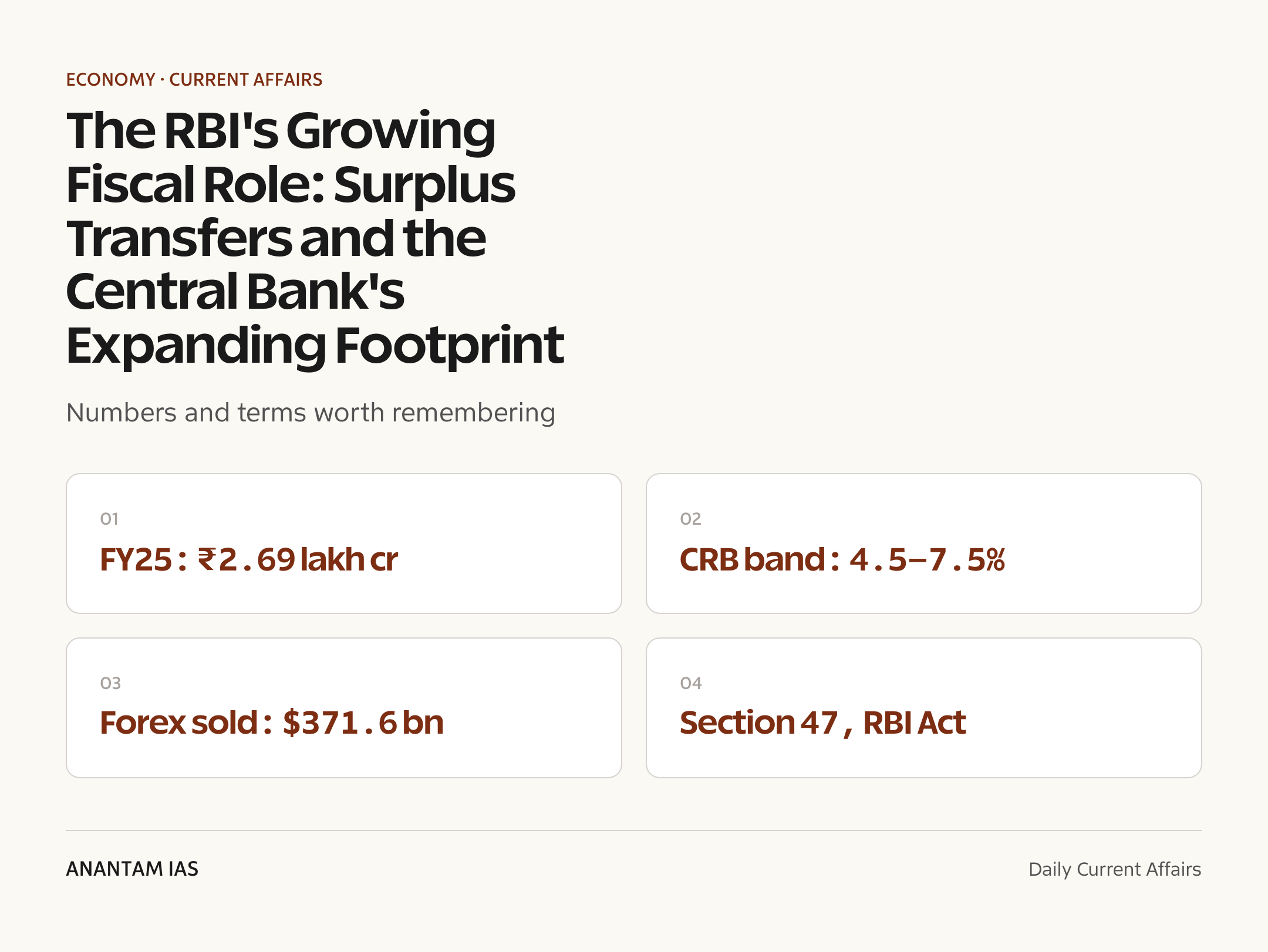
The Reserve Bank of India’s annual transfer of surplus to the Union government has grown so large that it now shapes the Centre’s fiscal arithmetic, not just its balance sheet. For 2024-25 the RBI paid a record ₹2.69 lakh crore dividend, a jump of roughly 27% over the ₹2.1 lakh crore transferred for 2023-24 and far above the ₹87,416 crore of 2022-23. The Hindu, examining this trend, argued that the central bank’s footprint has steadily crept into fiscal territory.
Behind the headline number sit deeper questions. The surplus is governed by Section 47 of the RBI Act, 1934 and sized by the Economic Capital Framework (ECF), whose revision in May 2025 widened the risk-buffer band the bank must hold. Alongside dividends, the RBI’s open market operations, foreign-exchange interventions and special liquidity windows carry quasi-fiscal consequences — reviving an old debate about the line between monetary and fiscal policy and the independence of the central bank.
- For FY 2024-25 the RBI’s Central Board approved a record surplus transfer of ₹2.69 lakh crore to the government — about a 27% rise over FY24.
- The payout was sized under a revised Economic Capital Framework adopted by the Central Board on 15 May 2025 at its 616th meeting, chaired by Governor Sanjay Malhotra.
- The Contingent Risk Buffer (CRB) band was widened from the earlier 5.5%–6.5% to 4.5%–7.5% of the balance sheet; the board set the CRB at the upper bound of 7.5%.
- A large slice of the surplus came from forex operations — the RBI sold about $371.6 billion of foreign currency in FY25 to steady the rupee, more than double the prior year, generating valuation and trading gains.
- The scale of transfers, plus the RBI’s bond purchases and liquidity tools, has sharpened the debate on the monetary-fiscal boundary and central-bank independence.
The development matters in the context of:
- A central bank’s surplus is what remains after meeting expenses and setting aside provisions and reserves; the residual passes to the owner — in India, the Union government.
- The ECF, recommended by the Bimal Jalan Committee (2018) and adopted in August 2019, is the methodology that decides how much risk provisioning the RBI keeps and how much surplus it distributes.
- anantamias has separately covered the FY25 dividend announcement; this note treats the broader analytical question of how the RBI’s role has expanded into fiscal space.
UPSC Relevance
Prelims Relevance
- Section 47 of the RBI Act, 1934 mandates that the RBI’s surplus, after provisions, be paid to the Central government.
- The Economic Capital Framework (ECF) governs risk provisioning and surplus distribution; it was recommended by the Bimal Jalan Committee (2018) and adopted in August 2019.
- The Contingent Risk Buffer (CRB) is a provision against monetary, financial and operational risks; the original band was 5.5%–6.5%, revised in May 2025 to 4.5%–7.5% of the balance sheet.
- For FY 2024-25 the surplus transfer was a record ₹2.69 lakh crore; FY24 was ₹2.1 lakh crore and FY23 was ₹87,416 crore.
- The RBI’s income comes mainly from interest on domestic and foreign securities, gains on forex operations and seigniorage from currency issue.
- Open Market Operations (OMOs) are RBI purchases or sales of government securities to manage rupee liquidity; large-scale bond buying can indirectly support government borrowing.
- Direct monetisation of the deficit — the RBI printing money to fund the government — was effectively ended by the 1997 agreement that phased out ad hoc treasury bills and is fenced by the FRBM Act, 2003.
- The surplus is approved by the RBI Central Board; the financial year for these accounts now aligns with the government’s April–March year.
- Forex and gold revaluation gains are unrealised and held in revaluation accounts, not counted as distributable income unless realised through actual sales.
Mains Relevance
GS Paper 3
- Examine how the size and composition of RBI surplus transfers affect the Union government’s fiscal deficit and borrowing programme, and the risks of fiscal dependence on the central bank.
- Discuss the quasi-fiscal dimension of the RBI’s operations — OMOs, forex intervention and special liquidity windows — and the rationale of the Economic Capital Framework in balancing buffers against payouts.
GS Paper 2
- Evaluate the case for central-bank independence in India and how large, growing surplus transfers and the monetary-fiscal interface test the autonomy of the RBI vis-a-vis the executive.
Essay
- Where money policy ends and the budget begins — the eroding boundary between the central bank and the treasury.
- Independence with accountability: can an institution that funds the state also discipline it?
Background and Context
How the RBI earns and what it transfers
The surplus is a by-product of how a central bank holds its assets, not a profit motive.
- The RBI earns interest on its holdings of government securities (domestic) and foreign sovereign bonds, plus returns on deposits and gold.
- It also books gains from forex operations — buying and selling dollars to manage rupee volatility — and earns seigniorage, the difference between the face value of currency and its production cost.
- From this income it deducts expenditure (printing costs, agency charges, staff) and transfers to reserves and the Contingent Risk Buffer.
- Whatever remains is the distributable surplus, paid to the Centre under Section 47 of the RBI Act, 1934 — there is no separate tax; the central bank’s residual is the government’s revenue.
- For a refresher on the institution’s wider mandate, see our note on the Reserve Bank of India.
The Economic Capital Framework and the Jalan Committee
How much the RBI keeps versus distributes is decided by a formal framework, not discretion alone.
- After a 2018 standoff between the RBI and the Finance Ministry over how much reserve the bank should hold, a six-member committee under former Governor Bimal Jalan was set up to review economic capital.
- Its Economic Capital Framework, adopted in August 2019, splits the RBI’s economic capital into a realised-equity component (the CRB) and a revaluation-balances component (unrealised gains on forex and gold).
- The framework defined the Contingent Risk Buffer (CRB) band at 5.5%–6.5% of the balance sheet; any realised equity above the band could be transferred as surplus.
- In May 2025 the board adopted a revised ECF, widening the CRB band to 4.5%–7.5% and setting the actual buffer at 7.5% given the macroeconomic environment.
- The framework is meant to depoliticise the transfer decision — anchoring it to a rule rather than year-to-year bargaining between the bank and the government.
When dividends become fiscal arithmetic
Surplus transfers have grown large enough to influence the Union Budget’s deficit maths.
- The ₹2.69 lakh crore FY25 payout exceeded the dividend the government had budgeted, easing pressure on the fiscal deficit and the borrowing calendar.
- Such transfers are non-tax revenue — a windfall that can fund spending or trim market borrowing, but one that is volatile and tied to global rates and the rupee.
- A large slice of the FY25 surplus traced to forex sales of about $371.6 billion, more than double the prior year, which realised valuation gains as the rupee was defended.
- Reliance on a buoyant central-bank dividend can mask underlying fiscal slippage and is hard to repeat if forex gains or interest income fall.
- Read more on the wider picture in our explainer on the fiscal deficit.
Quasi-fiscal operations and the monetary-fiscal boundary
Beyond dividends, several RBI tools carry fiscal-like consequences that blur the policy line.
- Open Market Operations (OMOs) — RBI purchases of government bonds to inject liquidity — lower yields and indirectly ease the cost of government borrowing, even when the aim is purely monetary.
- Forex intervention to manage the rupee builds or runs down reserves and creates revaluation gains or losses that feed into the surplus.
- Special liquidity windows, sectoral refinancing and crisis facilities can allocate credit in ways that resemble fiscal choices.
- Direct monetisation of the deficit — the RBI printing money to fund the Centre — was largely ended after the 1997 supplemental agreement phased out ad hoc treasury bills, and is constrained by the FRBM Act, 2003; but bond buying and forex operations keep the boundary porous.
- The Hindu’s argument is that the cumulative effect of these instruments expands the RBI’s fiscal footprint well beyond its dividend cheque.
The independence question
A central bank that funds the state and steadies its bond market must guard its autonomy.
- Central-bank independence rests on insulating monetary decisions from short-term political and fiscal pressures — a credibility anchor for inflation control.
- Large, growing transfers create an incentive for the executive to view the RBI as a revenue source, risking pressure to under-provision or distribute more.
- The ECF, by tying transfers to a rule and a buffer range, is a safeguard — but a wide band still leaves the buffer level to board judgement.
- Independence is not absence of accountability: the RBI answers to Parliament, publishes accounts and operates the inflation-targeting framework agreed with the government.
- The balance, as commentators note, lies in transparent, rule-based surplus decisions and clear separation between liquidity management and deficit financing.
Way Forward
Rule-based, transparent transfers
- Disclose the ECF computation and CRB rationale each year so the surplus is seen as rule-driven, not negotiated.
- Communicate the volatility of forex-linked income so the Budget does not over-rely on a buoyant dividend.
Guard the monetary-fiscal line
- Keep OMOs and liquidity tools transparently anchored to monetary objectives, not to financing the deficit.
- Preserve the post-1997 firewall against direct monetisation and respect FRBM discipline on the fiscal side.
Strengthen the RBI’s institutional autonomy with clear board processes, fixed tenures and published minutes, so independence rests on rules rather than personalities.
Conclusion
The RBI’s surplus has grown from a routine accounting residual into a number that moves the Union Budget. Behind it sits a deliberate architecture — Section 47, the Economic Capital Framework and the Contingent Risk Buffer — designed to balance financial safety against the government’s claim on the bank’s earnings. The May 2025 revision and the record ₹2.69 lakh crore transfer show that architecture in action.
The harder challenge is conceptual. As OMOs, forex intervention and large dividends pull the central bank deeper into fiscal territory, the line between managing money and funding the state grows fainter. Keeping that line visible — through rule-based transfers, transparency and a firewall against deficit financing — is what will protect both the credibility of monetary policy and the independence of the institution behind it.
UPSC Practice Questions
Prelims MCQ 1
With reference to the RBI’s surplus transfer to the government, consider the following statements:
- The transfer of the RBI’s surplus to the Central government is mandated by Section 47 of the RBI Act, 1934.
- The Economic Capital Framework governing this transfer was recommended by the Bimal Jalan Committee.
- The surplus is paid to the government only after Parliament passes a separate appropriation bill.
How many of the above statements are correct?
(a) Only one (b) Only two (c) All three (d) None
Answer: (b) Only two
Explanation:
Statements 1 and 2 are correct — Section 47 of the RBI Act, 1934 requires the surplus to be paid to the Centre, and the Economic Capital Framework was recommended by the Bimal Jalan Committee (2018) and adopted in 2019. Statement 3 is wrong: the transfer is approved by the RBI’s Central Board, not contingent on a separate appropriation bill.
Prelims MCQ 2
The Contingent Risk Buffer (CRB) of the Reserve Bank of India is best described as:
(a) A statutory cash reserve that commercial banks keep with the RBI (b) A provision the RBI holds against monetary, financial and operational risks, sized as a band of its balance sheet (c) A fund earmarked exclusively for recapitalising public sector banks (d) The portion of foreign-exchange reserves pledged to the IMF
Answer: (b) A provision the RBI holds against monetary, financial and operational risks, sized as a band of its balance sheet
Explanation:
Under the Economic Capital Framework, the CRB is the realised-equity buffer the RBI maintains against monetary, financial and operational risks. Its band was 5.5%–6.5% of the balance sheet and was revised in May 2025 to 4.5%–7.5%, with the buffer set at 7.5%. It is unrelated to the Cash Reserve Ratio kept by commercial banks.
UPSC Mains Questions
- The Reserve Bank of India’s surplus transfers have grown large enough to shape the Union government’s fiscal arithmetic. Examine the role of the Economic Capital Framework and the Contingent Risk Buffer in sizing these transfers, and the risks of fiscal dependence on the central bank. (250 words)
- “The boundary between monetary and fiscal policy is becoming harder to draw.” In the light of the RBI’s open market operations, forex interventions and dividend transfers, discuss the challenges to central-bank independence in India. (250 words)
Source: The Hindu.
Frequently Asked Questions
Why does the RBI transfer a surplus to the government?
The RBI is owned by the Union government, so its income left over after expenses, provisions and reserves — the surplus — belongs to the Centre. Section 47 of the RBI Act, 1934 requires this residual to be paid to the government. It is non-tax revenue, not a profit dividend in the corporate sense.
What is the Economic Capital Framework (ECF)?
The ECF is the methodology that decides how much risk provisioning the RBI keeps and how much surplus it can distribute. Recommended by the Bimal Jalan Committee and adopted in August 2019, it splits economic capital into a realised-equity buffer (the CRB) and unrealised revaluation balances on forex and gold. It was revised in May 2025.
What is the Contingent Risk Buffer and what was changed in 2025?
The Contingent Risk Buffer (CRB) is the realised-equity provision the RBI holds against monetary, financial and operational risks. Its band was 5.5%–6.5% of the balance sheet. In May 2025 the revised ECF widened the band to 4.5%–7.5%, and the board set the buffer at the upper bound of 7.5%.
How big was the FY 2024-25 surplus transfer?
For 2024-25 the RBI transferred a record ₹2.69 lakh crore to the Central government — roughly 27% more than the ₹2.1 lakh crore of 2023-24 and far above the ₹87,416 crore of 2022-23. A large share came from forex operations, with the RBI selling about $371.6 billion to steady the rupee.
What does ‘quasi-fiscal’ mean for a central bank?
Quasi-fiscal operations are central-bank actions that resemble government spending or taxation. RBI bond purchases (OMOs) ease the cost of government borrowing, forex intervention reshapes reserves, and special liquidity windows allocate credit. These have budget-like effects even when the stated aim is monetary, blurring the monetary-fiscal boundary.
Why does this raise central-bank independence concerns?
Independence shields monetary decisions from short-term fiscal and political pressure, anchoring inflation credibility. When transfers grow large, the government may treat the RBI as a revenue source and push for higher payouts or lower buffers. Rule-based transfers under the ECF and a firewall against deficit financing are the safeguards.
Source: https://anantamias.com/current-affairs/rbi-growing-fiscal-role/
Glacial Lakes Expand in Arunachal: Tawang’s GLOF Risk and Sanhapo Lake
Why in News?
A satellite-based study has found that four of five high-risk glacial lakes in the Mago Chu basin of Tawang district, Arunachal Pradesh, expanded between 2016 and June 2026. The Hindu reported that the geospatial intelligence firm Suhora Technologies used high-resolution multi-sensor imagery to compare five lakes that the National Disaster Management Authority (NDMA) had already classified as potentially dangerous, tracking changes in their spatial extent.
The standout case is Sanhapo Lake, flagged as the top Glacial Lake Outburst Flood (GLOF) priority. Its surface area grew from about 55.87 hectares in 2016 to 87.02 hectares in 2026, reaching roughly 88.81 hectares by 15 June 2026. Sitting in a fragile, high-altitude Eastern Himalaya zone near the Bhutan and China borders, the basin’s growing lakes link Himalayan climate change with downstream hydropower and settlement risk.
- Four of five NDMA-flagged high-risk lakes in the Mago Chu basin, Tawang, expanded over 2016 to June 2026.
- Sanhapo Lake grew from about 55.87 ha (2016) to 87.02 ha (2026), and roughly 88.81 ha by 15 June 2026.
- Study by Suhora Technologies, a geospatial intelligence firm, using satellite imagery from 2016 to June 2026.
- Expanding lakes are mostly dammed by unstable ice and loose moraine, making them more hazardous as they fill.
- Lake growth alone does not mean an imminent flood, but it raises long-term GLOF exposure for downstream villages and projects.
The development matters in the context of:
- The Eastern Himalaya is warming and its glaciers are retreating, feeding meltwater into moraine-dammed lakes that can burst suddenly.
- NDMA has identified 189 high-risk glacial lakes across the Indian Himalayas for mitigation, with many in Arunachal Pradesh, Sikkim, Uttarakhand and Himachal Pradesh.
- Recent Himalayan disasters such as the South Lhonak Lake GLOF in Sikkim (October 2023) and the Chamoli flood (February 2021) exposed the threat to dams and habitations.
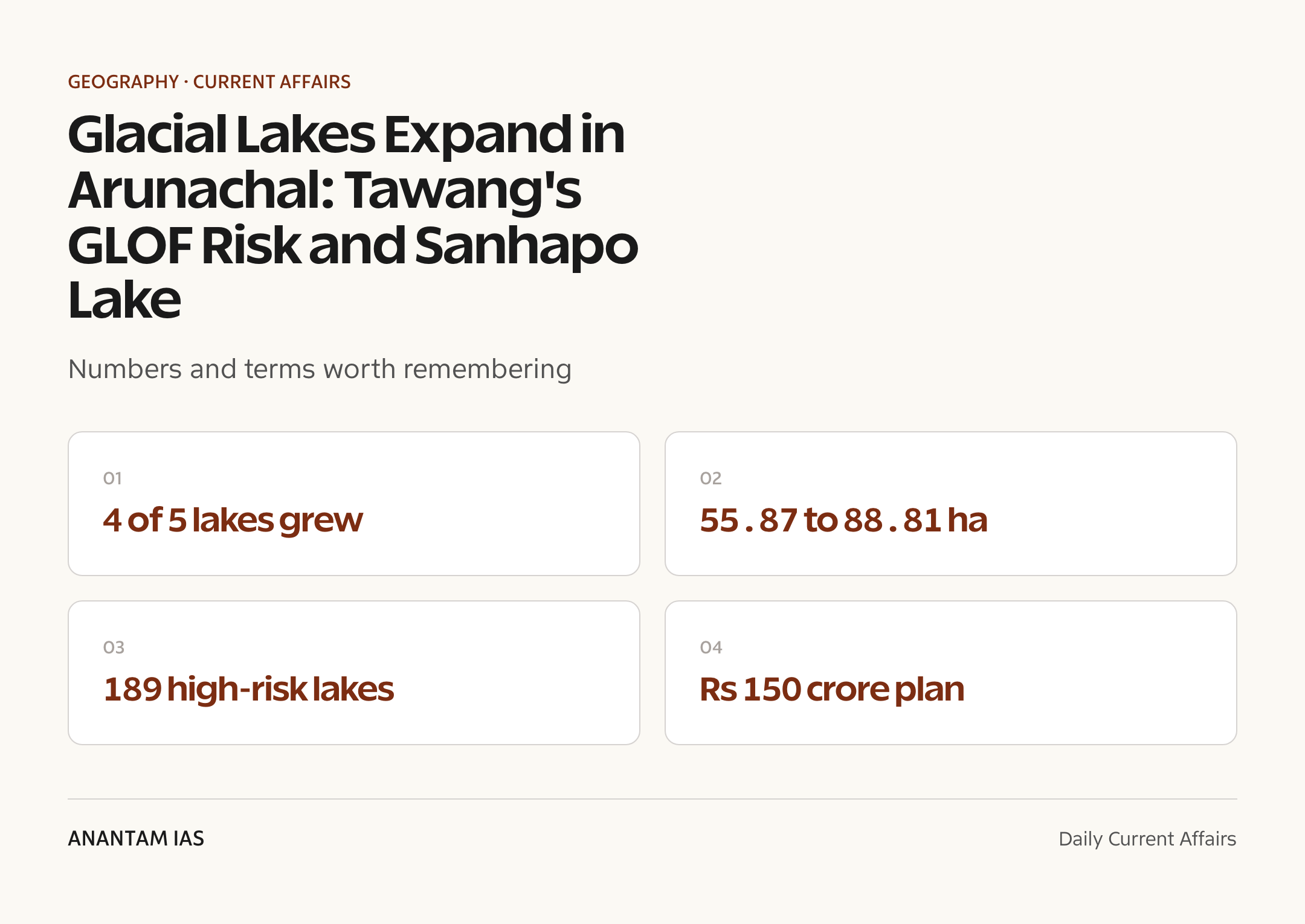
UPSC Relevance
Prelims Relevance
- GLOF = Glacial Lake Outburst Flood; a sudden release of water from a glacial lake when its natural dam fails.
- Moraine-dammed lakes are held back by glacial debris (loose rock and sediment); they are more failure-prone than bedrock-dammed lakes.
- Mago Chu basin lies in Tawang district, Arunachal Pradesh, in the India-Bhutan-China transboundary belt of the Eastern Himalaya.
- Sanhapo Lake is the top GLOF-priority lake flagged in the 2016-2026 Tawang study.
- NDMA, set up under the Disaster Management Act, 2005, is the apex body chaired by the Prime Minister.
- The National GLOF Risk Mitigation Programme was approved in 2024 with about Rs 150 crore for Himachal Pradesh, Uttarakhand, Sikkim and Arunachal Pradesh.
- NDMA has shortlisted 189 high-risk glacial lakes out of nearly 7,500 lakes in the Indian Himalayas for mitigation.
- The South Lhonak Lake GLOF (Sikkim, October 2023) destroyed the Teesta-III (Chungthang) hydropower dam.
- Common GLOF triggers: ice or rock avalanches, landslides into the lake, intense rainfall, and dam-wall seepage or piping.
Mains Relevance
GS Paper 1
- Physical geography of the Eastern Himalaya: glacier retreat, moraine-dammed lake formation, and the geomorphology that makes high-altitude basins hazard-prone.
- Impact of climate change on Himalayan cryosphere and the geographical distribution of glacial lakes across Indian Himalayan states.
GS Paper 3
- Disaster management: GLOF risk assessment, early-warning systems, the NDMA framework and the National GLOF Risk Mitigation Programme.
- Trade-off between Himalayan hydropower expansion and cascading-disaster risk to dams, downstream settlements and critical infrastructure.
Essay
- When the mountains melt: climate change, the Himalayan cryosphere and the limits of human preparedness.
- Development in fragile zones: balancing energy needs against the rising cost of disasters.
Background and Context
What a GLOF is and how it forms
A GLOF is a flash flood born when the natural dam holding back a glacial lake gives way.
- As a glacier retreats, meltwater pools behind the loose ridge of debris it left behind, forming a moraine-dammed lake.
- These dams are made of unstable ice and sediment, so they can fail from seepage, piping, overtopping or slope collapse.
- A sudden trigger, such as an ice or rock avalanche or landslide plunging into the lake, sends a surge wave over the dam.
- The result is a fast, sediment-laden flood that can travel far downstream and scour valleys within minutes to hours.
- Lake growth raises the stored water volume, so an expanding lake carries a larger potential flood if its dam ever breaches.

The Tawang study and Sanhapo Lake
The new findings track five flagged lakes in one Eastern Himalayan basin over a decade.
- Suhora Technologies compared five NDMA-listed high-risk lakes in the Mago Chu basin using satellite imagery from 2016 to June 2026.
- Four of the five lakes expanded over the period, signalling sustained meltwater input from a warming basin.
- Sanhapo Lake showed the clearest growth, from about 55.87 ha (2016) to 87.02 ha (2026) and around 88.81 ha by 15 June 2026.
- The study cautions that expansion by itself does not confirm an imminent burst, but it does raise long-term exposure.
- It strengthens the case for continuous monitoring rather than one-off surveys in fast-changing high-altitude lakes.
Eastern Himalaya geography and warming
Tawang sits in a sensitive, high, border-zone stretch of the Himalaya.
- The Mago Chu basin lies in Tawang district near the Bhutan and China borders, in the India-Bhutan transboundary belt.
- The Eastern Himalaya holds a dense cluster of glaciers and glacial lakes feeding rivers such as the Tawang Chu and Mago Chu.
- Rising temperatures are retreating glaciers and enlarging meltwater lakes across the region, a pattern seen Himalaya-wide.
- Steep slopes, high seismicity and heavy monsoon rain make the basin prone to landslides that can trigger lake bursts.
- Remote terrain and thin road links make rescue, monitoring and early warning especially hard at altitude.
Past Indian GLOF events
Recent disasters show how quickly a glacial lake failure becomes a downstream catastrophe.
- South Lhonak Lake, Sikkim (October 2023): a moraine-dam breach sent a flood down the Teesta, wrecking the Teesta-III dam and killing scores of people.
- Chamoli, Uttarakhand (February 2021): a rock-and-ice avalanche triggered a flash flood that destroyed the Tapovan-Vishnugad and Rishiganga projects.
- Both events struck hydropower infrastructure first, showing the concentration of risk at dams.
- They exposed gaps in early warning, monitoring and cascading-hazard planning in Himalayan valleys.
- These cases pushed governments to treat GLOF as a distinct, high-priority disaster category.
NDMA guidelines and the national programme
India now has a dedicated policy and funding track for glacial-lake risk.
- NDMA, the apex body under the Disaster Management Act, 2005, issued GLOF guidelines covering lake mapping, risk classification and mitigation.
- The National GLOF Risk Mitigation Programme, approved in 2024 with about Rs 150 crore, targets Himachal Pradesh, Uttarakhand, Sikkim and Arunachal Pradesh.
- NDMA has shortlisted 189 high-risk lakes from nearly 7,500 Himalayan glacial lakes for ground-truthing and treatment.
- Planned measures include automated weather and water-level stations, early-warning systems, bathymetry, and lake-lowering to cut stored volume.
- Several Arunachal lakes, including those in Tawang, sit on the priority list for these interventions.
Way Forward
Continuous monitoring and early warning
- Install automated water-level and weather sensors on Sanhapo and other priority lakes, linked to last-mile community alerts.
- Combine satellite tracking with periodic bathymetric and ground surveys so lake changes are caught early.
Engineer down the hazard
- Where feasible, reduce stored volume through controlled lake-lowering or siphoning on the most dangerous lakes.
- Strengthen moraine dams and downstream defences for the highest-exposure villages and hydropower sites.
Plan development around the risk
- Run rigorous GLOF-exposure assessments before clearing new Himalayan hydropower and infrastructure projects.
- Build transboundary data-sharing with Bhutan and the wider region for early warning across the India-Bhutan basin.
Conclusion
The Tawang findings turn a slow, almost invisible process, glaciers melting and lakes swelling, into a concrete planning problem. Sanhapo Lake’s steady growth is a reminder that the Eastern Himalaya’s hazard map is being redrawn by climate change, well before any flood actually arrives.
The answer is not panic but preparedness: dense monitoring, working early-warning systems, lake-lowering where needed, and honest risk assessment before the next dam or settlement is built downstream. India’s GLOF programme gives the framework; the test is whether it reaches remote, high-altitude basins in time.
UPSC Practice Questions
Prelims MCQ 1
With reference to Glacial Lake Outburst Floods (GLOFs), consider the following statements:
- GLOFs occur when the natural dam containing a glacial lake fails, releasing water suddenly.
- Moraine-dammed lakes are generally more prone to such failures than bedrock-dammed lakes.
- An ice or rock avalanche falling into a glacial lake can act as a trigger for a GLOF.
How many of the above statements are correct?
(a) Only one (b) Only two (c) All three (d) None
Answer: (c) All three
Explanation:
All three are correct. A GLOF is the sudden release of water when a glacial lake’s dam fails. Lakes held back by loose glacial debris (moraine) are more failure-prone than those dammed by solid bedrock. An ice or rock avalanche, or a landslide, plunging into the lake can generate a surge wave that overtops or breaches the dam, triggering the flood.
Prelims MCQ 2
Consider the following statements about glacial-lake risk management in India:
- The 2026 study flagged Sanhapo Lake in the Mago Chu basin of Tawang district as a top GLOF priority.
- The National Disaster Management Authority is the apex body constituted under the Disaster Management Act, 2005.
- The 2023 GLOF in Sikkim originated from South Lhonak Lake and damaged the Teesta-III hydropower project.
How many of the above statements are correct?
(a) Only one (b) Only two (c) All three (d) None
Answer: (c) All three
Explanation:
All three are correct. The satellite study identified Sanhapo Lake in Tawang’s Mago Chu basin as the top GLOF priority among the lakes examined. The NDMA was set up under the Disaster Management Act, 2005, and is chaired by the Prime Minister. The October 2023 Sikkim GLOF originated from South Lhonak Lake and destroyed the Teesta-III (Chungthang) dam downstream.
UPSC Mains Questions
- Explain how glacial retreat in the Eastern Himalaya leads to the formation and expansion of moraine-dammed lakes, and analyse why basins such as Mago Chu in Tawang are especially vulnerable to Glacial Lake Outburst Floods.
- Recent GLOF disasters have repeatedly struck Himalayan hydropower projects first. Critically examine India’s GLOF risk-mitigation framework and suggest measures to reconcile hydropower development with disaster resilience in the Himalayas.
Source: The Hindu.
Frequently Asked Questions
What is a Glacial Lake Outburst Flood (GLOF)?
A GLOF is a sudden flood caused when the natural dam holding back a glacial lake fails, releasing a large volume of water downstream. The dam is often loose glacial debris (moraine) or unstable ice, and failure can be triggered by avalanches, landslides into the lake, overtopping or seepage, producing a fast, destructive surge.
What did the 2026 Tawang glacial-lake study find?
A satellite-based study by the firm Suhora Technologies found that four of five NDMA-flagged high-risk glacial lakes in the Mago Chu basin of Tawang district, Arunachal Pradesh, expanded between 2016 and June 2026. Sanhapo Lake stood out, growing from about 55.87 hectares in 2016 to roughly 88.81 hectares by 15 June 2026.
Why is Sanhapo Lake a concern?
Sanhapo Lake, in Tawang’s Mago Chu basin, has been flagged by NDMA as potentially dangerous and is the top GLOF priority in the study. Its steady expansion means it now stores more water, so a future dam failure could send a larger flood toward downstream villages and hydropower projects, even though growth alone does not signal an imminent burst.
Where is the Mago Chu basin and why is it vulnerable?
The Mago Chu basin lies in Tawang district of Arunachal Pradesh, in the Eastern Himalaya near the Bhutan and China borders. Warming temperatures are retreating its glaciers and enlarging meltwater lakes, while steep slopes, high seismicity and heavy monsoon rain make the basin prone to landslides that can trigger lake bursts.
Which past GLOF events have hit India?
The most recent major event was the South Lhonak Lake GLOF in Sikkim in October 2023, which breached its moraine dam, flooded the Teesta and destroyed the Teesta-III dam. Earlier, the February 2021 Chamoli disaster in Uttarakhand, a rock-and-ice avalanche-driven flood, wrecked the Tapovan-Vishnugad and Rishiganga projects.
What is India doing to manage GLOF risk?
NDMA has issued GLOF guidelines and runs the National GLOF Risk Mitigation Programme, approved in 2024 with about Rs 150 crore for Himachal Pradesh, Uttarakhand, Sikkim and Arunachal Pradesh. It has shortlisted 189 high-risk lakes from nearly 7,500 Himalayan glacial lakes for steps such as automated monitoring, early-warning systems and lake-lowering.
Source: https://anantamias.com/current-affairs/glacial-lakes-expansion-arunachal-glof/