Why in News?
A satellite-based study has found that four of five high-risk glacial lakes in the Mago Chu basin of Tawang district, Arunachal Pradesh, expanded between 2016 and June 2026. The Hindu reported that the geospatial intelligence firm Suhora Technologies used high-resolution multi-sensor imagery to compare five lakes that the National Disaster Management Authority (NDMA) had already classified as potentially dangerous, tracking changes in their spatial extent.
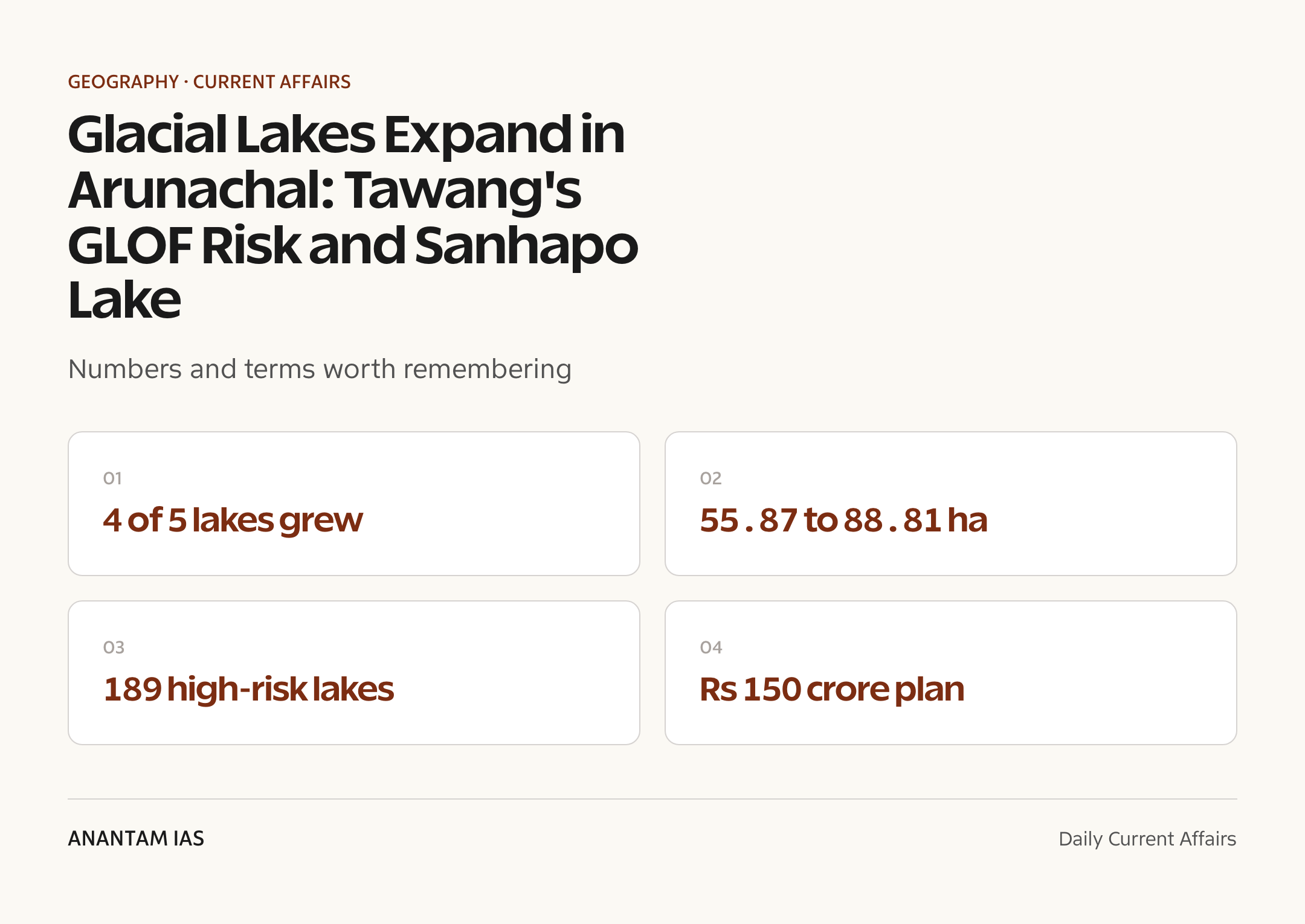
The standout case is Sanhapo Lake, flagged as the top Glacial Lake Outburst Flood (GLOF) priority. Its surface area grew from about 55.87 hectares in 2016 to 87.02 hectares in 2026, reaching roughly 88.81 hectares by 15 June 2026. Sitting in a fragile, high-altitude Eastern Himalaya zone near the Bhutan and China borders, the basin’s growing lakes link Himalayan climate change with downstream hydropower and settlement risk.
- Four of five NDMA-flagged high-risk lakes in the Mago Chu basin, Tawang, expanded over 2016 to June 2026.
- Sanhapo Lake grew from about 55.87 ha (2016) to 87.02 ha (2026), and roughly 88.81 ha by 15 June 2026.
- Study by Suhora Technologies, a geospatial intelligence firm, using satellite imagery from 2016 to June 2026.
- Expanding lakes are mostly dammed by unstable ice and loose moraine, making them more hazardous as they fill.
- Lake growth alone does not mean an imminent flood, but it raises long-term GLOF exposure for downstream villages and projects.
The development matters in the context of:
- The Eastern Himalaya is warming and its glaciers are retreating, feeding meltwater into moraine-dammed lakes that can burst suddenly.
- NDMA has identified 189 high-risk glacial lakes across the Indian Himalayas for mitigation, with many in Arunachal Pradesh, Sikkim, Uttarakhand and Himachal Pradesh.
- Recent Himalayan disasters such as the South Lhonak Lake GLOF in Sikkim (October 2023) and the Chamoli flood (February 2021) exposed the threat to dams and habitations.
UPSC Relevance
Prelims Relevance
- GLOF = Glacial Lake Outburst Flood; a sudden release of water from a glacial lake when its natural dam fails.
- Moraine-dammed lakes are held back by glacial debris (loose rock and sediment); they are more failure-prone than bedrock-dammed lakes.
- Mago Chu basin lies in Tawang district, Arunachal Pradesh, in the India-Bhutan-China transboundary belt of the Eastern Himalaya.
- Sanhapo Lake is the top GLOF-priority lake flagged in the 2016-2026 Tawang study.
- NDMA, set up under the Disaster Management Act, 2005, is the apex body chaired by the Prime Minister.
- The National GLOF Risk Mitigation Programme was approved in 2024 with about Rs 150 crore for Himachal Pradesh, Uttarakhand, Sikkim and Arunachal Pradesh.
- NDMA has shortlisted 189 high-risk glacial lakes out of nearly 7,500 lakes in the Indian Himalayas for mitigation.
- The South Lhonak Lake GLOF (Sikkim, October 2023) destroyed the Teesta-III (Chungthang) hydropower dam.
- Common GLOF triggers: ice or rock avalanches, landslides into the lake, intense rainfall, and dam-wall seepage or piping.
Mains Relevance
GS Paper 1
- Physical geography of the Eastern Himalaya: glacier retreat, moraine-dammed lake formation, and the geomorphology that makes high-altitude basins hazard-prone.
- Impact of climate change on Himalayan cryosphere and the geographical distribution of glacial lakes across Indian Himalayan states.
GS Paper 3
- Disaster management: GLOF risk assessment, early-warning systems, the NDMA framework and the National GLOF Risk Mitigation Programme.
- Trade-off between Himalayan hydropower expansion and cascading-disaster risk to dams, downstream settlements and critical infrastructure.
Essay
- When the mountains melt: climate change, the Himalayan cryosphere and the limits of human preparedness.
- Development in fragile zones: balancing energy needs against the rising cost of disasters.
Background and Context
What a GLOF is and how it forms
A GLOF is a flash flood born when the natural dam holding back a glacial lake gives way.
- As a glacier retreats, meltwater pools behind the loose ridge of debris it left behind, forming a moraine-dammed lake.
- These dams are made of unstable ice and sediment, so they can fail from seepage, piping, overtopping or slope collapse.
- A sudden trigger, such as an ice or rock avalanche or landslide plunging into the lake, sends a surge wave over the dam.
- The result is a fast, sediment-laden flood that can travel far downstream and scour valleys within minutes to hours.
- Lake growth raises the stored water volume, so an expanding lake carries a larger potential flood if its dam ever breaches.
The Tawang study and Sanhapo Lake
The new findings track five flagged lakes in one Eastern Himalayan basin over a decade.
- Suhora Technologies compared five NDMA-listed high-risk lakes in the Mago Chu basin using satellite imagery from 2016 to June 2026.
- Four of the five lakes expanded over the period, signalling sustained meltwater input from a warming basin.
- Sanhapo Lake showed the clearest growth, from about 55.87 ha (2016) to 87.02 ha (2026) and around 88.81 ha by 15 June 2026.
- The study cautions that expansion by itself does not confirm an imminent burst, but it does raise long-term exposure.
- It strengthens the case for continuous monitoring rather than one-off surveys in fast-changing high-altitude lakes.
Eastern Himalaya geography and warming
Tawang sits in a sensitive, high, border-zone stretch of the Himalaya.
- The Mago Chu basin lies in Tawang district near the Bhutan and China borders, in the India-Bhutan transboundary belt.
- The Eastern Himalaya holds a dense cluster of glaciers and glacial lakes feeding rivers such as the Tawang Chu and Mago Chu.
- Rising temperatures are retreating glaciers and enlarging meltwater lakes across the region, a pattern seen Himalaya-wide.
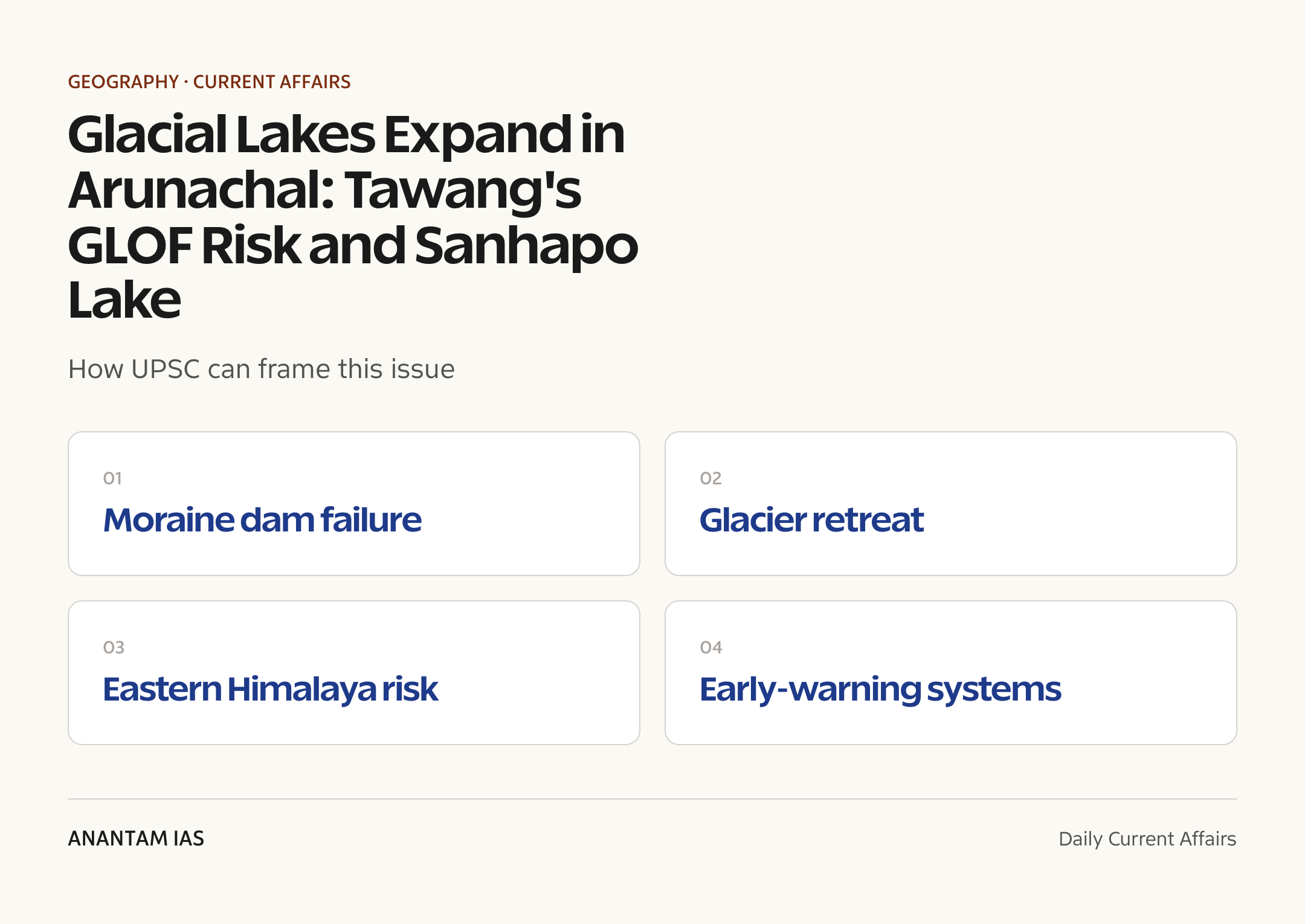
- Steep slopes, high seismicity and heavy monsoon rain make the basin prone to landslides that can trigger lake bursts.
- Remote terrain and thin road links make rescue, monitoring and early warning especially hard at altitude.
Past Indian GLOF events
Recent disasters show how quickly a glacial lake failure becomes a downstream catastrophe.
- South Lhonak Lake, Sikkim (October 2023): a moraine-dam breach sent a flood down the Teesta, wrecking the Teesta-III dam and killing scores of people.
- Chamoli, Uttarakhand (February 2021): a rock-and-ice avalanche triggered a flash flood that destroyed the Tapovan-Vishnugad and Rishiganga projects.
- Both events struck hydropower infrastructure first, showing the concentration of risk at dams.
- They exposed gaps in early warning, monitoring and cascading-hazard planning in Himalayan valleys.
- These cases pushed governments to treat GLOF as a distinct, high-priority disaster category.
NDMA guidelines and the national programme
India now has a dedicated policy and funding track for glacial-lake risk.
- NDMA, the apex body under the Disaster Management Act, 2005, issued GLOF guidelines covering lake mapping, risk classification and mitigation.
- The National GLOF Risk Mitigation Programme, approved in 2024 with about Rs 150 crore, targets Himachal Pradesh, Uttarakhand, Sikkim and Arunachal Pradesh.
- NDMA has shortlisted 189 high-risk lakes from nearly 7,500 Himalayan glacial lakes for ground-truthing and treatment.
- Planned measures include automated weather and water-level stations, early-warning systems, bathymetry, and lake-lowering to cut stored volume.
- Several Arunachal lakes, including those in Tawang, sit on the priority list for these interventions.
Way Forward
Continuous monitoring and early warning
- Install automated water-level and weather sensors on Sanhapo and other priority lakes, linked to last-mile community alerts.
- Combine satellite tracking with periodic bathymetric and ground surveys so lake changes are caught early.
Engineer down the hazard
- Where feasible, reduce stored volume through controlled lake-lowering or siphoning on the most dangerous lakes.
- Strengthen moraine dams and downstream defences for the highest-exposure villages and hydropower sites.
Plan development around the risk
- Run rigorous GLOF-exposure assessments before clearing new Himalayan hydropower and infrastructure projects.
- Build transboundary data-sharing with Bhutan and the wider region for early warning across the India-Bhutan basin.
Conclusion
The Tawang findings turn a slow, almost invisible process, glaciers melting and lakes swelling, into a concrete planning problem. Sanhapo Lake’s steady growth is a reminder that the Eastern Himalaya’s hazard map is being redrawn by climate change, well before any flood actually arrives.
The answer is not panic but preparedness: dense monitoring, working early-warning systems, lake-lowering where needed, and honest risk assessment before the next dam or settlement is built downstream. India’s GLOF programme gives the framework; the test is whether it reaches remote, high-altitude basins in time.
UPSC Practice Questions
Prelims MCQ 1
With reference to Glacial Lake Outburst Floods (GLOFs), consider the following statements:
- GLOFs occur when the natural dam containing a glacial lake fails, releasing water suddenly.
- Moraine-dammed lakes are generally more prone to such failures than bedrock-dammed lakes.
- An ice or rock avalanche falling into a glacial lake can act as a trigger for a GLOF.
How many of the above statements are correct?
(a) Only one (b) Only two (c) All three (d) None
Answer: (c) All three
Explanation:
All three are correct. A GLOF is the sudden release of water when a glacial lake’s dam fails. Lakes held back by loose glacial debris (moraine) are more failure-prone than those dammed by solid bedrock. An ice or rock avalanche, or a landslide, plunging into the lake can generate a surge wave that overtops or breaches the dam, triggering the flood.
Prelims MCQ 2
Consider the following statements about glacial-lake risk management in India:
- The 2026 study flagged Sanhapo Lake in the Mago Chu basin of Tawang district as a top GLOF priority.
- The National Disaster Management Authority is the apex body constituted under the Disaster Management Act, 2005.
- The 2023 GLOF in Sikkim originated from South Lhonak Lake and damaged the Teesta-III hydropower project.
How many of the above statements are correct?
(a) Only one (b) Only two (c) All three (d) None
Answer: (c) All three
Explanation:
All three are correct. The satellite study identified Sanhapo Lake in Tawang’s Mago Chu basin as the top GLOF priority among the lakes examined. The NDMA was set up under the Disaster Management Act, 2005, and is chaired by the Prime Minister. The October 2023 Sikkim GLOF originated from South Lhonak Lake and destroyed the Teesta-III (Chungthang) dam downstream.
UPSC Mains Questions
- Explain how glacial retreat in the Eastern Himalaya leads to the formation and expansion of moraine-dammed lakes, and analyse why basins such as Mago Chu in Tawang are especially vulnerable to Glacial Lake Outburst Floods.
- Recent GLOF disasters have repeatedly struck Himalayan hydropower projects first. Critically examine India’s GLOF risk-mitigation framework and suggest measures to reconcile hydropower development with disaster resilience in the Himalayas.
Source: The Hindu.
Frequently Asked Questions
What is a Glacial Lake Outburst Flood (GLOF)?
A GLOF is a sudden flood caused when the natural dam holding back a glacial lake fails, releasing a large volume of water downstream. The dam is often loose glacial debris (moraine) or unstable ice, and failure can be triggered by avalanches, landslides into the lake, overtopping or seepage, producing a fast, destructive surge.
What did the 2026 Tawang glacial-lake study find?
A satellite-based study by the firm Suhora Technologies found that four of five NDMA-flagged high-risk glacial lakes in the Mago Chu basin of Tawang district, Arunachal Pradesh, expanded between 2016 and June 2026. Sanhapo Lake stood out, growing from about 55.87 hectares in 2016 to roughly 88.81 hectares by 15 June 2026.
Why is Sanhapo Lake a concern?
Sanhapo Lake, in Tawang’s Mago Chu basin, has been flagged by NDMA as potentially dangerous and is the top GLOF priority in the study. Its steady expansion means it now stores more water, so a future dam failure could send a larger flood toward downstream villages and hydropower projects, even though growth alone does not signal an imminent burst.
Where is the Mago Chu basin and why is it vulnerable?
The Mago Chu basin lies in Tawang district of Arunachal Pradesh, in the Eastern Himalaya near the Bhutan and China borders. Warming temperatures are retreating its glaciers and enlarging meltwater lakes, while steep slopes, high seismicity and heavy monsoon rain make the basin prone to landslides that can trigger lake bursts.
Which past GLOF events have hit India?
The most recent major event was the South Lhonak Lake GLOF in Sikkim in October 2023, which breached its moraine dam, flooded the Teesta and destroyed the Teesta-III dam. Earlier, the February 2021 Chamoli disaster in Uttarakhand, a rock-and-ice avalanche-driven flood, wrecked the Tapovan-Vishnugad and Rishiganga projects.
What is India doing to manage GLOF risk?
NDMA has issued GLOF guidelines and runs the National GLOF Risk Mitigation Programme, approved in 2024 with about Rs 150 crore for Himachal Pradesh, Uttarakhand, Sikkim and Arunachal Pradesh. It has shortlisted 189 high-risk lakes from nearly 7,500 Himalayan glacial lakes for steps such as automated monitoring, early-warning systems and lake-lowering.
Tell Google you want more of this.
Add Anantam IAS as a preferred sourceOne tap, and this site shows up more often in your own Top Stories, AI Overviews and AI Mode. Remove it any time.