Why in News?
Solar and wind have become India’s cheapest source of new electricity, with utility-scale solar tariffs discovered as low as around Rs 2.5/kWh and solar-plus-storage bids near Rs 2.70/kWh. The Hindu reported that the country is adding record renewable capacity, yet a large share of that cheap power cannot reach consumers because the transmission grid has not kept pace. The mismatch has turned the cost of clean electrons from a generation problem into a wires-and-storage problem.
Industry trackers cited in the reporting estimate that more than 50 GW of commissioned or near-ready renewable capacity is stranded for want of grid connectivity, while curtailment is rising on the inter-state network. The Indian Express explained that the deeper challenge is the speed of electrification needed for climate goals, where grids, storage and flexible supply must scale together rather than generation alone.
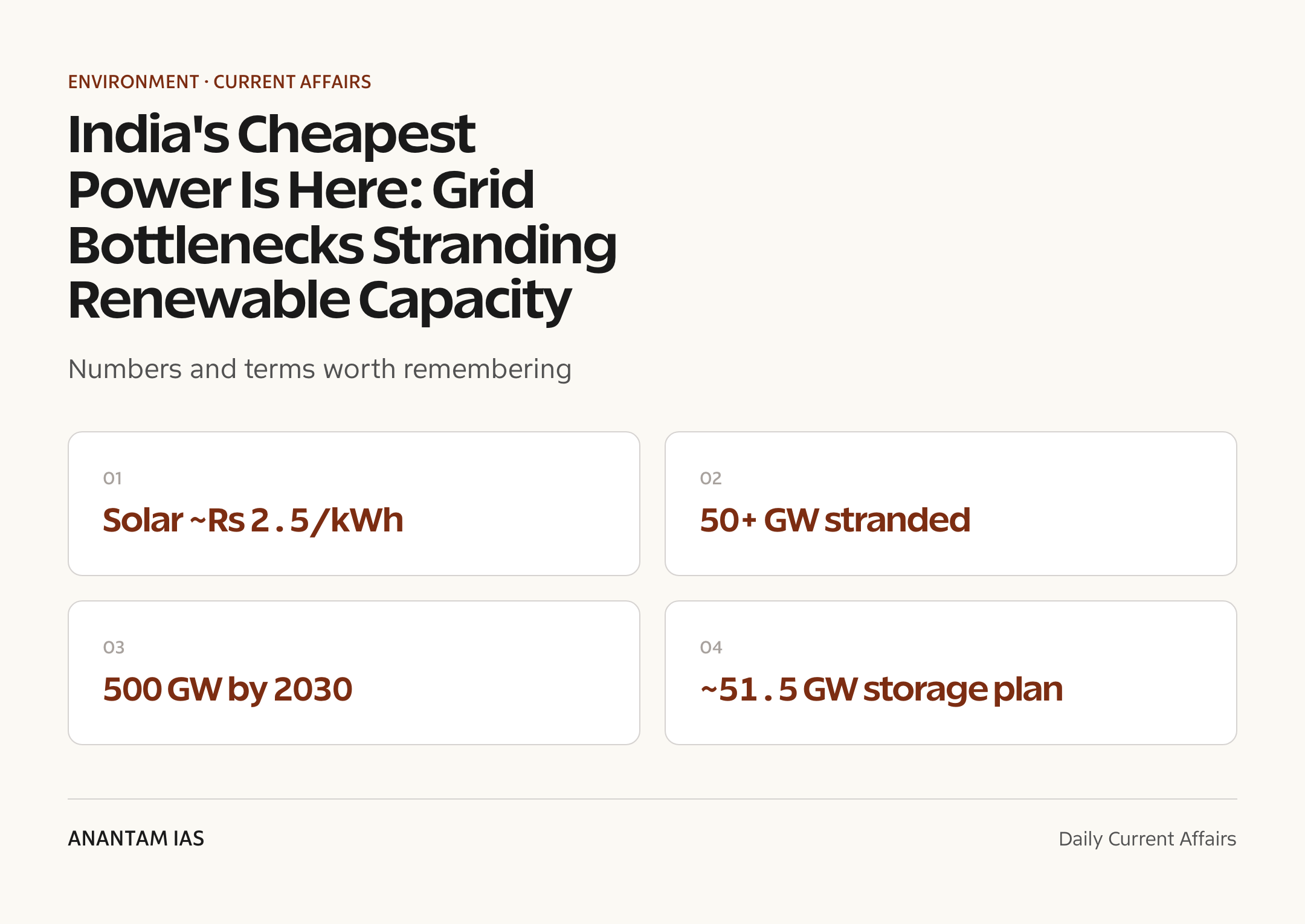
- Lowest utility-scale solar tariffs of around Rs 2.48-2.50/kWh make solar the cheapest new power in India; solar-plus-storage bids touch Rs 2.70/kWh.
- Estimated 50+ GW of renewable capacity stranded or delayed by inadequate transmission and connectivity.
- Around 300 GWh of renewable generation was curtailed in Q1 2026, with transmission constraints causing the bulk of inter-state curtailment.
- Record build-out continues: solar reached about 150 GW and wind about 56 GW of installed capacity by early 2026.
- Transmission projects lag at roughly 80% of targets, with about one in four schemes delayed, Rajasthan a key chokepoint.
The development matters in the context of:
- Renewable tariffs have collapsed over a decade, but grid evacuation, storage and flexible thermal operation now decide how much of that cheap power is usable.
- The Central Electricity Authority (CEA) transmission plan maps the wires needed to integrate over 500 GW non-fossil capacity by 2030, including about 51.5 GW of battery storage.
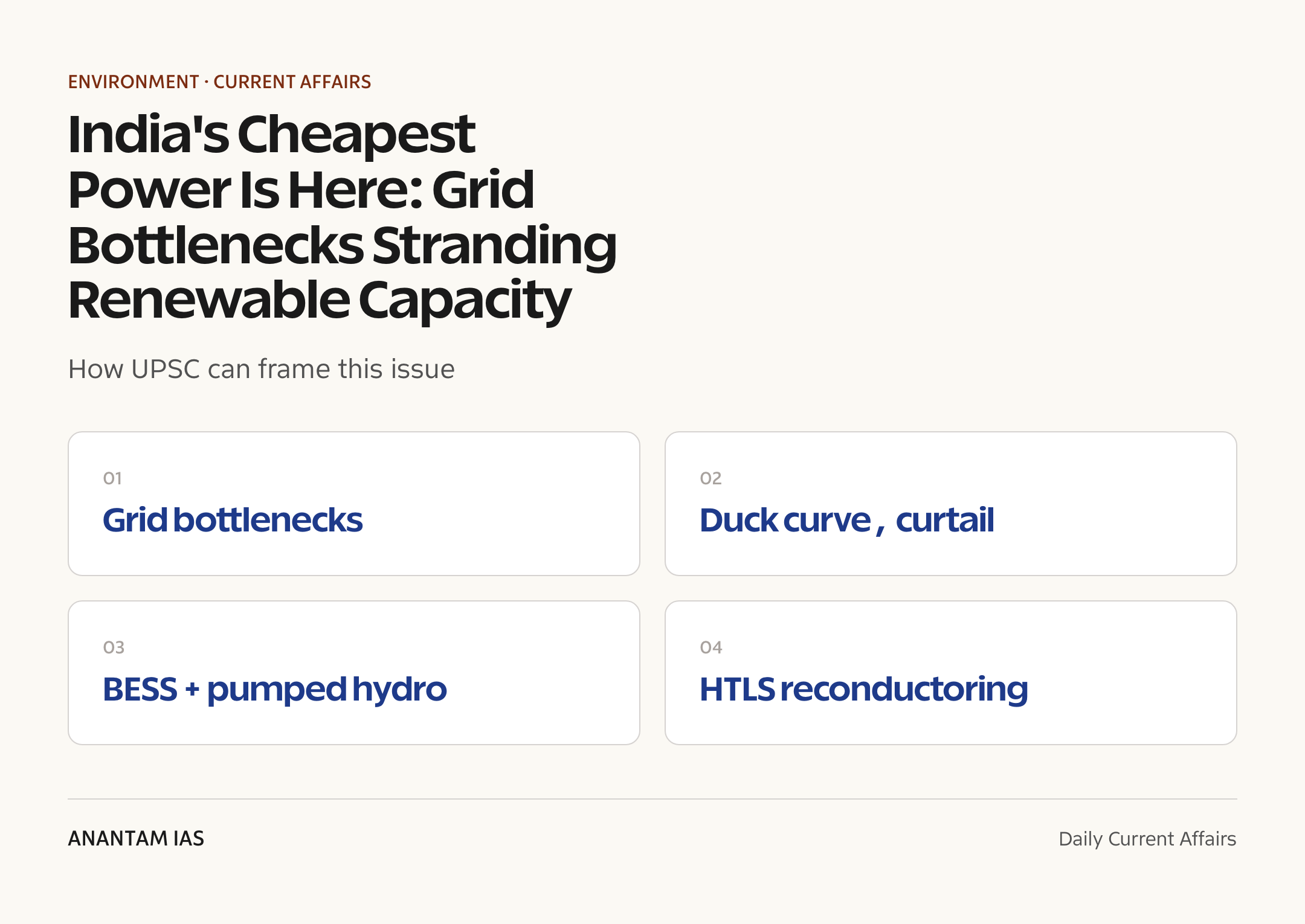
- Variable solar and wind create a duck curve and force thermal back-down, raising curtailment and grid-stability concerns during peak solar hours.
UPSC Relevance
Prelims Relevance
- Green Energy Corridors (GEC): Ministry of Power scheme for intra- and inter-state transmission to evacuate renewable power.
- ISTS charge waiver: inter-state transmission charge waiver for solar, wind, hydro pumped storage and BESS, being phased out for projects commissioned after a cut-off (extended to June 2028 for storage/PSP categories).
- CEA prepared the transmission plan for integrating over 500 GW non-fossil capacity by 2030, envisaging about 51.5 GW of battery storage.
- Grid-India (formerly POSOCO) is the National Load Despatch Centre operator handling real-time grid balancing and curtailment instructions.
- BESS (Battery Energy Storage Systems) and pumped hydro storage (PSP) are the two main grid-scale storage routes for time-shifting solar.
- HTLS conductors (High Temperature Low Sag) enable reconductoring to raise line capacity within the existing right of way.
- Must-run status: solar and wind enjoy priority dispatch, so balancing falls on backing down thermal plants.
- Targets: 500 GW non-fossil by 2030; 50% installed capacity from non-fossil sources; long-term net-zero by 2070.
- Duck curve: the demand-net-of-solar curve that dips at midday and ramps sharply in the evening.
Mains Relevance
GS Paper 3
- Energy security and transition: why cost-competitive renewables alone do not deliver clean power without transmission and storage co-investment.
- Grid integration of variable renewables: must-run dispatch, curtailment, the duck curve and flexible thermal operation as system-level challenges.
GS Paper 3
- Infrastructure and investment: Green Energy Corridors, ISTS waivers, reconductoring with HTLS and Right-of-Way constraints as bottlenecks to a 500 GW grid.
Essay
- Cheap energy is only as useful as the wires and storage that carry it: India’s clean-power paradox.
- Building the grid of tomorrow today: infrastructure as the silent enabler of the energy transition.
Background and Context
Why Solar and Wind Became the Cheapest Power
A decade of falling costs has made variable renewables India’s cheapest new generation.
- Utility-scale solar tariffs discovered as low as around Rs 2.48-2.50/kWh, among the lowest globally, driven by cheap modules, low capital costs and competitive reverse auctions.
- India recorded its highest-ever annual wind addition of about 6 GW in FY2026, alongside solar crossing roughly 150 GW installed.
- Solar-plus-storage bids near Rs 2.70/kWh show round-the-clock clean power is becoming commercially viable.
- The challenge has shifted from making clean power cheap to delivering and timing it through the grid.
The Grid Bottleneck: Stranded and Curtailed Power
Generation has outrun the wires, stranding capacity and forcing curtailment.
- Industry estimates put over 50 GW of renewable capacity stranded or delayed for want of evacuation infrastructure.
- Around 300 GWh of renewable energy was curtailed in Q1 2026, with transmission constraints responsible for the larger share of inter-state curtailment.
- Rajasthan, a solar-wind hub, sees gigawatts stuck behind connectivity delays and ecological clearances on transmission corridors.
- Transmission build-out lags at roughly 80% of targets, with about a quarter of schemes delayed, stranding investor capital and raising project risk.
Intermittency, Must-Run and the Duck Curve
Variable supply with priority dispatch strains a coal-heavy grid.
- Solar and wind have must-run status, so grid operators balance the system mainly by backing down thermal plants.
- Midday solar floods the grid and evening ramps are steep, producing a deepening duck curve that thermal flexibility must absorb.
- On peak-solar days in 2025, operators backed thermal down to roughly 58% and curtailed close to 10 GW of solar to hold grid frequency.
- The CEA has flagged the need to lower minimum thermal load toward 40% to accommodate renewables and restrict curtailment.
The Policy and Institutional Architecture
Schemes, waivers and operators shape how renewables reach the grid.
- Green Energy Corridors (Ministry of Power) build intra- and inter-state lines for renewable evacuation from resource-rich states.
- The ISTS charge waiver made inter-state renewable power cheaper; its phase-down (with extended windows for storage and pumped hydro) is reshaping project economics.
- CEA authored the transmission roadmap for over 500 GW non-fossil by 2030, including about 51.5 GW of battery storage.
- Grid-India (formerly POSOCO) operates the National Load Despatch Centre, issuing real-time dispatch and curtailment instructions to keep the grid stable.
Storage and Grid Upgrades: The Route to 1,000 GW
Storage, smarter lines and corridor reuse unlock cheap power at scale.
- BESS and pumped hydro storage time-shift midday solar into the evening peak, flattening the duck curve; viability-gap funding and waivers support both.
- Reconductoring with HTLS conductors can raise existing line capacity by roughly 25-50% within the same right of way, sidestepping land acquisition.
- Right-of-Way (RoW) disputes, forest clearances and land costs are core reasons new corridors lag, making corridor reuse attractive.
- Reaching a longer-term ~1,000 GW renewables pathway needs synchronised investment in wires, storage and digital grid management, not generation alone.
Way Forward
Build wires ahead of generation
- Sequence transmission corridors and substations to lead, not lag, renewable capacity additions so commissioned projects are not stranded.
- Use HTLS reconductoring and dynamic line rating to raise capacity fast within existing rights of way while new lines are built.
Scale storage and flexible supply
- Accelerate BESS and pumped hydro through viability-gap funding and storage obligations to absorb midday solar and serve the evening peak.
- Make the coal fleet two-shift and flexible down toward 40% minimum load to cut curtailment without threatening grid frequency.
Fix market and institutional signals
- Give clarity on the ISTS waiver glide path so storage and round-the-clock tenders stay bankable.
- Strengthen real-time markets and forecasting so Grid-India can dispatch and curtail efficiently, sharing flexibility across regions.
Conclusion
India has won the cost battle of the energy transition: solar and wind are now the cheapest electrons it can buy. But cheap power stuck behind an underbuilt grid is a paradox that strands capital, curtails clean generation and slows the march to 500 GW non-fossil by 2030.
The next decade is a grid-and-storage decade. Building corridors ahead of demand, reusing existing rights of way through reconductoring, and scaling batteries and pumped hydro will decide whether India’s cheapest power actually reaches its homes and factories.
UPSC Practice Questions
Prelims MCQ 1
With reference to the integration of renewable energy into India’s power grid, consider the following statements:
- Solar and wind generators in India enjoy must-run status, giving them priority dispatch.
- The Central Electricity Authority prepared the transmission plan for integrating over 500 GW of non-fossil capacity by 2030.
- Grid-India (formerly POSOCO) operates the National Load Despatch Centre for real-time grid balancing.
How many of the above statements are correct?
(a) Only one (b) Only two (c) All three (d) None
Answer: (c) All three
Explanation:
All three are correct. Solar and wind have must-run (priority dispatch) status; the CEA authored the transmission roadmap for over 500 GW non-fossil capacity by 2030 (including about 51.5 GW of battery storage); and Grid-India, the renamed POSOCO, runs the National Load Despatch Centre that issues real-time dispatch and curtailment instructions.
Prelims MCQ 2
Which of the following best explains why some commissioned renewable capacity in India remains ‘stranded’?
(a) Solar and wind tariffs have risen above thermal power tariffs (b) Transmission and grid-connectivity build-out has lagged behind generation additions (c) The Green Energy Corridors scheme has been discontinued (d) India has exhausted its solar and wind resource potential
Answer: (b) Transmission and grid-connectivity build-out has lagged behind generation additions
Explanation:
Stranded capacity arises because transmission lines and connectivity have not kept pace with rapid solar and wind additions, leaving over 50 GW unable to evacuate power. Tariffs have fallen, not risen; Green Energy Corridors continue; and India’s resource potential is far from exhausted.
UPSC Mains Questions
- India has achieved among the world’s lowest renewable tariffs, yet a significant share of clean capacity remains stranded. Examine why cost-competitiveness alone cannot deliver an energy transition, and discuss the role of transmission and storage. (250 words)
- Integrating variable renewables strains a coal-heavy grid through must-run dispatch, the duck curve and rising curtailment. Discuss the institutional and infrastructural measures needed to reach 500 GW non-fossil capacity by 2030. (250 words)
Sources: The Hindu and Indian Express Explained.
Frequently Asked Questions
Why is renewable power called India’s cheapest electricity?
Utility-scale solar tariffs in India have been discovered as low as around Rs 2.48-2.50 per unit, and solar-plus-storage near Rs 2.70, undercutting new thermal power. Falling module costs, low capital costs and competitive reverse auctions have made solar and wind the cheapest new generation the country can build.
What does it mean that renewable capacity is ‘stranded’?
Stranded capacity is solar or wind that is built or ready but cannot send power to consumers because transmission lines and grid connectivity are missing or delayed. Industry trackers estimate over 50 GW is stranded in India, locking up investment and forcing curtailment of otherwise cheap, clean power.
What is the duck curve and why does it matter?
The duck curve is the shape of electricity demand minus solar output: it dips at midday when solar floods the grid and ramps sharply in the evening as solar fades. It matters because the grid must back down thermal plants at noon and ramp them fast at dusk, raising curtailment and grid-stability risks.
What are Green Energy Corridors and the ISTS waiver?
Green Energy Corridors are a Ministry of Power scheme building intra- and inter-state transmission to evacuate renewable power from resource-rich states. The ISTS charge waiver lowered inter-state transmission charges for solar, wind, storage and pumped hydro; its phased withdrawal, with extended windows for storage categories, is reshaping project economics.
How can storage and reconductoring help unlock cheap power?
Battery storage (BESS) and pumped hydro shift surplus midday solar into the evening peak, flattening the duck curve and cutting curtailment. Reconductoring with HTLS conductors raises the capacity of existing lines by roughly 25-50% within the same right of way, adding capacity quickly without new land acquisition.
What is India’s renewable capacity target?
India aims for 500 GW of non-fossil installed capacity by 2030, with about half of total installed capacity from non-fossil sources and net-zero by 2070. The CEA’s transmission plan covers integrating over 500 GW, including roughly 51.5 GW of battery storage, with longer-term pathways pointing toward around 1,000 GW of renewables.
Tell Google you want more of this.
Add Anantam IAS as a preferred sourceOne tap, and this site shows up more often in your own Top Stories, AI Overviews and AI Mode. Remove it any time.