Daily Digest
UPSC · Civil Services Examination
Current Affairs · Friday, 24 October 2025
Current affairs curated and edited by Anantam IAS faculty — pulled from The Hindu, PIB, IDSA, Foreign Affairs and the ministries. Read, annotate, revise.
Old Rajinder Nagar · Delhi 110005 · anantamias.com
Wildlife Sanctuary Status

Context:
This directive comes after years of delay despite NGT (National Green Tribunal) recommendations in 2020 and growing ecological degradation due to mining activities. The Supreme Court of India has directed the Jharkhand government to notify the Saranda forests — a rich biodiversity hotspot on the Jharkhand–Odisha border — as a wildlife sanctuary.
UPSC Relevance:
Environment
UPSC PYQ:
Q. Which one of the following protected areas is wellknown for the conservation of a sub-species of the Indian swamp deer (Barasingha) that thrives well on hard ground and is exclusively graminivorous? (2020)
(a) Kanha National Park
(b) Manas National Park
(c) Mudumalai Wildlife Sanctuary
(d) Tal Chhapar Wildlife Sanctuary
Saranda Forest:
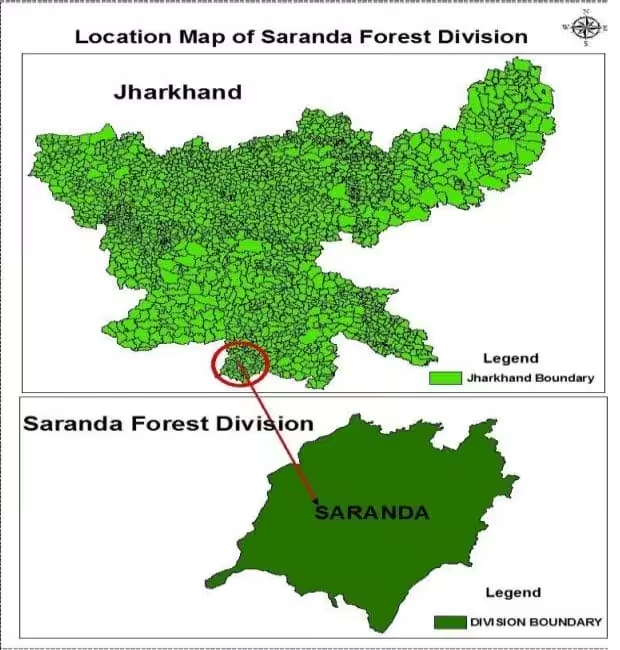
- The Saranda forests are home to India’s finest Sal (Shorea robusta) forests and cover an area of about 850 sq km in West Singhbhum district, Jharkhand.
- The forest has faced extensive degradation due to iron ore and manganese mining, which has fragmented habitats and impacted local wildlife such as elephants, leopards, and tigers.
What is Wildlife Sanctuary:
- Wildlife sanctuaries are designated havens for India’s diverse species and ecosystems. Legally protected under the Wildlife (Protection) Act of 1972, they protect habitats, manage populations, and combat threats.
- Each sanctuary is zoned for specific purposes: core areas untouched, buffer zones with controlled activities, and tourism zones for responsible exploration.
- These sanctuaries not only safeguard endangered species but also maintain biodiversity, preserve ecosystems, channelling their invaluable services and educate communities.
- A wildlife sanctuary may be a separately existing entity or stand within a national park. It may even be upgraded into a national park. Infact, many national parks in India were initially wildlife sanctuaries and upgraded later. Such as the Kaziranga National Park.
- Human activities are permissible inside these sanctuaries. People are allowed to graze cattle and collect forest produce. Settlements aren’t permitted but rights over land are granted to their rightful holders.
Each sanctuary adheres to a meticulous management plan, dividing its area into distinct zones:
● Core Zone : This undisturbed heartland prohibits human interference, safeguarding sensitive species.
● Buffer Zone: Controlled human activities like tribal settlements and sustainable resource utilization occur here.
● Tourism Zone: Responsible tourism activities like guided tours and nature trails are conducted here which is within the buffer zone itself and raise awareness and generate revenue.
Both the State and Central Governments can notify a wildlife sanctuary by issuing a notification, with the State Government being the primary authority for most cases. The Central Government can also declare a sanctuary if an area is leased or transferred to it by the State Government.
Under the Wildlife (Protection) Act, 1972, no alteration to the boundaries of a wildlife sanctuary can be made by a state government except on the recommendation of the National Board for Wild Life (NBWL).
Source: https://anantamias.com/current-affairs/wildlife-sanctuary-status/
Special Intensive Revision (SIR) of Electoral Rolls: Ensuring Electoral Integrity in India
Context: The Election Commission (EC) is all set to announce the schedule for a country-wide roll-out of the Special Intensive Revision (SIR) of electoral rolls at a press conference in the next few days. The first phase of the process will be implemented in more than 10 States and one Union Territory, including election-bound Assam, Tamil Nadu, Puducherry, Kerala, and West Bengal.
For prelims, master RP Act sections
What is SIR?
The Election Commission of India (ECI) is conducting Special Intensive Revision (SIR) of the electoral rolls to sanitize and upgrade voter lists. This will ensure that there are only genuine citizens in the lists and that errors such as duplication, registrations of deceased persons, and registrations of ineligible people are minimized. The SIR began as an experiment in Bihar ahead of the state’s Legislative Assembly elections in 2025. It is now a nationwide strategy that addresses issues that have existed for ages due to urbanisation, migration, and population change.
Constitutional and Legal Framework
The foundation of India’s electoral system lies in the Constitution and statutory laws, emphasizing universal adult suffrage while safeguarding against ineligible voting.
Key Constitutional Provisions
- Article 324: Vests the ECI with superintendence, direction, and control over elections, including preparation of electoral rolls.
- Article 326: Guarantees the right to vote to every citizen above 18 years, forming the bedrock of “one citizen, one vote.”
Statutory Framework: Representation of the People Act, 1950 (RP Act)
The RP Act operationalizes these provisions through a structured hierarchy of officials:
- Chief Electoral Officer (CEO): State-level oversight.
- District Election Officer (DEO): District-level implementation.
- Electoral Registration Officer (ERO) and Assistant EROs: Constituency-level preparation.
- Booth Level Officers (BLOs): Grassroots verification and updates.
| Section | Key Provision |
|---|---|
| Section 16 | Disqualifies non-citizens from enrollment. |
| Section 19 | Eligibility criteria: Age ≥18 on qualifying date (1st Jan/Apr/Jul/Oct); ordinarily resident in the constituency. |
| Section 20 | Defines “ordinarily resident” – habitual, permanent ties; exceptions for service personnel, NRIs (via Section 20A, added 2010), and constitutional functionaries. Temporary absence does not disqualify. |
| Section 21 | Authorizes summary revisions before elections and special revisions (like SIR) at ECI’s discretion, with recorded reasons. |
The Registration of Electors Rules, 1960 (RER) supplements this, mandating self-declaration (Rule 8) and appeals (Section 24, RP Act) to DEO (15 days) and CEO (30 days).
Prelims Tip: Remember, electoral rolls are prepared per assembly constituency, aggregated for Lok Sabha segments. NRIs vote at their passport address.
Evolution and Need for SIR
Electoral rolls have undergone periodic updates since 1950, but rapid changes—India’s population grew from 36 crore in 1951 to 140 crore in 2021—necessitated intensive measures. Summary revisions occur annually or pre-election, but SIR is a “from-scratch” overhaul under Section 21.
Why SIR Now?
- Demographic Pressures: Urbanization and migration led to 20+ years of unchecked additions/deletions in Bihar, risking duplicates (e.g., one person in multiple rolls) and ghost voters.
- Constitutional Mandate: ECI’s duty under Article 326 to exclude non-citizens and include all eligibles.
- Historical Precedent: Bihar’s last SIR was in 2003; nationwide efforts were sporadic until 2025.
The ECI’s June 24, 2025, order cited these as rationale, starting with Bihar (due for polls in November 2025) as a pilot.
Outcomes of Bihar SIR
The exercise achieved its core goals but sparked scrutiny over scale.
| Metric | Before SIR (June 24, 2025) | After SIR (Sept 30, 2025) | Change |
|---|---|---|---|
| Total Electors | 7.89 crore | 7.42 crore | -47 lakh net |
| Additions | – | 21.53 lakh (via Form 6) | +21.53 lakh |
| Deletions | – | 65 lakh total (incl. 3.66 lakh ineligible) | -65 lakh |
- Success Factors: High stakeholder involvement (1.6 lakh BLAs, media campaigns); digital-physical roll access.
- Challenges: Reports of errors (e.g., wrong photos, undeleted dead voters) in drafts; ~65 lakh deletions raised disenfranchisement fears, especially among migrants.
ECI hailed it as a “milestone,” but critics noted opaque deletion breakdowns.
Pros and Cons of SIR
| Pros | Cons |
|---|---|
| Accuracy Enhancement: Removed duplicates/ghosts, ensuring “clean” rolls for fair polls. | Voter Burden: Document demands herculean for poor/rural; ~3 crore post-2003 voters struggled. |
| Citizenship Safeguard: Excluded potential non-citizens, upholding Article 326. | Disenfranchisement Risk: Mass deletions (65 lakh) hit migrants; seen as “backdoor NRC.” |
| Transparency: Party involvement via BLAs minimized fraud. | Resource Strain: Tight timelines overburdened BLOs; errors like undeleted deceased persisted. |
| Inclusivity for New Voters: Added 21.53 lakh eligibles, boosting youth turnout. | Equity Issues: Excluded Aadhaar initially disadvantaged 80%+ Aadhaar-linked poor. |
| Long-Term Integrity: Pilot for pan-India, addressing migration-induced duplicates. | Political Bias Allegations: Timing pre-Bihar polls fueled tampering claims. |
Key Concerns: Migrants and Citizenship
Migrant Laborers
- Ordinarily Resident Test: Gauhati HC (Manmohan Singh, 1999) emphasized “habitual/permanent” ties. Seasonal migrants (e.g., construction workers) retain home-state rolls, as they return periodically.
- Impact: Strict enforcement could delete millions, disenfranchising them at work sites. Bihar SIR shared “permanently migrated” lists with parties, but many deletions affected returnees.
Citizenship Verification
- ECI’s Limits: Not a Home Ministry function; SIR’s parentage proofs mimic NRC, burdening voters without legal authority.
- Scale: Verifying 3 crore post-2003 entries in months was “gigantic,” per critics, leading to wrongful exclusions.
Judicial Scrutiny
The Association for Democratic Reforms (ADR) v. ECI (WP Civil 640/2025) challenged Bihar SIR as unconstitutional, alleging citizenship overreach and voter suppression.
- Key Hearings: July 2025 petition; SC interim (July 10) allowed flexible docs. October 7/16 hearings—Bench (Justices Surya Kant, Joymalya Bagchi) adjourned, trusting ECI’s “awareness of duty” but directing detailed deletion data. Prashant Bhushan highlighted 21 lakh inclusions vs. 3.66 lakh exclusions, booth-level changes.
- Status: Ongoing; next hearing pending.
Pan-India Rollout
Post-Bihar success, ECI announced phased SIR from November 2025:
- Phase 1 (>10 States): 2026 poll-bound—Assam, Kerala, Puducherry, Tamil Nadu, West Bengal; others like Uttar Pradesh, Maharashtra follow.
- Preparations: October 23 CEO meeting reviewed voter mapping, address standardization; TN prelims done.
- Rationale: Nationwide duplicates/migration; Bihar as template.
Way Forward and Reforms
Legislative Push: Parliament to clarify ECI’s citizenship role; explore e-voting for 15 crore migrants.
Timeline Extensions: Stretch phases; integrate AI for verification.
Inclusive Documents: Mandate Aadhaar/ration cards; relax for migrants via self-declaration.
Migrant Protections: Amend RP Act/RER for remote voting; Aadhaar-seeding to curb multi-rolls without deletions.
Safeguards: BLAs as watchdogs; transparent deletion audits.
Context: The Election Commission (EC) is all set to announce the schedule for a country-wide roll-out of the Special Intensive Revision (SIR) of electoral rolls at a press conference in the next few days. The first phase of the process will be implemented in more than 10 States and one Union Territory, including election-bound Assam, Tamil Nadu, Puducherry, Kerala, and West Bengal.For prelims, master RP Act sectionsWhat is SIR?The Election Commission of India (ECI) is conducting Special Intensive Revision (SIR) of the electoral rolls to sanitize and upgrade voter lists. This will ensure that there are only genuine citizens in the lists and that errors such as duplication, registrations of deceased persons, and registrations of ineligible people are minimized. The SIR began as an experiment in Bihar ahead of the state’s Legislative Assembly elections in 2025. It is now a nationwide strategy that addresses issues that have existed for ages due to urbanisation, migration, and population change.Constitutional and Legal FrameworkThe foundation of India’s electoral system lies in the Constitution and statutory laws, emphasizing universal adult suffrage while safeguarding against ineligible voting.Key Constitutional Provisions
- Article 324: Vests the ECI with superintendence, direction, and control over elections, including preparation of electoral rolls.
- Article 326: Guarantees the right to vote to every citizen above 18 years, forming the bedrock of “one citizen, one vote.”
- Chief Electoral Officer (CEO): State-level oversight.
- District Election Officer (DEO): District-level implementation.
- Electoral Registration Officer (ERO) and Assistant EROs: Constituency-level preparation.
- Booth Level Officers (BLOs): Grassroots verification and updates.
- Demographic Pressures: Urbanization and migration led to 20+ years of unchecked additions/deletions in Bihar, risking duplicates (e.g., one person in multiple rolls) and ghost voters.
- Constitutional Mandate: ECI’s duty under Article 326 to exclude non-citizens and include all eligibles.
- Historical Precedent: Bihar’s last SIR was in 2003; nationwide efforts were sporadic until 2025.
- Success Factors: High stakeholder involvement (1.6 lakh BLAs, media campaigns); digital-physical roll access.
- Challenges: Reports of errors (e.g., wrong photos, undeleted dead voters) in drafts; ~65 lakh deletions raised disenfranchisement fears, especially among migrants.
- Ordinarily Resident Test: Gauhati HC (Manmohan Singh, 1999) emphasized “habitual/permanent” ties. Seasonal migrants (e.g., construction workers) retain home-state rolls, as they return periodically.
- Impact: Strict enforcement could delete millions, disenfranchising them at work sites. Bihar SIR shared “permanently migrated” lists with parties, but many deletions affected returnees.
- ECI’s Limits: Not a Home Ministry function; SIR’s parentage proofs mimic NRC, burdening voters without legal authority.
- Scale: Verifying 3 crore post-2003 entries in months was “gigantic,” per critics, leading to wrongful exclusions.
- Key Hearings: July 2025 petition; SC interim (July 10) allowed flexible docs. October 7/16 hearings—Bench (Justices Surya Kant, Joymalya Bagchi) adjourned, trusting ECI’s “awareness of duty” but directing detailed deletion data. Prashant Bhushan highlighted 21 lakh inclusions vs. 3.66 lakh exclusions, booth-level changes.
- Status: Ongoing; next hearing pending.
- Phase 1 (>10 States): 2026 poll-bound—Assam, Kerala, Puducherry, Tamil Nadu, West Bengal; others like Uttar Pradesh, Maharashtra follow.
- Preparations: October 23 CEO meeting reviewed voter mapping, address standardization; TN prelims done.
- Rationale: Nationwide duplicates/migration; Bihar as template.
Timeline Extensions: Stretch phases; integrate AI for verification.
Inclusive Documents: Mandate Aadhaar/ration cards; relax for migrants via self-declaration.
Migrant Protections: Amend RP Act/RER for remote voting; Aadhaar-seeding to curb multi-rolls without deletions.
Safeguards: BLAs as watchdogs; transparent deletion audits.
Source: https://anantamias.com/current-affairs/hello-jeet-sir/