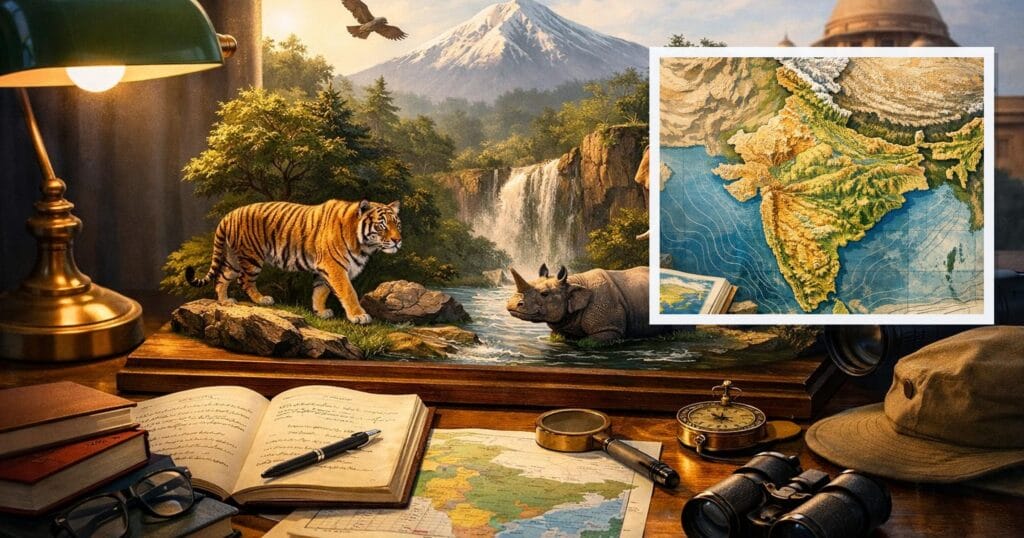
India has 106 national parks covering about 1.27% of the country's geographical area. But for UPSC, knowing the major ones — where they are, what they protect, and which schemes govern them — is what counts.
This guide gives you everything: the complete major parks table, Project Tiger, Project Elephant, biosphere reserves, and the legal framework under the Wildlife Protection Act, 1972.
Legal Framework: Wildlife Protection Act, 1972
Before the parks, understand the law. The Wildlife (Protection) Act, 1972 is the backbone of wildlife conservation in India. It classifies protected areas into:
| Category | Authority to Create | Hunting | Human Habitation |
|---|---|---|---|
| National Park | State Government | Prohibited | Not permitted |
| Wildlife Sanctuary | State Government | Regulated | May be permitted |
| Conservation Reserve | State Government | Regulated | Permitted |
| Community Reserve | State/Central Government | Regulated | Permitted |
| Tiger Reserve | NTCA (Central) | Prohibited | Core zone: none; Buffer: regulated |
Key distinction: A National Park has a stricter protection regime than a Wildlife Sanctuary. Grazing, private land holdings, and human settlement are not permitted in national parks. The boundaries of a national park cannot be altered except by a resolution of the State legislature.
2022 Amendment
The Wildlife (Protection) Amendment Act, 2022 added provisions for:
- Regulating trade in "scheduled specimens" under CITES
- More stringent penalties
- New categories for invasive species management
Related: Western Ghats: Biodiversity and Conservation
Major National Parks of India: Complete Table
| National Park | State | Area (km²) | Famous For |
|---|---|---|---|
| Jim Corbett National Park | Uttarakhand | 520 | Bengal Tiger, Elephants (oldest national park, est. 1936) |
| Kaziranga National Park | Assam | 430 | One-horned Rhinoceros, Royal Bengal Tiger |
| Ranthambore National Park | Rajasthan | 392 | Bengal Tiger |
| Bandhavgarh National Park | Madhya Pradesh | 449 | Bengal Tiger (highest density) |
| Kanha National Park | Madhya Pradesh | 940 | Bengal Tiger, Barasingha (Swamp Deer) |
| Pench National Park | Madhya Pradesh/Maharashtra | 758 | Bengal Tiger, Leopard |
| Tadoba Andhari National Park | Maharashtra | 625 | Bengal Tiger |
| Sundarbans National Park | West Bengal | 1,330 | Bengal Tiger, Saltwater Crocodile, Irrawaddy Dolphin |
| Gir National Park | Gujarat | 258 | Asiatic Lion (only wild population) |
| Periyar National Park | Kerala | 350 | Elephants, Tiger |
| Nagarhole National Park | Karnataka | 643 | Tiger, Elephant, Gaur |
| Bandipur National Park | Karnataka | 874 | Tiger, Elephant, Leopard |
| Mudumalai National Park | Tamil Nadu | 321 | Tiger, Elephant |
| Simlipal National Park | Odisha | 2,750 | Tiger, Elephant, Black Tiger (melanistic tigers reported) |
| Manas National Park | Assam | 500 | Golden Langur, Pygmy Hog, One-horned Rhino |
| Hemis National Park | Ladakh | 4,400 | Snow Leopard (largest national park in India) |
| Nanda Devi National Park | Uttarakhand | 630 | Snow Leopard, Himalayan Brown Bear |
| Valley of Flowers National Park | Uttarakhand | 87.5 | Alpine flowers, Himalayan fauna (UNESCO WHS) |
| Great Himalayan National Park | Himachal Pradesh | 754 | Snow Leopard, Western Tragopan (UNESCO WHS) |
| Blackbuck National Park | Gujarat | 34.08 | Blackbuck, Lesser Florican |
| Rajaji National Park | Uttarakhand | 820 | Elephants, Tiger |
| Dudhwa National Park | Uttar Pradesh | 490 | Tiger, One-horned Rhino, Swamp Deer |
| Valmiki National Park | Bihar | 335 | Tiger |
| Palamu National Park | Jharkhand | 226 | Tiger, Elephant |
| Namdapha National Park | Arunachal Pradesh | 1,985 | All four big cats (Tiger, Leopard, Snow Leopard, Clouded Leopard) |
| Dibru-Saikhowa National Park | Assam | 340 | Feral Horses, Gangetic River Dolphin |
| Orang National Park | Assam | 79 | One-horned Rhino, Tiger |
| Keibul Lamjao National Park | Manipur | 40 | Sangai (Manipur Brow-antlered Deer) — only floating national park |
| Khangchendzonga National Park | Sikkim | 1,784 | Snow Leopard, Red Panda (UNESCO Mixed WHS) |
| Silent Valley National Park | Kerala | 237 | Lion-tailed Macaque, Nilgiri Langur |
| Kudremukh National Park | Karnataka | 600 | Shola-grassland ecosystem |
| Eravikulam National Park | Kerala | 97 | Nilgiri Tahr |
Jim Corbett: India's First National Park
Jim Corbett National Park in Uttarakhand is the oldest national park in India, established in 1936 as Hailey National Park (renamed after hunter-turned-conservationist Jim Corbett in 1957). It was also India's first tiger reserve under Project Tiger (1973).
Located in the Nainital district, it lies in the foothills of the Himalayas along the Ramganga River. The park has a significant Bengal Tiger population and is one of the best places in India for tiger sightings.
Unique National Parks Worth Noting for UPSC
- Hemis National Park (Ladakh) — Largest national park in India (4,400 km²). Best place in the world to spot Snow Leopard in winter.
- Keibul Lamjao National Park (Manipur) — Only floating national park in the world. Located on Loktak Lake, it's home to the endangered Sangai (Manipur Brow-antlered Deer).
- Namdapha National Park (Arunachal Pradesh) — The only park in India (and possibly Asia) with all four big cat species: Tiger, Leopard, Snow Leopard, and Clouded Leopard.
- Gir National Park (Gujarat) — Only place in the world with wild Asiatic Lions.
- Sundarbans National Park (West Bengal) — Largest delta in the world, UNESCO World Heritage Site, Ramsar Wetland, and Biosphere Reserve. Home to swimming tigers.
- Valley of Flowers National Park (Uttarakhand) — UNESCO World Heritage Site; famous for its meadows of endemic alpine flowers.
Project Tiger
Project Tiger was launched in 1973 under Prime Minister Indira Gandhi. It was India's first major wildlife conservation programme and remains one of the most successful.
Key Facts
- Launched: April 1, 1973
- First tiger reserve: Jim Corbett, Uttarakhand
- Implementing body: National Tiger Conservation Authority (NTCA) — established under the Wildlife (Protection) Amendment Act, 2006
- Current number of tiger reserves: 55 (as of 2024)
Tiger Census
India conducts a tiger census every four years using camera traps and pug mark analysis.
| Year | Tiger Population |
|---|---|
| 1973 | ~1,827 |
| 2006 | 1,411 |
| 2010 | 1,706 |
| 2014 | 2,226 |
| 2018 | 2,967 |
| 2022 | 3,167 |
India now has more than 75% of the world's wild tiger population. The 2022 census confirmed India met its target of doubling tiger numbers from 2010 levels — four years ahead of the Tx2 goal (pledged at St. Petersburg in 2010).
Major Tiger Reserves
| Tiger Reserve | State | Key Feature |
|---|---|---|
| Jim Corbett | Uttarakhand | First tiger reserve |
| Ranthambore | Rajasthan | Most famous for tigers |
| Bandhavgarh | Madhya Pradesh | Highest tiger density |
| Kaziranga | Assam | Also home to rhinos |
| Sundarbans | West Bengal | Swimming tigers |
| Nagarhole | Karnataka | Coorg region, high density |
| Tadoba | Maharashtra | Accessible tiger reserve |
| Manas | Assam | UNESCO WHS, Golden Langur |
| Panna | Madhya Pradesh | Ken-Betwa link controversy |
| Mudumalai | Tamil Nadu | Nilgiri Biosphere Reserve |
Related: Western Ghats Biodiversity
Project Elephant
Project Elephant was launched in 1992 by the Ministry of Environment and Forests.
Key Facts
- Launched: 1992
- Current elephant reserves: 32 across 14 states
- India's elephant population: approximately 30,000 (60% of Asia's elephant population)
- Elephant Corridors: 101 identified elephant corridors in India
Elephant Reserves
Some important ones:
- Singhbhum Elephant Reserve (Jharkhand) — first elephant reserve
- Mysore Elephant Reserve (Karnataka) — largest by area
- Nilgiri Elephant Reserve (Tamil Nadu/Kerala/Karnataka) — part of Nilgiri Biosphere Reserve
- Garo Hills Elephant Reserve (Meghalaya)
- Shivalik Elephant Reserve (Uttarakhand/UP)
Human-Elephant Conflict
India loses approximately 400–500 people per year to elephant attacks, mostly in corridor states like Odisha, Assam, and West Bengal. The government has deployed Rapid Response Teams and elephant tracking systems.
Biosphere Reserves in India
A biosphere reserve is a UNESCO concept — it's a larger landscape with a core zone (strictly protected), a buffer zone, and a transition zone (with human activity).
India has 18 biosphere reserves, of which 12 are part of UNESCO’s World Network of Biosphere Reserves.
| Biosphere Reserve | State(s) | Notable For |
|---|---|---|
| Nilgiri | Tamil Nadu, Kerala, Karnataka | First Indian biosphere reserve (1986), largest in India |
| Gulf of Mannar | Tamil Nadu | Marine biosphere reserve, coral reefs |
| Sundarbans | West Bengal | Mangroves, Bengal Tiger |
| Nanda Devi | Uttarakhand | Himalayan flora-fauna |
| Nokrek | Meghalaya | Citrus gene pool, Red Panda |
| Manas | Assam | Assamese macaque, Golden Langur |
| Simlipal | Odisha | Melanistic tigers |
| Great Nicobar | Andaman & Nicobar Islands | Leatherback sea turtle, Nicobar Megapode |
| Pachmarhi | Madhya Pradesh | Satpura range |
| Agasthyamalai | Kerala/Tamil Nadu | Endemic plants, Kani tribe |
| Achanakmar-Amarkantak | MP/Chhattisgarh | Narmada source |
| Khangchendzonga | Sikkim | Snow Leopard, Red Panda |
| Panna | Madhya Pradesh | Ken-Betwa link controversy |
| Cold Desert | Himachal Pradesh | Snow Leopard, Trans-Himalayan species |
| Seshachalam | Andhra Pradesh | Red Sanders |
| Panchmarhi | Madhya Pradesh | Satpura Tiger Reserve |
| Dibru-Saikhowa | Assam | Feral horses |
| Kachchh | Gujarat | Flamingo, Rann ecology |
The Nilgiri Biosphere Reserve is the largest in India and was the first to be established (1986). It covers the Nilgiri Hills across Tamil Nadu, Kerala, and Karnataka and includes Mudumalai, Bandipur, Nagarhole, and Silent Valley national parks.
Ramsar Wetlands in India
Ramsar sites are wetlands of international importance designated under the Ramsar Convention (1971).
India has 85 Ramsar sites (as of 2024) — the most in Asia.
Key ones:
- Chilika Lake (Odisha) — largest coastal lagoon in India, first Ramsar site (1981)
- Keoladeo Ghana National Park (Rajasthan) — UNESCO WHS, wintering ground for Siberian Crane
- Wular Lake (J&K) — largest freshwater lake in India
- Loktak Lake (Manipur) — largest freshwater lake in Northeast India, floating phumdis
- Harike Wetland (Punjab) — largest wetland in North India
UNESCO World Heritage Sites: Natural Sites
India has 7 natural UNESCO World Heritage Sites:
- Kaziranga National Park (1985) — Assam
- Keoladeo National Park (1985) — Rajasthan
- Manas Wildlife Sanctuary (1985) — Assam
- Sundarbans National Park (1987) — West Bengal
- Nanda Devi and Valley of Flowers (1988, extended 2005) — Uttarakhand
- Western Ghats (2012) — Multiple states
- Great Himalayan National Park (2014) — Himachal Pradesh
- Khangchendzonga National Park (2016) — Sikkim (Mixed site — natural + cultural)
Recent Additions and Developments
- Simlipal Tiger Reserve (Odisha) — made national news in 2021 after sightings of melanistic (black) tigers, only confirmed population of this colour variant in the world
- Ramsar Sites expansion — India added 75 new Ramsar sites in 2021-22, taking the total past 75
- Orang National Park (Assam) — called "Mini Kaziranga"; became a tiger reserve in 2016
- Guru Ghasidas-Tamor Pingla Tiger Reserve — India's 53rd and 54th tiger reserves notified in 2021 in Chhattisgarh
- Veerangana Durgavati Tiger Reserve — 55th tiger reserve, Madhya Pradesh (2023)
Conservation Issues for UPSC Mains
Human-Wildlife Conflict
India's growing population has shrunk wildlife corridors. Key flashpoints:
- Elephant raids on crops in Assam, Odisha, West Bengal
- Tiger attacks near buffer zones of Sundarbans
- Leopard attacks near urban areas (Mumbai's Sanjay Gandhi National Park)
Eco-Sensitive Zones (ESZ)
The Supreme Court mandated ESZs around national parks and sanctuaries to create a buffer. Guidelines require a minimum 1 km ESZ, though many parks don't have this. The 2022 Supreme Court order on ESZs created controversy — it required no human habitation in ESZs, affecting millions. The court later moderated this position.
Forest Rights Act, 2006
The Scheduled Tribes and Other Traditional Forest Dwellers (Recognition of Forest Rights) Act, 2006 gives forest communities rights over land they've cultivated for generations. This sometimes conflicts with national park boundaries.
Frequently Asked Questions
Q1. How many national parks are there in India in 2026?
India has 106 national parks spread across all states and some Union Territories. They cover approximately 44,000 km², which is about 1.27% of India's total geographical area. Madhya Pradesh has the most national parks (10), followed by Andaman & Nicobar Islands (9) and Arunachal Pradesh (9).
Q2. What is the difference between a national park and a wildlife sanctuary?
A national park has stricter protection — no grazing, private land holdings, or human settlement are allowed inside. Its boundaries can only be changed by state legislature resolution. A wildlife sanctuary allows regulated grazing and may permit some human activities. Also, a national park requires no human consultation before notification, while a sanctuary requires certain procedures for settlement of rights.
Q3. Which national park has the highest tiger density?
Bandhavgarh National Park in Madhya Pradesh is generally considered to have the highest tiger density in India. The park has one of the best tiger sighting records in the country. Other high-density parks include Corbett, Ranthambore, and Nagarhole.
Q4. What is Project Tiger and when was it launched?
Project Tiger was launched on April 1, 1973 under Prime Minister Indira Gandhi, starting with 9 tiger reserves. It created a dedicated system of tiger reserves with core zones (fully protected) and buffer zones (limited human activity). Today it covers 55 reserves. India's tiger population has grown from roughly 1,400 in 2006 to over 3,167 in 2022 — the most of any country in the world.
Q5. What makes Keibul Lamjao National Park unique?
Keibul Lamjao National Park in Manipur is the only floating national park in the world. It sits on phumdis — masses of floating vegetation on Loktak Lake. It's the last natural refuge of the Sangai (Manipur Brow-antlered Deer), a deer that uses its splayed hooves to walk on floating vegetation. The Sangai is also called the "dancing deer" and is the state animal of Manipur.
Tell Google you want more of this.
Add Anantam IAS as a preferred sourceOne tap, and this site shows up more often in your own Top Stories, AI Overviews and AI Mode. Remove it any time.