Context:
This directive comes after years of delay despite NGT (National Green Tribunal) recommendations in 2020 and growing ecological degradation due to mining activities. The Supreme Court of India has directed the Jharkhand government to notify the Saranda forests — a rich biodiversity hotspot on the Jharkhand–Odisha border — as a wildlife sanctuary.
UPSC Relevance:
Environment
UPSC PYQ:
Q. Which one of the following protected areas is wellknown for the conservation of a sub-species of the Indian swamp deer (Barasingha) that thrives well on hard ground and is exclusively graminivorous? (2020)
(a) Kanha National Park
(b) Manas National Park
(c) Mudumalai Wildlife Sanctuary
(d) Tal Chhapar Wildlife Sanctuary
Saranda Forest:
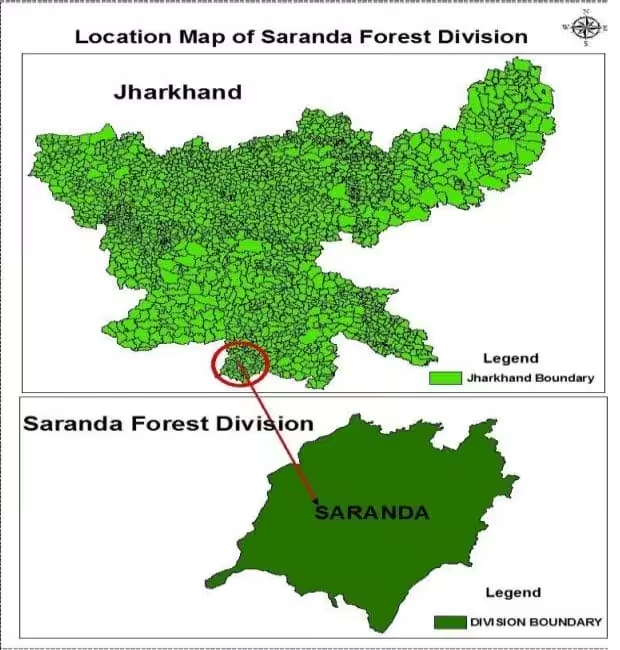
- The Saranda forests are home to India’s finest Sal (Shorea robusta) forests and cover an area of about 850 sq km in West Singhbhum district, Jharkhand.
- The forest has faced extensive degradation due to iron ore and manganese mining, which has fragmented habitats and impacted local wildlife such as elephants, leopards, and tigers.
What is Wildlife Sanctuary:
- Wildlife sanctuaries are designated havens for India’s diverse species and ecosystems. Legally protected under the Wildlife (Protection) Act of 1972, they protect habitats, manage populations, and combat threats.
- Each sanctuary is zoned for specific purposes: core areas untouched, buffer zones with controlled activities, and tourism zones for responsible exploration.
- These sanctuaries not only safeguard endangered species but also maintain biodiversity, preserve ecosystems, channelling their invaluable services and educate communities.
- A wildlife sanctuary may be a separately existing entity or stand within a national park. It may even be upgraded into a national park. Infact, many national parks in India were initially wildlife sanctuaries and upgraded later. Such as the Kaziranga National Park.
- Human activities are permissible inside these sanctuaries. People are allowed to graze cattle and collect forest produce. Settlements aren’t permitted but rights over land are granted to their rightful holders.
Each sanctuary adheres to a meticulous management plan, dividing its area into distinct zones:
● Core Zone : This undisturbed heartland prohibits human interference, safeguarding sensitive species.
● Buffer Zone: Controlled human activities like tribal settlements and sustainable resource utilization occur here.
● Tourism Zone: Responsible tourism activities like guided tours and nature trails are conducted here which is within the buffer zone itself and raise awareness and generate revenue.
Both the State and Central Governments can notify a wildlife sanctuary by issuing a notification, with the State Government being the primary authority for most cases. The Central Government can also declare a sanctuary if an area is leased or transferred to it by the State Government.
Under the Wildlife (Protection) Act, 1972, no alteration to the boundaries of a wildlife sanctuary can be made by a state government except on the recommendation of the National Board for Wild Life (NBWL).
Tell Google you want more of this.
Add Anantam IAS as a preferred sourceOne tap, and this site shows up more often in your own Top Stories, AI Overviews and AI Mode. Remove it any time.