Daily Digest
UPSC · Civil Services Examination
Current Affairs · Tuesday, 26 August 2025
Current affairs curated and edited by Anantam IAS faculty — pulled from The Hindu, PIB, IDSA, Foreign Affairs and the ministries. Read, annotate, revise.
Old Rajinder Nagar · Delhi 110005 · anantamias.com
Criminalisation of politics


Why in news:
A latest nationwide analysis of elected representatives across India has revealed a disturbing rise in the number of MPs and MLAs facing serious criminal charges, raising pressing concerns over criminalisation of politics and the failure of decriminalisation reforms.
UPSC Relevance:
Parliament and State legislatures—structure, functioning, conduct of business, powers & privileges and issues arising out of these.
UPSC PYQ (2013):
Q: It is often said that ‘politics’ and ‘ethics’ do not go together. What is your opinion in this regard? Justify your answer with illustrations.
Criminalsation of politics:
What?
“Criminalisation of politics” refers to the rise in the number of people with criminal histories participating in politics. This complex issue not only undermines democratic principles but also harms the difficult process of developing and enacting public policy.
Data:
- In the Lok Sabha, the share of MPs facing serious criminal cases has more than doubled, from 14% in 2009 to 31% in 2024. In the Assemblies, the share was 29% in 2024, which accounts for more than 1,200 MLAs.
State wise:

- Telangana had the highest share of MPs with serious criminal cases (71%), followed by Bihar (48%). Uttar Pradesh recorded the highest absolute number at 34.
- The Bharatiya Janata Party (BJP) had the highest absolute number of MPs facing serious cases (63 members or 26% of its total). The Congress followed with 32 MPs (32%). Among smaller parties, the proportions were higher: all four MPs of the Rashtriya Janata Dal (RJD) had serious cases against them.
- Andhra Pradesh had the highest share of MLAs with serious criminal cases at 56%, followed by Telangana (50%). U.P. recorded the highest absolute number (154 MLAs or 38% of its total).

Association for Democratic Reforms report:
According to the ADR report, 306 out of the 763 sitting MPs that were examined (about 40%) had filed criminal complaints against themselves. The ADR analysis encompassed that out of 4033 MLA’s serving in India, 1136 MLA’s are having criminal record. Several factors have contributed to the growth of the relationship between politics and crime, including the relationship between politicians and organized crime, the use of coercion during elections, and the abuse of legal loopholes.
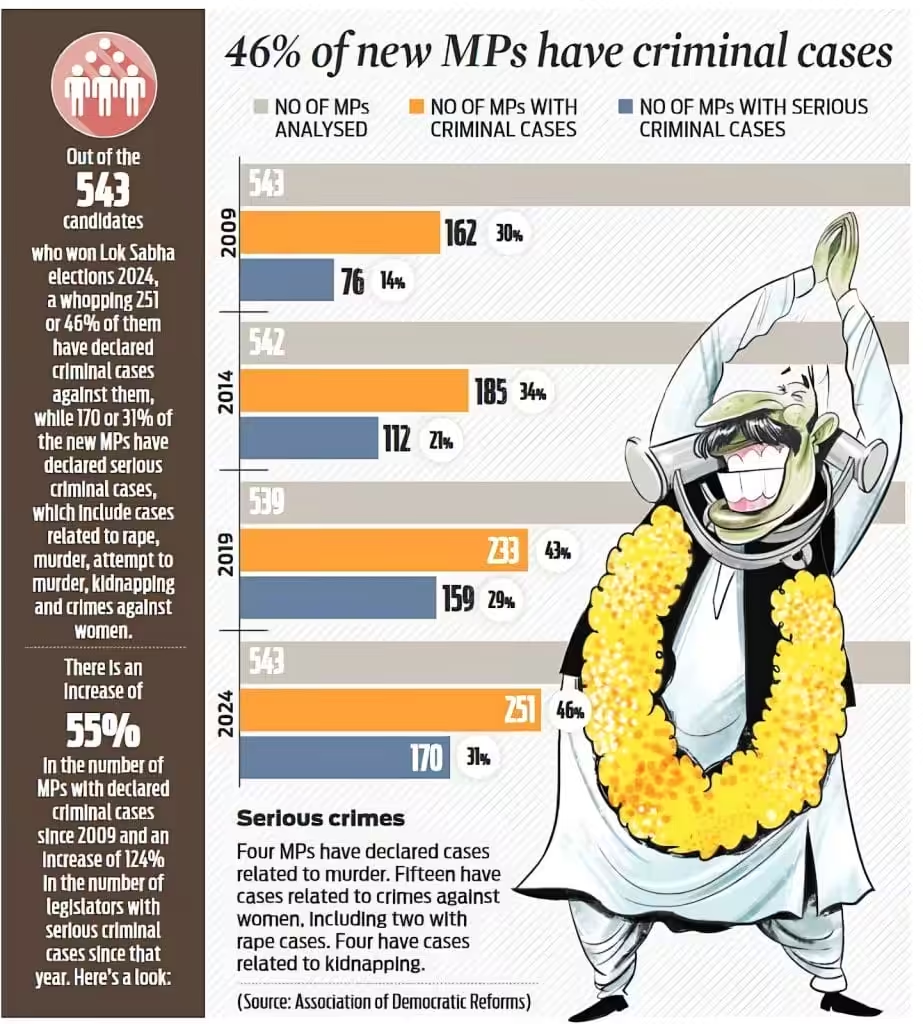
Causes and Impact:
| Causes | Impact | Way Forward |
| 1) Focus on Electoral Dynamics & Vote Bank Politics rather than criminal background. Ability to win elections matters more. | 1) Decline in parliamentary productivity and legislature – quality of deliberation and debate has declined, use of unparliamentary language and frequent disruption and misbehaviour by some MP’s and MLA’s. | 1) ARC and Law Commission– Debar such people from contesting and membership post chargesheet |
| 2) Political Patronage – Criminals are often backed by some influential politician and vice versa. | 2) Undermines Democracy as it prevents good candidates from contesting & prevents discussions and discourse on public’s issues. | 2) ECI – Life time ban for certain heinous offences. |
| 3) Contribution in terms of money power for election expenses by criminals. | 3) Social disharmony – Elected criminals act arbitrarily and cause threat to society. | 3) Criminalising false disclosure under Sec 8 of RPA, 1950. |
| 4) Legal loophole– under (sec 8) false disclosure of criminal background is not criminalised | 4) Compromises on the Morale of Civil Services – well qualified civil servants are supposed to work under alleged criminals. | 4) Follow ups and verification of affidavits submitted by candidates must be done. |
| 5) Political Culture in Country – Apathy and Tolerance to Criminals Electorate focuses more on parochial identities than background of candidate. | 5) Threat to Constitutionalism and constitutional value of Rule of Law. | |
| 6) Vohra Committee – Nexus of Criminal, Politicians, Bureaucrats Acc to CBI, RAW, IB this network runs a parallel govt. virtually. |
SC Judgements:
- Union of India v Association for Democratic Reforms(2002):
- The Court in dealing with the question of criminalization of politics held that under the Indian Constitution, electors had a fundamental right to know the antecedents of candidates contesting elections to hold public office. The court read in ‘right to be informed’ as a right flowing from freedom of speech and expression.
- Election Commission was directed to secure affidavits by candidates recording all particulars relating to past or pending criminal charges or cases against them. This included information as to whether the candidate was convicted/acquitted/discharged of any criminal offence in the past. Additionally, if convicted, the quantum of punishment that was awarded; and whether prior to six months of filing of nomination, the candidate was accused of an offence punishable with minimum two years of imprisonment.
2. PUCL v Union of India(2004):
- The Peoples Union for Civil Liberties approached the Supreme Court challenging Section 33B of the Representation of People (Third Amendment) Act which nullified the decision in Association for Democratic Reforms (2002) by providing that candidates contesting elections need not file affidavit of criminal antecedents and particulars as directed by the Court.
- This provision was held unconstitutional and void as it infringed the “right of electors’ to know”, a constituent of the fundamental right to free speech and expression and hindered free and fair elections, which is part of the basic structure of the Constitution.
3. Lily Thomas v Union of India(2013):
A 2 Judge bench of the Supreme Court in 2013 ruled that Members of Parliament, Legislative Councils and Legislative Assemblies convicted of crimes where they had been awarded a minimum sentence of 2 years imprisonment would cease to be members of the house to which they were elected from the date of sentencing. It further struck down the provision, which allowed convicted members a 3 month time period for appeal against the conviction and sentencing and held that those convicted would suffer immediate disqualification.
4. Rambabu Singh Thakur v Sunil Arora(2020):
On February 13th 2020, a 2 judge Bench comprising RF Nariman and SR Bhat JJ delivered a judgment in the contempt petition arising out of the Electoral Disqualification case (Public Interest Foundation). Various litigants, including BJP spokesperson Ashwini Kumar Upadhyay, had filed contempt petitions against the Election Commission of India for not monitoring whether political parties were complying with the directions issued in the 2018 judgment in Public Interest Foundation. The Bench re-iterated the Court’s 2018 directions and directed the Election Commission to report to the Supreme Court any non-compliance by political parties.
Conclusion:
The infamous definition of democracy given by former U.S. President, Abraham Lincoln, says,
“Democracy is a government of the people, by the people and for the people”. It provides for an
ambiance in which the rights of not only the majority of the citizens but also that of minority are preserved. In a democracy, the people are sovereign and hence are the ultimate source of
authority. But the criminalization of politics has led to the dominance of money and muscle power which has posed a threat to the very foundation of democratic arrangement in the nation.
Bills for removal of PM, CM and Ministers on Arrest – Anantam IAS
Source: https://anantamias.com/current-affairs/criminalisation-of-politics/
Unified Pension Scheme and National Pension Scheme

Why in news:
The Ministry of Finance has introduced a one-time, one-way switch option for Central government employees to migrate from the Unified Pension Scheme (UPS) to the National Pension System (NPS). This is a significant development in India’s pension policy framework, especially for those nearing retirement or reconsidering their pension plan choices.
UPSC Relevance:
UPSC has been continuously asking questions based on various Govt. scheme in news. for example-
PYQ 2015:
Q.‘Pradhan Mantri Jan-Dhan Yojana’ has been launched for
(a) providing housing loan to poor people at cheaper interest rates
(b) promoting women’s Self-Help Groups in backward areas
(c) promoting financial inclusion in the country
(d) providing financial help to the marginalised communities
About NPS Scheme:
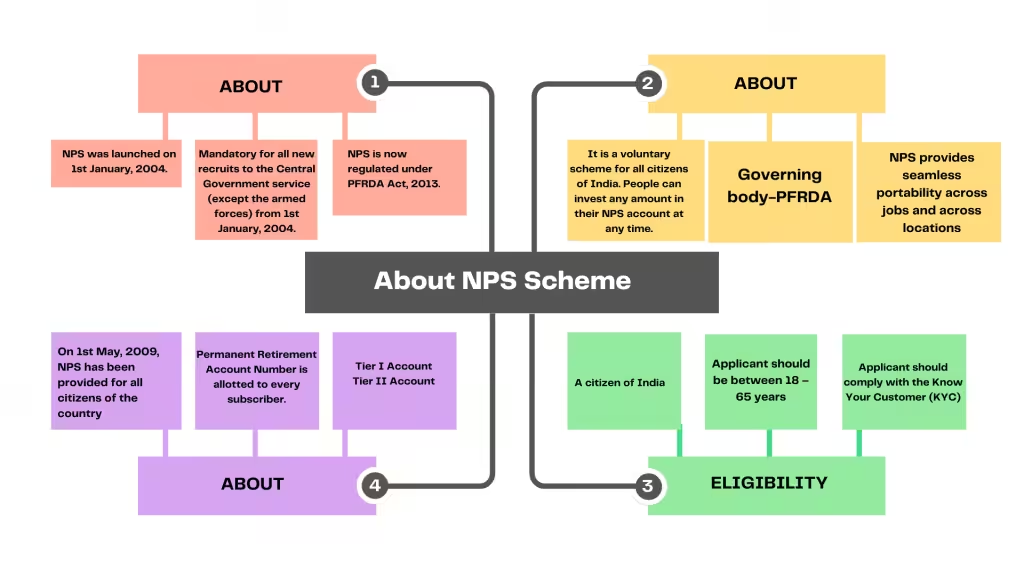
- National Pension System (NPS), was introduced for Central Government employees vide Ministry of Finance (Department of Economic Affairs) dated 22nd December, 2003.
- NPS was made mandatory for all new recruits to the Central Government service (except the armed forces) from 1st January, 2004.
- NPS is now regulated under PFRDA Act, 2013.
- Benefits under these rules would not be applicable to the Government employees appointed on or after 1.1.2004 and covered by NPS.
- On 1st May, 2009, NPS has been provided for all citizens of the country, including the unorganised sector workers on voluntary basis. It mean people can invest any amount in their NPS account at any time.
- Permanent Retirement Account Number is allotted to every subscriber.
Types of account under NPS:
- Tier I Account: A non-withdrawable account meant for savings for retirement.
- Tier II Account: This is simply a voluntary savings facility. The subscriber is free to withdraw savings from this account whenever he or she wishes. No tax benefit is available on this account.
About Unified Pension Scheme:
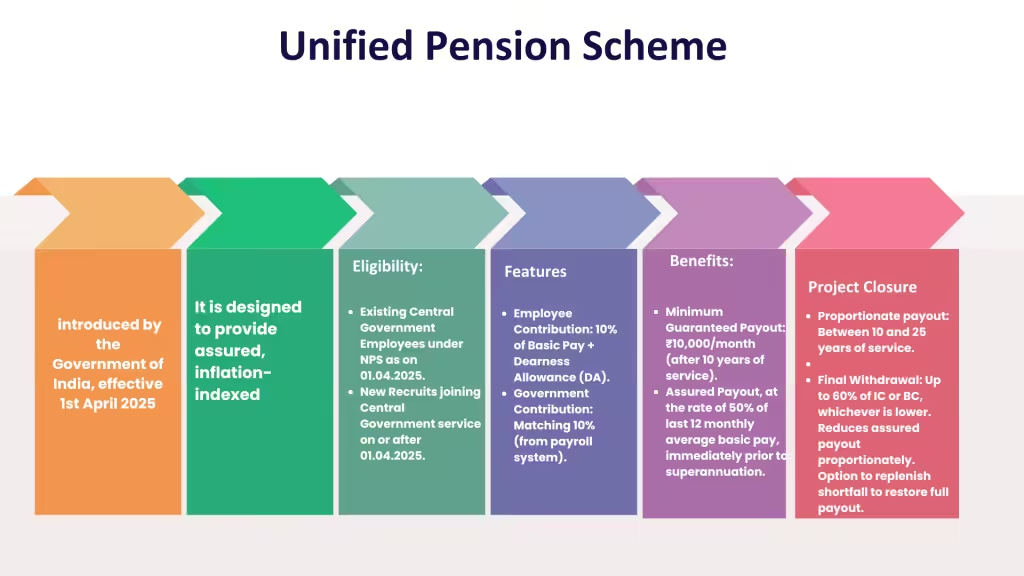
- The Unified Pension Scheme (UPS) is a pension scheme introduced by the Government of India, effective 1st April 2025, as an option under the National Pension System (NPS) for Central Government employees.
- It is designed to provide assured, inflation-indexed, and adequate retirement benefits, addressing concerns of longevity protection and pension predictability.
- UPS operates within the existing NPS architecture regulated by the Pension Fund Regulatory and Development Authority (PFRDA) and is applicable to both serving and retired employees under specific conditions.
Eligibility:
- Existing Central Government Employees under NPS as on 01.04.2025.
- New Recruits joining Central Government service on or after 01.04.2025.
- Retired NPS Subscribers who superannuated or retired on or before 31.03.2025, provided:
- Minimum 10 years of qualifying service.
- Legally wedded spouse as on date of retirement, in case of subscriber’s demise.
Timelines for Option Exercise:
- New recruits: Within 30 days of joining.
- Existing employees/retirees: By 30th September 2025.
Features of UPS:
Contribution Structure
- Employee Contribution: 10% of Basic Pay + Dearness Allowance (DA).
- Government Contribution: Matching 10% (from payroll system).
- Additional Government Contribution: An estimated 8.5% of Basic Pay + DA to a Pool Corpus.
Corpus Composition
- Individual Corpus (IC): Accumulated contributions of employee and matching government share.
- Benchmark Corpus (BC): Notional corpus computed using default investment pattern, regular and timely contributions and without any partial withdrawal & voluntary corpus.
Investment Options
- Default Pattern (auto-assigned if no choice made).
- 100% Government Securities (Scheme G).
- Life Cycle Funds:
- LC-25 (max 25% equity).
- LC-50 (max 50% equity).
- Change Frequency:
- Pension Fund: Once per financial year.
- Investment Pattern: Twice per financial year.
Benefits under UPS
- Assured Payout, at the rate of 50% of last 12 monthly average basic pay, immediately prior to superannuation. Assured payout is payable after a minimum 25 years of qualifying service. In case of lesser qualifying service period, proportionate payout would be admissible.
- Minimum Guaranteed Payout: ₹10,000/month (after 10 years of service).
- Proportionate payout: Between 10 and 25 years of service.
- Final Withdrawal: Up to 60% of IC or BC, whichever is lower. Reduces assured payout proportionately. Option to replenish shortfall to restore full payout.
- Lump Sum Payment: ₹(1/10) × (Basic Pay + DA) for every completed 6 months of qualifying service. Payable on superannuation, voluntary retirement, or retirement under FR 56(j).
Family Payout:
- 60% of subscriber’s admissible payout to legally wedded spouse as on date of retirement.
Dearness Relief: Payable on both admissible payout and family payout, as notified by the Government.
Gratuity Benefits: Retirement Gratuity and Death Gratuity are extended to UPS subscribers under the CCS (Payment of Gratuity under NPS) Rules, 2021.
Tax Treatment
As per the CBDT Office Memorandum dated 02.07.2025, the following provisions of the Income Tax Act, 1961 apply to UPS:
- Section 80CCD(1), 80CCD(1B), 80CCD(2), 80CCD(3), 80CCD(4) – Deductions for contributions.
- Section 10(12A), 10(12B) – Exemptions on withdrawals and annuities.
These provisions apply mutatis mutandis to UPS, subject to prescribed limits. Any deviation in payout or contribution structure would require legislative amendment.
Comparative Overview: NPS vs UPS
| Parameter | NPS | UPS |
|---|---|---|
| Contribution | 10% (employee) + 14% (Govt.) | 10% (employee) + 10% (Govt.) + 8.5% (Pool Corpus) |
| Assured Payout | No | Yes (subject to conditions) |
| Minimum Pension | No | ₹10,000/month |
| Dearness Relief | No | Yes |
| Final Withdrawal | Up to 60% | Up to 60% |
| Family Benefits | Depends on annuity | 60% of subscriber’s payout |
| Partial Withdrawal | Yes | Yes |
| Tax Benefits | EEE | Same as NPS |
| Investment Choice | Available | Available |
| Voluntary Contribution | Permitted | Permitted |
Mind Map:
Source: https://anantamias.com/current-affairs/unified-pension-scheme-and-national-pension-scheme/
Decline of legislature

Why in News?
Addressing the two-day All India Speakers’ Conference in New Delhi on August 24, Union Home Minister Shah called attention to the frequent disruptions that have paralysed deliberations in Assemblies and Parliament.
UPSC Relevance
GS2, Parliament and State Legislatures – Structure, Functioning, Conduct of Business, Powers & Privileges and Issues Arising out of these.
Questions are often asked on the nuances of the overall functioning of the legislature and the challenges and trends visible with respect to it.
PYQ
2023 – Explain the structure of the Parliamentary Committee system. How far have the financial committees helped in the institutionalisation of Indian Parliament?
2024 – “The growth of the cabinet system has practically resulted in the marginalisation of parliamentary supremacy:” Elucidate.
Legislature is the law making organ of the state. An effectively working legislature is crucial to any representative democracy where people elect their representatives to legislature on their behalf to make laws. Former President Pranab Mukherji had highlighted that the essence of democracy is 3 Ds: debate & discussion, dissent and decision and how, one more D had been added to it called, disruption. This points towards the declining productivity and effectiveness of legislatures in India whether it be the parliament or the state legislative assemblies.
Role of legislatures
Legislation: The legislature is the primary body responsible for creating, debating, and passing laws that govern the nation i.e. the positive power of legislation. It also has the power to stall, amend or repeal existing laws in.e. negative power of legislation.
Representation: As the elected body, it represents the will, interests, and concerns of the citizens, ensuring their voices are heard in the government.
Deliberation: The legislature serves as a platform for public debate on critical national issues, allowing for a thorough discussion of policy and other matters of public interest and grievance redressal.
Oversight and Accountability: It acts as a check on the executive branch of the government (the administration). Through tools like Question Hour, committees, and debates, it holds the executive accountable for its actions and decisions.
Financial Control: Legislatures have the power of the “purse,” meaning they approve the government’s budget and control taxation and spending.
Electoral: electing President, Vice President, Speaker etc.
Judicial : Impeaching President, removal of judge, vice president and adjudication in case of breaches of Privileges, anti defection law.
Constitutional: Article 368 vests Parliament with the power to amend the Constitution, subject to the “basic structure doctrine” as laid down by the Supreme Court.
Constitutional Provisions for Legislature in India
The Indian Constitution establishes a parliamentary system of government at both the central and state levels.
The Union Legislature (Parliament)
The Parliament of India is a bicameral legislature, consisting of the President and two Houses: the Rajya Sabha (Council of States) and the Lok Sabha (House of the People).
Article 79: States that there shall be a Parliament for the Union, consisting of the President and two Houses.
Article 80: Outlines the composition of the Rajya Sabha (the Upper House), which represents the states and union territories. It also provides for the nomination of 12 members by the President who have special knowledge in areas like art, science, and literature.
Article 81: Defines the composition of the Lok Sabha (the Lower House), which represents the people directly through general elections.
Articles 107-111: Deal with the legislative procedures, including the introduction and passing of bills.
Article 110: Specifically defines a “Money Bill,” giving the Lok Sabha special powers over financial matters.
The State Legislature
The states in India also have a legislative body, which can be either unicameral (one house) or bicameral (two houses).
Article 168: States that for every state, there shall be a legislature consisting of the Governor and the legislative assembly. Some states may also have a legislative council.
Article 170: Defines the composition of the Legislative Assembly.
Article 171: Defines the composition of the Legislative Council (where it exists).
Article 246 and the Seventh Schedule: These provisions distribute legislative powers between the Union and the states through three lists: the Union List, State List, and Concurrent List. This ensures a clear demarcation of powers.
Recent Trends

Parliament and State Assembly Disruptions
- Disruption and Lack of Debate: Union Home Minister Amit Shah highlighted the frequent disruptions in Parliament and state assemblies, emphasizing the critical need for debate in a democracy.
- Reduced Functioning: The 18th Lok Sabha’s functioning was at its lowest, operating for only 29% of its scheduled time, while the Rajya Sabha functioned for 34%. Two-thirds of the planned time was lost due to repeated adjournments.
- Legislative Business: In a 21-day session, 15 Bills were passed with little or no debate.
Ineffectiveness of Question Hour and Legislative Accountability
- Ineffective Question Hour: The Question Hour, which is an important tool for executive accountability, has been rendered ineffective.
- Low Oral Replies: Only 8% of starred questions in the Lok Sabha and 5% in the Rajya Sabha received an oral reply. In a 21-day session, there were 12 days in the Rajya Sabha and seven days in the Lok Sabha where no questions were answered orally.
Concentration of Power and Legislative Dysfunction
- Centralization of Power: The dysfunction of legislatures is linked to the concentration of power in the chief executive (Prime Minister and Chief Ministers).
- Decline in Sitting Days: State Assemblies met for an average of just 20 days in 2024, a significant drop from 28 days in 2017.
- Lack of Deputy Speakers: Eight state assemblies and the Lok Sabha have not had a Deputy Speaker for an extended period, which contributes to the lack of consensus and proper functioning.
- Partisanship in Committees: Parliamentary committees, once a platform for deliberative debates, have also been affected by partisanship.
Challenges to Legislatures
Declining legislative power
- The positive power of legislation is declining due to the rise and dominance of the executive backed with a strong mandate. The laws and their substance are largely decided by the cabinet and not the legislature.
- Increased use of ordinances
- For example, the President’s promulgation of several ordinances related to the COVID-19 pandemic in 2020, and the Delhi Services Ordinance in 2023, indicate a rising trend in recent times compared to the earlier period of decline.
- The negative power is limited due to the majority of seats belonging to the government making it difficult for the opposition to stall or reject or amend the bills.
- Only 14 private bills have been passed in India so far.(No private bill passed since1970)
- Legislation through parliament not legislation by parliament.
Declining productivity
- Average sittings down to 56 (2022) from 103 (1952).
- In 17th Loksabha 48% time lost in disruption.
- Suspension of opposition MPs en masse (in big numbers).
- 103 CAA passed without debate (Kangaroo, Guillotine)
- Reduced quality of debate which is now more marked with rhetoric and partisan agenda than genuine public interest and substantive arguments.
- Discipline & Decorum have reduced.
Restricted freedom of deliberation
- Owing to the provisions of Anti defection Law, the MP’s are required to tow the line of party strictly and thus deliberation has been shifted to party headquarters and not parliament.
- The speaker continues to be affiliated with the party and often seen as being biased by the opposition.
Declining parliamentary committees
- Less than 20% bills are now referred to committees as compared to more than 40% in 25th LS.
Loss of “House of Notables” – Rajya Sabha
- The Rajya Sabha was intended to be a house of experts and notables, providing a non-partisan counterweight to the Lok Sabha. However, it has become increasingly partisan and prone to political logjams.
- There has often been controversial use of Money Bill classifications to bypass the Upper House.
Lack of Representativeness
- The number of women MP’s in LS is barely 14% in 18th LS.
- The eighteenth Lok Sabha has the lowest share of Muslim MPs in six decades. Less than 5% of its members currently are Muslims despite people from the community forming over 15% of the country’s population.
- No representative of LGBTQ community.
Other challenges
- Criminalisation – 46% MP’s with criminal cases in 18th LS.
- No recorded voting which reduces accountability.
- Lack of a fixed calendar gives full discretion to the government to decide the business of the house.
What is responsible for the decline of legislatures?
- The rising power of the Executive due to the huge one sided majority gives the government control over the functioning of parliament.
- Increased polarization and confrontational politics, often fuelled by the media.
- The rise of regional parties in parliament and identity politics has made it more of a platform for identity assertion, regional interests and political messaging instead of shaping policies in national interests and voicing genuine grievances.
- Strict control of the party over MP’s due to anti defection law.
- Lack of adequate preparation before introducing the bill by MP’s due to disinterest and supposed lack of information from the government.
- Weak parliamentary committees due to lack of expertise among committee members due to limited tenure of one year and lack of staffing support and infrastructure to committees
- Weaker and scattered opposition with no clear leader makes it difficult to arrive at consensus and decide agenda.
Reforms
Procedural
- A fixed calendar should be there for a year.
- Minimum number of days of sitting should be fixed – 100 days for RS and 120 days for LS.
- Also fix days for discussion and questions by Opposition members as happens in the UK.
- Link salaries of MP’s to performance and on the basis of number of days and hours of participation.
- Capacity building of MP’s – Proper training to members.
- Introduce legislature performance index for all legislatures across India to inculcate a healthy competition.
Ethical
- Code of Conduct for MP’s.
- Strengthen the Ethics Committee and make it non-partisan with independent members also like civil activists.
- Penalty for unruly behaviour
Political Party Reforms
- Amend Anti Defection Law to give freedom of speech and vote to MP’s except when it’s a question of survival of government like no confidence motion.
- The speaker must resign from the political party as in the UK.
- Only constructive votes of no confidence must be allowed. It must not be used to disrupt proceedings.
Above all the citizens must be vigilant enough to choose the right representatives who voice public interest in Parliament, not rhetorics.
Source: https://anantamias.com/current-affairs/decline-of-legislatures/