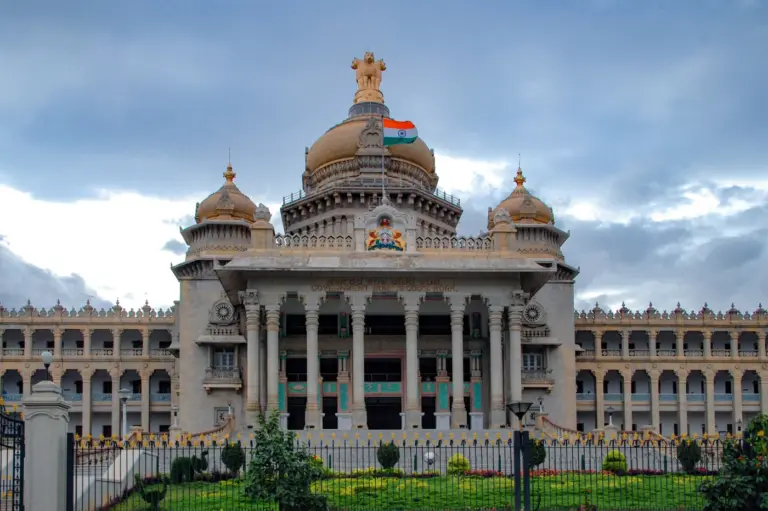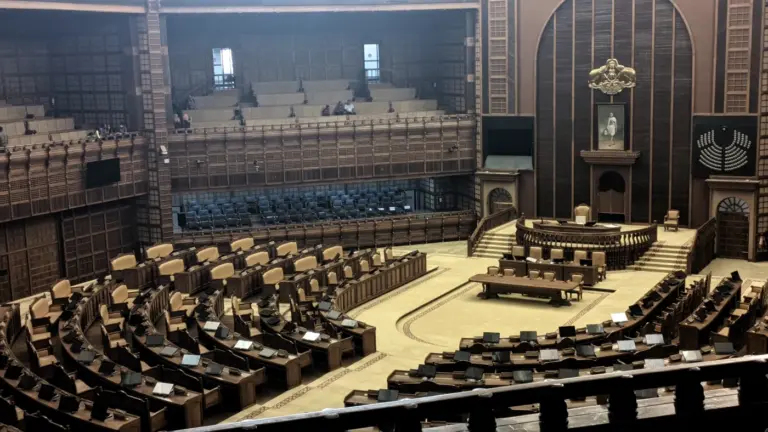
The Parliament of India is the supreme legislative body of the Union and the highest deliberative forum of a parliamentary democracy of over 1.4 billion people. Established under Article 79 of the Constitution, it comprises the President, the Lok Sabha (House of the People), and the Rajya Sabha (Council of States). For UPSC, Parliament is a foundational GS-II topic cutting across legislation, executive accountability, budget scrutiny, and institutional reform — and the operational shift into the new Parliament building in 2023 has added fresh layers of relevance.
This guide brings together the structure of Parliament, its functions, its committee system, the new Parliament House, reforms demanded by committee reports, and the most recent 2024-26 developments.
Structure of Parliament
Parliament is bicameral at the Union level. The Lok Sabha is directly elected and has a maximum strength of 550 members (currently 543 elected plus the removal of the anglo-indian nomination by the 104th Amendment, 2019). The Rajya Sabha has a maximum strength of 250 members — 238 elected by the elected members of State and UT legislative assemblies, and 12 nominated by the President for distinction in art, literature, science and social service.
The President is a constituent part of Parliament (Article 79) — without Presidential assent, no Bill becomes law. This integration — rather than strict separation — is a Westminster inheritance that UPSC often tests against the American presidential model.
Functions of Parliament
The Parliament performs five classical functions. Memorising these with examples helps in both Prelims and Mains answers.
1. Legislative Function
Parliament enacts laws for the Union List (97 subjects), the Concurrent List (52 subjects), and the Residuary list under Article 248. It can legislate on State List subjects under special circumstances — Article 249 (Rajya Sabha resolution in national interest), Article 250 (during Emergency), Article 252 (two or more states requesting), and Article 253 (implementing international treaties).
2. Deliberative Function
Parliament is the highest deliberative forum of Indian democracy. Question Hour, Zero Hour, Calling Attention motions, Short Duration Discussions, and Adjournment motions enable MPs to hold the executive accountable and surface public grievances. The principle of "3 Ds" — debate, dialogue, dissent — is central to its legitimacy.
3. Representational Function
Parliament represents the will of the people. The Lok Sabha captures the popular mandate through direct elections; the Rajya Sabha represents states and allows continuity (one-third of members retire every two years).
4. Financial Function
- Presenting the Annual Financial Statement (Budget) under Article 112
- No tax can be levied or collected except by the authority of law (Article 265)
- Expenditure charged on the Consolidated Fund of India requires parliamentary sanction
- A Financial Emergency (Article 360) can be proclaimed only after parliamentary approval within two months
5. Electoral and Judicial Functions
- Electing the President (Article 54) and the Vice-President (Article 66)
- Impeachment of the President (Article 61), removal of Supreme Court and High Court judges (Articles 124, 217), and removal of the CAG (Article 148)
Challenges: The 3Ds in Decline
Parliament as an institution is under strain. The numbers tell the story:
- Average number of annual sittings fell from 103 in 1952 to 56 in 2022
- Time lost to disruption rose from 5% in 1985 to around 30% today
- Major laws — including the 103rd Constitutional Amendment (EWS reservation) — were passed with minimal debate
- Private Members' Bills are rarely even taken up; only 14 have become law, none since 1970
- Women's representation remained at around 14.4% in the 17th Lok Sabha, below even the South Asian average
- Kangaroo closure and the guillotine truncate budget discussions; large Demands for Grants are passed without proper scrutiny
Underlying Causes
- Anti-Defection Law (Tenth Schedule) discourages voting according to conscience
- Lack of recorded voting reduces individual accountability
- The Speaker's party affiliation occasionally manifests in partisan conduct
- No fixed parliamentary calendar gives the executive excessive discretion to summon and prorogue
Parliamentary Committees: The Backbone of Scrutiny
Parliament cannot scrutinise a Union Budget of over Rs 48 lakh crore in 55-odd sitting days a year. Committees exist precisely to fill that gap. They enable detailed examination of Bills, Demands for Grants, and policy issues — and they function year-round.
Why Committees Are Needed
- Detailed scrutiny that the floor of the House cannot provide
- Expert and stakeholder input through deposition and written submissions
- Consensus-building across party lines in a relatively non-public setting
- Financial oversight through Public Accounts Committee, Estimates Committee, and Committee on Public Undertakings
- Continuous operation — unlike Parliament, which sits only for limited periods
Types of Parliamentary Committees
| Category | Examples | Key Features |
|---|---|---|
| Departmentally Related Standing Committees (DRSCs) | 24 DRSCs, 31 members each (21 LS + 10 RS) | Examine Bills, Demands for Grants, policy issues |
| Financial Committees | Public Accounts (22, chaired by Opposition), Estimates (30, Lok Sabha only), Public Undertakings (22) | Financial oversight, CAG audit scrutiny |
| Administrative Committees | Business Advisory, Rules, Privileges, Ethics | Manage House business |
| Accountability Committees | Government Assurances, Subordinate Legislation, Petitions | Track executive compliance |
| Ad Hoc Committees | Select Committees, Joint Parliamentary Committees (JPCs) | Task-specific, dissolve on report |
Why India's Committee System Needs Strengthening
- Not all Bills are referred to committees: 60% in 14th Lok Sabha, 70% in 15th LS, 30% in 16th LS, and the 17th LS continued the declining trend
- Average attendance in committee meetings is only around 50% compared to 84% in House sittings
- Annual membership doesn't allow specialisation
- Inadequate research staff compared to the UK, US and Canadian models
- Recommendations are non-binding — acceptance rates vary from 30% to 60%
Reforms Suggested
- Adopt the UK practice of mandating that all Bills be referred to committees
- Provide full-time sector-specific research staff (like the US Congressional Budget Office)
- Legislate on committee appointments with fixed, longer tenures to enable specialisation
- The NCRWC (2002) recommended committees on Constitutional Amendment Bills and National Economy
- Open committee proceedings to the public selectively — balancing accountability with the need for candid discussion
The New Parliament Building (2023 onwards)
The new Parliament House was inaugurated on 28 May 2023 as the centrepiece of the Central Vista redevelopment. It replaces the circular colonial-era Lutyens and Baker building inaugurated in 1931.
Why a New Parliament Was Needed
- Inadequate seating: Post-2026 delimitation the strength of the Lok Sabha will likely increase from 543, and the old building's seating capacity was a limit
- Structural concerns: The old building was designed for Seismic Zone II — Delhi has since been reclassified as Zone IV
- Fire safety and services: Not compliant with contemporary standards
- Cramped workspace: Sub-partitions and poor acoustic systems
- Heritage conservation: The old building could not be indefinitely retrofitted without compromising its character
Features of the New Building
- Lok Sabha chamber: 888 seats (national bird — peacock — theme)
- Rajya Sabha chamber: 384 seats (national flower — lotus — theme)
- Joint sitting capacity: 1,272 seats
- Banyan tree (national tree) in the central courtyard; the historic Sengol installed near the Speaker's chair
- Materials sourced across India — teak from Nagpur, marble from Gujarat, stone from Rajasthan, bamboo flooring from Tripura — reflecting the Ek Bharat Shreshtha Bharat theme
- Earthquake-resistant, 30% energy reduction target, paperless operation
- Three gates themed on water (Jal Dwar), land (Shram Dwar), and sky (Gyan Dwar)
- The Ashoka Emblem and the motto Satyamev Jayate prominent across the building
Historical Context
The present (old) Parliament House was designed by Sir Edwin Lutyens and Sir Herbert Baker (1921–1927), with its circular shape said to be inspired by the Chausath Yogini Temple, Morena (Madhya Pradesh). Two additional floors were added in 1956. The first elected Parliament met in April 1952.
Standing Committee Report on Election Reform — Key Takeaways
The Standing Committee on Personnel, Public Grievances, Law and Justice (Chair: Mr Sushil Kumar Modi) has submitted recommendations on election reform that UPSC aspirants should know:
Common Electoral Roll
- Proposal to establish a centralised voter repository to streamline resources
- Concerns: impact on State Election Commissions' jurisdiction over local elections, constitutional separation under Article 325, and delimitation of local wards by states
- Recommendation: the ECI must carefully assess constitutional provisions before implementation
Minimum Age for Contesting Elections
- UK, Canada, and Australia allow 18 years as minimum candidacy age
- Committee recommended reducing the minimum age for State Assembly elections to enable youth engagement
- Emphasised civic education for political literacy
Aadhaar-Voter Linking
- Transparency needed on the voluntary nature of the linkage
- Risk: Aadhaar of non-citizens may be linked with EPIC
- Recommendation: statutory provisions to prevent non-citizens from entering the electoral roll
False Declarations in Affidavits
- Amend the Representation of the People Act, 1951 to define and penalise false declarations
- Increase punishment to up to two years imprisonment (currently six months)
- Institute a verification process for affidavits and involve civil society stakeholders
Latest Developments (2024-26)
Updated context: The 18th Lok Sabha (constituted June 2024) has reported ~13.6% women's representation (74 of 543), a marginal decline from the 17th LS's 14.4% — making the 106th Constitutional Amendment (Nari Shakti Vandan Adhiniyam, 2023) implementation trigger (delimitation after next census) even more significant.
The Three New Criminal Codes — Bharatiya Nyaya Sanhita (BNS), Bharatiya Nagarik Suraksha Sanhita (BNSS), and Bharatiya Sakshya Adhiniyam (BSA) — replaced the IPC, CrPC and Evidence Act from 1 July 2024, having been passed in December 2023 without DRSC scrutiny despite their civilisational scale. This has renewed debate over mandatory committee referrals for legislation.
The suspension of 146 MPs in December 2023 raised questions about the quorum and legitimacy of legislation passed during mass suspensions, and has influenced the 18th Lok Sabha's procedural debates.
The Speaker's role in the Tenth Schedule has been tested in multiple cases (Maharashtra, Jharkhand) with the Supreme Court repeatedly holding that reasonable time must govern disqualification decisions.
The Presidential Reference (2025) on the timeliness of Governors and the President acting on State Bills has further defined the contours of parliamentary-executive relations at both Union and State levels.
UPSC Relevance
Prelims focus:
- Articles 79–122 (Parliament), Article 105 (privileges), Article 117 (money bills)
- Number of DRSCs (24) and their composition (21 LS + 10 RS = 31 members)
- Public Accounts Committee (22 members, chaired by Opposition by convention since 1967)
- Estimates Committee (30 members, Lok Sabha only)
- New Parliament inauguration date (28 May 2023) and capacity (888/384)
- 91st Amendment (2003) and its impact on Anti-Defection Law and Council of Ministers size
Mains GS-II: Questions typically ask about the decline in legislative scrutiny, the effectiveness of the committee system, reforms needed (UK model, research support, mandatory referrals), and the shift in deliberative culture. Use concrete data — 30% Bills referred, 56 sittings average, 30% time lost to disruption.
Essay and ethics: Parliamentary decline connects to themes of deliberative democracy, institutional trust, and the 3Ds (debate, dialogue, dissent). Quote the Nolan Committee's Code of Conduct and NCRWC recommendations.
Tell Google you want more of this.
Add Anantam IAS as a preferred sourceOne tap, and this site shows up more often in your own Top Stories, AI Overviews and AI Mode. Remove it any time.