Why in news:
The Ministry of Finance has introduced a one-time, one-way switch option for Central government employees to migrate from the Unified Pension Scheme (UPS) to the National Pension System (NPS). This is a significant development in India’s pension policy framework, especially for those nearing retirement or reconsidering their pension plan choices.
UPSC Relevance:
UPSC has been continuously asking questions based on various Govt. scheme in news. for example-
PYQ 2015:
Q.‘Pradhan Mantri Jan-Dhan Yojana’ has been launched for
(a) providing housing loan to poor people at cheaper interest rates
(b) promoting women’s Self-Help Groups in backward areas
(c) promoting financial inclusion in the country
(d) providing financial help to the marginalised communities
About NPS Scheme:
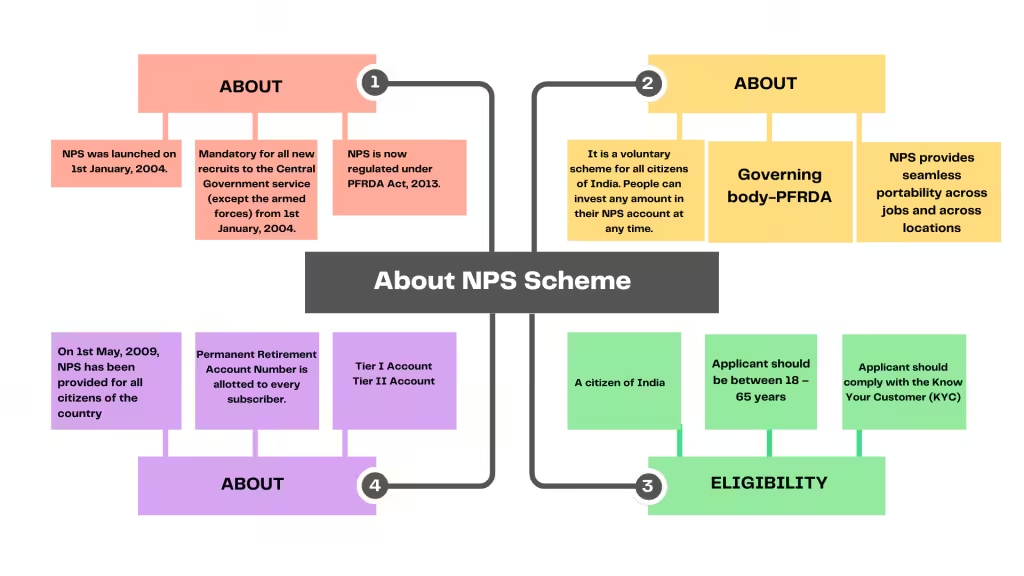
- National Pension System (NPS), was introduced for Central Government employees vide Ministry of Finance (Department of Economic Affairs) dated 22nd December, 2003.
- NPS was made mandatory for all new recruits to the Central Government service (except the armed forces) from 1st January, 2004.
- NPS is now regulated under PFRDA Act, 2013.
- Benefits under these rules would not be applicable to the Government employees appointed on or after 1.1.2004 and covered by NPS.
- On 1st May, 2009, NPS has been provided for all citizens of the country, including the unorganised sector workers on voluntary basis. It mean people can invest any amount in their NPS account at any time.
- Permanent Retirement Account Number is allotted to every subscriber.
Types of account under NPS:
- Tier I Account: A non-withdrawable account meant for savings for retirement.
- Tier II Account: This is simply a voluntary savings facility. The subscriber is free to withdraw savings from this account whenever he or she wishes. No tax benefit is available on this account.
About Unified Pension Scheme:
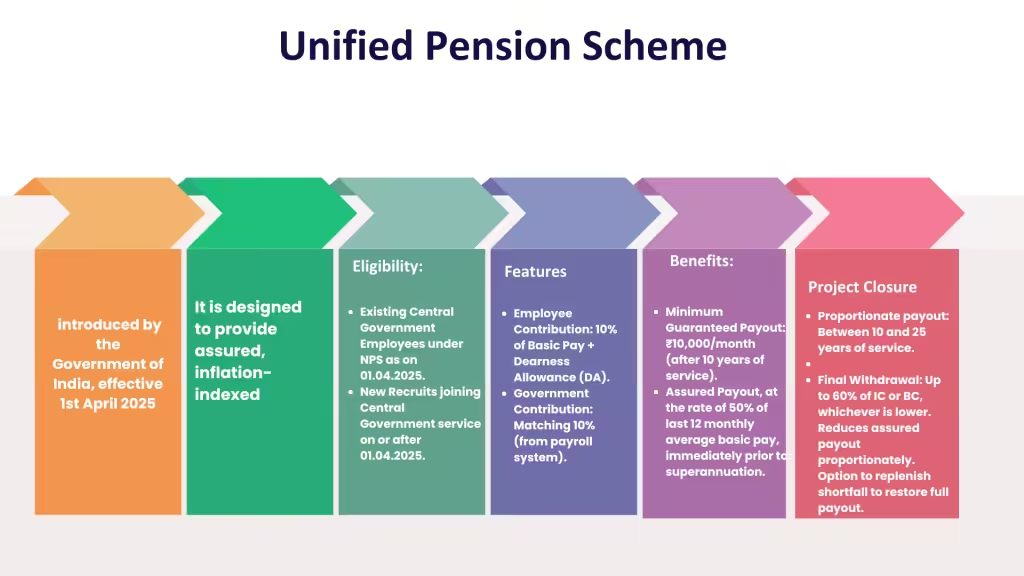
- The Unified Pension Scheme (UPS) is a pension scheme introduced by the Government of India, effective 1st April 2025, as an option under the National Pension System (NPS) for Central Government employees.
- It is designed to provide assured, inflation-indexed, and adequate retirement benefits, addressing concerns of longevity protection and pension predictability.
- UPS operates within the existing NPS architecture regulated by the Pension Fund Regulatory and Development Authority (PFRDA) and is applicable to both serving and retired employees under specific conditions.
Eligibility:
- Existing Central Government Employees under NPS as on 01.04.2025.
- New Recruits joining Central Government service on or after 01.04.2025.
- Retired NPS Subscribers who superannuated or retired on or before 31.03.2025, provided:
- Minimum 10 years of qualifying service.
- Legally wedded spouse as on date of retirement, in case of subscriber’s demise.
Timelines for Option Exercise:
- New recruits: Within 30 days of joining.
- Existing employees/retirees: By 30th September 2025.
Features of UPS:
Contribution Structure
- Employee Contribution: 10% of Basic Pay + Dearness Allowance (DA).
- Government Contribution: Matching 10% (from payroll system).
- Additional Government Contribution: An estimated 8.5% of Basic Pay + DA to a Pool Corpus.
Corpus Composition
- Individual Corpus (IC): Accumulated contributions of employee and matching government share.
- Benchmark Corpus (BC): Notional corpus computed using default investment pattern, regular and timely contributions and without any partial withdrawal & voluntary corpus.
Investment Options
- Default Pattern (auto-assigned if no choice made).
- 100% Government Securities (Scheme G).
- Life Cycle Funds:
- LC-25 (max 25% equity).
- LC-50 (max 50% equity).
- Change Frequency:
- Pension Fund: Once per financial year.
- Investment Pattern: Twice per financial year.
Benefits under UPS
- Assured Payout, at the rate of 50% of last 12 monthly average basic pay, immediately prior to superannuation. Assured payout is payable after a minimum 25 years of qualifying service. In case of lesser qualifying service period, proportionate payout would be admissible.
- Minimum Guaranteed Payout: ₹10,000/month (after 10 years of service).
- Proportionate payout: Between 10 and 25 years of service.
- Final Withdrawal: Up to 60% of IC or BC, whichever is lower. Reduces assured payout proportionately. Option to replenish shortfall to restore full payout.
- Lump Sum Payment: ₹(1/10) × (Basic Pay + DA) for every completed 6 months of qualifying service. Payable on superannuation, voluntary retirement, or retirement under FR 56(j).
Family Payout:
- 60% of subscriber’s admissible payout to legally wedded spouse as on date of retirement.
Dearness Relief: Payable on both admissible payout and family payout, as notified by the Government.
Gratuity Benefits: Retirement Gratuity and Death Gratuity are extended to UPS subscribers under the CCS (Payment of Gratuity under NPS) Rules, 2021.
Tax Treatment
As per the CBDT Office Memorandum dated 02.07.2025, the following provisions of the Income Tax Act, 1961 apply to UPS:
- Section 80CCD(1), 80CCD(1B), 80CCD(2), 80CCD(3), 80CCD(4) – Deductions for contributions.
- Section 10(12A), 10(12B) – Exemptions on withdrawals and annuities.
These provisions apply mutatis mutandis to UPS, subject to prescribed limits. Any deviation in payout or contribution structure would require legislative amendment.
Comparative Overview: NPS vs UPS
| Parameter | NPS | UPS |
|---|---|---|
| Contribution | 10% (employee) + 14% (Govt.) | 10% (employee) + 10% (Govt.) + 8.5% (Pool Corpus) |
| Assured Payout | No | Yes (subject to conditions) |
| Minimum Pension | No | ₹10,000/month |
| Dearness Relief | No | Yes |
| Final Withdrawal | Up to 60% | Up to 60% |
| Family Benefits | Depends on annuity | 60% of subscriber’s payout |
| Partial Withdrawal | Yes | Yes |
| Tax Benefits | EEE | Same as NPS |
| Investment Choice | Available | Available |
| Voluntary Contribution | Permitted | Permitted |
Mind Map:
Tell Google you want more of this.
Add Anantam IAS as a preferred sourceOne tap, and this site shows up more often in your own Top Stories, AI Overviews and AI Mode. Remove it any time.