Daily Digest
UPSC · Civil Services Examination
Current Affairs · Wednesday, 26 August 2026
Current affairs curated and edited by Anantam IAS faculty — pulled from The Hindu, PIB, IDSA, Foreign Affairs and the ministries. Read, annotate, revise.
Old Rajinder Nagar · Delhi 110005 · anantamias.com
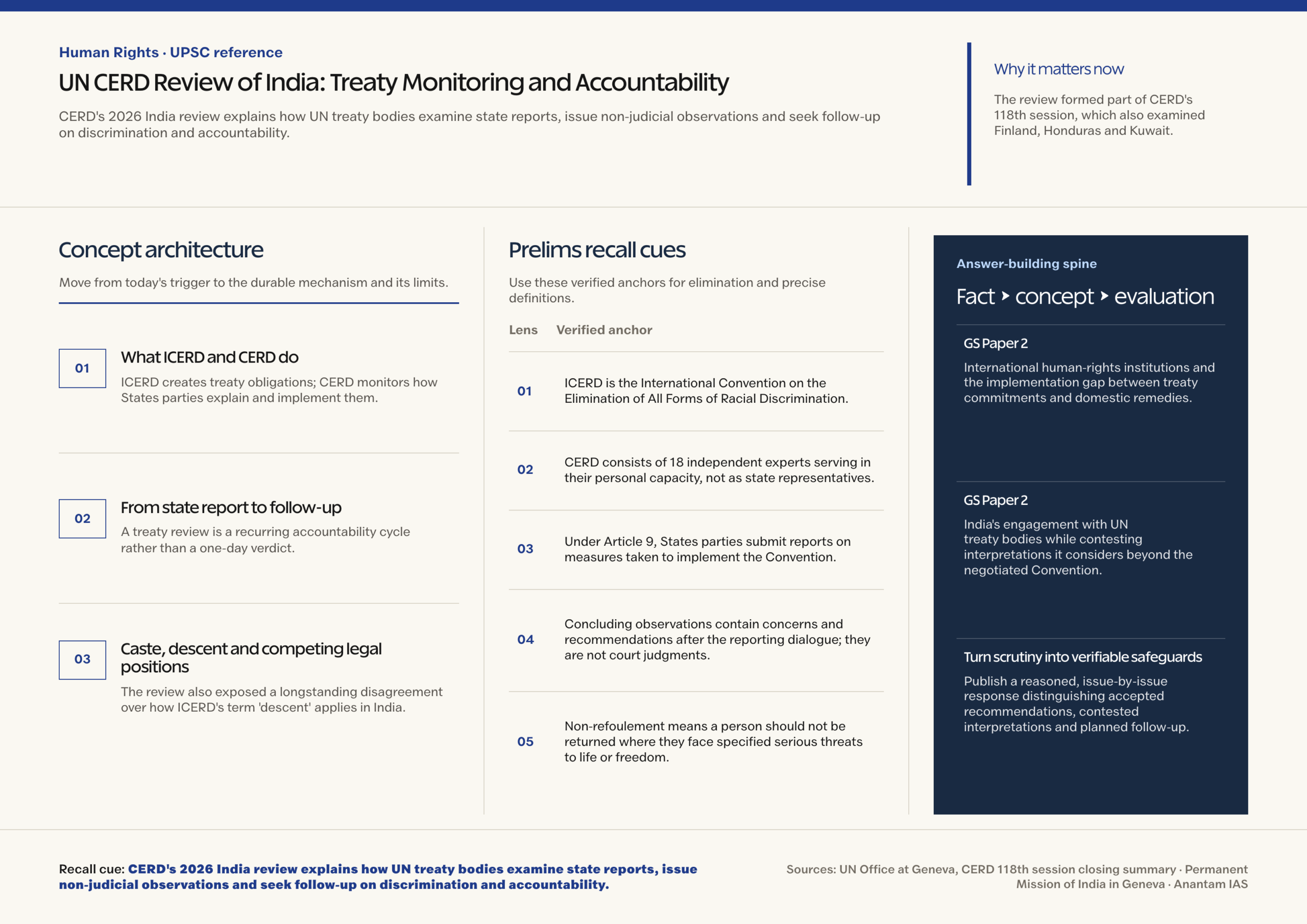
UN CERD Review of India: Treaty Monitoring and Accountability
Why in News?
On 25 August 2026, CERD issued concluding observations after reviewing India’s combined twentieth and twenty-first periodic reports, its first dialogue with India since 2007.
- The review formed part of CERD’s 118th session, which also examined Finland, Honduras and Kuwait.
- The Committee expressed concern about reported abuses against protected groups and recommended prompt, impartial investigations and accountability.
- It also raised reported racial profiling and treatment of Rohingya, Bengali-speaking Muslims, migrants and asylum-seekers, including non-refoulement concerns.
- India highlighted its constitutional safeguards and maintained that engagement did not imply acceptance of an expanded treaty mandate or additional obligations.
- The episode shows how international monitoring can generate scrutiny and policy pressure without itself changing domestic law.
- For India, the review intersects international obligations with constitutional equality, anti-untouchability protections, remedies and federal implementation.
UPSC Relevance
Prelims Relevance
- ICERD is the International Convention on the Elimination of All Forms of Racial Discrimination.
- CERD consists of 18 independent experts serving in their personal capacity, not as state representatives.
- Under Article 9, States parties submit reports on measures taken to implement the Convention.
- Concluding observations contain concerns and recommendations after the reporting dialogue; they are not court judgments.
- Non-refoulement means a person should not be returned where they face specified serious threats to life or freedom.
Mains Relevance
GS Paper 2
- International human-rights institutions and the implementation gap between treaty commitments and domestic remedies.
- Constitutional equality, social justice and accountability for alleged discrimination against vulnerable groups.
GS Paper 2
- India’s engagement with UN treaty bodies while contesting interpretations it considers beyond the negotiated Convention.
Essay
- Accountability is strongest when international scrutiny, constitutional remedies and credible domestic investigation reinforce one another.
Background and Context
What ICERD and CERD do
ICERD creates treaty obligations; CERD monitors how States parties explain and implement them.
- The Convention prohibits distinctions based on race, colour, descent, or national or ethnic origin that impair equal enjoyment of rights across political, civil, economic, social and cultural life.
- CERD is a body of 18 independent experts drawn from different regions; it is neither a court nor a political organ representing governments.
- Under Article 9, a State submits periodic reports describing its legal, administrative and policy measures, practical results and the obstacles it faces.
- Committee experts question the delegation in a public dialogue, where the State can clarify contested claims, and may consider submissions from institutions and civil society.
- The review assesses treaty implementation; it does not replace Indian courts, criminal investigations or constitutional decision-making, or make allegations judicially proven.
From state report to follow-up
A treaty review is a recurring accountability cycle rather than a one-day verdict.
- India submitted its combined twentieth and twenty-first reports in 2023, responding to a prior list of issues that framed the information sought under simplified reporting.
- The dialogue on 11 and 12 August 2026 allowed India to present its constitutional framework, affirmative action, judicial remedies and policy measures directly to the Committee.
- After deliberation, CERD adopted concluding observations that record positive aspects, concerns, recommendations and priorities for later follow-up by the State party.
- The Committee’s India findings called for investigation of reported abuses and stronger protection against discrimination, hate speech, hate crime, racial profiling and collective expulsion.
- Follow-up depends on domestic choices: authorities may review law, enforcement, data, remedies and institutional practice, then report implementation through periodic or targeted follow-up.
Caste, descent and competing legal positions
The review also exposed a longstanding disagreement over how ICERD’s term ‘descent’ applies in India.
- CERD has treated discrimination based on descent as including caste and analogous inherited-status systems, including through General Recommendation No. 29 on descent.
- India maintains that caste is distinct from race and descent under ICERD, citing the treaty’s negotiating history, separate constitutional terminology and original scope.
- India nevertheless supplied information on Scheduled Castes and Scheduled Tribes, while saying this transparency was voluntary and did not create additional treaty obligations.
- An answer should present the disagreement, not convert the Committee’s interpretation into an uncontested rule, India’s objection into withdrawal, or shared concern about discrimination into consensus on scope.
- Domestic protection remains independently anchored in constitutional equality, non-discrimination and abolition of untouchability, alongside statutory remedies, commissions, judicial review and targeted protective legislation.
Way Forward
Turn scrutiny into verifiable safeguards
- Publish a reasoned, issue-by-issue response distinguishing accepted recommendations, existing safeguards and points of legal disagreement.
- Ensure independent investigation, due process and accessible remedies wherever credible allegations of discriminatory policing or abuse arise.
- Improve disaggregated, privacy-respecting data on complaints, investigations, prosecutions and remedies so implementation can be measured.
- Engage Parliament, states, commissions, courts and affected communities because treaty implementation crosses several institutions and levels of government.
Conclusion
- CERD’s observations are authoritative treaty-body scrutiny, but not a judicial conviction or automatic amendment to Indian law; their influence works through reporting, public reasoning and follow-through.
- A balanced answer should separate allegations, Committee recommendations and India’s legal position, then assess whether domestic institutions provide credible investigation, remedies and measurable follow-up.
- The durable lesson is that treaty monitoring matters most when dialogue produces transparent implementation without obscuring legitimate disputes over legal scope; answers should test both authority and implementation evidence.
UPSC Practice Questions
Prelims MCQ 1
With reference to the Committee on the Elimination of Racial Discrimination, consider the following statements:
- It monitors implementation of ICERD by States parties.
- Its 18 members serve as independent experts in their personal capacity.
- Its concluding observations automatically amend the domestic law of a reviewed State.
How many of the above statements are correct?
(a) Only one (b) Only two (c) All three (d) None
Answer: (b) Only two
Explanation:
Statements 1 and 2 are correct. Concluding observations communicate treaty-body concerns and recommendations; they do not automatically amend a State’s domestic law.
Prelims MCQ 2
In the ICERD reporting cycle, ‘concluding observations’ are best understood as:
(a) binding judgments delivered by an international criminal court (b) resolutions adopted by the UN Security Council (c) concerns and recommendations issued by the treaty-monitoring committee after review (d) reservations entered by a State when ratifying the treaty
Answer: (c) concerns and recommendations issued by the treaty-monitoring committee after review
Explanation:
CERD adopts concluding observations after considering a State report and dialogue. They guide follow-up but are not Security Council decisions or criminal judgments.
UPSC Mains Questions
- Explain the reporting and follow-up cycle under ICERD. Why should CERD’s concluding observations be distinguished from judicial findings?
- International treaty monitoring can strengthen domestic accountability even when the State contests parts of a committee’s interpretation. Discuss with reference to India’s 2026 CERD review.
Sources: UN Office at Geneva, CERD 118th session closing summary and Permanent Mission of India in Geneva.
Frequently Asked Questions
What is CERD?
CERD is the 18-member independent-expert committee that monitors how States parties implement the International Convention on the Elimination of All Forms of Racial Discrimination.
Are CERD concluding observations binding court judgments?
No. They are treaty-body concerns and recommendations adopted after review. They do not convict individuals or automatically alter domestic law, though States should engage with them in good faith.
Why is caste discussed under ICERD?
CERD interprets descent-based discrimination as covering caste-like inherited status. India disputes equating caste with race or descent under the Convention while separately applying constitutional and statutory protections.
What did CERD recommend after India’s 2026 review?
Among its recommendations, CERD sought impartial investigation of reported abuses, accountability, protection against discrimination and hate crimes, and safeguards for migrants, asylum-seekers and people needing international protection.
What is the main UPSC takeaway from the review?
Separate the treaty obligation, the Committee’s non-judicial interpretation, India’s stated legal position and the domestic institutions responsible for investigation, remedies and implementation.
Source: https://anantamias.com/current-affairs/un-cerd-india-findings-racial-discrimination/
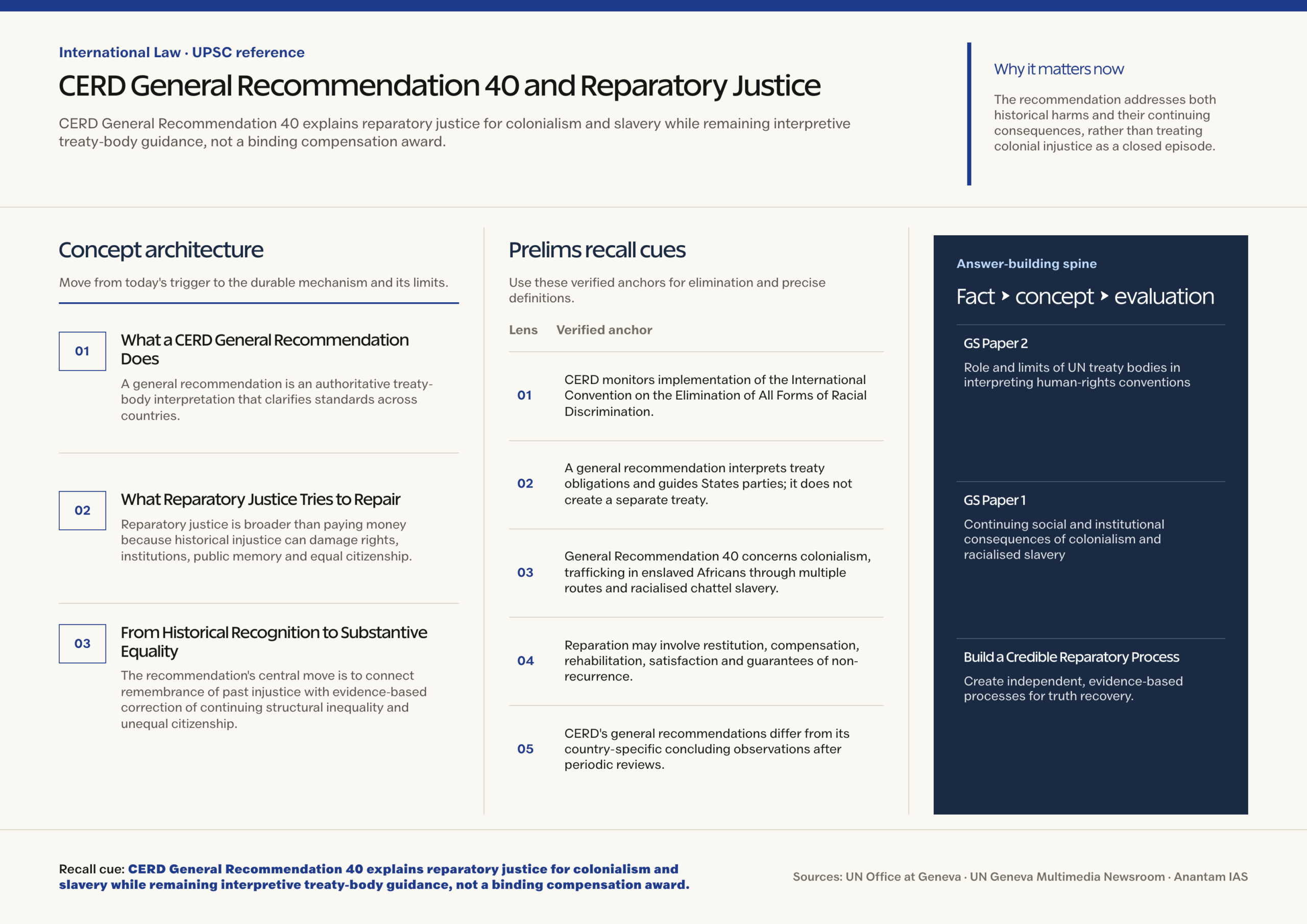
CERD General Recommendation 40 and Reparatory Justice
Why in News?
On 25 August 2026, CERD adopted General Recommendation 40 on reparatory justice for colonialism, trafficking in enslaved Africans and racialised chattel slavery.
- The recommendation addresses both historical harms and their continuing consequences, rather than treating colonial injustice as a closed episode.
- The official UN summary highlights dignity, structural inequality, truth-telling, historical memory, education and prevention of recurrence.
- It situates reparatory justice within States parties’ duty to eliminate racial discrimination and pursue substantive equality.
- It is interpretive guidance, not a new treaty, judicial verdict, compensation order or automatic amendment of domestic law.
- The development links colonial history to present institutions, unequal access, inherited disadvantage and the public narratives through which societies remember past injustice.
- For UPSC answers, the key issue is how international norms shape domestic policy without confusing expert guidance with directly enforceable adjudication.
UPSC Relevance
Prelims Relevance
- CERD monitors implementation of the International Convention on the Elimination of All Forms of Racial Discrimination.
- A general recommendation interprets treaty obligations and guides States parties; it does not create a separate treaty.
- General Recommendation 40 concerns colonialism, trafficking in enslaved Africans through multiple routes and racialised chattel slavery.
- Reparation may involve restitution, compensation, rehabilitation, satisfaction and guarantees of non-recurrence.
- CERD’s general recommendations differ from its country-specific concluding observations after periodic reviews.
Mains Relevance
GS Paper 2
- Role and limits of UN treaty bodies in interpreting human-rights conventions
- Relationship between international normative guidance and domestic implementation
GS Paper 1
- Continuing social and institutional consequences of colonialism and racialised slavery
- Historical memory, education and truth-telling as components of justice
Essay
- Justice for historical wrongs requires both acknowledgement of the past and reform of institutions that reproduce its consequences.
Background and Context
What a CERD General Recommendation Does
A general recommendation is an authoritative treaty-body interpretation that clarifies standards across countries, but its legal effect must be described carefully.
- CERD is the independent-expert body that monitors how States parties implement the racial discrimination convention through periodic reports, public dialogues, concluding observations and follow-up.
- Under the Convention’s reporting framework, CERD develops general recommendations from its accumulated review of State reports, recurring legal questions and patterns of discrimination.
- Such guidance explains how the Committee understands treaty duties and gives governments, courts and civil society a common normative framework for evaluating laws and policies.
- It can influence legislation, policy, diplomatic scrutiny and legal reasoning, yet implementation still depends on domestic institutions, constitutional arrangements and each legal system.
- It must not be confused with a court’s binding judgment, an individual compensation award or a new obligation created outside the ratified treaty and accepted procedures.
What Reparatory Justice Tries to Repair
Reparatory justice is broader than paying money because historical injustice can damage rights, institutions, public memory, social trust and equal participation across generations.
- Restitution seeks, where possible, to restore rights, status, property, liberty or other conditions disturbed by the wrongful act; literal restoration may be impossible after generations.
- Compensation addresses economically assessable harm and lost opportunities, but money alone cannot reverse erased histories, social exclusion, cultural damage or institutional discrimination.
- Rehabilitation concerns services needed to rebuild lives, including medical, psychological, legal and social support suited to affected persons, families and communities.
- Satisfaction can include truth recovery, acknowledgement, accountability, commemoration, accurate historical records and education that restores dignity rather than reproducing denial or silence.
- Guarantees of non-recurrence look forward through legal reform, institutional safeguards, equal participation and measures that prevent discriminatory structures, practices and narratives from reproducing harm.
From Historical Recognition to Substantive Equality
The recommendation’s central move is to connect remembrance of past injustice with evidence-based correction of continuing structural inequality and unequal citizenship.
- Colonialism and racialised slavery created durable hierarchies through dispossession, coerced labour, exclusion and narratives that treated unequal status, extraction and political marginalisation as natural or legitimate.
- A reparatory approach asks whether present laws, institutions, public narratives and resource patterns still carry those consequences, not merely whether historical abuse has formally ended.
- Truth-telling establishes a shared factual record; historical memory and education help prevent denial, distortion, selective commemoration and transmission of discriminatory ideas.
- Affected communities require meaningful participation in defining harm, priorities, remedies and review mechanisms; a purely top-down programme can repeat the exclusion it claims to correct.
- The exam trap is to present one universal payment formula: context, evidence, affected groups, institutional responsibility and domestic legal processes shape the appropriate mix of measures.
Way Forward
Build a Credible Reparatory Process
- Create independent, evidence-based processes for truth recovery, archival access and assessment of continuing structural effects.
- Ensure affected communities help design remedies, priorities, timelines and monitoring instead of being treated only as beneficiaries.
- Combine material measures with education, institutional reform, accountability and non-recurrence safeguards suited to the documented harm.
- Report progress transparently while respecting constitutional structures, judicial processes and the distinction between international guidance and enforceable domestic rules.
Conclusion
- General Recommendation 40 makes reparatory justice a framework for dignity, truth and substantive equality, not a synonym for a single payment.
- A strong Mains answer should pair historical recognition with present institutional reform, while stating clearly that CERD guidance is interpretive rather than binding adjudication.
UPSC Practice Questions
Prelims MCQ 1
With reference to CERD General Recommendation 40, consider the following statements:
- It concerns reparatory justice for colonialism, trafficking in enslaved Africans and racialised chattel slavery.
- It is a judicial compensation award directly enforceable in every State party.
- It addresses both historical harms and their continuing consequences.
How many of the above statements are correct?
(a) Only one (b) Only two (c) All three (d) None
Answer: (b) Only two
Explanation:
Statements 1 and 3 are correct. A CERD general recommendation is interpretive treaty-body guidance, not a judicial award automatically enforceable in every domestic legal system.
Prelims MCQ 2
Which one of the following best describes a guarantee of non-recurrence in reparatory justice?
(a) Restoring property to its former holder (b) Paying for economically assessable loss (c) Reforming institutions to prevent repetition of the harm (d) Providing medical and psychological support
Answer: (c) Reforming institutions to prevent repetition of the harm
Explanation:
Guarantees of non-recurrence are forward-looking safeguards. Restitution, compensation and rehabilitation perform different remedial functions.
UPSC Mains Questions
- Reparatory justice is wider than monetary compensation. Explain with reference to CERD General Recommendation 40.
- How do UN treaty-body general recommendations influence State conduct despite not being binding judicial decisions? Discuss.
Sources: UN Office at Geneva and UN Geneva Multimedia Newsroom.
Frequently Asked Questions
What is CERD General Recommendation 40?
It is CERD’s interpretive guidance on reparatory justice for harms and continuing consequences of colonialism, trafficking in enslaved Africans and racialised chattel slavery.
Is General Recommendation 40 a binding court judgment?
No. It is authoritative treaty-body guidance that interprets ICERD obligations, but it is not a new treaty, judicial verdict or automatic domestic compensation order.
What are the main forms of reparation?
A common framework includes restitution, compensation, rehabilitation, satisfaction and guarantees of non-recurrence. The appropriate combination depends on the documented harm and legal context.
Why are truth-telling and education part of reparatory justice?
They restore historical memory, challenge denial and discriminatory narratives, recognise affected communities’ dignity and help prevent harmful structures and ideas from recurring.
How should General Recommendation 40 be used in a UPSC answer?
Use it to connect colonial legacies with substantive equality, then distinguish historical recognition, material repair and institutional reform from automatically enforceable adjudication.
Source: https://anantamias.com/current-affairs/cerd-gr40-reparatory-justice-colonialism/
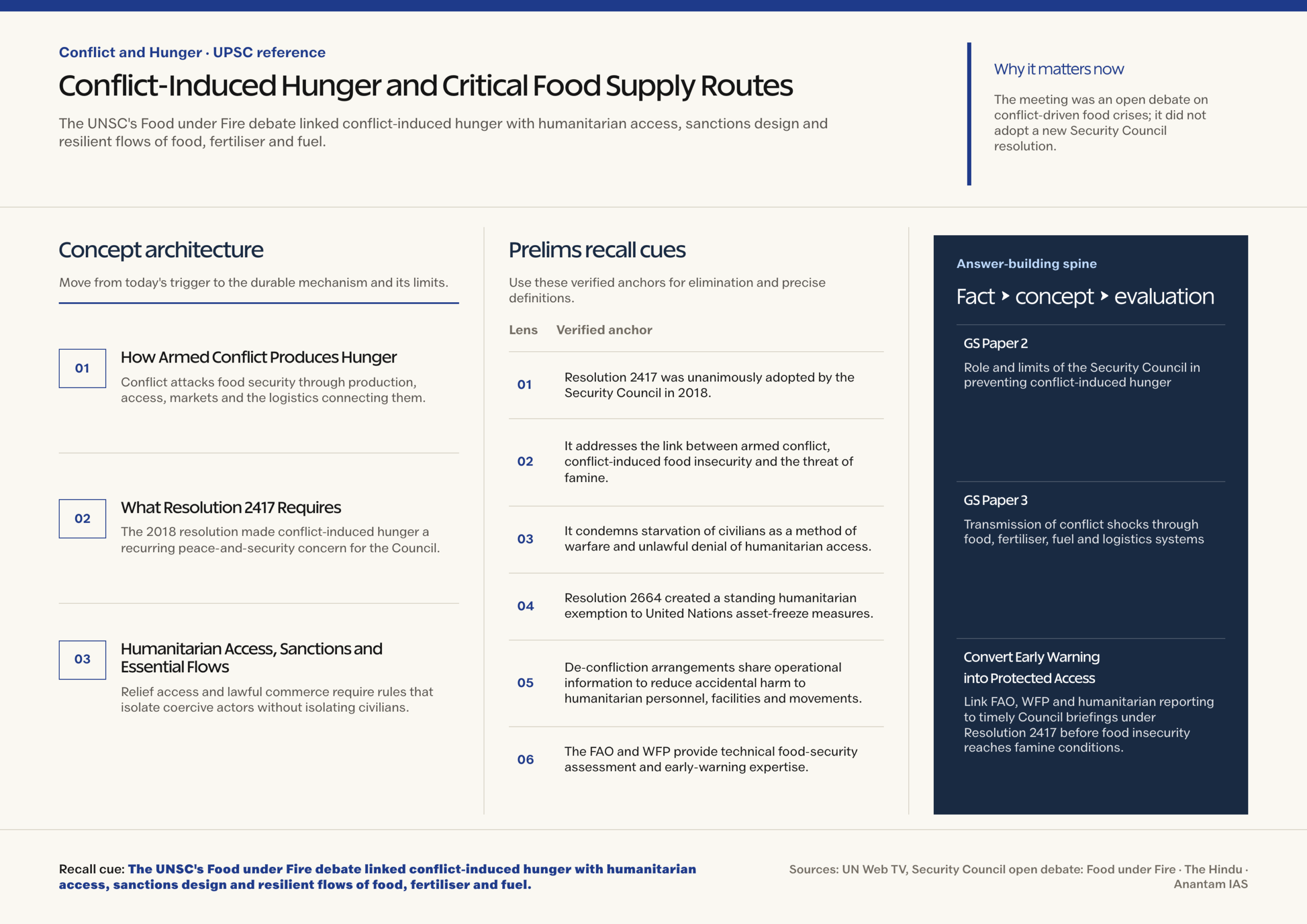
Conflict-Induced Hunger and Critical Food Supply Routes
Why in News?
At the UN Security Council’s 25 August 2026 Food under Fire debate, India urged protection of humanitarian access and essential food, fertiliser and fuel flows during conflict.
- The meeting was an open debate on conflict-driven food crises; it did not adopt a new Security Council resolution.
- The UN Secretary-General said at least 266 million people faced acute food insecurity in 2025.
- He said conflict and violence were the primary drivers in 12 of 13 hunger hotspots of greatest concern.
- India prioritised safe humanitarian access, de-confliction, sanctions safeguards and uninterrupted legitimate trade in essential commodities.
- Conflict can simultaneously destroy local food systems and interrupt the cross-border supplies needed to keep production, transport and relief operations functioning.
- The Council’s task is not food management; it is addressing conflict-related threats, protecting civilians and using its tools without worsening humanitarian conditions.
- Import-dependent developing countries bear cascading costs when insecurity delays shipping, raises insurance and freight costs, or constrains fertiliser and fuel availability.
UPSC Relevance
Prelims Relevance
- Resolution 2417 was unanimously adopted by the Security Council in 2018.
- It addresses the link between armed conflict, conflict-induced food insecurity and the threat of famine.
- It condemns starvation of civilians as a method of warfare and unlawful denial of humanitarian access.
- Resolution 2664 created a standing humanitarian exemption to United Nations asset-freeze measures.
- De-confliction arrangements share operational information to reduce accidental harm to humanitarian personnel, facilities and movements.
- The FAO and WFP provide technical food-security assessment and early-warning expertise.
Mains Relevance
GS Paper 2
- Role and limits of the Security Council in preventing conflict-induced hunger
- International humanitarian law, humanitarian access and sanctions design
GS Paper 3
- Transmission of conflict shocks through food, fertiliser, fuel and logistics systems
- Supply-chain resilience and food security in import-dependent economies
Essay
- Hunger in war is not only a humanitarian outcome; it can become an instrument of coercion and a multiplier of displacement and instability.
Background and Context
How Armed Conflict Produces Hunger
Conflict attacks food security through production, access, markets and the logistics connecting them.
- Fighting can damage farms, irrigation, storage, markets and power systems, while displacement separates cultivators, pastoralists and fishers from the land, water, labour and productive assets needed for local production.
- Insecurity, checkpoints and access denials can block planting, harvesting and relief delivery, turning an availability problem into an acute access and nutrition crisis during critical seasonal windows.
- A fuel disruption raises costs for irrigation, milling, refrigeration and road transport; a fertiliser disruption can depress yields and household purchasing power in the next agricultural season.
- Commercial shipping and ports carry essential inputs across borders, so conflict-related delays can transmit a regional shock to distant food-importing economies through price and availability pressures.
- The burden is unequal: poorer importing countries face higher freight and insurance costs, limited fiscal buffers and weaker storage, leaving less capacity to absorb sudden external shocks.
What Resolution 2417 Requires
The 2018 resolution made conflict-induced hunger a recurring peace-and-security concern for the Council.
- Unanimously adopted on 24 May 2018, Resolution 2417 recognised the link among armed conflict, food insecurity and the threat of famine.
- It strongly condemned starvation of civilians as a method of warfare and the unlawful denial of access to food and other objects indispensable to civilian survival during hostilities.
- Parties must comply with international humanitarian law, protect civilians and civilian objects, and allow safe and unimpeded passage of impartial humanitarian relief where required.
- The resolution asked the Secretary-General to report swiftly when conflict creates a risk of famine or widespread food insecurity, making early warning relevant to preventive Council action.
- Council responses can include diplomacy, access demands, monitoring, accountability and targeted sanctions against aid obstruction; the resolution does not create automatic enforcement in every crisis.
Humanitarian Access, Sanctions and Essential Flows
Relief access and lawful commerce require rules that isolate coercive actors without isolating civilians.
- Poorly designed restrictions can trigger over-compliance: banks, insurers and carriers may avoid even lawful transactions, delaying food, agricultural inputs, fuel and humanitarian payments across multiple jurisdictions.
- Resolution 2664 permits specified humanitarian funds, goods and services despite UN asset freezes, while retaining risk management, due diligence and monitoring against diversion.
- That exemption concerns UN asset-freeze measures; it does not automatically remove other sectoral restrictions, domestic licensing duties or the need for case-specific permissions where applicable.
- De-confliction can share locations, routes and timings to reduce accidental harm to relief movements, but it neither guarantees safety nor replaces parties’ legal obligations.
- India called for objective FAO-WFP assessments, protected legitimate trade and stronger domestic production, storage and logistics; these remain resilience proposals from the debate, not outcomes adopted by the Council.
Way Forward
Convert Early Warning into Protected Access
- Link FAO, WFP and humanitarian reporting to timely Council briefings under Resolution 2417 before food insecurity reaches famine conditions.
- Demand rapid, safe and unimpeded relief access, protect food-system infrastructure and investigate deliberate starvation or unlawful obstruction.
- Design sanctions with clear humanitarian exemptions, workable payment channels and monitoring that controls diversion without encouraging blanket private-sector withdrawal.
- Diversify import sources, storage and logistics while keeping legitimate food, fertiliser and fuel trade moving under international law.
Conclusion
- Conflict-induced hunger is produced by damaged livelihoods, denied access and disrupted supply systems; treating it only as a shortage misses the coercion and governance failures involved.
- A strong answer should connect Resolution 2417 to early warning, international humanitarian law, humanitarian access, accountability and targeted Council action.
- It should also explain that resilient commodity flows and carefully designed sanctions protect civilians without turning a food-security note into a generic maritime-security discussion.
UPSC Practice Questions
Prelims MCQ 1
With reference to United Nations Security Council Resolution 2417, consider the following statements:
- It recognises the link between armed conflict, conflict-induced food insecurity and the threat of famine.
- It condemns starvation of civilians as a method of warfare and unlawful denial of humanitarian access.
- It created a standing humanitarian exemption to asset freezes under all United Nations sanctions regimes.
How many of the above statements are correct?
(a) Only one (b) Only two (c) All three (d) None
Answer: (b) Only two
Explanation:
Statements 1 and 2 describe Resolution 2417. The standing humanitarian exemption to UN asset-freeze measures was created by Resolution 2664, not Resolution 2417.
Prelims MCQ 2
In conflict settings, the primary purpose of humanitarian de-confliction arrangements is to:
(a) authorise military control over all relief agencies (b) replace the obligations of parties under international humanitarian law (c) share operational information to reduce accidental harm to humanitarian movements and facilities (d) exempt all commercial shipments from sanctions and customs rules
Answer: (c) share operational information to reduce accidental harm to humanitarian movements and facilities
Explanation:
De-confliction communicates relevant locations, routes or timings to reduce operational risk. It does not remove legal obligations, guarantee safety or provide a blanket trade exemption.
UPSC Mains Questions
- Conflict-induced hunger is both a protection-of-civilians challenge and a threat to international peace. Discuss the relevance and limits of UNSC Resolution 2417.
- Explain how humanitarian access, sanctions exemptions and resilient food, fertiliser and fuel flows can reduce the civilian costs of armed conflict.
Sources: UN Web TV, Security Council open debate: Food under Fire and The Hindu.
Frequently Asked Questions
What is conflict-induced hunger?
It is acute food insecurity caused or intensified by fighting, displacement, destruction of food systems, access denial, market disruption and obstruction of humanitarian relief to civilians.
What does UNSC Resolution 2417 do?
Adopted in 2018, it links armed conflict with food insecurity and famine, condemns starvation tactics and unlawful aid denial, and supports early warning and Council action.
Why do sanctions need humanitarian exemptions?
Exemptions keep specified aid funds, goods and services moving despite asset freezes, while due diligence and monitoring seek to prevent benefits from reaching sanctioned actors.
What is humanitarian de-confliction?
It is the exchange of operational information, such as protected locations or movement routes, intended to reduce accidental harm; it does not replace international humanitarian law.
Why do food, fertiliser and fuel flows matter together?
Food supplies meet immediate needs, fertiliser affects future harvests, and fuel powers irrigation, processing, refrigeration and transport, so disruption can compound across seasons and markets.
Source: https://anantamias.com/current-affairs/conflict-food-insecurity-critical-sea-lanes/
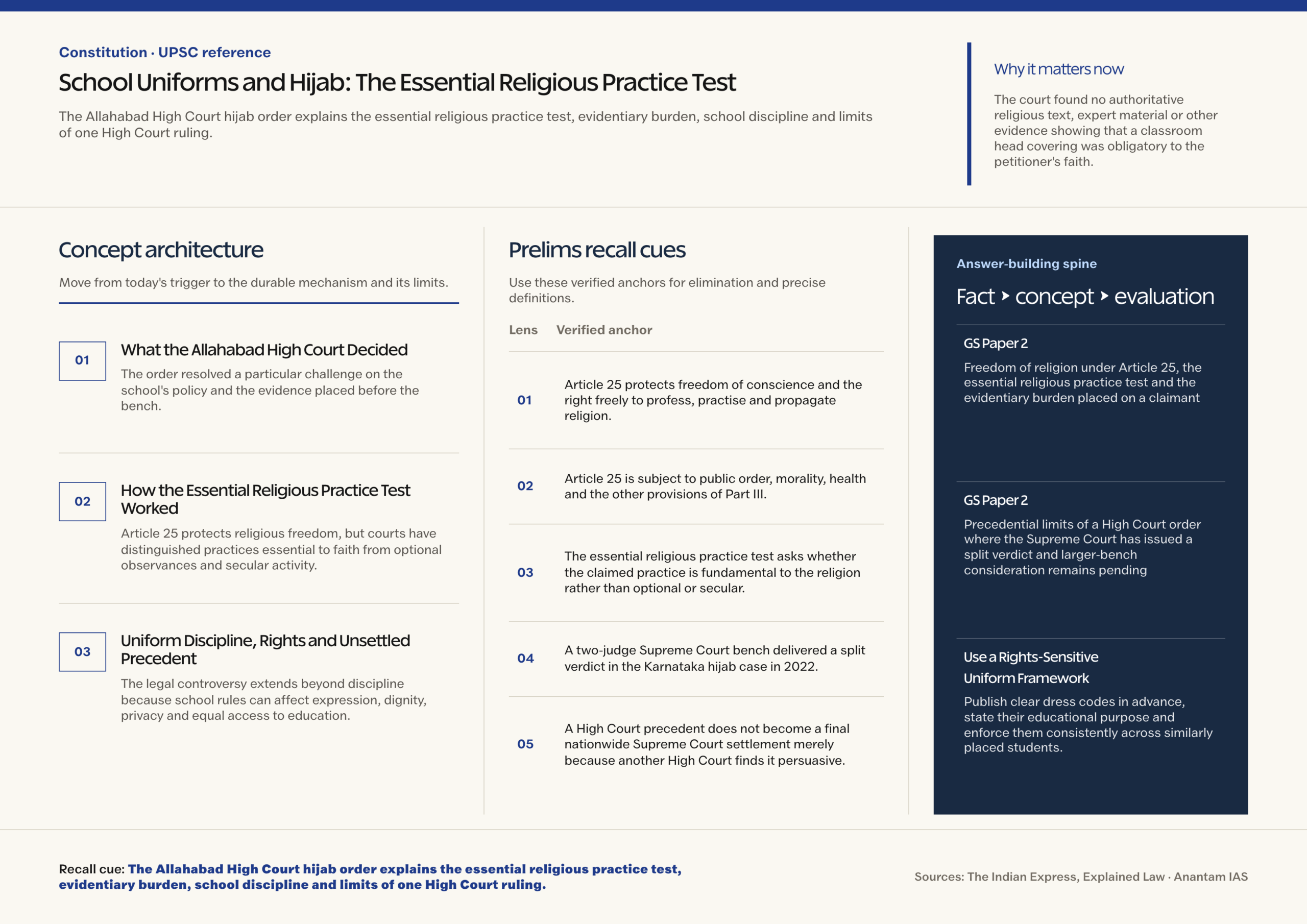
School Uniforms and Hijab: The Essential Religious Practice Test
Why in News?
In an order dated 21 August 2026, the Allahabad High Court rejected a Prayagraj school student’s challenge to enforcement of a uniform rule barring her classroom headscarf.
- The court found no authoritative religious text, expert material or other evidence showing that a classroom head covering was obligatory to the petitioner’s faith.
- Her earlier attendance with the scarf did not create an enforceable right to continued departure from the prescribed uniform.
- The bench treated a uniform, bona fide and non-discriminatory dress code aimed at discipline and institutional identity as primarily within the school’s authority.
- The order is case-specific; the national hijab question remains unresolved after the Supreme Court’s split verdict in 2022.
- The dispute tests how courts examine a religious-freedom claim when an institution invokes a generally applicable rule governing conduct.
- It also shows why a claim about school discipline must be kept analytically separate from the broader constitutional questions of expression, dignity, privacy and educational access.
UPSC Relevance
Prelims Relevance
- Article 25 protects freedom of conscience and the right freely to profess, practise and propagate religion.
- Article 25 is subject to public order, morality, health and the other provisions of Part III.
- The essential religious practice test asks whether the claimed practice is fundamental to the religion rather than optional or secular.
- A two-judge Supreme Court bench delivered a split verdict in the Karnataka hijab case in 2022.
- A High Court precedent does not become a final nationwide Supreme Court settlement merely because another High Court finds it persuasive.
Mains Relevance
GS Paper 2
- Freedom of religion under Article 25, the essential religious practice test and the evidentiary burden placed on a claimant
- Balancing institutional autonomy and uniform discipline with expression, dignity, privacy and access to education
GS Paper 2
- Precedential limits of a High Court order where the Supreme Court has issued a split verdict and larger-bench consideration remains pending
Essay
- Uniformity can support common institutions, but constitutional democracy must still examine whether its burdens fall fairly on individual conscience and educational opportunity.
Background and Context
What the Allahabad High Court Decided
The order resolved a particular challenge on the school’s policy and the evidence placed before the bench.
- The petitioner had attended the same school from Class VI to Class X with a headscarf and relied on photographs and identity cards to show the earlier practice.
- The school said the scarf was an addition to its prescribed uniform; the court found no change in policy, only later enforcement of the existing code.
- Past non-enforcement could reflect inaction, hesitation or courtesy; it did not create estoppel against future enforcement or vest an enduring entitlement.
- The bench accepted institutional choice where the rule was bona fide, uniform and non-discriminatory and served discipline and a common institutional identity.
- This discipline finding did not announce that every uniform rule defeats every rights claim; its force depends on the policy, purpose, application and evidentiary record.
How the Essential Religious Practice Test Worked
Article 25 protects religious freedom, but courts have distinguished practices essential to faith from optional observances and secular activity.
- The claimant must identify the practice with sufficient precision and support religious obligation through authoritative texts, doctrine, expert material or other reliable evidence.
- The court described the petitioner’s claim as a bare assertion because wearing the scarf since childhood did not itself establish a binding religious requirement inside the classroom.
- Under the test, the question is not whether a practice is sincerely preferred, common or identity-bearing, but whether its omission changes the religion’s fundamental character.
- Critics argue that judges may become interpreters of theology; alternative reasoning can examine individual conscience, choice and rights impact without deciding religious essentiality.
- For answers, distinguish two inquiries: whether Article 25 protects the claimed practice and whether restrictions are constitutionally justified under its text and the wider rights framework.
Uniform Discipline, Rights and Unsettled Precedent
The legal controversy extends beyond discipline because school rules can affect expression, dignity, privacy, equality and access to education.
- A valid uniform policy requires more than administrative preference: it should have a legitimate purpose, apply consistently and avoid direct or indirect discrimination.
- A proportionality-oriented review asks whether the restriction is suitable, necessary and balanced, including whether a reasonable accommodation could protect discipline with a smaller rights burden.
- The Allahabad High Court relied heavily on the Karnataka High Court’s 2022 ruling that hijab was not an essential Islamic practice and upheld that state’s uniform requirement.
- The Supreme Court appeal produced two opposing opinions: one prioritised the prescribed uniform, while the other emphasised choice, dignity and educational access beyond the school gate.
- Because there was no majority Supreme Court holding, the matter went for larger-bench consideration; the present order must not be presented as a final national rule.
Way Forward
Use a Rights-Sensitive Uniform Framework
- Publish clear dress codes in advance, state their educational purpose and enforce them consistently across similarly placed students.
- Create a reasoned accommodation process that tests safety, identification and discipline concerns against less restrictive alternatives.
- Hear the student and guardian before exclusion, provide written reasons and preserve grievance and judicial-review routes.
- Keep continuity of education central while courts clarify the relationship among religious freedom, expression, dignity, equality and institutional autonomy.
Conclusion
- The order demonstrates that religious-freedom litigation turns on precise claims, credible evidence and the character of the impugned rule, not on assertion alone.
- In a Mains answer, separate the case-specific discipline holding from the unsettled nationwide doctrine, then assess both essentiality and proportionality without treating either as automatic.
UPSC Practice Questions
Prelims MCQ 1
With reference to Article 25 of the Constitution, consider the following statements:
- It protects freedom of conscience as well as the right freely to profess, practise and propagate religion.
- Its protection is subject to public order, morality and health.
- Its protection is entirely independent of the other provisions of Part III.
How many of the above statements are correct?
(a) Only one (b) Only two (c) All three (d) None
Answer: (b) Only two
Explanation:
Statements 1 and 2 are correct. Article 25 expressly remains subject to public order, morality, health and the other provisions of Part III, making Statement 3 incorrect.
Prelims MCQ 2
Which statement best describes the present precedential position of the 2022 Supreme Court hijab appeal?
(a) A unanimous bench invalidated all school uniform rules (b) A Constitution Bench conclusively held hijab essential to Islam (c) A two-judge bench delivered a split verdict, leaving no majority holding (d) The appeal was dismissed without reasons
Answer: (c) A two-judge bench delivered a split verdict, leaving no majority holding
Explanation:
The two judges reached opposing conclusions in 2022, and the matter was referred for constitution of a larger bench.
UPSC Mains Questions
- Explain the essential religious practice test under Article 25. What evidentiary and institutional concerns arise when courts apply it to school dress codes?
- School discipline and constitutional rights are related but distinct inquiries. Discuss with reference to uniform rules, proportionality and reasonable accommodation.
Source: The Indian Express, Explained Law.
Frequently Asked Questions
What did the Allahabad High Court decide in the school hijab case?
It rejected one student’s challenge because the religious-obligation claim lacked supporting evidence and the school applied an existing, bona fide, uniform and non-discriminatory dress code.
What is the essential religious practice test?
It is a judicial test used to examine whether a claimed practice is fundamental to a religion rather than optional, secular or merely customary.
Did wearing the headscarf earlier create a continuing legal right?
No. The court held that earlier non-enforcement could reflect inaction or hesitation and did not prevent the school from later enforcing its existing uniform policy.
Has the Supreme Court finally settled whether hijab may be worn in school?
No. Its two-judge bench delivered opposing opinions in 2022, producing no majority holding, and the issue was referred for larger-bench consideration.
Why is proportionality relevant to a school uniform dispute?
It helps test whether a rule pursues a legitimate aim through suitable, necessary and balanced means, including whether reasonable accommodation can reduce the burden on rights.
Source: https://anantamias.com/current-affairs/allahabad-hc-hijab-essential-religious-practice/
Anonymous Living Organ Donation: Building a Safe Allocation Policy
Why in News?
On 25 August 2026, the Karnataka High Court asked the State to place its policy on altruistic living organ donation to an anonymous recipient on record.
- The petitioner wished to donate a kidney without compensation to a deserving person whom he did not select personally.
- The Court said a standing system could prevent willing donors from repeatedly approaching it and losing time while an individual order was sought.
- Karnataka referred to scrutiny by its transplant committee and allocation to a compatible recipient according to the State’s waiting-list seniority.
- The proceeding concerns a policy exercise; it did not adopt nationwide rules, approve automatic harvesting or remove the statutory approval process.
- Anonymous living donation could widen access, but the absence of a pre-existing relationship also raises sharper questions about coercion, concealed payment and informed consent.
- A defensible policy must separate three decisions: whether the donor is safe and voluntary, whether the donation is lawful, and which compatible patient receives the organ.
UPSC Relevance
Prelims Relevance
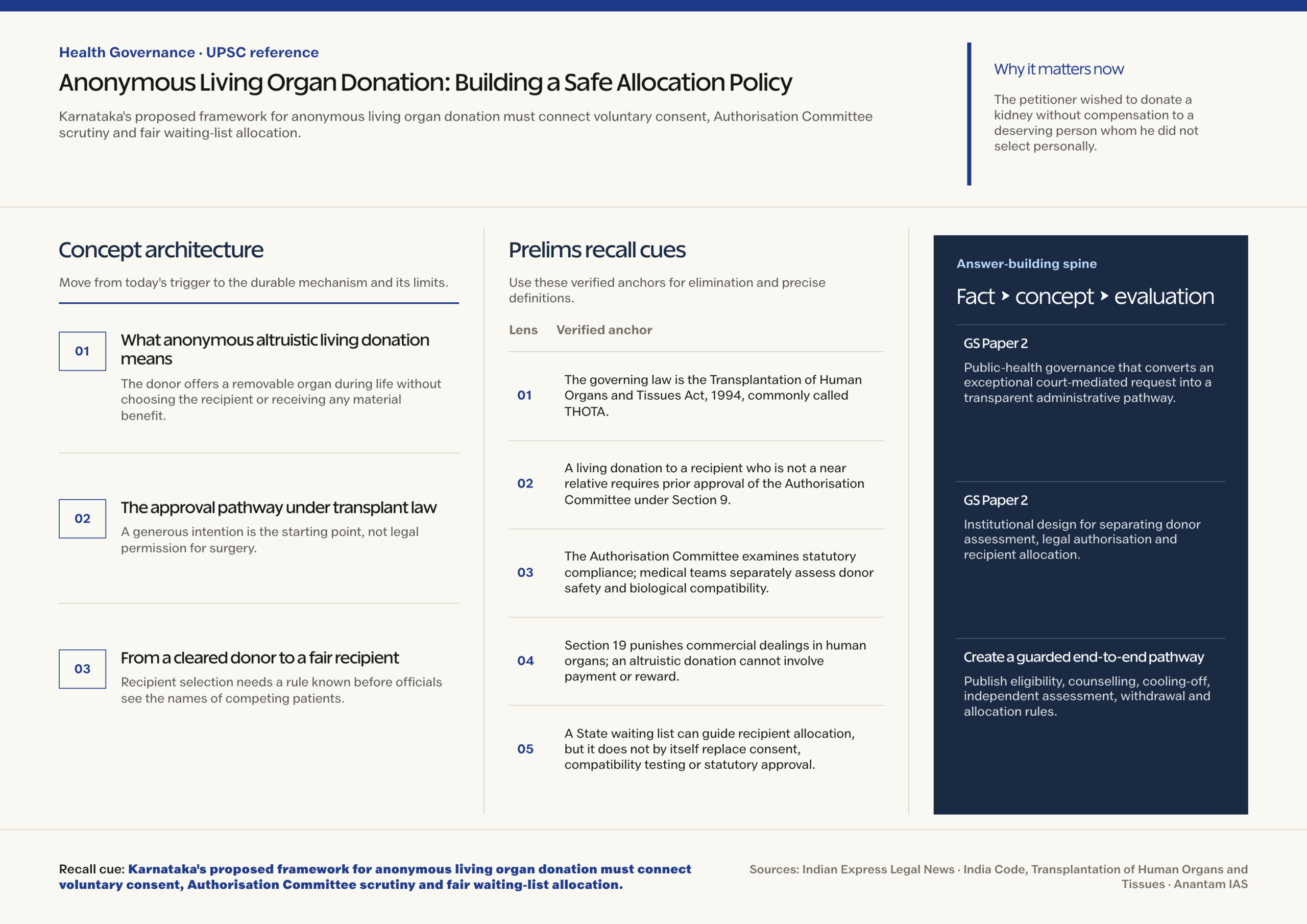
- The governing law is the Transplantation of Human Organs and Tissues Act, 1994, commonly called THOTA.
- A living donation to a recipient who is not a near relative requires prior approval of the Authorisation Committee under Section 9.
- The Authorisation Committee examines statutory compliance; medical teams separately assess donor safety and biological compatibility.
- Section 19 punishes commercial dealings in human organs; an altruistic donation cannot involve payment or reward.
- A State waiting list can guide recipient allocation, but it does not by itself replace consent, compatibility testing or statutory approval.
Mains Relevance
GS Paper 2
- Public-health governance that converts an exceptional court-mediated request into a transparent administrative pathway.
- Balancing patient access with donor autonomy, bodily integrity, informed consent and protection against exploitation.
GS Paper 2
- Institutional design for separating donor assessment, legal authorisation, recipient matching and waiting-list allocation.
Essay
- Compassion becomes just public policy only when institutions protect both the intended beneficiary and the person offering the sacrifice.
Background and Context
What anonymous altruistic living donation means
The donor offers a removable organ during life without choosing the recipient or receiving any material benefit.
- The proposal differs from ordinary related donation because the donor has no family relationship with the eventual recipient and may not know that person.
- It is also distinct from deceased donation: the donor remains a patient whose present and future health, decision-making capacity and freedom from pressure require independent protection.
- The proposed route is uncompensated. Reimbursement of legitimate medical expenses cannot become a disguised price, brokerage fee or reward for supplying an organ.
- Anonymity can reduce directed favouritism, but it complicates the statutory sequence because the law contemplates scrutiny of a donor-recipient case rather than an organ offered in the abstract.
- A policy must define when matching occurs, when identities are disclosed to authorised bodies, and how privacy continues after transplantation.
The approval pathway under transplant law
A generous intention is the starting point, not legal permission for surgery.
- Under Section 9 of THOTA, transplantation from a living donor to a person who is not a near relative requires prior Authorisation Committee approval.
- The Committee must examine the application and satisfy itself that statutory and rule-based requirements are met; it may reject the case with recorded reasons after hearing the applicants.
- A registered transplant hospital must separately establish medical suitability, informed consent, risk comprehension and biological compatibility before removal or transplantation can proceed.
- Independent psychosocial assessment should test whether the decision is stable and whether debt, family pressure, employment dependence, brokers or promised benefits are influencing consent.
- The State’s proposed pathway cannot convert committee scrutiny into a formality or treat a court’s request for policy as approval of the petitioner’s donation.
From a cleared donor to a fair recipient
Recipient selection needs a rule known before officials see the names of competing patients.
- The State told the Court that a compatible recipient could be identified through its waiting list, with seniority supplying the reported allocation route.
- Seniority is understandable but cannot operate alone: blood group, tissue compatibility, urgency, clinical fitness and transplant-centre logistics may determine whether a particular kidney can safely be used.
- Allocation criteria should be published, consistently applied and auditable, with reasons recorded when the highest-listed person cannot receive the offered organ.
- The donor should not be allowed to sell access, while hospitals and officials should not privately substitute a preferred recipient outside the declared queue and compatibility rules.
- Traceable hand-offs among the hospital, Authorisation Committee and allocation body can preserve anonymity for the parties while retaining accountability for regulators.
Way Forward
Create a guarded end-to-end pathway
- Publish eligibility, counselling, cooling-off, independent assessment, withdrawal, matching and appeal procedures before accepting anonymous living-donor applications.
- Separate the teams assessing donor welfare, authorising legality and allocating the organ to reduce conflicts of interest and arbitrary influence.
- Give donors a confidential, penalty-free right to withdraw at any stage and protect the stated reason from family, recipients and intermediaries.
- Audit every case for financial links, broker contact, queue deviation, donor outcomes and recipient allocation while protecting medical privacy.
Conclusion
- Anonymous living donation should be understood as a regulated pathway, not a waiver: generosity does not displace medical safety, Authorisation Committee approval or anti-commercialisation checks.
- In a Mains answer, map the process as donor assessment, legal scrutiny, compatibility matching, waiting-list allocation and post-donation follow-up; each stage protects a different public value.
- The Karnataka proceeding is best framed as a court-prompted policy opportunity whose legitimacy will depend on the safeguards in any final rules, not as an adopted national entitlement.
UPSC Practice Questions
Prelims MCQ 1
With reference to living organ donation under the Transplantation of Human Organs and Tissues Act, 1994, consider the following statements:
- A donation to a recipient who is not a near relative requires prior approval of the Authorisation Committee.
- Placement on a State waiting list by itself removes the need for medical compatibility testing.
- Commercial dealings in human organs are punishable under the Act.
How many of the above statements are correct?
(a) Only one (b) Only two (c) All three (d) None
Answer: (b) Only two
Explanation:
Statements 1 and 3 are correct. A waiting list structures allocation, but compatibility, donor safety, consent and statutory approval remain necessary.
Prelims MCQ 2
In an anonymous altruistic living-donor policy, which arrangement would best protect fairness and donor autonomy?
(a) Let the transplant hospital privately select any recipient and waive committee approval (b) Permit the donor to auction priority among compatible recipients (c) Separate donor assessment, statutory authorisation and rule-based waiting-list allocation (d) Treat judicial consideration of one petition as a nationwide transplant licence
Answer: (c) Separate donor assessment, statutory authorisation and rule-based waiting-list allocation
Explanation:
Separation reduces conflicts of interest while preserving medical suitability, legal scrutiny, transparent allocation and the donor’s voluntary choice.
UPSC Mains Questions
- Why does anonymous altruistic living organ donation require safeguards beyond ordinary medical consent? Explain the institutional pathway a State policy should create.
- A fair transplant system must protect both the person waiting for an organ and the person volunteering to donate. Discuss with reference to authorisation, allocation and anti-commercialisation safeguards.
Sources: Indian Express Legal News and India Code, Transplantation of Human Organs and Tissues Act, 1994.
Frequently Asked Questions
What is anonymous altruistic living organ donation?
It is a living person’s voluntary, uncompensated donation to a recipient the donor does not choose personally, subject to medical suitability, legal authorisation and allocation safeguards.
Did the Karnataka High Court create a new organ-donation law?
No. It asked Karnataka to place its policy on record and indicated that a standing framework could avoid repeated petitions. Existing statutory scrutiny continues to apply.
What does the Authorisation Committee examine?
For an unrelated living-donor case, it examines compliance with transplant law and rules, including whether consent is genuine and whether payment, coercion or an improper arrangement is involved.
How would an anonymous recipient be selected?
Karnataka referred to its waiting list and recipient seniority, but final allocation must also account for compatibility, clinical suitability and transparent reasons for any deviation.
Can an altruistic donor withdraw after volunteering?
A safe policy should preserve confidential withdrawal until surgery. Volunteering does not erase bodily autonomy, and withdrawal should not expose the donor to pressure or penalty.
Source: https://anantamias.com/current-affairs/altruistic-organ-donation-karnataka-policy/
E-Commerce Food Licensing and Datura Enforcement
Why in News?
Karnataka directed suspension action against food licences linked to three e-commerce platforms after toxic datura fruits and seeds were listed for human consumption.
- The Karnataka food-safety department directed competent authorities to suspend relevant licences of Amazon, Swiggy Instamart and BigBasket until further orders.
- Officials were separately told to suspend licences or registrations of establishments and sellers supplying datura products through these platforms.
- The platforms and concerned FBOs were directed to remove the listings and stop displaying, selling or distributing datura fruits and seeds for human consumption.
- The order did not identify every licence number or covered premise, so it does not by itself establish a statewide halt to every food sale by the platforms.
- Digital intermediation does not remove food-safety responsibility when a platform facilitates orders or transactions involving food.
- A platform-level Central Licence and licences or registrations for particular operating locations can coexist, making enforcement scope dependent on the exact authorisation suspended.
- The case tests whether platform due diligence can detect hazardous listings before consumers encounter them, rather than relying only on removal after regulatory intervention.
UPSC Relevance
Prelims Relevance
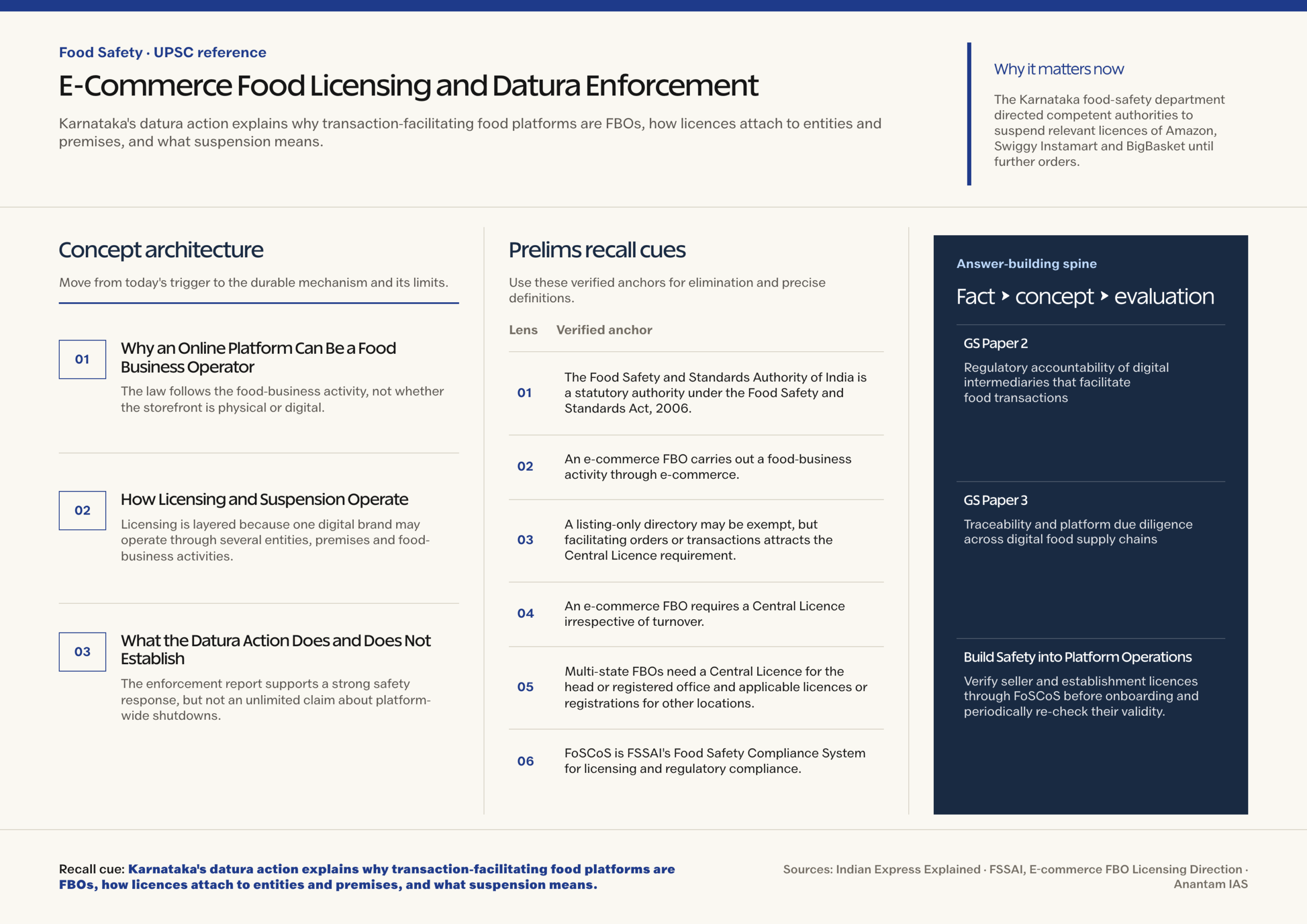
- The Food Safety and Standards Authority of India is a statutory authority under the Food Safety and Standards Act, 2006.
- An e-commerce FBO carries out a food-business activity through e-commerce.
- A listing-only directory may be exempt, but facilitating orders or transactions attracts the Central Licence requirement.
- An e-commerce FBO requires a Central Licence irrespective of turnover.
- Multi-state FBOs need a Central Licence for the head or registered office and applicable licences or registrations for other locations.
- FoSCoS is FSSAI’s Food Safety Compliance System for licensing and regulatory compliance.
Mains Relevance
GS Paper 2
- Regulatory accountability of digital intermediaries that facilitate food transactions
- Proportional enforcement, reasoned orders and opportunity of hearing in public-health regulation
GS Paper 3
- Traceability and platform due diligence across digital food supply chains
- Risk-based removal, seller verification and compliance monitoring for hazardous products
Essay
- Digital markets widen consumer choice, but trust depends on making convenience compatible with traceability and public-health accountability.
Background and Context
Why an Online Platform Can Be a Food Business Operator
The law follows the food-business activity, not whether the storefront is physical or digital.
- Section 3(n) of the Food Safety and Standards Act, 2006 defines food business broadly across manufacture, processing, packaging, storage, transport, distribution, import and food services.
- An entity carrying out such an activity through e-commerce becomes an e-commerce food business operator; being an intermediary does not automatically remove regulatory responsibility.
- A website that only provides a directory may fall outside licensing, provided it is not otherwise conducting food business under the Act’s definition.
- Once the entity also facilitates orders or transactions, FSSAI’s licensing framework requires it to hold a Central Licence from the competent Central Licensing Authority.
- E-commerce FBO rules also require seller licence details and compliance arrangements, turning platform onboarding and listing controls into food-safety safeguards rather than optional marketplace features.
How Licensing and Suspension Operate
Licensing is layered because one digital brand may operate through several entities, premises and food-business activities.
- The e-commerce activity requires a Central Licence irrespective of turnover, but that licence does not necessarily cover every warehouse, seller, dark store or other operating location.
- A multi-state FBO generally needs a Central Licence for its head or registered office and separate licences or registrations for other locations according to their eligibility and activities.
- The Karnataka direction identified the Designated Officer (Central) for Central Licences and the Designated Officer (State) for State Licences or registrations as the relevant enforcement channels.
- Under Regulation 2.1.8, a licensing or registering authority may suspend or cancel an authorisation forthwith in the interest of public health, recording reasons in writing.
- Suspension stops only the food-business activities authorised by the affected licence for its duration; cancellation is a separate, more final consequence under the regulatory framework.
What the Datura Action Does and Does Not Establish
The enforcement report supports a strong safety response, but not an unlimited claim about platform-wide shutdowns.
- The immediate trigger was the reported listing of toxic datura fruits and seeds for human consumption, creating a direct product-safety risk rather than a nutrition-labelling dispute.
- Karnataka ordered removal and discontinuation of those listings and directed suspension action against platform licences and the licences or registrations of supplying establishments and sellers.
- The platforms were asked to submit compliance reports; the reported process also contemplated an opportunity of hearing before the authorities passed appropriate further orders.
- Because the order did not specify licence numbers, entities or premises, its exact operational reach depends on which authorisations the competent authorities suspend.
- For governance analysis, the key issue is preventive due diligence: verified sellers, accurate food information, hazardous-listing controls, traceable supply chains and rapid compliance escalation.
Way Forward
Build Safety into Platform Operations
- Verify seller and establishment licences through FoSCoS before onboarding and periodically re-check their validity, authorised activities and linked operating locations.
- Create risk-based controls for prohibited or hazardous food listings, with rapid human review, removal, seller suspension and regulator notification where public health may be threatened.
- Keep product, seller, warehouse and transaction records traceable so regulators can identify the exact licence, premise and supply source instead of imposing unnecessarily broad disruption.
- Use reasoned, licence-specific enforcement with hearing and compliance review, while retaining immediate public-health powers for urgent hazards.
Conclusion
- The datura episode shows that platform accountability begins when a digital service moves beyond listing and participates in the food transaction.
- A strong answer should distinguish the platform’s Central Licence from premises-level authorisations and explain why suspension affects only the activities and locations covered by the identified licence.
- Effective regulation combines rapid hazard removal with seller verification, traceability, reasoned orders and a fair compliance review.
UPSC Practice Questions
Prelims MCQ 1
With reference to e-commerce Food Business Operators in India, consider the following statements:
- An e-commerce entity that only lists food businesses must always obtain a Central FSSAI Licence.
- An e-commerce entity that facilitates food orders or transactions requires a Central FSSAI Licence.
- A multi-state FBO may require separate licences or registrations for operating locations in addition to the head-office Central Licence.
How many of the above statements are correct?
(a) Only one (b) Only two (c) All three (d) None
Answer: (b) Only two
Explanation:
Statements 2 and 3 are correct. A listing-only directory may be exempt when it does not otherwise fall within the statutory definition of food business.
Prelims MCQ 2
What is the most accurate effect of suspending an FSSAI licence?
(a) It permanently dissolves every legal entity in the corporate group (b) It stops the food-business activities authorised by that licence for the suspension period (c) It automatically cancels every seller’s licence throughout India (d) It prohibits the platform from offering all non-food goods
Answer: (b) It stops the food-business activities authorised by that licence for the suspension period
Explanation:
Suspension operates through the affected licence and its authorised activities. Its territorial and operational reach depends on the identified entity, premises and licence scope.
UPSC Mains Questions
- Why are e-commerce platforms that facilitate food transactions regulated as Food Business Operators? Explain the licensing and due-diligence implications.
- The effectiveness of digital food-safety regulation depends on both rapid hazard removal and licence-specific due process. Discuss with reference to the Karnataka datura action.
Sources: Indian Express Explained and FSSAI, E-commerce FBO Licensing Direction.
Frequently Asked Questions
Why does an e-commerce food platform need an FSSAI licence?
A platform that facilitates food orders or transactions performs a regulated food-business activity through e-commerce and must obtain a Central Licence from the competent authority.
Is a listing-only food directory also required to obtain a licence?
Not necessarily. It may be exempt when it merely lists businesses or products and does not otherwise conduct food business or facilitate orders and transactions.
Does one Central Licence cover every platform operation?
No. A head-office Central Licence may coexist with separate licences or registrations for other entities, premises and operating locations, depending on their activities and eligibility.
What did Karnataka direct in the datura case?
It directed suspension action, removal of datura listings, discontinuation of sales for human consumption and compliance reports from the platforms, establishments and sellers concerned.
Did the order stop every food sale by the platforms across Karnataka?
That cannot be concluded from the reported order alone because it did not identify every affected licence number, entity, premise or authorised activity.
Source: https://anantamias.com/current-affairs/ecommerce-food-licensing-fssai-datura/
Slum Rehabilitation: Article 21 Requires More Than Relocation
Why in News?
On August 25, the Delhi High Court gave residents of three jhuggi clusters six weeks to relocate to Savda Ghevra while ordering safeguards for meaningful rehabilitation.
- The order covered residents of Bhai Ram Camp, Masjid Camp and DID Colony near Lok Kalyan Marg.
- A committee headed by a retired judicial officer was ordered to monitor the rehabilitation process.
- Authorities had to honor assurances covering schools, electricity, LPG connections, bus passes, dispensaries and other essential amenities.
- The Delhi Urban Shelter Improvement Board was directed to help transport residents’ household belongings to the allotted accommodation.
- The reported relocation involved 717 residents, but the court did not recognize a general right to rehabilitation at the original site.
- Relocation changes access to work, education, health care and social networks; a housing unit alone may not preserve a resident’s effective standard of living.
- The order illustrates how positive obligations under Article 21 can shape the implementation of an otherwise permitted administrative action.
- Court-supervised monitoring converts promises about services from a general assurance into duties whose performance can be reviewed.
UPSC Relevance
Prelims Relevance
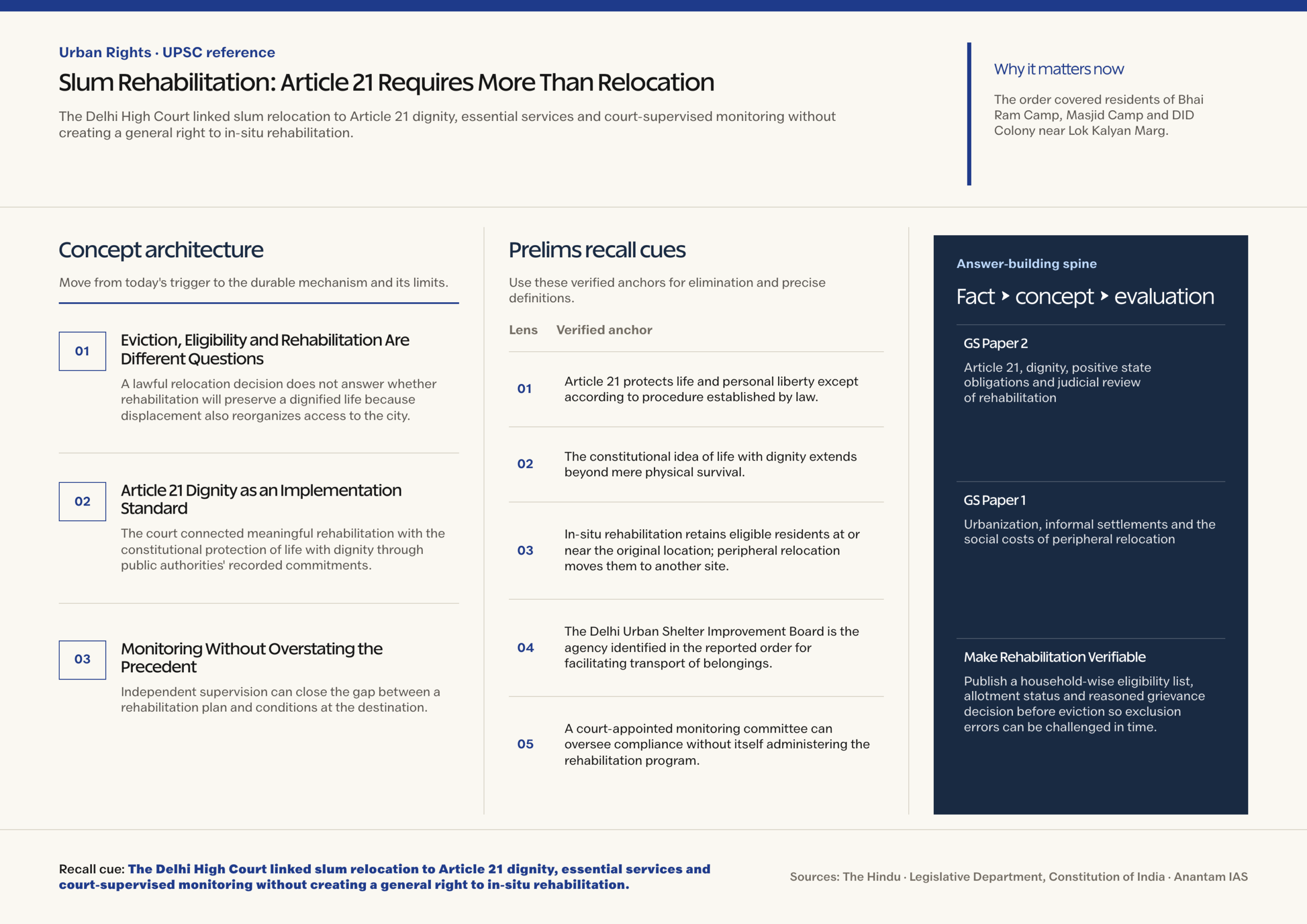
- Article 21 protects life and personal liberty except according to procedure established by law.
- The constitutional idea of life with dignity extends beyond mere physical survival.
- In-situ rehabilitation retains eligible residents at or near the original location; peripheral relocation moves them to another site.
- The Delhi Urban Shelter Improvement Board is the agency identified in the reported order for facilitating transport of belongings.
- A court-appointed monitoring committee can oversee compliance without itself administering the rehabilitation program.
Mains Relevance
GS Paper 2
- Article 21, dignity, positive state obligations and judicial review of rehabilitation
- Accountability tools for converting government assurances into measurable implementation
GS Paper 1
- Urbanization, informal settlements and the social costs of peripheral relocation
Essay
- Development becomes just when the State protects both physical shelter and the relationships that make urban life viable.
Background and Context
Eviction, Eligibility and Rehabilitation Are Different Questions
A lawful relocation decision does not answer whether rehabilitation will preserve a dignified life because displacement also reorganizes access to the city.
- Eviction concerns removal from occupied land; eligibility determines who qualifies under the applicable policy; rehabilitation concerns what support eligible households receive after displacement.
- The Division Bench rejected the residents’ challenge based on the Delhi Slum and JJ Rehabilitation and Relocation Policy, 2015 and allowed relocation to proceed.
- The reported order did not create an unconditional right to remain near Lok Kalyan Marg or a general constitutional entitlement to in-situ rehabilitation.
- In-situ rehabilitation can reduce disruption to jobs, schools and neighborhood networks, but land constraints or public-interest claims may make it contested or unavailable.
- Peripheral relocation may provide allotted housing while increasing travel time and household costs; rehabilitation quality must account for these functional consequences.
Article 21 Dignity as an Implementation Standard
The court connected meaningful rehabilitation with the constitutional protection of life with dignity through public authorities’ recorded commitments.
- Article 21 says no person shall be deprived of life or personal liberty except according to procedure established by law.
- Constitutional dignity asks whether State action leaves people able to live as rights-bearing persons, not merely whether a physical structure has been allotted.
- Schools, electricity, cooking fuel, transport and health facilities matter because they connect shelter with education, safety, mobility, nutrition and access to care.
- Transporting household belongings is a small but concrete safeguard against loss during displacement and lowers the immediate burden imposed on relocated families.
- The order’s force lies in linking stated service commitments to the relocation process; it does not make every promised amenity an independent fundamental right.
Monitoring Without Overstating the Precedent
Independent supervision can close the gap between a rehabilitation plan and conditions at the destination, supplying evidence for corrective orders.
- A committee led by a retired judicial officer creates an identifiable channel for checking whether agencies deliver what they assured the court.
- Monitoring should track readiness before movement, continuity during transition and access after occupation, rather than treating the allotment letter as completion.
- Useful indicators include functioning utilities, school access, public transport, primary health services, grievance resolution and safe movement of household possessions.
- The service and monitoring directions were case-specific implementation safeguards; they should not be converted into a final, universal merits doctrine on all slum evictions.
- For a Mains answer, separate the immediate holding, the authorities’ recorded assurances and the broader Article 21 principle; this prevents overstating judicial precedent.
Way Forward
Make Rehabilitation Verifiable
A rights-sensitive relocation process needs measurable duties before, during and after the move.
- Publish a household-wise eligibility list, allotment status and reasoned grievance decision before eviction so exclusion errors can be challenged in time.
- Verify utilities, schools, health care and transport at the destination before movement, with independent inspection records accessible to residents.
- Track livelihood and school disruption after relocation, and provide time-bound remedies when promised services are absent or unusable.
- Give the monitoring body clear reporting intervals, agency responsibility and an escalation route so recorded non-compliance leads to corrective action.
Conclusion
- The Delhi High Court order shows that meaningful rehabilitation is judged by whether relocation preserves the practical conditions of a dignified life, not by housing allotment alone.
- Use the case to argue for service guarantees and accountable monitoring, while noting that it did not establish a general right to in-situ rehabilitation.
- A balanced constitutional answer should test both sides: the State’s stated public-interest justification for relocation and its positive duty to prevent avoidable deprivation at the destination.
UPSC Practice Questions
Prelims MCQ 1
With reference to slum rehabilitation and the reported Delhi High Court order, consider the following statements:
- The Court recognized a general fundamental right to in-situ rehabilitation.
- A monitoring committee headed by a retired judicial officer was ordered to oversee rehabilitation.
- The Delhi Urban Shelter Improvement Board was directed to facilitate transport of household belongings.
How many of the above statements are correct?
(a) Only one (b) Only two (c) All three (d) None
Answer: (b) Only two
Explanation:
Statements 2 and 3 are correct. The Court allowed relocation with case-specific safeguards; it did not recognize a general fundamental right to rehabilitation at the original site.
Prelims MCQ 2
Which one of the following best explains the constitutional significance of essential-service assurances during relocation?
(a) They automatically transfer ownership of the original land to residents (b) They convert every welfare benefit into an absolute fundamental right (c) They connect physical shelter with the practical requirements of life with dignity (d) They remove the need to determine eligibility under a rehabilitation policy
Answer: (c) They connect physical shelter with the practical requirements of life with dignity
Explanation:
Education, electricity, cooking fuel, transport and health care affect whether relocated residents can sustain a dignified life. The assurances do not settle title or erase policy eligibility rules.
UPSC Mains Questions
- Slum rehabilitation must be assessed as a question of dignified urban citizenship, not merely physical relocation. Discuss with reference to Article 21.
- How can court-supervised monitoring make rehabilitation assurances enforceable without converting the judiciary into a day-to-day administrator?
Sources: The Hindu and Legislative Department, Constitution of India.
Frequently Asked Questions
What did the Delhi High Court direct in the slum relocation case?
It allowed six weeks for relocation to Savda Ghevra, ordered a monitoring committee and required authorities to honor assurances on essential services and transport of belongings.
Did the Court recognize a general right to in-situ rehabilitation?
No. The reported order rejected the residents’ relocation challenge and imposed case-specific safeguards; it should not be read as a universal right to remain at the original site.
Why is Article 21 relevant to rehabilitation?
Article 21 protects life and personal liberty. The Court treated dignity as requiring meaningful rehabilitation supported by services that make the allotted shelter practically habitable.
What is the role of the monitoring committee?
The committee provides independent oversight of whether rehabilitation commitments are carried out, helping the court review implementation without directly managing each service.
How should aspirants use this case in a Mains answer?
Use it to connect Article 21 dignity with service-linked rehabilitation and monitoring, while clearly stating that the directions were fact-specific and did not establish a universal in-situ right.
Source: https://anantamias.com/current-affairs/delhi-slum-rehabilitation-article-21-dignity/
India-Seychelles Fisheries Cooperation Agenda
Why in News?
India-Seychelles fisheries cooperation advanced through bilateral talks on 25 August 2026, but the official release recorded proposals and interest in an MoU, not a newly signed fisheries agreement.
- India’s Department of Fisheries hosted the Seychelles delegation to review existing frameworks and explore a collaborative road map for fisheries and aquaculture.
- The agenda covered stock assessment, fisheries data systems, monitoring-control-surveillance infrastructure, mariculture, hatcheries, tuna value chains and conservation.
- Both sides identified an annual work plan, regulatory alignment, reciprocal laboratory access and jointly designed pilots as routes for implementation.
- Seychelles expressed interest in a dedicated fisheries-and-aquaculture MoU; the release did not say that such an MoU was signed.
- The proposed architecture moves bilateral cooperation from broad diplomatic intent toward measurable tasks, responsible institutions, shared evidence and recurring review.
- Fisheries cooperation requires ecological data and compliance capacity because harvest expansion without stock assessment or surveillance can weaken both livelihoods and conservation.
- Small pilots can test hatchery, mariculture, processing or waste-management approaches before either country treats an unproven model as an operational programme.
UPSC Relevance
Prelims Relevance
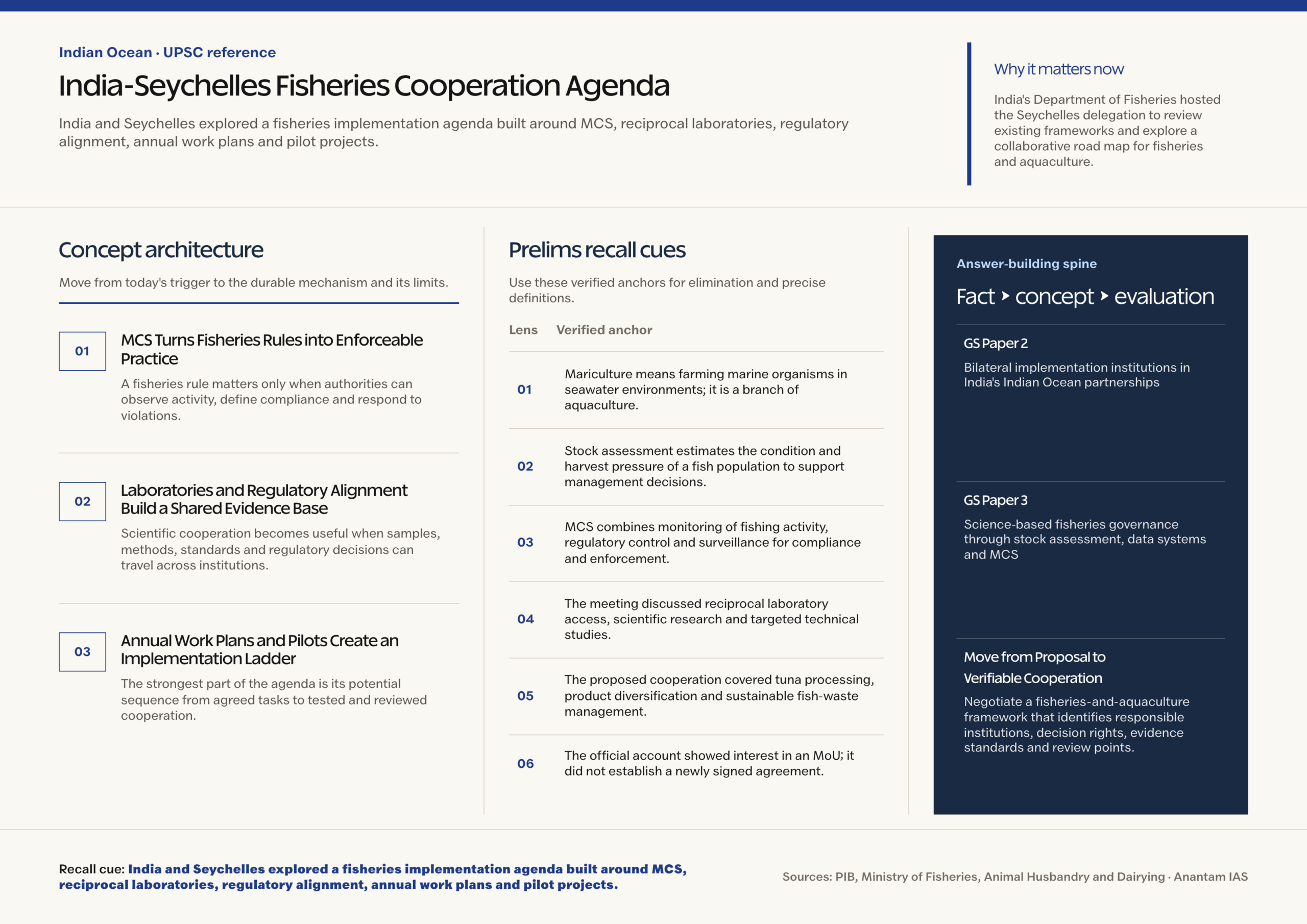
- Mariculture means farming marine organisms in seawater environments; it is a branch of aquaculture.
- Stock assessment estimates the condition and harvest pressure of a fish population to support management decisions.
- MCS combines monitoring of fishing activity, regulatory control and surveillance for compliance and enforcement.
- The meeting discussed reciprocal laboratory access, scientific research and targeted technical studies.
- The proposed cooperation covered tuna processing, product diversification and sustainable fish-waste management.
- The official account showed interest in an MoU; it did not establish a newly signed agreement.
Mains Relevance
GS Paper 2
- Bilateral implementation institutions in India’s Indian Ocean partnerships
- Technical cooperation, regulatory alignment and capacity-building between India and Seychelles
GS Paper 3
- Science-based fisheries governance through stock assessment, data systems and MCS
- Mariculture, tuna value chains, post-harvest engineering and marine conservation
Essay
- Durable international cooperation depends less on broad declarations than on institutions that turn shared intent into evidence, rules, pilots and accountable review.
Background and Context
MCS Turns Fisheries Rules into Enforceable Practice
A fisheries rule matters only when authorities can observe activity, define compliance and respond to violations.
- Monitoring collects information on vessels, fishing effort, catch, landing and location so regulators can compare actual activity with authorised activity and scientific advice.
- Control supplies the legal and administrative layer: licences, permitted gear, reporting duties, harvest conditions, closed areas or seasons, and sanctions for non-compliance.
- Surveillance checks behaviour through inspections, patrols and other verification tools, allowing authorities to detect discrepancies and direct limited enforcement resources toward higher-risk activity.
- A joint agenda can improve interoperability between data systems and procedures, but the talks did not establish that shared MCS infrastructure or artificial-intelligence tools were already operational.
- Stock assessment gives MCS an ecological purpose: compliance data and scientific evidence can inform harvest decisions rather than treating vessel tracking as an isolated security exercise.
Laboratories and Regulatory Alignment Build a Shared Evidence Base
Scientific cooperation becomes useful when samples, methods, standards and regulatory decisions can travel across institutions.
- The talks proposed reciprocal laboratory access, enabling researchers and technical agencies to use complementary facilities for testing, training and joint scientific work.
- Targeted studies can connect stock assessment with hatchery, mariculture, tuna-processing, conservation and fish-waste questions instead of producing research detached from implementation needs.
- Regulatory alignment does not require identical domestic laws; it can begin with compatible definitions, sampling protocols, documentation, quality controls and reporting practices for agreed activities.
- Comparable evidence can reduce disputes over methods and help administrators judge whether a pilot should be expanded, modified or stopped before it creates ecological or market risk.
- Commercialising joint research requires clear safeguards for data governance, scientific integrity, intellectual contributions, biosecurity and public-interest regulation; the release proposed acceleration but supplied no completed arrangement.
Annual Work Plans and Pilots Create an Implementation Ladder
The strongest part of the agenda is its potential sequence from agreed tasks to tested and reviewed cooperation.
- An annual work plan can assign institutions, milestones, training needs, data outputs and review dates, making bilateral intent easier to monitor than an open-ended cooperation statement.
- A mariculture or hatchery pilot should establish baseline ecological conditions, species suitability, disease safeguards, feed and waste controls, community participation and measurable stop-or-scale criteria.
- A tuna-value-chain pilot can examine post-harvest engineering, processing, product diversification and waste management without assuming that greater harvest volume is the only route to higher value.
- Extension services, exposure visits and specialised exchanges can translate laboratory knowledge into operational practice while revealing whether methods fit each country’s administrative and ecological conditions.
- The sequence remains proposed: talks identified work plans, alignment, laboratories and pilots, while Seychelles sought a dedicated MoU to institutionalise continuing engagement.
Way Forward
Move from Proposal to Verifiable Cooperation
- Negotiate a fisheries-and-aquaculture framework that identifies responsible institutions, decision rights, data-sharing safeguards and a public method for reviewing annual work-plan results.
- Choose pilots through stock evidence and ecological risk screening, then define baseline indicators, time limits and stop-or-scale criteria before implementation.
- Align laboratory protocols, catch documentation and compliance definitions sufficiently for evidence to be compared without erasing each country’s domestic regulatory authority.
- Evaluate value-chain gains alongside stock health, waste reduction, livelihood access and enforcement costs rather than measuring cooperation only by production or export volume.
Conclusion
- The talks matter as a proposed implementation architecture: MCS, shared science, reciprocal laboratories, regulatory alignment, annual planning and pilots can connect diplomacy with measurable fisheries governance.
- A strong answer should distinguish an agenda from an agreement; Seychelles expressed interest in a dedicated MoU, but the official release did not show a new fisheries MoU as signed.
- The test of cooperation will be whether pilots produce traceable evidence, compatible rules and sustainable value chains without treating higher extraction as the default measure of success.
UPSC Practice Questions
Prelims MCQ 1
With reference to fisheries governance, consider the following statements:
- Mariculture is the farming of marine organisms in seawater environments.
- Stock assessment helps estimate the condition and harvest pressure of fish populations.
- Monitoring, Control and Surveillance refers only to scientific estimation of fish stocks.
How many of the above statements are correct?
(a) Only one (b) Only two (c) All three (d) None
Answer: (b) Only two
Explanation:
Statements 1 and 2 are correct. MCS covers observing fishing activity, setting regulatory controls and checking compliance; stock assessment is related scientific evidence, not the complete meaning of MCS.
Prelims MCQ 2
Which of the following best describes the outcome recorded by the official release on the 25 August 2026 India-Seychelles fisheries meeting?
(a) A new fisheries MoU entered into force immediately (b) A common fishing fleet began joint operations (c) The sides explored cooperation instruments and Seychelles expressed interest in a dedicated MoU (d) A binding regional tuna quota was adopted
Answer: (c) The sides explored cooperation instruments and Seychelles expressed interest in a dedicated MoU
Explanation:
The release describes talks, proposed implementation instruments and Seychelles’ interest in an MoU. It does not report a newly signed fisheries MoU, joint fleet or binding tuna quota.
UPSC Mains Questions
- India-Seychelles fisheries cooperation can become a model of implementation-led Indian Ocean diplomacy. Examine the role of MCS, shared laboratories, regulatory alignment and annual work plans.
- Why should mariculture and fisheries value-chain pilots be tied to stock assessment, ecological safeguards and measurable stop-or-scale criteria? Discuss.
Source: PIB, Ministry of Fisheries, Animal Husbandry and Dairying.
Frequently Asked Questions
What did India and Seychelles decide on fisheries cooperation?
They explored cooperation on MCS, laboratories, research, mariculture, value chains, regulatory alignment, annual planning and pilots. The release recorded proposals, not completed implementation.
Was a new India-Seychelles fisheries MoU signed?
No new signed fisheries MoU was reported. Seychelles expressed interest in a dedicated fisheries-and-aquaculture MoU supported by an advanced work plan and continuing institutional engagement.
What is Monitoring, Control and Surveillance in fisheries?
MCS combines information on fishing activity, regulatory rules and compliance checks so authorities can compare actual conduct with licences, management measures and conservation requirements.
Why does reciprocal laboratory access matter?
It can let institutions use complementary facilities, compare methods, train specialists and conduct joint studies, creating a stronger evidence base for regulation and pilot evaluation.
How should a mariculture pilot be evaluated?
It should begin with ecological baselines and assess species suitability, disease, feed, waste, community access and compliance against stated time limits and stop-or-scale criteria.
Source: https://anantamias.com/current-affairs/india-seychelles-fisheries-blue-economy/
Limits of Air Power and Implications for India’s Theatreisation
Why in News?
Recent conflicts in Ukraine and Iran show that air power remains indispensable but is rarely sufficient to secure victory independently. This has renewed India’s debate over whether centralised control of the Indian Air Force (IAF) can meet a prolonged China or two-front contingency, or whether Integrated Theatre Commands are necessary.
| UPSC Relevance: GS-3 Internal Security: Defence preparedness, Emerging warfare Prelims: Integrated Theatre Commands, CDS, DMA, Andaman and Nicobar Command, ISO Act, 2023 Mains: Jointness among Armed Forces, two-front challenge, military reforms |
What is an Integrated Theatre Command?
- Air power is the ability to employ aircraft, missiles, drones, surveillance systems and supporting space assets to produce strategic and tactical military effects.
- Theatre-isation involves reorganising service-specific commands into geographical or functional Joint Theatre Commands, with assigned Army, Navy and Air Force assets placed under a single operational commander.
India is examining commands for land borders, maritime security and integrated air defence.
Key Facts:
- Cost-exchange asymmetry: One-way attack drones may cost only tens of thousands of dollars, while sophisticated surface-to-air interceptors can cost hundreds of thousands or millions of dollars.
- IAF’s squadron deficit: Against an authorised benchmark of 42 fighter squadrons, open-source assessments place the IAF’s operational strength at approximately 30-31 squadrons.
- China’s quantitative advantage: China possesses a much larger overall combat-air fleet. However, direct numerical comparisons can be misleading because not all Chinese aircraft can be deployed across the Himalayas, while high-altitude Tibetan airbases impose payload penalties.
- Operation Sindoor: Pakistani drones and missiles were countered through India’s Integrated Counter-UAS Grid and layered air-defence systems.
Fundamental Limits of Modern Air Power:
- Contested Airspace: Ukraine’s dispersed and networked surface-to-air defences prevented Russia’s larger air force from obtaining uncontested control. Numerical superiority can therefore be offset by mobile air defences, electronic warfare and resilient command networks.
- Air Superiority without Strategic Victory: Despite extensive US-Israeli freedom of action over Iran, dispersed missile forces and underground infrastructure survived. Air power can destroy visible targets and disrupt logistics, but cannot independently occupy territory or compel a durable political settlement.
- Unfavourable Cost Arithmetic: Drone swarms can force defenders to exhaust expensive and finite interceptor stocks. This allows a weaker force to impose disproportionate economic and operational costs.
- Dependence on Other Domains: Air operations require satellites, intelligence, cyber networks, radars, special forces and secure logistics. Air power must therefore operate within a multi-domain system, rather than as a standalone war-winning instrument.
The IAF’s Case against Theatreisation:
- Flexibility and rapid swing: Fighters such as Rafales and Su-30MKIs can be shifted rapidly between the China and Pakistan fronts. The IAF fears that fixed allocation to theatres would weaken this flexibility.
- Scarcity of assets: Permanently dividing approximately 30-31 fighter squadrons among multiple commanders could prevent the concentration of combat power at the decisive location.
- Need for central prioritisation: Strategic assets such as airborne warning aircraft, refuellers, long-range surveillance platforms and air-defence systems may be required across theatres simultaneously.
- Risk of land-centric employment: Placing air assets under ground-force commanders may reduce air power to close-air-support duties, overlooking offensive counter-air operations, strategic strikes and air interdiction.
- Proven effectiveness: Centralised control supported successful limited operations such as Balakot and Operation Sindoor.
- Coordination as an alternative: The IAF has favoured a Joint Planning and Coordination Centre to improve inter-service cooperation without permanently transferring air assets to theatre commanders.
Why the Existing Model may Face Challenges against China?
- Strategic and industrial depth: Unlike Pakistan, China can disperse assets, absorb losses and sustain a longer conflict.
- Extended and difficult frontier: The LAC stretches from Ladakh to Arunachal Pradesh. Terrain, weather and limited basing options complicate rapid force generation and redeployment.
- Multi-domain challenge: China can combine aircraft with missiles, drones, cyberattacks, electronic warfare and space-based surveillance.
- Two-front contingency: Simultaneous pressure from China and Pakistan would require real-time decisions regarding the allocation of scarce fighters, air-defence systems and surveillance platforms.
- Consultative delays: A coordination centre depends upon inter-service consultation. During a fast-moving crisis, the absence of a clearly empowered commander may delay targeting, logistics and reinforcement decisions.
- Air-land integration gap: Ground formations and Integrated Battle Groups along the LAC require predictable and timely air support based on pre-agreed joint plans.
- Institutional friction: Differences in rank equivalence, promotions, career incentives and command authority continue to complicate unified chains of command.
Significance of Integrated Theatre Commands:
- Unity of command: One commander becomes responsible for the operational outcome within the theatre.
- Faster decision-making: Reduces crisis-time consultation and accelerates the allocation of intelligence, strike and logistics assets.
- Joint-force multiplication: Integrates land, maritime, air, cyber, space and electronic warfare capabilities.
- Common operational picture: Enables all Services to access the same surveillance, intelligence and targeting information.
- Efficient resource utilisation: Common logistics, infrastructure, maintenance and procurement can reduce duplication and costs.
- Multi-domain preparedness: Provides an institutional structure for synchronising kinetic and non-kinetic operations.
India already possesses a technological foundation for such integration. The Army’s Akashteer network connects with the IAF’s IACCS and the Navy’s air-defence network to generate a common air picture.
The Inter-Services Organisations (Command, Control and Discipline) Act, 2023 also empowers commanders of inter-service formations to exercise authority over personnel from different Services, providing a legal foundation for greater integration.
Associated Concerns:
- Fragmentation of a numerically constrained Air Force
- Over-centralisation of operational power in theatre commanders
- Duplication between Service Headquarters and theatre establishments
- Inter-service rivalry over command appointments and asset ownership
- Absence of a clear mechanism for reallocating assets between theatres; and
- Risk of mechanically copying foreign models unsuited to Indian geography.
Way Forward:
- Adopt a phased approach: Begin with integrated planning, logistics, communications, intelligence and air defence before transferring wider operational control.
- Create a national strategic reserve: Keep scarce assets (AEW&C aircraft, refuellers, strategic transport, long-range ISR and selected fighter units) under central control.
- Ensure dynamic asset allocation: Theatre commanders may receive operational control of designated air assets, while the Air Chief retains the ability to recommend cross-theatre reallocation during national emergencies.
- Appoint Air Component Commanders: Every theatre must have a senior air officer responsible for designing and executing the air campaign.
- Institutionalise peacetime jointness: Make tri-service postings, joint professional education and joint exercises essential for promotion, drawing lessons from the US Goldwater-Nichols reforms.
- Conduct China-centric war games: Test theatre structures against prolonged LAC conflict, two-front escalation and disruption of cyber-space networks.
- Build economical counter-drone layers: Expand jamming, spoofing, guns, interceptor drones, VSHORADS and laser-based directed-energy systems. DRDO’s Integrated Air Defence Weapon System combines QRSAM, VSHORADS and a high-power laser.
- Integrate C4ISR networks: Link the sensors, radars and weapon systems of all three Services into a secure and real-time operational grid.
Recent wars do not establish the decline of air power; they expose the limitations of employing it in isolation. The IAF’s concern about preserving flexibility is valid, particularly given its squadron deficit. However, flexibility without unified planning and command may prove inadequate against a peer adversary such as China.
India therefore requires a hybrid theatre architecture: centralised control of scarce strategic assets combined with integrated theatre-level execution so that its Armed Forces fight as one military system rather than three coordinated Services.
Ending Secrecy in Judicial Appointments
Why in News?
Supreme Court judge Justice Ujjal Bhuyan recently called for greater transparency in collegium decisions, arguing that non-disclosure of reasons weakens public confidence and may disadvantage meritorious candidates. The debate highlights the need to reconcile judicial independence with constitutional accountability.
| UPSC Relevance: GS-2 Polity and Governance: Judiciary, Separation of powers, Transparency and accountability Prelims: Collegium system, Judges Cases, NJAC, Articles 124 and 217 Mains: Judicial appointments, independence versus accountability, judicial reforms |
What is the Collegium System?
- The Collegium system is a mechanism used for the appointment and transfer of judges in the Supreme Court and High Courts.
- Constitutional basis:
- Judicial appointments in India are governed by Articles 124 and 217 of the Constitution of India, which empower the President to appoint judges to the Supreme Court and High Courts.
- The Collegium system is not explicitly mentioned in the Indian Constitution but has evolved through a series of judicial interpretations (known as the Judges Cases).
- Composition of Collegium:
- For SC: Chief Justice of India and four senior-most judges of the Supreme Court.
- For HC: Chief Justice of the respective HC and two senior-most judges of the HC.
Evolution of the Collegium System:
- First Judges Case (1981): Gave the executive primacy in judicial appointments. The President was not bound to appoint a candidate based on the consultation of the SC. Consultation did not mean concurrence.
- Second Judges Case (1993): Reversed executive primacy and held that the institutional opinion of the CJI and senior judges would prevail. It resulted in the birth of the Collegium System.
- Third Judges Case (1998): Collegium was expanded and took its current form. Consultation would include a plurality of judges.
- 99th Constitutional Amendment and NJAC Act: Sought to replace the collegium with the National Judicial Appointments Commission.
- NJAC Judgment (2015): Supreme Court struck down the NJAC framework for undermining judicial independence, which forms part of the Constitution’s basic structure. However, the Court acknowledged deficiencies in the collegium and invited reforms.
Recent Transparency Initiatives:
- In 2017, the Supreme Court began publishing collegium resolutions to improve transparency.
- In 2025, it published the broader appointment process and data on High Court appointees, including source of recruitment, gender, social category and whether an appointee was related to a sitting or retired judge.
- The Supreme Court also decided to place judges’ asset declarations in the public domain.
However, recent collegium statements have frequently disclosed the names recommended without explaining the criteria applied or reasons for selection.
Concerns with the Collegium System:
- Absence of publicly defined criteria: There is no comprehensive and consistently applied matrix covering merit, integrity, judicial temperament, domain expertise and diversity.
- Limited disclosure of reasons: Bare recommendations make it difficult to determine why one candidate was preferred over other eligible persons.
- Restricted talent pool: Vacancies are not ordinarily filled through a public expression-of-interest process, disadvantaging first-generation lawyers and advocates outside influential professional networks.
- Possibility of nepotism: The absence of transparent conflict-of-interest rules fuels allegations that candidates with judicial or professional connections enjoy easier access to consideration.
- Inadequate diversity: Women, marginalised social groups, first-generation lawyers and several regions remain under-represented in constitutional courts.
- Lack of accountability: Collegium decisions are not subjected to administrative review, while judicial review of appointment decisions remains extremely limited.
- Executive opacity: The Union government may delay, segregate or return recommendations without publicly explaining its objections. Therefore, opacity is not confined to the judiciary alone.
- Weak institutional capacity: The collegium does not have a permanent secretariat with systematic databases on judgments, professional competence, integrity, diversity and potential candidates.
Constitutional and Jurisprudential Concerns:
- Articles 14 and 16: Embody equality and non-arbitrariness in public appointments. However, judges hold constitutional offices and cannot be equated directly with ordinary public employees. These provisions nevertheless provide a strong normative case for fair and structured selection.
- Article 19(1)(a): The citizen’s right to information supports reasonable disclosure regarding the functioning of public institutions.
- Article 50: Requires separation of the judiciary from the executive and supports protection from political interference.
- MediaOne Case (2023): The Supreme Court held that blanket secrecy and sealed-cover procedures are incompatible with a transparent and accountable system.
- CPIO v. Subhash Chandra Agarwal (2019): Held that the CJI’s office is a “public authority” under the RTI Act, while recognising that transparency must be balanced against privacy and judicial independence.
Thus, the judiciary’s own jurisprudence favours proportionate disclosure rather than absolute secrecy.
Why complete disclosure may be problematic?
- Intelligence inputs may contain sensitive or unverified information.
- Publication of adverse material could permanently damage unsuccessful candidates.
- Public interviews may encourage lobbying, ideological labelling and media trials.
- Judicial merit includes integrity, independence and temperament, which cannot be reduced entirely to numerical scoring.
- Excessive executive or political participation could compromise judicial independence.
Therefore, transparency need not mean publication of every confidential document. The objective should be process transparency with protected personal information.
Way Forward:
- Permanent Collegium Secretariat: Establish an independent professional body to maintain candidate databases, vacancy calendars, diversity statistics and institutional records.
- Advance vacancy notification: Publish anticipated vacancies and invite nominations or expressions of interest from eligible advocates and judicial officers.
- Transparent selection matrix: Disclose broad criteria covering professional competence, integrity, judgments, constitutional values, temperament, specialisation and diversity. Publish the positive reasons for selecting a candidate.
- Conflict-of-interest safeguards: Require collegium members to disclose relationships and recuse themselves where necessary. Relatives of judges should face enhanced scrutiny, but not automatic exclusion solely on lineage.
- Structured consultation: Institutionalise inputs from the Bar, senior judges and relevant professional bodies through documented procedures.
- Diversity audit: Publish annual data on gender, caste, minority, regional and professional representation without introducing rigid quotas for constitutional offices.
- Executive accountability: Impose timelines for processing recommendations and require reasoned communication when names are returned or withheld.
- Graded transparency: Separate information into what must be publicly disclosed, what may be shared with the candidate and what must remain confidential.
- Revise the Memorandum of Procedure: Codify responsibilities, timelines, eligibility standards and disclosure norms while preserving judicial primacy.
India can preserve judicial independence while introducing objective criteria, institutional capacity, reasoned disclosure and conflict-of-interest safeguards. Independence protects judges from external pressure; transparency protects the institution from arbitrariness and declining public trust.
Source: https://anantamias.com/current-affairs/ending-secrecy-in-judicial-appointments/
Protecting Elephant Corridors in India
Why in News?
Recently, the Supreme Court has directed the Union government to undertake a fresh nationwide survey of elephant corridors and submit a comprehensive status report within eight weeks.
- The Court held that States cannot erect walls, trenches or other obstacles on traditional elephant routes merely to prevent crop damage.
- It also sought enforcement of its 2018 prohibition on the barbaric and illegal use of fireballs, burning torches and spikes by hula parties to drive away elephants.
| UPSC Relevance: GS-3 Environment: Biodiversity, Conservation Prelims: Elephant Corridors, Asiatic Elephants |
What are Elephant Corridors?
- Elephant corridors are narrow stretches of land connecting two or more larger elephant habitats. They enable herds to move between forests in search of food, water and breeding grounds. Disrupting them can not only spark human-elephant conflict but pose a threat to the animals themselves.
- India has 150 scientifically validated elephant corridors across 15 States and 33 Elephant Reserves. India is also home to nearly 60% of the world’s wild Asian elephant population.
- India has four principal elephant population landscapes:
- Western Ghats
- North-Eastern Hills and Brahmaputra floodplains
- Shivalik Hills and Gangetic plains
- Central India and Eastern Ghats.
- More than 50% of India’s 22,446 elephants are distributed in the Western Ghats across Karnataka (6,013), Tamil Nadu (3,136) and Kerala (2,785).
But the habitat of the once-contiguous Western Ghats population is rapidly getting fragmented owing to changing land use, coffee and tea plantations, invasive plants, and farmland fencing.
Why do Elephants move long distances?
- Asian elephants are highly mobile and social mammals. A male elephant’s average home range (the area it typically uses for food, water and shelter) extends between 50 and 300 square kilometres, but can increase depending on the availability of resources.
- Elephants can move through their range in herds or individually. These home ranges can also vary depending on habitat type, food availability, water sources, population density and human disturbances.
- Elephant movements are strongly influenced by the seasonal and spatial distribution of food, water and habitat. For instance, seasonal migrations into Kerala are common during the dry months as elephants seek water and food in the relatively moist forests of the Western Ghats. Climate change and drought have played a role in forcing migration.
In all this, corridors play a crucial role, allowing elephants to move for food, for natural dispersal and everyday movement. Now, the migratory routes are also increasingly being influenced by infrastructure construction, mining and farmland.
Why are Corridors Important?
- Genetic connectivity: They prevent elephant populations from becoming isolated and genetically unviable.
- Reduction of conflict: Predictable, unobstructed routes reduce the likelihood that elephants enter villages and agricultural fields.
- Landscape conservation: Elephants are a keystone and umbrella species; protecting their movement routes benefits several other species.
- Climate resilience: Connected habitats allow wildlife to adjust its range in response to changing rainfall, water availability and vegetation.
- To provide Inter-State connectivity, as Elephant movement is ecological rather than administrative.
Major Threats:
- Elephant corridors are fragmented by construction/ expansion of highways, railway lines, mines, dams, settlements, resorts, agricultural expansion and transmission infrastructure.
- Fences, trenches and walls erected to protect crops may divert elephants towards densely populated areas, thereby worsening human-elephant conflict.
Inclusion in an official corridor inventory does not automatically provide the same statutory protection as a National Park or Wildlife Sanctuary, particularly where corridors pass through private or revenue land.
Legal Protection:
- The Asiatic elephant is listed in Schedule I of the Wildlife (Protection) Act, 1972, and receives the highest level of domestic legal protection.
- IUCN status: Endangered
- CITES: Appendix I
- Project Elephant, launched in 1992, supports habitat and corridor conservation and the mitigation of human-elephant conflict.
- Articles 48A and 51A(g) of the Constitution create obligations for environmental and wildlife protection.
Significance of the Court’s Direction:
- The order adopts a landscape-based approach to conservation. It recognises that wildlife corridors cannot be managed independently by individual States.
- It also shifts conflict mitigation away from coercive blockades towards scientific habitat management, cooperative federalism and humane coexistence.
Way Forward:
- Map corridors using satellite imagery, camera traps, Global Positioning System telemetry and local ecological knowledge.
- Provide corridor-specific legal protection through Eco-Sensitive Zones, conservation reserves, land acquisition or voluntary conservation agreements.
- Construct scientifically designed underpasses and overpasses across highways and railway lines.
- Undertake cumulative environmental impact assessments for infrastructure passing through elephant landscapes.
- Develop interoperable early-warning systems and inter-State rapid-response teams.
- Ensure prompt and transparent compensation for crop, property and human losses.
- Promote non-lethal deterrents, crop insurance and less elephant-attractive crops along conflict-prone boundaries.
- Restore degraded forests, water sources and fragmented corridors instead of merely driving elephants away.
Human-elephant conflict cannot be solved by obstructing the animal’s traditional right of passage. Securing connected habitats, protecting local livelihoods and coordinating conservation across State boundaries constitute the most durable path towards coexistence.
Source: https://anantamias.com/current-affairs/protecting-elephant-corridors-in-india/
Scaling Compressed Biogas: Feedstock Supply Chain Is the Next Critical Lever
Why in News?
The Union Cabinet has recently approved the GOBARdhan or the National Circular Bioenergy Scheme with an outlay of ₹23,731 crore for FY 2026-27 to FY 2035-36. It seeks nearly tenfold growth in domestic compressed biogas (CBG) production through assured offtake, stable pricing, capital assistance, pipeline connectivity and credit support.
With the demand side becoming more predictable, reliable sourcing, storage and quality management of feedstock have emerged as the next major constraints.
| UPSC Relevance: GS-3: Energy, Circular Economy, Government Schemes Prelims: Biogas, anaerobic digestion, SATAT, GOBARdhan, CBG Obligation. Mains: Renewable energy, energy security, waste management, circular economy. |
What is Compressed Biogas?
- Biogas is produced when microorganisms break down biodegradable material in the absence of oxygen, a process called anaerobic digestion.
- Raw biogas generally contains around 55-60% methane, along with carbon dioxide, hydrogen sulphide and moisture.
- After these impurities are removed and the gas is compressed, it becomes Compressed Biogas or Bio-CNG, with methane content generally above 90%.

The residual digestate is processed into Fermented Organic Manure (FOM), Liquid Fermented Organic Manure (LFOM) or bio-slurry.
India’s CBG Position:
- According to the GOBARdhan Unified Registration Portal, as of mid-2026, a total of 1,908 Compressed Biogas (CBG)/Bio-CNG plants have been registered across the country. Of these, 217 plants have already been commissioned, producing 0.4 Million Standard Cubic Meters per Day (MMSCMD), while 339 plants are under construction.
- The original SATAT vision is 5,000 plants and 15 MMT annual production by 2023-24. This highlights the gap between project announcements and sustained commercial operation.
Why is Feedstock the Critical Bottleneck?
CBG plants require a year-round supply of feedstock with consistent quality. Disruptions reduce gas yield, plant utilisation and financial viability.
- Press mud: It is moist, perishable and available mainly during the four-to-five-month sugar-crushing season. Year-round production requires timely procurement and storage, while long-distance transportation is costly. A radius of about 25 km is generally considered viable.
- Cattle dung: Though available throughout the year, it is dispersed across small livestock holdings. Its high moisture and low energy density necessitate local aggregation through dairy cooperatives, gaushalas or rural entrepreneurs.
- Paddy and wheat straw: Crop residues have relatively high gas potential but are seasonal. Paddy straw may need to be collected, baled and transported within a 15-day window. Storage must prevent summer fires and monsoon moisture damage.
- Municipal and food waste: Poor source segregation causes contamination, while variations in composition and additional pre-sorting increase operational costs.
- Competing uses: Agricultural residues are also used as fodder, bedding and inputs for paper, ethanol, biomass power and industrial boilers. This competition can increase feedstock prices and undermine plant viability.
Why can an Aggregator-Based Model help?
- Individual farmers may be unwilling to sign complex, long-term contracts with industrial plants. An intermediary can bridge this institutional and logistical gap.
- Potential Aggregators include: Farmer Producer Organisations, Primary Agricultural Credit Societies, Dairy and sugar cooperatives, Custom-hiring centres, Self-help groups, Gaushalas and rural entrepreneurs.
- Functions of an Aggregator:
- Mapping farmers and seasonal biomass availability
- arranging balers, rakers, tractors and collection centres
- making prompt digital payments to farmers
- testing moisture and contamination
- managing fire-safe warehouses
- providing plants with assured quantities under supply contracts;
- returning bio-slurry or organic manure to farmers.

Significance of Scaling CBG:
- Energy security: India imports nearly half of its natural gas requirement. Domestically produced CBG can substitute fossil gas and provide protection against global price and supply disruptions.
- Managing stubble and organic waste: Creating a remunerative market for paddy straw can reduce open-field burning and associated air pollution. CBG plants can also divert dung, food waste and municipal organic waste from unmanaged dumping.
- Climate mitigation: CBG can avoid methane emissions from decomposing organic waste and displace fossil natural gas.
- Rural income and employment: Farmers can earn from residues that were previously treated as waste. Collection, baling, transport, storage, plant operation and manure marketing generate decentralised rural employment.
- Soil health: Returning processed bio-slurry to farms can reduce dependence on chemical fertilisers, recycle nutrients and improve soil organic matter.
Government Measures:
- Revamped GOBARdhan Scheme: The 2026 scheme contains six major growth engines:
- assured CBG offtake
- administered price of ₹2,110 per MMBTU
- capital assistance of up to ₹2 crore per tonne-per-day of installed capacity
- pipeline infrastructure connecting plants with gas networks
- credit-guarantee support
- CBG Ecosystem Challenge Fund for feedstock mapping, aggregation, technology and district planning.
- CBG Obligation: City Gas Distribution entities must procure CBG to meet the blending trajectory:
- 3% in FY 2026-27
- 4% in FY 2027-28
- 5% from FY 2028-29 onwards for the CNG-transport and PNG-domestic segments.
Other supporting measures:
- SATAT, 2018: Encouraged entrepreneurs to produce and supply CBG to oil and gas marketing companies.
- Biomass Aggregation Machinery Scheme: Supports machinery required for collection, baling and transport.
- Development of Pipeline Infrastructure Scheme: Supports CBG connectivity with CGD and trunk pipelines.
- Market Development Assistance: Provides ₹1,500 per tonne for eligible FOM, LFOM and phosphate-rich organic manure.
- National Bioenergy Programme: Provides Central Financial Assistance for bioenergy and CBG projects.
Remaining Challenges:
- Overestimation of locally available surplus biomass
- Seasonal feedstock shortages and price spikes
- Single-feedstock plants being vulnerable to crop cycles
- High working-capital requirements for seasonal procurement
- Fire, odour, leachate and moisture risks in storage
- Poor organic-waste segregation
- Methane leakage during production and transport
- Inadequate technical skills and plant maintenance
- Weak market acceptance of bio-manure
- Pipeline and last-mile evacuation gaps
- Inconsistent data between different biogas and CBG portals.
Way Forward:
- Feedstock mapping: Prepare district-level GIS atlases of actual surplus biomass and seasonal availability.
- Optimal location: Establish plants near sugar mills, dairy clusters, gaushalas and crop-residue hotspots.
- Multi-feedstock plants: Enable co-digestion of dung, press mud, food waste and crop residues.
- Aggregation infrastructure: Support balers, collection centres, covered storage, testing facilities and seasonal working capital.
- Quality-linked pricing: Base prices on moisture, contamination and biomethane potential.
- Secure supply contracts: Facilitate multi-year agreements between plants, FPOs and cooperatives.
- Manure market: Standardise and market FOM/LFOM while returning bio-slurry to farmers.
- Environmental monitoring: Track methane leakage, transport emissions, water use and digestate disposal.
India’s CBG challenge is shifting from setting up plants to keeping them reliably fed for 365 days. A locally anchored system of FPOs, cooperatives and professional aggregators supported by feedstock mapping, multi-feedstock technology, safe storage and reverse logistics for bio-manure can convert India’s waste-to-energy ambition into a commercially viable circular bioeconomy.