

Why in News?
In an order dated 21 August 2026, the Allahabad High Court rejected a Prayagraj school student’s challenge to enforcement of a uniform rule barring her classroom headscarf.
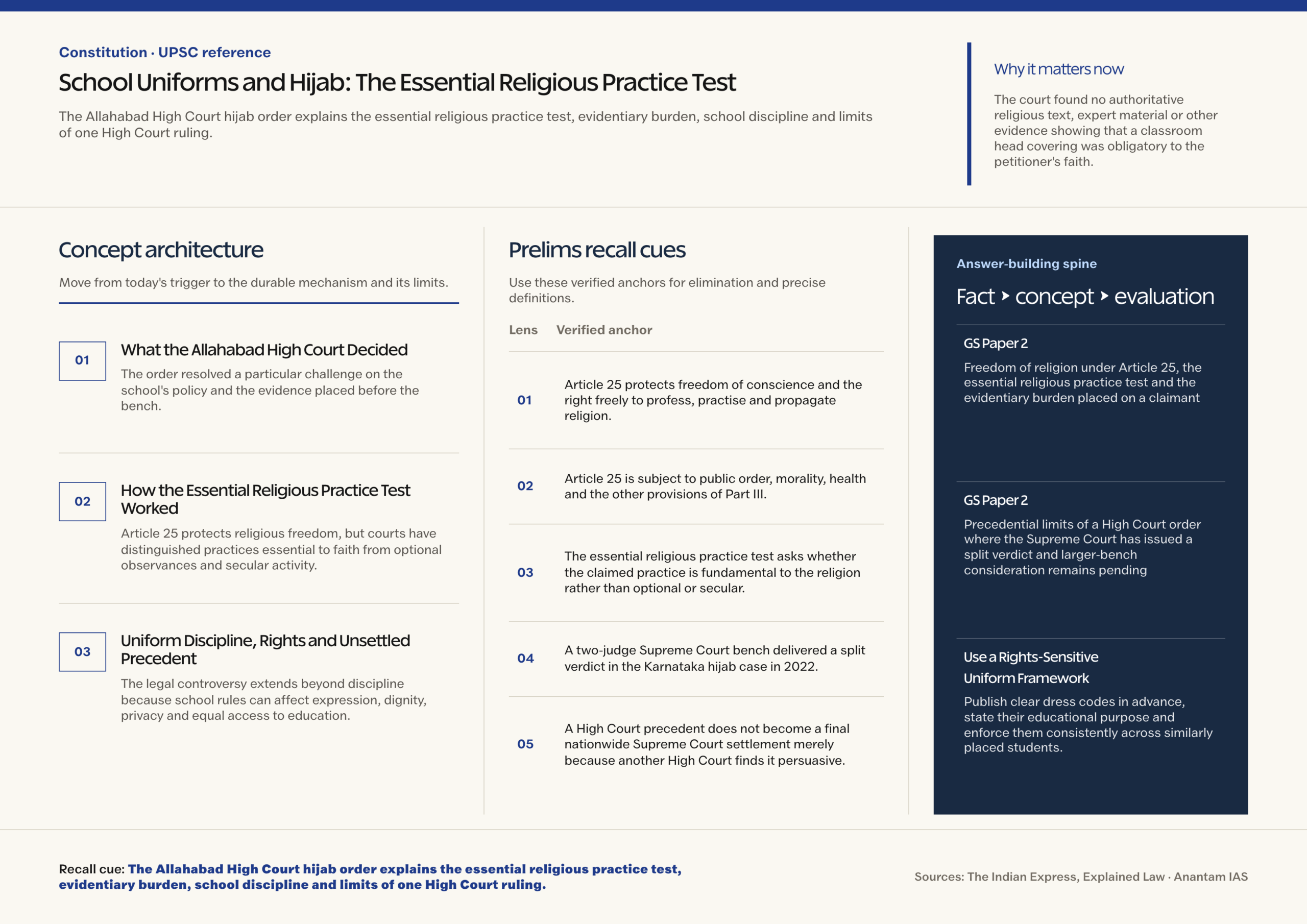
- The court found no authoritative religious text, expert material or other evidence showing that a classroom head covering was obligatory to the petitioner’s faith.
- Her earlier attendance with the scarf did not create an enforceable right to continued departure from the prescribed uniform.
- The bench treated a uniform, bona fide and non-discriminatory dress code aimed at discipline and institutional identity as primarily within the school’s authority.
- The order is case-specific; the national hijab question remains unresolved after the Supreme Court’s split verdict in 2022.
- The dispute tests how courts examine a religious-freedom claim when an institution invokes a generally applicable rule governing conduct.
- It also shows why a claim about school discipline must be kept analytically separate from the broader constitutional questions of expression, dignity, privacy and educational access.
UPSC Relevance
Prelims Relevance
- Article 25 protects freedom of conscience and the right freely to profess, practise and propagate religion.
- Article 25 is subject to public order, morality, health and the other provisions of Part III.
- The essential religious practice test asks whether the claimed practice is fundamental to the religion rather than optional or secular.
- A two-judge Supreme Court bench delivered a split verdict in the Karnataka hijab case in 2022.
- A High Court precedent does not become a final nationwide Supreme Court settlement merely because another High Court finds it persuasive.
Mains Relevance
GS Paper 2
- Freedom of religion under Article 25, the essential religious practice test and the evidentiary burden placed on a claimant
- Balancing institutional autonomy and uniform discipline with expression, dignity, privacy and access to education
GS Paper 2
- Precedential limits of a High Court order where the Supreme Court has issued a split verdict and larger-bench consideration remains pending
Essay
- Uniformity can support common institutions, but constitutional democracy must still examine whether its burdens fall fairly on individual conscience and educational opportunity.
Background and Context
What the Allahabad High Court Decided
The order resolved a particular challenge on the school’s policy and the evidence placed before the bench.
- The petitioner had attended the same school from Class VI to Class X with a headscarf and relied on photographs and identity cards to show the earlier practice.
- The school said the scarf was an addition to its prescribed uniform; the court found no change in policy, only later enforcement of the existing code.
- Past non-enforcement could reflect inaction, hesitation or courtesy; it did not create estoppel against future enforcement or vest an enduring entitlement.
- The bench accepted institutional choice where the rule was bona fide, uniform and non-discriminatory and served discipline and a common institutional identity.
- This discipline finding did not announce that every uniform rule defeats every rights claim; its force depends on the policy, purpose, application and evidentiary record.
How the Essential Religious Practice Test Worked
Article 25 protects religious freedom, but courts have distinguished practices essential to faith from optional observances and secular activity.
- The claimant must identify the practice with sufficient precision and support religious obligation through authoritative texts, doctrine, expert material or other reliable evidence.
- The court described the petitioner’s claim as a bare assertion because wearing the scarf since childhood did not itself establish a binding religious requirement inside the classroom.
- Under the test, the question is not whether a practice is sincerely preferred, common or identity-bearing, but whether its omission changes the religion’s fundamental character.
- Critics argue that judges may become interpreters of theology; alternative reasoning can examine individual conscience, choice and rights impact without deciding religious essentiality.
- For answers, distinguish two inquiries: whether Article 25 protects the claimed practice and whether restrictions are constitutionally justified under its text and the wider rights framework.
Uniform Discipline, Rights and Unsettled Precedent
The legal controversy extends beyond discipline because school rules can affect expression, dignity, privacy, equality and access to education.
- A valid uniform policy requires more than administrative preference: it should have a legitimate purpose, apply consistently and avoid direct or indirect discrimination.
- A proportionality-oriented review asks whether the restriction is suitable, necessary and balanced, including whether a reasonable accommodation could protect discipline with a smaller rights burden.
- The Allahabad High Court relied heavily on the Karnataka High Court’s 2022 ruling that hijab was not an essential Islamic practice and upheld that state’s uniform requirement.
- The Supreme Court appeal produced two opposing opinions: one prioritised the prescribed uniform, while the other emphasised choice, dignity and educational access beyond the school gate.
- Because there was no majority Supreme Court holding, the matter went for larger-bench consideration; the present order must not be presented as a final national rule.
Way Forward
Use a Rights-Sensitive Uniform Framework
- Publish clear dress codes in advance, state their educational purpose and enforce them consistently across similarly placed students.
- Create a reasoned accommodation process that tests safety, identification and discipline concerns against less restrictive alternatives.
- Hear the student and guardian before exclusion, provide written reasons and preserve grievance and judicial-review routes.
- Keep continuity of education central while courts clarify the relationship among religious freedom, expression, dignity, equality and institutional autonomy.
Conclusion
- The order demonstrates that religious-freedom litigation turns on precise claims, credible evidence and the character of the impugned rule, not on assertion alone.
- In a Mains answer, separate the case-specific discipline holding from the unsettled nationwide doctrine, then assess both essentiality and proportionality without treating either as automatic.
UPSC Practice Questions
Prelims MCQ 1
With reference to Article 25 of the Constitution, consider the following statements:
- It protects freedom of conscience as well as the right freely to profess, practise and propagate religion.
- Its protection is subject to public order, morality and health.
- Its protection is entirely independent of the other provisions of Part III.
How many of the above statements are correct?
(a) Only one (b) Only two (c) All three (d) None
Answer: (b) Only two
Explanation:
Statements 1 and 2 are correct. Article 25 expressly remains subject to public order, morality, health and the other provisions of Part III, making Statement 3 incorrect.
Prelims MCQ 2
Which statement best describes the present precedential position of the 2022 Supreme Court hijab appeal?
(a) A unanimous bench invalidated all school uniform rules (b) A Constitution Bench conclusively held hijab essential to Islam (c) A two-judge bench delivered a split verdict, leaving no majority holding (d) The appeal was dismissed without reasons
Answer: (c) A two-judge bench delivered a split verdict, leaving no majority holding
Explanation:
The two judges reached opposing conclusions in 2022, and the matter was referred for constitution of a larger bench.
UPSC Mains Questions
- Explain the essential religious practice test under Article 25. What evidentiary and institutional concerns arise when courts apply it to school dress codes?
- School discipline and constitutional rights are related but distinct inquiries. Discuss with reference to uniform rules, proportionality and reasonable accommodation.
Source: The Indian Express, Explained Law.
Frequently Asked Questions
What did the Allahabad High Court decide in the school hijab case?
It rejected one student’s challenge because the religious-obligation claim lacked supporting evidence and the school applied an existing, bona fide, uniform and non-discriminatory dress code.
What is the essential religious practice test?
It is a judicial test used to examine whether a claimed practice is fundamental to a religion rather than optional, secular or merely customary.
Did wearing the headscarf earlier create a continuing legal right?
No. The court held that earlier non-enforcement could reflect inaction or hesitation and did not prevent the school from later enforcing its existing uniform policy.
Has the Supreme Court finally settled whether hijab may be worn in school?
No. Its two-judge bench delivered opposing opinions in 2022, producing no majority holding, and the issue was referred for larger-bench consideration.
Why is proportionality relevant to a school uniform dispute?
It helps test whether a rule pursues a legitimate aim through suitable, necessary and balanced means, including whether reasonable accommodation can reduce the burden on rights.
Tell Google you want more of this.
Add Anantam IAS as a preferred sourceOne tap, and this site shows up more often in your own Top Stories, AI Overviews and AI Mode. Remove it any time.






