Why in News?
On 25 August 2026, the Karnataka High Court asked the State to place its policy on altruistic living organ donation to an anonymous recipient on record.
- The petitioner wished to donate a kidney without compensation to a deserving person whom he did not select personally.
- The Court said a standing system could prevent willing donors from repeatedly approaching it and losing time while an individual order was sought.
- Karnataka referred to scrutiny by its transplant committee and allocation to a compatible recipient according to the State’s waiting-list seniority.
- The proceeding concerns a policy exercise; it did not adopt nationwide rules, approve automatic harvesting or remove the statutory approval process.
- Anonymous living donation could widen access, but the absence of a pre-existing relationship also raises sharper questions about coercion, concealed payment and informed consent.
- A defensible policy must separate three decisions: whether the donor is safe and voluntary, whether the donation is lawful, and which compatible patient receives the organ.
UPSC Relevance
Prelims Relevance
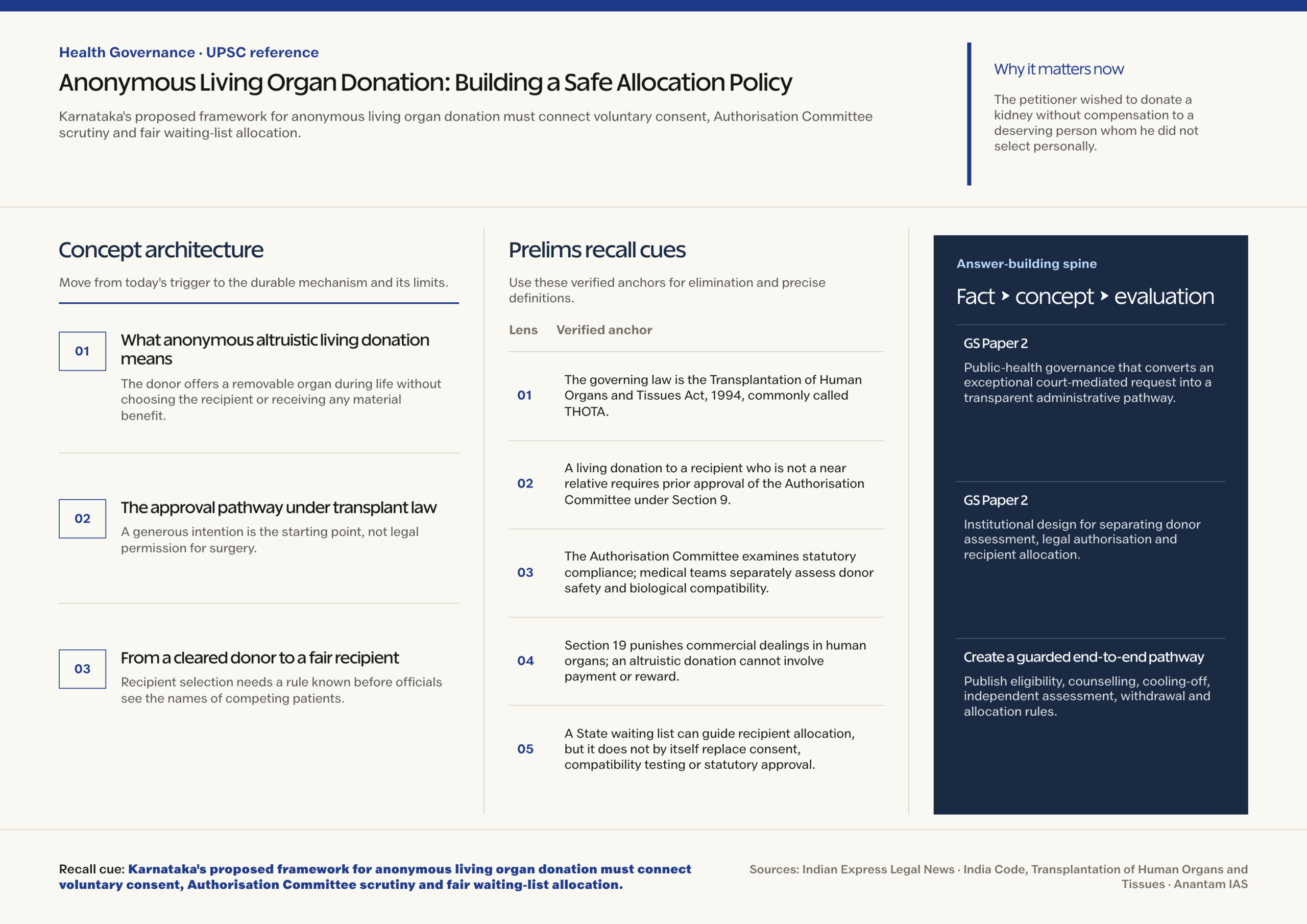
- The governing law is the Transplantation of Human Organs and Tissues Act, 1994, commonly called THOTA.
- A living donation to a recipient who is not a near relative requires prior approval of the Authorisation Committee under Section 9.
- The Authorisation Committee examines statutory compliance; medical teams separately assess donor safety and biological compatibility.
- Section 19 punishes commercial dealings in human organs; an altruistic donation cannot involve payment or reward.
- A State waiting list can guide recipient allocation, but it does not by itself replace consent, compatibility testing or statutory approval.
Mains Relevance
GS Paper 2
- Public-health governance that converts an exceptional court-mediated request into a transparent administrative pathway.
- Balancing patient access with donor autonomy, bodily integrity, informed consent and protection against exploitation.
GS Paper 2
- Institutional design for separating donor assessment, legal authorisation, recipient matching and waiting-list allocation.
Essay
- Compassion becomes just public policy only when institutions protect both the intended beneficiary and the person offering the sacrifice.
Background and Context
What anonymous altruistic living donation means
The donor offers a removable organ during life without choosing the recipient or receiving any material benefit.
- The proposal differs from ordinary related donation because the donor has no family relationship with the eventual recipient and may not know that person.
- It is also distinct from deceased donation: the donor remains a patient whose present and future health, decision-making capacity and freedom from pressure require independent protection.
- The proposed route is uncompensated. Reimbursement of legitimate medical expenses cannot become a disguised price, brokerage fee or reward for supplying an organ.
- Anonymity can reduce directed favouritism, but it complicates the statutory sequence because the law contemplates scrutiny of a donor-recipient case rather than an organ offered in the abstract.
- A policy must define when matching occurs, when identities are disclosed to authorised bodies, and how privacy continues after transplantation.
The approval pathway under transplant law
A generous intention is the starting point, not legal permission for surgery.
- Under Section 9 of THOTA, transplantation from a living donor to a person who is not a near relative requires prior Authorisation Committee approval.
- The Committee must examine the application and satisfy itself that statutory and rule-based requirements are met; it may reject the case with recorded reasons after hearing the applicants.
- A registered transplant hospital must separately establish medical suitability, informed consent, risk comprehension and biological compatibility before removal or transplantation can proceed.
- Independent psychosocial assessment should test whether the decision is stable and whether debt, family pressure, employment dependence, brokers or promised benefits are influencing consent.
- The State’s proposed pathway cannot convert committee scrutiny into a formality or treat a court’s request for policy as approval of the petitioner’s donation.
From a cleared donor to a fair recipient
Recipient selection needs a rule known before officials see the names of competing patients.
- The State told the Court that a compatible recipient could be identified through its waiting list, with seniority supplying the reported allocation route.
- Seniority is understandable but cannot operate alone: blood group, tissue compatibility, urgency, clinical fitness and transplant-centre logistics may determine whether a particular kidney can safely be used.
- Allocation criteria should be published, consistently applied and auditable, with reasons recorded when the highest-listed person cannot receive the offered organ.
- The donor should not be allowed to sell access, while hospitals and officials should not privately substitute a preferred recipient outside the declared queue and compatibility rules.
- Traceable hand-offs among the hospital, Authorisation Committee and allocation body can preserve anonymity for the parties while retaining accountability for regulators.
Way Forward
Create a guarded end-to-end pathway
- Publish eligibility, counselling, cooling-off, independent assessment, withdrawal, matching and appeal procedures before accepting anonymous living-donor applications.
- Separate the teams assessing donor welfare, authorising legality and allocating the organ to reduce conflicts of interest and arbitrary influence.
- Give donors a confidential, penalty-free right to withdraw at any stage and protect the stated reason from family, recipients and intermediaries.
- Audit every case for financial links, broker contact, queue deviation, donor outcomes and recipient allocation while protecting medical privacy.
Conclusion
- Anonymous living donation should be understood as a regulated pathway, not a waiver: generosity does not displace medical safety, Authorisation Committee approval or anti-commercialisation checks.
- In a Mains answer, map the process as donor assessment, legal scrutiny, compatibility matching, waiting-list allocation and post-donation follow-up; each stage protects a different public value.
- The Karnataka proceeding is best framed as a court-prompted policy opportunity whose legitimacy will depend on the safeguards in any final rules, not as an adopted national entitlement.
UPSC Practice Questions
Prelims MCQ 1
With reference to living organ donation under the Transplantation of Human Organs and Tissues Act, 1994, consider the following statements:
- A donation to a recipient who is not a near relative requires prior approval of the Authorisation Committee.
- Placement on a State waiting list by itself removes the need for medical compatibility testing.
- Commercial dealings in human organs are punishable under the Act.
How many of the above statements are correct?
(a) Only one (b) Only two (c) All three (d) None
Answer: (b) Only two
Explanation:
Statements 1 and 3 are correct. A waiting list structures allocation, but compatibility, donor safety, consent and statutory approval remain necessary.
Prelims MCQ 2
In an anonymous altruistic living-donor policy, which arrangement would best protect fairness and donor autonomy?
(a) Let the transplant hospital privately select any recipient and waive committee approval (b) Permit the donor to auction priority among compatible recipients (c) Separate donor assessment, statutory authorisation and rule-based waiting-list allocation (d) Treat judicial consideration of one petition as a nationwide transplant licence
Answer: (c) Separate donor assessment, statutory authorisation and rule-based waiting-list allocation
Explanation:
Separation reduces conflicts of interest while preserving medical suitability, legal scrutiny, transparent allocation and the donor’s voluntary choice.
UPSC Mains Questions
- Why does anonymous altruistic living organ donation require safeguards beyond ordinary medical consent? Explain the institutional pathway a State policy should create.
- A fair transplant system must protect both the person waiting for an organ and the person volunteering to donate. Discuss with reference to authorisation, allocation and anti-commercialisation safeguards.
Sources: Indian Express Legal News and India Code, Transplantation of Human Organs and Tissues Act, 1994.
Frequently Asked Questions
What is anonymous altruistic living organ donation?
It is a living person’s voluntary, uncompensated donation to a recipient the donor does not choose personally, subject to medical suitability, legal authorisation and allocation safeguards.
Did the Karnataka High Court create a new organ-donation law?
No. It asked Karnataka to place its policy on record and indicated that a standing framework could avoid repeated petitions. Existing statutory scrutiny continues to apply.
What does the Authorisation Committee examine?
For an unrelated living-donor case, it examines compliance with transplant law and rules, including whether consent is genuine and whether payment, coercion or an improper arrangement is involved.
How would an anonymous recipient be selected?
Karnataka referred to its waiting list and recipient seniority, but final allocation must also account for compatibility, clinical suitability and transparent reasons for any deviation.
Can an altruistic donor withdraw after volunteering?
A safe policy should preserve confidential withdrawal until surgery. Volunteering does not erase bodily autonomy, and withdrawal should not expose the donor to pressure or penalty.
Tell Google you want more of this.
Add Anantam IAS as a preferred sourceOne tap, and this site shows up more often in your own Top Stories, AI Overviews and AI Mode. Remove it any time.