Daily Digest
UPSC · Civil Services Examination
Current Affairs · Saturday, 26 September 2026
Current affairs curated and edited by Anantam IAS faculty — pulled from The Hindu, PIB, IDSA, Foreign Affairs and the ministries. Read, annotate, revise.
Old Rajinder Nagar · Delhi 110005 · anantamias.com
The murky world of political party finance
Why in news?
BBC probe found six Gujarat-based RUPPs got ~₹1,700 crore donations, reviving demands for party-finance transparency.
UPSC Relevance
Prelims
- Constitutional provisions , tenth Schedule; RPA 1951 Sections, 29A etc.
Mains
- GS-II: Salient features of the Representation of People’s Act; Appointment, powers and functions of Constitutional Bodies (ECI); Transparency and Accountability; Statutory and quasi-judicial bodies (CIC).
Observations by former CEC Ashok Lavasa
- Constitutional silence: Political parties find no mention in the Constitution except the Tenth Schedule. Yet enjoy full income-tax exemption – sometimes becoming receptacles of unexplained money. The author calls them “shell political parties”, like shell companies.
- BBC investigation: Six Gujarat-based RUPPs (Aam Janmat Party, Bharatiya National Janata Dal, Garib Kalyan Party etc.) received about ₹1,700 crore in FY 2023-24 – more than the ₹1,480 crore received together by Congress, AAP, BSP, CPI(M) and NPP. But the six fielded just 15 Lok Sabha candidates in 2024.
- ADR report : 223% rise in declared income of RUPPs in FY 2022-23; of 2,764 RUPPs, only 739 filed financial records with the ECI.
- ECI clean-up: Delisted 334 RUPPs on 9 Aug 2025.
- Scale of political wealth (Venkatesh Nayak, CHRI): 22 parties had ₹18,742.31 crore for the 2024 general election; raised ₹7,416.31 crore during the election; spent ₹3,861.57 crore; still held ₹14,848.46 crore after polls.
- The ECI seems increasingly unable to curb the unfair, and corrupt financial practices that in longer run has ailed the democratic elections too. Former CEC S.Y. Quraishi has called money power the biggest challenge to free and fair elections.
Constitutional and legal framework on finance of political parties
- Art 19(1)(c) – right to form associations; parties exist under it. Reasonable restrictions under Art 19(4).
- Tenth Schedule (52nd Amendment, 1985) – the only place “political party” appears; deals with anti-defection.
- Art 324 – superintendence, direction and control of elections vests in ECI.
- Arts 327, 328 – Parliament and state legislatures make laws on elections.
Statutes
- RPA 1951 – Sec 29B (parties may accept contributions from any person or company except a Government company; no foreign source); Sec 29C (annual report of donations above ₹20,000 to ECI, else no tax exemption); Sec 77 (candidate expenditure; Explanation 1 exempts party spending); Sec 10A (disqualification for failure to lodge accounts); Sec 123(6) (excess expenditure is a corrupt practice).
- Income-tax law – Sec 13A (party income exempt if accounts kept, donors above ₹20,000 recorded, accounts audited, cash donations capped at ₹2,000 since Finance Act 2017, return filed); Secs 80GGB/80GGC (100% deduction for company/individual donors, not in cash). Note: the Income-tax Act, 2025 replaced the 1961 Act from 1 April 2026; these benefits continue under renumbered sections.
- Companies Act 2013 – Sec 182 – company must be at least 3 years old and not a Government company; must disclose donation in P&L. The 7.5% cap removed in 2017 stands revived after the SC struck down the amendment in 2024.
- FCRA 2010 – bars parties from foreign contributions (amended retrospectively in 2016 and 2018).
- Electoral Trusts Scheme 2013 (CBDT) – trusts must pass on at least 95% of receipts to parties and disclose donors.
- Election Symbols Order 1968 – Para 6 (recognition criteria), Para 16A (suspension/withdrawal of recognition).
- ECI Guidelines on Transparency and Accountability in Party Funds (2014) – issued under Art 324; bank transactions, accounts audit, disclosure.
Key judgments
- Common Cause v Union of India (1996) – parties must file income-tax returns and maintain audited accounts; ECI can seek expenditure details under Art 324.
- Union of India v ADR (2002) and PUCL v Union of India (2003) – voters’ right to know about candidates flows from Art 19(1)(a).
- INC (I) v Institute of Social Welfare (2002) – ECI has no general power to deregister parties.
- ADR v Union of India (15 Feb 2024) – 5-judge Constitution Bench unanimously struck down electoral bonds; voters’ right to information under Art 19(1)(a); unlimited corporate funding violates Art 14.
What are the problems in political party finance?
- Legal vacuum – easy to register, almost impossible to remove. Any association can register under Sec 29A with 100 members and a ₹10,000 fee. But in Indian National Congress (I) v Institute of Social Welfare (2002), the SC held the ECI cannot deregister a party except in narrow cases (registration by fraud, party ceasing to follow the Constitution, or declared unlawful). Hence the ECI only “delists”. There is still no comprehensive law on political parties.
- Delisting ≠ Prohibition on finance : T.N. Seshan in 1994 flagged the “adhocism” in parties, and introduced Para 16A (ECI can suspend/withdraw recognition for violating MCC or ECI directions). Registration guidelines require a party to contest within 5 years; a party not contesting for 6 years is taken off the list. Even delisted or unrecognised parties can still receive contributions (Sec 29B RPA) and claim tax exemption (Sec 13A IT Act).
- Shell parties and tax arbitrage. Donors get 100% deduction (Secs 80GGB/80GGC) and parties pay no tax (Sec 13A, Income Tax Act). Chartered accountants told the BBC that donors may take donation certificates to claim tax relief and get most of the money back in cash, minus commission – i.e., round-tripping and money laundering.
- Opacity of source. Sec 29C requires disclosure only of donations above ₹20,000. ADR has repeatedly found that more than half of national parties’ income comes from “unknown sources”. Donations can be split into smaller amounts to avoid disclosure.
- Corporate money and quid pro quo. The Finance Act 2017 removed the 7.5% cap on company donations (Companies Act Sec 182) and the need to name the party. Electoral bonds (about ₹16,500 crore sold, 2018–24) allowed anonymous corporate giving. Data disclosed after the 2024 verdict showed donations by firms facing ED/IT action or winning contracts, raising quid pro quo concerns.
- No ceiling on party spending. Candidates face limits (₹95 lakh for Lok Sabha in larger states), but Explanation 1 to Sec 77 RPA excludes party spending. This overturned Kanwar Lal Gupta v Amar Nath Chawla (1974), which had counted party spending on a candidate. The Centre for Media Studies estimated the 2024 Lok Sabha election cost about ₹1.35 lakh crore – the world’s costliest.
- Weak audit and enforcement. Parties choose their own chartered accountants. The ECI only receives accounts; it cannot verify or penalise. The only penalty for non-filing is loss of the Sec 13A exemption – rarely enforced. Only 739 of 2,764 RUPPs filed records which is less than one third. Accounts meet “the letter of the law, even if its spirit gasps”.
- Parties outside RTI. Central Information Commission, in 2013 declared six national parties “public authorities” under Sec 2(h) of the RTI Act because they get subsidised land, bungalows, tax exemption, free airtime. Parties objected to it; the matter is pending before the SC.
- Foreign money door. A Delhi HC (2014) ruling found the BJP and Congress had taken donations from Vedanta subsidiaries in breach of FCRA. Parliament then amended the FCRA through the Finance Acts of 2016 and 2018, with retrospective effect, redefining “foreign source”.
- Uneven playing field. Money concentrates with the ruling party. It raises entry barriers for new and smaller parties and weakens the “one person, one vote” ideal.
Reforms needed
| Committee / Report | Key recommendations on party finance |
|---|---|
| Dinesh Goswami Committee (1990) | Partial state funding in kind (vehicles, fuel, posters, electoral rolls) to recognised parties. |
| Indrajit Gupta Committee on State Funding of Elections (1998) | State funding is constitutionally and legally justified; only in kind, not cash; only to recognised national/state parties and their candidates; full state funding not feasible for now. |
| ECI – Proposed Electoral Reforms (2004, updated 2016) | Power to deregister parties; audit by firms from a CAG/ICAI-approved panel; ban anonymous donations of ₹2,000 and above; ceiling on party expenditure; tax exemption only for parties that contest and win seats. |
| 2nd ARC – 4th Report “Ethics in Governance” (2007) | Introduce partial state funding to reduce illegitimate and unnecessary funding; tighter audit and disclosure of party accounts. |
| Law Commission – 255th Report (2015) | New chapter in RPA on parties; ECI power to deregister (e.g., no contest for 10 years); cap anonymous donations at ₹20 crore or 20% of total, whichever is less; penalties for late or false contribution reports; party spending on a candidate to count towards the candidate’s limit. |
| Former CEC Ashok Lavasa | Court-monitored probe into electoral bonds and RUPP funding; CAG (or nominee) audit of party accounts using Art 324; ceiling on party expenditure; tax exemption only up to the expenditure limit; automatic deregistration of non-contesting RUPPs; a centralised digital portal for standardised financial data. |
Global practices
- UK: Electoral Commission regulates donations (only “permissible donors”) and caps national party campaign spending under PPERA 2000.
- USA: Federal Election Commission; disclosure is strong but Citizens United v FEC (2010) allowed unlimited independent corporate spending via Super PACs.
- Brazil: Supreme Court banned corporate donations (2015); public election fund created.
Way forward
- National Election Fund (proposed by S.Y. Quraishi) – anonymous donations to a common fund, shared among parties by vote share.
- Mandate digital-only donations and real-time online disclosure of all donations.
- Enact a Political Parties (Registration and Regulation) Act combining LC 170th and 255th Report drafts.
- Link tax exemption to real electoral participation (ECI 2016 proposal).
- Bring party finances (not internal deliberations) under RTI.
Practice MCQ
Q1. Consider the following statements:
1. The term “political party” finds mention in the Constitution of India at three places.
2. Political parties are registered with the Election Commission under Section 29A of the Representation of the People Act, 1951.
3. The Election Commission has statutory power to deregister a registered political party that has not contested elections for six consecutive years.
How many of the above statements are correct?
(a) Only one (b) Only two (c) All three (d) None
Answer and explanation: (a)
Statement 1 is incorrect – The term “political party” finds mention in the Constitution of India in only the tenth schedule.
Statement 3 is incorrect – the ECI only “delists” such parties; it cannot deregister them except in narrow cases (INC (I) v Institute of Social Welfare, 2002).
Q2. Consider the following statements:
Statement I: Companies can claim a deduction for donations made to registered political parties.
Statement II: Section 29B of the Representation of the People Act, 1951 allows political parties to accept contributions from any company other than a Government company.
Which one of the following is correct in respect of the above statements?
(a) Both Statement I and Statement II are correct and Statement II explains Statement I
(b) Both Statement I and Statement II are correct but Statement II does not explain Statement I
(c) Statement I is correct but Statement II is incorrect
(d) Statement I is incorrect but Statement II is correct
Answer and explanation: (b)
Both are correct, but statement 2 does not explain Statement 1. The deductions come from separate IT law.
Mains Practice Question
Q. “Registered Unrecognised Political Parties are increasingly becoming conduits of tax arbitrage rather than vehicles of representation.” Critically examine the legal framework governing political party finance in India and suggest reforms. (15 marks, 250 words)
PYQ: “Discuss the role of the Election Commission of India in the light of the evolution of the Model Code of Conduct.” (GS-II, 2022)
Source: https://anantamias.com/current-affairs/the-murky-world-of-political-party-finance/
Policing the line between publicity and justice
Why in news?
A Supreme Court PIL seeking a nationwide police media protocol has revived debate on publishing accused persons’ photographs before trial.
UPSC Relevance
Mains: GS-II – Fundamental rights and judicial interpretation; Role of police and criminal justice reforms;
GS-IV – Probity, dignity, presumption of innocence, ethical dilemmas in policing.
Author’s views in the editorial
- Arguments for publishing photos
- Wanted-person photos and reward notices have solved crimes.
- Helps trace absconders and missing persons; multiplies thin police capacity (India has far fewer police per lakh than the sanctioned strength).
- Public order and deterrence; public has a right to know about dangerous persons at large.
- Legitimate aim under Puttaswamy if necessary and proportionate.
- Arguments against
- Photos of handcuffed accused, sometimes with placards, go viral within minutes – often before they are produced before a magistrate.
- Violates presumption of innocence; leads to media trial and social boycott even after acquittal.
- No clear legal basis – fails the “legality” limb of Puttaswamy.
- Digital permanence: images cannot be recalled; reputational harm is irreversible.
- Rajasthan High Court called such practices “institutional humiliation”.
- Misused for police publicity and political optics; can target marginalised groups.
- Can harm investigation itself – e.g., spoils test identification parades (TIP) of witnesses.
- The core conflict
- Three interests collide: effective investigation and public safety (public help in tracing fugitives), the public’s right to know and press freedom (Art. 19(1)(a)), and the accused’s dignity, privacy and fair trial (Art. 21). An arrest is not a conviction – but a viral photo acts like one.
- “The justification for publishing is strong; the legal architecture is weak.” Police need a clear legal basis, not a habit inherited from precedent.
- Current law is a patchwork: No single statute permits or prohibits publishing photos of accused persons.
- Institutional steps: In January 2026, SC asked States to frame policies within three months based on the amicus’s Police Manual for Media Briefing.
- Global practice: US – “wanted” notices are public-record exceptions but carefully worded (“alleged”, “wanted for questioning”). UK – withholds arrested persons’ identities altogether.
- Test question for any disclosure according to the author : Is the disclosure necessary to the investigation, or merely convenient to the narrative or showcasing police achievements?
Legal framework at a glance
- Constitution: Art. 21 – dignity, privacy, fair trial; Art. 20(3) – no self-incrimination; Art. 22 – rights on arrest; Seventh Schedule – police and public order are State subjects (List II, Entries 1–2).
- Sec. 84 BNSS (Sec. 82 CrPC): Courts can proclaim absconders and publish proclamations; photos are attached by practice. But this applies only after a warrant fails – not at the investigation stage.
- Sec. 43(3) BNSS – handcuffing allowed only for certain categories (habitual offenders, escapees, serious crimes).
- Investigation stage: Relies on general powers – every person must help police; IO can examine anyone. Photo publicity is a digital version of the colonial-era “Hue and Cry Notice” in State Police Manuals.
- Criminal Procedure (Identification) Act, 2022: Replaced Identification of Prisoners Act, 1920; allows taking photos, fingerprints etc.; NCRB stores records up to 75 years; wrongly cited as allowing publication and is actually silent on publication.
- Police Act, 1861 and State Police Manuals/Regulations: Reward notices, Hue and Cry Notices – administrative, not statutory rules on photo publicity.
- Absolute bars:
- Sec. 74 JJ Act, 2015 (no disclosure of child’s identity);
- Sec. 72 BNS – deals with the prohibition and punishment for disclosing the identity of victims in certain sexual and related offenses.
- DPDP Act, 2023: Exempts processing for prevention and investigation of offences – so data law gives no real protection here.
Key judgments
- Kali Ram v State of HP (1973): Presumption of innocence is a cardinal principle of criminal law.
- Prem Shankar Shukla v Delhi Admin (1980): Routine handcuffing violates Art. 21 dignity – directly relevant to handcuffed-accused photos.
- Sahara v SEBI (2012): Courts can order postponement of reporting to protect fair trial.
- K.S. Puttaswamy (2017): Privacy is a fundamental right; any intrusion must pass legality, legitimate aim and proportionality.
- Right to be forgotten: Recognised by some High Courts (e.g., Karnataka HC in Vasunathan, 2017; Delhi HC in Jorawar Singh Mundy, 2021) – relevant for takedown after acquittal.
- 15 Jan 2026 (2026 INSC 79) – Justices M.M. Sundresh and N. Kotiswar Singh asked States to frame policies in three months, using amicus Gopal Sankaranarayanan’s manual.
Way ahead
- Codified national protocol (author) – ideally a model law/rules adopted by States, since police is a State subject.
- Necessity test before release; written reasons by a senior officer (SP rank).
- Blackout categories like juveniles, sexual-offence survivors, and ordinary arrested adults unless absconding from publication.
- Careful wording: “accused”, “wanted for questioning” – never “criminal”; no placards or parading.
- Sunset clause: Mandatory takedown after arrest of absconder, discharge or acquittal.
- Accountability: Departmental action and compensation for violations; oversight by Police Complaints Authorities (Prakash Singh, 2006).
- Training: Media cells and training modules via Bureau of Police Research and Development.
Practice MCQs
Q1. With reference to police in India, consider:
1. ‘Police’ and ‘Public order’ are subjects in the State List.
2. The Bureau of Police Research and Development functions under the Ministry of Home Affairs.
3. The Police Act, 1861 was abolished after independence to replace colonial police laws.
Which of the above are correct? (a) 1 and 2 only (b) 2 and 3 only (c) 1 and 3 only (d) 1, 2 and 3
Answer: (a)
Mains practice questions
Media trials undermine the presumption of innocence. Discuss the role of the police in preventing them. (10 marks, 150 words)
Source: https://anantamias.com/current-affairs/policing-the-line-between-publicity-and-justice/
What are the alternatives to the SWIFT payment system?
Why in news?
The New Delhi Declaration (18th BRICS Summit) resolved to raise intra-BRICS trade and payments in national currencies. Reuters had reported India would propose linking CBDCs for cross-border payments, but the proposal did not make it into the Declaration
UPSC Relevance
Prelims
- Payment systems and mediums
Mains
- GS-II: Bilateral, regional and global groupings affecting India’s interests (BRICS); Effect of policies and politics of developed countries on India’s interests (US sanctions); Important international institutions (BIS, IMF).
- GS-III: Indian economy – external sector, mobilisation of resources; Awareness in IT (blockchain, CBDCs); Money-laundering and its prevention (sanctions evasion risks).
What SWIFT is?
- Society for Worldwide Interbank Financial Telecommunication is a member-owned cooperative set up in 1973, headquartered in La Hulpe, Belgium.
- It links over 11,000 financial institutions in more than 200 countries via it’s messaging services for financial transactions.
- It is bound by Belgian law and European Union (EU) regulations.
- SWIFT only sends messages. It does not move money. The actual settlement happens through correspondent banks (nostro/vostro accounts) and, for dollars, through US systems such as CHIPS and Fedwire. So even a non-SWIFT message system still needs a settlement route.
Why is it a pressure point?
- Why it becomes a tool of sanctions: SWIFT is governed by Belgian law, so it must follow EU sanctions. Iranian banks were cut off from SWIFT in 2012 and again from 2018. Seven Russian banks were removed in March 2022. Since most trade is priced in dollars, US Treasury (OFAC) sanctions can also reach non-US banks – this is the “weaponisation of interdependence” (Farrell and Newman).
- Wars and US “weaponisation of the dollar” through sanctions are pushing Global South countries to find options beyond Belgium-based SWIFT. Efforts so far have been patchy.
- Dollar dominance : The dollar is on one side of close to 9 in 10 foreign exchange trades (BIS Triennial Survey) and makes up around 57–58% of global foreign exchange reserves (IMF COFER).
- Freezing of reserves: The G7 froze about $300 billion of Russia’s central bank reserves in 2022. This alarmed many central banks and increased interest in alternatives and in gold buying.
The alternatives : A patch work
| System | Owner / Year | Nature | Status and limits |
|---|---|---|---|
| SWIFT | Cooperative, Belgium (1973) | Messaging only | Global standard; bound by EU law; ISO 20022 migration completed Nov 2025 |
| CHIPS / Fedwire | USA | Dollar settlement | Core of dollar clearing; CHIPS handles far larger daily volume than CIPS |
| CIPS | PBoC, China (2015) | Yuan clearing and settlement (+ own messaging), backed by the People’s Bank of China to internationalise the yuan. | 120+ countries except India ; still uses SWIFT messages for many transactions; limited by China’s capital controls |
| SPFS | Bank of Russia (2014) | Messaging, Built to bypass Western sanctions; became crucial after Russian banks were cut off from SWIFT in 2022. | 440 users (2023); mainly Russia and allies; high sanctions risk for foreign users |
| SEPAM | Central Bank of Iran | Domestic interbank messaging | Linked to SPFS; small scale |
| mBridge | Central banks of China, HongKong, Thailand, UAE, Saudi Arabia | A multi-CBDC platform on its own blockchain (mBridge Ledger) for direct peer-to-peer settlement without correspondent banks.. | Reached minimum viable product (MVP) stage in 2024 BIS exited 2024; By late 2025, mBridge was reportedly working as a renminbi-based wholesale settlement rail for China–Gulf trade, outside the dollar correspondent system. |
| Project Nexus | BIS-born; India, Malaysia, Philippines, Singapore, Thailand | Links fast retail payment systems (like UPI) | India joined June 2024; retail, not a SWIFT replacement |
| BRICS Pay / Cross-Border Payments Initiative | BRICS (Kazan 2024 onwards) | Plan to link national systems | Voluntary; no common currency; work by BRICS Payment Task Force |
India’s own toolkit
- Rupee trade settlement (RBI, 11 July 2022): Special Rupee Vostro Accounts (SRVA) let foreign banks settle trade in rupees. Many foreign banks have opened such accounts.
- India–Russia settlement: Rupees and roubles now account for 96% of bilateral trade, according to Sberbank’s India head Ivan Nosov. 22 Russian banks and 17 Indian banks service this trade.
- Local currency deals: Local Currency Settlement System with the UAE – the first rupee payment for UAE crude followed in August 2023; similar arrangements with Indonesia and the Maldives.
- UPI abroad: UPI–PayNow link with Singapore (2023); UPI now accepted in several countries such as the UAE, Bhutan, Nepal, Sri Lanka, Mauritius and France. India also joined Project Nexus (2024).
- e₹ (CBDC): RBI piloted wholesale e₹ (Nov 2022) and retail e₹ (Dec 2022) – the base for India’s proposal to link BRICS CBDCs.
- SFMS: India’s domestic financial messaging system (built by IDRBT) – a backup if access to SWIFT is ever at risk.
- Legal base: FEMA 1999 and RBI’s powers under the RBI Act and the Payment and Settlement Systems Act, 2007 govern cross-border and payment system arrangements.
Why the alternatives remain limited?
- Larger network of SWIFT : Banks join systems that everyone else uses. SWIFT and the dollar have deep liquidity, trust and legal certainty.
- Secondary sanctions risk: Banks using SPFS or dealing with sanctioned entities risk US penalties. Chinese and Indian banks limit exposure for this reason.
- China’s capital controls: The yuan is not fully convertible, so it cannot easily become a global currency. Its share in global payments is still small.
- Trade imbalances: Local-currency trade works only if both sides can use the money. Russia piled up rupees it could not easily spend – the “rupee surplus” problem – and some oil payments shifted to AED and yuan.
- Trust deficit within BRICS: India does not want to replace dollar dependence with yuan dependence. This explains India’s absence from CIPS and its caution on mBridge.
- Tech and governance limits: CBDCs are still at pilot stage in most countries; there are no common standards, legal rules or data-sharing agreements for linking them.
India’s position – “de-risking, not de-dollarisation”
- External Affairs Minister S. Jaishankar and the RBI have said that India has no policy of targeting the dollar. The aim is to lower transaction costs and exchange-rate risk and to protect trade from disruption.
- This balance matters because US President Donald Trump has threatened extra tariffs on countries pursuing de-dollarisation or aligning with BRICS policies (late 2024 and 2025).
- India’s approach is interoperability, not a new bloc currency: UPI linkages, Nexus, SRVA and local currency settlement agreements.
Alternatives to SWIFT are about insurance against coercion, not about replacing the dollar – at least not yet.
Practice MCQ
Q1. Consider the following statements about SWIFT:
1. It is a payment settlement and messaging network.
2. It is headquartered in Belgium and is subject to European Union regulations.
3. It is owned and operated by the Bank for International Settlements.
How many of the above statements are correct?
(a) Only one (b) Only two (c) All three (d) None
Answer and explanation: (a). Statement 1 and 3 are wrong – SWIFT is a cooperative owned by its member financial institutions, not by the BIS and is only limited to messaging.
Q2. Consider the following pairs:
1. CIPS – People’s Bank of China
2. SPFS – Central Bank of Iran
3. mBridge – Multi-CBDC platform
4. Project Nexus – Linking fast retail payment systems
How many of the pairs given above are correctly matched?
(a) Only one (b) Only two (c) Only three (d) All four
Answer and explanation: (c). Pair 2 is wrong – SPFS was developed by Russia (Bank of Russia); Iran’s system is SEPAM.
Q3. Consider the following statements:
Statement I: Countries are building payment systems outside SWIFT.
Statement II: SWIFT has been used to cut off banks of certain countries as part of sanctions.
Which one of the following is correct in respect of the above statements?
(a) Both Statement I and Statement II are correct and Statement II explains Statement I
(b) Both Statement I and Statement II are correct but Statement II does not explain Statement I
(c) Statement I is correct but Statement II is incorrect
(d) Statement I is incorrect but Statement II is correct
Answer and explanation: (a). Removal of Iranian (2012, 2018) and Russian (2022) banks from SWIFT is the main reason for building alternatives such as SPFS and for expanding CIPS.
Mains Practice Question
“The use of financial networks as tools of sanctions has pushed the Global South to look beyond SWIFT.” Examine the prospects and limits of alternative payment systems, and discuss India’s approach. (15 marks, 250 words)
Source: https://anantamias.com/current-affairs/what-are-the-alternatives-to-the-swift-payment-system/
Agnibaan RLV: Why Reuse Needs More Than a Recoverable Booster
Why in News?
On September 25, the Technology Development Board announced an agreement supporting Agnikul Cosmos in developing Agnibaan RLV, a launch system intended to advance beyond first-stage recovery towards full-system reusability.
- The development programme combines a lightweight upper stage, precise orbital insertion and propulsion designed for restart and deep throttling.
- The proposed architecture includes upper-stage reuse and descent propulsion for controlled recovery, making the return journey a central engineering requirement.
- Support comes through the Research Development and Innovation Fund; the announcement describes technology development and validation, not a completed reusable launch service.
- Reusability joins ascent, payload delivery, descent and preparation for another mission into one system; success at only one stage cannot establish operational readiness.
- Lower costs and less debris are intended benefits. Their achievement depends on recovery reliability, refurbishment requirements and the number of successful repeat flights.
UPSC Relevance
Prelims Relevance
- First-stage recovery versus full-system reusability
- Engine restart versus deep throttling
- Semi-cryogenic liquid propulsion
- Orbital insertion and upper-stage functions
- Recovery, refurbishment and reflight
Mains Relevance
GS Paper 3
- Engineering trade-offs in reusable space transportation.
- Assessing innovation through demonstrated performance rather than announced benefits.
Essay
- The distance between a successful prototype and a dependable public capability.
Background and Context
What changes when the whole launch system must return?
Full-system reuse makes recovery part of the original vehicle design, rather than treating a recovered booster as the complete technological achievement.
- Staging separates parts of a launcher during ascent so later propulsion does not carry unnecessary empty hardware. Recovering only the first stage leaves the question of upper-stage disposal or reuse unresolved.
- The upper stage performs the later work of delivering a payload into its intended orbit. A reusable architecture must preserve that mission while also preparing the stage for a controlled return.
- Orbital insertion means achieving the required orbit, not merely reaching a high altitude. Guidance and propulsion must deliver the correct trajectory before the same mission can be assessed for successful recovery.
- A lightweight upper stage helps protect payload capacity because the launcher must accelerate its own hardware alongside its cargo. Recovery equipment creates additional design demands that engineers must reconcile with this weight constraint.
- The announced programme targets full-system reusability, including reusable upper-stage architecture. Its components must work together across a mission; the release does not establish that this integrated sequence has already succeeded in flight.
Why restart and deep throttling matter during descent
An engine that accelerates a launcher during ascent must meet different control requirements when propulsion is used to slow and recover a returning stage.
- Restart capability means an engine can ignite again after shutting down. This supports separated powered phases, unlike a single continuous burn, but each restart must function reliably under the conditions of that phase.
- Deep throttling means reducing thrust substantially below its higher operating level while maintaining controlled combustion. It gives descent propulsion a wider operating range instead of offering only maximum thrust or complete shutdown.
- Restart and throttling solve different problems: one restores thrust after an interruption; the other varies thrust during operation. Neither capability alone establishes accurate landing, because trajectory and vehicle attitude must also remain controlled.
- The release identifies semi-cryogenic liquid propulsion as part of the proposed architecture. It does not specify the complete engine configuration, so the announcement cannot support claims about a particular nozzle, fuel combination or landing arrangement.
- Guidance, propulsion and vehicle design must operate as an integrated control system. A command to reduce speed is useful only if the engine responds predictably and the vehicle remains on its intended descent path.

Recovery is a milestone; reliable reflight is the test
A recovered vehicle becomes economically reusable only when engineers can inspect it, prepare it and send it on further missions with dependable performance.
- Recovery preserves hardware that might otherwise be discarded, but preservation alone does not establish readiness for another launch. Engineers must determine what suffered damage, what needs replacement and what can safely remain in service.
- Thermal and structural loads accumulate across flight phases. A reusable system needs evidence that repeated exposure does not compromise critical components; an isolated engine test cannot answer every vehicle-level question about repeated operation.
- Payload delivery and recovery compete for vehicle resources. Fuel retained for descent cannot simultaneously power payload delivery, so mission planning must balance return requirements against the useful cargo and orbit the launcher can serve.
- Launch-cost reductions depend on more than avoiding manufacture of a new vehicle. Inspection, repair, recovery operations and flight frequency affect the result; the release presents savings as an objective without demonstrated operational cost evidence.
- Reduced debris generation likewise remains an intended outcome of this programme. Assessments should check how stages are returned or disposed of, rather than assuming the word reusable guarantees that every mission leaves no hardware behind.
Way Forward
Validate the complete mission sequence
- Link development milestones to demonstrated restart, throttling, orbital delivery and controlled recovery, with clear separation between component tests and integrated missions.
- Track refurbishment effort and repeat-flight reliability alongside recovery success; these measures test whether reusable hardware produces a repeatable launch service.
- Report payload and recovery trade-offs transparently so cost and debris claims can be evaluated against the actual mission profile.
Conclusion
- Agnibaan RLV is a development commitment to integrate launch and recovery functions, not an announcement that fully reusable orbital flight has already been demonstrated.
- For an answer on space innovation, distinguish capability, integration and operations: an engine can work, a vehicle can return, and yet reliable low-cost reflight can remain an unfinished engineering task.
UPSC Practice Questions
Prelims MCQ 1
With reference to reusable launch propulsion, consider the following statements:
- Restart capability allows an engine to ignite again after shutdown.
- Deep throttling refers to controlled operation at substantially reduced thrust.
- Successful recovery alone proves that a vehicle is ready for repeated flights without inspection.
How many of the above statements are correct?
(a) Only one (b) Only two (c) All three (d) None
Answer: (b) Only two
Explanation:
Restart and throttling are distinct propulsion capabilities. Recovery must be followed by inspection and readiness assessment; it does not establish maintenance-free reflight.
Prelims MCQ 2
Which requirement most directly distinguishes the announced Agnibaan RLV ambition from first-stage-only recovery?
(a) Eliminating all guidance requirements (b) Replacing orbital insertion with altitude alone (c) Integrating reusable upper-stage architecture with descent and recovery (d) Treating engine development as proof of commercial service
Answer: (c) Integrating reusable upper-stage architecture with descent and recovery
Explanation:
The programme seeks full-system reusability, including upper-stage architecture. It remains a development effort rather than demonstrated commercial operation.
UPSC Mains Questions
- Explain why restart and deep-throttling capabilities are necessary but insufficient for a dependable reusable launch system.
- Discuss the engineering and operational trade-offs that determine whether launch-vehicle recovery translates into economical, repeated access to space.
Source: PIB, Ministry of Science and Technology.
Frequently Asked Questions
Has Agnibaan RLV demonstrated full reusability?
The announcement concerns an agreement supporting development and validation. It describes a proposed reusable architecture and intended benefits; it does not establish successful full-system recovery and repeated operational flight.
How are engine restart and throttling different?
Restart means igniting an engine after shutdown. Throttling means adjusting thrust while it operates. Controlled descent may require both, together with guidance and vehicle control, rather than either capability in isolation.
Why is upper-stage recovery important?
First-stage recovery leaves the later propulsion stage outside the reuse cycle. Including the upper stage extends the engineering problem to orbital delivery, return, recovery and preparation for subsequent missions.
Does reusability automatically make launches cheaper?
No. Avoided manufacturing costs must be weighed against recovery, inspection, repair and operating costs. Flight frequency and reliability also matter, so intended savings need evidence from repeated missions and actual operations.
Source: https://anantamias.com/current-affairs/agnibaan-reusable-launch-propulsion-recovery/
Black Hole Jets: How Narrow Beams Can Heat a Galaxy’s Gas Reservoir
Why in News?
On 25 September 2026, the Ministry of Science and Technology reported research involving the Raman Research Institute that identified a possible mechanism connecting black-hole jets with energised gas surrounding galaxies.
- The researchers found a strong gas-emission signal along jet directions, although averaging measurements over all directions around the galaxies did not reveal a detectable signal.
- The reported signal was strongest near the stellar disk edge and the outer circumgalactic boundary, supporting an interpretation involving energy transfer where jets encounter surrounding gas.
- The study proposes a route for black-hole feedback: heating and disturbance can make gas less able to cool and clump into new stars.
- The circumgalactic medium is a diffuse gas reservoir around a galaxy; the finding concerns its interaction with jets, not matter escaping from inside a black hole.
- Galaxies need available gas to form stars, but gas availability and the ability of that gas to cool are different constraints.
- A small central region can affect much larger surroundings by transferring energy through jets; physical influence need not require swallowing all the affected gas.
UPSC Relevance
Prelims Relevance
- Circumgalactic medium: diffuse gas surrounding a galaxy.
- Plasma: a gas containing charged particles.
- Ionisation: formation of ions by adding or removing electrons.
- Accretion disk and jets exist outside the event horizon.
- Directional measurements can reveal a signal concealed by averaging.
Mains Relevance
GS Paper 3
- Indian research institutions and international cooperation in fundamental science.
- Using observations to distinguish a plausible astrophysical mechanism from a universal conclusion.
Essay
- The method used to observe a system can determine which patterns become visible.
Background and Context
The gas reservoir beyond the visible galaxy
A galaxy’s future star formation depends partly on gas beyond its bright stellar disk and on whether that gas can cool, condense and become available.
- The circumgalactic medium, or CGM, is the diffuse gaseous environment surrounding a galaxy. It is distinct from the bright collection of stars usually pictured as the galaxy and can supply material for later star formation.
- Cooling allows gas to lose thermal energy, making conditions more favourable for condensation and gravitational collapse. A gas reservoir is not automatically a reservoir of newly formed stars; its physical state matters.
- Heating and disturbance can interrupt this route to star formation. The question is how energy generated near a central supermassive black hole reaches gas distributed far beyond that small central region of the galaxy.
- The study reported by the science ministry examines jets as one energy-transfer route. It addresses a specific physical mechanism, rather than claiming that every quiet galaxy must have stopped forming stars for the same reason.
- Feedback here means that activity near the central black hole can influence the surrounding gas and the galaxy’s subsequent development. It does not mean that the black hole deliberately regulates stars or consumes them all.
How a narrow jet can influence distant gas
A jet transports energy away from the central environment; interactions along its path can energise gas far beyond the black hole’s immediate surroundings.
- A jet is a directed outflow of fast-moving plasma, rather than a solid object or an ordinary beam of light. Its interaction with surrounding material can transfer energy beyond the compact region that launches it.
- Plasma contains charged particles. When gas becomes ionised, atoms gain or lose electrons; emissions from energised gas provide observable clues that researchers can examine when testing whether a jet affects its surroundings.
- The reported interpretation is that the jet encounters circumgalactic gas and deposits energy through the interaction. Heating and disturbance along its route can hinder the cooling and clumping needed for subsequent star formation.
- The research identifies stronger signals near the disk edge and outer CGM boundary. These locations matter because they connect observed emission with proposed interactions, rather than merely noting that an active black hole exists nearby.
- NASA explains that jets involve material redirected in the accretion environment. They do not establish that matter escapes from inside the event horizon; the surrounding disk and the black hole’s interior are different physical regions.

Why the direction of observation changes the result
The key observational distinction is between combining every direction and examining the direction a jet actually follows through the surrounding gas reservoir.
- An all-direction average combines measurements around the galaxy. If an effect is concentrated along a narrow path, combining that path with many less affected directions can weaken its prominence in the resulting overall signal.
- The team reported no detected signal in the averaged measurements, but a strong signal along the jet direction. The contrast supports a directional interaction; it does not show equal heating throughout the whole surrounding reservoir.
- Non-detection in an averaged measurement is not automatically proof that no interaction exists. The result illustrates why an observational method should reflect the geometry of the physical process being investigated before conclusions are drawn.
- The evidence supports a possible feedback mechanism, not universal proof that jets control every galaxy. Avoid converting a directional gas-emission finding into a claim that the study measured the complete history of star formation.
- Separate observation, interpretation and implication: directional emission is observed; jet energy deposition explains it; reduced cooling offers a route to suppressed star formation. These statements have different roles in the scientific argument.
Way Forward
Test the mechanism across different conditions
- Compare jet-aligned and off-axis observations to test how far the heating interpretation accounts for the spatial distribution of emission.
- Study different galactic environments before treating one proposed mechanism as the explanation for every instance of reduced star formation.
- Present illustrations and observations separately: conceptual images can teach the relationship, but measured signals must carry claims about actual gas behaviour.
Conclusion
- Jets can connect central black-hole activity with distant gas, providing a possible explanation for how heating limits future star formation. The important chain is energy transfer, changed gas conditions and altered capacity to form stars.
- Direction matters in scientific measurement. This study’s useful lesson is both astrophysical and methodological: a focused interaction can become visible when observations follow its geometry, while the broader interpretation remains open to further testing.
UPSC Practice Questions
Prelims MCQ 1
With reference to black-hole jets and the circumgalactic medium, consider the following statements:
- The circumgalactic medium can supply gas for future star formation.
- Black-hole jets demonstrate that matter can escape from inside the event horizon.
- Heating can hinder the cooling and clumping of gas.
How many of the above statements are correct?
(a) Only one (b) Only two (c) All three (d) None
Answer: (b) Only two
Explanation:
The first and third statements are correct. Jet material is launched from the surrounding accretion environment, not from inside the event horizon.
Prelims MCQ 2
Why can an all-direction average fail to reveal a jet-related emission signal?
(a) The circumgalactic medium contains no gas. (b) Plasma never emits detectable radiation. (c) A narrow directional effect may be diluted when combined with other directions. (d) Averaging proves that jets cannot interact with matter.
Answer: (c) A narrow directional effect may be diluted when combined with other directions.
Explanation:
A directional interaction need not affect all surrounding gas equally. Combining many directions can reduce the prominence of the signal aligned with a jet.
UPSC Mains Questions
- Explain how black-hole jets may influence star formation through their interaction with circumgalactic gas.
- Using the reported jet study, discuss why observational geometry and cautious interpretation matter in scientific research.
Sources: PIB, Ministry of Science and Technology and NASA: Black-hole jets and accretion.
Frequently Asked Questions
What is the circumgalactic medium?
The circumgalactic medium is diffuse gas surrounding a galaxy beyond its bright stellar disk. It acts as a potential reservoir for future star formation, depending on whether the gas can cool and condense.
How might jets reduce star formation?
Jets can transfer energy to surrounding gas along their paths. Heating and disturbance may prevent some gas from cooling and clumping, limiting the material able to participate in future star formation.
Does a jet escape from inside a black hole?
No. Jets involve material in the accretion environment outside the event horizon. Their presence does not overturn the distinction between observable activity around a black hole and the region from which escape is impossible.
What made the reported observation distinctive?
The researchers detected a strong gas-emission signal along the jet direction, despite no detected signal in the all-direction average. The strongest reported signals occurred near the stellar disk edge and outer circumgalactic boundary.
Does this explain every galaxy with low star formation?
No. The research supports a possible mechanism linking jets and circumgalactic gas. It does not establish that every galaxy experiences the same interaction or that jets are the sole influence on star formation.
Source: https://anantamias.com/current-affairs/black-hole-jets-circumgalactic-gas-heating/
Government Borrowing: Separating Debt Funding From Cash Management
Why in News?
On September 25, the Finance Ministry announced the Union government’s second-half borrowing programme for FY 2026–27, with expected annual market borrowing through dated securities below the Budget estimate.
- The government plans ₹7.86 lakh crore of gross market borrowing in the second half, including sovereign green bonds.
- The programme spreads issuance across different maturities and retains switches and buybacks to smooth the repayment schedule.
- It separately provides for Treasury Bill auctions and an RBI Ways and Means Advances limit for temporary cash mismatches.
- Borrowing volume, repayment timing and daily cash availability answer different policy questions. A single headline borrowing number cannot describe all three.
- Lower planned gross borrowing does not by itself prove a lower realised fiscal deficit or guarantee lower market interest rates.
UPSC Relevance
Prelims Relevance
- Gross versus net market borrowing
- Dated government securities and maturity
- Switching securities versus buying them back
- Treasury Bills as short-term market debt
- Ways and Means Advances from RBI
Mains Relevance
GS Paper 3
- Managing refinancing risk while financing the Union government.
- Interpreting borrowing announcements without confusing cash management and fiscal consolidation.
Essay
- Prudent public finance requires managing both obligations and their timing.
Background and Context
What does the borrowing calendar actually finance?
Government borrowing brings in funds today in exchange for future repayment obligations, but gross issuance and the addition to outstanding debt are different measures.
- Dated securities specify when principal becomes repayable and generally provide interest payments during their life. Selling them raises market funds, while their maturity determines when the government must return the principal to investors.
- Gross borrowing measures fresh issuance during a period without first deducting repayments. Part of that money may replace debt reaching maturity, so it should not all be read as additional resources for new expenditure.
- Net borrowing, on a comparable basis, deducts repayments from gross borrowing. Comparing the two reveals why a large issuance programme can coexist with a smaller addition to debt through that particular financing channel.
- The fiscal deficit concerns expenditure exceeding non-borrowing receipts, while gross market issuance also reflects refinancing needs. Financing can come through different channels; a change in one borrowing line cannot establish the final deficit.
- An auction calendar signals planned timing and securities offered, helping investors prepare for supply. It remains a programme rather than a record of completed borrowing; actual auction outcomes provide the evidence of implementation.
Why the maturity mix matters as much as the total
Debt becomes difficult to refinance when large repayments fall together, even if the outstanding total has not suddenly increased or the government continues paying interest.
- Maturity is the date when a security’s principal falls due. Spreading issuance across different tenors distributes future repayments, avoiding excessive concentration in a narrow period when replacement funding could become expensive or difficult.
- Refinancing risk arises when maturing obligations must be replaced under uncertain market conditions. Extending maturities can reduce near-term repayment pressure, but the government must still consider interest costs and investor demand across tenors.
- A switch exchanges an existing security for another security, often moving obligations from a nearer maturity to a later one. It changes the redemption profile without treating the original repayment pressure as permanently extinguished.
- A buyback repurchases an outstanding security before its scheduled maturity, using funds to retire that obligation early. Unlike a switch, the immediate transaction need not replace the purchased security with another debt instrument.
- The redemption profile records when principal repayments fall due. Smoothing it makes cash needs more manageable, but neither a switch nor a buyback alone establishes that the government’s underlying spending-revenue imbalance has improved.
Treasury Bills and WMA address shorter funding horizons
Receipts and payments rarely arrive together, so the government also needs instruments that manage short-term funding without confusing cash timing with its annual fiscal position.
- Treasury Bills are short-term government securities sold to market participants. They raise cash through borrowing and create a repayment obligation, even though their horizon is shorter than that of the government’s dated securities.
- Ways and Means Advances are temporary advances from RBI to the government for mismatches between receipts and payments. They are not receipts earned through taxation and should not be treated as a permanent spending resource.
- The key institutional distinction is the funding route: Treasury Bills raise money through market issuance, whereas WMA provides temporary RBI accommodation. Both require repayment, but they are not interchangeable names for the same instrument.
- A cash mismatch can arise when a payment falls due before expected receipts arrive. Bridging that interval addresses liquidity timing; it does not automatically correct a persistent gap between government expenditure and its revenue.
- Bond yields respond to demand, inflation expectations, liquidity and monetary conditions as well as issuance. Less planned supply may influence markets, but the borrowing announcement cannot guarantee a particular movement in government financing costs.
Way Forward
Evaluate financing and repayment together
- Read gross issuance, repayments and net borrowing on a consistent basis before drawing conclusions about the increase in debt.
- Track redemption concentration alongside interest costs when judging switches, buybacks and changes in the maturity mix.
- Compare actual auctions and fiscal accounts with the announced programme; distinguish realised outcomes from plans and temporary cash accommodation.
Conclusion
- Debt management must secure funds at acceptable cost while distributing repayment risks over time. The revised programme combines issuance, maturity management and short-term cash tools rather than relying on one instrument.
- For a fiscal-policy answer, separate financing, refinancing and liquidity timing. Lower gross borrowing is a relevant announcement, but a claim of deficit reduction or cheaper debt needs additional evidence.
UPSC Practice Questions
Prelims MCQ 1
With reference to government debt management, consider the following statements:
- Gross market borrowing can include funds used to repay maturing debt.
- Switching securities can change the timing of principal repayments.
- Ways and Means Advances are permanent, non-repayable receipts of the government.
How many of the above statements are correct?
(a) Only one (b) Only two (c) All three (d) None
Answer: (b) Only two
Explanation:
Gross issuance includes refinancing needs, and switches alter the redemption profile. WMA is temporary, repayable RBI accommodation rather than permanent revenue.
Prelims MCQ 2
Which statement best distinguishes a Treasury Bill from Ways and Means Advances?
(a) Treasury Bills are tax receipts, while WMA is market debt. (b) Treasury Bills raise short-term market funds, while WMA is temporary RBI accommodation. (c) Treasury Bills never require repayment, while WMA does. (d) WMA automatically reduces the fiscal deficit, while Treasury Bills increase revenue.
Answer: (b) Treasury Bills raise short-term market funds, while WMA is temporary RBI accommodation.
Explanation:
The instruments differ in their funding route and structure. Neither is tax revenue, and both create obligations rather than eliminate the underlying fiscal gap.
UPSC Mains Questions
- Explain how maturity diversification, switches and buybacks can help manage refinancing risk in public debt.
- Why should a reduction in planned gross market borrowing not automatically be interpreted as fiscal-deficit reduction? Distinguish borrowing, refinancing and temporary cash management.
Sources: PIB, Ministry of Finance and Reserve Bank of India, Government Securities Market Primer.
Frequently Asked Questions
What is the difference between gross and net borrowing?
Gross borrowing is issuance before deducting repayments. Net borrowing deducts repayments on a comparable basis. The distinction matters because some new borrowing replaces maturing obligations rather than financing an equivalent increase in expenditure.
How does a switch differ from a buyback?
A switch exchanges an outstanding security for another security and changes repayment timing. A buyback repurchases a security before maturity, using funds to retire it rather than necessarily issuing a replacement in that transaction.
Why does the government need WMA?
Payments may fall due before expected receipts arrive. Ways and Means Advances provide temporary RBI accommodation for such timing mismatches. They require repayment and are not a substitute for sustainable revenue and expenditure policies.
Does lower borrowing guarantee lower bond yields?
No. Borrowing supply is one influence, but investor demand, liquidity, inflation expectations and monetary conditions also matter. The announced programme does not establish the prices or yields at which every auction will clear.
Source: https://anantamias.com/current-affairs/government-borrowing-calendar-maturity-cash-management/
NHA Secure Data Environment: Research Without Open Patient Records
Why in News?
The National Health Authority launched its Secure Data Environment application at Arogya Manthan on 25 September 2026 to support governed health-data research.
- NHA developed the environment with support from the Indian Institute of Science, Bengaluru.
- The announced design covers access to and analysis of AB PM-JAY and ABDM health data.
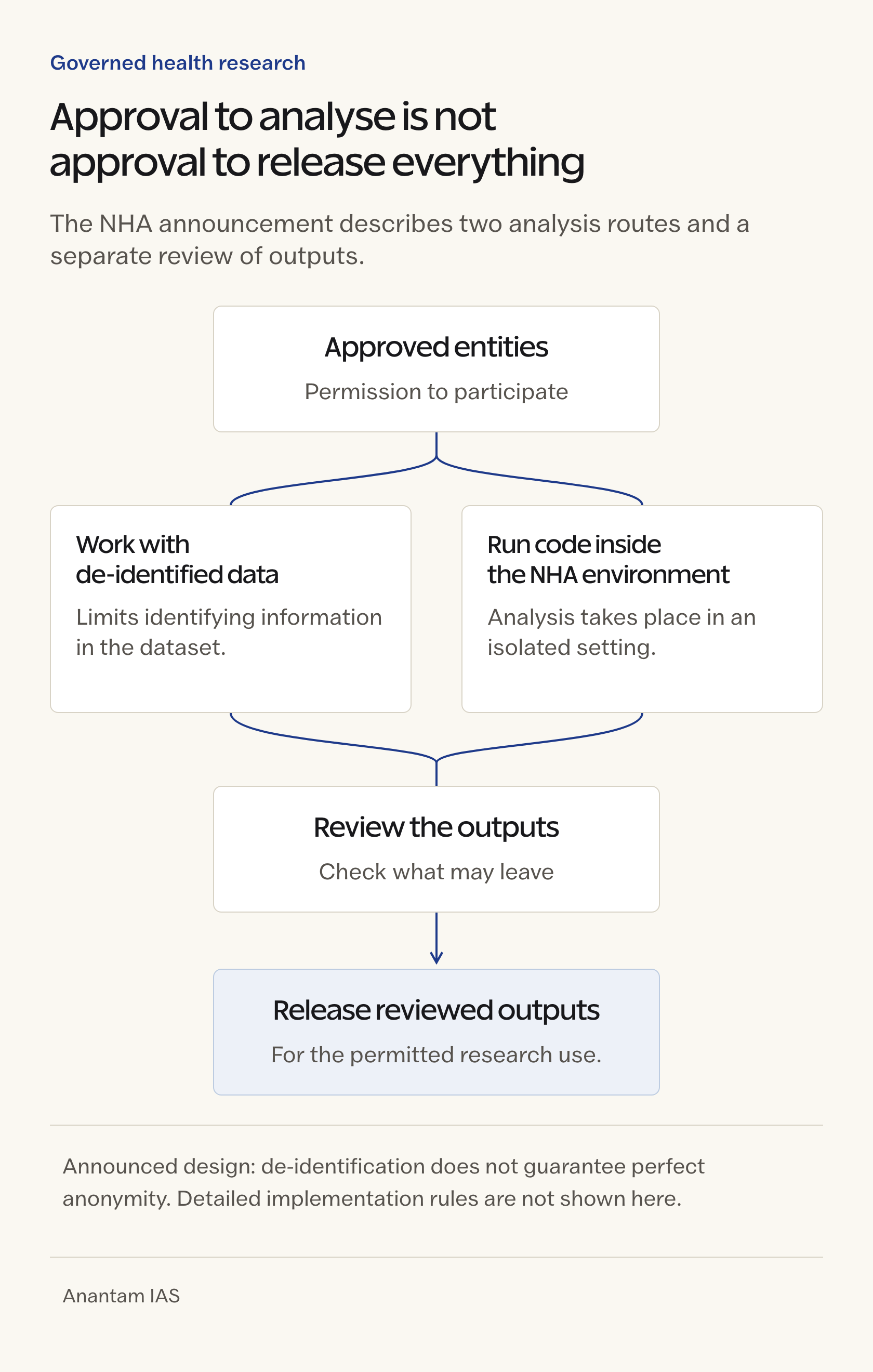
- Approved entities will work with de-identified data or execute code within an isolated NHA environment; outputs will undergo review before release.
- The release describes intended uses, including programme planning, outcome analysis and responsible AI innovation; it does not establish completed research outcomes.
- Health records can support research while revealing intimate information, making the conditions of access as important as the research objective.
- A governed environment makes the distinction between permission to analyse records and permission to release results central to data use.
UPSC Relevance
Prelims Relevance
- NHA: National Health Authority; developer of the SDE with IISc support.
- SDE: governed access to and analysis of health data.
- ABHA: digital health identity, distinct from health-assurance coverage.
- NHCX: National Health Claims Exchange for interoperable claims processes.
- De-identification: reducing identifiability, not proof of zero disclosure risk.
Mains Relevance
GS Paper 2
- Governance of sensitive health information and accountability for research access.
- Separating digital health identity, health assurance, claims exchange and research functions.
GS Paper 3
- Responsible AI research and the limits of technical safeguards.
Essay
- Public value from data depends on justified use and accountable access.
Background and Context
Different health systems serve different purposes
The SDE adds a research function to the health ecosystem; it should not be confused with an identity, insurance benefit or claims-processing service.
- AB PM-JAY is a health-assurance programme. The research value of records generated through its operation is a separate question from a beneficiary’s entitlement to treatment or the settlement of an individual hospital claim.
- ABDM supports the digital health ecosystem. Its health-data context can inform research, but the SDE announcement does not say that every linked record has already become available to every approved researcher.
- ABHA provides a digital health identity. Possessing an identifier is not the same as receiving health-assurance coverage, approving a research project or authorising unrestricted disclosure of the person’s clinical information to outside users.
- NHCX concerns standardised exchanges between participants in health-insurance processes. The SDE instead concerns governed analysis: exchanging a claim for processing and analysing health information for research have different purposes and access requirements.
- Programme planning and outcome analysis are intended research uses. For example, studying patterns of service use asks a population-level question; it does not require publishing named patient histories as the research product.
How controlled research and reviewed outputs fit together
The source describes approved participation, controlled analysis and output review; these safeguards answer different questions about who can work, how and what may leave.
- Approved entities are the intended users. Approval is an entry condition, not a declaration that everyone can browse patient records; the launch release does not detail the full application procedure or eligibility criteria.
- De-identified data is one announced route. De-identification addresses the information exposed in a research dataset; it does not, by itself, decide whether a particular organisation should receive permission to use that dataset.
- Code execution inside an isolated NHA environment is the other announced route. In this arrangement, a researcher’s analytical instructions work within a controlled setting rather than requiring unrestricted export of the underlying records.
- Output review before release creates a separate checkpoint after analysis. Permission to run a calculation does not automatically grant permission to publish or export everything it produces, including potentially revealing individual-level results.
- The PIB announcement states these mechanisms at a high level. It does not specify a particular encryption system, differential-privacy technique or output-testing threshold, so those implementation details should not be presented as established features.
Research access is neither perfect anonymity nor clinical approval
The launch establishes a direction for governed research, while operational reach, residual privacy risks and the quality of resulting evidence remain separate questions.
- De-identification should not be equated with guaranteed anonymity. A prudent governance assessment asks whether unusual combinations of information could expose someone, rather than assuming that removing direct identifiers eliminates every possible disclosure risk.
- Privacy safeguards do not establish scientific validity. A securely handled dataset can still be incomplete or unrepresentative; researchers must examine what their observations can support before applying conclusions to populations beyond the data.
- Responsible AI innovation is an intended use, not certification of a diagnostic system. Access to research data does not itself demonstrate clinical safety, effectiveness or suitability for deployment in decisions affecting patient care.
- The release calls the SDE an envisaged governed environment and describes what approved entities will be able to do. Launching the application is not evidence of universal access, completed rollout or measured patient benefits.
- Consent and lawful processing remain governance questions. Nothing in the launch announcement establishes an exemption from consent requirements, mandatory patient participation or permission to reuse health information for any purpose researchers might propose.
Way Forward
Make the research boundary accountable
- Publish clear access criteria and permitted research purposes, with responsibilities for applicants and reviewers.
- Explain output-review rules and the process for challenging a refusal without exposing sensitive records.
- Require researchers to report data limitations and distinguish exploratory findings from evidence supporting clinical use.
- Assess privacy protection and research usefulness separately, so successful access controls are not mistaken for reliable scientific conclusions.
Conclusion
- The SDE’s central idea is governed research: approved work with protected data and review before outputs leave. Its value depends on implementing those boundaries clearly, rather than treating a launch as proof that privacy risks have disappeared.
- For a governance answer, distinguish identity, health assurance, claims exchange and research access. Then assess whether access decisions, analytical methods and release checks each protect patients while allowing useful questions about healthcare to be investigated.
UPSC Practice Questions
Prelims MCQ 1
With reference to the announced NHA Secure Data Environment, consider the following statements:
- Approved entities may execute code within an isolated NHA environment.
- Research outputs are to be reviewed before release.
- The launch establishes unrestricted public access to identifiable patient records.
How many of the above statements are correct?
(a) Only one (b) Only two (c) All three (d) None
Answer: (b) Only two
Explanation:
The announcement provides for approved users, controlled analysis and reviewed outputs. It does not create unrestricted access to identifiable records.
Prelims MCQ 2
Which function most directly distinguishes NHCX from the announced Secure Data Environment?
(a) NHCX supports interoperable health-insurance claims processes. (b) NHCX certifies every research model for clinical use. (c) NHCX guarantees that de-identified data cannot reveal identity. (d) NHCX grants unrestricted public research access.
Answer: (a) NHCX supports interoperable health-insurance claims processes.
Explanation:
NHCX concerns standardised health-insurance exchanges; the SDE is intended for governed health-data research and analysis.
UPSC Mains Questions
- Explain how approved access, controlled analysis and output review address different governance risks in health-data research.
- Why should privacy safeguards in a health-data environment be assessed separately from the scientific validity and clinical usefulness of research outputs?
Source: PIB, Ministry of Health and Family Welfare.
Frequently Asked Questions
What is the NHA Secure Data Environment?
It is an application envisaged as a governed environment for accessing and analysing AB PM-JAY and ABDM health data. NHA developed it with support from IISc Bengaluru for approved research uses.
Can researchers freely download identifiable patient records?
The announcement does not provide unrestricted access to identifiable records. It describes approved entities working with de-identified data or executing code within an isolated NHA environment, with outputs reviewed before release.
Does de-identification guarantee complete anonymity?
No. De-identification reduces identifiability but should not be read as proof that disclosure is impossible. Access decisions and output review remain distinct safeguards in the announced approach to governed health-data research.
Is SDE the same as ABHA or NHCX?
No. ABHA is a digital health identity, and NHCX supports health-insurance claims exchanges. SDE concerns governed research access and analysis; permission for one function should not be assumed to authorise another.
Does the launch approve AI tools for clinical use?
No. Responsible AI innovation is an intended research use. The launch announcement does not demonstrate that any resulting model is clinically safe or effective, or that it has received approval for patient-care deployment.
Source: https://anantamias.com/current-affairs/nha-secure-data-environment-governed-health-research/
PABS Negotiations: Linking Pathogen Sharing to Fair Access
Why in News?
At the UN pandemic meeting on 25 September, reported by PIB on 26 September, India sought fair Pathogen Access and Benefit Sharing (PABS) and cautioned against prejudging ongoing annex negotiations.
- India linked access to pathogens and biological resources with timely vaccines, diagnostics, therapeutics, technologies and other benefits for contributing countries.
- The WHO Pandemic Agreement was adopted in May 2025; India described a fair PABS system as essential to its credibility.
- India said the political declaration should not prejudge the PABS annex and should reflect national circumstances and capacities.
- The statement called for national sovereignty alongside global solidarity; it did not announce a completed annex or an operational allocation mechanism.
- Early warning depends on cooperation, but countries need confidence that sharing biological resources will not leave their populations behind when products become available.
- Equity concerns both the terms of cooperation and access during emergencies; a diplomatic commitment alone does not establish delivery or affordability.
UPSC Relevance
Prelims Relevance
- PABS: Pathogen Access and Benefit Sharing.
- World Health Assembly: body that adopted the WHO Pandemic Agreement.
- PABS annex: separate negotiating work on the system’s rules.
- Diagnostics, vaccines and therapeutics: detection, prevention and treatment functions.
- Adoption and ratification: distinct stages in the treaty process.
Mains Relevance
GS Paper 2
- Equity, national sovereignty and accountability in global health governance.
- Linking contributions to international cooperation with timely access to essential health products.
GS Paper 3
- The relationship between pathogen research and development of medical countermeasures.
Essay
- Trust in international cooperation depends on whether shared contributions produce shared benefits.
Background and Context
What access and benefit sharing connect
PABS addresses a practical question: how can countries help identify a pandemic threat without losing fair access to the tools developed against it?
- Pathogen access concerns material and information needed to understand disease threats. Researchers can use these inputs to investigate the organism, assess risks and work on medical countermeasures before an emergency expands.
- Benefit sharing concerns what follows from cooperation. India named vaccines, diagnostics, therapeutics, technologies and other benefits, making clear that providing an input and receiving a useful health product are different steps.
- Vaccines, diagnostics and therapeutics serve different purposes: prevention, detection and treatment. Fair access cannot be judged solely by vaccine availability when countries also need tests and treatments to manage an outbreak.
- The central relationship is reciprocity, rather than an automatic one-for-one exchange of samples for doses. The unfinished annex must translate shared principles into workable arrangements; this statement does not establish their final terms.
- Timeliness matters because access after an emergency peaks may offer less protection. India’s position asks whether contributing countries can obtain useful products when needed, rather than merely receiving an eventual promise of support.

Why sovereignty and cooperation must work together
The negotiating challenge is to make sharing dependable while ensuring that countries retain a meaningful role in decisions affecting their resources and populations.
- National sovereignty means countries’ authority over biological resources remains relevant to cooperation. The official position combines respect for that authority with timely benefits; it does not present pathogen sharing as unrestricted access without conditions.
- Shared early warning and domestic responsibility are complementary. Detecting a threat in one country can inform preparedness elsewhere, but international arrangements still need national institutions capable of carrying out agreed responsibilities effectively.
- Trust is a practical design issue: contributors need confidence that cooperation will support their populations. This explains why access and benefits are discussed together, even though the final operational commitments remain under negotiation.
- Technology access broadens the equity discussion beyond receiving finished products. India included technologies among the benefits sought, but its statement does not establish compulsory technology transfers or specify an agreed mechanism for providing them.
- Member-state consultation also matters when reviewing pandemic tools, assessments and data. India highlighted their policy implications, showing that technical cooperation involves governance choices about participation and national capacity, alongside the science of disease control.
Political commitment is not completed implementation
Keep three stages separate: political endorsement, adoption of an agreement, and the legal and practical steps that make its arrangements work.
- A political declaration records a collective political position. India’s warning against prejudging the annex means that broad endorsement should not be treated as settling detailed questions still being negotiated through the PABS process.
- Agreement adoption is an institutional milestone, not evidence that every country is already bound. WHO’s adoption announcement distinguishes the agreement from subsequent signature and ratification processes following adoption of the PABS annex.
- The annex carries operational importance because general commitments need agreed rules. The September statement explicitly describes negotiations as ongoing, so neither a completed system nor compulsory sharing duties should be inferred from this meeting.
- Implementation capacity is a further test: access promises must become usable products and services. India stressed national circumstances and capacities, rather than suggesting that adopting international language automatically creates equivalent capabilities in every country.
- For analysis, distinguish a proposed safeguard from an achieved result. Fair allocation, dependable delivery and credible accountability are questions for judging the eventual system, not outcomes demonstrated by the latest diplomatic statement itself.
Way Forward
Make the eventual rules testable
- Define responsibilities and timelines clearly so participating countries understand what sharing entails and when benefits should become available.
- Build transparent reporting and review into the agreed arrangements so product-access commitments can be assessed against delivery during an emergency.
- Align national implementation with agreed international obligations and domestic capacity, while keeping unfinished negotiating provisions distinct from operative rules.
Conclusion
- PABS puts a distributional question inside pandemic cooperation: countries that contribute biological resources need credible, timely benefits. India’s intervention supports that linkage while preserving sovereignty and the integrity of unfinished negotiations.
- The durable distinction is between commitment and implementation. Assess an eventual PABS system by its agreed obligations and delivered access, while avoiding claims that this meeting completed the annex or guaranteed products to every country.
UPSC Practice Questions
Prelims MCQ 1
With reference to Pathogen Access and Benefit Sharing (PABS), consider the following statements:
- India’s stated benefit-sharing concerns include diagnostics and therapeutics as well as vaccines.
- Adoption of the WHO Pandemic Agreement proves that the PABS annex negotiations are complete.
- India has linked fair benefit sharing with respect for national sovereignty.
How many of the above statements are correct?
(a) Only one (b) Only two (c) All three (d) None
Answer: (b) Only two
Explanation:
Statements 1 and 3 reflect India’s position. Statement 2 is incorrect: the September 2026 statement explicitly refers to ongoing negotiations on the PABS annex.
Prelims MCQ 2
Which distinction best explains India’s caution concerning the political declaration and PABS annex?
(a) A political declaration automatically ratifies every associated treaty. (b) Pathogen research eliminates the need for diagnostic products. (c) Political endorsement should not be treated as settling provisions still under negotiation. (d) Benefit sharing concerns vaccines exclusively.
Answer: (c) Political endorsement should not be treated as settling provisions still under negotiation.
Explanation:
India said the declaration should not prejudge the annex negotiations. Broad political support and agreement on detailed operational provisions are different matters.
UPSC Mains Questions
- How can linking pathogen access with benefit sharing strengthen international pandemic cooperation? Discuss the associated concerns of equity and national sovereignty.
- Distinguish political commitment from operational implementation in global health agreements, with reference to ongoing PABS annex negotiations.
Sources: PIB, Ministry of Health and Family Welfare and World Health Organization.
Frequently Asked Questions
What does PABS stand for?
PABS means Pathogen Access and Benefit Sharing. It links cooperation over pathogens and related resources with fair benefits, including access to vaccines, diagnostics, therapeutics and technologies relevant to pandemic response.
What did India seek at the UN meeting?
India sought timely benefits for countries contributing pathogens and biological resources, with respect for national sovereignty. It also said the political declaration should not prejudge ongoing negotiations on the PABS annex.
Has the PABS annex been completed?
The September 2026 official statement describes annex negotiations as ongoing. The WHO Pandemic Agreement’s adoption in May 2025 should not be treated as proof that the annex or its operational arrangements are complete.
Does benefit sharing mean only vaccine donations?
No. India’s stated position includes diagnostics, therapeutics, technologies and other benefits alongside vaccines. Final arrangements remain subject to negotiation; the statement does not itself create an operational guarantee of allocation.
Source: https://anantamias.com/current-affairs/pabs-pathogen-sharing-pandemic-benefit-equity/
Property Connectivity Ratings: Testing the Network Inside Buildings
Why in News?
On September 25, 2026, TRAI launched its Digital Connectivity Rating platform to support building assessments and make property-level connectivity ratings publicly searchable and verifiable.
- The platform implements an existing regulatory framework, rather than creating a new telecom law through the launch announcement.
- Property managers apply for assessment and select a registered Digital Connectivity Rating Agency, which records observations, tests and supporting evidence.
- Assessment covers fibre readiness, mobile network availability, in-building solutions and Wi-Fi infrastructure, using applicable benchmarks for property categories.
- Consumers can examine published ratings and verify digitally signed certificates, including through the certificate’s QR code.
- Building-level information addresses a practical consumer question: whether the property being considered has connectivity infrastructure suitable for everyday use.
- Documented assessment makes infrastructure claims easier to scrutinise than an unverified sales assurance, while remaining distinct from an individual subscriber’s service contract.
UPSC Relevance
Prelims Relevance
- TRAI: regulator responsible for the property connectivity rating framework.
- Digital Connectivity Rating Agency: registered assessment agency.
- Fibre readiness, mobile availability, in-building solutions and Wi-Fi infrastructure.
- Constructed and under-construction properties: both supported by prescribed assessment workflows.
- eSign and certificate verification: tools for authenticating assessment documents.
Mains Relevance
GS Paper 2
- Consumer information, independent assessment and verifiable public records.
- Regulatory implementation through an evidence-based digital workflow.
GS Paper 3
- In-building digital infrastructure and planning for connectivity during property development.
Essay
- The usefulness of digital public systems depends on the physical infrastructure that connects people to them.
Background and Context
What a property connectivity rating assesses
The unit of assessment is a property, making its infrastructure and in-building connectivity visible before a consumer commits to buying or leasing the premises.
- Fibre readiness concerns the property’s preparation for fibre-based connectivity. It directs attention to the building’s infrastructure, rather than treating the advertised availability of an internet subscription as sufficient evidence about the premises themselves.
- Mobile network availability is assessed within the property under the prescribed methodology. An assurance about coverage in a neighbourhood is not a substitute for evidence about connectivity inside the particular building being considered.
- In-building solutions form a separate assessment area because the premises have their own connectivity requirements. Evaluation links those arrangements with recorded observations and tests instead of relying solely on the property manager’s description.
- Wi-Fi infrastructure is also included in the framework. Its assessment does not mean that every resident receives the same subscription, equipment or service; the rating concerns the property under the applicable evaluation parameters.
- The assessment uses category-specific benchmarks for different types of property. The launch release identifies the major parameter groups but does not provide the score thresholds needed to calculate a rating independently from those descriptions.

How applications become verifiable evidence
The digital workflow connects information supplied by property managers with agency assessment, supporting documents and the rating certificate eventually made available to consumers.
- The property manager registers the premises, provides prescribed information and documents, submits a rating application and selects a registered agency. This establishes an application record, but the application itself is not a completed rating.
- The rating agency undertakes the assessment, records its observations and test results, and manages supporting documentation. Its role is to evaluate the assigned property through the prescribed framework, not simply reproduce a marketing claim.
- A dedicated field-assessment application supports authorised in-building measurements. Data captured during assessment synchronises with property information supplied through the web interface, connecting the evaluation record with the specific property under review rather than an unrelated site.
- The workflow covers assessment, reporting, certification and publication. Keeping these stages connected allows a consumer to examine a published result supported by a recorded process, rather than a claim detached from its assessment documentation.
- Digital signatures and certificate verification help authenticate the record presented to a consumer. The platform also stores test results, supporting records and audit logs, providing an evidence trail behind the visible rating and its certificate.
What the rating establishes and what it does not
The value lies in comparable property information; its limits matter because a building assessment cannot answer every question about an individual user’s internet experience.
- The system supports both constructed and under-construction properties. Existing properties can be assessed for infrastructure and connectivity performance, while property development creates an opportunity to plan connectivity infrastructure before the premises enter regular use.
- A property rating differs from an individual service subscription. Consumers should still examine their chosen service and contractual terms; a building’s certificate does not itself set the price or speed promised under a subscriber’s plan.
- Certificate authenticity answers whether a document corresponds to the official rating record. It should not be confused with a guarantee that every future call, download or online session will achieve an identical level of performance.
- The framework already existed under the 2024 regulations, with subsequent amendments and a rating manual. The new platform operationalises assessment and public visibility; the launch is not evidence that every property has already been rated.
- Public search enables consumers to find rated properties, examine certificates and compare premises of interest. The announcement does not establish universal mandatory coverage, a new nationwide operator ranking or proven improvements across all participating buildings.
Way Forward
Make the assessment useful at the property decision
- Keep property identity, certificate authenticity and assessment documentation clearly connected, so consumers can verify that a cited rating belongs to the premises being considered.
- Encourage early infrastructure planning during development, while using field evidence to identify limitations in existing buildings.
- Explain rating scope plainly alongside results, helping consumers distinguish building connectivity information from subscription terms and guarantees that the assessment does not provide.
Conclusion
- Property connectivity ratings make a previously difficult-to-check building attribute more visible through structured assessment and verifiable documentation. Their policy value is stronger consumer information and better infrastructure planning, not an automatic promise of perfect connectivity everywhere.
- For UPSC answers, connect physical infrastructure with trustworthy digital records: property information, field measurement and certificate verification serve different purposes. Preserve that distinction when discussing transparency, regulatory implementation and informed consumer decisions in digital service markets.
UPSC Practice Questions
Prelims MCQ 1
With reference to TRAI’s Digital Connectivity Rating framework, consider the following statements:
- Its assessment includes fibre readiness and Wi-Fi infrastructure.
- The assessment workflow supports both constructed and under-construction properties.
- A published rating fixes the internet subscription price for every resident.
How many of the above statements are correct?
(a) Only one (b) Only two (c) All three (d) None
Answer: (b) Only two
Explanation:
The first two statements are correct. A property connectivity rating is not an individual subscriber’s service contract and does not fix subscription prices.
Prelims MCQ 2
Which is the primary purpose of verifying a digitally signed property rating certificate?
(a) To guarantee identical speeds for every device (b) To authenticate the rating document against its record (c) To replace the need for field assessment (d) To assign a nationwide rank to a mobile operator
Answer: (b) To authenticate the rating document against its record
Explanation:
Certificate verification establishes authenticity. It does not replace measurements or guarantee every user’s future connectivity performance.
UPSC Mains Questions
- How can property-level digital connectivity assessments improve consumer choice and infrastructure planning? Explain the limits of such ratings.
- Distinguish property information, field-test evidence and certificate authentication in a digital regulatory workflow. Why must these functions remain connected?
Source: PIB, Ministry of Communications.
Frequently Asked Questions
What does a Digital Connectivity Rating assess?
It assesses a property’s digital connectivity under the prescribed framework. Major parameter groups include fibre readiness, mobile network availability, in-building solutions and Wi-Fi infrastructure, with applicable benchmarks for different property categories.
Who applies for and conducts the assessment?
A property manager submits the application and prescribed documents and selects a registered Digital Connectivity Rating Agency. The agency undertakes assessment, records observations and test results, and completes the prescribed rating process.
Does a rating guarantee the speed of my internet plan?
No such guarantee is established by the launch announcement. The rating concerns the property’s assessed connectivity and infrastructure; an individual subscription’s price, contractual terms and promised service remain separate questions.
How can consumers verify the published rating?
Consumers can find rated properties through the public interface and inspect digitally signed certificates. The certificate’s QR code supports authenticity verification, helping connect a presented document with the relevant property’s rating record.
Source: https://anantamias.com/current-affairs/property-digital-connectivity-rating-measurement/
Tiger Reserve Evaluation: From Management Inputs to Conservation Results
Why in News?
On September 25, 2026, India launched the sixth Management Effectiveness Evaluation cycle for tiger reserves, introducing a separate solid-waste criterion to assess practical conservation management.
- The National Tiger Conservation Authority, working with the Wildlife Institute of India, commenced the evaluation cycle and released its technical manual.
- The exercise will cover 58 tiger reserves and use independent multidisciplinary evaluation teams.
- The new solid-waste criterion addresses forest posts, tourism activities and biomedical waste from wildlife rescue centres.
- This is the start of an evaluation cycle; the announcement does not report completed scores or resulting improvements in tiger populations.
- Management effectiveness connects administrative decisions with ecological results, helping distinguish a reserve that has resources from one that uses them well.
- Waste handling makes everyday operations part of conservation accountability, alongside habitat protection, wildlife monitoring and community engagement.
UPSC Relevance
Prelims Relevance
- Management Effectiveness Evaluation of Tiger Reserves: purpose and scope.
- NTCA and Wildlife Institute of India: institutions involved.
- IUCN World Commission on Protected Areas: adapted evaluation framework.
- Context, planning, inputs, processes, outputs and outcomes: six assessment elements.
- Solid waste from forest posts, tourism and wildlife rescue centres.
Mains Relevance
GS Paper 3
- Evaluate conservation programmes through ecological outcomes and management evidence.
- Integrate waste handling with protected-area governance.
GS Paper 2
- Independent assessment, local knowledge and evidence-based allocation of administrative resources.
Essay
- Environmental stewardship depends on the quality of ordinary institutions and daily decisions.
Background and Context
What management effectiveness measures
A protected area needs more than a designation: evaluation asks whether its management arrangements address actual threats and achieve the conservation objectives set for it.
- Context identifies the reserve’s values, pressures and surrounding circumstances. The same management action may have different significance where tourism, human-wildlife conflict or local livelihoods create different conservation challenges for field staff.
- Planning examines the intended response to those circumstances. Evaluators need to connect management priorities with identified problems, rather than treat the existence of a written plan as proof that protection is effective.
- Inputs concern the resources available to carry out plans, while processes concern how management operates. Adequate staff or equipment cannot establish success unless their deployment supports the reserve’s identified conservation needs.
- Outputs capture what management produces; outcomes concern the conservation results achieved. As an illustration, completing a planned protection activity and demonstrating an improvement in the condition being protected are different evidentiary claims.
- The Indian approach adapts the IUCN-WCPA framework across these six elements. Reading them together helps locate a management weakness: poor results may reflect an unsuitable plan, insufficient resources or ineffective implementation in practice.

Why waste becomes a separate criterion
The new criterion brings routine waste-generating activities into explicit evaluation, including work inside the forest and services connected with visitors or injured wildlife.
- Forest chowkis, or field posts, are operational sites within reserves. Their waste arrangements belong in management assessment because conservation administration must account for its own everyday footprint, alongside the threats it monitors outside.
- Tourism activities generate another waste stream. Assessment should examine how the visitor-management system handles that stream; the presence of tourism facilities alone says little about whether their waste is being managed sustainably.
- Wildlife rescue centres can generate biomedical waste. Its explicit inclusion prevents the assessment from reducing waste management to visible litter around tourist locations while overlooking material associated with the treatment of rescued animals.
- A separate criterion makes waste management an identifiable subject of scrutiny within the evaluation. It does not, by itself, demonstrate compliance everywhere or establish that previously identified waste problems have already been resolved.
- The announcement specifies these waste sources but does not publish reserve-level findings. A useful answer should explain the management question without inventing disposal performance, compliance rates or improvements attributed to the new criterion.
Evaluation is different from a tiger census
The central question is how a reserve is managed, rather than simply how many tigers an estimation exercise records within a particular landscape.
- MEE examines planning, resources, systems and conservation results. A tiger population estimate addresses abundance; reading the two as interchangeable would obscure management strengths and weaknesses that a population figure cannot explain on its own.
- The assessment includes tiger and prey conservation, habitat management, protection and wildlife crime. It also covers monitoring, wildlife health, fire and disaster management, showing why a single species count cannot represent its full scope.
- Independent multidisciplinary teams will identify strengths, gaps and improvement priorities. Their field-based evidence is intended to inform management actions and resource allocation, rather than merely produce a list of positions for public comparison.
- Local ecological and social knowledge can help explain site-specific constraints. The launch called for such contributions and community-sensitive conservation; these are directions for the exercise, not evidence that participation is already uniform across reserves.
- Adaptive management means using assessment findings to revise action as conditions change. The credible test is whether identified gaps lead to a relevant response, followed by evidence that the response improved the conservation situation.
Way Forward
Turn evaluation into corrective action
- Connect each identified gap with a responsible management unit, an appropriate corrective action and evidence that can show whether the action worked.
- Keep waste-source records distinct so forest operations, tourism and wildlife rescue facilities receive scrutiny suited to the material they generate.
- Use local expertise to interpret reserve-specific pressures, while maintaining independent evidence standards and clearly separating recommendations from verified improvements.
Conclusion
- Tiger-reserve evaluation is a test of whether protection systems deliver their objectives. Its value lies in connecting context, decisions and implementation with conservation results, rather than assuming that administrative effort automatically produces ecological success.
- The new waste criterion extends that accountability to daily operations. In an answer, distinguish the announced evaluation framework from completed findings, and distinguish management effectiveness from population estimation before drawing conclusions about conservation performance.
UPSC Practice Questions
Prelims MCQ 1
With reference to Management Effectiveness Evaluation of Tiger Reserves, consider the following statements:
- The Indian framework is adapted from the IUCN World Commission on Protected Areas framework.
- Outputs and outcomes are separate elements of assessment.
- The sixth cycle confines waste assessment to tourist litter.
How many of the above statements are correct?
(a) Only one (b) Only two (c) All three (d) None
Answer: (b) Only two
Explanation:
The first two statements are correct. The waste criterion also covers forest chowkis and biomedical waste at wildlife rescue centres.
Prelims MCQ 2
Which question most directly concerns a conservation outcome rather than a management input?
(a) How much equipment was provided? (b) How many staff positions were available? (c) Did management achieve the intended conservation result? (d) What resources were allocated for field operations?
Answer: (c) Did management achieve the intended conservation result?
Explanation:
Inputs are resources supporting management. Outcomes concern whether management achieves its intended conservation results.
UPSC Mains Questions
- Why is management effectiveness evaluation necessary alongside wildlife population estimation? Discuss with reference to tiger reserves.
- Explain the significance of introducing solid-waste management as a separate criterion in tiger-reserve evaluation. How can assessment findings guide corrective action?
Source: PIB, Ministry of Environment, Forest and Climate Change.
Frequently Asked Questions
What is Management Effectiveness Evaluation of tiger reserves?
It is an evidence-based assessment of how effectively a tiger reserve is managed to achieve conservation objectives. It examines planning, resources, management systems and actions, together with the conservation results they produce.
What are the six elements of the MEE framework?
The six elements are context, planning, inputs, processes, outputs and outcomes. They connect the reserve’s circumstances and intended response with available resources, management practices, completed activities and the conservation results achieved.
What is new about waste management in the sixth cycle?
Solid-waste management becomes a separate evaluation criterion. The announced scope gives particular attention to waste at forest posts, waste from tourism and biomedical waste generated at wildlife rescue centres.
Does the announcement provide new tiger counts or completed scores?
No. It marks the commencement of the sixth evaluation cycle and release of its technical manual. It does not report completed sixth-cycle scores, new tiger population estimates or demonstrated improvements caused by the exercise.
Source: https://anantamias.com/current-affairs/tiger-reserve-mee-waste-management-evaluation/
TReDS Guarantees: Sharing Default Risk in Invoice Finance
Why in News?
On 25 September 2026, the Ministry of MSME announced that CGTMSE credit guarantee cover had gone live on three TReDS platforms to support invoice discounting for eligible micro and small enterprises.
- Eligibility: both the buyer and seller must be micro or small enterprises; the special guarantee does not automatically cover every transaction eligible for the wider TReDS platform.
- Cover: CGTMSE guarantees 75% of the amount in default, rather than paying a subsidy against the original invoice value.
- Exposure ceilings: ₹10 crore for an eligible buyer and ₹2 crore for an eligible seller, both on a revolving basis.
- Financiers can check invoice eligibility and apply through the integrated platforms; fee calculation, debit and generation of the guarantee cover note are digitised.
- A completed sale can leave a business waiting for payment while wages and input bills are already due; invoice finance bridges this timing gap.
- The guarantee targets financier credit risk; it does not, by itself, ensure buyer acceptance, competitive bids or cheaper finance for every eligible business.
UPSC Relevance
Prelims Relevance
- TReDS: RBI-regulated electronic trade receivables financing.
- Factoring unit: invoice or bill details representing a receivable.
- CGTMSE: Credit Guarantee Fund Trust for Micro and Small Enterprises.
- Special guarantee eligibility: both counterparties must be micro or small enterprises.
- Default cover differs from an invoice subsidy and from a revolving exposure ceiling.
Mains Relevance
GS Paper 3
- Working-capital constraints and formal finance for small enterprises.
- Credit guarantees, competition and prudent sharing of default risk.
GS Paper 2
- Distinguishing a digital scheme launch from verified delivery outcomes.
Essay
- A healthy credit system depends on reliable payment relationships, not only additional lending.
Background and Context
Why a profitable small firm can still lack cash
Invoice finance addresses the gap between making a sale and collecting its payment, rather than proving that every business receiving finance is profitable.
- A trade receivable is money owed for goods or services already supplied. It records a claim against a buyer, but cannot immediately pay wages or purchase the next batch of raw materials.
- Working capital supports day-to-day operations. When buyers pay later than production costs arise, a small manufacturer may have confirmed sales yet insufficient available cash to continue accepting orders without arranging additional short-term finance.
- Under invoice discounting, the seller receives money before the invoice matures, less the financing charge. The practical trade-off is accepting a smaller immediate payment instead of waiting for the full amount later.
- TReDS brings sellers, buyers and competing financiers into an electronic marketplace. Its broader MSME remit must be separated from the narrower micro-and-small-enterprise eligibility conditions attached to this particular guarantee provision for invoice financing.
- The ministry announcement links the new cover to timely working capital. That is the policy objective; establishing actual benefits requires evidence about participation, financing charges and payment performance after implementation.

Follow the invoice and the money
The essential sequence separates recognition of the buyer’s obligation, payment to the seller and eventual repayment to the financier, rather than treating them as one transaction.
- According to the RBI explanation, a factoring unit records invoice or bill details. The seller or buyer creates it, and the other party accepts it before financing proceeds through the platform.
- Acceptance connects the invoice to an acknowledged buyer obligation. Uploading a document alone is not the same as obtaining finance; the transaction must proceed through acceptance and the subsequent bidding and selection stages.
- Eligible financiers offer competing bids for the receivable, and a bid is selected. The financing charge reflects the transaction’s terms; the presence of an electronic auction does not mean that funding is free.
- The selected financier pays the seller early, allowing the seller to use the proceeds in its business. At maturity, the buyer pays the financier, completing the normal repayment path associated with that receivable.
- For an eligible covered transaction, CGTMSE shares default risk with the financier if the buyer fails to repay, subject to scheme conditions. This is a separate contingent protection, not another routine payment to the seller.
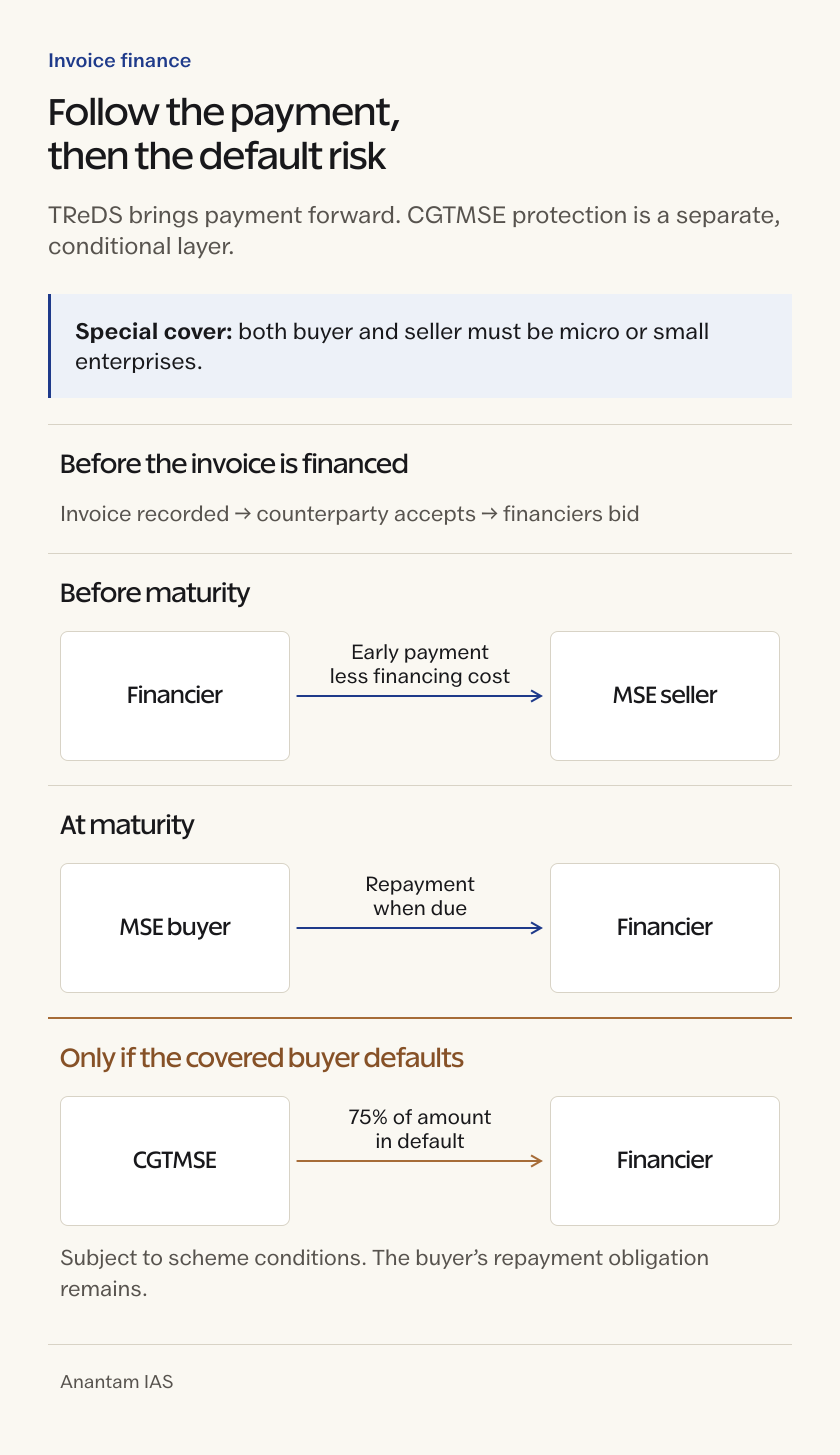
What a guarantee changes, and what it does not
The new protection changes the financier’s exposure to default; it does not turn a commercial receivable into a grant or remove the buyer’s payment obligation.
- Partial cover leaves some default exposure outside the guarantee. Financiers still have reasons to assess the transaction carefully; a guarantee should support credit decisions rather than replace checks on whether the underlying sale is genuine.
- The announced limits apply to revolving exposure, meaning capacity can become available again as covered obligations run off, within the applicable rules. They are not permanent cash entitlements that every participating enterprise receives upfront.
- Guarantee fees are calculated using invoice value, financier type and tenor, according to the ministry. Any assessment of affordability should consider applicable costs together, rather than looking only at the discount rate quoted initially.
- The buyer remains responsible for repayment. Guarantee protection addresses the financier’s risk after default; it should not be confused with debt forgiveness or permission for a buyer to disregard the agreed payment date.
- Go-live establishes operational availability, not universal access or measured savings. Useful evaluation asks whether otherwise underserved firms obtain bids, what they pay, and whether financing expands without weakening scrutiny or encouraging avoidable defaults.
Way Forward
Measure access without weakening payment discipline
- Track eligible invoices financed and unsuccessful applications to identify whether buyer acceptance, limited bidding or documentation remains the main obstacle.
- Compare total financing costs across comparable transactions, including applicable guarantee charges, before describing the scheme as cheaper credit.
- Maintain checks on genuine receivables and publish claim-processing performance so easier access does not conceal poor underwriting or delayed risk protection.
Conclusion
- TReDS converts a payment claim into earlier liquidity, while CGTMSE adds conditional protection against default. Keeping these two functions separate explains why invoice finance can support production without becoming a subsidy for every invoice.
- For a Mains answer, assess access, cost and repayment discipline together. The relevant question is whether risk sharing brings viable small enterprises into formal finance while preserving scrutiny of invoices and the buyer’s obligation to pay.
UPSC Practice Questions
Prelims MCQ 1
With reference to the special CGTMSE guarantee provision for TReDS, consider the following statements:
- Both the buyer and seller must be micro or small enterprises.
- The cover equals 75% of the amount in default.
- The guarantee extinguishes the buyer’s repayment obligation.
How many of the above statements are correct?
(a) Only one (b) Only two (c) All three (d) None
Answer: (b) Only two
Explanation:
The ministry specifies the first two conditions. A guarantee protects against default risk; it does not cancel the buyer’s payment obligation.
Prelims MCQ 2
Which sequence best describes normal financing and repayment on TReDS?
(a) Buyer pays seller early; seller repays CGTMSE at maturity. (b) CGTMSE grants the invoice value to the seller before acceptance. (c) Financier pays seller early; buyer pays financier at maturity. (d) Seller pays financier first; buyer receives the guarantee as cash.
Answer: (c) Financier pays seller early; buyer pays financier at maturity.
Explanation:
Invoice discounting brings forward the seller’s receipt through financing. The buyer subsequently settles the financed obligation with the financier.
UPSC Mains Questions
- Explain how invoice discounting and partial credit guarantees address different barriers to working-capital finance for small enterprises.
- What indicators would you use to evaluate whether the new TReDS guarantee provision improves access without weakening payment discipline?
Sources: PIB, Ministry of Micro, Small and Medium Enterprises and Reserve Bank of India: TReDS FAQs.
Frequently Asked Questions
What is TReDS?
TReDS is an RBI-regulated electronic system that facilitates financing of MSME trade receivables. It connects sellers, buyers and financiers so an accepted invoice can provide cash before its payment due date.
Who qualifies for the new CGTMSE guarantee?
The special provision requires both buyer and seller to be micro or small enterprises. This is narrower than the broader MSME financing scope of TReDS and does not automatically cover every platform transaction.
Is the guarantee an invoice subsidy?
No. The announced cover is 75% of the amount in default, subject to scheme conditions. It protects against part of the financier’s risk rather than giving the seller that share of its invoice as a subsidy.
Do the revolving limits provide free money?
No. They cap exposure associated with eligible buyers and sellers. Revolving capacity can become available again as obligations run off under applicable rules; the limits are not upfront grants or unconditional payments.
Does go-live mean every eligible enterprise gets cheaper credit?
No. The ministry states an objective of improved access at competitive rates. Actual availability and cost depend on transaction eligibility, acceptance, bids and applicable charges, and must be assessed using evidence after launch.
Source: https://anantamias.com/current-affairs/treds-cgtmse-guarantee-invoice-discounting/
Revisiting India’s Nuclear Doctrine without Revising it
Context:
Changes in India’s security environment warrant reviewing its nuclear doctrine and supporting capabilities, without necessarily changing its core principles. A review assesses whether the doctrine remains effective; revision changes its commitments.
| UPSC Relevance: GS-III: Internal Security: India’s Nuclear Doctrine; GS-3 Science and Technology: Defence Technology Prelims: No First Use, Credible minimum deterrence, Nuclear Command Authority, Nuclear Triad. |
India’s Nuclear Doctrine- Evolution and Core Principles:
Following Pokhran-II (1998) and the 1999 Draft Nuclear Doctrine, the Cabinet Committee on Security publicly outlined India’s Nuclear Doctrine on 4 January 2003. The policy is the legally binding state framework.
Its principal features are:
- Credible Minimum Deterrence (CMD): Maintaining a robust survivable arsenal sufficient to deter adversaries. “Minimum” does not imply a permanently fixed number of weapons; it scales with the threat environment.
- No First Use (NFU): A strict posture where nuclear weapons are strictly retaliatory assets, triggered only in response to a nuclear strike on Indian territory or forces anywhere.
- Massive Retaliation: Any nuclear first strike against India will be met with a massive, punitive counter-response designed to inflict unacceptable damage.
- Qualified Restraint: India pledges non-use against non-nuclear states. However, it explicitly retains the nuclear option if subjected to a major chemical or biological attack.
- Civilian Control: The authority to release and execute nuclear weapons rests solely with the democratically elected civilian political leadership (via the Nuclear Command Authority).
- Disarmament & Non-Proliferation: Active support for universal, non-discriminatory nuclear disarmament alongside strict export controls, a testing moratorium, and engagement in Fissile Material Cut-off Treaty (FMCT) talks.
Institutional Mechanism:
- The Nuclear Command Authority’s Political Council, chaired by the Prime Minister, alone authorises nuclear use.
- Its Executive Council, chaired by the National Security Adviser, provides inputs and implements directives.
- The Strategic Forces Command manages and administers strategic forces.
Why is a Review relevant?
- An interconnected China-Pakistan challenge: China’s rapid nuclear expansion and tactical advancements directly shift the regional balance of power. India faces a complex, combined threat matrix where Chinese strategic capabilities and Pakistani tactical postures overlap. Hence, India must assess how pressure from the two adversaries could interact during a crisis, without assuming that coordinated nuclear action is inevitable.
- Pakistan’s Tactical Nuclear Weapons: Pakistan’s deployment of battlefield TNWs aims to exploit the space below India’s conventional retaliation threshold. A review addresses the core paradox of India’s doctrine: Whether a threat of Massive Retaliation remains politically and operationally credible against a localised, low-yield tactical strike. It would reinforce that India’s Credible Minimum Deterrent makes no distinction between tactical and strategic nuclear use; any use triggers massive retaliation.
- Compressing timelines via Disruptive technologies:
- AI & Cyber vulnerabilities: Emerging tech introduces risks of deepfakes, spoofing, false-flag indicators, and compromised command-and-control (C2) communication networks.
- Hypersonic weapons: Extreme speeds eliminate traditional early-warning windows, severely compressing the time leaders have to verify threats and make decisions.
- BMD & Space Surveillance: Advanced Ballistic Missile Defence (BMD) and persistent space surveillance create a paradox; they protect assets but may provoke adversaries into building larger stockpiles to guarantee penetration.
- Wider Geopolitical Competition: U.S.-China rivalry, China-Russia coordination and Indo-Pacific competition mean that regional nuclear crises may have consequences extending beyond bilateral relations.
Key Strategic Dilemmas:
- NFU vs. Survivability Paradox: No First Use (NFU) relies entirely on an assured, highly resilient second-strike capability. The credibility of NFU rests on hard operational capabilities (like the SSBN submarine leg of the nuclear triad) rather than just diplomatic declarations.
- The Credibility Gap in Massive Retaliation: While a blanket threat of Massive Retaliation acts as a powerful deterrent, critics argue it lacks political and operational credibility when responding to a minor, low-yield tactical nuclear strike.
- The Stability-Instability Paradox: While the fear of mutual nuclear devastation successfully deters full-scale wars, it inadvertently creates space for limited conventional conflicts or sub-conventional proxy warfare. The 1999 Kargil War proved that a nuclear umbrella does not eliminate conventional military friction.
- The Chemical-Biological Ambiguity: The exception allowing a nuclear response to chemical or biological attacks introduces severe operational hurdles. Defining what constitutes a “major” attack and accurately attributing blame is deeply complicated, especially if executed by non-state proxies.
Why retain the Core Principles?
The editorial’s case for continuity rests on four considerations:
- Predictability: Clear commitments reduce miscalculation during crises.
- Strategic restraint: NFU reinforces India’s standing as a responsible nuclear power.
- Resource discipline: Credible minimum deterrence limits pressure for open-ended arsenal competition.
- Escalation control: Unexplained ambiguity could encourage adversaries to adopt more dangerous postures.
Way Forward:
- Consolidate the Nuclear Triad: Maintain credible land-, air- and sea-based delivery capabilities. Accelerate the deployment of survivable second-strike assets.
- Institutionalise periodic reviews: Establish formal, routine reviews of the nuclear doctrine under civilian oversight to evaluate evolving regional threats, technological risks, and the validity of core deterrence assumptions.
- Build resilient command systems: Invest heavily in hardened communication networks, robust cyber defences, and fail-safe early-warning systems to ensure the absolute continuity of political control during a crisis.
- Preserve human judgement: Strictly mandate that AI-driven data processing and battlefield assessments remain subordinate to human decision-making, preventing automated or algorithmic escalation.
- Improve crisis communication: Strengthen direct hotlines and institutionalised risk-reduction dialogues with nuclear-armed neighbours to prevent miscalculation and accidental escalation during periods of high tension.
- Align deterrence with diplomacy: Balance robust military modernisation with active diplomatic engagement, reinforcing India’s commitment to strategic autonomy, global non-proliferation, and universal disarmament.
India’s priority should be to ensure that doctrine, capability and survivability remain aligned. A periodic review can reinforce credible deterrence while preserving the strategic value of restraint.
Practice Prelims MCQ:
Q. Consider the following statements about India’s Nuclear Doctrine:
- NFU contains no exception relating to chemical or biological attacks.
- The Political Council of the Nuclear Command Authority is chaired by the Prime Minister.
- The declared retaliation policy covers nuclear attacks on Indian forces outside Indian territory.
Which are correct?
(a) 1 and 2 only
(b) 2 and 3 only
(c) 1 and 3 only
(d) 1, 2 and 3
Answer: (b). Statement 1 is incorrect because India retains the nuclear option following a major chemical or biological attack. Statements 2 and 3 are correct.
Mains Practice Question:
Q. “Reviewing India’s Nuclear Doctrine need not entail revising its core principles.” Discuss in the context of emerging security and technological challenges.
Source: https://anantamias.com/current-affairs/revisiting-indias-nuclear-doctrine-without-revising-it/
J&K Assembly passes Statehood Resolution
Why in News?
In a resolution passed on September 28, the Jammu and Kashmir Assembly called upon the Government of India for the “immediate and urgent restoration of full Statehood” to the nearly seven-year-old Union Territory of Jammu and Kashmir.
| UPSC Relevance: GS-2 Polity and Governance: Federalism, Centre-State relations, Parliament and State Legislatures. Prelims: Articles 2, 3 and 4; Union Territories; Jammu and Kashmir Reorganisation Act, 2019 |
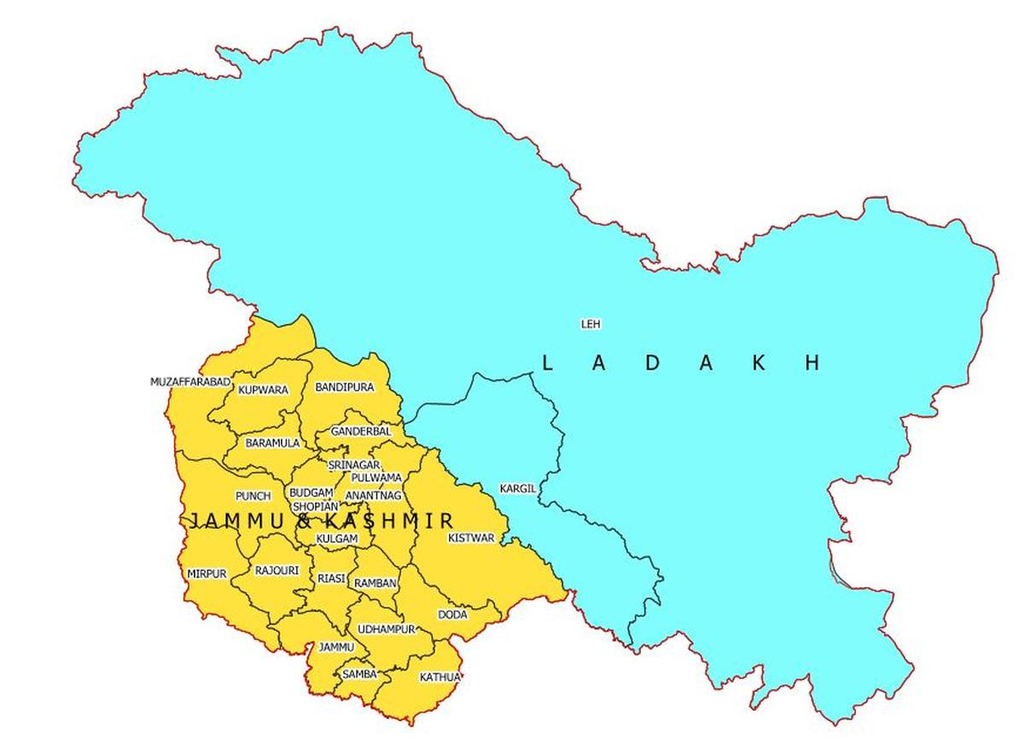
J&K Background: From State to Union Territory:
- In 2019, the constitutional changes concerning Article 370 removed J&K’s special constitutional status.
- The Jammu and Kashmir Reorganisation Act, 2019, reorganised the erstwhile State into:
- Jammu and Kashmir: Union Territory with a Legislative Assembly.
- Ladakh: Union Territory without a Legislative Assembly.
- In its 2023 judgment on Article 370, the Supreme Court upheld the constitutional validity of the changes. It also directed that Assembly elections be held and recorded the Union government’s submission that statehood for J&K would be restored. The Court directed that restoration should take place at the earliest and as soon as possible.
- Assembly elections were subsequently held in 2024, leading to the formation of an elected government.
The present resolution therefore seeks to place the demand for statehood before the Union Government through the elected legislature.
Note: Restoring statehood would not automatically revive Article 370, the former J&K Constitution or the pre-1953 arrangement.
Constitutional Framework for Statehood and Reorganisation:
- Article 2 (Admission or Establishment): Governs the admission of foreign territories into the Union or the establishment of entirely new States. It does not apply to the reorganisation of existing Indian Union Territories or States.
- Article 3 (Formation and Alteration): Empowers Parliament to alter boundaries, change names, or create new States from existing territories. Any bill for this purpose requires the prior recommendation of the President before introduction.
- Article 4: Allows Parliament to make necessary updates to the First Schedule (territories) and Fourth Schedule (Council of States allocation). It explicitly mandates that such laws can be passed via a simple majority (ordinary legislative process), bypassing the stringent amendment procedure of Article 368.
- Role of the Legislative Assembly: A resolution passed by a Union Territory Assembly (such as Jammu & Kashmir) serves as a formal expression of political intent. However, it possesses no binding legal authority over Parliament, which retains ultimate constitutional supremacy regarding statehood.
Why is Statehood Significant?
- Federalism and democratic decentralisation: Statehood would restore J&K to the State-level position within India’s federal structure, giving the elected government greater constitutional and political space in governance.
- Greater democratic accountability: A UT with a legislature differs from a full-fledged State because the Lieutenant Governor has a substantially greater role, particularly in matters assigned to the Union under the J&K constitutional framework. Restoration of statehood would therefore strengthen the principle that elected representatives should have greater responsibility for day-to-day governance.
- Fulfilment of the Supreme Court’s 2023 framework: The SC explicitly recorded the Union’s submission that statehood would be restored and directed that restoration take place at the earliest. It reinforces the separation of powers by complying with the SC’s directions.
- Cooperative Federalism: Restoring statehood can facilitate a more conventional relationship between the Union and an elected State government, potentially reducing friction over administrative powers, allocation of responsibilities, policing and public order, development priorities, and institutional accountability.
- Political integration and public confidence: For J&K, constitutional status also has a strong political and symbolic dimension. A stable federal arrangement with representative institutions can contribute to greater political participation, institutional trust and integration.
Why is the Issue Contentious?
- Security considerations: J&K has distinctive national-security and cross-border challenges. The Union has historically exercised a strong role because of these concerns. Any restoration of statehood therefore has to balance federal autonomy with national-security requirements.
- Powers of the elected government vs Lieutenant Governor: The J&K model has already generated debates over the distribution of powers between the elected government and the Lieutenant Governor. Restoration of statehood would require greater clarity regarding the institutional division of responsibilities.
- Need for an inclusive federal settlement: The debate should not be reduced to a confrontation between the Union and the J&K government. It also involves the interests of Jammu, Kashmir and Ladakh, as well as questions concerning representation, security and administrative viability.
Way Forward:
- Implement the constitutional roadmap: The Union should address restoration of statehood within the framework laid down by the Supreme Court and the commitments placed on record before it.
- Clarify the division of powers: Before restoration, the Union and J&K government should work out a clear institutional framework for matters involving the elected government and the Lieutenant Governor, particularly in areas where administrative overlap can arise.
- Separate distinct constitutional questions: The debate on statehood should be addressed independently from the separate and settled judicial question concerning Article 370, avoiding conflation of the two issues.
- Strengthen cooperative federalism: Regular institutional dialogue between the Union and the elected J&K government can prevent constitutional disagreements from becoming governance disputes.
- Maintain security-democracy balance: Restoration of statehood should be accompanied by mechanisms that preserve necessary national-security coordination while ensuring meaningful democratic accountability.
Restoration of statehood can strengthen democratic accountability, federal balance and public trust. The issue should therefore be examined not merely as a political demand but through the lenses of Article 3, federalism, representative democracy, cooperative federalism and the Supreme Court’s 2023 judgment.
Practice Prelims MCQ:
Q. Consider the following statements:
- A J&K Assembly resolution can independently restore statehood.
- Restoration of statehood would automatically revive Article 370’s former provisions.
- The Supreme Court’s 2023 judgment left open the broader question of converting an entire State into Union Territories.
Which is/are correct?
(a) 1 only
(b) 3 only
(c) 2 and 3 only
(d) 1, 2 and 3
Answer: (b) Parliamentary legislation is required; ordinary statehood does not automatically restore special status. Statement 3 correctly reflects the judgment.
Mains Practice Question:
Q. The restoration of statehood to Jammu and Kashmir involves not merely a change in administrative status but questions of federalism, democratic accountability and constitutional trust. Discuss.
Source: https://anantamias.com/current-affairs/jk-cm-brings-statehood-resolution-in-assembly/
The Case for Accountable Lottery Regulation in India
Why in news?
The author, a retired IAS officer, argues that India should regulate State lotteries transparently rather than prohibit them outright.
UPSC Relevance
Prelims: Seventh Schedule entries on lotteries and gambling, Lotteries (Regulation) Act 1998,
Mains
GS III: Mobilisation of resources, State finances, GST, informal and illegal economies.
Author’s observations
- Vices like tobacco, alcohol and lotteries have always been fiscally valuable; the author cites Napoleon III, who said he would ban tobacco once someone found a virtue yielding as much revenue.
- Prohibition often backfires: US Prohibition (1920–33) left demand intact, fuelled organised crime and cost excise revenue, and was repealed by the 21st Amendment. Indian States with prohibition faced similar problems.
- Harms are real: lotteries fall disproportionately on poor households, and rapid draws, huge jackpots, credit sales and opaque odds encourage compulsive play. These justify strict regulation, not a ban.
- Paternalism is not class-neutral: Affluent citizens can trade Future & Options or crypto despite SEBI data showing most retail derivatives traders lose money. Disclosure, regulated intermediaries and fraud punishment, not bans, make those markets legal.
Lotteries in India
- As per a Lok Sabha reply (March 2023), only nine States run lotteries: Arunachal Pradesh, Goa, Kerala, Maharashtra, Mizoram, Nagaland, Punjab, Sikkim and West Bengal.
- Sin taxes / demerit goods: lotteries, betting and gambling are taxed at the highest GST slab, which underpins the author’s revenue argument.
Constitutional scheme
- Entry 40, List I (Union): lotteries organised by the Government of India or a State Government.
- Entry 34, List II (State): betting and gambling.
- Entry 62, List II: taxes on betting and gambling.
- Parliament thus regulates State-organised lotteries, while private lotteries and gambling fall to States. This split is the source of the federal friction.
Lotteries (Regulation) Act, 1998
- Section 4: conditions for a State lottery, including State-printed tickets, sale directly or through distributors/agents, proceeds credited to the public account, limits on draw frequency, and draws conducted by the State itself.
- Section 5: a State may prohibit sale of lottery tickets organised by other States within its territory.
- A State directly controls its own lottery but only indirectly supervises another State’s lottery sold on its soil, while still bearing the enforcement burden. The all-or-nothing rule forced Tamil Nadu (2003) and Karnataka (2007) to choose total prohibition, giving up the option of running an accountable public lottery.
- Section 6: the Union may prohibit a lottery that violates Section 4 conditions.
The regulatory dilemma
| Prohibition | Regulation |
| Moral signalling | Harm reduction through audits, age limits, capped draw frequency |
| Pushes demand to illegal satta / offshore apps | Brings play into a traceable, taxable channel |
| Revenue loss plus enforcement costs | Surplus earmarked for welfare (Kerala) |
| Vendors criminalised | Livelihoods for PwDs, SHGs, cooperatives |
Judicial doctrine
- State of Bombay v. R.M.D. Chamarbaugwala (1957): gambling is ‘res extra commercium’ (outside commerce), so it gets no protection under Article 19(1)(g) or Article 301.
- Skill Lotto Solutions v. UoI (2020): upheld levying GST on lotteries as “actionable claims”.
- Union of India v. Future Gaming Solutions (2025): lottery distribution is not a “service” for service tax; taxing lotteries lies with States under Entry 62, List II.
Way Ahead
- Two amendments proposed to the 1998 Act:
- Amend Section 5 so a State can bar other States’ lotteries whether or not it runs its own, overturning the “all-or-nothing” reading in B.R. Enterprises (1999), subject to uniform treatment of all outside lotteries.
- Insert Section 4A allowing two or more States to run a common lottery by agreement, helping smaller north-eastern States.
- Kerala model: departmental operation with retail through small vendors, persons with disabilities, SHGs and cooperatives. In FY 2023-24 it earned ₹2,883.80 crore (₹1,129.71 crore net surplus + ₹1,754.09 crore State GST), channelled into health and welfare.
- Global norm is controlled legality: lotteries are legal in about four-fifths of countries. Roughly 70% of lottery jurisdictions use a public-operator model. Federations (US, Canada, Australia, Germany) leave lotteries to sub-national units, with cross-border sales only by consent or joint lotteries such as Powerball.
Practice MCQs
Q1. Consider the following statements:
- Lotteries organised by the Government of India or a State Government are listed in the Union List.
- Betting and gambling is a subject in the State List.
- Under the Lotteries (Regulation) Act, 1998, the Union Government may prohibit a State lottery that contravenes the conditions laid down in the Act.
How many of the statements given above are correct?
(a) Only one
(b) Only two
(c) All three
(d) None
Answer: (c). Entry 40, List I; Entry 34, List II; Section 6 of the Act.
Q2. Consider the following statements:
Statement I: Trade in lottery tickets cannot claim the protection of Article 19(1)(g) of the Constitution of India.
Statement II: The Supreme Court has held that gambling, including State-organised lotteries, is res extra commercium.
Which one of the following is correct in respect of the above statements?
(a) Both Statement I and Statement II are correct and Statement II explains Statement I
(b) Both Statement I and Statement II are correct but Statement II does not explain Statement I
(c) Statement I is correct but Statement II is incorrect
(d) Statement I is incorrect but Statement II is correct
Answer: (a)
Source: https://anantamias.com/current-affairs/the-case-for-accountable-lottery-regulation-in-india/
AFSPA Extended in Parts of Arunachal, Manipur, Nagaland
Why in news?
Union Home Ministry extended AFSPA for six more months in parts of Manipur, Nagaland and Arunachal Pradesh.
UPSC Relevance
Prelims: AFSPA 1958 provisions (Sections 3, 4, 6), “disturbed area” declaration, Seventh Schedule entries on public order and armed forces.
Mains:
GS II: salient features of Indian Constitution (Articles 21, 355, 356), Centre–State relations.
GS III: Security challenges in border areas, internal security, various security forces and their mandate, linkages between development and insurgency.
Latest developments
- The Union Home Ministry has extended the Armed Forces (Special Powers) Act (AFSPA) in parts of Manipur, Arunachal Pradesh and Nagaland for another six months.
- Manipur: AFSPA covers the whole State except 13 police stations in five valley districts.
- AFSPA has been applied in Manipur since 1981. Manipur, a former Union Territory, became a State in 1972.
- President’s Rule was imposed in Manipur on February 13, 2025 and revoked on February 4, 2026.
- The Manipur government had withdrawn AFSPA from all valley police stations between April 1, 2022 and April 1, 2023, citing improved security. It was lifted from the Imphal municipality area in 2004.
- Nagaland: extended for six months in nine districts and 21 police stations in five other districts.
- Arunachal Pradesh: three districts and three police stations in another district bordering Assam declared “disturbed areas” for six more months.
- Rollback trend: AFSPA was fully withdrawn from Tripura (2015) and Meghalaya (2018), and disturbed areas in Assam, Nagaland and Manipur were significantly reduced from April 2022, after the Oting incident (Mon district, Nagaland, December 2021) in which civilians were killed in a botched operation.
- Why the valley–hills split matters ?
- Manipur’s valley districts (largely Meitei-inhabited) saw AFSPA withdrawn in 2022–23, while the hill districts (largely Naga and Kuki-Zo) remained under it. After the 2023 ethnic conflict, the Centre reimposed it in six valley police stations in 2024. The pattern of exemptions has itself become politically sensitive, as each community perceives security deployment differently.
What is AFSPA?
- The Armed Forces (Special Powers) Act, 1958 grants special powers to the armed forces to maintain public order in areas declared “disturbed”.
- It grew out of a 1942 colonial ordinance against the Quit India Movement and was enacted to deal with the Naga insurgency.
- A separate AFSPA (Jammu & Kashmir), 1990 applies in J&K; the Punjab and Chandigarh version (1983) lapsed in 1997.
Key provisions
- Section 3, disturbed area: the Governor of the State, the Administrator of a UT, or the Central Government can declare an area “disturbed” when use of armed forces in aid of civil power is necessary. The Centre’s power was added by a 1972 amendment, which critics see as diluting federalism.
- Section 4, special powers: an officer (even a non-commissioned officer) may, after due warning, fire upon or use force, even causing death, against persons acting in contravention of law or orders prohibiting assembly of five or more persons or carrying weapons; destroy arms dumps and hideouts; arrest without warrant on reasonable suspicion; and enter and search premises without warrant.
- Section 5: arrested persons must be handed over to the nearest police station with the least possible delay.
- Section 6, legal immunity: no prosecution, suit or legal proceeding against any person acting under the Act without prior sanction of the Central Government.
Constitutional basis
- Entry 2A, List I (added by 42nd Amendment, 1976): deployment of armed forces of the Union in aid of civil power in any State.
- Entry 1, List II: public order is a State subject, which is why State consent and Centre’s unilateral declaration power are contested.
- Article 355: duty of the Union to protect every State against external aggression and internal disturbance, often cited to justify AFSPA.
- Article 21: critics argue powers to kill and immunity from prosecution clash with the right to life and due process.
Judicial pronouncements
- Naga People’s Movement of Human Rights v. Union of India (1998): Constitution Bench upheld the validity of AFSPA, but held that the declaration must be reviewed before six months expire, that Centre can declare without State consent (though State should be consulted), that force must be minimal, and that the Army’s do’s and don’ts are binding.
- Extra-Judicial Execution Victim Families Association (EEVFAM) v. Union of India (2016): there is no absolute immunity; excessive or retaliatory force even in a disturbed area must be investigated. The SC ordered a CBI probe into alleged fake encounters in Manipur.
- The Santosh Hegde Commission (2013), appointed by the SC, found that the six Manipur encounters it examined were not genuine.
The core debate
| Arguments for continuation | Arguments against |
| Insurgent groups and ethnic militias remain active; Manipur violence since 2023 | Human rights violations: fake encounters, Oting (2021), Manorama Devi (2004) |
| Protects soldiers from frivolous litigation in hostile terrain | Section 6 immunity breeds impunity; sanction rarely granted |
| Porous Indo-Myanmar border, arms and drug smuggling | Decades of use without ending insurgency; alienates local population |
| Armed forces need legal cover to operate beyond peacetime powers | Undermines federalism and civilian authority; normalises emergency rule |
Way Ahead
- The Justice B.P. Jeevan Reddy Committee (2005) recommended repeal of AFSPA and insertion of suitable provisions in the Unlawful Activities (Prevention) Act.
- The Second ARC (5th Report, Public Order) endorsed repeal.
- The Justice Verma Committee (2013) recommended that sexual offences by armed forces personnel be tried under ordinary criminal law.
- The UN Special Rapporteur on extrajudicial executions (2012) also called for repeal.
Security must be pursued with accountability. Thus, AFSPA should be a temporary instrument, not a permanent governance tool.
Practice MCQs
Q1. With reference to the Armed Forces (Special Powers) Act, 1958, consider the following statements:
- Both the Central Government and the Governor of a State can declare an area as “disturbed” under the Act.
- Prosecution of armed forces personnel for acts done under the Act requires prior sanction of the concerned State Government.
- The Supreme Court has upheld the constitutional validity of the Act.
How many of the statements given above are correct?
(a) Only one
(b) Only two
(c) All three
(d) None
Answer: (b). Statement 2 is incorrect: Section 6 requires sanction of the Central Government. Validity upheld in Naga People’s Movement of Human Rights (1998).
Q2. Consider the following statements:
Statement I: A declaration of “disturbed area” under AFSPA is ordinarily notified for a period of six months at a time.
Statement II: The Supreme Court has held that the declaration of an area as “disturbed” must be reviewed before the expiry of six months.
Which one of the following is correct in respect of the above statements?
(a) Both Statement I and Statement II are correct and Statement II explains Statement I
(b) Both Statement I and Statement II are correct but Statement II does not explain Statement I
(c) Statement I is correct but Statement II is incorrect
(d) Statement I is incorrect but Statement II is correct
Answer: (a)
Mains Practice Question
“Despite claims of improved security, AFSPA continues to be extended in parts of the North-East.” Critically examine the continued relevance of AFSPA in the light of judicial pronouncements and committee recommendations. Suggest a way forward. (15 marks, 250 words)
Source: https://anantamias.com/current-affairs/afspa-extended-in-parts-of-arunachal-manipur-nagaland/
Coffee Board brews sustainability push with new framework
Why in news?
Coffee Board published sustainability standards and is rolling out a three-level certification to boost coffee exports.
UPSC Relevance
- Prelims: Coffee Board, Coffee Act 1942, INDICOFS, coffee-growing states and GI coffees, EUDR, International Coffee Organization.
Status of coffee production
- India is the world’s 7th-largest coffee producer and 5th-largest exporter.
- Exports crossed $2 billion in 2025-26, and nearly 39% of them were value-added products (instant or roasted coffee).
- Indian coffee’s unique selling point is shade-grown cultivation, which the new standards aim to leverage.
- Indian coffee grows under a two-tier canopy of native and leguminous trees, intercropped with pepper, cardamom, orange and banana. This protects Western Ghats biodiversity, stores carbon and protects soil. It is effectively agroforestry, unlike the sun-grown monocultures of Brazil and Vietnam.
Sustainability framework
- The Coffee Board has published sustainability standards for coffee under Indian Coffee Sustainability Standard and Certification Scheme (INDICOFS).
- The scheme was launched in December 2025 and is voluntary.
- It starts with growers and will later extend to the whole value chain through Chain of Custody Standards.
- Three-level certification:
- Level 1 (Basic) is meant for smallholders and is done by the Coffee Board, based on growers’ self-certification.
- Levels 2 (Aspiring) is for independent third-party verification.
- Level 3 (International Benchmark) are handled by independent certification bodies accredited under ISO 17065. It benchmarks Indian standards against internationally recognised sustainability frameworks.
- A steering committee has been set up to put certification into effect .
Why the sustainability certification push ?
- The certification gap. Although most Indian coffee is grown sustainably, only about 15% of output holds a global certification such as Rainforest Alliance, Fairtrade or 4C. India has more than 4 lakh small and marginal holdings, and nearly 2 million people depend on the sector.
- The EU Deforestation Regulation (EUDR), Regulation (EU) 2023/1115. It covers coffee, cocoa, palm oil, soy, rubber, cattle and wood. Only deforestation-free, legally produced goods with a due diligence statement can enter the EU market. Europe (Italy, Germany, Belgium) is India’s largest coffee market.
- Brand value. Premium buyers pay more for certified, traceable coffee. A national standard lowers the cost of certification for small growers compared with expensive private labels.
- Leverage India’s shade-grown advantage.
Coffee Board
| Fact | Detail |
| Status | Statutory body under the Coffee Act, 1942 |
| Ministry | Ministry of Commerce and Industry (Department of Commerce) |
| Headquarters | Bengaluru, Karnataka |
| Composition | Chairperson + CEO/Secretary + members representing growers, trade, labour, States and Parliament (33 members in all) |
Coffee geography
- Climate: Tropical, 15 to 28°C, 150 to 250 cm of rainfall, hill slopes at about 600 to 1,600 m, well-drained soils, and shade. It is sensitive to frost and to strong sun.
- Varieties: Robusta makes up about 70% of production and Arabica about 30%.
- History: Baba Budan is said to have brought 7 coffee seeds from Yemen (Mocha) around 1670 and planted them in the Chandragiri hills (Bababudangiri), Chikkamagaluru.
- GI coffees: Coorg Arabica, Wayanad Robusta, Chikmagalur Arabica, Araku Valley Arabica, Bababudangiri Arabica, and Monsooned Malabar Robusta. Monsooned Malabar is beans exposed to the monsoon winds on the Malabar coast.
- International: The International Coffee Organization (ICO) is headquartered in London and India is a member. International Coffee Day is 1 October.
Coffee growing states

Practice MCQ
Q1. Consider the following statements about the Coffee Board of India:
1. It is a statutory body set up under the Coffee Act, 1942 and works under the Ministry of Agriculture and Farmers’ Welfare.
2. The Coffee Board is headquartered at Bangalore.
3. Its new sustainability certification scheme has three levels, of which the entry level is based on self-certification by growers.
How many of the above statements are correct?
(a) Only one
(b) Only two
(c) All three
(d) None
Answer: (b). Statement 1 is wrong because the Board is under the Ministry of Commerce and Industry. Statements 2 and 3 are correct.
Q2. Consider the following pairs (Geographical Indication coffee : State):
1. Monsooned Malabar Robusta : Kerala
2. Araku Valley Arabica : Andhra Pradesh
3. Wayanad Robusta : Tamil Nadu
How many of the above pairs are correctly matched?
(a) Only one
(b) Only two
(c) All three
(d) None
Answer: (b). Wayanad Robusta belongs to Kerala, not Tamil Nadu.
Source: https://anantamias.com/current-affairs/coffee-board-brews-sustainability-push-with-new-framework/