Daily Digest
UPSC · Civil Services Examination
Current Affairs · Saturday, 27 June 2026
Current affairs curated and edited by Anantam IAS faculty — pulled from The Hindu, PIB, IDSA, Foreign Affairs and the ministries. Read, annotate, revise.
Old Rajinder Nagar · Delhi 110005 · anantamias.com
Banned Drugs: Why the Government Barred 16 Fixed-Dose Combinations
Why in News?
The Union Health Ministry has prohibited the manufacture, sale and distribution of 16 irrational fixed-dose combination (FDC) drugs after concluding that they carry no therapeutic justification and that their continued use is not beneficial relative to the risks involved. The Indian Express, in its Explained section, set out how a decade-long regulatory and legal process under the Drugs and Cosmetics Act, 1940 produced this latest round of bans.
The banned list spans common painkillers, antibiotics, antidiabetic and topical skin formulations — for instance, antibiotic combinations pairing amoxicillin or cefuroxime with the enzyme serratiopeptidase, which the expert committee found pharmacodynamically irrelevant. For UPSC, the episode is a clean window into India’s drug-regulation architecture (CDSCO, DTAB), the meaning of irrational FDCs, and their link to antimicrobial resistance (AMR).
- Notifications under Section 26A of the Drugs and Cosmetics Act, 1940 prohibit 16 FDCs for lacking therapeutic justification.
- Categories hit: paracetamol-based painkillers, antibiotic-enzyme pairings, gliclazide + chromium picolinate (antidiabetic), and topical skin products.
- A DTAB sub-committee finalised its recommendation on 28 December 2024 after giving manufacturers a chance to submit data through public notices.
- The ban flows from a long chain: the 2016 ban on 344 FDCs, court challenges, a 2017 Supreme Court reference, and fresh DTAB scrutiny.
- Antibiotic FDCs were flagged because injudicious use fuels antimicrobial resistance, a recurring concern of the expert committees.
The development matters in the context of:
- An FDC is a single dosage form (tablet, syrup, injection) combining two or more active drugs in a fixed ratio.
- FDCs are rational only when each ingredient adds proven benefit; otherwise they are termed irrational FDCs.
- India has long carried a large market of unscientific combinations, prompting repeated regulatory clean-ups since 2016.
UPSC Relevance
Prelims Relevance
- FDC = fixed-dose combination: two or more active pharmaceutical ingredients in one fixed-ratio dosage form.
- Power to ban drugs in the public interest flows from Section 26A of the Drugs and Cosmetics Act, 1940.
- CDSCO (Central Drugs Standard Control Organisation) is India’s national drug regulator under the Ministry of Health and Family Welfare.
- The DCGI (Drugs Controller General of India) heads CDSCO and approves new drugs and FDCs.
- The Drugs Technical Advisory Board (DTAB) is the top technical advisory body on drug matters under the Act.
- The Kokate Committee (chaired by Prof. C. K. Kokate) examined the rationality of FDCs and underpinned the 2016 ban on 344 FDCs.
- State drug controllers can license drug manufacture, which historically allowed many FDCs to enter the market without central approval.
- Antimicrobial resistance (AMR) is the ability of microbes to survive drugs that once killed them, worsened by misuse of antibiotics including irrational FDCs.
- The current action bans 16 FDCs; notifications take effect on issue and apply nationwide.
Mains Relevance
GS Paper 2
- Health governance: how regulatory bodies (CDSCO, DTAB) and statutory powers (Section 26A) are used to protect public health against market and industry pressures.
- Regulation versus enforcement gap: persistent circulation of irrational FDCs despite repeated bans points to weaknesses in licensing, surveillance and centre-state coordination.
Essay
- Science, ethics and public interest: when commercial convenience collides with patient safety and the long-term threat of antimicrobial resistance.
Background and Context
What FDCs are, and what makes one irrational
Not every combination pill is a problem; the issue is combinations that add risk without adding proven benefit.
- A fixed-dose combination packs two or more active drugs in a single fixed-ratio tablet, capsule, syrup or injection.
- Rational FDCs (for example, many tuberculosis and HIV regimens) improve adherence and outcomes and appear on the WHO model list.
- An irrational FDC combines drugs with no scientific basis — ingredients that overlap, work against each other, or have no evidence for joint use.
- Reviewers flagged amoxicillin + serratiopeptidase and cefuroxime + serratiopeptidase as pharmacodynamically irrelevant, with no robust evidence or treatment-guideline support.
- Gliclazide + chromium picolinate was barred because diabetes guidelines do not recommend chromium picolinate.
- Combinations stacking redundant antispasmodics (such as adding clidinium to dicyclomine) were judged to offer no extra benefit while raising the risk burden.
Why the 16 were banned now
The 16 notifications rest on a single test: no therapeutic justification, so risk outweighs benefit.
- The Health Ministry held that the 16 FDCs lack therapeutic justification and that continued use is not beneficial against the potential risks.
- A DTAB sub-committee examined safety, efficacy and therapeutic value, then finalised its report on 28 December 2024.
- Manufacturers and stakeholders were invited to submit supporting data through public notices before the recommendation was finalised.
- The list spans everyday categories — painkillers, antibiotics, antidiabetic and topical products — meaning the ban touches widely sold formulations.
- Notifications were issued under Section 26A, which lets the Centre prohibit a drug in the public interest, and the Indian Express noted they take effect on issue.
The regulatory architecture: CDSCO, DCGI, DTAB and Section 26A
Drug regulation in India runs on a shared central-and-state structure with one key ban power at the top.
- CDSCO, headed by the DCGI, is the central regulator that approves new drugs, FDCs and clinical trials under the Drugs and Cosmetics Act, 1940.
- The DTAB is the highest statutory technical body advising the centre and states on technical drug matters.
- State drug controllers license manufacture and sale, a split that historically let some FDCs reach the market without central clearance.
- Section 26A empowers the Centre to prohibit the manufacture, sale or distribution of a drug if it is satisfied this is needed in the public interest.
- The Kokate Committee (from 2014) supplied the scientific review that drove the first big clean-up, the 2016 ban on 344 FDCs.
- Subsequent scrutiny was routed through DTAB and its sub-committees, the route used again for the current 16.
The antimicrobial-resistance link
Several flagged FDCs are antibiotics, tying the ban to India’s wider AMR challenge.
- Antimicrobial resistance develops when bacteria, viruses and other microbes survive the drugs meant to kill them, making infections harder to treat.
- Irrational antibiotic FDCs encourage injudicious use — wrong combinations and unnecessary exposure — which accelerates resistance.
- Expert committees, including the Kokate review, repeatedly named antibiotic resistance from over-use as a serious national concern.
- Curbing pointless antibiotic-enzyme pairings supports antibiotic stewardship and India’s National Action Plan on AMR.
- Internal context for readers is available in our explainer on antimicrobial resistance.
Past FDC bans and the litigation trail
The 16 bans are the latest step in a decade of regulation tangled in courtrooms.
- In March 2016 the Centre issued 344 notifications banning 344 FDCs based on the Kokate Committee’s finding of no therapeutic justification.
- Major manufacturers challenged the bans, and the Delhi High Court stayed them in 2016, holding that the DTAB should have been consulted.
- In December 2017 the Supreme Court set aside the High Court order but referred most post-1988 FDCs back to DTAB for fresh examination.
- A DTAB sub-committee reported in 2018, and the government issued fresh prohibitions covering hundreds of FDCs.
- The 2026 action on 16 FDCs shows the review machinery continues to work case-by-case through DTAB rather than in a single sweep.
Significance and the enforcement gap
Bans on paper matter only if irrational combinations actually disappear from pharmacy shelves.
- Each ban removes a specific risk while signalling that combinations need evidence, not just market demand, to survive.
- A recurring weakness is the gap between notification and ground reality, as banned or unapproved FDCs keep resurfacing.
- The centre-state split in licensing complicates uniform enforcement across India’s large, fragmented pharma market.
- Stronger post-market surveillance, pharmacovigilance and rational-prescribing norms are needed to make the bans stick.
- For aspirants, the case links health policy, federal regulation and the science of drug safety in one example.
Way Forward
Close the enforcement gap
- Strengthen state-level inspection and pharmacovigilance so banned FDCs are pulled from shelves, not just from notifications.
- Build a shared CDSCO-state database to track licensed FDCs and flag unapproved combinations quickly.
Make approvals evidence-first
- Require robust clinical evidence and guideline support before any new FDC is licensed.
- Route all FDC approvals through central CDSCO scrutiny to prevent state-level back doors.
Protect antibiotics
- Tie FDC policy to the National Action Plan on AMR and antibiotic-stewardship programmes.
- Promote rational prescribing and curb over-the-counter sale of antibiotic combinations.
Conclusion
The ban on 16 irrational fixed-dose combinations is a small but telling step in a long campaign to bring evidence back into India’s medicine cabinet. Working through Section 26A, CDSCO and the DTAB, the government is steadily weeding out combinations that add risk without adding proven benefit.
The harder task lies beyond the notification. Unless enforcement, surveillance and prescribing habits catch up, irrational FDCs will keep returning and the threat of antimicrobial resistance will keep growing. For policymakers and aspirants alike, drug regulation is a standing test of whether public health can outweigh commercial convenience.
UPSC Practice Questions
Prelims MCQ 1
With reference to the regulation of Fixed-Dose Combination (FDC) drugs in India, consider the following statements:
- The power to prohibit a drug in the public interest is drawn from Section 26A of the Drugs and Cosmetics Act, 1940.
- The Drugs Technical Advisory Board (DTAB) is the highest statutory technical advisory body on drug matters under the Act.
- All fixed-dose combinations are classified as irrational and stand banned in India.
How many of the above statements are correct?
(a) Only one (b) Only two (c) All three (d) None
Answer: (b) Only two
Explanation:
Statements 1 and 2 are correct. Statement 3 is wrong: many FDCs (such as standard TB and HIV regimens) are rational and remain in use; only irrational FDCs without therapeutic justification are banned.
Prelims MCQ 2
Which body in India’s drug-regulation system heads the Central Drugs Standard Control Organisation (CDSCO) and approves new drugs and FDCs?
(a) Drugs Technical Advisory Board (b) Indian Council of Medical Research (c) Drugs Controller General of India (d) National Pharmaceutical Pricing Authority
Answer: (c) Drugs Controller General of India
Explanation:
The DCGI heads CDSCO and approves new drugs, FDCs and clinical trials. DTAB is advisory, ICMR is a research body, and the NPPA handles drug pricing.
UPSC Mains Questions
- India has repeatedly banned irrational fixed-dose combination drugs, yet they keep returning to the market. Examine the regulatory architecture for drug approval and the structural reasons for this enforcement gap. (GS2)
- Irrational antibiotic combinations contribute to antimicrobial resistance. Discuss how India’s drug-regulation framework can be aligned with antibiotic stewardship to safeguard public health. (GS2)
Source: Indian Express.
Frequently Asked Questions
What is a fixed-dose combination (FDC) drug?
An FDC is a single dosage form, such as a tablet, capsule or syrup, that combines two or more active drugs in a fixed ratio. It is rational only when each ingredient adds a proven benefit.
Why did the government ban these 16 FDCs?
A DTAB sub-committee found the 16 combinations lacked therapeutic justification, meaning their risks were not outweighed by any proven benefit. The Centre then prohibited them in the public interest.
Under which law are FDCs banned in India?
Bans are issued under Section 26A of the Drugs and Cosmetics Act, 1940, which lets the central government prohibit the manufacture, sale or distribution of a drug in the public interest.
Which bodies regulate drugs and FDCs in India?
The Central Drugs Standard Control Organisation (CDSCO), headed by the Drugs Controller General of India (DCGI), is the national regulator. The Drugs Technical Advisory Board (DTAB) is the top technical advisory body, and state drug controllers license manufacture and sale.
How are irrational FDCs linked to antimicrobial resistance?
Several banned FDCs are antibiotics. Pointless or unscientific antibiotic combinations encourage injudicious use, which speeds up antimicrobial resistance and makes infections harder to treat.
Has India banned FDCs before?
Yes. In 2016 the Centre banned 344 FDCs based on the Kokate Committee’s review. After legal challenges and a 2017 Supreme Court reference, fresh DTAB scrutiny led to further bans, of which the current 16 are the latest.
Source: https://anantamias.com/current-affairs/banned-fixed-dose-combination-drugs/
Bharat Taxi: A cooperative-based ride-hailing service launches in Gujarat
Why in News?
The Ministry of Cooperation has rolled out Bharat Taxi, billed as India’s first driver-owned cooperative ride-hailing service, with operations live in parts of Gujarat (Ahmedabad and Surat) and the National Capital Region. The platform is run by Sahakar Taxi Cooperative Limited, registered on 6 June 2025, and was formally launched by Union Home and Cooperation Minister Amit Shah on 5 February 2026.
Bharat Taxi is the working incarnation of the Sahkar Taxi idea that Amit Shah first announced in the Lok Sabha in March 2025. Its central promise is zero commission on rides, with earnings credited directly to drivers, positioning the cooperative model as an alternative to commission-charging aggregators like Ola, Uber and Rapido. The launch operationalises the ‘Sahkar se Samriddhi’ (prosperity through cooperation) vision in the gig and platform economy.
- Run by Sahakar Taxi Cooperative Limited, supported by the Ministry of Cooperation and eight apex cooperatives including AMUL (GCMMF), IFFCO, KRIBHCO, NAFED, NABARD, NDDB, NCEL and NCDC.
- Live in Gujarat (Ahmedabad, Surat) and the NCR, with reported expansion toward Vadodara and other cities; the customer app first went live as a soft launch on 1 December 2025.
- Marketed as the ‘Amul of cabs’ — drivers are enrolled as members of the cooperative, not independent contractors, and the platform advertises no platform fee and no surge fee.
- Reported reach of around 6 lakh drivers nationwide (about 1 lakh in Gujarat) and over 35 lakh app downloads, with fares quoted near Rs 17-18 per km against roughly Rs 30 per km on rival platforms.
The development matters in the context of:
- The Ministry of Cooperation, carved out as a separate ministry in 2021, has driven a wave of new national cooperatives; Bharat Taxi extends this push into urban mobility and the gig economy.
- App-based aggregators have faced sustained criticism over high commissions (often 20-30%), opaque surge pricing and weak driver welfare — the gaps the cooperative model claims to close.
- The initiative draws on the 97th Constitutional Amendment framework that gave cooperatives constitutional backing through Part IXB and the right to form societies under Article 19(1)(c).
UPSC Relevance
Prelims Relevance
- Ministry of Cooperation was created in 2021, separated from the Ministry of Agriculture, with the slogan ‘Sahkar se Samriddhi’.
- Bharat Taxi is operated by Sahakar Taxi Cooperative Limited, registered 6 June 2025, and supported by the Ministry of Cooperation.
- The idea was announced as Sahkar Taxi by Amit Shah in the Lok Sabha in March 2025; it covers two-wheeler taxis, autorickshaws and four-wheelers.
- A cooperative society is a member-owned, democratically governed body (one-member-one-vote) that distributes surplus among members rather than external investors.
- An aggregator is a digital platform that connects riders and drivers and typically charges a per-ride commission; Bharat Taxi’s distinction is its zero-commission claim.
- The 97th Constitutional Amendment Act, 2011 added Part IXB on cooperative societies and made forming cooperatives a fundamental right under Article 19(1)(c).
- Apex cooperatives linked to the project include AMUL/GCMMF, IFFCO, KRIBHCO, NAFED, NABARD, NDDB, NCEL and NCDC.
- Three recent national multi-state cooperatives — for exports (NCEL), organic produce (NCOL) and seeds (BBSSL) — were set up by the Ministry of Cooperation alongside this mobility push.
Mains Relevance
GS Paper 3
- Cooperatives as a model for inclusive growth and the gig economy: can a driver-owned, zero-commission platform compete with venture-funded aggregators on scale, technology and capital?
- Platform economy and labour welfare — how the cooperative structure addresses commission burden, surge pricing and social security gaps for gig workers.
GS Paper 2
- Role of the Ministry of Cooperation and the 97th Amendment in strengthening cooperative federalism and democratic, member-led governance of economic institutions.
Essay
- Prosperity through cooperation: whether member-owned enterprise can humanise the platform economy.
- Technology, ownership and dignity of labour in the age of app-based work.
Background and Context
What Bharat Taxi is and how it launched
A government-backed cooperative running cabs on a member-ownership model.
- Bharat Taxi is a ride-hailing platform operated by Sahakar Taxi Cooperative Limited, a multi-state cooperative society registered on 6 June 2025.
- The customer app went live as a soft launch on 1 December 2025, and Union Minister Amit Shah formally launched the service on 5 February 2026.
- Early operations are concentrated in Gujarat — notably Ahmedabad and Surat — and the National Capital Region, with reported expansion toward Vadodara.
- Drivers are enrolled as cooperative members rather than independent contractors, so they collectively own and govern the platform — the reason it is nicknamed the ‘Amul of cabs’.
- Reported scale includes around 6 lakh drivers nationwide, about 1 lakh in Gujarat, and over 35 lakh app downloads.
The cooperative model versus aggregators
Ownership and pricing set Bharat Taxi apart from Ola and Uber.
- An aggregator (Ola, Uber, Rapido) is an investor-owned platform that charges drivers a per-ride commission, often in the 20-30% range, and applies dynamic surge pricing.
- A cooperative is member-owned and democratically run, distributing surplus to members rather than external shareholders — the surplus stays with drivers.
- Bharat Taxi advertises zero commission, with ride earnings credited directly to driver accounts, and no platform fee or surge fee.
- Fares are quoted near Rs 17-18 per km against roughly Rs 30 per km on rival apps, with passengers reportedly saving on average fares.
- Drivers report a meaningful rise in take-home income because the intermediary cut is removed.
Ministry of Cooperation and 'Sahkar se Samriddhi'
A young ministry extending cooperatives into new sectors.
- The Ministry of Cooperation was created in 2021 by separating cooperative functions from the Ministry of Agriculture, with Amit Shah as the first minister.
- Its guiding slogan is ‘Sahkar se Samriddhi’ — prosperity through cooperation — aimed at strengthening the cooperative movement as a people-centric economic model.
- The ministry has launched national multi-state cooperatives for exports (NCEL), organic produce (NCOL) and seeds (BBSSL), plus reforms in PACS computerisation.
- Bharat Taxi marks the model’s entry into urban mobility, an area long dominated by private platforms.
- The Sahkar Taxi concept was first announced by Amit Shah in the Lok Sabha in March 2025, covering two-wheeler taxis, autos and four-wheelers.
Gig economy and the driver-welfare angle
The launch responds to long-standing gig-worker grievances.
- India’s gig and platform workforce is projected to reach roughly 2.35 crore by 2029-30 as estimated by NITI Aayog, making driver welfare a structural policy question.
- Gig drivers commonly face high commissions, unpredictable surge-linked earnings, and limited social security or bargaining power.
- The Code on Social Security, 2020 recognises gig and platform workers and envisages welfare schemes funded partly by aggregator contributions.
- By making drivers owner-members, the cooperative aims to convert workers into stakeholders with a voice in pricing and policy.
- Direct, commission-free payouts are pitched as a route to higher and steadier monthly incomes for drivers.
Significance
Why the experiment matters beyond a single app.
- If it scales, India could host one of the first large government-backed cooperative ride-hailing platforms in the world.
- It tests whether member-owned enterprise can hold its own against capital-rich aggregators in a technology-heavy sector.
- It channels the trust and reach of established cooperatives such as AMUL and IFFCO into a new consumer service.
- Success could create a template for cooperatives in other gig segments — delivery, logistics and home services.
- It reframes the platform debate around ownership and fair pay, not just price and convenience.
Challenges in scaling and technology
Cooperatives carry real execution risks.
- Aggregators are backed by deep capital and engineering teams; a cooperative must match app reliability, mapping, safety and customer support without burning investor money.
- Without surge pricing and commissions, the cooperative must find a sustainable revenue model to fund technology, insurance and operations.
- Cooperatives historically struggle with professional management, governance and political interference, the very weaknesses reform aims to fix.
- Building a critical mass of riders and drivers in each city — the classic two-sided network problem — is hard against entrenched incumbents.
- Passenger safety, grievance redressal and quality control at national scale will test the model far more than a pilot in two states.
Way Forward
Professional management
- Run the cooperative with arm’s-length, professional management and transparent governance to avoid the failures that have plagued older cooperatives.
- Invest in robust app technology, mapping, payments and a real-time safety and grievance system.
Financial sustainability
- Design a modest, transparent service charge that funds operations without reviving the high commissions it set out to abolish.
- Tap patient capital and credit from cooperative financial bodies like NABARD rather than relying on volatile private funding.
Driver and rider trust
- Bundle social security, insurance and training for member-drivers so ownership delivers tangible welfare, not just a label.
- Maintain consistent fares, vehicle quality and safety standards so riders choose the platform on merit, not novelty.
Phased, evidence-led scaling
- Expand city by city only after each market proves service quality and unit economics, rather than rushing a national rollout.
- Publish independent performance data on earnings, ride volumes and safety to build public confidence.
Conclusion
Bharat Taxi turns a slogan into a service: it asks whether drivers, organised as a cooperative, can run a modern ride-hailing platform that pays them fairly while charging riders less. By stripping out commissions and surge fees and making drivers owner-members, it directly targets the grievances that have long shadowed the platform economy.
The promise is real, but so are the risks. Capital, technology, governance and the network effects that favour incumbents will decide whether this is a durable model or a well-meaning pilot. If the Ministry of Cooperation can pair member-ownership with professional management and honest economics, Bharat Taxi could become a genuine proof of concept for ‘Sahkar se Samriddhi’ in urban India.
UPSC Practice Questions
Prelims MCQ 1
With reference to the cooperative sector in India, consider the following statements:
- The Ministry of Cooperation was established as a separate Union ministry in 2021.
- The 97th Constitutional Amendment added Part IXB on cooperative societies to the Constitution.
- Bharat Taxi is operated directly by a department of the Ministry of Cooperation rather than by a cooperative society.
How many of the above statements are correct?
(a) Only one (b) Only two (c) All three (d) None
Answer: (b) Only two
Explanation:
The Ministry of Cooperation was created in 2021 and the 97th Amendment added Part IXB, so the first two are correct. Bharat Taxi is run by Sahakar Taxi Cooperative Limited, a cooperative society, not directly by a government department, so the third is wrong.
Prelims MCQ 2
Which of the following best describes the key feature distinguishing Bharat Taxi from conventional ride-hailing aggregators such as Ola and Uber?
(a) It operates only electric vehicles (b) It is owned by foreign investors (c) Drivers are members and owners of the cooperative with a zero-commission model (d) It charges a higher platform fee to fund driver welfare
Answer: (c) Drivers are members and owners of the cooperative with a zero-commission model
Explanation:
Bharat Taxi is run by a cooperative in which drivers are owner-members, and it advertises zero commission with no surge or platform fee, unlike investor-owned aggregators that charge per-ride commissions.
UPSC Mains Questions
- The cooperative model is being extended from agriculture into the urban gig economy. Examine the potential and limitations of a driver-owned, zero-commission platform like Bharat Taxi in competing with private aggregators. (GS Paper 3)
- Discuss how the Ministry of Cooperation, backed by the 97th Constitutional Amendment, is reshaping the role of cooperatives in India’s economy. (GS Paper 2)
Source: PIB, Ministry of Cooperation.
Frequently Asked Questions
What is Bharat Taxi?
Bharat Taxi is a cooperative-based ride-hailing service backed by the Ministry of Cooperation and run by Sahakar Taxi Cooperative Limited. Drivers are enrolled as owner-members, and the platform advertises zero commission with no surge or platform fee.
How is Bharat Taxi different from Ola and Uber?
Ola and Uber are investor-owned aggregators that charge drivers a per-ride commission and apply surge pricing. Bharat Taxi is owned by its driver-members, credits earnings directly to drivers, and claims no commission, no surge fee and no platform fee, with fares quoted near Rs 17-18 per km.
Where is Bharat Taxi available?
Early operations are concentrated in Gujarat, especially Ahmedabad and Surat, and in the National Capital Region, with reported expansion toward cities such as Vadodara. The customer app first went live in a soft launch in December 2025.
What is the connection with ‘Sahkar se Samriddhi’ and Sahkar Taxi?
Sahkar Taxi was the concept Union Minister Amit Shah announced in the Lok Sabha in March 2025. Bharat Taxi is its working form, advancing the ‘Sahkar se Samriddhi’ (prosperity through cooperation) vision in the gig economy.
Which cooperatives support Bharat Taxi?
It is supported by the Ministry of Cooperation and apex cooperatives including AMUL (GCMMF), IFFCO, KRIBHCO, NAFED, NABARD, NDDB, NCEL and NCDC.
What constitutional backing do cooperatives have in India?
The 97th Constitutional Amendment Act, 2011 added Part IXB on cooperative societies and made forming cooperatives a fundamental right under Article 19(1)(c), giving the movement a stronger constitutional footing.
Source: https://anantamias.com/current-affairs/bharat-taxi-cooperative-taxi-service/
Nuclear Hydrogen: India’s world-first Cu-Cl thermochemical plant at Kalpakkam
Why in News?
In late June 2026, the Department of Atomic Energy (DAE) inaugurated the world’s first hydrogen production facility based on the Copper-Chlorine (Cu-Cl) thermochemical cycle, using nuclear process heat drawn from the Fast Breeder Test Reactor (FBTR) at Kalpakkam, Tamil Nadu. PIB confirmed the plant is a technology demonstrator built jointly by BARC and IGCAR.
It is the first time anywhere that a reactor’s heat has been coupled to the Cu-Cl process to split water into hydrogen, marrying India’s three-stage nuclear programme with its clean-hydrogen ambitions.
- Facility commissioned at the Indira Gandhi Centre for Atomic Research (IGCAR), Kalpakkam, by the Department of Atomic Energy.
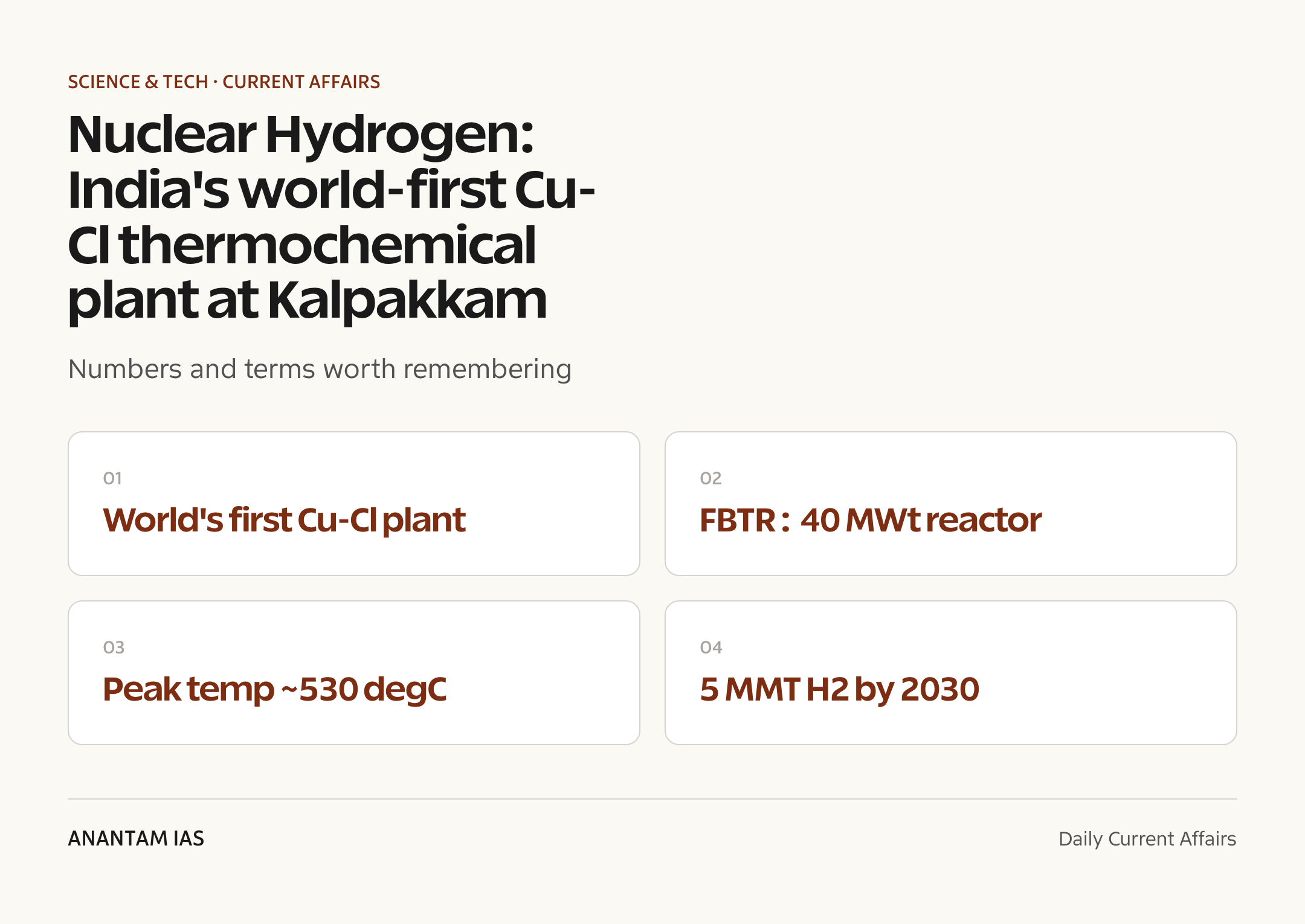
- Heat source is the 40 MWt FBTR, a sodium-cooled fast reactor that first went critical on 18 October 1985.
- The Cu-Cl cycle was developed indigenously by Bhabha Atomic Research Centre (BARC), Mumbai.
- Engineering, fabrication, installation, testing and commissioning were a joint BARC-IGCAR effort.
- Described by DAE as a technology demonstrator to validate nuclear-powered hydrogen at lab-to-pilot scale.
The development matters in the context of:
- Links nuclear energy to the National Green Hydrogen Mission goal of 5 MMT of green hydrogen a year by 2030.
- Adds a third, carbon-free pathway (alongside electrolysis and steam reforming) to make hydrogen at industrial scale.
- Showcases the strategic payoff of India’s long-running fast-reactor and thorium roadmap beyond just electricity.

UPSC Relevance
Prelims Relevance
- Copper-Chlorine (Cu-Cl) cycle — hybrid thermochemical-electrolytic water splitting, max temperature ~530 degC.
- FBTR — 40 MWt sodium-cooled fast reactor at Kalpakkam; critical 1985; plutonium-uranium carbide fuel.
- IGCAR — set up 1971; lead centre for fast-reactor R&D under DAE.
- BARC — premier nuclear research institute, Mumbai.
- Three-stage nuclear programme — PHWR to FBR to thorium-U233 reactors.
- PFBR — 500 MWe Prototype Fast Breeder Reactor, the Stage-II flagship at Kalpakkam.
- National Green Hydrogen Mission — outlay Rs 19,744 crore; 5 MMT target by 2030.
- Colour codes of hydrogen — green (renewables), grey (fossil), and the new nuclear-derived (pink/red) route.
Mains Relevance
GS Paper 3
- Indigenous technology and energy security — how fast-reactor heat unlocks fossil-free hydrogen.
- Achievements of Indians in science and technology — the three-stage programme and the Cu-Cl demonstrator as a case study in self-reliance.
Essay
- Science as a means to energy independence and a clean-energy transition.
- Self-reliance and the long arc of patient, mission-mode public R&D.
Background and Context
What was inaugurated, and by whom
A first-of-its-kind pilot that turns reactor heat into clean hydrogen.
- The Department of Atomic Energy inaugurated the plant at IGCAR, Kalpakkam in late June 2026.
- PIB describes it as the world’s first hydrogen facility on the Copper-Chlorine thermochemical cycle driven by nuclear process heat.
- The heat is tapped from the FBTR, in operation for over four decades.
- Built as a technology demonstrator — the aim is to prove the engineering, not yet to produce at commercial volume.
- It caps years of process development, design, fabrication and commissioning by BARC and IGCAR working together.

The science of the Copper-Chlorine cycle
A hybrid loop that splits water using heat plus a little electricity, recycling all its copper and chlorine.
- Thermochemical water splitting uses a sequence of chemical reactions, driven by heat, to break water into hydrogen and oxygen — no direct electrolysis of water at high voltage.
- The Cu-Cl cycle is a four-step hybrid: it mixes thermochemical reactions with one electrolysis step.
- Its big advantage is a relatively low peak temperature of about 530 degC — well within what a fast reactor’s coolant can supply, unlike rival cycles that need 800-900 degC.
- Copper and chlorine compounds act as recyclable intermediaries; the net reaction is simply water in, hydrogen and oxygen out.
- Lower temperature plus higher thermodynamic efficiency make Cu-Cl one of the most promising routes for nuclear-coupled hydrogen.
Why the FBTR is the right heat source
India’s veteran fast reactor doubles as a clean, high-grade heat supply.
- The FBTR is a 40 MWt, sodium-cooled, loop-type fast breeder reactor at Kalpakkam, modelled on France’s Rapsodie.
- It went critical on 18 October 1985, making India the seventh nation able to build and run a breeder reactor.
- Fast reactors deliver heat at temperatures suited to thermochemical cycles, and that heat is carbon-free.
- Coupling it to hydrogen production turns a research reactor into a working bridge between fission and fuels.
- The same Kalpakkam complex hosts the 500 MWe PFBR, the next big step of the fast-reactor line.
Fit with the three-stage nuclear programme
Homi Bhabha’s roadmap was always about leveraging India’s thorium — and now its heat.
- Stage I — Pressurised Heavy Water Reactors burn natural uranium and breed plutonium.
- Stage II — Fast Breeder Reactors use plutonium-based fuel and breed more fissile material, the role played by FBTR and PFBR.
- Stage III — advanced reactors exploit India’s vast thorium reserves via the uranium-233 route.
- Hydrogen from fast-reactor heat shows Stage-II assets earning their keep beyond power generation.
- It strengthens the case for treating nuclear as a platform for process heat, not only electricity.
Why it matters for the clean-energy transition
A fossil-free way to make hydrogen at scale plugs a real gap.
- Most hydrogen today is grey hydrogen, made from natural gas with heavy CO2 emissions.
- Nuclear-coupled Cu-Cl hydrogen emits no greenhouse gases and runs around the clock, unlike intermittent solar-powered electrolysis.
- It can decarbonise hard-to-abate sectors — fertilisers, refining, steel — that need molecular hydrogen, not just electrons.
- It complements the National Green Hydrogen Mission (Rs 19,744 crore outlay, 5 MMT by 2030) by adding a non-renewable, low-carbon pathway.
- It cuts reliance on imported fossil feedstock, a clear energy-security gain.
Caveats and the road from pilot to plant
A demonstrator proves a concept; scale, cost and safety still have to be earned.
- This is a technology demonstrator, far from commercial throughput.
- Cu-Cl chemistry involves hydrochloric acid and corrosive intermediates, demanding tough materials and careful handling.
- Coupling chemical plant to a reactor raises safety, siting and regulatory questions.
- Economics versus cheap electrolyser-plus-renewables routes remains to be proven at scale.
- Scaling from a single reactor to a fleet supplying hydrogen will take sustained engineering and capital.
Way Forward
Scale and validate
- Run the demonstrator long enough to gather efficiency, durability and safety data before any scale-up.
- Develop corrosion-resistant materials for the HCl-bearing steps of the cycle.
Integrate with national missions
- Position nuclear hydrogen as a complementary track within the National Green Hydrogen Mission.
- Map demand from fertiliser, refining and steel clusters that could absorb reactor-made hydrogen.
Build the ecosystem
- Frame regulatory norms for reactor-coupled chemical plants through the atomic energy regulator.
- Encourage academia-industry partnerships to drive down costs and transfer the technology.
Conclusion
The Kalpakkam plant is a small pilot with an outsized signal: India can turn its hard-won fast-reactor expertise into clean fuel, not only clean power. By pairing the FBTR with BARC’s indigenous Cu-Cl cycle, the Department of Atomic Energy has shown a credible, carbon-free route to hydrogen that few countries can attempt.
The hard work now is scaling from a demonstrator to economically viable plants and integrating this pathway with the wider hydrogen economy. If that succeeds, the three-stage nuclear programme will have delivered an unexpected dividend, fortifying both energy security and the clean-energy transition.
UPSC Practice Questions
Prelims MCQ 1
With reference to the Copper-Chlorine (Cu-Cl) cycle recently in the news, consider the following statements:
- It is a thermochemical process used to split water into hydrogen and oxygen.
- It requires a peak operating temperature of around 530 degrees Celsius.
- It was developed indigenously by the Bhabha Atomic Research Centre.
How many of the above statements are correct?
(a) Only one (b) Only two (c) All three (d) None
Answer: (c) All three
Explanation:
The Cu-Cl cycle is a hybrid thermochemical water-splitting process with a peak temperature near 530 degC, developed indigenously by BARC; all three statements are correct.
Prelims MCQ 2
The Fast Breeder Test Reactor (FBTR), used as the heat source for the new hydrogen facility, is located at:
(a) Tarapur, Maharashtra (b) Kalpakkam, Tamil Nadu (c) Kudankulam, Tamil Nadu (d) Kakrapar, Gujarat
Answer: (b) Kalpakkam, Tamil Nadu
Explanation:
The FBTR is a 40 MWt sodium-cooled fast reactor at the Indira Gandhi Centre for Atomic Research, Kalpakkam, Tamil Nadu; it first went critical in 1985.
UPSC Mains Questions
- India’s three-stage nuclear programme was conceived for electricity. Examine how coupling fast-reactor heat to a thermochemical hydrogen cycle expands the programme’s strategic value and contributes to energy security.
- Discuss the technological and economic challenges in scaling up nuclear-coupled hydrogen production from a demonstrator to commercial plants, and suggest how it can complement the National Green Hydrogen Mission.
Source: PIB, Department of Atomic Energy.
Frequently Asked Questions
What was inaugurated at Kalpakkam?
The Department of Atomic Energy inaugurated the world’s first hydrogen production facility based on the Copper-Chlorine thermochemical cycle, using nuclear process heat from the Fast Breeder Test Reactor at IGCAR, Kalpakkam. It is a technology demonstrator built jointly by BARC and IGCAR.
What is the Copper-Chlorine cycle?
It is a four-step hybrid thermochemical cycle that uses heat plus one electrolysis step to split water into hydrogen and oxygen. Its peak temperature is only about 530 degC, and the copper and chlorine compounds are recycled, leaving water as the only net input.
Why use nuclear heat instead of electricity?
Fast reactors supply high-grade, carbon-free heat continuously. Driving the chemical reactions directly with reactor heat can be more efficient than first making electricity and then running electrolysis, and it produces hydrogen without greenhouse-gas emissions.
What is the FBTR?
The Fast Breeder Test Reactor is a 40 MWt, sodium-cooled fast breeder reactor at Kalpakkam. It went critical on 18 October 1985 and has served as a testbed for fast-reactor fuels, materials and sodium-coolant technology for over four decades.
How does this link to the three-stage nuclear programme?
Fast reactors are the second stage of India’s three-stage programme, which moves from PHWRs to fast breeders to thorium-based reactors. Using FBTR heat for hydrogen shows Stage-II assets delivering value beyond electricity generation.
How does it support the National Green Hydrogen Mission?
The Mission, with a Rs 19,744 crore outlay, targets 5 MMT of green hydrogen a year by 2030. Nuclear-coupled Cu-Cl hydrogen adds a fossil-free, round-the-clock pathway that complements renewable-powered electrolysis and cuts dependence on imported feedstock.
Source: https://anantamias.com/current-affairs/dae-nuclear-hydrogen-copper-chlorine-cycle/
Green Urea: India’s roadmap for fossil-free fertilizer using green ammonia
Why in News?
The Department of Fertilizers (DoF) has issued an Invitation for Expression of Interest (EOI) to set up Green Urea plants in India, and held a high-level Pre-EOI meeting with industry at the Projects and Development India Limited (PDIL) headquarters in Noida. The move aims to make urea production fossil-free by replacing natural-gas-based ammonia with green ammonia made from renewable-powered electrolysis.
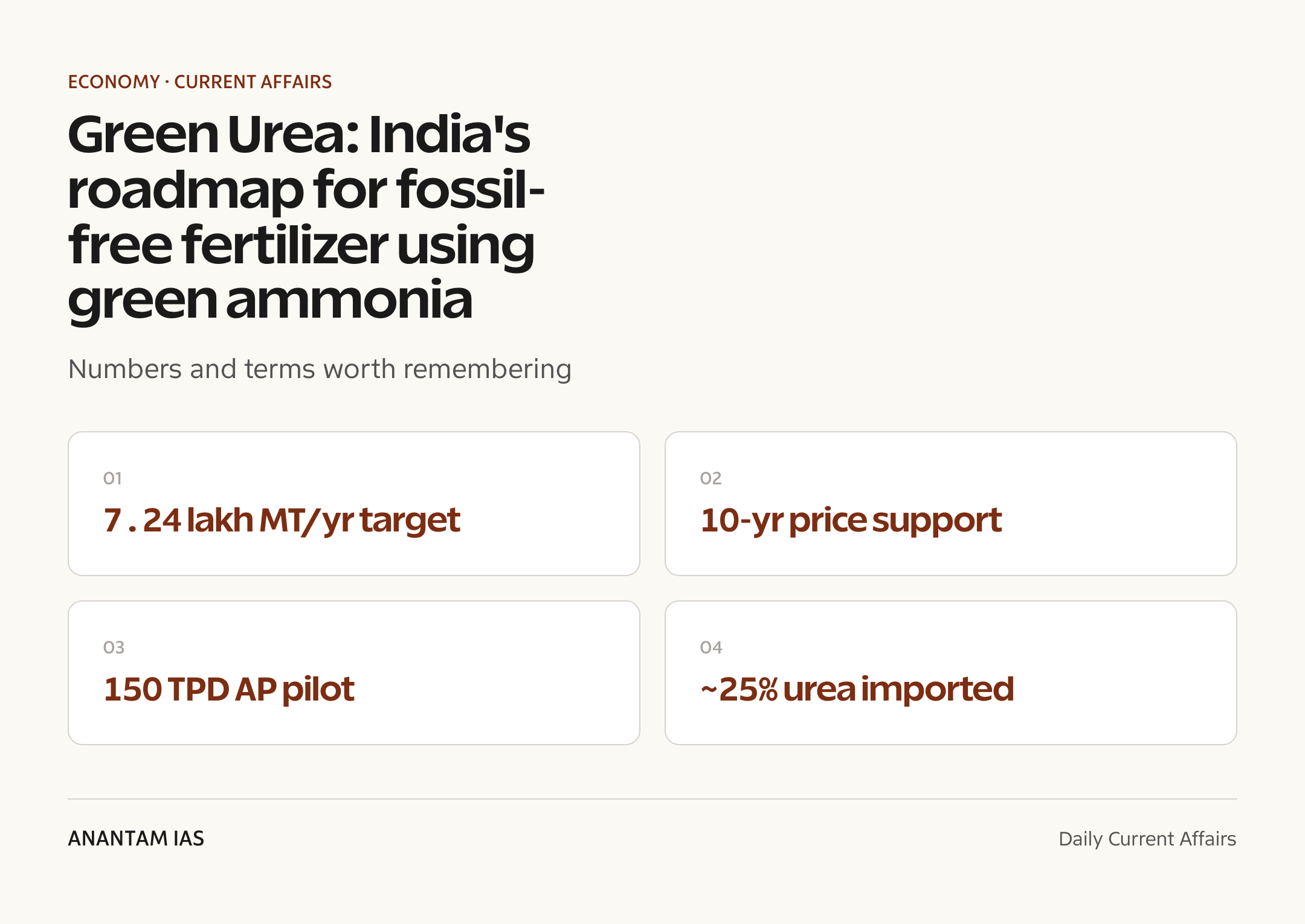
The design pairs three instruments that earlier worked in silos: MNRE funding under the National Green Hydrogen Mission, a procurement and price-support role for the Solar Energy Corporation of India (SECI), and the fertilizer-subsidy machinery of the DoF. The reported procurement target is 7.24 lakh tonnes per annum of green ammonia, to be awarded through a competitive e-reverse auction.
- DoF EOI invites developers to build Green Urea plants; a Pre-EOI consultation was held with industry at PDIL, Noida.
- SECI will purchase green ammonia from producers and supply it to domestic fertilizer companies at market-linked grey-ammonia prices, absorbing the green premium.
- A reported 7.24 lakh MT/year green-ammonia procurement target is to be allocated via a SECI-managed e-reverse auction.
- Incentives run from the date of commercial supply and are locked for 10 years through binding agreements, giving developers long-term certainty.
- A 150 tonnes-per-day Green Urea pilot at Pudimadaka, Andhra Pradesh is being developed by NETRA, the R&D arm of NTPC.
The development matters in the context of:
- Urea is the world’s most-used nitrogen fertilizer; conventionally it is made by reacting ammonia (NH3) with carbon dioxide, and the ammonia itself comes from the Haber-Bosch process using grey hydrogen stripped from natural gas.
- Green urea swaps grey hydrogen for green hydrogen (water split by electrolysers run on solar or wind), so the resulting green ammonia and urea carry near-zero production emissions.
- India imports roughly 25-26% of its urea demand and about 85% of the natural gas used to make urea domestically, so the feedstock is a strategic and fiscal vulnerability.
UPSC Relevance
Prelims Relevance
- Green hydrogen is produced by electrolysis of water using renewable electricity; grey hydrogen uses fossil natural gas without carbon capture.
- Ammonia (NH3) is synthesised from nitrogen and hydrogen via the Haber-Bosch process; it is the precursor for urea.
- The National Green Hydrogen Mission (2023) has an outlay of Rs 19,744 crore and targets at least 5 MMT/year of green hydrogen by 2030.
- The Mission targets about 125 GW of added renewable capacity and aims to avoid nearly 50 MMT of CO2 per year by 2030.
- SECI (Solar Energy Corporation of India) is a CPSE under MNRE that runs renewable-energy auctions and aggregation.
- Urea stays outside the Nutrient Based Subsidy (NBS) regime; its MRP is fixed by the Centre at about Rs 242 per 45-kg bag.
- Non-urea fertilizers such as DAP and MOP are covered under NBS, where subsidy is linked to nutrient content.
- The SIGHT programme (Strategic Interventions for Green Hydrogen Transition) is the largest financial component of the Green Hydrogen Mission.
Mains Relevance
GS Paper 3
- Energy security and decarbonisation: how a green-hydrogen-to-fertilizer value chain reduces both import dependence and the carbon footprint of agriculture.
- Fertilizer subsidy reform and fiscal sustainability: whether a differential-pricing model can deliver green urea without inflating an already large subsidy bill.
- Industrial policy and demand creation: using public procurement (SECI aggregation, e-reverse auctions) to seed an early market for green ammonia.
Essay
- Self-reliance and sustainability are not rivals: India’s path to fertilizer security can also be its path to decarbonisation.
- Technology is only as transformative as the institutions that price it.
Background and Context
What green urea and green ammonia actually are
The chemistry tells you exactly where the carbon hides and how it is removed.
- Urea production needs ammonia; ammonia needs hydrogen. Conventionally the hydrogen is grey hydrogen reformed from natural gas, which releases CO2.
- Green hydrogen replaces that step: water is split into hydrogen and oxygen by electrolysers powered by solar or wind, with no carbon emitted at the point of production.
- Combining green hydrogen with nitrogen from air via the Haber-Bosch process yields green ammonia, which is then reacted with CO2 to make green urea.
- The label green refers to the fossil-free feedstock, not a different molecule. Green urea is chemically identical to ordinary urea (the same 46% nitrogen content) but produced without natural gas.
The EOI and scheme design
The novelty is the pricing plumbing, not the chemistry.
- The Department of Fertilizers EOI invites developers to build Green Urea plants, with a Pre-EOI consultation held at PDIL, Noida to surface industry concerns.
- Because green ammonia costs more than conventional grey ammonia, a differential subsidy bridges the gap: the DoF covers the premium so manufacturers receive green ammonia at parity with grey feedstock.
- SECI aggregates demand, buys green ammonia from producers, and on-sells it to fertilizer companies at market-linked grey-ammonia prices, taking on the price-discovery and contracting role.
- Allocation runs through a competitive e-reverse auction for a reported 7.24 lakh tonnes per annum, with support fixed for 10 years from the start of commercial supply.
Link to the National Green Hydrogen Mission
Green urea is the demand anchor the hydrogen mission has been looking for.
- The National Green Hydrogen Mission (2023), with a Rs 19,744 crore outlay, targets at least 5 MMT/year of green hydrogen by 2030 and around 125 GW of new renewable capacity.
- MNRE support flows largely through the SIGHT programme, which incentivises both electrolyser manufacturing and green-hydrogen production.
- Fertilizer is one of the hardest-to-electrify, ammonia-hungry sectors, so guaranteed green-ammonia offtake creates the stable demand that makes electrolyser investment bankable.
- Read our explainer on the Green Hydrogen Policy and National Mission for the full mission architecture.
Why it matters: urea import and subsidy burden
The economic case rests on two stubborn dependencies.
- India imports about 25-26% of its urea, and roughly 85% of the natural gas feeding domestic urea plants is imported, exposing farmers and the budget to global price swings.
- The fertilizer subsidy has ballooned, with urea alone accounting for close to two-thirds of the total subsidy bill in recent years.
- Urea remains outside the Nutrient Based Subsidy regime, sold at a Centre-fixed MRP of about Rs 242 per 45-kg bag, which keeps demand high and the subsidy open-ended.
- Domestically produced green urea, run on Indian renewables, can chip away at both the natural-gas import bill and the long-run subsidy exposure to volatile gas prices.
Challenges and the cost question
The premium is real, and so are the execution risks.
- Cost parity is not yet here: green ammonia is dearer than grey, and the differential subsidy shifts that gap onto the exchequer rather than eliminating it.
- Electrolyser capacity, cheap firm renewable power, and water availability all have to scale together; intermittency raises the effective cost of running ammonia plants continuously.
- The model depends on credible 10-year contracts and timely auctions; weak demand aggregation or price disputes could stall offtake.
- Pilots such as the 150 TPD plant at Pudimadaka (NETRA/NTPC) are essential to validate costs before any large-scale, nationwide rollout.
Way Forward
Drive down the green premium
- Scale electrolyser manufacturing under SIGHT and secure low-cost firm renewable power so the differential subsidy shrinks over time rather than becoming permanent.
- Use long-tenure offtake and round-the-clock renewable contracts to cut the cost of continuous ammonia synthesis.
Sequence pilots before scale
- Use the Pudimadaka pilot and similar projects to lock down real-world capital and operating costs before committing to mass procurement.
- Publish transparent auction outcomes so price discovery improves with each tranche.
Protect fiscal discipline
- Cap and ring-fence the differential subsidy with a glide path, tying support to declining green-ammonia costs.
- Pair green urea with demand-side reform (balanced fertilization, nano urea, soil-health-led efficiency) so the subsidy base does not keep expanding.
Conclusion
Green urea stitches together three policy worlds that rarely talk to each other: renewable energy, fertilizer self-reliance, and climate action. By letting SECI aggregate demand and the Department of Fertilizers absorb the green premium, the EOI tries to convert a clean-fuel ambition into a bankable industrial market.
The test will be cost. If the green premium falls as electrolysers and renewables scale, India gains a domestic, low-carbon fertilizer base and trims a structural import dependence. If it does not, the country merely shifts one subsidy for another. The pilots and the early auctions will decide which way the roadmap runs.
UPSC Practice Questions
Prelims MCQ 1
With reference to green ammonia and green urea, consider the following statements:
- Green ammonia is produced using hydrogen obtained from the electrolysis of water powered by renewable energy.
- Green urea differs chemically from conventional urea and contains a higher percentage of nitrogen.
- The Haber-Bosch process is used to synthesise ammonia from nitrogen and hydrogen.
How many of the above statements are correct?
(a) Only one (b) Only two (c) All three (d) None
Answer: (b) Only two
Explanation:
Statements 1 and 3 are correct. Statement 2 is wrong: green urea is chemically identical to conventional urea (same ~46% nitrogen); only the feedstock (green vs grey hydrogen) differs.
Prelims MCQ 2
Which of the following best describes the proposed role of the Solar Energy Corporation of India (SECI) in India’s Green Urea roadmap?
(a) It will manufacture green urea directly and sell it to farmers at a fixed MRP. (b) It will purchase green ammonia from producers and supply it to fertilizer companies at grey-ammonia-linked prices. (c) It will regulate the maximum retail price of all fertilizers under the Nutrient Based Subsidy. (d) It will fund electrolyser imports through the Department of Fertilizers.
Answer: (b) It will purchase green ammonia from producers and supply it to fertilizer companies at grey-ammonia-linked prices.
Explanation:
SECI aggregates demand, buys green ammonia, and on-sells it at market-linked grey-ammonia prices; the Department of Fertilizers covers the differential. SECI does not set fertilizer MRPs or make urea.
UPSC Mains Questions
- Green urea links the National Green Hydrogen Mission to fertilizer self-reliance. Examine the design of the proposed differential-pricing model and the fiscal and technological challenges it must overcome. (GS Paper 3)
- India’s urea sector is doubly exposed, to imported fertilizer and imported natural gas. Discuss how a green-ammonia value chain could address this, and the reforms needed to keep the fertilizer subsidy sustainable. (GS Paper 3)
Source: PIB, Department of Fertilizers.
Frequently Asked Questions
What is green urea?
Green urea is ordinary urea made without fossil fuels. Its feedstock is green ammonia, produced from green hydrogen (water split by renewable-powered electrolysers) instead of natural-gas-based grey hydrogen. The fertilizer itself is chemically identical to conventional urea.
How is green ammonia different from grey ammonia?
Both are the same molecule (NH3). The difference is the hydrogen source: green ammonia uses green hydrogen from renewable electrolysis, while grey ammonia uses hydrogen reformed from natural gas, which emits CO2.
What is the differential-pricing mechanism in the Green Urea plan?
Because green ammonia costs more than grey, the Department of Fertilizers covers the price gap so manufacturers receive green ammonia at parity with conventional feedstock. SECI buys the green ammonia and supplies it at grey-ammonia-linked prices.
How does this connect to the National Green Hydrogen Mission?
Fertilizer is a major ammonia consumer. Guaranteed green-ammonia offtake creates stable demand for green hydrogen, helping the Mission (Rs 19,744 crore outlay, 5 MMT/year target by 2030) build a viable market for electrolysers and renewables.
Why does India need green urea at all?
India imports about a quarter of its urea and roughly 85% of the natural gas used to make urea at home. Domestic green urea, run on Indian renewables, reduces both import exposure and the carbon footprint of fertilizer.
What is the Pudimadaka pilot?
A 150 tonnes-per-day Green Urea pilot plant at Pudimadaka in Andhra Pradesh, developed by NETRA, the R&D arm of NTPC, to validate costs and technology before any large-scale rollout.
Source: https://anantamias.com/current-affairs/green-urea-roadmap-green-ammonia-fertilizer/
India-UK CETA: 1,000 advisory personnel deployed to help exporters
Why in News?
Speaking at the 10th Annual UK-India Week in London, Commerce and Industry Minister Piyush Goyal announced that the Centre will deploy roughly 1,000 advisory personnel across the country and upgrade its trade portal to help businesses extract the full benefit of the India-UK Comprehensive Economic and Trade Agreement (CETA).
The move marks the shift from signing to implementation. With CETA set to enter into force on 15 July 2026, the focus is now on outreach so that small exporters and MSMEs, not just large firms, actually use the new tariff concessions, as reported by PIB and the Ministry of Commerce and Industry.
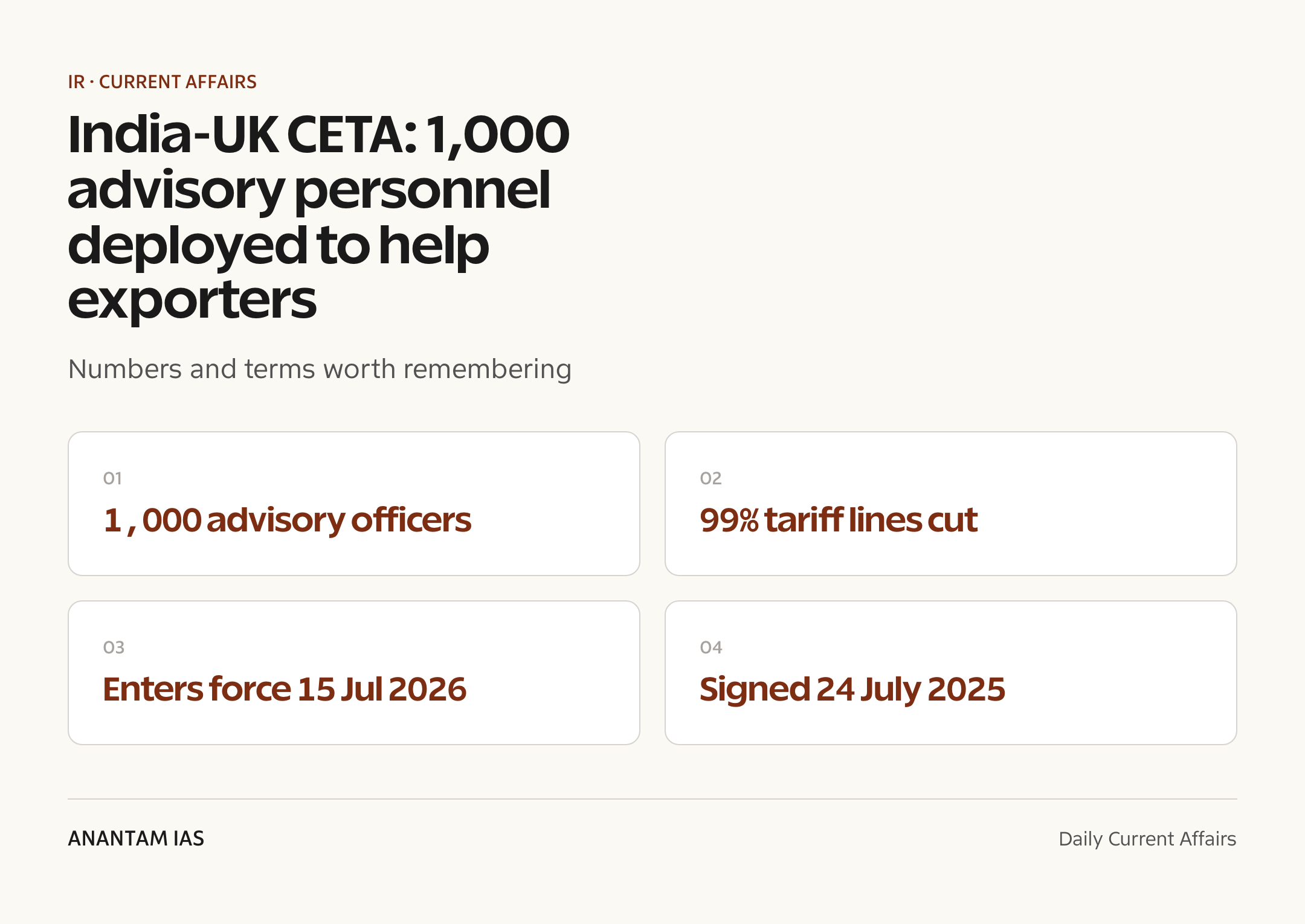
- About 1,000 advisory personnel / field officers to be deployed nationwide to hand-hold exporters on using CETA.
- The Commerce Ministry’s trade portal will be upgraded to guide businesses on tariff lines, rules of origin and documentation.
- Announcement made at the 10th Annual UK-India Week, ahead of CETA’s 15 July 2026 entry into force.
- Outreach explicitly targets Tier-2 and Tier-3 city exporters and first-time exporters, several of whom joined the London delegation.
- CETA is projected to lift bilateral trade by about GBP 25.5 billion a year over the long run.
The development matters in the context of:
- India-UK CETA was signed in London on 24 July 2025 and is India’s most comprehensive trade pact with a G-7 economy.
- Both the CETA and the linked Double Contribution Convention (DCC) on social security take effect on 15 July 2026 after completing ratification in both countries.
- A recent India-UK free trade agreement note already covered the deal’s terms and the July-15 start date; this update tracks the implementation and awareness rollout.
UPSC Relevance
Prelims Relevance
- CETA (Comprehensive Economic and Trade Agreement) is a wide free trade agreement covering goods, services, investment, mobility and other rule-areas, broader than a simple goods FTA.
- India-UK CETA was signed 24 July 2025 in London; it enters into force on 15 July 2026.
- The UK will eliminate duties on about 99% of Indian tariff lines on entry into force.
- Sector tariff removals include up to 70% on some processed foods, 21.5% on marine products, 18% on engineering goods, 16% on leather and footwear and 12% on textiles and clothing.
- The Double Contribution Convention (DCC) gives eligible Indian professionals a three-year-plus social-security exemption window (about five years as cited by the minister) so they pay social security in only one country at a time.
- The nodal body for India’s FTAs and exporter facilitation is the Department of Commerce, with the DGFT (Directorate General of Foreign Trade) handling foreign-trade policy.
- Rules of origin decide whether a good qualifies as ‘Indian’ enough to claim preferential CETA tariffs and are a key compliance hurdle for exporters.
- The implementation push was announced at the 10th Annual UK-India Week in London by Piyush Goyal.
Mains Relevance
GS Paper 2
- India-UK CETA as an instrument of bilateral diplomacy and India’s post-Brexit engagement with a G-7 economy.
- The advisory rollout shows how trade-agreement gains depend on state capacity for implementation, not just negotiation.
GS Paper 3
- How FTA outreach to MSMEs and first-time exporters supports export-led growth and India’s trade-diversification strategy.
Essay
- Trade agreements are written by negotiators but realised by exporters: implementation capacity decides who actually gains.
- Diversification and self-reliance can coexist when openness is paired with support for small producers.
Background and Context
The advisory rollout: the new development
The headline is delivery, not deal terms.
- The Centre will field roughly 1,000 advisory personnel across states to guide exporters through CETA’s tariff schedules, certificates and procedures.
- The Commerce Ministry’s trade portal is being upgraded into a single window for tariff-line lookups, rules-of-origin checks and documentation help.
- Outreach is pitched at Tier-2 and Tier-3 city exporters and first-time exporters, the firms most likely to miss out on a complex new agreement.
- Timing is deliberate: the drive runs in the weeks before CETA’s 15 July 2026 entry into force so businesses are ready on day one.
- The aim is to convert headline tariff cuts into actual shipments by closing the information gap small firms face.
- Several first-time exporters and businesses from smaller cities joined the UK-India Week delegation, signalling that the outreach is meant to widen, not just deepen, the exporter base.
- Awareness sessions, helpdesks and the upgraded portal together form the delivery layer that sits on top of the signed agreement.
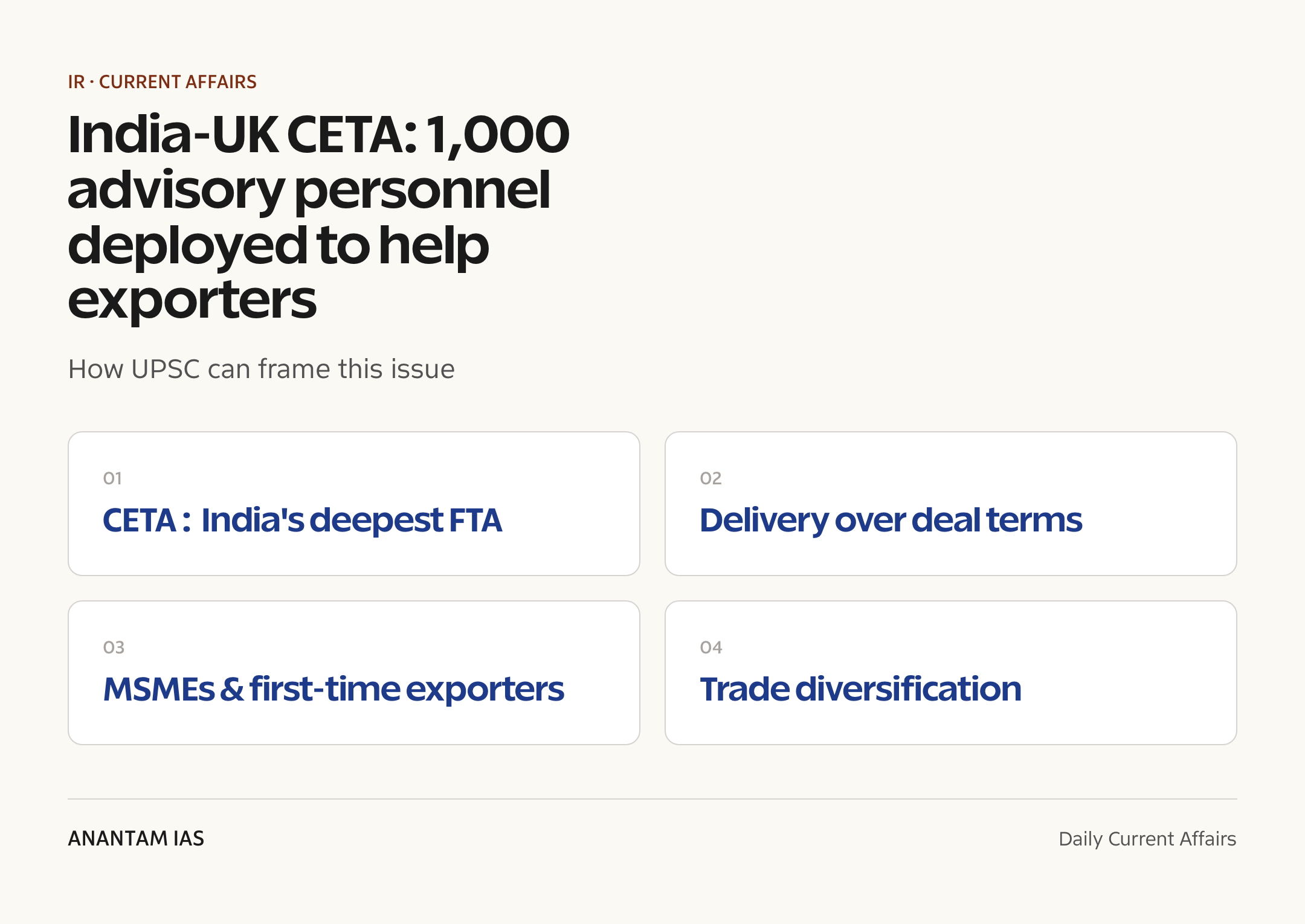
India-UK CETA in brief
A quick refresher on the deal being implemented.
- CETA was signed in London on 24 July 2025 and is India’s most comprehensive trade pact with a G-7 nation.
- On entry into force the UK removes duties on about 99% of Indian tariff lines, covering the bulk of India’s exports by value.
- Big tariff gains land in labour-intensive sectors: textiles and clothing (12% duty removed), leather and footwear (16%), marine products (21.5%) and engineering goods (18%).
- The accompanying Double Contribution Convention spares eligible Indian professionals double social-security payments while on short UK postings.
- CETA goes beyond goods into services, investment, mobility, government procurement and cooperation on technology, clean energy and critical minerals.
- The minister has framed the long-run prize as a roughly GBP 25.5 billion annual increase in bilateral trade once the agreement is fully working.
- An FTA (free trade agreement) lowers or removes tariffs between partners; a CETA is a deeper version that also writes rules for services, investment and people movement.
What exporters and MSMEs gain
Lower duties only help if firms can claim them.
- Zero or near-zero UK duties make Indian textiles, leather, marine and engineering exports sharply more competitive against rivals still facing tariffs.
- MSMEs get a clearer route into global value chains serving UK buyers, plus easier access to inputs and technology, building on India’s existing MSME sector support framework.
- Hand-holding on rules of origin and certificates of origin reduces the compliance cost that usually deters smaller exporters.
- First-time exporters in Tier-2 and Tier-3 cities can test export markets with official support rather than navigating paperwork alone.
- Service professionals benefit from mobility commitments and the DCC’s relief on social-security contributions.
India's FTA strategy and trade diversification
CETA fits a wider pivot in trade policy.
- After years of caution, India has moved to sign deep agreements with partners such as Australia, the UAE and the EFTA bloc, with the UK pact among the most ambitious.
- The strategy is diversification: widening export destinations and supply sources to cut over-dependence on any single market, a theme that runs through India’s wider free trade agreements push.
- Deals are increasingly paired with domestic reforms and capacity-building so that gains reach producers rather than staying on paper.
- Region-to-region links such as Birmingham-Gujarat and Manchester-Maharashtra aim to embed business ties below the central level.
- The 1,000-officer rollout signals that implementation capacity is now treated as part of trade strategy, not an afterthought.
Significance
Why the rollout matters beyond one agreement.
- It tests whether India can translate a landmark FTA into measurable export and MSME gains within a tight timeline.
- Success would set a template for delivering future agreements, including ongoing talks with the United States and others.
- Targeting smaller cities and first-time exporters spreads trade gains more widely and supports inclusive growth.
- Stronger India-UK economic ties reinforce a broader strategic partnership spanning technology, defence and clean energy.
Implementation challenges
Delivery at this scale is not guaranteed.
- Training and coordinating around 1,000 advisory personnel across states demands sustained administrative effort.
- Rules-of-origin compliance and quality standards remain demanding, especially for first-time and small exporters.
- Awareness drives must reach beyond metros to genuinely cover Tier-2 and Tier-3 producers.
- Tariff cuts alone do not fix logistics costs, financing gaps and non-tariff barriers that constrain Indian exports.
- Sustained outreach beyond the launch window is needed so firms keep using CETA over time.
- Coordination between the Department of Commerce, the DGFT, customs and state export agencies has to be tight, or businesses will face conflicting guidance on the ground.
Way Forward
Sustain the outreach machinery
- Keep advisory officers active well past the 15 July launch with periodic district-level export clinics.
- Track usage data so support flows to sectors and regions that under-utilise CETA concessions.
Simplify compliance
- Make rules-of-origin self-certification and the upgraded trade portal as simple as possible for small firms.
- Integrate the portal with DGFT and customs systems to cut duplicate paperwork.
Address structural costs
- Pair tariff gains with logistics, credit and quality-certification support so exporters can actually deliver.
- Use region-to-region partnerships to build durable buyer-supplier links in the UK market.
Conclusion
The deployment of around 1,000 advisory personnel and an upgraded trade portal turns India-UK CETA from a signed text into a working tool for exporters. The message is that a trade deal’s value is decided after the ink dries, in the hands of the firms expected to use it.
If the outreach genuinely reaches MSMEs and first-time exporters in smaller cities before 15 July 2026, CETA could become a model for delivering, not just negotiating, India’s growing roster of free trade agreements.
UPSC Practice Questions
Prelims MCQ 1
With reference to the India-UK Comprehensive Economic and Trade Agreement (CETA), consider the following statements:
- It was signed in 2025 and is scheduled to enter into force in July 2026.
- On entry into force, the United Kingdom will eliminate duties on about 99% of Indian tariff lines.
- It is confined strictly to trade in goods and does not cover services or professional mobility.
How many of the above statements are correct?
(a) Only one (b) Only two (c) All three (d) None
Answer: (b) Only two
Explanation:
CETA was signed on 24 July 2025 and enters into force on 15 July 2026, and the UK removes duties on roughly 99% of Indian tariff lines, so statements 1 and 2 are correct. Statement 3 is wrong: CETA also covers services, investment and professional mobility, with a linked Double Contribution Convention.
Prelims MCQ 2
The ‘Double Contribution Convention’ linked to the India-UK CETA primarily deals with which of the following?
(a) Avoidance of double taxation of corporate profits (b) Social security contributions for professionals working across the two countries (c) Twin certification of rules of origin for exported goods (d) Joint contributions to a bilateral infrastructure fund
Answer: (b) Social security contributions for professionals working across the two countries
Explanation:
The Double Contribution Convention ensures that employees moving between India and the UK, and their employers, pay social security contributions in only one country at a time, sparing eligible Indian professionals double payments during short postings.
UPSC Mains Questions
- The gains from a free trade agreement depend less on its terms than on the state’s capacity to help firms use it. Examine in the light of India’s implementation rollout for the India-UK CETA.
- Discuss how the India-UK CETA fits into India’s broader strategy of trade diversification, and the steps needed to ensure its benefits reach MSMEs and first-time exporters.
Source: PIB, Ministry of Commerce and Industry.
Frequently Asked Questions
What is the new development around India-UK CETA?
The Commerce Ministry announced it will deploy about 1,000 advisory personnel across India and upgrade its trade portal to help exporters and MSMEs use CETA, ahead of the deal taking effect on 15 July 2026.
When does the India-UK CETA come into force?
Both the CETA and the linked Double Contribution Convention enter into force on 15 July 2026, after completing ratification in both countries. The agreement was signed on 24 July 2025.
What does CETA mean?
CETA stands for Comprehensive Economic and Trade Agreement, a wide free trade agreement covering goods, services, investment, mobility and other rule-areas, broader than a goods-only FTA.
How much will the UK cut tariffs under CETA?
On entry into force the UK eliminates duties on about 99% of Indian tariff lines, with large cuts in textiles, leather and footwear, marine products, engineering goods and processed foods.
Who is the rollout meant to help?
It targets exporters and MSMEs, and especially first-time exporters and firms in Tier-2 and Tier-3 cities, so that the tariff gains are not captured only by large companies.
What is the Double Contribution Convention?
It is a social-security agreement ensuring that employees moving between India and the UK pay social security in only one country at a time, sparing eligible Indian professionals double contributions during short postings.
Source: https://anantamias.com/current-affairs/india-uk-ceta-advisory-personnel-rollout/
Jan Vishwas Act: Health-sector minor offences moved to administrative penalties
Why in News?
The Ministry of Health and Family Welfare, through a PIB release, has detailed how the Jan Vishwas (Amendment of Provisions) framework is being operationalised across health-sector laws, replacing imprisonment for minor and procedural violations with graded monetary penalties and a structured adjudication mechanism. The reform extends the trust-based, decriminalisation approach first set out in the Jan Vishwas Act, 2023 to core public-health statutes such as the Drugs and Cosmetics Act, 1940 and the Food Safety and Standards Act, 2006.
The change matters for governance because it tries to thread a difficult needle: easing compliance burdens and improving ease of doing business for legitimate manufacturers, while keeping strict criminal liability for serious offences involving spurious or adulterated drugs that endanger patient safety. The Ministry stresses that minor lapses (such as labelling or documentation errors) now attract civil penalties, but toxic, adulterated, or spurious products remain firmly within the criminal net.
- Health-sector laws being streamlined under the Jan Vishwas framework include the Drugs and Cosmetics Act, 1940, the Pharmacy Act, 1948, the Food Safety and Standards Act, 2006, the Clinical Establishments (Registration and Regulation) Act, 2010, and the National Commission for Allied and Healthcare Professions Act, 2021.
- Imprisonment for several minor and procedural violations is being replaced by graded monetary penalties decided through a civil adjudication route rather than a criminal court.
- An adjudication mechanism has been introduced for specified violations (for example, certain cosmetics offences other than spurious or adulterated ones), with appointment of adjudicating authorities by Central and State Governments.
- The process now provides for issuance of show-cause notices, a personal hearing, and an appellate mechanism before penalties are finalised.
- Strict criminal provisions are retained for serious offences involving spurious or adulterated drugs, products causing bodily injury or death, and manufacturing without licence or in unsanitary conditions.
The development matters in the context of:
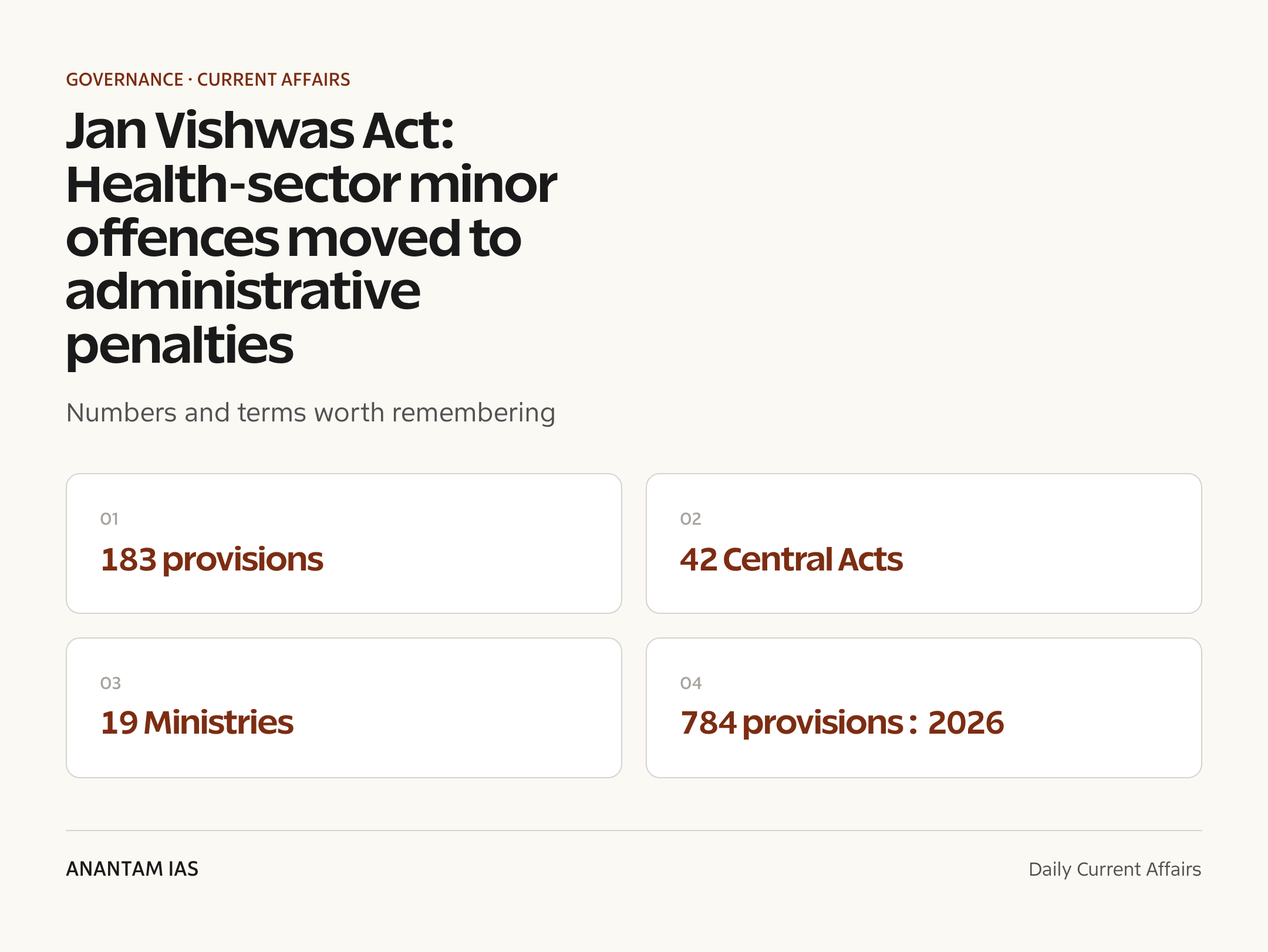
- The parent statute, the Jan Vishwas (Amendment of Provisions) Act, 2023, decriminalised 183 provisions across 42 Central Acts administered by 19 Ministries/Departments.
- The wider Jan Vishwas (Amendment of Provisions) Bill, 2026, introduced in the Lok Sabha on 27 March 2026, took the agenda further by touching 784 provisions across 79 Central Acts under 23 Ministries, of which 717 were decriminalised for ease of doing business and 67 amended for ease of living.
- The health-sector amendments form one of the most debated parts of this exercise because they affect medicines and food, where consumer harm can be severe.
UPSC Relevance
Prelims Relevance
- The Jan Vishwas (Amendment of Provisions) Act, 2023 decriminalised 183 provisions in 42 Central Acts across 19 Ministries/Departments.
- Methods of decriminalisation used include removing imprisonment, retaining or enhancing fines, converting offences to civil penalties, and introducing compounding of offences.
- The Drugs and Cosmetics Act, 1940 is administered by the Ministry of Health and Family Welfare and regulates import, manufacture, and sale of drugs and cosmetics.
- The Food Safety and Standards Act, 2006 established the Food Safety and Standards Authority of India (FSSAI) as the apex food regulator.
- The Pharmacy Act, 1948 regulates the profession and practice of pharmacy through the Pharmacy Council of India.
- The Clinical Establishments (Registration and Regulation) Act, 2010 provides for registration and regulation of clinical establishments.
- Under the reforms, adjudicating officers/authorities are appointed by the Central and State Governments, with a show-cause notice, personal hearing, and appeal built in.
- Adjudication for cosmetics offences applies to violations other than spurious or adulterated products; serious drug offences remain criminal.
- The Jan Vishwas Bill, 2026 was introduced in the Lok Sabha on 27 March 2026 and amended 784 provisions across 79 Central Acts.
- ‘Not of Standard Quality’ (NSQ) drugs are a distinct category in drug-quality regulation, separate from spurious or adulterated drugs.
Mains Relevance
GS Paper 2
- Trust-based, citizen-friendly governance and regulatory reform: how decriminalising minor offences reshapes the State-business-citizen relationship and reduces adversarial enforcement.
- Role of administrative adjudication in reducing the burden on courts, pendency of cases, and the trade-off between speed of disposal and procedural safeguards.
- Balancing ease of doing business with the State’s duty to protect public health and the right to health under Article 21.
GS Paper 3
- Ease of doing business, regulatory cholesterol, and the compliance burden on the pharmaceutical and food-processing industries.
- Drug-quality regulation and the risk that lighter penalties for substandard drugs could weaken deterrence against NSQ and counterfeit medicines.
Essay
- Trust is the foundation of governance: when the State stops treating every citizen as a suspect.
- Ease of doing business cannot mean ease of doing harm.
Background and Context
What the Jan Vishwas framework does
The reform is built on the idea that minor, technical defaults should not carry the threat of jail.
- The Jan Vishwas (Amendment of Provisions) Act, 2023 was the first omnibus law to systematically decriminalise minor offences across many statutes in one go.
- It decriminalised 183 provisions in 42 Central Acts administered by 19 Ministries/Departments, aiming to convey trust-based governance and ease of doing business.
- Decriminalisation was done through several routes: removing imprisonment and/or fine, removing imprisonment while retaining or enhancing fines, converting offences into civil penalties, and allowing compounding of certain offences.
- The follow-on Jan Vishwas Bill, 2026 widened the canvas dramatically, touching 784 provisions across 79 Central Acts under 23 Ministries, with 717 decriminalised for ease of doing business and 67 for ease of living.
- The core philosophy is a shift from criminal penalties for minor, technical, or procedural defaults to civil and administrative enforcement mechanisms.
The health-sector changes: drugs, cosmetics and food
Several public-health statutes have been brought under the decriminalisation lens.
- Affected laws include the Drugs and Cosmetics Act, 1940, the Pharmacy Act, 1948, the Food Safety and Standards Act, 2006, the Clinical Establishments (Registration and Regulation) Act, 2010, and the National Commission for Allied and Healthcare Professions Act, 2021.
- In the Drugs and Cosmetics Act, 1940, imprisonment for several minor violations is substituted with financial penalties decided through a structured adjudication mechanism.
- An adjudication route has been introduced for specified violations, including certain cosmetics offences that are not spurious or adulterated, so that such cases need not go to a criminal court.
- Under the Food Safety and Standards Act, 2006, provisions are streamlined so that penalties are proportionate to the nature of the offence while enforcement against genuinely unsafe food is strengthened.
- For the first time, the framework provides for appointment of adjudicating authorities by Central and State Governments, with show-cause notice, personal hearing, and an appellate path.
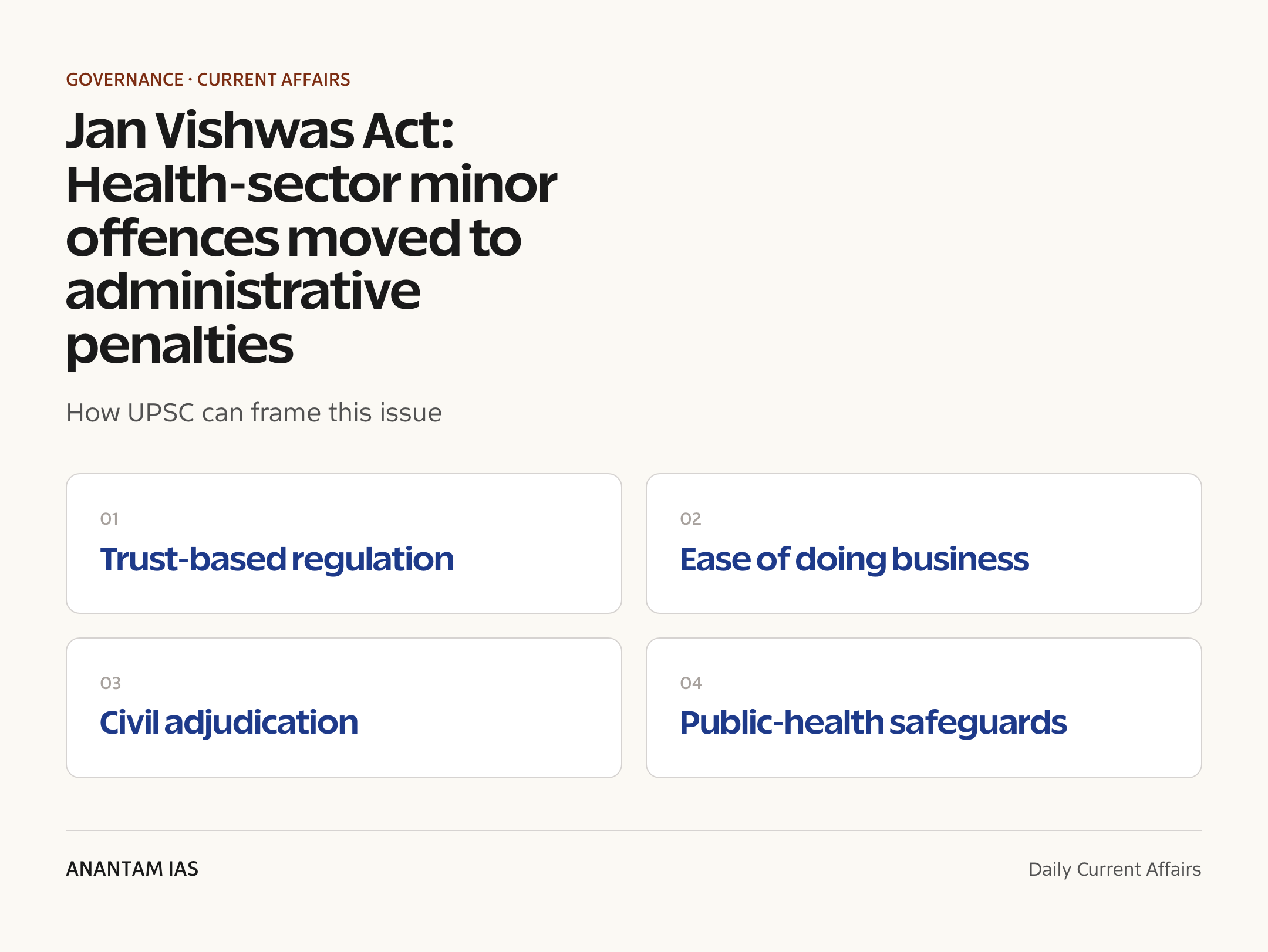
The rationale: trust-based regulation and ease of doing business
The government frames the reform as a move from a suspicion-first to a trust-first regulatory model.
- Treating every procedural lapse as a criminal offence creates ‘regulatory cholesterol’ that deters investment and clogs the courts.
- Replacing jail terms for minor defaults with civil penalties reduces undue pressure on the justice system and helps cut the pendency of cases.
- A graded, proportionate penalty structure lets regulators distinguish a labelling slip from a genuine threat to health.
- Predictable, administrative adjudication improves the compliance climate for legitimate manufacturers and small businesses in the pharma and food sectors.
- The approach links to broader efforts on ease of doing business and ease of living, complementing reforms readers can explore via ease of doing business in India and good governance.
Safeguards retained for serious public-health offences
Decriminalisation of minor lapses does not extend to dangerous products.
- Strict criminal liability is retained for offences involving spurious or adulterated drugs.
- Cases causing bodily injury or death, or involving manufacturing without licence or in unsanitary conditions, stay within the criminal net.
- Only relatively minor offences (labelling errors, minor documentation lapses, and certain NSQ drug cases that do not cause harm) are eligible for civil penalties or compounding.
- The framework deliberately distinguishes minor procedural violations from serious offences that endanger patient safety and food safety.
- The State’s duty to protect the right to health under Article 21 is cited as the bright line the reform does not cross.
Criticism and concerns
Health activists and legal scholars question whether drug offences belong in a business-easing law at all.
- Critics from the All India Drug Action Network (AIDAN) warn that the option of compounding may let makers of substandard drugs get away too lightly.
- A ‘Not of Standard Quality’ (NSQ) medicine can still be ineffective or harmful and can fuel antimicrobial resistance, so weaker deterrence is risky.
- Legal scholars at the Vidhi Centre for Legal Policy have questioned why the Drugs and Cosmetics Act features in a decriminalisation Bill at all.
- Some argue the reform is justified largely in terms of ease of business and foreign investment, with less attention to the consumer’s point of view.
- There are concerns that capacity gaps among newly empowered adjudicating authorities could weaken enforcement if appointments and training lag.
Way Forward
Sharpen the minor-versus-serious distinction
- Publish clear, public criteria separating compoundable procedural lapses from offences that endanger health, to remove discretion-driven uncertainty.
- Keep NSQ cases that pose real risk inside the criminal track rather than defaulting them to compounding.
Build adjudication capacity
- Appoint and train adjudicating authorities promptly so that civil penalties are imposed consistently and fairly.
- Ensure the appellate mechanism is well-resourced to prevent it from becoming a fresh source of backlog.
Strengthen deterrence where it matters
- Pair lighter penalties for minor lapses with tougher surveillance and quicker sampling of drug quality.
- Use higher monetary penalties and repeat-offender escalation to keep deterrence credible for substandard products.
Protect the consumer interest
- Maintain transparent public dashboards of penalties imposed and serious prosecutions, so accountability is visible.
- Consult patient-safety and consumer groups before extending compounding to any new category of health offence.
Conclusion
The Jan Vishwas approach to the health sector reflects a genuine reform instinct: a State that trusts compliant businesses, frees courts from trivial cases, and reserves criminal force for conduct that actually harms people. Applied to labelling slips and paperwork lapses, decriminalisation is sound governance.
The harder question is medicines. A wrong move that softens deterrence against substandard or spurious drugs would shift risk onto the most vulnerable patients. The test of these reforms will be whether the safeguards on spurious and adulterated products hold in practice, and whether adjudicating authorities are equipped to enforce them. Ease of doing business has value only when it never becomes ease of doing harm.
UPSC Practice Questions
Prelims MCQ 1
With reference to the Jan Vishwas (Amendment of Provisions) Act, 2023, consider the following statements:
- It decriminalised provisions across more than 40 Central Acts.
- It relied only on the removal of imprisonment, without introducing any civil penalty or compounding mechanism.
- Its stated objectives include trust-based governance and ease of doing business.
How many of the above statements are correct?
(a) Only one (b) Only two (c) All three (d) None
Answer: (b) Only two
Explanation:
Statements 1 and 3 are correct: the 2023 Act decriminalised 183 provisions across 42 Central Acts and aimed at trust-based governance and ease of doing business. Statement 2 is wrong, as the Act also introduced civil penalties and compounding of offences.
Prelims MCQ 2
Under the health-sector reforms in the Jan Vishwas framework, which one of the following is most accurate?
(a) All offences under the Drugs and Cosmetics Act, 1940 have been fully decriminalised, including those involving spurious drugs. (b) Minor and procedural violations may attract civil penalties through an adjudication mechanism, while serious offences involving spurious or adulterated drugs remain criminal. (c) The Food Safety and Standards Act, 2006 has been repealed and replaced. (d) Adjudicating authorities can be appointed only by the Central Government, not the States.
Answer: (b) Minor and procedural violations may attract civil penalties through an adjudication mechanism, while serious offences involving spurious or adulterated drugs remain criminal.
Explanation:
The reform replaces imprisonment for minor violations with civil penalties via adjudication, but retains strict criminal liability for spurious or adulterated drugs. Both Central and State Governments may appoint adjudicating authorities, so (d) is wrong; (a) and (c) are incorrect.
UPSC Mains Questions
- Decriminalising minor offences can ease compliance, but in the health sector it risks diluting deterrence against unsafe products. Critically examine the trade-offs in the Jan Vishwas reforms. (250 words)
- “Trust-based regulation is sound governance only when matched by credible enforcement.” Discuss with reference to the shift from criminal sanctions to administrative penalties in India. (250 words)
Sources: PIB, Ministry of Health and Family Welfare and Ministry of Health and Family Welfare (PIB release on health-sector decriminalisation).
Frequently Asked Questions
What is the Jan Vishwas (Amendment of Provisions) Act, 2023?
It is an omnibus law that decriminalised minor and procedural offences across many statutes at once, covering 183 provisions in 42 Central Acts administered by 19 Ministries/Departments, to promote trust-based governance and ease of doing business.
What are the health-sector changes?
Minor violations under laws like the Drugs and Cosmetics Act, 1940 and the Food Safety and Standards Act, 2006 are being shifted from imprisonment to graded monetary penalties decided through a civil adjudication mechanism, rather than a criminal court.
Does this mean makers of fake or spurious drugs face lighter punishment?
No. The reforms retain strict criminal liability for spurious or adulterated drugs, products causing bodily injury or death, and unlicensed or unsanitary manufacturing. Only minor lapses such as labelling or documentation errors are decriminalised.
Who decides the penalties now?
Adjudicating authorities appointed by the Central and State Governments decide civil penalties, following a process of show-cause notice, personal hearing, and an appellate mechanism, instead of routine recourse to criminal courts.
Why have some experts criticised the move?
Health activists and legal scholars worry that allowing compounding for some drug offences could weaken deterrence against substandard medicines, which can be ineffective and may fuel antimicrobial resistance, and they question why drug law features in a business-easing statute.
How does this connect to ease of doing business?
By removing the threat of jail for minor defaults and reducing court burden, the reform aims to make compliance simpler and the regulatory climate more predictable for legitimate manufacturers, part of the broader ease of doing business and ease of living agenda.
Source: https://anantamias.com/current-affairs/jan-vishwas-act-health-sector-decriminalisation-reforms/
National Quantum Mission: Over Half of Targets Met Within Three Years
Why in News?
Speaking at a media conclave on 26 June 2026, Union Minister of State (Independent Charge) for Science and Technology Dr. Jitendra Singh said the National Quantum Mission (NQM) has already achieved more than half of its targeted outcomes within three years of its launch in 2023, per a PIB release from the Ministry of Science and Technology.
The Minister flagged that several milestones were met ahead of schedule, with substantial progress in quantum-secure communication — a domain with direct applications in defence, strategic communications, cyber security and the protection of sensitive information — placing India alongside leading nations in frontier technology.
- NQM has crossed the 50% mark on its targeted outcomes within three years of a 2023 start, per Dr. Jitendra Singh (PIB).
- Headline gains are in quantum-secure communication, plus parallel advances in quantum computing and allied research.
- The Minister framed quantum, AI, space and nuclear as the technologies that will decide India’s future growth, national security and global competitiveness.
- PIB cites the pace as evidence India is now progressing alongside global leaders rather than playing catch-up.
The development matters in the context of:
- NQM was approved on 19 April 2023 with an outlay of Rs 6,003.65 crore for 2023-24 to 2030-31, implemented by the Department of Science and Technology (DST).
- The Mission runs on four verticals delivered through four Thematic Hubs (T-Hubs) hosted at IISc and the IITs.
- This update is a progress checkpoint, distinct from the broader emerging-tech ecosystem narrative that also features the Mission.
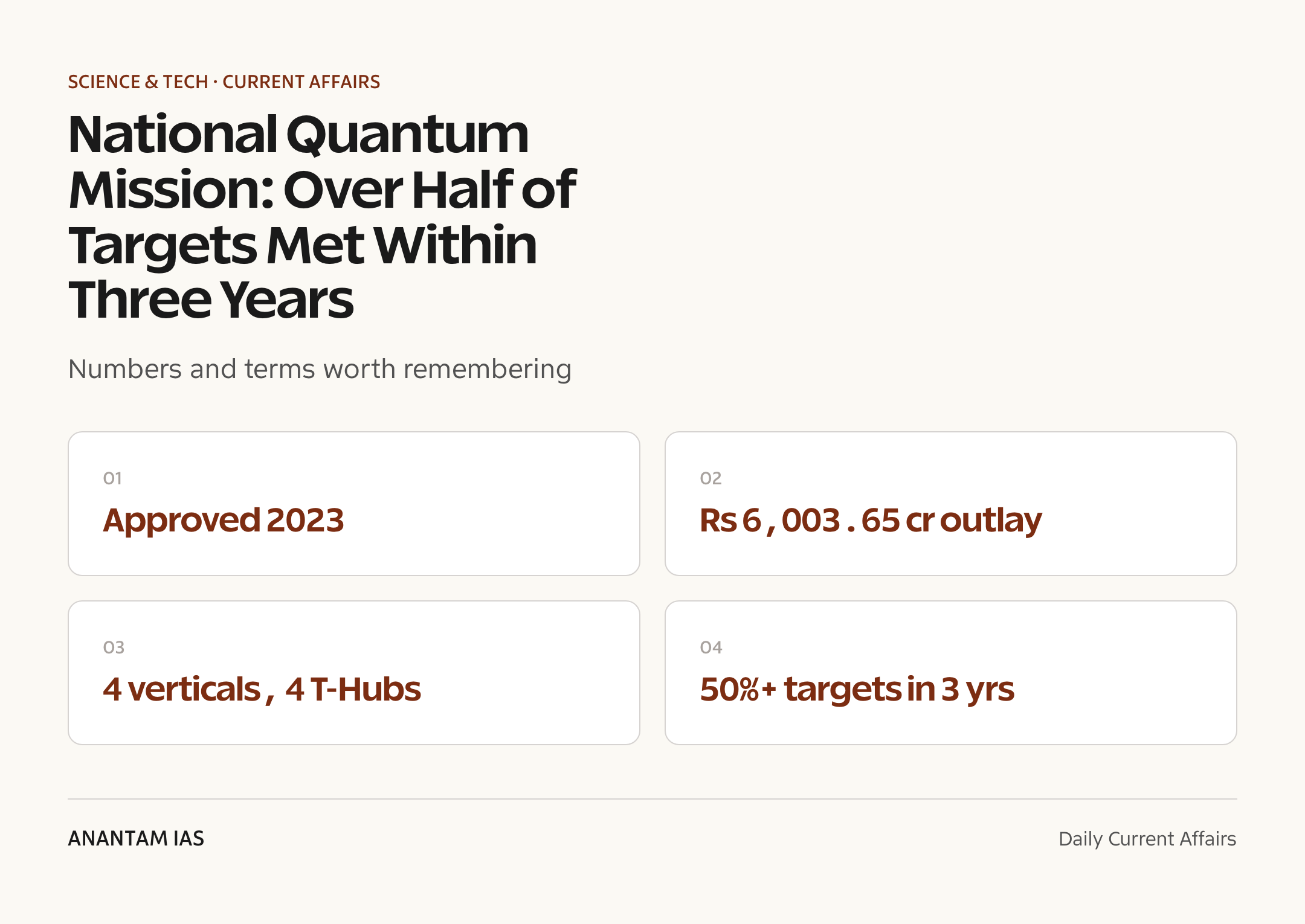
UPSC Relevance
Prelims Relevance
- Launch: approved 19 April 2023; period 2023-24 to 2030-31.
- Outlay: Rs 6,003.65 crore; nodal department is DST, Ministry of Science and Technology.
- Four verticals: Quantum Computing, Quantum Communication, Quantum Sensing and Metrology, Quantum Materials and Devices.
- Four T-Hubs: IISc Bengaluru (Computing), IIT Madras with C-DOT (Communication), IIT Bombay (Sensing and Metrology), IIT Delhi (Materials and Devices).
- Computing target: intermediate-scale machines of 50-1000 physical qubits in 8 years (20-50 qubits in 3 years, 50-100 in 5 years).
- Communication target: satellite-based secure quantum communication over 2,000 km within India, plus long-distance inter-city quantum key distribution.
- Metrology target: high-precision atomic clocks for timing and navigation, and high-sensitivity magnetometers.
- Status (June 2026): more than half of targeted outcomes met within three years, per PIB.
Mains Relevance
GS Paper 3
- Assess how the National Quantum Mission’s hub-and-vertical design accelerates indigenous capability in a dual-use frontier technology.
- Evaluate quantum-secure communication as a strategic asset for national security, defence and cyber resilience, and the gaps that remain.
Essay
- Frontier technologies and the new race for strategic autonomy.
- Science as the engine of national power: from import dependence to indigenous capability.
Background and Context
NQM design and the four verticals
A mission built to take India from quantum research to deployable systems.
- The National Quantum Mission was approved on 19 April 2023 at Rs 6,003.65 crore for the period 2023-24 to 2030-31, run by the Department of Science and Technology.
- It is organised around four verticals: Quantum Computing (machines built on qubits), Quantum Communication (tamper-evident key sharing), Quantum Sensing and Metrology (ultra-precise clocks and sensors) and Quantum Materials and Devices (the hardware substrate).
- A qubit (quantum bit) is the basic unit of quantum information; unlike a classical bit fixed at 0 or 1, it can hold a superposition of both, letting quantum computers explore many states at once and crack problems classical machines find intractable.
- Targets are staged: 20-50 physical qubits in 3 years, 50-100 in 5 years and 50-1,000 in 8 years, alongside 2,000 km secure satellite communication and precision atomic clocks.
- The mission also pursues high-sensitivity magnetometers and atomic clocks for navigation and timing, and the new materials and devices that make all of the above physically possible — a deliberately full-stack design rather than a single bet.
The three-year achievements
What the June 2026 milestone actually claims.
- Per PIB, NQM has met more than half of its targeted outcomes within three years of its 2023 launch — several milestones reached ahead of schedule.
- The standout area is quantum-secure communication, where progress feeds directly into defence, strategic communication, cyber security and the protection of sensitive data.
- Dr. Jitendra Singh placed quantum advances next to AI, space and nuclear as the cluster that will shape India’s economic and strategic future.
- PIB’s framing is comparative: India is described as advancing alongside global leaders in critical technology domains, not lagging them.
- The Minister linked the quantum push to a wider policy shift, with reforms in the space and nuclear sectors and the National Education Policy 2020 cited as foundations for a stronger research and innovation ecosystem.
Thematic Hubs and host institutions
Four hubs, one per vertical, anchored at premier institutions.
- Quantum Computing hub: the Foundation for QC Innovation at IISc Bengaluru.
- Quantum Communication hub: the IITM-CDOT Samgnya Technologies Foundation at IIT Madras, working with the Centre for Development of Telematics (C-DOT).
- Quantum Sensing and Metrology hub: the Qmet Tech Foundation at IIT Bombay.
- Quantum Materials and Devices hub: the QMD Foundation at IIT Delhi.
- The hubs run technology development, human-resource development, entrepreneurship and industry collaboration, and international partnerships — turning lab research into a domestic supply chain.
Why quantum-secure communication matters
The security payoff that makes quantum a strategic priority.
- Quantum Key Distribution (QKD) uses the laws of physics to share an encryption key so that any eavesdropping disturbs the signal and is detected — making intercepted traffic useless to an adversary.
- This is a hedge against the ‘harvest now, decrypt later’ risk, where encrypted data is stolen today to be broken once large quantum computers exist.
- NQM’s communication vertical targets satellite-based secure links over 2,000 km and long-distance inter-city QKD, with C-DOT giving the effort a telecom backbone.
- For defence, finance and critical infrastructure, sovereign quantum-secure channels reduce dependence on foreign cryptographic systems.
- Because the protection comes from physics rather than the difficulty of a maths problem, QKD-secured links stay safe even against a future adversary armed with a powerful quantum computer.
The global quantum race
India is one of a small group of states with a national quantum programme.
- Major economies — including the United States, China, the European Union, the United Kingdom and Japan — run large public quantum programmes, treating the field as strategically decisive.
- Dr. Jitendra Singh warned that countries falling behind in quantum, AI, space and nuclear risk falling behind in both development and security.
- The dual-use nature of quantum — civilian computing plus military-grade cryptography and sensing — drives heavy state funding worldwide.
- NQM positions India to set standards and build export-capable hardware rather than remain a technology importer.
Challenges that remain
Crossing the 50% mark is not the same as crossing the finish line.
- Scaling qubits from tens to the 50-1,000 range demands error correction and stable hardware that few labs anywhere have mastered.
- Talent is scarce — a deep pool of quantum physicists, engineers and cryogenics specialists takes years to build.
- Supply chains for specialised components (dilution refrigerators, photonic devices, control electronics) are still largely import-dependent.
- Translating hub research into deployed, standardised products needs sustained industry uptake and procurement demand beyond the mission’s grant window.
- The PIB statement reports the more-than-half figure as an aggregate claim by the Minister; granular target-by-target data, peer-reviewed results and independent benchmarks will matter for judging how durable the lead really is.
Way Forward
Hold the qubit roadmap
- Keep the staged targets honest — demonstrate working intermediate-scale machines with verifiable qubit counts, not just prototypes, before the 5- and 8-year gates.
- Invest early in quantum error correction, the hard problem that decides whether qubit counts translate into usable computing.
Build the talent pipeline
- Scale quantum curricula, fellowships and industry internships through the T-Hubs to widen the specialist base.
- Use international collaborations to bring back expertise while protecting strategic know-how.
Anchor a domestic supply chain
- Incentivise local manufacture of cryogenics, photonics and control electronics to cut import dependence.
- Seed quantum startups around each hub so research converts into deployable, export-ready products.
Operationalise quantum-secure networks
- Pilot QKD on government, defence and banking networks with C-DOT to move from lab demos to live deployment.
- Develop and adopt post-quantum cryptography standards in parallel as a transition layer.
Conclusion
Crossing half its targets in three years gives the National Quantum Mission genuine momentum, and the early lead in quantum-secure communication is the most strategically valuable place to be ahead. The hub-and-vertical structure has given each domain an institutional home and a route from research to product.
The harder half lies ahead — scaling qubits, deepening the talent pool and localising a fragile supply chain. Whether India ends the decade as a quantum standard-setter or a fast follower depends on converting these milestones into deployed, sovereign systems rather than headline demonstrations.
UPSC Practice Questions
Prelims MCQ 1
With reference to the National Quantum Mission (NQM), consider the following statements:
- It is implemented by the Department of Science and Technology.
- It was approved in 2023 with an outlay exceeding Rs 6,000 crore for an eight-year period.
- Its four verticals include Quantum Computing, Quantum Communication, Quantum Sensing and Metrology, and Quantum Materials and Devices.
How many of the above statements are correct?
(a) Only one (b) Only two (c) All three (d) None
Answer: (c) All three
Explanation:
NQM is run by DST, was approved on 19 April 2023 at Rs 6,003.65 crore for 2023-24 to 2030-31 (eight years), and rests on the four verticals named. All three statements are correct.
Prelims MCQ 2
The Thematic Hub for Quantum Communication under the NQM is anchored at which institution, working alongside C-DOT?
(a) IISc Bengaluru (b) IIT Bombay (c) IIT Madras (d) IIT Delhi
Answer: (c) IIT Madras
Explanation:
The Quantum Communication T-Hub (IITM-CDOT Samgnya Technologies Foundation) is at IIT Madras with C-DOT. IISc Bengaluru leads Computing, IIT Bombay leads Sensing and Metrology, and IIT Delhi leads Materials and Devices.
UPSC Mains Questions
- The National Quantum Mission has met more than half its targets within three years. Examine its design and assess the challenges India must overcome to become a global quantum leader. (250 words)
- Quantum-secure communication is a strategic asset, not merely a scientific goal. Discuss in the context of India’s National Quantum Mission and national security. (150 words)
Sources: PIB, Ministry of Science & Technology and Department of Science & Technology.
Frequently Asked Questions
What is the National Quantum Mission’s recent milestone?
On 26 June 2026, Dr. Jitendra Singh announced that the NQM has met more than half of its targeted outcomes within three years of its 2023 launch, with several milestones reached ahead of schedule.
When was the NQM approved and what is its outlay?
It was approved on 19 April 2023 with an outlay of Rs 6,003.65 crore for the period 2023-24 to 2030-31, implemented by the Department of Science and Technology.
What are the four verticals of the NQM?
Quantum Computing, Quantum Communication, Quantum Sensing and Metrology, and Quantum Materials and Devices.
Where are the four Thematic Hubs located?
Quantum Computing at IISc Bengaluru, Quantum Communication at IIT Madras with C-DOT, Quantum Sensing and Metrology at IIT Bombay, and Quantum Materials and Devices at IIT Delhi.
What are the NQM’s qubit targets?
Intermediate-scale quantum computers of 20-50 physical qubits in 3 years, 50-100 in 5 years and 50-1,000 in 8 years.
Why does quantum-secure communication matter strategically?
It uses Quantum Key Distribution, where any eavesdropping disturbs the signal and is detected, protecting defence, financial and critical-infrastructure data against current and future attacks, including ‘harvest now, decrypt later’ threats.
Source: https://anantamias.com/current-affairs/national-quantum-mission-three-year-progress/
Threatened Species SOP: NBA frames Section 38 process under Biodiversity Act
Why in News?
The National Biodiversity Authority (NBA), the apex body under the Ministry of Environment, Forest and Climate Change, has issued a Standard Operating Procedure (SOP) for the notification of threatened species under Section 38 of the Biological Diversity Act, 2002. The SOP gives states and union territories a single, uniform pathway to identify, assess and recommend species that are on the verge of extinction, replacing the earlier patchy, case-by-case approach.
The move matters because Section 38 has so far been used unevenly. As per the Ministry, 159 plant species and 173 animal species have been notified as threatened across only 17 states and 3 union territories. By laying out a step-by-step process anchored in scientific evidence and stakeholder consultation, the SOP aims to make notification consistent, transparent and scientifically rigorous nationwide.
- NBA released an SOP operationalising Section 38 of the Biological Diversity Act, 2002 for notifying threatened species.
- Cumulative status cited: 159 plant and 173 animal species notified as threatened across 17 states and 3 UTs.
- SOP prescribes a seven-stage chain: scientific assessment, stakeholder consultation, validation, notification, conservation planning, monitoring and periodic review.
- State Biodiversity Boards and UT Biodiversity Councils are the nodal recommenders to state governments.
- Post-notification, species recovery and conservation action plans become mandatory, and collection can be regulated or prohibited.
The development matters in the context of:
- Section 38 lets the Central Government, in consultation with the concerned state, notify a species on the verge of extinction as a Threatened Species and regulate or prohibit its collection.
- The SOP draws on the Botanical Survey of India (BSI), Zoological Survey of India (ZSI), academic institutions, local communities and Biodiversity Management Committees (BMCs) for evidence.
- It dovetails with India’s commitments under the Kunming-Montreal Global Biodiversity Framework and the updated National Biodiversity Strategy and Action Plan (NBSAP) 2024-2030.
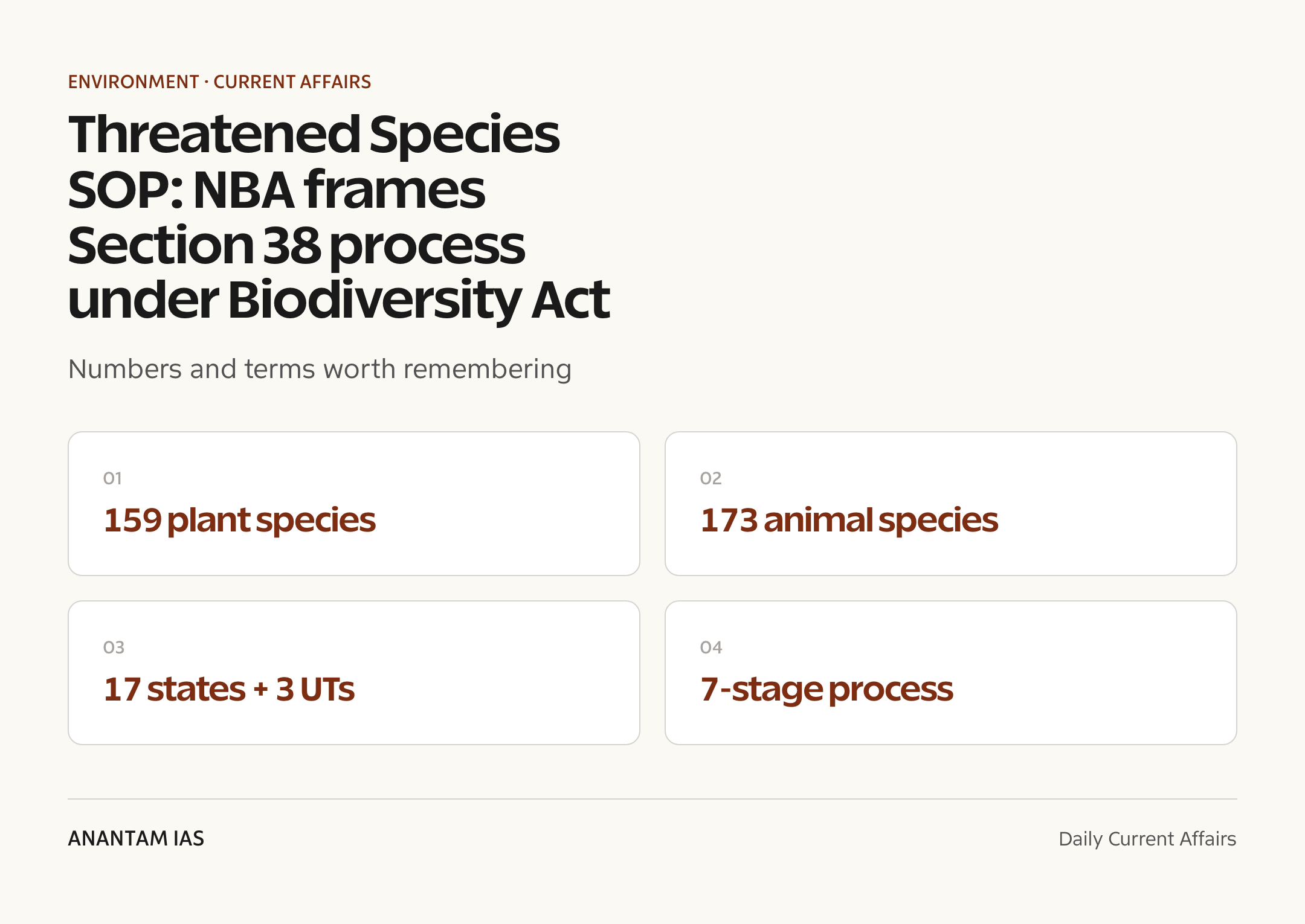
UPSC Relevance
Prelims Relevance
- Section 38 of the Biological Diversity Act, 2002 empowers the Centre, in consultation with the state, to notify a species as threatened and regulate/prohibit its collection.
- The NBA is a statutory autonomous body headquartered at Chennai, established in 2003.
- The Act has a three-tier structure: NBA (national), State Biodiversity Boards (state), and Biodiversity Management Committees (local).
- BMCs maintain People’s Biodiversity Registers (PBRs) documenting local flora, fauna and traditional knowledge.
- As cited by the Ministry, 159 plant and 173 animal species stand notified as threatened across 17 states and 3 UTs.
- The Kunming-Montreal Global Biodiversity Framework was adopted at CBD COP15 (2022) and sets 23 targets and 4 goals for 2030, including its 30×30 protected-area target.
- The Biological Diversity (Amendment) Act, 2023 decriminalised offences (civil penalties up to Rs 1 crore) and shifted the patent checkpoint to the pre-grant stage.
- The IUCN Red List is the global benchmark for extinction-risk categories (e.g., Critically Endangered, Endangered, Vulnerable), distinct from a Section 38 legal notification.
- Section 38 notification is separate from the Wildlife (Protection) Act, 1972 schedules; the two protection regimes can apply to overlapping species.
Mains Relevance
GS Paper 3
- Why standardising threatened-species notification matters for cooperative federalism in environmental governance, given that Section 38 use has been confined to 17 states and 3 UTs.
- How the SOP can translate India’s Kunming-Montreal GBF and NBSAP 2024-2030 commitments into measurable, on-ground species-recovery outcomes.
- The role of scientific institutions (BSI, ZSI), local communities and BMCs in building credible, participatory conservation processes.
Essay
- Conservation as a shared responsibility: science, the state and the citizen.
- Standardising the rules of the game to protect what cannot be replaced.
Background and Context
The Biological Diversity Act, 2002 and Section 38
The Act is India’s principal law for conserving biodiversity, sharing its benefits fairly, and regulating access to biological resources.
- Enacted to give effect to the 1992 Convention on Biological Diversity (CBD), which rests on three objectives: conservation, sustainable use, and fair benefit-sharing.
- It set up a three-tier architecture: the National Biodiversity Authority (NBA) at Chennai, State Biodiversity Boards (SBBs), and grassroots Biodiversity Management Committees (BMCs).
- Section 38 empowers the Central Government, in consultation with the concerned state, to notify any species on the verge of extinction, or likely to become extinct, as a Threatened Species.
- Once a species is notified, its collection can be regulated or prohibited, and rehabilitation and conservation measures can be mandated.
- Read the full primer on the Biological Diversity Act, 2002 for the institutional design and 2023 amendments.
What the new SOP actually does
The SOP converts a broad statutory power into a predictable, repeatable workflow that any state can follow.
- Establishes a uniform, transparent and scientifically rigorous process for identifying, assessing and notifying threatened species.
- Prescribes a step-by-step chain: scientific assessment and field-based evaluation, stakeholder consultation, validation, formal notification, conservation planning, monitoring and periodic review.
- Anchors decisions in the best available scientific evidence, field assessments and traditional knowledge rather than ad-hoc proposals.
- Makes species recovery and conservation action plans a mandatory follow-up after notification, with outcomes tracked over time.
- Brings in BSI, ZSI, academic institutions, subject experts, local communities and BMCs as participants in assessment and consultation.
NBA, State Boards and the chain of responsibility
The SOP clarifies who proposes, who validates and who finally notifies, reducing ambiguity between the Centre and states.
- State Biodiversity Boards and UT Biodiversity Councils identify candidate species and recommend them to their respective state governments.
- The Central Government retains the formal notification authority under Section 38, acting in consultation with the state.
- The NBA provides the overarching framework, scientific coordination and consistency across jurisdictions.
- BMCs, through People’s Biodiversity Registers, supply granular local data on rare and declining species.
- By naming each actor’s role, the SOP addresses the earlier problem of uneven, state-by-state application of Section 38.
Kunming-Montreal GBF and NBSAP 2024-2030
The SOP is a domestic instrument that helps deliver India’s global biodiversity promises.
- The Kunming-Montreal Global Biodiversity Framework, adopted at CBD COP15 in 2022, sets 4 goals and 23 targets for 2030.
- Its headline 30×30 target seeks to conserve 30 percent of land, inland waters and seas, while several targets focus on preventing extinctions.
- India’s updated National Biodiversity Strategy and Action Plan (NBSAP) 2024-2030 is the national roadmap aligning domestic action with the framework.
- A standardised threatened-species pipeline gives India auditable data to report progress on extinction-prevention targets.
- It complements other green laws such as the Wildlife (Protection) Amendment Act, 2022 and the Forest (Conservation) Amendment Act, 2023.
Significance and challenges
The SOP raises the floor for conservation practice, but its impact will depend on capacity and follow-through.
- Significance: shifts threatened-species protection from reactive, ad-hoc notification to a planned, evidence-led cycle with recovery plans.
- Significance: improves data quality and comparability, strengthening India’s biodiversity reporting under the CBD.
- Challenge: State Biodiversity Boards remain unevenly resourced, and weak boards may struggle with field assessments and validation.
- Challenge: a Section 38 notification is only as good as the funding and monitoring behind the recovery action plan that follows.
- Challenge: aligning the legal notification with the IUCN Red List and the Wildlife (Protection) Act, 1972 schedules to avoid duplication or gaps.
Way Forward
Strengthen state capacity
- Fund and staff under-resourced State Biodiversity Boards and UT Councils so they can run credible field assessments.
- Build standing scientific panels linking BSI, ZSI and universities to support validation.
Tie notification to funded recovery
- Make every Section 38 notification trigger a budgeted species recovery action plan with clear milestones.
- Use periodic review to retire, downgrade or escalate species status based on monitored outcomes.
Integrate data systems
- Cross-reference notifications with the IUCN Red List and People’s Biodiversity Registers to spot under-covered species.
- Report progress against NBSAP 2024-2030 and Kunming-Montreal targets through a single national dashboard.
Conclusion
The threatened-species SOP is a quiet but consequential reform. By converting a broad power under Section 38 into a clear seven-stage process, the NBA gives every state the same toolkit to find, protect and recover species before they slip away. The earlier picture, where only 17 states and 3 UTs had used the provision, reflected a gap in process as much as in will.
Its real test lies downstream. Notification is a beginning, not an end; without funded recovery plans, capable State Biodiversity Boards and honest periodic review, the SOP risks becoming paperwork. Handled well, it can anchor India’s Kunming-Montreal and NBSAP commitments in measurable, on-ground conservation rather than declarations.
UPSC Practice Questions
Prelims MCQ 1
With reference to the Biological Diversity Act, 2002, consider the following statements:
- Section 38 empowers the Central Government, in consultation with the concerned State Government, to notify a species as threatened.
- Biodiversity Management Committees function at the national level and advise the National Biodiversity Authority.
- The National Biodiversity Authority is headquartered at Chennai.
How many of the above statements are correct?
(a) Only one (b) Only two (c) All three (d) None
Answer: (b) Only two
Explanation:
Statements 1 and 3 are correct. Statement 2 is wrong: Biodiversity Management Committees operate at the local (panchayat/municipal) level, not the national level.
Prelims MCQ 2
The Kunming-Montreal Global Biodiversity Framework is associated with which of the following?
(a) The United Nations Framework Convention on Climate Change (b) The Convention on Biological Diversity (c) The Convention on International Trade in Endangered Species (d) The Ramsar Convention on Wetlands
Answer: (b) The Convention on Biological Diversity
Explanation:
The Kunming-Montreal Global Biodiversity Framework was adopted at COP15 of the Convention on Biological Diversity (CBD) in 2022, setting 4 goals and 23 targets for 2030.
UPSC Mains Questions
- The new SOP for notifying threatened species seeks to standardise a power that has been used unevenly across states. Examine how such standardisation can strengthen environmental federalism and India’s biodiversity commitments. (250 words)
- A legal notification of a threatened species is only the first step in conservation. Discuss the institutional and financial conditions needed to make Section 38 of the Biological Diversity Act, 2002 deliver real species recovery. (250 words)
Source: PIB, Ministry of Environment, Forest and Climate Change.
Frequently Asked Questions
What is Section 38 of the Biological Diversity Act, 2002?
Section 38 empowers the Central Government, in consultation with the concerned State Government, to notify any species that is on the verge of extinction or likely to become extinct as a Threatened Species. Once notified, the collection of that species can be regulated or prohibited, and conservation and rehabilitation measures can be ordered.
What does the new NBA SOP do?
The Standard Operating Procedure issued by the National Biodiversity Authority creates a uniform, step-by-step process for states to identify, assess and notify threatened species. It covers scientific assessment, stakeholder consultation, validation, notification, conservation planning, monitoring and periodic review, replacing the earlier ad-hoc approach.
How many species have been notified as threatened so far?
As cited by the Ministry of Environment, Forest and Climate Change, 159 plant species and 173 animal species have been notified as threatened under Section 38. This coverage spans only 17 states and 3 union territories, which is why a standardised process was considered necessary.
Who recommends a species for notification?
State Biodiversity Boards and Union Territory Biodiversity Councils identify candidate species and recommend them to their respective state governments. The Central Government then issues the formal notification under Section 38, drawing on inputs from the Botanical Survey of India, Zoological Survey of India, academics, local communities and Biodiversity Management Committees.
How does the SOP connect to global commitments?
It supports India’s obligations under the Kunming-Montreal Global Biodiversity Framework, adopted at CBD COP15 in 2022, and the updated National Biodiversity Strategy and Action Plan (NBSAP) 2024-2030. A standardised pipeline generates the data needed to report progress on extinction-prevention targets.
How is Section 38 notification different from the IUCN Red List?
The IUCN Red List is a global scientific assessment of extinction risk and carries no legal force on its own. A Section 38 notification is a domestic legal action that triggers protection and conservation duties within India. A species can appear on the Red List without being notified under Section 38, and vice versa.
Source: https://anantamias.com/current-affairs/nba-sop-threatened-species-biological-diversity-act/
RBI’s Upper-Layer NBFC Rules: What They Mean for Tata Sons’ Listing
Why in News?
The Reserve Bank of India (RBI) has revised the criteria for classifying Non-Banking Financial Companies (NBFCs) in the Upper Layer of its Scale-Based Regulation (SBR) framework, switching to a simple asset-size test of Rs 1 lakh crore and above. Indian Express reported that the change has reopened the long-running debate over whether Tata Sons, the holding company of the Tata group, must list its shares on a stock exchange.
A Non-Banking Financial Company is a firm that lends, invests, or holds financial assets without being a bank, so it cannot accept ordinary demand deposits but still does credit-like business. Because the largest NBFCs can pose systemic risk, RBI places the biggest ones in the Upper Layer and requires them to list within three years of being identified. The revision keeps that mandate alive for a holding company that has been seeking to step outside the net.
- RBI replaced the earlier parametric scoring method with a single clear rule: any NBFC with assets of Rs 1 lakh crore or more is an Upper-Layer NBFC (NBFC-UL).
- All NBFC-UL entities must get listed within three years of identification, a rule that brings Tata Sons back into focus.
- NBFCs that are fully owned and controlled by the government have been exempted from the mandatory listing requirement.
- The Rs 1 lakh crore threshold will now be reviewed every three years, instead of the five-year interval floated in the draft.
- Tata Sons, with an estimated asset base of around Rs 1.75 lakh crore, comfortably crosses the bar and is likely to stay in the Upper Layer.
The development matters in the context of:
- Tata Sons is registered as a Core Investment Company (CIC), a special kind of NBFC that mainly holds shares in group companies rather than lending to the public.
- Tata Sons had earlier applied to deregister itself as an Upper-Layer NBFC-CIC, a request still pending with RBI; the new norms make that exit harder to assume.
- The listing debate matters because a public float would force fuller disclosure, market valuation, and exit options for shareholders such as the Shapoorji Pallonji group.
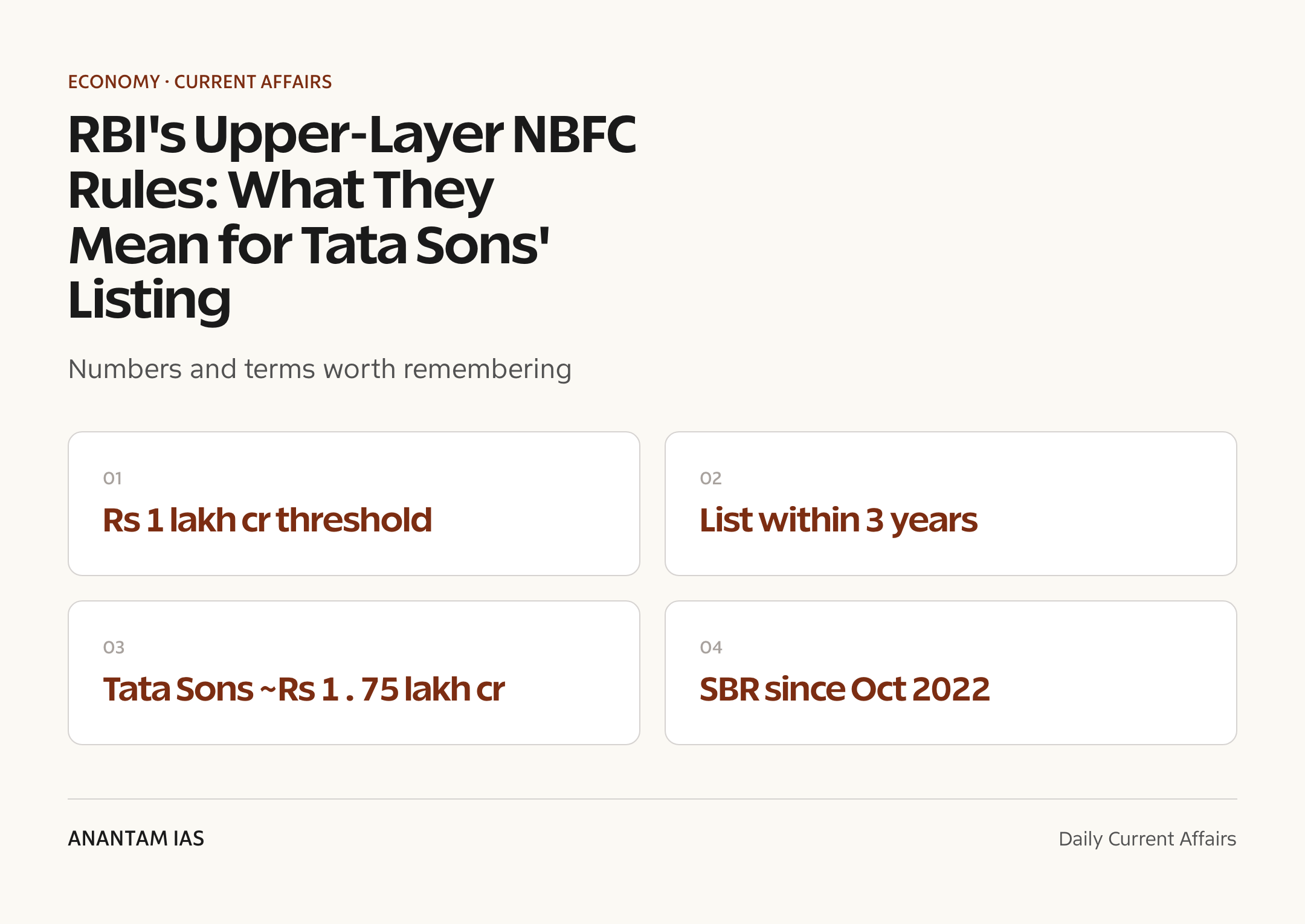
UPSC Relevance
Prelims Relevance
- Scale-Based Regulation (SBR) for NBFCs was notified by RBI on 22 October 2021 and came into effect from 1 October 2022.
- The SBR framework sorts NBFCs into four layers: Base Layer, Middle Layer, Upper Layer, and Top Layer, by size, activity, and perceived riskiness.
- The Base Layer holds smaller non-deposit-taking NBFCs, peer-to-peer lenders, and account aggregators; the Middle Layer holds deposit-taking NBFCs, housing finance companies, and core investment companies.
- The Upper Layer holds NBFCs deemed systemically significant; the Top Layer is normally empty and reserved for entities posing extreme systemic risk.
- Under the revised rule, the Upper Layer is identified by a single threshold: assets of Rs 1 lakh crore and above as per the latest audited balance sheet.
- Every NBFC-UL must be listed within three years of identification; government-owned NBFCs are exempt.
- A Core Investment Company (CIC) is an NBFC that holds at least 90% of its net assets as investments in group companies, with at least 60% in equity, and does not trade these holdings except for block sale.
- Tata Sons is a CIC and the principal holding company of the Tata group; Tata Trusts hold the majority stake in it.
Mains Relevance
GS Paper 3
- Regulation of the financial sector: how RBI’s Scale-Based Regulation balances ease of doing business against systemic-risk oversight of large shadow-banking entities.
- Corporate governance and transparency: whether mandatory listing of large holding companies improves disclosure and minority-shareholder protection, using Tata Sons as a live case.
Essay
- Regulation versus enterprise: how a maturing economy designs rules that contain systemic risk without smothering large private institutions.
Background and Context
What the Scale-Based Regulation framework is
RBI moved from a one-size-fits-all rulebook to a layered, risk-proportionate one.
- An NBFC is a company that does lending, investment, or financial holding business without a banking licence, so it cannot take ordinary demand deposits.
- After the IL&FS and DHFL stress episodes exposed how large NBFCs can shake the wider system, RBI tightened oversight of the biggest players.
- The Scale-Based Regulation (SBR) framework, notified on 22 October 2021, sorts NBFCs into four layers so that bigger and riskier firms face stricter rules.
- The guiding idea is proportionality: light-touch rules for small NBFCs, bank-like rigour for the systemically significant ones.
The four layers and what the Upper-Layer listing rule requires
The Upper Layer carries the heaviest obligations, including a forced market listing.
- Base Layer: smaller non-deposit-taking NBFCs, peer-to-peer lending platforms, and account aggregators, under the lightest regulation.
- Middle Layer: all deposit-taking NBFCs, plus housing finance companies, standalone primary dealers, and core investment companies.
- Upper Layer: NBFCs judged systemically significant; under the new norm, every firm with assets of Rs 1 lakh crore or more sits here.
- Top Layer: kept empty unless a firm grows to pose extreme systemic risk, when it would face the most intensive supervision.
- Each NBFC-UL must follow bank-like norms on capital, leverage, and governance, and must get its shares listed within three years of being identified.
Why Tata Sons, a Core Investment Company, is affected
Tata Sons is the Tata group’s holding company, and its size keeps it inside the Upper Layer.
- A Core Investment Company (CIC) is an NBFC that mainly holds equity in its own group companies rather than lending to the public; Tata Sons is registered as one.
- With an estimated asset base of about Rs 1.75 lakh crore, Tata Sons comfortably crosses the Rs 1 lakh crore line and stays classified as an NBFC-UL.
- Tata Sons featured on RBI’s earlier Upper-Layer list, so the three-year listing clock already applies to it on paper.
- Tata Sons had sought to deregister as an NBFC-CIC, partly by paring debt and reorganising, so that the listing mandate would no longer bind it; that application is still pending with RBI.
The revised rules and the exemption debate
RBI simplified the test, set a review cycle, and carved out the government’s own NBFCs.
- The old method used a parametric scoring exercise across a sample of NBFCs; the revision replaces it with a flat Rs 1 lakh crore asset threshold.
- The threshold will be reviewed every three years, tighter than the five-year cycle proposed in the draft guidelines.
- NBFCs that are fully owned and controlled by the government are exempted from the mandatory listing rule, narrowing the obligation to private players.
- Because no private exemption was offered, the move leaves Tata Sons facing the listing question unless its deregistration plea succeeds, a reprieve that remains uncertain.
The systemic-risk rationale and the case for listing
Forced listing is meant to bring transparency and discipline to firms large enough to matter to the system.
- Large NBFCs borrow heavily from banks, mutual funds, and bond markets, so distress at one can spread through the financial system, the lesson of IL&FS.
- A stock-market listing forces continuous disclosure, independent valuation, and analyst scrutiny, which can flag trouble earlier than private accounts.
- Listing also gives existing shareholders, such as the Shapoorji Pallonji group in Tata Sons, a transparent route to value and exit.
- Critics counter that a pure holding company has no public deposits at risk, so forcing it to list may be a heavy answer to a limited systemic concern.
Significance and criticism
The revision is cleaner to administer but reopens a politically and commercially sensitive choice.
- Switching to an asset-size threshold makes Upper-Layer classification predictable and transparent, reducing discretion.
- Tata Sons has resisted a public float, valuing the privacy and control that an unlisted holding structure gives the group.
- The government-only exemption draws a sharp line: state NBFCs escape the listing rule while large private holding companies do not.
- The outcome will signal how firmly RBI is willing to push transparency and systemic discipline against the preferences of a marquee private conglomerate.
Way Forward
Resolve the deregistration question quickly
- RBI should decide Tata Sons’ pending CIC deregistration plea on clear, published criteria so the market is not left guessing.
- Any exit route from NBFC-UL status should rest on genuine reduction of systemic footprint, not merely on accounting reorganisation.
Keep thresholds proportionate and reviewed
- The three-year review of the Rs 1 lakh crore line should track financial-sector growth so the Upper Layer captures the genuinely systemic, not the merely large.
- RBI can pair the listing mandate with calibrated relief on timelines where a firm demonstrably reduces leverage and interconnectedness.
Strengthen disclosure as the real goal
- Where listing is genuinely unsuitable, RBI could mandate listing-equivalent disclosure for large CICs to capture transparency without a forced float.
- Coordination with SEBI can ensure that any listing protects minority and legacy shareholders rather than triggering disputes.
Conclusion
RBI’s switch to a Rs 1 lakh crore asset threshold makes Upper-Layer classification cleaner and harder to argue around, and it keeps the three-year listing mandate squarely over large private NBFCs. For Tata Sons, the simplification removes the ambiguity it might have used to slip out of the net, leaving its pending deregistration plea as the main escape hatch.
The episode is a useful study of how a regulator weighs systemic-risk control and transparency against the autonomy of a large private institution. How RBI handles the Tata Sons case will set a marker for the credibility and even-handedness of the Scale-Based Regulation framework.
UPSC Practice Questions
Prelims MCQ 1
With reference to the RBI’s Scale-Based Regulation (SBR) framework for NBFCs, consider the following statements:
- The framework classifies NBFCs into four layers: Base, Middle, Upper, and Top.
- Core Investment Companies are placed by default in the Top Layer.
- Under the revised norms, an NBFC with assets of Rs 1 lakh crore and above is classified in the Upper Layer.
How many of the above statements are correct?
(a) Only one (b) Only two (c) All three (d) None
Answer: (b) Only two
Explanation:
Statements 1 and 3 are correct. The SBR framework has four layers and the revised Upper-Layer test is a Rs 1 lakh crore asset threshold. Statement 2 is wrong: Core Investment Companies sit in the Middle Layer, and the Top Layer is normally empty, reserved for entities posing extreme systemic risk.
Prelims MCQ 2
Which of the following best describes a Core Investment Company (CIC) under RBI norms?
(a) An NBFC that primarily accepts public demand deposits and lends to retail borrowers (b) An NBFC that mainly holds equity and debt in its own group companies and does not trade these investments except for block sale (c) A commercial bank that invests its surplus in government securities (d) A microfinance institution lending only to self-help groups
Answer: (b) An NBFC that mainly holds equity and debt in its own group companies and does not trade these investments except for block sale
Explanation:
A CIC is an NBFC that holds at least 90% of its net assets as investments in group companies (at least 60% in equity) and does not trade them except for block sale. Tata Sons is a registered CIC. NBFCs cannot take ordinary demand deposits, ruling out option (a).
UPSC Mains Questions
- The Scale-Based Regulation framework reflects a shift toward proportionate, risk-based regulation of NBFCs. Examine its rationale and assess whether the mandatory listing of Upper-Layer NBFCs strengthens financial-sector transparency. (GS Paper 3)
- Large holding companies and Core Investment Companies sit at the intersection of corporate control and systemic risk. Discuss, with reference to the Tata Sons listing debate, how RBI should balance regulatory discipline against private enterprise. (GS Paper 3)
Source: Indian Express.
Frequently Asked Questions
What is an NBFC-Upper Layer (NBFC-UL)?
An NBFC-UL is a non-banking financial company that RBI treats as systemically significant. Under the revised rule, any NBFC with assets of Rs 1 lakh crore or more falls in the Upper Layer and must follow stricter, bank-like norms, including listing within three years of identification.
What is the Scale-Based Regulation (SBR) framework?
SBR is RBI’s layered rulebook for NBFCs, notified on 22 October 2021 and effective from 1 October 2022. It sorts NBFCs into four layers, Base, Middle, Upper, and Top, by size, activity, and perceived riskiness, so larger and riskier firms face tougher regulation.
Why might Tata Sons have to list its shares?
Tata Sons is a Core Investment Company with an estimated asset base of about Rs 1.75 lakh crore, well above the Rs 1 lakh crore threshold. As an Upper-Layer NBFC, it is required to list within three years of identification, unless its pending plea to deregister succeeds.
What is a Core Investment Company (CIC)?
A CIC is an NBFC that mainly holds shares in its own group companies rather than lending to the public. It must hold at least 90% of net assets as group investments, with at least 60% in equity, and cannot trade these holdings except for block sale.
Are any NBFCs exempt from the listing rule?
Yes. NBFCs that are fully owned and controlled by the government have been exempted from the mandatory listing requirement. The obligation now applies mainly to large private NBFCs in the Upper Layer.
How often is the Rs 1 lakh crore threshold reviewed?
RBI will review the Rs 1 lakh crore asset threshold every three years, a tighter cycle than the five-year interval that had been proposed in the draft guidelines.
Source: https://anantamias.com/current-affairs/rbi-upper-layer-nbfc-rules-tata-sons-ipo/
Road Deaths: Why States Lag on the Supreme Court’s Trauma-Care Directive
Why in News?
An Indian Express explainer maps why several states are dragging their feet on building a national trauma-care system, more than a year after the Supreme Court ordered the Centre to frame a nationwide cashless treatment scheme for road-accident victims. The Court tied the dormant provisions of the Motor Vehicles Act to Article 21, the right to life, and warned that procedural or financial delay could invite contempt.
The scheme exists on paper: the Cashless Treatment of Road Accident Victims Scheme, 2025 took effect on 5 May 2025, promising care up to Rs 1.5 lakh for the first seven days. The bottleneck has shifted to the states, which must onboard hospitals, run portals and pay bills. Weak trauma infrastructure and thin nodal capacity mean the golden-hour promise is patchy on the ground.
- Supreme Court order of 8 January 2025 in S. Rajaseekaran v. Union of India directed the Centre to frame the cashless scheme by 14 March 2025.
- Court read Sections 162 and 164-B of the Motor Vehicles Act as flowing from the right to life under Article 21.
- The notified scheme covers Rs 1.5 lakh per victim for seven days, paid from the Motor Vehicle Accident Fund.
- Implementation runs through the National Health Authority, with the State Road Safety Council as state nodal agency.
- India recorded 172,890 road deaths in 2023 per the MoRTH report, the highest ever, driving the urgency.
The development matters in the context of:
- Road-safety litigation in the Supreme Court has run for over a decade, monitored by a court-appointed road-safety committee.
- The golden hour is now a statutory term under Section 2(12-A) of the Motor Vehicles Act, 1988.
- Health is a State subject, so emergency-care delivery depends on state hospitals, ambulances and budgets even when the scheme is central.
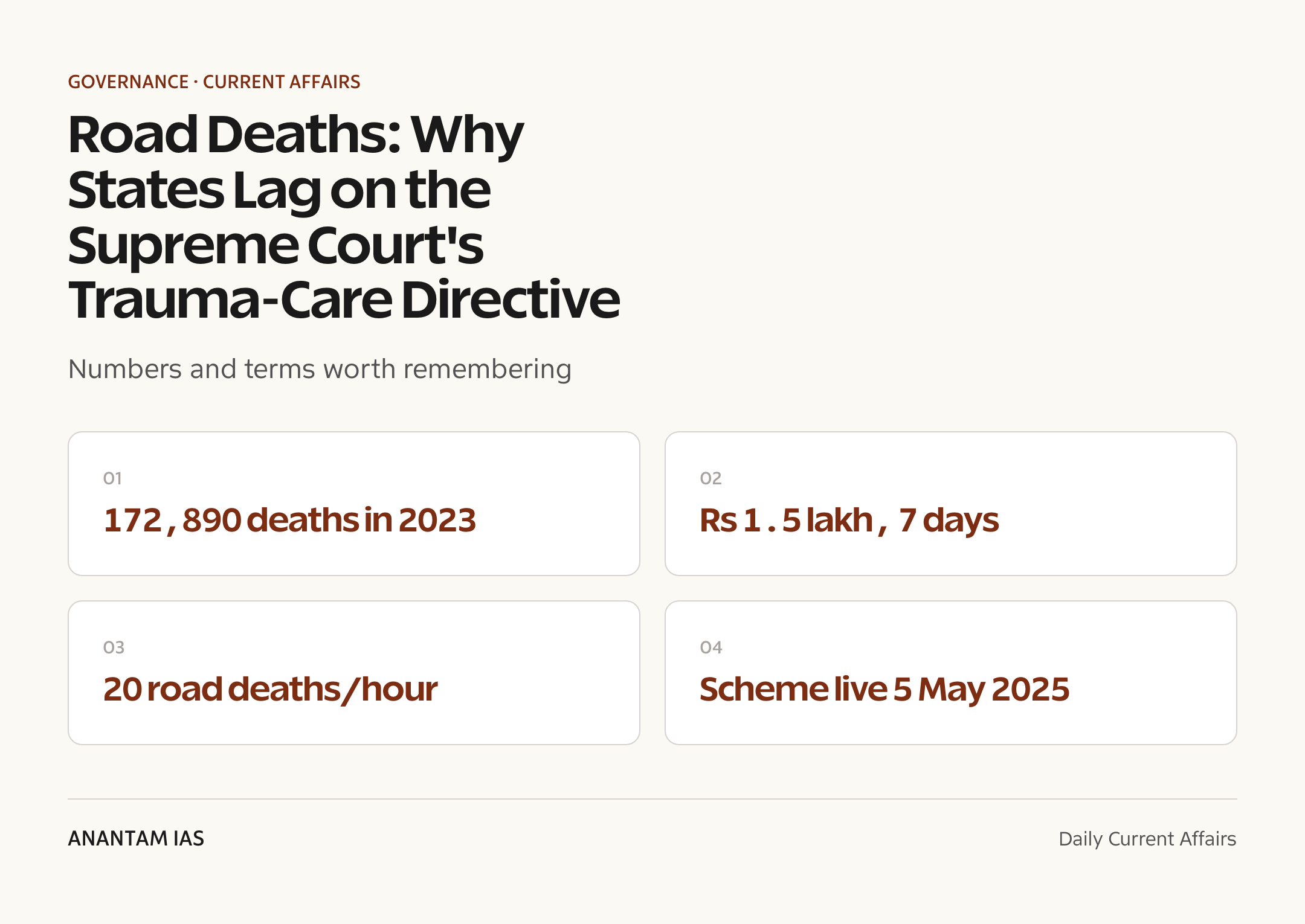
UPSC Relevance
Prelims Relevance
- Golden hour: defined in Section 2(12-A) of the Motor Vehicles Act as the first hour after a traumatic injury when prompt care is most likely to prevent death.
- Section 162, MV Act, mandates a scheme for cashless treatment of road-accident victims during the golden hour.
- Section 164-B establishes the Motor Vehicle Accident Fund that finances the scheme.
- Cashless Treatment of Road Accident Victims Scheme, 2025: effective 5 May 2025; up to Rs 1.5 lakh for seven days at designated hospitals.
- National Health Authority (NHA) is the implementing agency; the State Road Safety Council is the state nodal agency.
- Payment to hospitals is released from the Motor Vehicle Accident Fund within 10 days of approval.
- MoRTH Road Accidents in India 2023 report: 480,583 accidents, 172,890 deaths, 462,825 injured.
- Two-wheelers accounted for 44.8% of road-accident deaths in 2023; pedestrians 20.4%.
- Article 21 (right to life) is the constitutional anchor the Court used to make golden-hour care enforceable.
Mains Relevance
GS Paper 2
- Cooperative versus competitive federalism: a central scheme whose delivery depends on state health systems, nodal councils and hospital networks.
- Judicial enforcement of socio-economic rights: how the Court converted dormant MV Act provisions into an Article 21 obligation backed by contempt powers.
Essay
- Justice delayed is life lost: the state’s duty to protect the right to life on the road.
- Laws on paper, lives on the ground: the gap between policy design and last-mile delivery.
Background and Context
The Supreme Court directive and a decade of road-safety litigation
The trauma-care order grew out of long-running public-interest litigation.
- The case S. Rajaseekaran v. Union of India has run in the Supreme Court for over a decade as a continuing road-safety mandamus.
- On 8 January 2025, a bench of Justice Abhay S. Oka and Justice Augustine George Masih directed the Centre to frame the cashless scheme by 14 March 2025.
- The Court held that golden-hour trauma care is not a matter of policy discretion but a facet of the right to life under Article 21.
- It warned that any administrative, financial or procedural delay would be treated as a constitutional violation, enforceable through contempt.
- The litigation has been monitored alongside a court-appointed road-safety committee, earlier chaired by Justice K.S. Radhakrishnan and later Justice Abhay Manohar Sapre.

The golden hour and what a trauma-care system means
The clinical idea behind the law is simple, the delivery is hard.
- The golden hour is the first hour after a serious injury, when timely intervention has the highest chance of preventing death; it is defined in Section 2(12-A) of the MV Act.
- A trauma-care system links the chain: rapid emergency response, a standard ambulance, a stabilising hospital and an upgraded trauma centre.
- Trauma care means structured treatment of severe injuries: airway, bleeding control, fracture stabilisation and surgery, delivered fast.
- Many road deaths in India follow not from the crash alone but from delay in reaching a hospital that can treat the injury.
- Without ambulances, trained staff and equipped trauma bays, a cashless payment promise cannot save the patient in time.
The cashless scheme and the Motor Vehicles Act 2019
The 2019 amendment created the statutory tools the Court later activated.
- The Motor Vehicles (Amendment) Act, 2019 inserted Section 162, requiring a scheme for cashless golden-hour treatment.
- It also added Section 164-B, creating the Motor Vehicle Accident Fund to finance such care for every road user in India.
- The Cashless Treatment of Road Accident Victims Scheme, 2025 came into force on 5 May 2025.
- It offers up to Rs 1.5 lakh per victim for the first seven days at designated hospitals, with no upfront payment by the patient.
- The National Health Authority runs the portal; the State Road Safety Council onboards hospitals and coordinates payment within 10 days of approval.
Why states lag: funds, capacity and federal friction
Indian Express points to delivery gaps, not the scheme design, as the choke point.
- Health is a State subject, so onboarding hospitals, vetting bills and building trauma bays falls on state machinery.
- Many districts lack equipped trauma centres and round-the-clock specialists, so designated hospitals are thin outside big cities.
- Nodal capacity is weak: the State Road Safety Council in several states has limited staff to run portals, audits and claims.
- Cash-flow worries make private hospitals cautious about onboarding when reimbursement timelines feel uncertain.
- A central scheme layered on a state delivery system creates classic federal friction, where neither tier fully owns the last mile.
India's road-death burden
The scale of preventable loss is what makes the directive urgent.
- The MoRTH Road Accidents in India 2023 report logged 480,583 accidents and 172,890 deaths, the highest ever.
- That works out to roughly 20 deaths every hour on Indian roads.
- More than two-thirds of victims were in the 18-45 working-age group, deepening the economic loss to families.
- Two-wheeler riders made up 44.8% of deaths and pedestrians 20.4%, the most exposed road users.
- Deaths rose 2.6% over 2022, showing the curve is not yet bending despite tougher penalties.
Significance: how the golden hour saves lives
A working trauma system converts a legal right into survival.
- Cashless care removes the deadly pause when families hunt for money or a hospital refuses an accident case.
- It pairs with Good Samaritan protections, which shield bystanders who rush victims to hospital from harassment.
- Faster, guaranteed treatment can cut the share of deaths that come from delay rather than the injury itself.
- A national trauma registry, also sought by the Court, would let planners target ambulances and centres where crashes cluster.
- Done well, the system turns Article 21 from a courtroom phrase into a measurable drop in preventable road deaths.
Way Forward
Build last-mile trauma capacity
- Upgrade district hospitals into designated trauma centres with 24×7 specialists, equipped bays and a stocked blood supply.
- Standardise ambulances and dispatch on national highways so victims reach care within the golden hour.
Strengthen state nodal machinery
- Staff and fund the State Road Safety Council to onboard hospitals, run the NHA portal and clear claims promptly.
- Guarantee reimbursement timelines so private hospitals onboard without fear of stuck payments.
Use data and accountability
- Complete the national trauma registry and publish state-wise scheme uptake so laggards face scrutiny.
- Run public awareness on the cashless right and Good Samaritan protections so people act fast at a crash.
Anchor in cooperative federalism
- Tie central funds to verified state readiness on trauma centres and portal onboarding.
- Share best practices from states that have onboarded hospitals quickly as a template for others.
Conclusion
The Supreme Court has done the harder constitutional work, turning a dormant clause of the Motor Vehicles Act into an enforceable right to golden-hour care. The Centre has followed with a notified scheme and a funding channel. What remains is the least glamorous and most decisive part: trauma bays that are open, ambulances that arrive, hospitals that say yes, and portals that pay on time.
Indian Express frames the state lag as a delivery problem, not a design flaw, and that framing matters for the exam. With 172,890 lives lost in 2023, the test of this reform is not the elegance of the judgment but whether a two-wheeler rider injured on a district road reaches treatment inside the hour. Closing that gap is a federal task, and the clock is literal.
UPSC Practice Questions
Prelims MCQ 1
With reference to the golden hour and trauma care under the Motor Vehicles Act, consider the following statements:
- The golden hour is defined in the Motor Vehicles Act as the first hour after a traumatic injury when prompt care is most likely to prevent death.
- Section 162 of the Act provides for a cashless treatment scheme for road-accident victims.
- The Motor Vehicle Accident Fund under the Act is meant only for victims who hold valid third-party insurance.
How many of the above statements are correct?
(a) Only one (b) Only two (c) All three (d) None
Answer: (b) Only two
Explanation:
Statements 1 and 2 are correct: the golden hour is defined in Section 2(12-A) and Section 162 mandates the cashless scheme. Statement 3 is wrong; the Motor Vehicle Accident Fund (Section 164-B) covers road-accident victims generally, not only the insured.
Prelims MCQ 2
The Cashless Treatment of Road Accident Victims Scheme, 2025 is implemented at the national level by which of the following?
(a) Insurance Regulatory and Development Authority of India (b) National Health Authority (c) Ministry of Health and Family Welfare directly (d) National Highways Authority of India
Answer: (b) National Health Authority
Explanation:
The National Health Authority is the implementing agency for the scheme, coordinating with police, hospitals and State Road Safety Councils, which act as state nodal agencies.
UPSC Mains Questions
- The Supreme Court has read golden-hour trauma care as part of the right to life. Examine why a centrally notified cashless scheme still struggles at the state level, and suggest reforms. (GS Paper 2, 250 words)
- Road-accident deaths in India remain among the highest in the world. Discuss the role of a trauma-care system and the Motor Vehicles Act framework in reducing preventable fatalities. (GS Paper 2, 250 words)
Source: Indian Express.
Frequently Asked Questions
What is the golden hour in road-safety law?
It is the first hour after a serious injury, when prompt medical care has the highest chance of preventing death. The Motor Vehicles Act defines it in Section 2(12-A), making it a statutory, not just clinical, term.
What did the Supreme Court direct in January 2025?
On 8 January 2025 in S. Rajaseekaran v. Union of India, the Court directed the Centre to frame a nationwide cashless treatment scheme for road-accident victims by 14 March 2025, tying Sections 162 and 164-B of the MV Act to the right to life under Article 21.
How much does the cashless scheme cover?
The Cashless Treatment of Road Accident Victims Scheme, 2025 covers up to Rs 1.5 lakh per victim for the first seven days at designated hospitals, paid from the Motor Vehicle Accident Fund.
Why are states lagging on implementation?
Health delivery is a State subject, so onboarding hospitals, building trauma centres and clearing bills falls on state machinery. Thin trauma infrastructure, weak nodal capacity in State Road Safety Councils and payment-timeline worries slow uptake.
How many people die on Indian roads each year?
The MoRTH Road Accidents in India 2023 report recorded 172,890 deaths from 480,583 accidents, the highest ever, roughly 20 deaths an hour, with most victims aged 18 to 45.
What is a Good Samaritan in this context?
A Good Samaritan is a bystander who helps an accident victim, for example by rushing them to hospital. Guidelines and the MV Act protect such helpers from legal or procedural harassment, encouraging fast action within the golden hour.
Source: https://anantamias.com/current-affairs/supreme-court-trauma-care-system-road-deaths/