Daily Digest
UPSC · Civil Services Examination
Current Affairs · Wednesday, 27 May 2026
Current affairs curated and edited by Anantam IAS faculty — pulled from The Hindu, PIB, IDSA, Foreign Affairs and the ministries. Read, annotate, revise.
Old Rajinder Nagar · Delhi 110005 · anantamias.com
QUAD launches Indo-Pacific Maritime Surveillance Cooperation Plan
Why in News?
The Foreign Ministers of the QUAD countries, India, the United States, Japan and Australia, meeting in New Delhi, announced the launch of the Indo-Pacific Maritime Surveillance Cooperation Initiative.
The initiative was unveiled amid growing concerns over disruptions to global shipping routes, particularly following tensions around the Strait of Hormuz.
| UPSC Relevance: GS-2 International Relations: Intergovernmental groupings,; GS-3 Internal Security: Maritime Security Prelims & Mains: QUAD, Indo-Pacific, Maritime Domain Awareness (MDA) |
What is the QUAD?
- The Quadrilateral Security Dialogue (QUAD) is a strategic partnership comprising India, the United States, Japan, and Australia.
- It seeks to promote a Free, Open, Inclusive, and Rules-Based Indo-Pacific through cooperation in maritime security, critical technologies, supply chains, infrastructure, disaster relief, and regional connectivity.
What is the Indo-Pacific Maritime Surveillance Cooperation Initiative?
The initiative aims to integrate the maritime surveillance capabilities of the four QUAD countries into a coordinated regional monitoring network.
Key Features:
- Creation of a Common Operating Picture (COP): Enables sharing of near-real-time maritime information. Provides a common understanding of activities occurring across Indo-Pacific waters. Helps identify suspicious vessels and monitor strategic sea lanes.
- Enhanced Maritime Domain Awareness (MDA): Improves awareness of activities occurring at sea. Supports monitoring of shipping movements, fishing fleets, and maritime threats. Builds upon earlier QUAD initiatives such as the Indo-Pacific Partnership for Maritime Domain Awareness (IPMDA).
- Real-Time Information Sharing: Integrates surveillance assets, satellites, radar networks, and maritime tracking systems. Facilitates rapid responses to emerging threats.
- Regional Capacity Building: Assists Indo-Pacific partner countries in strengthening maritime governance. Supports law enforcement and maritime security agencies.
Why was the Initiative launched now?
Recent tensions surrounding the Strait of Hormuz highlighted the vulnerability of global trade and energy supply routes.
- Importance of the Strait of Hormuz:
- Connects the Persian Gulf with the Arabian Sea.
- Handles roughly one-fifth of the global oil trade.
- Vital for India’s energy security, given its dependence on imported crude oil.
- Any disruption could:
- Raise global oil prices.
- Increase inflation.
- Affect shipping and insurance costs.
- Threatens energy security across Asia.
- Major Objectives of the Initiative
- Securing Sea Lanes of Communication (SLOCs)
The Indo-Pacific hosts some of the world’s busiest maritime trade routes through which nearly 60% of global maritime trade flows.
What is Maritime Domain Awareness (MDA)?
- Maritime Domain Awareness refers to the effective understanding of all activities occurring in the maritime environment that could affect security, safety, economy, or the marine ecosystem.
- Components of MDA:
- Satellite surveillance
- Coastal radar chains
- Automatic Identification Systems (AIS)
- Unmanned Aerial Systems
- Naval and Coast Guard monitoring
- Intelligence-sharing platforms
India’s Information Fusion Centre-Indian Ocean Region (IFC-IOR) in Gurugram already serves as a major regional hub for maritime information sharing.
Other Major QUAD Announcements:
- Ports of the Future Partnership: For the first time, QUAD countries will jointly fund and develop port infrastructure in Fiji. Significance: Enhances Pacific connectivity, Strengthens resilient infrastructure & Expands QUAD’s developmental footprint in the Pacific.
- Indo-Pacific Energy Security Initiative: The QUAD launched a new framework aimed at building energy supply chain resilience and reducing dependence on vulnerable maritime chokepoints for Indo-Pacific energy flows. Focused on: Strategic fuel reserves, Emergency response mechanisms, Energy supply chain resilience, Protection of maritime energy routes.
- QUAD Fuel Security Forum: The United States will host a dedicated forum aimed at strengthening regional energy resilience and cooperation.
- Expansion of Maritime Cooperation: India will host the next QUAD at Sea mission involving the four countries’ Coast Guards to improve interoperability and maritime coordination.
Significance for India:
- Strengthening SAGAR Vision: The initiative aligns with India’s vision of Security and Growth for All in the Region (SAGAR) by promoting a secure maritime neighbourhood.
- Enhancing Indian Ocean Security: Improves surveillance across the Indian Ocean Region (IOR). Supports monitoring of critical chokepoints such as the Strait of Hormuz, Bab-el-Mandeb, Malacca Strait.
- Supporting Blue Economy Goals: Secure seas are essential for Fisheries, Offshore energy, Maritime trade, Coastal livelihoods, Capacity Building & Leadership. India can leverage IFC-IOR, Coastal radar networks, and naval diplomacy to emerge as a leading maritime security provider in the region.
- Countering Non-Traditional Security Threats: The initiative strengthens regional resilience against Piracy, Illegal fishing, Maritime disasters, and environmental crimes.
The Indo-Pacific Maritime Surveillance Cooperation Initiative marks an important evolution of the QUAD from a consultative platform into a mechanism for practical security cooperation.
For India, it complements its SAGAR doctrine, strengthens its role as a net security provider in the Indian Ocean, advances long-term maritime and economic interests and reinforces the vision of a free, open, secure, and prosperous Indo-Pacific.
Govt constitutes High-Level Committee on Demographic Change
Why in News?
The Union Government has constituted a High-Level Committee on Demographic Changes (HLCDC) under the Ministry of Home Affairs (MHA). It seeks to undertake a scientific assessment of demographic shifts occurring across India, particularly those linked to illegal immigration, abnormal settlement patterns, and other non-natural factors.
The committee has been tasked with recommending policy, administrative, and legal measures to address the issue within a year.
| UPSC Relevance: GS-2 Governance; GS-3 Internal Security: Border Management, Migration, and Demographic Challenges. Mains: Threats to Internal Security and Border Management |
About the High-Level Committee on Demographic Changes:
- The HLCDC is a government-appointed expert body mandated to examine demographic changes across India’s regions and assess their causes, impacts, and policy implications.
- It has been constituted under the Ministry of Home Affairs and will submit its report within one year.
- The multi-member committee is headed by a retired Supreme Court Judge. The committee may consult experts, security agencies, local governments, academic institutions and social organisations during the course of its study.
Why has the Committee been constituted?
- According to the MHA, demographic changes in certain regions cannot be fully explained by normal fertility and mortality trends. The government has pointed to factors such as:
- Illegal immigration
- Irregular population mobility
- Abnormal settlement patterns
- Administrative gaps in monitoring migration
- These changes are increasingly affecting not only border districts but also urban centres, industrial corridors, tribal regions, and other socio-economically sensitive areas.
The committee has been assigned an eight-point mandate:
- To undertake an extensive examination of challenges arising from demographic changes, including those linked to illegal immigration.
- To study possible causes behind such demographic shifts, including fertility variations, cross-border movement, economic opportunities and socio-environmental factors.
- To identify factors contributing to demographic imbalance, including illegal immigration, abnormal settlement trends and planned migration patterns.
- To analyse structural population changes among religious and social communities, especially where uniform trends are diverging.
- To recommend a permanent and legally structured mechanism for the identification, detention and deportation of illegal immigrants residing in the country.
- To suggest institutional measures for strengthening border management, population stabilisation and identification systems for long-term monitoring.
- To propose a comprehensive policy framework to improve coordination between the Centre and states on matters related to illegal immigration and demographic imbalance.
- To recommend any additional measures considered necessary to address demographic challenges arising due to illegal immigration.
What is meant by Demographic Change?
- Demographic change refers to shifts in the size, composition, and distribution of a population over time.
- Natural Drivers: Birth rates, Death rates, Age structure changes, Urbanisation
- Non-Natural Drivers: International migration, Illegal immigration, Conflict-induced displacement, and administrative or governance failures.
India shares long and porous land borders with several countries, including Bangladesh, Myanmar, Nepal, and Pakistan. The committee will focus particularly on demographic changes arising from the latter category.
Why does Demographic Change matter?
- Governance and Public Services: Sudden population growth can strain schools, hospitals, housing, water supply, and welfare schemes.
- Internal Security: Unregulated migration may create challenges related to border security, Identity verification, Law and order.
- Resource Distribution: Population changes influence Electoral constituencies, Fiscal transfers, and Local governance structures.
- Tribal and Indigenous Communities: Rapid demographic shifts can alter cultural identity, land ownership patterns and political representation.
The government has specifically highlighted concerns regarding the preservation of tribal groups and social cohesion.
Existing Legal Framework:
- Foreigners Act, 1946: Empowers the government to regulate the entry, stay, and deportation of foreigners.
- Passport (Entry into India) Act, 1920: Regulates the entry of foreign nationals.
- Citizenship Act, 1955: Defines acquisition and termination of Indian citizenship.
- Border Management Initiatives: Smart fencing projects, Integrated Check Posts (ICPs) & Comprehensive Integrated Border Management System (CIBMS).
Source: https://anantamias.com/current-affairs/govt-constitutes-high-level-committee-on-demographic-change/
Rising Deaths due to Non-Communicable Diseases
Why in News?
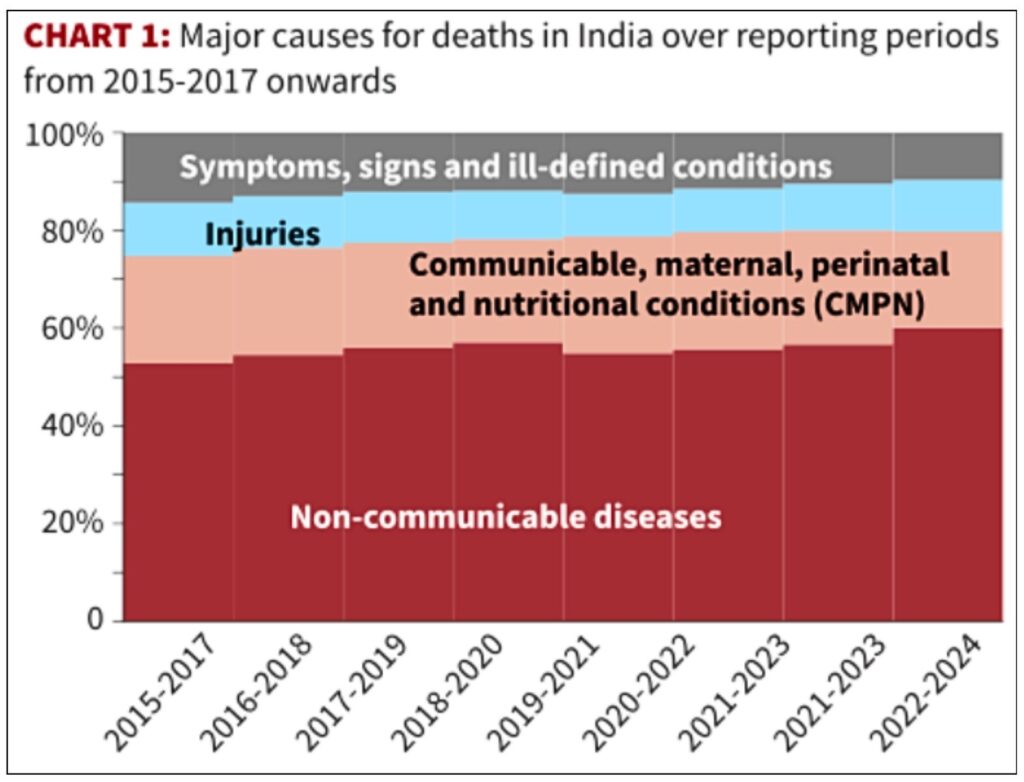
According to the Sample Registration System (SRS) Statistical Report 2024, Non-Communicable Diseases (NCDs) accounted for 60% of all deaths in India in 2022-2024.
| UPSC Relevance: GS-2 Social Justice: Heath; GS-3 Science and Technology: Biology and BioTechnology Mains: Rising burden of Non-Communicable Diseases: Factors, Impacts, Policies |
Major Highlights:
- Among the NCDs, cardiovascular diseases alone accounted for 32% of all deaths in 2022-2024. Heart-related illnesses are increasingly affecting adults in their 30s and 40s, which is a matter of concern as this age group forms a large part of the nation’s workforce.
- After cardiovascular diseases, the top causes of death in the period included cancer, respiratory diseases, digestive diseases and respiratory infections.
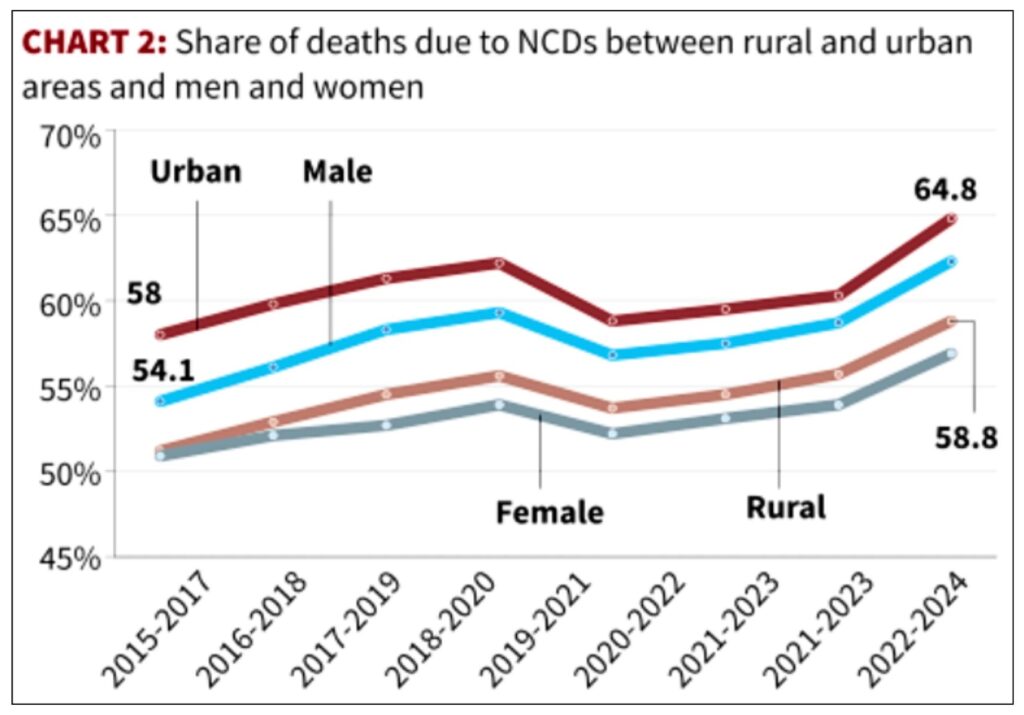
- Deaths due to NCDs are higher in urban areas than in rural areas. Men accounted for more deaths by NCDs than women.
What are Non-Communicable Diseases (NCDs)?
- Non-Communicable Diseases (NCDs) are chronic diseases that are not transmitted from person to person and generally develop over a long period.
- They result from a combination of genetic, physiological, environmental, and behavioural factors.
Major Types of NCDs:
- Cardiovascular Diseases (CVDs): Heart attacks, Strokes, and Hypertension.
- Cancers: various forms of malignant growths.
- Chronic Respiratory Diseases: Chronic Obstructive Pulmonary Disease (COPD), Asthma.
- Diabetes Mellitus
- Mental and Neurological Disorders: Depression, anxiety disorders, dementia, etc.
According to the World Health Organisation, NCDs account for approximately 74% of all deaths globally (around 41 million deaths annually). Cardiovascular diseases are the leading cause of NCD-related deaths worldwide.
Major Risk Factors for NCDs:
- Behavioural Risk Factors:
- Tobacco consumption
- Harmful use of alcohol
- Physical inactivity
- Unhealthy diets rich in sugar, salt, and trans-fats
- Metabolic Risk Factors
- Obesity and overweight
- Raised blood pressure
- High blood glucose levels
- Elevated cholesterol levels
- Environmental Risk Factors
- Air pollution
- Occupational hazards
- Exposure to harmful chemicals
- Climate change-related health impacts
- Social Determinants
- Poverty and inequality
- Limited access to healthcare
- Lack of health awareness
Socio-Economic Impact of NCDs:
- Health Consequences:
- Premature mortality
- Long-term disability
- Reduced quality of life
- Economic Costs:
- Increased healthcare expenditure
- Loss of workforce productivity
- Higher household out-of-pocket spending
- Increased burden on public health infrastructure
- Developmental Consequences: NCDs threaten India’s demographic dividend by affecting the productive-age population and slowing economic growth.
Government Initiatives for Prevention and Control of NCDs:
- National Programme for Prevention and Control of Non-Communicable Diseases (NP-NCD): It has been expanded to cover Hypertension, Diabetes, Cardiovascular diseases, Cancer, Stroke, and Chronic Kidney Disease (CKD), COPD and Asthma & Non-Alcoholic Fatty Liver Disease (NAFLD).
- Ayushman Bharat Pradhan Mantri Jan Arogya Yojana (PM-JAY): Provides financial protection for secondary and tertiary care, including treatment for many NCDs such as cancer and cardiac diseases.
- National Multisectoral Action Plan for NCDs (2017-2025): India adopted national targets aligned with WHO’s global NCD framework, including reducing premature mortality from NCDs through preventive and curative measures.
- Fit India Movement: Promotes Physical activity, Sports participation, Healthy lifestyles & Fitness awareness.
- National Mental Health Programme (NMHP): Strengthens Mental health services, Counselling facilities and Community mental healthcare. National Tele-Mental Health Programme (Tele-MANAS) provides 24×7 tele-counselling support, Accessible mental healthcare services across India.
- National Tobacco Control Programme (NTCP): Focuses on Tobacco cessation, Awareness campaigns, and enforcement of tobacco control laws.
As India undergoes rapid urbanisation, demographic ageing, and lifestyle transitions, the burden of NCDs is expected to rise further.
A comprehensive strategy centred on prevention, early detection, lifestyle modification, environmental improvement, and universal healthcare access is essential to achieve the SDG of reducing premature mortality from NCDs by one-third by 2030.
Source: https://anantamias.com/current-affairs/rising-deaths-due-to-non-communicable-diseases/
The judiciary’s role in complete justice
Why in News?
The Supreme Court recently held that safe travel on National Highways forms an integral component of the Right to Life under Article 21 of the Constitution in the case of In Re: Phalodi Accident vs. National Highways Authority of India and Others. Taking suo motu cognisance of two major road accidents in November 2025 that claimed 34 lives, the Court issued broad directions regarding road safety and maintenance. The judgment reflects the increasing use of Article 142 of the Constitution to secure “complete justice”, extending constitutional protections into emerging governance concerns.
UPSC Relevance
Prelims: Article 142, Article 21, judicial review, natural justice, Supreme Court powers.
Mains:
GS II: Judiciary, separation of powers, constitutional provisions, judicial activism, role of Supreme Court;
GS IV: Ethics and justice principles.
Background/Context
Road accidents continue to represent a major public safety concern in India.
- National Highways constitute only around 2% of India’s road network but account for nearly 30% of road fatalities.
- Approximately 26,770 deaths occurred on National Highways during the first six months of 2025.
- India aims to reduce road accidents by 50% by 2030 through the “4E Strategy”:
- Education
- Engineering (roads and vehicles)
- Enforcement
- Emergency Medical Services
The Supreme Court’s intervention reflects a broader constitutional approach where issues traditionally treated as policy matters increasingly acquire rights-based dimensions under Article 21.
What is the Constitutional Basis of Complete Justice?
Article 142 of the Constitution
Article 142(1) empowers the Supreme Court to pass such decrees or orders as may be necessary for “doing complete justice” in any matter pending before it.
Article 142 acts as a constitutional mechanism allowing the Court to bridge gaps where ordinary laws may be insufficient for effective grievance redressal.
Its essential purpose includes:
- Preventing injustice arising from procedural limitations.
- Addressing extraordinary situations where statutes may remain silent.
- Ensuring substantive rather than merely procedural justice.
The provision acts as a constitutional safety valve for exceptional situations.
Inherent Powers of the Supreme Court
The Supreme Court, as the guardian of the Constitution, possesses certain inherent powers beyond ordinary statutory powers.
Characteristics of inherent powers
- They are constitutional rather than statutory powers.
- They are exercised only in exceptional circumstances.
- They seek to avoid miscarriage of justice.
- They prioritize fairness and natural justice principles.
The Supreme Court observed in Delhi Judicial Service Association vs State of Gujarat that the power under Article 142 is of a different level and quality, and ordinary statutory restrictions cannot limit constitutional powers.
Understanding the Concept of Complete Justice
A question frequently raised is: If justice itself is expected to be complete, why was the phrase “complete justice” specifically included in the Constitution?
The answer lies in distinguishing procedural justice from substantive justice.
Procedural Justice
Procedural justice focuses on:
- Compliance with legal procedures
- Following statutory requirements
- Adherence to established legal rules
Substantive Justice
Substantive justice focuses on:
- Fairness in outcomes
- Removal of actual injustice
- Protection of constitutional values
The Constitution prioritizes substantive justice where rigid adherence to procedure may fail to produce fair outcomes.
The Supreme Court in Canara Bank vs Debasis Das emphasized that constitutional justice seeks removal of injustice either through legal justice or natural justice principles.
Natural Justice and Complete Justice
Natural justice forms a foundational component of the Indian constitutional framework.
The two primary principles include:
1). Rule against bias (Nemo Judex in Causa Sua)
No person should be a judge in his own cause.
2). Right to fair hearing (Audi Alteram Partem)
Every person should receive an adequate opportunity to present their case.
Natural justice becomes particularly significant when strict legal procedures become inadequate in addressing evolving realities.
Complete Justice and High Courts
The Supreme Court possesses unique powers under Article 142. However, High Courts also possess broad constitutional powers under Article 226.
The Supreme Court in Anil Kumar Jain vs Maya Jain clarified that powers under Article 226 are not equivalent to Article 142.
Distinction between Supreme Court and High Courts
| Supreme Court | High Courts |
|---|---|
| Article 142 | Article 226 |
| Explicit power for complete justice | Broad writ jurisdiction |
| Extraordinary and residuary powers | More circumscribed powers |
| Can transcend procedural limitations in exceptional situations | Limited by constitutional and statutory boundaries |
Thus, while High Courts may pursue complete justice in spirit, they do not enjoy the same expansive constitutional authority.
Judicial Activism and Article 142
The use of Article 142 frequently intersects with judicial activism.
Judicial activism refers to proactive judicial interpretation to protect constitutional values and address social realities.
Examples where judicial intervention expanded constitutional understanding include:
- Environmental protection
- Prison reforms
- Sexual harassment guidelines
- Rights of marginalized communities
- Recognition of privacy rights
Such interventions often emerge where legislative responses remain absent or delayed.
Challenges and Criticisms
Concerns regarding judicial overreach
Critics argue that extensive use of Article 142 may:
- Disturb the separation of powers.
- Allow courts to enter policy-making domains.
- Reduce democratic accountability.
- Create uncertainty in legal interpretation.
Lack of clearly defined limits
The Constitution does not precisely define circumstances for invoking Article 142, creating concerns regarding subjective application.
Institutional competence concerns
Courts may not possess administrative expertise necessary for designing policy solutions.
Way Forward
Develop clearer jurisprudential guidelines
The Supreme Court may evolve consistent principles regarding circumstances under which Article 142 can be exercised.
Strengthen institutional coordination
Greater coordination among the judiciary, executive and legislature can reduce excessive reliance on judicial intervention.
Prioritize constitutional morality
Exercise of extraordinary powers should remain rooted in constitutional values such as liberty, equality, dignity and fairness.
Improve legislative responsiveness
Timely legislative reforms in emerging areas can reduce the need for extraordinary judicial intervention.
Conclusion
Article 142 represents one of the most distinctive constitutional features of the Indian judicial system. It enables the Supreme Court to ensure that justice remains substantive rather than merely procedural. While concerns regarding judicial overreach remain important in a constitutional democracy, the power of complete justice acts as an important constitutional instrument for addressing new challenges and preserving the spirit of the Constitution. The true balance lies not in restricting constitutional powers, but in exercising them with restraint, prudence and fidelity to constitutional values.
Practice Questions
Prelims Question 1
With reference to Article 142 of the Constitution of India, consider the following statements:
- It empowers the Supreme Court to issue any decree necessary for complete justice.
- High Courts possess identical powers under Article 226.
- Powers under Article 142 can override ordinary statutory limitations.
Which of the statements given above is/are correct?
(a) 1 only
(b) 1 and 3 only
(c) 2 and 3 only
(d) 1, 2 and 3
Answer: (b)
Explanation: Statement 2 is incorrect because High Courts do not possess powers equivalent to Article 142. Statements 1 and 3 are correct.
Prelims Question 2
Consider the following pairs:
| Case | Subject |
|---|---|
| 1. Delhi Judicial Service Association case | Scope of Article 142 |
| 2. Canara Bank vs Debasis Das | Principles of natural justice |
| 3. Anil Kumar Jain vs Maya Jain | Equality before law |
Which of the pairs given above are correctly matched?
(a) 1 and 2 only
(b) 2 and 3 only
(c) 1 and 3 only
(d) 1, 2 and 3
Answer: (a)
Explanation: Pair 3 is incorrect because the case primarily dealt with comparative powers of High Courts and the Supreme Court regarding complete justice.
Mains Questions
- “Article 142 acts as a constitutional safety valve enabling the Supreme Court to bridge legal gaps.” Examine the significance and limitations of this provision.
- Judicial activism and judicial overreach often lie on a thin constitutional boundary. Discuss with reference to Article 142 and the concept of complete justice.
Source: https://anantamias.com/current-affairs/the-judiciarys-role-in-complete-justice/
Rajya Sabha defections, constitutional questions
Why in News?
Recent developments involving MPs of the Aam Admi Party (AAP) in the Rajya Sabha have triggered a constitutional debate regarding the interpretation of the anti-defection law under the Tenth Schedule of the Constitution. Seven out of ten Rajya Sabha MPs reportedly claimed that more than two-thirds of the legislature party had decided to merge with the BJP, invoking the merger exception under Paragraph 4 of the Tenth Schedule. The issue raises broader questions regarding the relationship between political parties and legislature parties, and the constitutional limits of defections.
UPSC Relevance
Prelims: Tenth Schedule, 52nd Constitutional Amendment Act, 91st Constitutional Amendment Act, Articles 102–103, anti-defection provisions, role of Speaker/Chairman.
Mains:
GS II – Parliament and State Legislatures, constitutional provisions, anti-defection law, judicial review, parliamentary democracy, role of opposition.
Background/Context
Political defections have long posed a challenge to India’s parliamentary democracy. Frequent switching of party allegiance during the 1960s and 1970s, popularly associated with the phrase “Aya Ram, Gaya Ram”, raised concerns regarding political instability and unethical political practices.
The anti-defection framework was introduced to:
- Promote political stability.
- Prevent elected representatives from changing political loyalties for personal gains.
- Preserve the mandate given by voters.
- Strengthen party discipline.
The current controversy focuses on whether a legislature party can independently claim a merger without the original political party itself formally merging.
Evolution of the Anti-Defection Framework
Original Constitutional Position
Initially, the Constitution dealt with disqualification under Articles 102 and 103.
Article 102 provides grounds for disqualification of MPs, while Article 103 authorises the President to decide such disputes after obtaining the opinion of the Election Commission.
However, the Constitution originally did not specifically address defections.
Introduction of the Tenth Schedule
The anti-defection law was introduced through the 52nd Constitutional Amendment Act.
Major features included:
- Disqualification of legislators who voluntarily give up party membership.
- Disqualification for violating party whip directions.
- Authority vested in Speaker or Chairman to decide disqualification matters.
- Creation of exceptions through split and merger provisions.
What is Split Doctrine and Its Removal?
Initially, Paragraph 3 of the Tenth Schedule recognised the “split doctrine.”
Earlier split provision
- One-third members of a legislature party could form a separate faction.
- Such members were protected from disqualification.
However, this provision led to widespread misuse.
Consequently, the 91st Constitutional Amendment Act deleted Paragraph 3.
Recommendations supporting its removal included:
- Dinesh Goswami Committee
- 170th Law Commission Report
Significance of deleting the split provision
The deletion reflected a shift in constitutional philosophy:
- Greater importance to political parties over temporary legislative factions.
- Reduction of opportunistic defections.
- Reinforcement of collective democratic accountability.
Understanding the Merger Exception
The present issue concerns Paragraph 4 of the Tenth Schedule.
Under Paragraph 4, legislators may avoid disqualification if:
- The original political party merges with another political party.
- At least two-thirds of legislators agree to such merger.
Constitutional issue in the present controversy
The central question is:
Can two-thirds of members of a legislature party independently decide a merger, or must the original political party first merge?
A plain reading of Paragraph 4 suggests emphasis on the “original political party” rather than merely the legislature party.
If only legislative strength becomes decisive:
- Legislature parties could effectively control the fate of political parties.
- Internal dissent could override organisational identity.
- The deletion of the split doctrine could become meaningless.
Legislature Party vs Political Party
This distinction is crucial for understanding the constitutional issue.
| Political Party | Legislature Party |
|---|---|
| Registered organisation outside legislature | Members elected under party banner within legislature |
| Determines ideology and political identity | Functions inside legislative institutions |
| Continuous organisational existence | Exists only during legislative tenure |
The Tenth Schedule generally prioritises the political party as the principal democratic unit.
Supreme Court Judgments Relevant to Anti-Defection
Kihoto Hollohan vs Zachillhu
Key observations:
- Upheld constitutional validity of the Tenth Schedule.
- Allowed judicial review of Speaker’s decisions.
Subhash Desai vs Principal Secretary, Governor of Maharashtra
Key observations:
- Rejected interpretations that separate legislature parties entirely from political parties.
- Emphasised continuing control of the parent political party.
Nabam Rebia vs Deputy Speaker
Key observations:
- Discussed limitations on Speaker’s powers during pending removal proceedings.
Significance of Opposition in Parliamentary Democracy
The anti-defection law serves purposes beyond regulating individual conduct.
Functions of an effective opposition
- Ensures executive accountability.
- Provides alternative policy perspectives.
- Protects democratic deliberation.
- Prevents concentration of power.
Weakening opposition representation through defections may affect the broader functioning of parliamentary democracy.
Challenges and Criticisms of Anti-Defection Law
Restricts legislative independence: The law sometimes reduces MPs and MLAs to agents of party leadership, limiting deliberative democracy.
Delays in decisions by Presiding Officers: Speakers and Chairpersons often delay disqualification proceedings, creating uncertainty.
Scope for strategic interpretation: Terms such as “voluntarily giving up membership” and “merger” remain open to competing interpretations.
Possibility of partisan conduct: The Speaker or Chairman may be perceived as politically influenced.
Way Forward
Establish time-bound decision-making
Disqualification petitions should be decided within a constitutionally prescribed period.
Independent adjudicatory mechanism
Recommendations have been made by various commissions to shift decision-making from Speakers to independent tribunals or the Election Commission.
Clarify merger provisions
The Supreme Court or Parliament should provide greater clarity regarding the relationship between legislature parties and political parties.
Reconsider the scope of the whip
Party whip provisions may be restricted to confidence motions and critical legislation, allowing greater legislative freedom.
Conclusion
The present controversy extends beyond the immediate issue of Rajya Sabha defections. It concerns the constitutional architecture of parliamentary democracy itself. The anti-defection law was designed not merely to prevent political opportunism but also to preserve the integrity of the party system. Judicial clarification regarding the scope of the merger exception will significantly shape the future balance between political parties, legislators and democratic accountability.
Practice Questions
Prelims Question 1
Consider the following statements regarding the Tenth Schedule of the Constitution:
- It was inserted through the 52nd Constitutional Amendment Act.
- The split provision under Paragraph 3 was removed by the 91st Constitutional Amendment Act.
- Disqualification decisions under the Tenth Schedule are made by the Election Commission.
Which of the statements given above is/are correct?
(a) 1 and 2 only
(b) 2 and 3 only
(c) 1 and 3 only
(d) 1, 2 and 3
Answer: (a)
Explanation: Statements 1 and 2 are correct. Statement 3 is incorrect because decisions under the Tenth Schedule are taken by the Speaker or Chairman, subject to judicial review.
Prelims Question 2
With reference to the anti-defection law, consider the following:
- The merger exception requires support of at least two-thirds of members of a legislature party.
- The split doctrine currently exists in the Tenth Schedule.
- The Supreme Court has upheld judicial review of Speaker’s decisions.
Which of the above statements are correct?
(a) 1 only
(b) 1 and 3 only
(c) 2 and 3 only
(d) 1, 2 and 3
Answer: (b)
Explanation: Statement 2 is incorrect because the split provision was deleted by the 91st Constitutional Amendment Act.
Mains Questions
- Discuss the objectives and limitations of the anti-defection law in preserving parliamentary democracy in India.
- “The relationship between a political party and its legislature party lies at the heart of the constitutional debate on defections.” Examine.
Source: https://anantamias.com/current-affairs/rajya-sabha-defections-constitutional-questions/
Gir lion cub deaths linked to suspected Babesia infection, Gujarat rules out outbreak

Why in News?
Two lion cubs in the Gir landscape of Gujarat recently died due to suspected Babesia infection, a tick-borne parasitic disease affecting animals. Three other Asiatic lions died in unrelated incidents due to natural causes and territorial conflicts. Gujarat authorities clarified that these were isolated cases and not indicative of a widespread outbreak. The incident has again brought attention to wildlife disease surveillance and conservation management in the only natural habitat of Asiatic lions.
UPSC Relevance
Prelims: Gir National Park, Asiatic Lion, Babesia infection, zoonotic diseases, wildlife conservation, IUCN status, Project Lion.
Mains:
GS III – Environment and biodiversity conservation, wildlife management, protected areas, human-wildlife interface, disease surveillance in ecosystems.
Background/Context
The Gir landscape in Gujarat remains the world’s only natural habitat of the Asiatic lion population.
According to the 2025 lion census:
- Gujarat has approximately 891 Asiatic lions.
- The population has shown significant growth over the past decades due to conservation measures.
- However, concentration of the entire wild population in a single landscape creates ecological vulnerabilities.
The present incident also recalls the major 2018 mortality event in which multiple lions died due to a combination of disease infections.
About the Asiatic Lion
Asiatic Lion is a subspecies of lion found naturally only in India.
Important features
- Smaller than African lions.
- Distinct abdominal skin fold.
- Males usually possess comparatively smaller manes.
- Lives in prides but often with smaller group structures.
Conservation status
- IUCN Status: Endangered
- Wildlife Protection Act, 1972: Schedule I protection
- Included under Appendix I of Convention on International Trade in Endangered Species of Wild Fauna and Flora
About Gir Landscape
Gir National Park forms part of a larger conservation landscape including protected forests, sanctuaries and surrounding ecosystems.
Ecological significance
- Only wild natural habitat of Asiatic lions globally.
- Supports rich biodiversity including leopards, hyenas, jackals and herbivores.
- Contains dry deciduous forests and scrub ecosystems.
Rivers associated with Gir
Major rivers include: Hiran, Shetrunji, Datardi, Shingoda, Machhundri
Understanding Babesia Infection
Babesiosis is a parasitic infection caused by protozoa of the genus Babesia.
Transmission mechanism
- Spread mainly through infected ticks.
- Parasites infect red blood cells.
- May affect domestic and wild animals.
Common symptoms
- Weakness, Fever, Respiratory distress
- Anaemia
- Reduced immunity
Young cubs and weak animals are particularly vulnerable because of lower immunity levels.
Wildlife Diseases and Conservation Concerns
Disease outbreaks increasingly represent major threats to wildlife populations.
Risks associated with single-population concentration
When a species is concentrated within a single region:
- Disease outbreaks can affect large numbers simultaneously.
- Genetic diversity may reduce over time.
- Environmental disasters can threaten survival.
- Habitat pressures increase competition.
The Gir lion population represents a classic example of “single population risk.”
Earlier Lion Mortality Event: 2018
In 2018, Gir witnessed a major mortality event.
Key factors included:
- Infection from Canine Distemper
- Protozoal infections
- Spread among closely located lion populations
The episode raised concerns regarding long-term conservation planning and disease preparedness.
Conservation Initiatives for Asiatic Lions
Project Lion
The Government of India launched Project Lion to strengthen conservation of Asiatic lions.
Objectives include:
- Habitat improvement, Disease surveillance, Veterinary healthcare infrastructure, Genetic conservation, Human-lion conflict management
Wildlife Health Surveillance
Important interventions include:
- Disease monitoring systems
- Sample collection and testing
- Veterinary rapid response teams
- Tick control measures
- Population monitoring through technology
Way Forward
Develop geographically dispersed populations
Establishing additional habitats can reduce risks arising from disease outbreaks and natural disasters.
Strengthen wildlife disease surveillance
Early-warning systems integrating veterinary science and technology should be expanded.
Improve One Health approach
Human, animal and ecosystem health should be addressed through integrated frameworks.
Enhance scientific monitoring
Use of satellite tracking, AI-based monitoring and genomic studies can improve conservation outcomes.
Conclusion
The recent deaths of lion cubs in Gir may not indicate a major outbreak, but they underline a broader conservation challenge. Wildlife protection today extends beyond protecting habitats and preventing poaching; it increasingly requires scientific disease surveillance and ecosystem-based management. Ensuring the long-term survival of the Asiatic lion demands a balance between population growth, habitat security and health resilience.
Practice Questions
Prelims Question 1 (Inference-based)
Consider the following situation:
A species exists almost entirely within a single geographical region, even though its population numbers are increasing steadily over time.
Which one of the following can most reasonably be inferred?
(a) Increase in population automatically reduces extinction risks
(b) Geographic concentration may continue to create long-term conservation vulnerabilities
(c) Disease outbreaks become impossible due to greater population size
(d) Protected area status alone guarantees species security
Answer: (b)
Explanation: Population increase alone does not eliminate risks. Concentration of an entire species within one region can expose it to disease outbreaks, disasters and genetic vulnerabilities.
Prelims Question 2
Consider the following pairs:
| Wildlife/Disease | Type |
|---|---|
| 1. Babesiosis | Tick-borne parasitic disease |
| 2. Canine Distemper | Viral disease |
| 3. Gir National Park | Only natural habitat of Asiatic lions |
Which of the pairs given above are correctly matched?
(a) 1 and 2 only
(b) 2 and 3 only
(c) 1 and 3 only
(d) 1, 2 and 3
Answer: (d)
Explanation: All three pairs are correctly matched. Babesiosis is a tick-borne parasitic infection, Canine Distemper is viral in nature, and Gir remains the only natural wild habitat of Asiatic lions.
Mains Questions
- Discuss the emerging role of disease surveillance in wildlife conservation. Examine with reference to recent concerns regarding Asiatic lions.
- “Conservation success measured only through population growth may hide deeper ecological vulnerabilities.” Critically examine with suitable examples.
Environmental activists challenge validity of Wetlands rules in SC
Why in News?
The Supreme Court of India issued notice to the Union of India and the National Wetlands Committee, seeking a response on a petition challenging the constitutional validity of Rule 2(g) of the Wetlands (Conservation and Management) Rules, 2017.
| UPSC Relevance: GS-2 Governance; GS-3 Environment: Conservation Prelims: Wetlands, Ramsar Convention on Wetlands, Wetlands (Conservation and Management) Rules 2017 Mains: Wetlands- Importance, Conservation and associated Challenges. |
What are Wetlands?
- Wetlands are ecosystems where water is the primary factor controlling the environment and the associated plant and animal life.
- According to the Ramsar Convention, wetlands include: Marshes, Swamps, Peatlands, Floodplains, Mangroves, Estuaries, Lakes, Coral reefs & Human-made wetlands such as reservoirs and fish ponds.
- Ecological Functions of Wetlands: Groundwater recharge, Flood moderation, Carbon sequestration, Water purification, Biodiversity conservation, Climate change adaptation & Livelihood support for local communities
Wetlands are often referred to as the “kidneys of the Earth” because of their role in filtering pollutants and maintaining ecological balance.
Ramsar Convention on Wetlands:
- The Ramsar Convention on Wetlands was adopted in 1971, in Ramsar, Iran, and came into force in 1975.
- It is the only global intergovernmental treaty dedicated exclusively to wetland conservation and sustainable use.
- India has ratified the convention, thereby committing to the wise use of all wetlands within its territory. It implies maintaining ecological character using ecosystem-based approaches within the context of sustainable development.
India currently has 99 designated Ramsar Sites spread across 28 states and union territories, covering over 1.36 million hectares.
Wetlands (Conservation and Management) Rules, 2010:
- The Wetlands (Conservation and Management) Rules, 2010, were notified by the Ministry of Environment and Forests (MoEF) under the Environment (Protection) Act, 1986.
- The rules were India’s first comprehensive legal framework for protecting, managing, and preventing the degradation of wetlands.
- Key Highlights:
- Established the Central Wetlands Regulatory Authority (CWRA) under the Ministry of Environment and Forests, making it a highly centralised governing body.
- The rules regulated only specific wetlands identified by the Central Government or those selected based on six broad criteria.
- Activities in or around regulated wetlands, such as dredging or extracting resources, require prior clearance from the CWRA.
- CWRA was widely criticised by environmentalists and state governments for being heavily bureaucratic, slow in granting approvals, and inadequately decentralising power to local authorities.
Wetlands (Conservation and Management) Rules, 2017:
The Wetlands (Conservation and Management) Rules, 2017 are a regulatory framework under the Environment (Protection) Act, 1986.
- Decentralised Management: The rules replace the central regulatory authority with a decentralised structure, establishing a State Wetlands Authority (SWA) in each State and Union Territory. Headed by the State’s Environment Minister, the SWA includes experts in wetland ecology, hydrology, fisheries, and socio-economics.
- National Wetland Committee (NWC): Replaced the central regulatory authority and now acts in an advisory capacity to guide state bodies.
- Digital Inventory: The rules mandate digital wetland inventories and require states to draft continuous conservation and management plans.
What is the Present controversy?
- The dispute lies in Rule 2(g) of the Wetlands (Conservation and Management) Rules, 2017.
- Rule 2(g) of the Wetlands (Conservation and Management) Rules defines a ‘wetland’ as an area of marsh, fen, peatland, or water, whether natural or artificial, permanent or temporary.
- Exclusionary Criteria: The definition of what constitutes a “wetland” explicitly strips away protections from protection from several wetlands by excluding river channels, paddy fields, human-made water bodies or tanks constructed for drinking water purposes, and structures created for aquaculture, salt production, recreation and irrigation.
The plea sought a declaration that Rule 2(g) of the Wetlands (Conservation and Management) Rules, 2017 is ultra vires Articles 14, 19 and 21 of the Constitution. The narrow definition violates the principle of non-regression by removing foundational protections for these ecosystems.
Impact on Ramsar Sites: This exclusionary rule strips regulatory protections from 44 of India’s 99 Ramsar Sites (wetlands of international importance), making them vulnerable to ecological degradation.
Legal and Constitutional Dimensions:
- Article 21: The right to life includes the right to a clean and healthy environment. Unprotected wetlands expose communities to flooding, water scarcity, and pollution, allegedly violating this fundamental right.
- Articles 14 & 19: The petition also seeks a declaration that Rule 2(g) is ultra vires Articles 14 (equality) and 19 (freedom), arguing the vague definition creates arbitrary exclusions.
- Non-regression principle: Environmental law prohibits the state from rolling back existing protections. Replacing the broader 2010 definition with the narrower 2017 one allegedly violates this principle, which the Supreme Court has recognised.
- International obligations: India’s binding commitments under the Ramsar Convention require protection of listed wetlands. A domestic rule that strips protection from 44 Ramsar Sites may conflict with these treaty obligations.
- EPA 1986 basis: Both sets of rules are framed under the Environment (Protection) Act, 1986, by the Ministry of Environment, Forest and Climate Change. The subordinate legislation must not violate the parent statute’s intent.
Way Forward:
- The Supreme Court should harmonise Rule 2(g) with India’s Ramsar obligations by either restoring or improving upon the broader 2010 definition.
- State Wetland Authorities must be strengthened with technical capacity, funding, and accountability mechanisms so decentralisation delivers conservation outcomes rather than diluting them.
- A comprehensive and inclusive statutory definition of wetlands should be legislated rather than left to subordinate rules, providing greater legal certainty.
- The National Wetland Atlas should be used as the authoritative baseline for protection, with satellite-based periodic updates and mandatory ground-truthing by state governments.
- Community-based wetland management, already recommended under the Ramsar Convention’s “wise use” principle, must be integrated into the regulatory framework to balance ecological protection with livelihood security.
India should align domestic wetland law more explicitly with its Ramsar commitments, following the model of the Biodiversity Act, which incorporates international treaty obligations into domestic legislation.
India-U.S. and Quad frameworks on critical minerals take shape amid Chinese curbs
Why in News?
India and the United States recently formalised a framework for cooperation in securing critical minerals and rare earth supply chains on the sidelines of the 11th Quad Foreign Ministers’ Meeting. Simultaneously, a separate critical minerals framework was signed among Quad members — Australia, India, Japan and the United States. The initiatives come amid concerns regarding China’s export controls on Rare Earth Elements (REEs) and strategic metals that are essential for high-technology industries and clean energy transitions.
UPSC Relevance
Prelims: Critical minerals, Rare Earth Elements (REEs), Quad, supply chains, Pax Silica initiative, critical mineral processing and recycling.
Mains:
GS II – Bilateral and multilateral relations, Quad, strategic partnerships;
GS III – Energy security, resource security, technology, industrial policy, critical minerals and economic security.
Background/Context
Critical minerals have increasingly emerged as strategic resources due to their importance in modern technologies and clean energy systems.
They are essential for:
- Electric vehicle batteries, Solar panels, Semiconductors, Defence systems Wind turbines Telecommunications equipment, Artificial intelligence infrastructure
The issue gained prominence after China imposed export controls on Rare Earth Elements and strategic metals in 2025, creating concerns regarding concentrated supply chains.
What are Critical Minerals?
Critical minerals are minerals that are:
- Economically important for industries and national security.
- Vulnerable to supply disruptions.
- Difficult to substitute.
Examples include:
- Lithium, Cobalt, Nickel, Graphite, Copper, Rare Earth Elements (REEs)
Rare Earth Elements (REEs)
Rare Earth Elements are a group of 17 chemically similar metallic elements used in high-end technologies.
Major applications:
- Permanent magnets, Electric vehicles, Defence equipment, Electronics, Space technologies, Renewable energy systems
Despite their name, they are relatively abundant but economically viable deposits are limited.
Why Critical Minerals Matter for India?
Energy Transition Requirements
India’s clean energy targets require large quantities of critical minerals.
These are important for:
- Electric mobility, Battery manufacturing, Green hydrogen infrastructure, Renewable energy systems
National Security Considerations
Critical minerals are important for:
- Missile systems, Radar systems, Aerospace technologies, Defence manufacturing
Industrial Growth
Emerging sectors under initiatives such as:
- Make in India
- Semiconductor manufacturing
- Digital economy
require reliable mineral supply chains.
India–U.S. Critical Minerals Framework
The new framework aims to deepen cooperation across the entire value chain.
Major areas include:
Mining and Exploration
- Identification and development of mineral resources.
- Joint projects and investments.
Processing and Refining
- Developing processing infrastructure.
- Reducing dependence on concentrated suppliers.
Recycling and Circular Economy
- Recovery of minerals from e-waste and industrial scrap.
- Efficient reuse of strategic resources.
Financing Support
- Facilitating investments and funding mechanisms.
Supply Chain Resilience
- Diversification of supply sources.
The initiative builds upon previous engagements including India’s participation in the Pax Silica Initiative.
Quad Critical Minerals Initiative
Quadrilateral Security Dialogue comprises:
- India, Australia, Japan, United States
The Quad framework intends to mobilise approximately $20 billion through public and private sector support.
Major objectives include:
Building diversified supply chains
Reducing excessive concentration of supply sources.
Supporting projects in partner countries
Projects located in Quad countries and operated by Quad-based companies may receive support.
Promoting recycling initiatives
Focus on extraction and recovery of critical minerals from: E-waste, Industrial waste, Scrap materials
Strengthening regulatory harmonisation
Promoting compatible laws and standards across partner countries.
China’s Dominance in Critical Minerals
China occupies a dominant position in global critical mineral supply chains.
Areas of dominance: Rare earth processing, Refining capacity, Permanent magnet production, Battery supply chains
This creates several concerns: Supply disruptions, Strategic vulnerabilities, Geopolitical leverage, Price manipulation risks
What is the Significance for India?
Reduced import dependence
Diversified sourcing can reduce vulnerabilities associated with single-country dependence.
Strengthening manufacturing ecosystem
Secure supplies support:
- Electronics manufacturing, Renewable energy, Semiconductor production
Strategic balancing
Critical minerals have become an important dimension of geopolitical partnerships.
Advancement of Atmanirbhar Bharat
Domestic value addition and technology partnerships can strengthen self-reliance.
Challenges
Limited domestic reserves: India possesses comparatively limited reserves of several strategic minerals.
Processing constraints: Mining alone is insufficient; refining and processing capacities remain weak.
Environmental concerns: Mining operations can create Habitat destruction,Water pollution, Land degradation
Geopolitical competition: Competition over strategic resources may intensify international tensions.
Way Forward for India
1. Fast-Tracking Domestic Permitting
To fully absorb foreign development capital from the Quad’s $20 billion pool, India must fast-track its internal clearance systems. Streamlining environmental and operational mining licenses will make domestic processing plants ready for immediate strategic investment.
2. Scaling Up Urban Mining & E-Waste Processing
India should use the recycling provisions of the Quad framework to build state-of-the-art “urban mining” centers. Upgrading domestic e-waste collection networks will allow India to extract secondary critical minerals locally, reducing its dependence on raw imports.
3. Securing Outpost Assets via Joint Ventures
Using the financial backing of U.S. and Japanese development finance institutions, Indian public sector undertakings (like KABIL) should enter into joint ventures to acquire and operate critical mineral blocks in resource-rich Quad partner states like Australia.
Conclusion
Critical minerals are increasingly becoming the foundation of future economic and strategic power. The India–U.S. and Quad initiatives indicate a shift from traditional energy security concerns towards broader resource security and technology resilience. As global competition over critical resources intensifies, India’s ability to secure diversified supply chains while strengthening domestic capabilities will play a significant role in its long-term economic and strategic objectives.
Practice Questions
Prelims Question 1 (Inference-based)
Consider the following statements with reference to critical mineral cooperation initiatives:
I. Critical mineral partnerships seek to diversify supply chains and reduce excessive dependence on concentrated sources of supply.
II. Quad critical mineral initiatives include cooperation in recycling, financing and supply-chain development.
III. India’s participation in such frameworks is linked to clean energy transition and strategic manufacturing objectives.
Which of the following relationships among the above statements is/are correct?
- Statement II validates the mechanisms through which the objectives mentioned in Statement I may be achieved.
- Statement III extends the rationale of Statement I by connecting supply-chain resilience to broader developmental and strategic goals.
- Statement I contradicts Statement III because strategic partnerships reduce domestic industrial self-reliance.
(a) 1 only
(b) 1 and 2
(c) 2 and 3
(d) 3 only
Answer: (b)
Explanation: Statement II explains operational mechanisms supporting supply diversification mentioned in Statement I. Statement III further extends the purpose into strategic and developmental domains. Statement 3 is incorrect because supply diversification and self-reliance are complementary rather than contradictory.
Prelims Question 2
Consider the following pairs:
| Item | Associated significance |
|---|---|
| 1. Rare Earth Elements | High-technology and clean energy applications |
| 2. Quad | Strategic partnership involving India, Australia, Japan and United States |
| 3. Critical minerals | Resources with high economic importance and low supply risk |
Which of the pairs given above are correctly matched?
(a) 1 and 2 only
(b) 2 and 3 only
(c) 1 and 3 only
(d) 1, 2 and 3
Answer: (a)
Explanation: Pair 3 is incorrect because critical minerals are economically important resources that generally possess significant supply vulnerability rather than low supply risk.
Mains Questions
- Critical minerals are increasingly emerging as strategic assets in international politics. Examine with reference to India’s economic and geopolitical interests.
- Discuss the significance of the Quad and India–U.S. critical mineral initiatives in strengthening resilient and diversified global supply chains.