
Why in News?
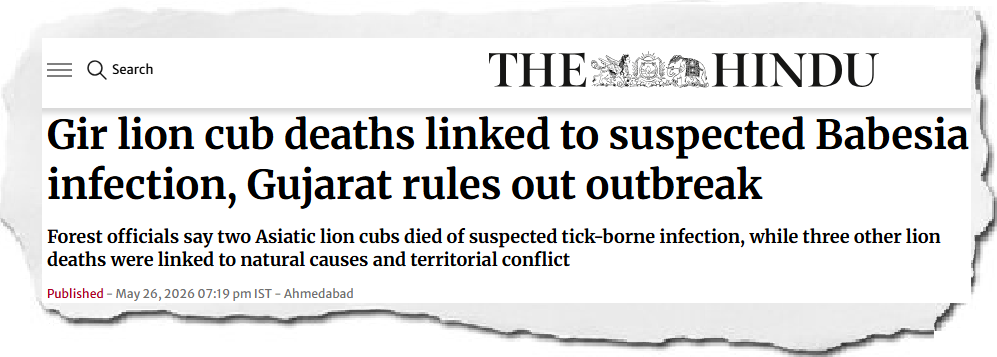
Two lion cubs in the Gir landscape of Gujarat recently died due to suspected Babesia infection, a tick-borne parasitic disease affecting animals. Three other Asiatic lions died in unrelated incidents due to natural causes and territorial conflicts. Gujarat authorities clarified that these were isolated cases and not indicative of a widespread outbreak. The incident has again brought attention to wildlife disease surveillance and conservation management in the only natural habitat of Asiatic lions.
UPSC Relevance
Prelims: Gir National Park, Asiatic Lion, Babesia infection, zoonotic diseases, wildlife conservation, IUCN status, Project Lion.
Mains:
GS III – Environment and biodiversity conservation, wildlife management, protected areas, human-wildlife interface, disease surveillance in ecosystems.
Background/Context
The Gir landscape in Gujarat remains the world’s only natural habitat of the Asiatic lion population.
According to the 2025 lion census:
- Gujarat has approximately 891 Asiatic lions.
- The population has shown significant growth over the past decades due to conservation measures.
- However, concentration of the entire wild population in a single landscape creates ecological vulnerabilities.
The present incident also recalls the major 2018 mortality event in which multiple lions died due to a combination of disease infections.
About the Asiatic Lion
Asiatic Lion is a subspecies of lion found naturally only in India.
Important features
- Smaller than African lions.
- Distinct abdominal skin fold.
- Males usually possess comparatively smaller manes.
- Lives in prides but often with smaller group structures.
Conservation status
- IUCN Status: Endangered
- Wildlife Protection Act, 1972: Schedule I protection
- Included under Appendix I of Convention on International Trade in Endangered Species of Wild Fauna and Flora
About Gir Landscape
Gir National Park forms part of a larger conservation landscape including protected forests, sanctuaries and surrounding ecosystems.
Ecological significance
- Only wild natural habitat of Asiatic lions globally.
- Supports rich biodiversity including leopards, hyenas, jackals and herbivores.
- Contains dry deciduous forests and scrub ecosystems.
Rivers associated with Gir
Major rivers include: Hiran, Shetrunji, Datardi, Shingoda, Machhundri
Understanding Babesia Infection
Babesiosis is a parasitic infection caused by protozoa of the genus Babesia.
Transmission mechanism
- Spread mainly through infected ticks.
- Parasites infect red blood cells.
- May affect domestic and wild animals.
Common symptoms
- Weakness, Fever, Respiratory distress
- Anaemia
- Reduced immunity
Young cubs and weak animals are particularly vulnerable because of lower immunity levels.
Wildlife Diseases and Conservation Concerns
Disease outbreaks increasingly represent major threats to wildlife populations.
Risks associated with single-population concentration
When a species is concentrated within a single region:
- Disease outbreaks can affect large numbers simultaneously.
- Genetic diversity may reduce over time.
- Environmental disasters can threaten survival.
- Habitat pressures increase competition.
The Gir lion population represents a classic example of “single population risk.”
Earlier Lion Mortality Event: 2018
In 2018, Gir witnessed a major mortality event.
Key factors included:
- Infection from Canine Distemper
- Protozoal infections
- Spread among closely located lion populations
The episode raised concerns regarding long-term conservation planning and disease preparedness.
Conservation Initiatives for Asiatic Lions
Project Lion
The Government of India launched Project Lion to strengthen conservation of Asiatic lions.
Objectives include:
- Habitat improvement, Disease surveillance, Veterinary healthcare infrastructure, Genetic conservation, Human-lion conflict management
Wildlife Health Surveillance
Important interventions include:
- Disease monitoring systems
- Sample collection and testing
- Veterinary rapid response teams
- Tick control measures
- Population monitoring through technology
Way Forward
Develop geographically dispersed populations
Establishing additional habitats can reduce risks arising from disease outbreaks and natural disasters.
Strengthen wildlife disease surveillance
Early-warning systems integrating veterinary science and technology should be expanded.
Improve One Health approach
Human, animal and ecosystem health should be addressed through integrated frameworks.
Enhance scientific monitoring
Use of satellite tracking, AI-based monitoring and genomic studies can improve conservation outcomes.
Conclusion
The recent deaths of lion cubs in Gir may not indicate a major outbreak, but they underline a broader conservation challenge. Wildlife protection today extends beyond protecting habitats and preventing poaching; it increasingly requires scientific disease surveillance and ecosystem-based management. Ensuring the long-term survival of the Asiatic lion demands a balance between population growth, habitat security and health resilience.
Practice Questions
Prelims Question 1 (Inference-based)
Consider the following situation:
A species exists almost entirely within a single geographical region, even though its population numbers are increasing steadily over time.
Which one of the following can most reasonably be inferred?
(a) Increase in population automatically reduces extinction risks
(b) Geographic concentration may continue to create long-term conservation vulnerabilities
(c) Disease outbreaks become impossible due to greater population size
(d) Protected area status alone guarantees species security
Answer: (b)
Explanation: Population increase alone does not eliminate risks. Concentration of an entire species within one region can expose it to disease outbreaks, disasters and genetic vulnerabilities.
Prelims Question 2
Consider the following pairs:
| Wildlife/Disease | Type |
|---|---|
| 1. Babesiosis | Tick-borne parasitic disease |
| 2. Canine Distemper | Viral disease |
| 3. Gir National Park | Only natural habitat of Asiatic lions |
Which of the pairs given above are correctly matched?
(a) 1 and 2 only
(b) 2 and 3 only
(c) 1 and 3 only
(d) 1, 2 and 3
Answer: (d)
Explanation: All three pairs are correctly matched. Babesiosis is a tick-borne parasitic infection, Canine Distemper is viral in nature, and Gir remains the only natural wild habitat of Asiatic lions.
Mains Questions
- Discuss the emerging role of disease surveillance in wildlife conservation. Examine with reference to recent concerns regarding Asiatic lions.
- “Conservation success measured only through population growth may hide deeper ecological vulnerabilities.” Critically examine with suitable examples.
Tell Google you want more of this.
Add Anantam IAS as a preferred sourceOne tap, and this site shows up more often in your own Top Stories, AI Overviews and AI Mode. Remove it any time.