Daily Digest
UPSC · Civil Services Examination
Current Affairs · Thursday, 27 November 2025
Current affairs curated and edited by Anantam IAS faculty — pulled from The Hindu, PIB, IDSA, Foreign Affairs and the ministries. Read, annotate, revise.
Old Rajinder Nagar · Delhi 110005 · anantamias.com
NJAC v/s Collegium System

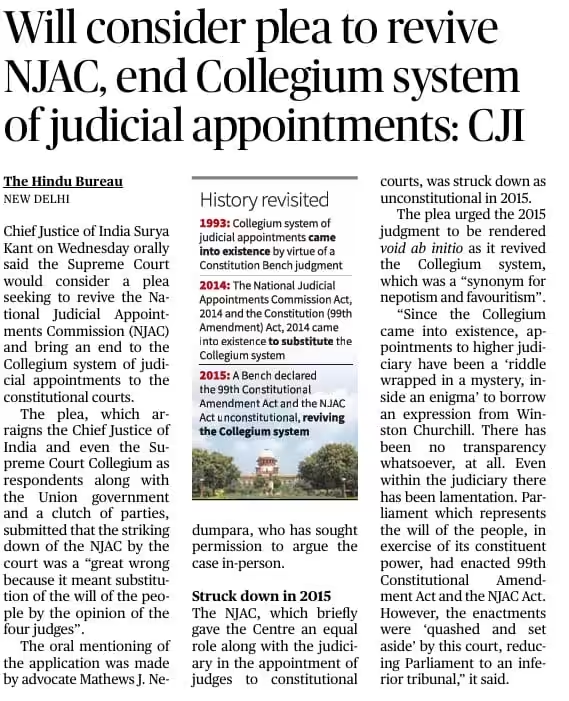
Why in news:
Chief Justice of India Surya Kant has orally stated that the Supreme Court will consider a plea that seeks:
- Abolition of the existing Collegium system for the appointment of judges to constitutional courts
- Revival of the National Judicial Appointments Commission (NJAC)
This is significant because it reopens the debate on judicial appointments, transparency, and separation of powers.
UPSC Relevance:
Polity and Governance
UPSC PYQ:
Q. Critically examine the Supreme Court’s judgement on the ‘National Judicial Appointments Commission Act, 2014’ with reference to the appointment of judges of higher judiciary in India. (2017)
About Collegium System and NJAC:
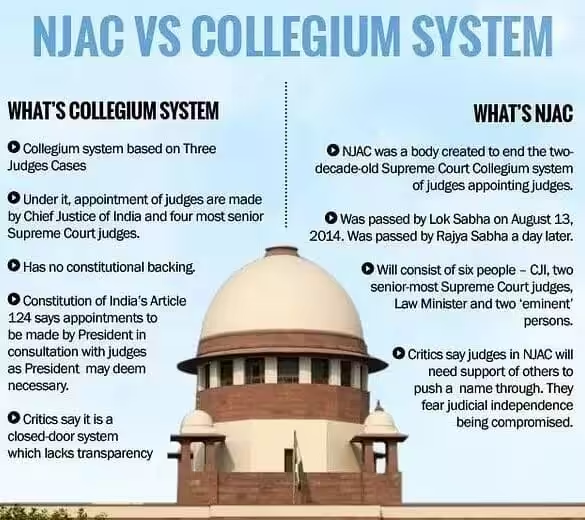
Collegium system:
The Collegium system, in factual terms and as an express legal provision, does not find its place in the Constitution of India and has rather evolved in India as a process of appointment of judges, by three prominent cases.
- Article 124 and Article 217 provide that the SC and HC judges, respectively, are appointed by the President of India after consultation with such Judges of Supreme Court & High Court as necessary, along with the mandatory consultation with the CJI.
The Three Judge Cases that shaped this process are–
First Judge Case –
- SP Gupta vs. UOI (1981) (AIR 1982 SC 149)– The court by this gave the executive, a decisive hand for appointment of Judges for SC & HC. Bench went on to interpret that the term ‘consultation’ under Article 124 and Article 217, did not mean ‘concurrence’.
Second Judge Case-
- Supreme Court Advocates-on-Record Association v. Union of India (1993) (AIR 1994 SC 268)– 9 judge bench of Supreme Court in 1993, reversed the earlier decision. The apex court held that ‘consultation’ with the CJI actually meant ‘concurrence’ of the CJI. Following this, the CJI would make a decision along with the 2 senior most judges of the court and hence paved the collegium system.
Third Judge Case–
- IN RE: APPOINTMENT & TRANSFER OF JUDGES (1998) (AIR 1999 SC 1)– In 1998 the President sought the Supreme Court’s opinion over the primacy accorded to the CJI in Judge’s appointment under collegium. Supreme Court upheld the stance and went on to increase the strength of collegium to 5 judges
- Following this, the collegium consists of the 4 senior most judges and the CJI (i.e. Total 5 members). Another possible contingency is that the successor of the CJI may not be one of these 4 senior most judges and in those cases he is made a part of the collegium as well.
- As for the High Court collegium – it is led by the Chief Justice of the high court and the four senior most Judges of that particular High Court. The recommendations by the High Court collegium are further approved by the CJI and the Supreme Court Collegium and are then sent to the President.
Criticism of the Collegium System:
Absence of Transparency
- An important critique levelled against the Collegium system is its lack of transparency. Judge nomination and transfer procedures take place behind closed doors, and the standards and reasoning for judgments are never made public. Concerns concerning the impartiality and fairness of the system are raised by this lack of openness. It is challenging to determine whether decisions are motivated by merit or other considerations in the absence of precise, openly accessible rules.
Claim of Favouritism and Nepotism
- Nepotism and favouritism, according to critics, might result from the Collegium System’s lack of accountability and openness. Allegations have been made that personal relationships or factors other than merit occasionally affect appointments and transfers. The public’s confidence in the courts is weakened by this view, which also may have an impact on the officers’ morale.
Arguments in Favour of the Collegium System:
Judges’ Independence
- The Collegium system’s guarantee of judicial independence is among its strongest justifications. The Collegium system helps prevent political meddling by giving senior judges, not the executive branch, the authority to make judicial nominations and transfers. Maintaining an unbiased judiciary that is able to make decisions free from outside pressures depends on this division.
Shielding Against Political Pressures
- It is believed that the Collegium System protects the judiciary from political pressure. Judges may be appointed more on the basis of their political allegiances or affiliations than their qualifications in nations where the president plays a major role in judicial nominations. Because the Collegium System retains the appointment process inside the judiciary, it reduces this risk.
National Judicial Appointments Commission (NJAC):
- The National Judicial Appointments Commission Act, 2014, and the 99th Constitutional Amendment Act were passed in 2014 in order to create the NJAC. There has been a lot of criticism regarding the Collegium System, so there were certain provisions made to correct these flaws. These legislative actions established the NJAC’s legal foundation, formally substituting this new commission for the Collegium System. The NJAC encountered strong opposition despite its promising framework, especially from the court.
- As per the appointment procedure that previously existed in the form of the National Judicial Appointment Commission (NJAC), no recommendation made by the NJAC could be forwarded if it was denied by two of its members. The commission (NJAC) and the NJAC Act were stuck down back in the year 2015 via the 4th Judge Case (Supreme Court Advocate on Record Association & Anr. vs. UOI) ((2016) 5 SCC 1), declaring it to be ultra vires and against the basic structure doctrine of the constitution.
Concluding, against all this criticism, the fact is that the collegium system withstands and maintains the rule of separation of power and the independence of the judiciary. It may need its own improvement and lens of transparency, but that doesn’t call for an absolute overthrow or disregard of this system of appointment. CJI’s opinion, in practice, is rather a collective opinion by people at the apex court level. CJI is given the decisive lead as he would be best to know and scrutinize the candidates & is backed by the extensive scrutiny by the collegium.
Source: https://anantamias.com/current-affairs/njac-v-s-collegium-system/
Presidential Reference versus Federal Structure

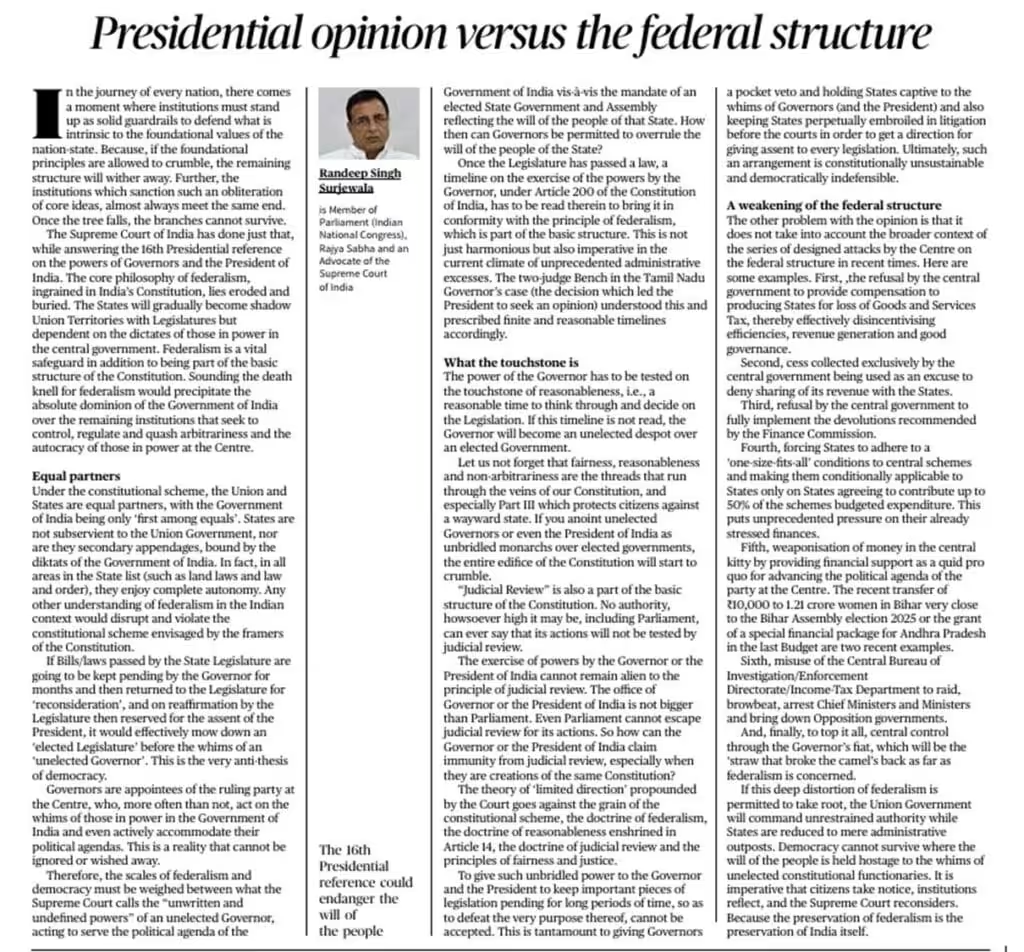
Why in news:
The Supreme Court’s opinion on the 16th Presidential Reference—which interprets the powers of Governors and the President vis-à-vis State Governments—weakens India’s federal structure.
UPSC Relevance:
Polity and Governance
UPSC PYQ:
Q. Do you think that the Constitution of India does not accept the principle of strict separation of powers rather it is based on the principle of ‘checks and balance’? Explain. (2019)
Background of this matter?
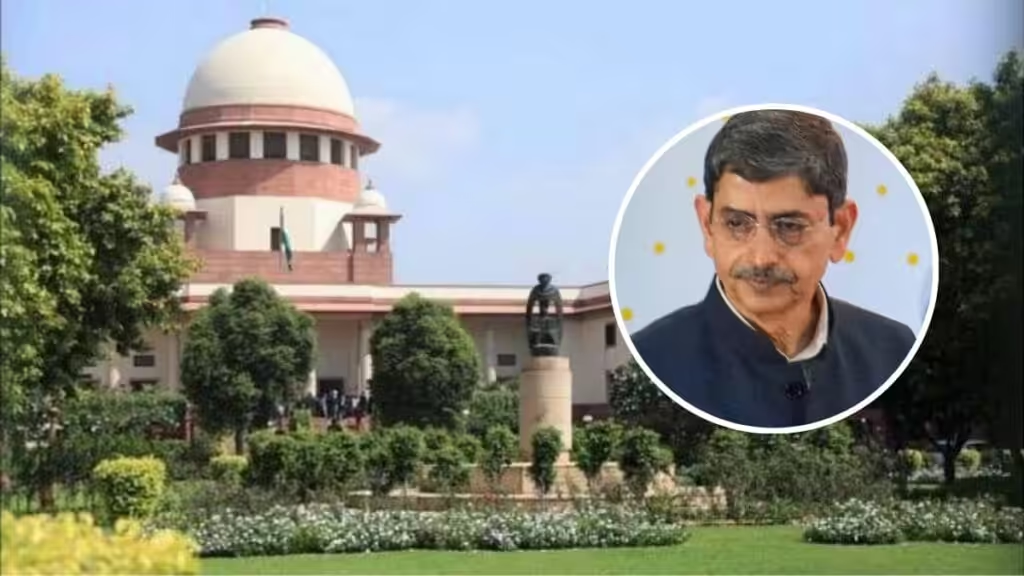
On 8 April 2025, the Supreme Court of India delivered a landmark judgment in State of Tamil Nadu vs Governor of Tamil Nadu.
Why?
The dispute arose from an unprecedented standoff: the Governor of Tamil Nadu had delayed or refused assent to several bills passed by the state legislature, effectively stalling the legislative will. The Tamil Nadu government’s petition accused the Governor of “inaction, omission, delay, and failure” in performing his constitutional duty .
Then SC,
Imposing timelines on Governors and the President to act on Bills passed by state legislatures.
The key directives included:
(a) ordinarily, a Governor should act on a bill (either assenting, withholding, or reserving it) “forthwith,” and in any case no later than one month
(b) if the Governor contemplates withholding assent against the advice of the Council of Ministers, he must return the bill with a reconsideration message within
(c) similarly, any decision to reserve a bill against the state’s advice should be made within three months; and
(d) if a bill is passed by the legislature a second time (after being returned), the Governor must give assent “forthwith,” and in any event
By prescribing these time frames, the Court aimed to fill what it perceived as a “constitutional silence” on the matter of timelines, to ensure Governors
Judicial Overreach and Separation of Powers Concerns:
“By invoking Article 142 to do “complete justice,” the Court certainly had the technical power to do what it did. Yet, the exercise of that power in this manner is what triggers accusations of overreach. Article 142 has been historically used to fill legal vacuums or provide relief in specific cases (for example, to order the release of a detainee when executive delays violated his rights, or to frame guidelines on sexual harassment in the workplace in the absence of legislation, as in the Vishakha case). In Tamil Nadu’s case, the Court used Article 142 to effectively override the explicit decision of another constitutional functionary (the President of India, no less, who had withheld assent to seven bills). This is arguably a much more intrusive use of Article 142 than usual. It raised concerns that the Court was rewriting the outcome of a legislative process to suit what it perceived as the right outcome.”
Now,
The President has invoked Article 143 of the Indian Constitution to refer a set of 14 constitutional questions to the Supreme Court (SC) for its advisory opinion.
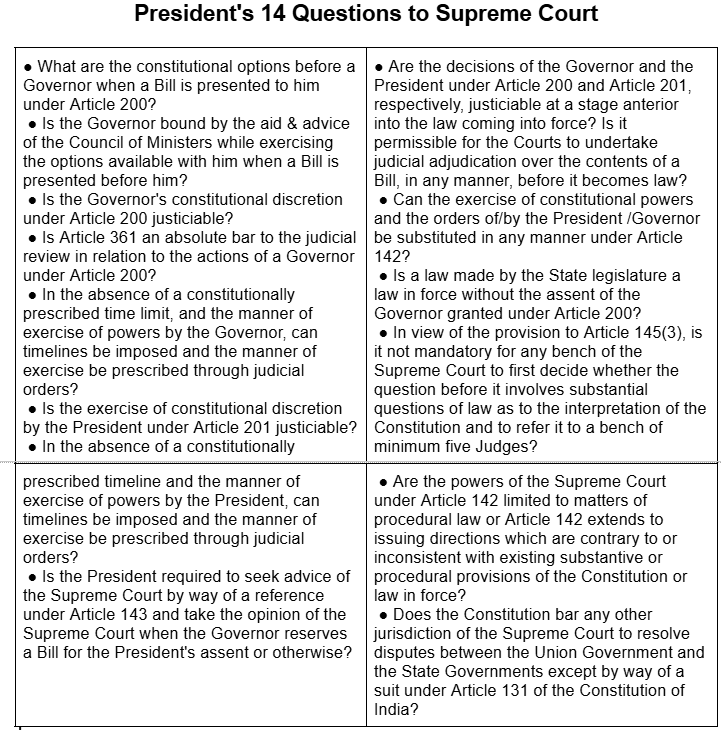
- Article 143 (1): The President may refer any question of law or fact of public importance which has arisen or which is likely to arise. Here, the Supreme Court may tender or may refuse to tender its opinion to the president.
- Article 143(2): It allows the President to refer disputes arising from out of any pre-constitution treaty, agreement, covenant, sanad or other similar instruments. The SC must tender its opinion to the President.
- Nature of the Advise: In both the cases, the opinion expressed by the SC is only advisory and not a judicial pronouncement.
Significance?
- Clarifies Constitutional Roles: Helps the Supreme Court interpret the powers and responsibilities of the President and Governors, including whether delays or discretion can be judicially reviewed.
- Protects Democratic Balance: Reinforces the balance among the legislature, executive, and judiciary by preventing misuse or overreach of constitutional powers.
- Removes Procedural Confusion: Settles doubts on procedures in Centre–State relations and provides clear guidelines for handling institutional disagreements.
- Strengthens Federalism: Clearly defines boundaries between Union and State powers, promoting smoother Centre–State coordination and cooperative federalism.
Federal Issues?
1. Fiscal Federalism Weakening
- GST compensation delays
- Union refuses compensation for losses to States
→ discourages revenue generation and hurts State finances.
2. Centrally Sponsored Schemes (CSS) Overburden States
- Many schemes require States to contribute up to 50%, despite limited finances.
→ uniform schemes ignore States’ unique needs.
3. Centre dictates administrative decisions
- Growing use of Governor to stall State bills.
- President’s referral route becomes a tool for central interference.
4. “One-size-fits-all”
- GST compensation delays
- Union refuses compensation for losses to States
→ discourages revenue generation and hurts State finances.
5. Weaponisation of Governors
- Governors sitting on Bills
- Withholding assent
- Sending Bills to President to block State laws
Examples: Tamil Nadu, Kerala, Punjab.
6. Excessive use of Central agencies
CBI, ED, Income Tax, etc. used to pressure State Governments.
→ undermines democratic federal balance.policymaking
- Union imposes same model on all States.
- Neglect of regional diversity.
“The Supreme Court of India’s ruling in State of Tamil Nadu vs Governor of Tamil Nadu is a landmark that simultaneously advances democratic governance and raises searching questions about judicial reach. By compelling a recalcitrant Governor to act and ultimately giving effect to the will of the Tamil Nadu legislature, the Court upheld the spirit of representative government and filled a void in the constitutional scheme regarding timelines for assent to bills. It asserted that constitutional functionaries cannot derelict their duties under the cloak of silence or open-ended discretion, thereby reinforcing accountability. In doing so, the judgment has clipped the wings of an unelected gubernatorial office often criticized for acting as a proxy of the central government, and it has fortified the principle that a state’s legislative will, once firmly expressed, must prevail in the ordinary course.”
Source: https://anantamias.com/current-affairs/presidential-reference-versus-federal-structure/
Goa Tiger Reserve Proposal

Why in news?
- A Supreme Court-appointed Central Empowered Committee (CEC) has recommended creating a Tiger Reserve in Goa in phases.
- This issue arose after:
- Bombay High Court (July 2023) ordered Goa to notify five protected areas as a Tiger Reserve.
- Goa challenged this HC order in the Supreme Court.
High Court’s directive (2023)
The HC ordered Goa to:
- Notify Mhadei WLS + 4 other sanctuaries as a tiger reserve within 3 months.
- Prepare a Tiger Conservation Plan.
- Settle rights of Scheduled Tribes & forest dwellers under FRA, 2006.
Trigger
- January 2020: 1 tigress + 3 cubs poisoned in Mhadei.
- NTCA (2016): Already recommended declaring a Tiger Reserve.
2. Why is Goa resisting?
The Goa government argued:
Claim 1: “Over 1 lakh people will be displaced.”
→ But its own affidavit later admitted:
- Only 1,274 households across 33 villages, i.e., 5,000–6,000 people.
Claim 2: “Goa has no resident tigers, only transient ones.”
→ Internally, government documents contradict this.
→ Tiger movement between Goa–Karnataka–Maharashtra is scientifically documented.
3. What did the CEC find?
The CEC conducted:
- Field visits
- Meetings with villagers, forest officials, NGOs
Key observations
- Forest dwellers fear forced displacement.
- The State must allay these fears through proper communication.
- A phased tiger reserve will minimize disruption.
4. CEC’s Proposed Structure of the Goa Tiger Reserve
Phase 1: Core Area (Least human presence + contiguous with Kali Tiger Reserve of Northern Karnataka)
Core:
- Netravali Wildlife Sanctuary
- 50 households
- Cotigao Wildlife Sanctuary
- 41 households
➡ Combined: 296.7 sq km
- 41 households
Phase 1: Buffer Area
- Northern part of Bhagwan Mahavir WLS (9 households)
- Bhagwan Mahavir National Park (2 households)
➡ Combined: 171 sq km
Total Area in Phase-1
→ 468.6 sq km
This area is fully contiguous with:
- Karnataka’s Kali Tiger Reserve (1,345 sq km)
- Together: Integrated landscape: 1,814 sq km
Mhadei Wildlife Sanctuary (208 sq km)
- Contains 612 households – largest human presence.
- Shares limited boundary with Kali reserve.
- To be included later, after consultations.
5. Why are Tiger Reserves important?
Tiger Reserve = Core Zone + Buffer Zone
Core Zone
- “Inviolate” (no human habitation ideally)
- Strict protection
- People cannot be forced to leave
- Only voluntary relocation
- Based on FRA 2006 rights, compensation
Buffer Zone
- Human activity allowed
- Eco-development, sustainable practices
- Acts as “shield” to core
Benefits of Tiger Reserves
- Enhances movement corridors
- Improves landscape-level conservation
- Brings more central funding from NTCA
- Supports habitat for elephants, leopards, gaur, biodiversity
6. Why is contiguity with Kali Tiger Reserve important?
Landscape connectivity
- Tigers need large territories (60–100 sq km per male).
- Goa forests link:
- Kali Tiger Reserve (Karnataka)
- Bhimgad WLS (Karnataka)
- Radhanagari WLS (Maharashtra)
- A continuous landscape ensures:
- Genetic diversity
- Avoidance of inbreeding
- Safe movement
7. Key Concepts
Central Empowered Committee (CEC)
- Set up by Supreme Court (2002)
- Advises SC on:
- Forest conservation
- Environmental violations
- Wildlife management
Tiger Reserve Declaration
Under Wildlife Protection Act, 1972 (Section 38V):
- State notifies tiger reserve
- NTCA approves Tiger Conservation Plan
- No alteration of boundaries without NTCA + Parliament approval
Forest Rights Act (FRA), 2006
- Recognises rights of forest dwellers on land & forest produce
- No relocation without:
- Consent of Gram Sabha
- Compensation package
Practice MCQs
With reference to Tiger Reserves in India, consider the following statements:
- The declaration of a Tiger Reserve by a State Government requires prior approval of the National Tiger Conservation Authority (NTCA).
- No modification of the boundaries of a Tiger Reserve can be made without the approval of the National Tiger Conservation Authority and the National Board for Wildlife.
- Core zones of Tiger Reserves must be completely free of human habitation by law.
Which of the above statements are correct?
(a) 1 and 2 only
(b) 2 and 3 only
(c) 1 and 3 only
(d) 1, 2 and 3
Source: https://anantamias.com/current-affairs/goa-tiger-reserve-proposal/