

Context: A five-judge Constitution Bench of the Supreme Court has issued notices to the Union and all State governments on a Presidential Reference seeking clarity on whether the court can impose timelines and lay down guidelines for the conduct of Governors and the President in dealing with State Bills submitted for assent or reserved for their consideration.
What is Presidential reference?

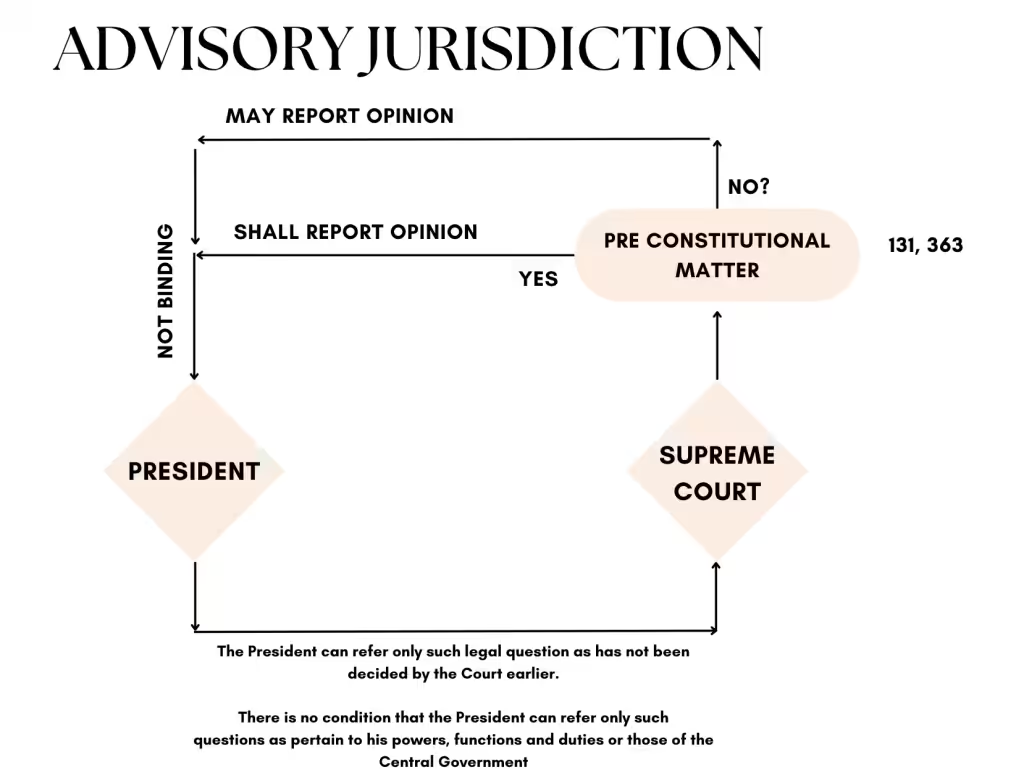
According to Article 143, the President may refer to the Supreme Court any question of law or fact of public importance for its opinion. The President refers such a matter on the advice of the Union council of ministers. Article 145 of the Constitution makes a provision that any reference shall be disposed of by a bench of at least five judges.
The Supreme Court can render its opinion following such hearing as it deems fit. The opinion is not binding in law on the President and is not precedential in value for the courts to apply in subsequent cases. It has a strong persuasive value and is generally obeyed by the executive and the courts.
What is the historical background?
The advisory jurisdiction of the Supreme Court under Article 143 is a leftover of the Government of India Act, 1935. It gave the Governor-General discretionary authority to refer any question of law of public importance to the federal court for its views.
Such a provision exists in the Canadian constitution as well. Under this mechanism, the Supreme Court of Canada can provide opinion on legal issues referred to it by the federal or provincial governments. The U.S. Supreme Court, however, has always refused to render any advisory opinion to the executive as it would be against the strict separation of powers contemplated in its constitution.
What were previous instances?
There have been approximately fifteen references since 1950 prior to the present reference. Some of the milestone judgments of such references are encapsulated herein.
The initial reference was given in the Delhi Laws Act case (1951) and provided the parameters of ‘delegated legislation’, in which the legislature could vest legislative authority upon the executive for smooth implementation of any law.
The mention of the Kerala Education Bill (1958) led to the court formulating the doctrine of harmonious construction of Fundamental Rights and Directive Principles of State Policy and protection afforded to minority educational institutions under Article 30.
In Berubari case (1960), the court believed that the ceding or the acquisition of territory by India would require a constitutional amendment under Article 368. In the Keshav Singh case (1965), the court interpreted legislative powers and privileges.
In the case of Presidential poll (1974), the court expressed the view that Presidential elections must be conducted despite vacancies in the electoral college because of dissolution of State legislatures.
The view expressed in the Special Courts Bill (1978) was notable on numerous scores. It enshrined that the court can refuse to answer a reference; that questions sent for reference should be clear and not ambiguous; and that the court, in answering a reference, should not infringe on the functions and privileges of Parliament.
The Third Judges case reference of 1998 established exhaustive guidelines for the collegium system in regard to appointing judges to the higher judiciary. It is not mandatory for the Supreme Court to give its opinion. Still, of the references made so far, the court has refused to give its opinion for just one reference in 1993 regarding the Ram Janmabhoomi case.
What is the current reference?
The current reference is a consequence of a recent Supreme Court ruling which had mandated specific timelines for Governors and the President to take action on Bills sent by State legislatures. The court had also ruled that actions by Governors and the President on such Bills could be judicially reviewed.
The current reference has posed 14 questions, mainly regarding the interpretation of Articles 200 and 201, to the court’s view. The government questioned the jurisdiction of the courts to sanction timelines where the Constitution does not mention them. It questioned whether Governors’ and President’s actions can be made justiciable at a stage earlier than enactment of a Bill into a law. The case also invites opinion on the scope of powers exercisable by the Supreme Court under Article 142.
Political divergence between the Union government and Opposition-governed State governments have been the main cause of this conflict. The Supreme Court had followed the timeframes specified under the President in the Office Memorandum of the Home Ministry while delivering its ruling.
In the Cauvery dispute reference (1992), the court had expressed the view that it cannot sit in appeal over earlier judgments in its advisory jurisdiction. But an authoritative ruling on this reference will hopefully resolve the questions regarding these constitutional provisions that are important to the smooth working of our democracy and federalism.
Tell Google you want more of this.
Add Anantam IAS as a preferred sourceOne tap, and this site shows up more often in your own Top Stories, AI Overviews and AI Mode. Remove it any time.
