Why in news:
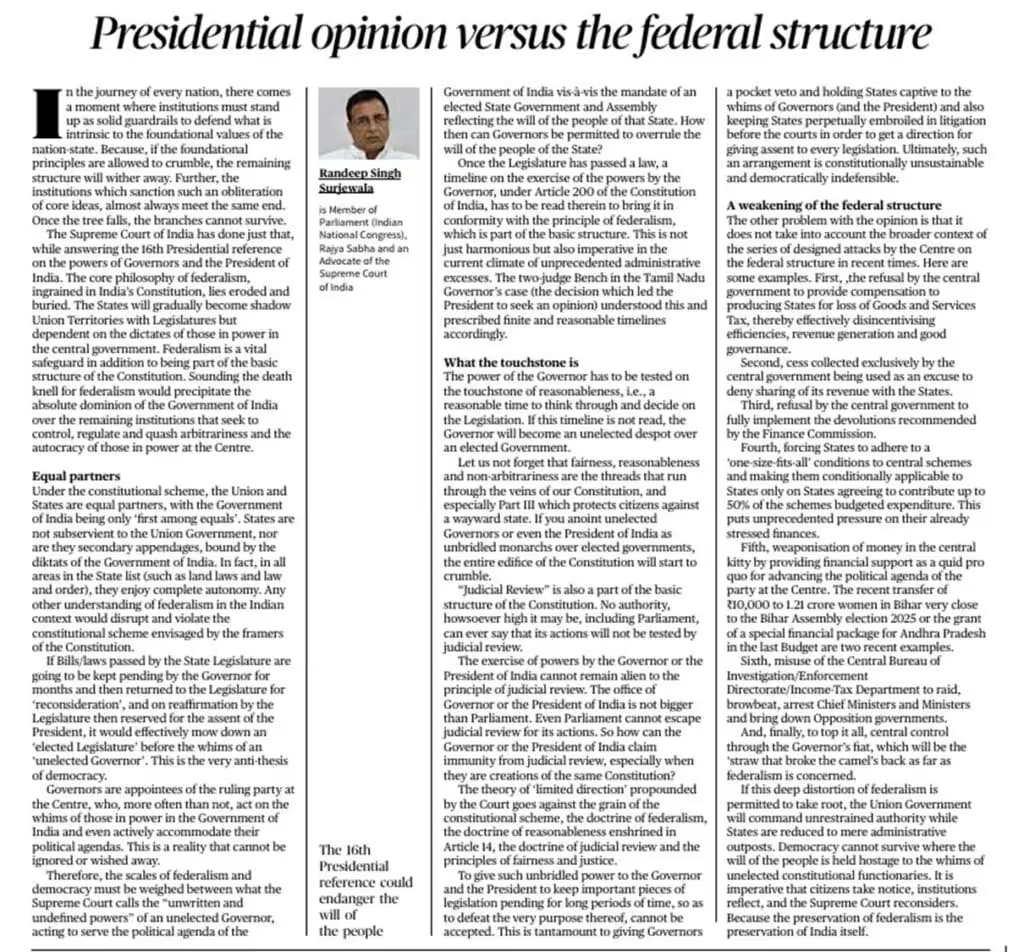
The Supreme Court’s opinion on the 16th Presidential Reference—which interprets the powers of Governors and the President vis-à-vis State Governments—weakens India’s federal structure.
UPSC Relevance:
Polity and Governance
UPSC PYQ:
Q. Do you think that the Constitution of India does not accept the principle of strict separation of powers rather it is based on the principle of ‘checks and balance’? Explain. (2019)
Background of this matter?
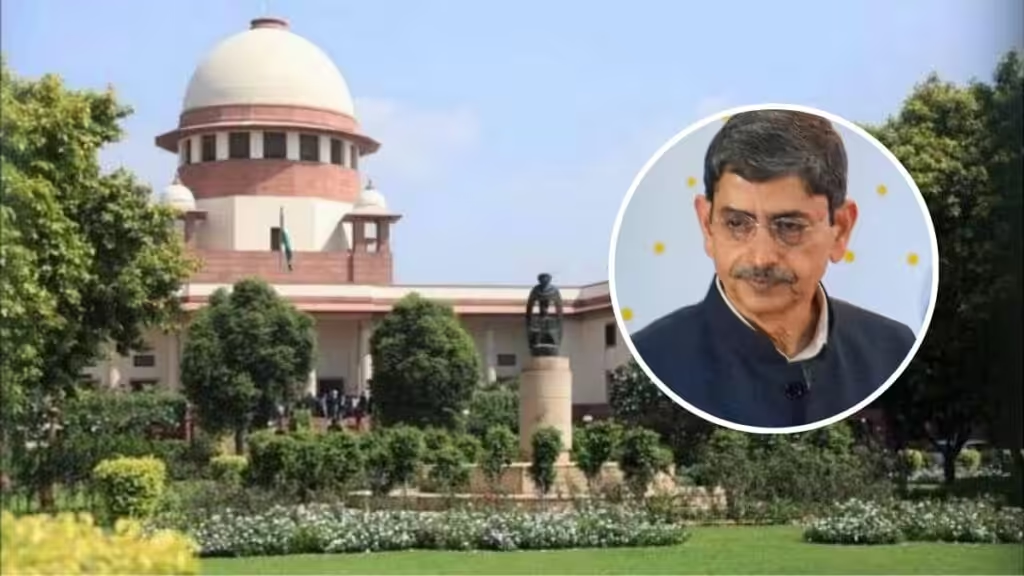
On 8 April 2025, the Supreme Court of India delivered a landmark judgment in State of Tamil Nadu vs Governor of Tamil Nadu.
Why?
The dispute arose from an unprecedented standoff: the Governor of Tamil Nadu had delayed or refused assent to several bills passed by the state legislature, effectively stalling the legislative will. The Tamil Nadu government’s petition accused the Governor of “inaction, omission, delay, and failure” in performing his constitutional duty .
Then SC,
Imposing timelines on Governors and the President to act on Bills passed by state legislatures.
The key directives included:
(a) ordinarily, a Governor should act on a bill (either assenting, withholding, or reserving it) “forthwith,” and in any case no later than one month
(b) if the Governor contemplates withholding assent against the advice of the Council of Ministers, he must return the bill with a reconsideration message within
(c) similarly, any decision to reserve a bill against the state’s advice should be made within three months; and
(d) if a bill is passed by the legislature a second time (after being returned), the Governor must give assent “forthwith,” and in any event
By prescribing these time frames, the Court aimed to fill what it perceived as a “constitutional silence” on the matter of timelines, to ensure Governors
Judicial Overreach and Separation of Powers Concerns:
“By invoking Article 142 to do “complete justice,” the Court certainly had the technical power to do what it did. Yet, the exercise of that power in this manner is what triggers accusations of overreach. Article 142 has been historically used to fill legal vacuums or provide relief in specific cases (for example, to order the release of a detainee when executive delays violated his rights, or to frame guidelines on sexual harassment in the workplace in the absence of legislation, as in the Vishakha case). In Tamil Nadu’s case, the Court used Article 142 to effectively override the explicit decision of another constitutional functionary (the President of India, no less, who had withheld assent to seven bills). This is arguably a much more intrusive use of Article 142 than usual. It raised concerns that the Court was rewriting the outcome of a legislative process to suit what it perceived as the right outcome.”
Now,
The President has invoked Article 143 of the Indian Constitution to refer a set of 14 constitutional questions to the Supreme Court (SC) for its advisory opinion.
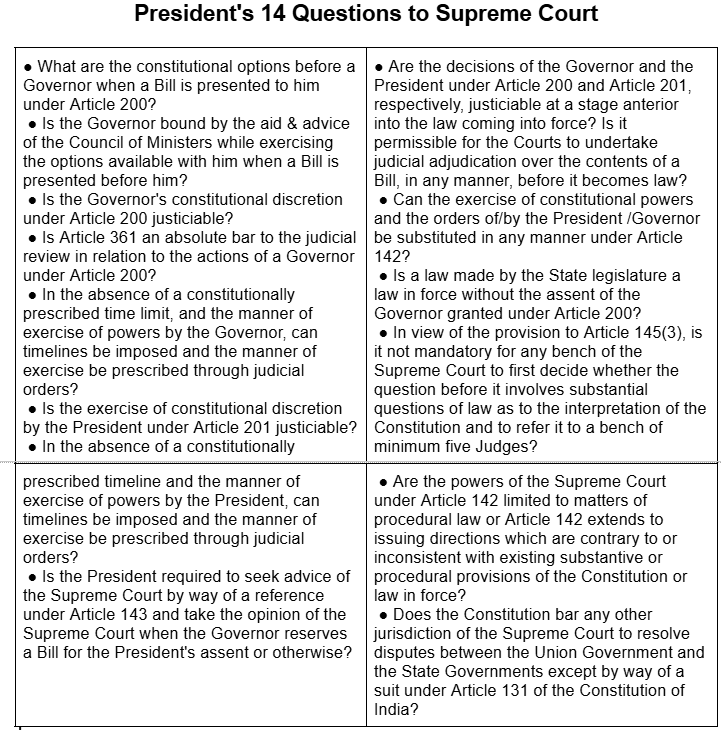
- Article 143 (1): The President may refer any question of law or fact of public importance which has arisen or which is likely to arise. Here, the Supreme Court may tender or may refuse to tender its opinion to the president.
- Article 143(2): It allows the President to refer disputes arising from out of any pre-constitution treaty, agreement, covenant, sanad or other similar instruments. The SC must tender its opinion to the President.
- Nature of the Advise: In both the cases, the opinion expressed by the SC is only advisory and not a judicial pronouncement.
Significance?
- Clarifies Constitutional Roles: Helps the Supreme Court interpret the powers and responsibilities of the President and Governors, including whether delays or discretion can be judicially reviewed.
- Protects Democratic Balance: Reinforces the balance among the legislature, executive, and judiciary by preventing misuse or overreach of constitutional powers.
- Removes Procedural Confusion: Settles doubts on procedures in Centre–State relations and provides clear guidelines for handling institutional disagreements.
- Strengthens Federalism: Clearly defines boundaries between Union and State powers, promoting smoother Centre–State coordination and cooperative federalism.
Federal Issues?
1. Fiscal Federalism Weakening
- GST compensation delays
- Union refuses compensation for losses to States
→ discourages revenue generation and hurts State finances.
2. Centrally Sponsored Schemes (CSS) Overburden States
- Many schemes require States to contribute up to 50%, despite limited finances.
→ uniform schemes ignore States’ unique needs.
3. Centre dictates administrative decisions
- Growing use of Governor to stall State bills.
- President’s referral route becomes a tool for central interference.
4. “One-size-fits-all”
- GST compensation delays
- Union refuses compensation for losses to States
→ discourages revenue generation and hurts State finances.
5. Weaponisation of Governors
- Governors sitting on Bills
- Withholding assent
- Sending Bills to President to block State laws
Examples: Tamil Nadu, Kerala, Punjab.
6. Excessive use of Central agencies
CBI, ED, Income Tax, etc. used to pressure State Governments.
→ undermines democratic federal balance.policymaking
- Union imposes same model on all States.
- Neglect of regional diversity.
“The Supreme Court of India’s ruling in State of Tamil Nadu vs Governor of Tamil Nadu is a landmark that simultaneously advances democratic governance and raises searching questions about judicial reach. By compelling a recalcitrant Governor to act and ultimately giving effect to the will of the Tamil Nadu legislature, the Court upheld the spirit of representative government and filled a void in the constitutional scheme regarding timelines for assent to bills. It asserted that constitutional functionaries cannot derelict their duties under the cloak of silence or open-ended discretion, thereby reinforcing accountability. In doing so, the judgment has clipped the wings of an unelected gubernatorial office often criticized for acting as a proxy of the central government, and it has fortified the principle that a state’s legislative will, once firmly expressed, must prevail in the ordinary course.”
Tell Google you want more of this.
Add Anantam IAS as a preferred sourceOne tap, and this site shows up more often in your own Top Stories, AI Overviews and AI Mode. Remove it any time.