Daily Digest
UPSC · Civil Services Examination
Current Affairs · Sunday, 28 December 2025
Current affairs curated and edited by Anantam IAS faculty — pulled from The Hindu, PIB, IDSA, Foreign Affairs and the ministries. Read, annotate, revise.
Old Rajinder Nagar · Delhi 110005 · anantamias.com
Special Intensive Revision of Electoral Rolls and the ECI
Why in News?
Through December 2025 the Election Commission of India (ECI) continued its phased, pan-India Special Intensive Revision (SIR) of electoral rolls, extending to several states the door-to-door verification model it first ran in Bihar earlier in the year.
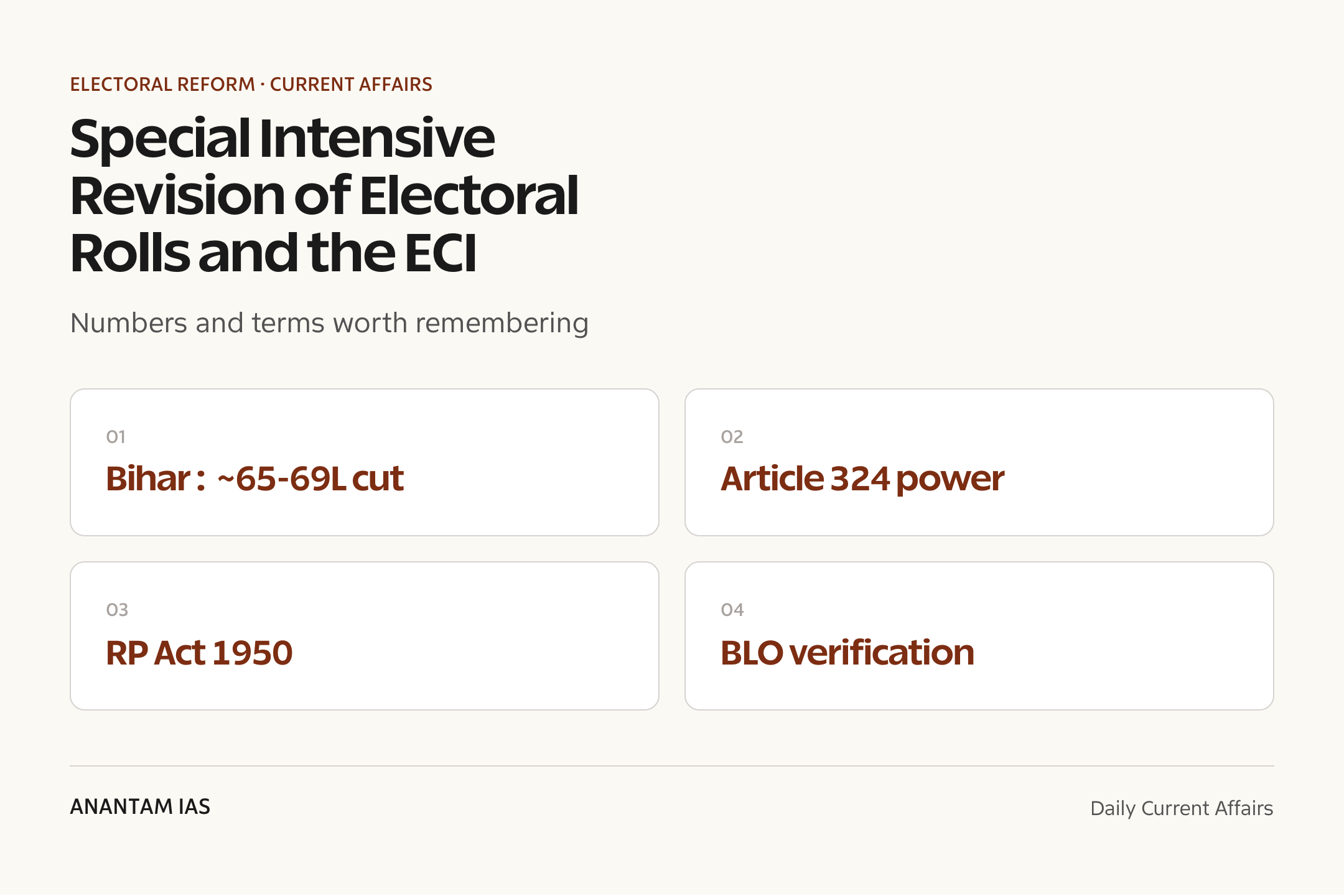
The exercise has been politically charged. In Bihar, the SIR led to the deletion of about 65-69 lakh names from the draft rolls, prompting questions about disenfranchisement and documentation burdens. A clutch of petitions challenging the SIR, led by the Association for Democratic Reforms (ADR), remained pending before the Supreme Court, which was still hearing the matter.
- The ECI is conducting a Special Intensive Revision (SIR) of electoral rolls in phases across states.
- The pilot in Bihar saw roughly 65-69 lakh names removed from the draft roll as deceased, shifted, duplicate or untraceable.
- Enumeration uses Booth Level Officers (BLOs), enumeration forms, and an earlier ‘intensive’ roll as the reference base.
- Petitioners argued the process risks excluding poor, migrant and marginalised voters; the ECI defended it as roll purification.
- The challenge in ADR v. ECI was being heard by the Supreme Court, with the matter pending.
The development matters in the context of:
- Accurate electoral rolls are the foundation of free and fair elections — both wrongful inclusion and wrongful exclusion damage the franchise.
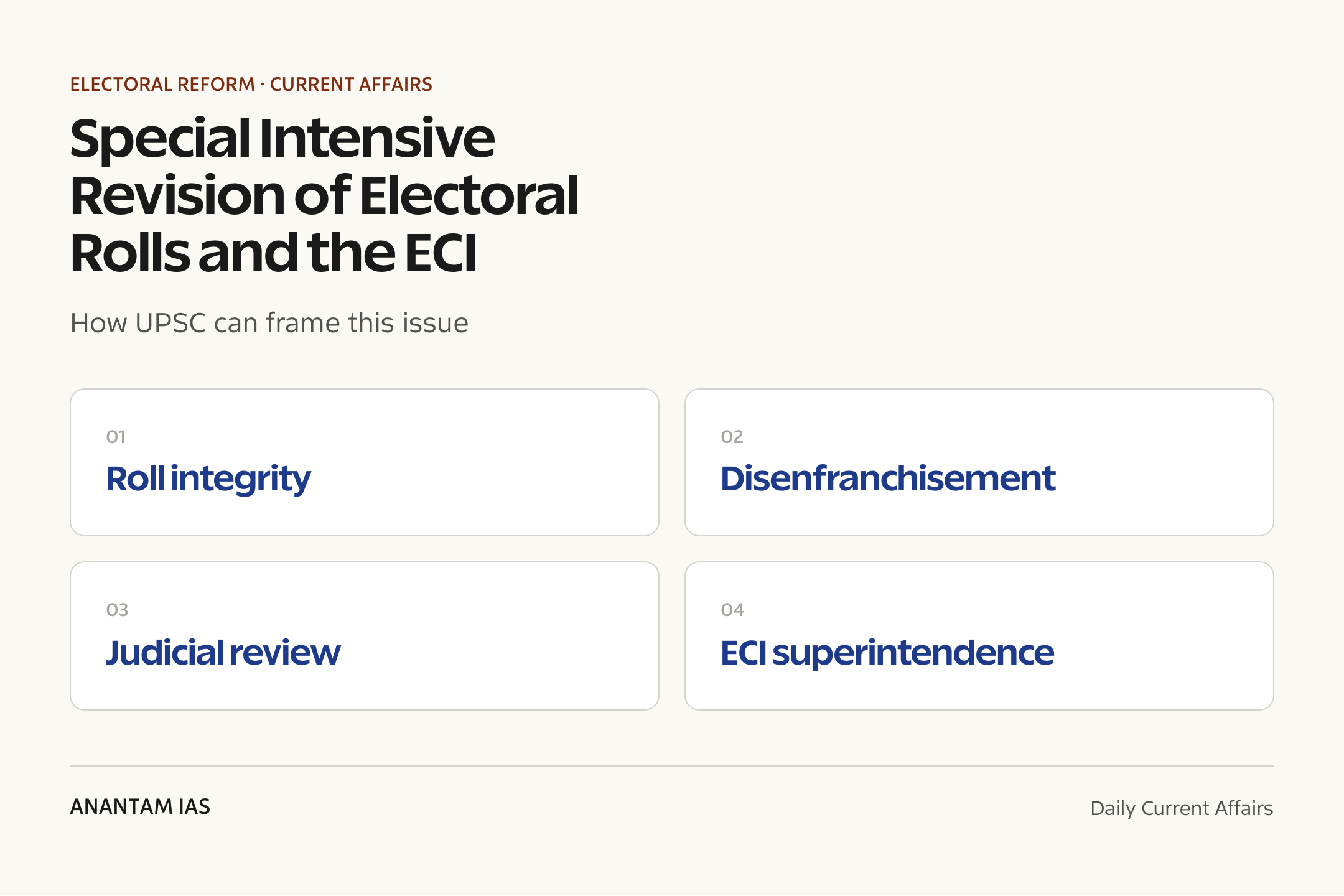
- The ECI’s superintendence of rolls draws on a constitutional power that the courts can review for legality and fairness.

UPSC Relevance
Prelims Relevance
- Article 324: superintendence, direction and control of elections and electoral rolls vests in the ECI.
- Article 325: no person to be excluded from rolls on grounds of religion, race, caste or sex.
- Article 326: elections to Lok Sabha and State Assemblies on the basis of universal adult suffrage (voting age 18).
- Representation of the People Act, 1950 governs the preparation and revision of electoral rolls.
- Registration of Electors Rules, 1960 lay down the procedure for enrolment and revision.
- Roll revisions are of two kinds — intensive, summary, or a combination; SIR is an intensive house-to-house exercise.
- Booth Level Officers (BLOs) conduct field verification; the relevant authority is the Electoral Registration Officer (ERO).
- The ECI is a multi-member body (Chief Election Commissioner + Election Commissioners).
Mains Relevance
GS Paper 2
- Powers of the ECI under Article 324 and the limits of judicial review over the conduct of elections.
- Balancing the integrity of electoral rolls against the risk of disenfranchising vulnerable citizens.
GS Paper 2 (Social Justice)
- How documentation requirements can disproportionately affect the poor, migrants and the marginalised.
Essay
- Every name on the roll is a citizen’s voice: the quiet politics of who gets to vote.
Background and Context
What a Special Intensive Revision is
SIR is the most thorough form of roll revision the ECI runs.
- Electoral rolls are revised either by a summary revision (updates on the existing roll) or an intensive revision (fresh house-to-house enumeration).
- A Special Intensive Revision (SIR) rebuilds the roll through field verification, typically against an earlier baseline roll.
- Booth Level Officers (BLOs) distribute and collect enumeration forms, verifying each elector’s existence and ordinary residence.
- The draft roll is published, claims and objections are invited, and a final roll is issued.
The constitutional and legal basis
The ECI’s authority over rolls is broad but not unbounded.
- Article 324 vests the superintendence, direction and control of rolls and elections in the ECI.
- The Representation of the People Act, 1950 governs roll preparation; the Registration of Electors Rules, 1960 set the procedure.
- Article 326 guarantees the vote to every citizen of 18 or above, subject to disqualifications such as non-residence or unsound mind.
- Courts can review whether the ECI’s exercise of power is lawful, reasonable and non-arbitrary.
The Bihar experience
Bihar was the first large SIR and set the template — and the controversy.
- The Bihar SIR led to the deletion of about 65-69 lakh names from the draft roll.
- The ECI said deletions covered the deceased, permanently shifted, duplicate and untraceable electors.
- Critics argued that documentation requirements and tight timelines risked dropping genuine voters, especially migrants and the poor.
- The exercise fed directly into the litigation now before the Supreme Court.
The legal challenge — pending
The matter was before the Supreme Court and undecided.
- Petitions led by the Association for Democratic Reforms (ADR) challenged the SIR’s legality and feasibility.
- Petitioners raised concerns about the burden of proof on voters and the risk of mass exclusion.
- The ECI defended the SIR as necessary roll purification to keep the electorate accurate.
- As of late December 2025 the Court was still hearing the matter; no final verdict had been delivered.
Why this is a high-stakes balance
Both errors of inclusion and exclusion threaten the franchise.
- Bogus or duplicate entries undermine the integrity of the roll and invite fraud.
- Wrongful deletions silently strip eligible citizens of the vote — a denial that is hard to reverse before polling.
- The poor, internal migrants and those lacking paperwork are most exposed to exclusion.
- Public transparency — published lists, easy claims and objections, and grievance redress — is the safeguard.
Way Forward
Protect the genuine voter
- Keep documentation requirements reasonable and accept widely held identity proofs to avoid exclusion.
- Give adequate time and an accessible claims-and-objections window, with active grievance redress.
Strengthen transparency
- Publish deletion lists with reasons and share machine-readable rolls with recognised parties.
- Audit a sample of deletions independently to catch errors.
Institutional trust
- Engage all stakeholders early and communicate the process clearly to sustain confidence in the ECI.
Conclusion
The Special Intensive Revision goes to the heart of electoral democracy: a roll that is accurate enough to prevent fraud, yet inclusive enough that no genuine voter is silently dropped. Bihar showed both the scale of correction possible and the risk of exclusion that comes with it.
With the constitutional challenge still pending before the Supreme Court, the durable lessons for the aspirant lie in the framework — the ECI’s powers under Article 324, the statutory basis in the Representation of the People Act 1950, and the perennial tension between roll purification and the right to vote.
UPSC Practice Questions
Prelims MCQ 1
With reference to electoral rolls in India, consider the following statements:
- The superintendence, direction and control of the preparation of electoral rolls is vested in the Election Commission of India.
- The preparation and revision of electoral rolls is governed by the Representation of the People Act, 1950.
- Article 326 provides for elections on the basis of universal adult suffrage.
How many of the above statements are correct?
(a) Only one (b) Only two (c) All three (d) None
Answer: (c) All three
Explanation:
All three are correct. Article 324 vests roll superintendence in the ECI; the RP Act 1950 governs roll preparation and revision; and Article 326 provides for universal adult suffrage with the voting age of 18.
Prelims MCQ 2
A ‘Special Intensive Revision (SIR)’ of electoral rolls is best described as:
(a) A house-to-house intensive re-verification of electors to rebuild the roll (b) A one-time deletion of all voters above a certain age (c) The linking of every voter ID to a bank account (d) An online-only self-registration drive with no field verification
Answer: (a) A house-to-house intensive re-verification of electors to rebuild the roll
Explanation:
An intensive revision involves fresh, door-to-door field verification by Booth Level Officers, as opposed to a summary revision that only updates the existing roll.
UPSC Mains Questions
- The Special Intensive Revision of electoral rolls highlights the tension between roll integrity and the risk of disenfranchisement. Examine the powers of the Election Commission under Article 324 and the safeguards needed to protect genuine voters.
- ‘An electoral roll must be both clean and inclusive.’ Discuss the challenges of revising electoral rolls in India and the role of judicial review in this domain.
Sources: Election Commission of India and Supreme Court Observer.
Frequently Asked Questions
What is the Special Intensive Revision (SIR) of electoral rolls?
It is an intensive, house-to-house re-verification of voters conducted by the Election Commission to rebuild the electoral roll, as opposed to a summary revision that only updates the existing list. Booth Level Officers distribute and collect enumeration forms to confirm each elector’s existence and residence.
Why was the SIR controversial in Bihar?
The Bihar SIR led to the deletion of roughly 65-69 lakh names from the draft roll. The Commission attributed these to deceased, shifted, duplicate or untraceable electors, but critics argued that tight timelines and documentation requirements risked dropping genuine voters, especially the poor and migrants.
Under what authority does the ECI revise electoral rolls?
The Election Commission acts under Article 324, which vests in it the superintendence, direction and control of elections and electoral rolls. The detailed process is governed by the Representation of the People Act, 1950 and the Registration of Electors Rules, 1960.
Was the SIR upheld or struck down by the courts?
As of late December 2025 the matter was still being heard by the Supreme Court in petitions led by the Association for Democratic Reforms. No final verdict had been delivered, and the challenge remained pending.
Who actually verifies voters during the SIR?
Field verification is carried out by Booth Level Officers (BLOs) under the Electoral Registration Officer for each constituency. They collect enumeration forms, check residence, and feed corrections into the draft roll, which is then opened to claims and objections.
Why does an accurate electoral roll matter so much?
The roll decides who can vote. Bogus or duplicate entries enable fraud, while wrongful deletions silently strip eligible citizens of the franchise. A roll that is both clean and inclusive is essential to free and fair elections.
Source: https://anantamias.com/current-affairs/special-intensive-revision-electoral-rolls-2025/
Green Hydrogen Mission: Scaling Toward 5 MMT by 2030
Why in News?
Through late 2025 the National Green Hydrogen Mission, run by the Ministry of New and Renewable Energy (MNRE), was steadily scaling up its build-out of electrolyser manufacturing and green-hydrogen production capacity, with fresh allocations under its incentive scheme and pilot projects in hard-to-abate sectors.
The Mission, approved in January 2023 with an outlay of Rs 19,744 crore, targets annual green-hydrogen production of 5 million tonnes (MMT) by 2030. Green hydrogen — made by splitting water through electrolysis powered by renewable electricity — is central to decarbonising sectors that cannot easily run on electricity and to India’s net-zero-by-2070 pathway.
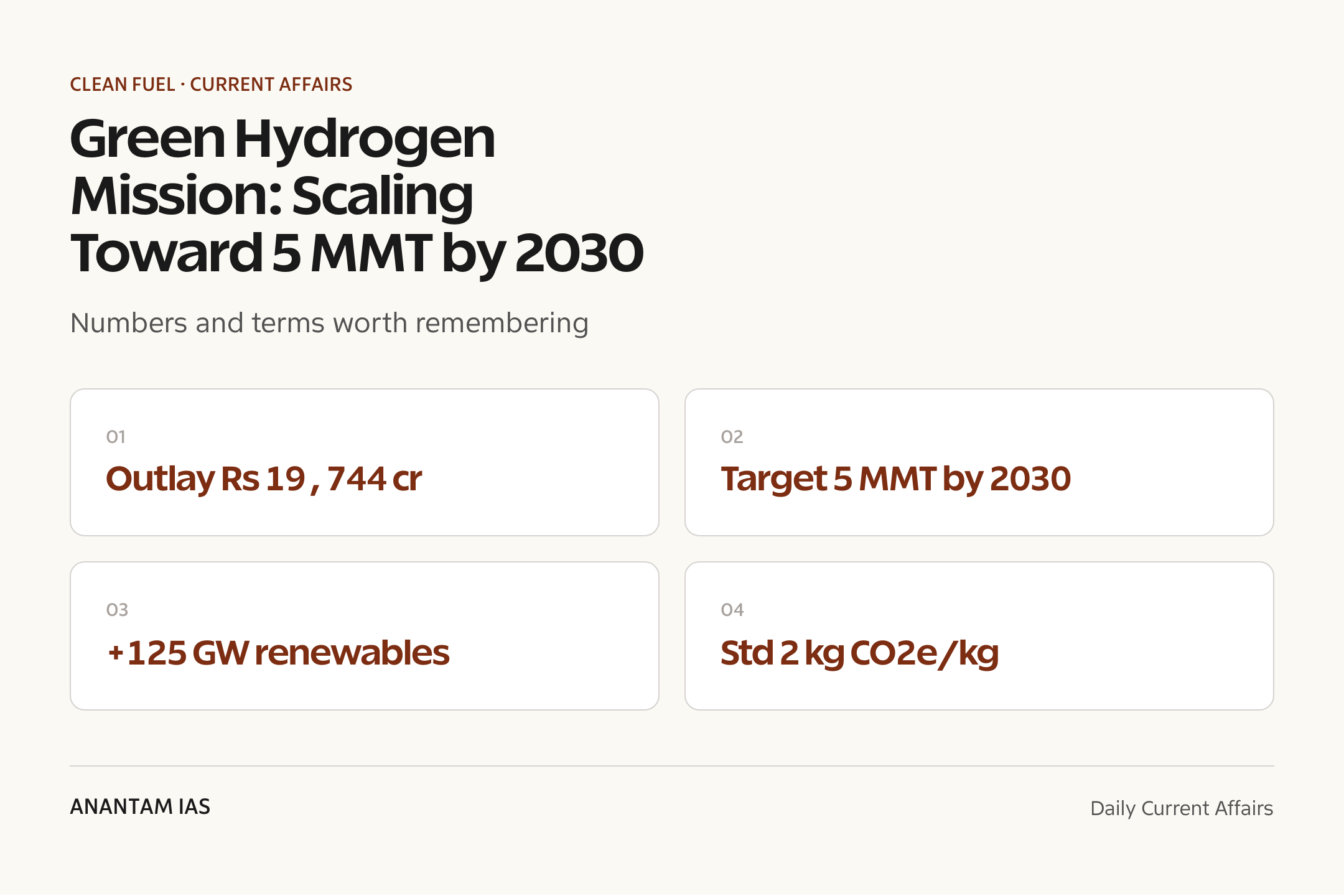
- Mission outlay of Rs 19,744 crore up to 2029-30; production target of 5 MMT/year by 2030 (expandable with exports).
- The SIGHT programme (Strategic Interventions for Green Hydrogen Transition) gives incentives for both electrolyser manufacturing and green-hydrogen production.
- Targeted co-benefits by 2030: about 125 GW of added renewable capacity, roughly Rs 8 lakh crore of investment, and large cuts in fossil-fuel imports.
- Green Hydrogen Hubs and pilot projects in steel, shipping, mobility and ports were being rolled out.
- MNRE notified a Green Hydrogen Standard capping emissions at 2 kg CO2-equivalent per kg of hydrogen (averaged) to qualify as ‘green’.
The development matters in the context of:
- Hydrogen is colour-coded by source: grey (from natural gas), blue (grey plus carbon capture), and green (renewable-powered electrolysis).
- India imports most of its crude oil and gas; domestic green hydrogen is pitched as both a decarbonisation and an energy-security lever.
UPSC Relevance
Prelims Relevance
- National Green Hydrogen Mission launched in January 2023; nodal ministry is MNRE.
- SIGHT has two components — incentives for electrolyser manufacturing and for green-hydrogen production.
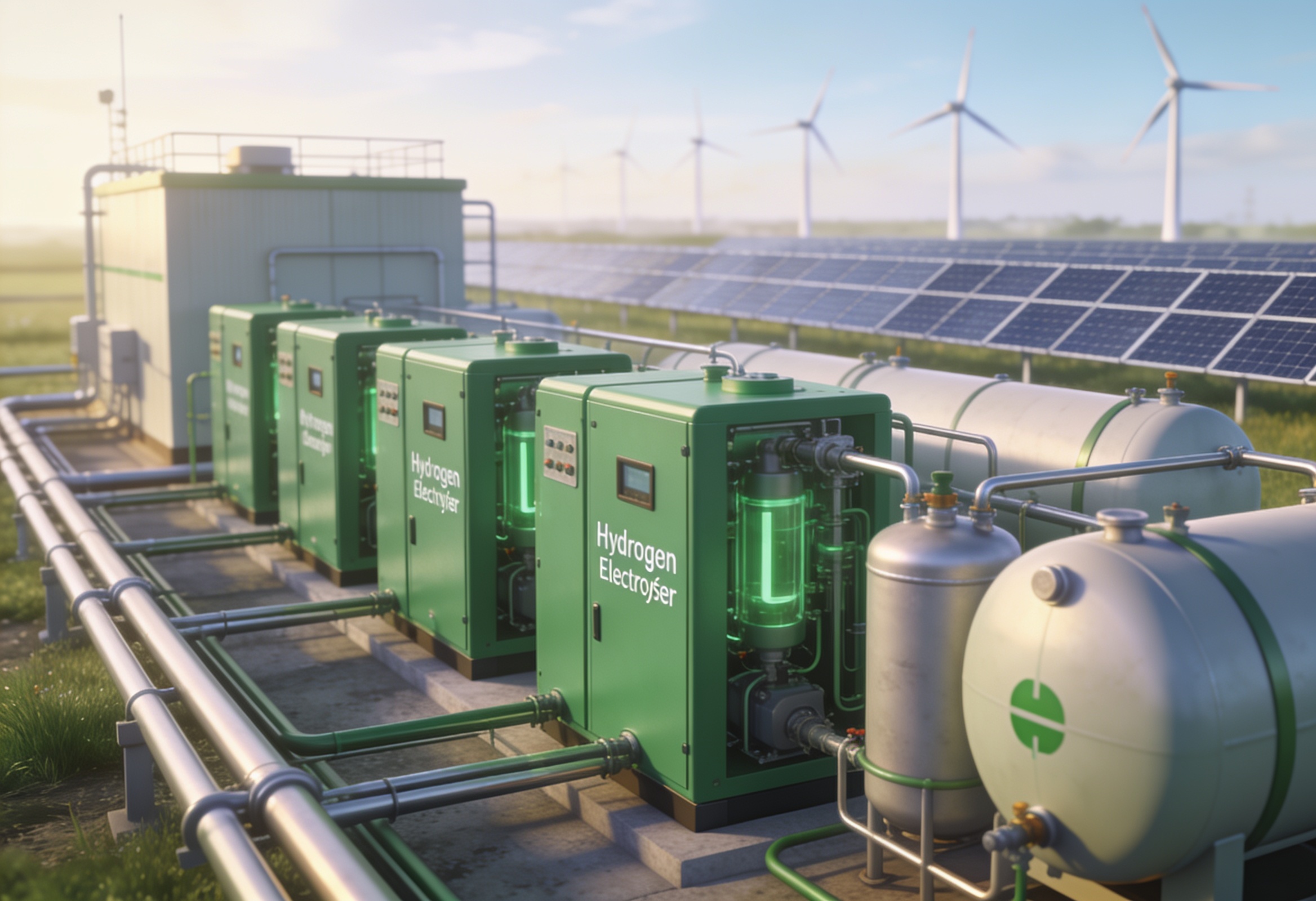
- Electrolysis splits water (H2O) into hydrogen and oxygen using electricity; renewable power makes it ‘green’.
- India’s Green Hydrogen Standard: emissions up to 2 kg CO2e/kg H2 qualify as green.
- Hydrogen carries high energy per unit mass and burns to water, emitting no CO2 at point of use.
- Hard-to-abate sectors targeted: steel, fertiliser (ammonia), refining, shipping, long-haul mobility.
- Green hydrogen links to ISTS waiver for renewable power used in production and to Green Hydrogen Hubs.
- Supports India’s Panchamrit goals and net-zero by 2070.
Mains Relevance
GS Paper 3
- Role of green hydrogen in decarbonising hard-to-abate sectors and improving energy security.
- Design and effectiveness of the SIGHT incentive scheme and the challenge of bringing down green-hydrogen costs.
GS Paper 2
- Mission-mode governance and centre-state-industry coordination in scaling a new energy technology.
Essay
- The next energy transition will be written in molecules as much as in electrons.
Background and Context
What green hydrogen is and why it matters
The ‘colour’ of hydrogen depends entirely on how it is made.
- Green hydrogen is produced by electrolysis of water using renewable electricity, so its production emits little or no carbon.
- Grey hydrogen (the bulk of today’s supply) is made from natural gas and is carbon-intensive; blue adds carbon capture.
- Hydrogen is an energy carrier, not a primary source — it stores and moves energy, and burns or reacts to produce only water.
- It is most valuable where direct electrification is hard: steel, ammonia/fertiliser, refining, shipping and heavy transport.
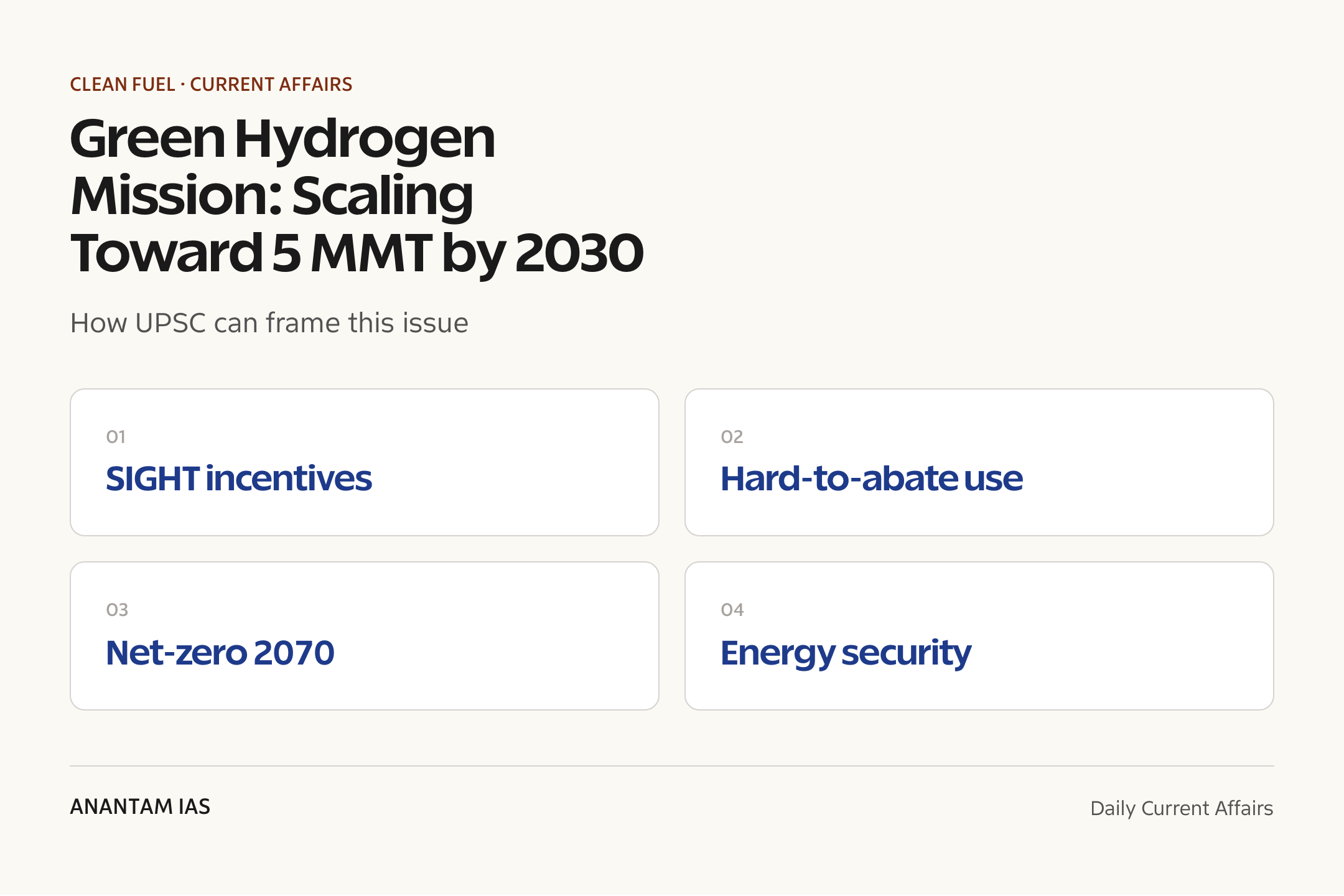
The Mission's design and targets
The Mission bundles production, manufacturing and demand creation.
- Approved in January 2023 with an outlay of Rs 19,744 crore up to 2029-30.
- Headline target: 5 MMT of green hydrogen a year by 2030, scalable upward with an export market.
- Expected to draw about 125 GW of new renewable capacity and roughly Rs 8 lakh crore of investment.
- Aims to cut greenhouse-gas emissions and reduce dependence on imported fossil fuels.
SIGHT and the incentive architecture
The SIGHT programme is the financial engine of the Mission.
- SIGHT (Strategic Interventions for Green Hydrogen Transition) runs two incentive tracks — one for electrolyser manufacturing, one for green-hydrogen production.
- Capacity is allocated through competitive bidding, with incentives tapering over the support period to drive down costs.
- Green Hydrogen Hubs co-locate production, storage and demand near ports and renewable-rich regions.
- An inter-state transmission system (ISTS) charge waiver lowers the cost of renewable power used to make hydrogen.
Pilots and sectoral deployment
Demand pilots are meant to seed early markets.
- Pilot projects span steel (hydrogen-based reduction), shipping, mobility (fuel-cell vehicles) and port ecosystems.
- Green ammonia for fertiliser and as a hydrogen carrier is a priority off-take route.
- A certification scheme verifies the ‘green’ credential against the notified standard.
- Skilling, R&D and standards round out the Mission’s supporting pillars.
The hurdles to scale
Cost and infrastructure remain the binding constraints.
- Green hydrogen is still costlier than grey hydrogen; closing the gap depends on cheaper electrolysers and renewable power.
- Large volumes of round-the-clock renewable energy and water are needed, raising siting and resource questions.
- Storage and transport of hydrogen are technically demanding, given its low volumetric density.
- Building domestic demand and bankable off-take contracts is essential to justify investment.
Way Forward
Drive down costs
- Scale electrolyser manufacturing and cheap renewable power to make green hydrogen cost-competitive.
- Use demand aggregation and purchase obligations in steel and fertiliser to anchor early markets.
Build the ecosystem
- Develop hubs, pipelines, storage and ports and a robust certification regime.
- Invest in R&D and skilling for the hydrogen value chain.
Position for exports
- Pursue green-ammonia and hydrogen export partnerships while securing domestic energy-security gains.
Conclusion
By the close of 2025 the National Green Hydrogen Mission had moved from announcement to execution — allocating production and electrolyser capacity, notifying standards, and seeding pilots in the sectors hardest to decarbonise.
Whether India hits 5 MMT by 2030 will hinge less on the target and more on cost: bringing green hydrogen to parity with grey hydrogen, building demand, and creating the infrastructure to move and store it. For the aspirant, the durable themes are the colour taxonomy of hydrogen, the SIGHT design, and the link between decarbonisation and energy security.
UPSC Practice Questions
Prelims MCQ 1
With reference to the National Green Hydrogen Mission, consider the following statements:
- Green hydrogen is produced by electrolysis of water using renewable electricity.
- The Mission is implemented by the Ministry of Petroleum and Natural Gas.
- The SIGHT programme provides incentives for both electrolyser manufacturing and green-hydrogen production.
How many of the above statements are correct?
(a) Only one (b) Only two (c) All three (d) None
Answer: (b) Only two
Explanation:
Statements 1 and 3 are correct. Statement 2 is wrong — the Mission is implemented by the Ministry of New and Renewable Energy (MNRE), not the Ministry of Petroleum and Natural Gas.
Prelims MCQ 2
Green hydrogen is considered especially useful for decarbonising which of the following ‘hard-to-abate’ sectors?
(a) Steel and fertiliser (ammonia) production (b) Household lighting (c) Rooftop solar generation (d) Urban water supply
Answer: (a) Steel and fertiliser (ammonia) production
Explanation:
Steel making and ammonia/fertiliser production are classic hard-to-abate sectors that are difficult to electrify directly, making them prime candidates for green hydrogen.
UPSC Mains Questions
- Green hydrogen is being positioned as the keystone of India’s deep decarbonisation. Examine the design of the National Green Hydrogen Mission and the principal barriers to achieving its 2030 production target.
- Discuss how green hydrogen can advance both India’s climate commitments and its energy security, and assess the policy support required to make it cost-competitive.
Sources: Ministry of New and Renewable Energy (MNRE) and PIB, Ministry of New and Renewable Energy.
Frequently Asked Questions
What is the National Green Hydrogen Mission?
Launched in January 2023 by the Ministry of New and Renewable Energy with an outlay of Rs 19,744 crore, it is India’s flagship programme to make the country a global hub for green-hydrogen production, use and export, with a target of 5 million tonnes of annual production by 2030.
What is green hydrogen?
Green hydrogen is hydrogen made by splitting water through electrolysis using renewable electricity, so its production releases little or no carbon dioxide. It differs from grey hydrogen, which is made from natural gas, and blue hydrogen, which adds carbon capture.
What is the SIGHT scheme?
SIGHT stands for Strategic Interventions for Green Hydrogen Transition. It is the Mission’s main financial instrument, offering incentives along two tracks: one for manufacturing electrolysers and one for producing green hydrogen, with capacity allocated through competitive bidding.
Why is green hydrogen important for India?
It can decarbonise hard-to-abate sectors such as steel, fertiliser, refining and shipping that are difficult to electrify, while cutting India’s heavy dependence on imported fossil fuels. It is central to the net-zero-by-2070 pathway and energy security.
What are the main challenges to scaling green hydrogen?
The biggest hurdle is cost — green hydrogen remains more expensive than grey hydrogen. Other challenges include the need for abundant round-the-clock renewable power and water, the difficulty of storing and transporting hydrogen, and building reliable domestic demand.
What is the Green Hydrogen Standard in India?
MNRE has notified a standard under which hydrogen qualifies as ‘green’ only if its production emits no more than 2 kg of carbon-dioxide-equivalent per kilogram of hydrogen, measured on an averaged basis. A certification scheme verifies compliance.
Source: https://anantamias.com/current-affairs/national-green-hydrogen-mission-scaleup-2025/