Why in News?
Through late 2025 the National Green Hydrogen Mission, run by the Ministry of New and Renewable Energy (MNRE), was steadily scaling up its build-out of electrolyser manufacturing and green-hydrogen production capacity, with fresh allocations under its incentive scheme and pilot projects in hard-to-abate sectors.
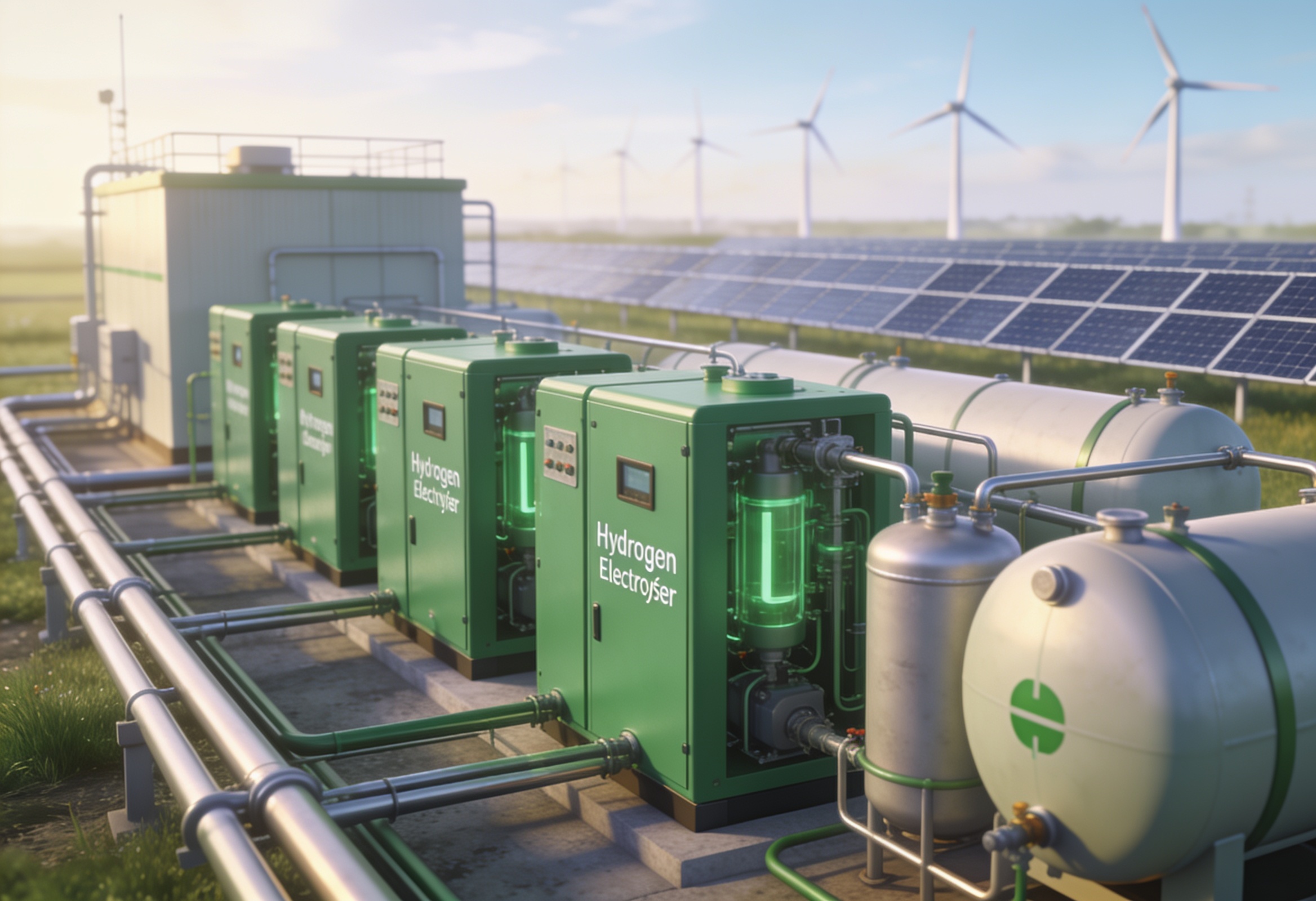
The Mission, approved in January 2023 with an outlay of Rs 19,744 crore, targets annual green-hydrogen production of 5 million tonnes (MMT) by 2030. Green hydrogen — made by splitting water through electrolysis powered by renewable electricity — is central to decarbonising sectors that cannot easily run on electricity and to India’s net-zero-by-2070 pathway.
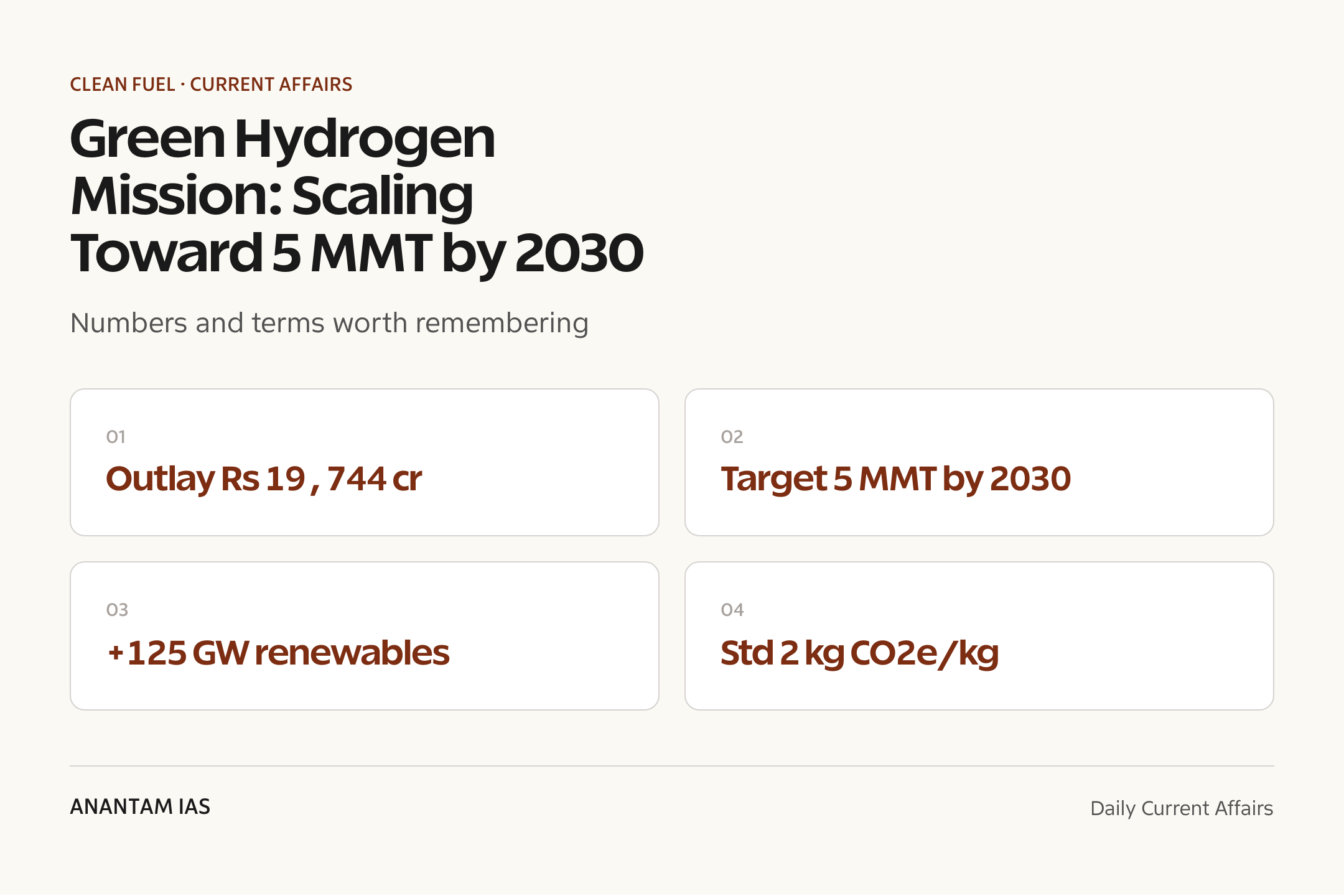
- Mission outlay of Rs 19,744 crore up to 2029-30; production target of 5 MMT/year by 2030 (expandable with exports).
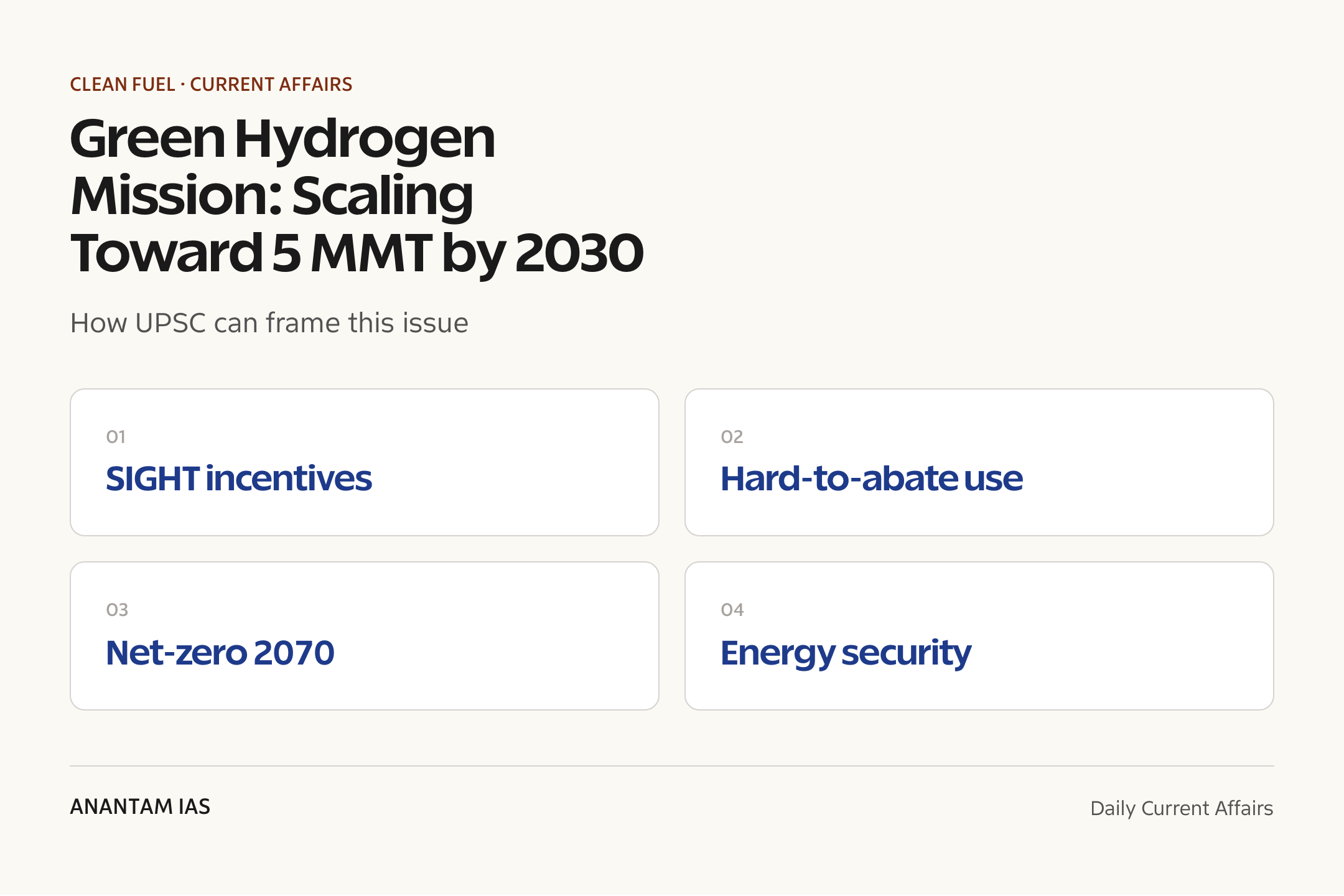
- The SIGHT programme (Strategic Interventions for Green Hydrogen Transition) gives incentives for both electrolyser manufacturing and green-hydrogen production.
- Targeted co-benefits by 2030: about 125 GW of added renewable capacity, roughly Rs 8 lakh crore of investment, and large cuts in fossil-fuel imports.
- Green Hydrogen Hubs and pilot projects in steel, shipping, mobility and ports were being rolled out.
- MNRE notified a Green Hydrogen Standard capping emissions at 2 kg CO2-equivalent per kg of hydrogen (averaged) to qualify as ‘green’.
The development matters in the context of:
- Hydrogen is colour-coded by source: grey (from natural gas), blue (grey plus carbon capture), and green (renewable-powered electrolysis).
- India imports most of its crude oil and gas; domestic green hydrogen is pitched as both a decarbonisation and an energy-security lever.
UPSC Relevance
Prelims Relevance
- National Green Hydrogen Mission launched in January 2023; nodal ministry is MNRE.
- SIGHT has two components — incentives for electrolyser manufacturing and for green-hydrogen production.
- Electrolysis splits water (H2O) into hydrogen and oxygen using electricity; renewable power makes it ‘green’.
- India’s Green Hydrogen Standard: emissions up to 2 kg CO2e/kg H2 qualify as green.
- Hydrogen carries high energy per unit mass and burns to water, emitting no CO2 at point of use.
- Hard-to-abate sectors targeted: steel, fertiliser (ammonia), refining, shipping, long-haul mobility.
- Green hydrogen links to ISTS waiver for renewable power used in production and to Green Hydrogen Hubs.
- Supports India’s Panchamrit goals and net-zero by 2070.
Mains Relevance
GS Paper 3
- Role of green hydrogen in decarbonising hard-to-abate sectors and improving energy security.
- Design and effectiveness of the SIGHT incentive scheme and the challenge of bringing down green-hydrogen costs.
GS Paper 2
- Mission-mode governance and centre-state-industry coordination in scaling a new energy technology.
Essay
- The next energy transition will be written in molecules as much as in electrons.
Background and Context
What green hydrogen is and why it matters
The ‘colour’ of hydrogen depends entirely on how it is made.
- Green hydrogen is produced by electrolysis of water using renewable electricity, so its production emits little or no carbon.
- Grey hydrogen (the bulk of today’s supply) is made from natural gas and is carbon-intensive; blue adds carbon capture.
- Hydrogen is an energy carrier, not a primary source — it stores and moves energy, and burns or reacts to produce only water.
- It is most valuable where direct electrification is hard: steel, ammonia/fertiliser, refining, shipping and heavy transport.
The Mission's design and targets
The Mission bundles production, manufacturing and demand creation.
- Approved in January 2023 with an outlay of Rs 19,744 crore up to 2029-30.
- Headline target: 5 MMT of green hydrogen a year by 2030, scalable upward with an export market.
- Expected to draw about 125 GW of new renewable capacity and roughly Rs 8 lakh crore of investment.
- Aims to cut greenhouse-gas emissions and reduce dependence on imported fossil fuels.
SIGHT and the incentive architecture
The SIGHT programme is the financial engine of the Mission.
- SIGHT (Strategic Interventions for Green Hydrogen Transition) runs two incentive tracks — one for electrolyser manufacturing, one for green-hydrogen production.
- Capacity is allocated through competitive bidding, with incentives tapering over the support period to drive down costs.
- Green Hydrogen Hubs co-locate production, storage and demand near ports and renewable-rich regions.
- An inter-state transmission system (ISTS) charge waiver lowers the cost of renewable power used to make hydrogen.
Pilots and sectoral deployment
Demand pilots are meant to seed early markets.
- Pilot projects span steel (hydrogen-based reduction), shipping, mobility (fuel-cell vehicles) and port ecosystems.
- Green ammonia for fertiliser and as a hydrogen carrier is a priority off-take route.
- A certification scheme verifies the ‘green’ credential against the notified standard.
- Skilling, R&D and standards round out the Mission’s supporting pillars.
The hurdles to scale
Cost and infrastructure remain the binding constraints.
- Green hydrogen is still costlier than grey hydrogen; closing the gap depends on cheaper electrolysers and renewable power.
- Large volumes of round-the-clock renewable energy and water are needed, raising siting and resource questions.
- Storage and transport of hydrogen are technically demanding, given its low volumetric density.
- Building domestic demand and bankable off-take contracts is essential to justify investment.
Way Forward
Drive down costs
- Scale electrolyser manufacturing and cheap renewable power to make green hydrogen cost-competitive.
- Use demand aggregation and purchase obligations in steel and fertiliser to anchor early markets.
Build the ecosystem
- Develop hubs, pipelines, storage and ports and a robust certification regime.
- Invest in R&D and skilling for the hydrogen value chain.
Position for exports
- Pursue green-ammonia and hydrogen export partnerships while securing domestic energy-security gains.
Conclusion
By the close of 2025 the National Green Hydrogen Mission had moved from announcement to execution — allocating production and electrolyser capacity, notifying standards, and seeding pilots in the sectors hardest to decarbonise.
Whether India hits 5 MMT by 2030 will hinge less on the target and more on cost: bringing green hydrogen to parity with grey hydrogen, building demand, and creating the infrastructure to move and store it. For the aspirant, the durable themes are the colour taxonomy of hydrogen, the SIGHT design, and the link between decarbonisation and energy security.
UPSC Practice Questions
Prelims MCQ 1
With reference to the National Green Hydrogen Mission, consider the following statements:
- Green hydrogen is produced by electrolysis of water using renewable electricity.
- The Mission is implemented by the Ministry of Petroleum and Natural Gas.
- The SIGHT programme provides incentives for both electrolyser manufacturing and green-hydrogen production.
How many of the above statements are correct?
(a) Only one (b) Only two (c) All three (d) None
Answer: (b) Only two
Explanation:
Statements 1 and 3 are correct. Statement 2 is wrong — the Mission is implemented by the Ministry of New and Renewable Energy (MNRE), not the Ministry of Petroleum and Natural Gas.
Prelims MCQ 2
Green hydrogen is considered especially useful for decarbonising which of the following ‘hard-to-abate’ sectors?
(a) Steel and fertiliser (ammonia) production (b) Household lighting (c) Rooftop solar generation (d) Urban water supply
Answer: (a) Steel and fertiliser (ammonia) production
Explanation:
Steel making and ammonia/fertiliser production are classic hard-to-abate sectors that are difficult to electrify directly, making them prime candidates for green hydrogen.
UPSC Mains Questions
- Green hydrogen is being positioned as the keystone of India’s deep decarbonisation. Examine the design of the National Green Hydrogen Mission and the principal barriers to achieving its 2030 production target.
- Discuss how green hydrogen can advance both India’s climate commitments and its energy security, and assess the policy support required to make it cost-competitive.
Sources: Ministry of New and Renewable Energy (MNRE) and PIB, Ministry of New and Renewable Energy.
Frequently Asked Questions
What is the National Green Hydrogen Mission?
Launched in January 2023 by the Ministry of New and Renewable Energy with an outlay of Rs 19,744 crore, it is India’s flagship programme to make the country a global hub for green-hydrogen production, use and export, with a target of 5 million tonnes of annual production by 2030.
What is green hydrogen?
Green hydrogen is hydrogen made by splitting water through electrolysis using renewable electricity, so its production releases little or no carbon dioxide. It differs from grey hydrogen, which is made from natural gas, and blue hydrogen, which adds carbon capture.
What is the SIGHT scheme?
SIGHT stands for Strategic Interventions for Green Hydrogen Transition. It is the Mission’s main financial instrument, offering incentives along two tracks: one for manufacturing electrolysers and one for producing green hydrogen, with capacity allocated through competitive bidding.
Why is green hydrogen important for India?
It can decarbonise hard-to-abate sectors such as steel, fertiliser, refining and shipping that are difficult to electrify, while cutting India’s heavy dependence on imported fossil fuels. It is central to the net-zero-by-2070 pathway and energy security.
What are the main challenges to scaling green hydrogen?
The biggest hurdle is cost — green hydrogen remains more expensive than grey hydrogen. Other challenges include the need for abundant round-the-clock renewable power and water, the difficulty of storing and transporting hydrogen, and building reliable domestic demand.
What is the Green Hydrogen Standard in India?
MNRE has notified a standard under which hydrogen qualifies as ‘green’ only if its production emits no more than 2 kg of carbon-dioxide-equivalent per kilogram of hydrogen, measured on an averaged basis. A certification scheme verifies compliance.
Tell Google you want more of this.
Add Anantam IAS as a preferred sourceOne tap, and this site shows up more often in your own Top Stories, AI Overviews and AI Mode. Remove it any time.