Daily Digest
UPSC · Civil Services Examination
Current Affairs · Wednesday, 29 April 2026
Current affairs curated and edited by Anantam IAS faculty — pulled from The Hindu, PIB, IDSA, Foreign Affairs and the ministries. Read, annotate, revise.
Old Rajinder Nagar · Delhi 110005 · anantamias.com
Kaleshwaram Project Controversy: Governance, Accountability and Infrastructure Challenges
Why in News?
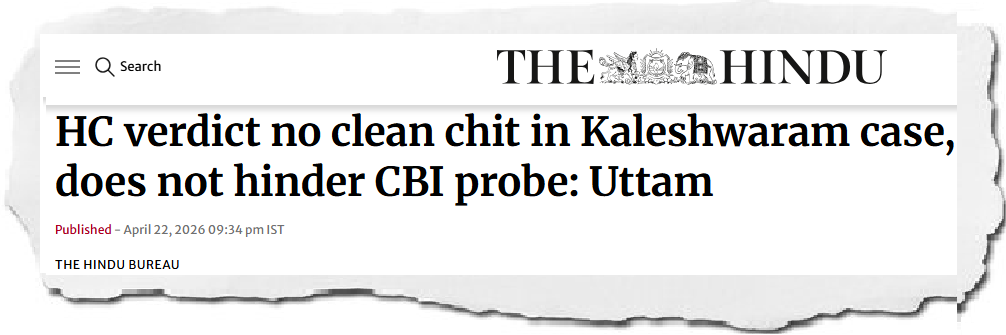
The Telangana High Court upheld the validity of the Commission of Inquiry into the Kaleshwaram Lift Irrigation Project, while clarifying that its findings do not prevent further investigation, including a proposed probe by the Central Bureau of Investigation.
UPSC Relevance
GS-II: Governance, Accountability, Statutory Bodies
GS-III: Infrastructure, Water Resources, Disaster Management
About Kaleshwaram Lift Irrigation Project (KLIP)
- One of the largest multi-stage lift irrigation projects in the world
- Built on the Godavari River in Telangana
- Objective:
- Irrigation support
- Drinking water supply
- Industrial use
- Key component:
- Series of barrages, including Medigadda
Institutional Framework
1. Commission of Inquiry
- Set up under the Commissions of Inquiry Act, 1952
- Purpose:
- Investigate alleged irregularities
- Examine project execution and failures
2. Role of Judiciary
- High Court upheld:
- Legality of the Commission
- Clarified:
- Commission findings alone cannot be the sole basis for punitive action without due process
What are the Key Issues Highlighted?
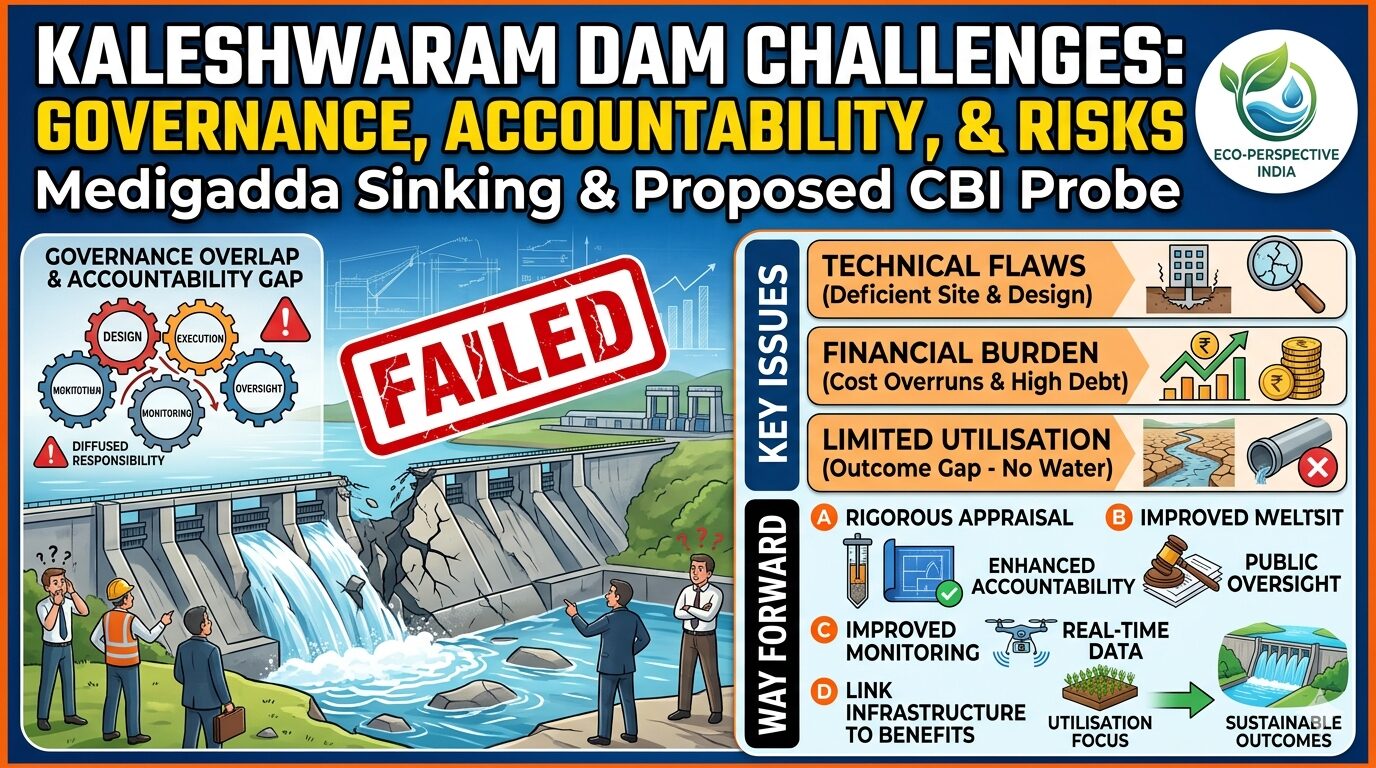
1. Structural and Technical Concerns
- Reports indicate deficiencies in:
- Site selection
- Design
- Construction quality
- Maintenance
The sinking of a portion of the Medigadda barrage points to serious engineering lapses, raising concerns about infrastructure safety.
2. Financial Burden
- Annual debt servicing estimated at ₹15,000–20,000 crore
- Limited or no operational output in recent years
This raises questions about:
- Cost-benefit analysis
- Fiscal sustainability of large infrastructure projects
3. Governance and Accountability Deficit
Multiple agencies, including:
- National Dam Safety Authority
- Vigilance bodies
have flagged irregularities, indicating:
- Weak oversight mechanisms
- Possible lapses in project monitoring
4. Role of Investigative Agencies
The proposed CBI probe reflects:
- Need for independent investigation
- Ensuring accountability in public expenditure
5. Infrastructure vs Outcome Gap
Despite massive investment:
- Limited utilisation (no water lifting in recent period)
This highlights a broader issue in India:
- Focus on project creation rather than long-term performance and sustainability
What are the Broader Issues Involved?
1. Challenges in Large Infrastructure Projects
- Cost overruns
- Delays
- Technical flaws
- Weak feasibility assessment
2. Institutional Overlap and Coordination
Multiple bodies involved in:
- Design
- Execution
- Monitoring
Often leads to:
- Diffused accountability
3. Environmental and Safety Concerns
Large irrigation projects may:
- Alter river ecosystems
- Pose structural risks if poorly designed
4. Public Finance Implications
Heavy borrowing for such projects can:
- Strain state finances
- Reduce fiscal space for welfare spending
Way Forward
1. Strengthening Pre-Project Appraisal
All major infrastructure projects should undergo:
- Rigorous feasibility studies
- Independent technical evaluation
- Environmental and social impact assessments
This will reduce risks of flawed design and execution.
2. Enhancing Institutional Accountability
Clear allocation of responsibility at each stage of the project lifecycle is necessary. Independent auditing mechanisms should regularly review:
- Financial management
- Technical quality
3. Improving Project Monitoring
Real-time monitoring using technology and third-party audits can help detect:
- Structural weaknesses
- Implementation gaps
at an early stage.
4. Ensuring Transparency and Public Oversight
Making project data publicly accessible can:
- Improve accountability
- Enable expert scrutiny
5. Strengthening Dam Safety and Regulation
Institutions like the National Dam Safety Authority should be empowered with:
- Greater enforcement powers
- Mandatory compliance mechanisms
6. Linking Infrastructure to Outcomes
Evaluation of projects should focus not just on completion, but on:
- Actual utilisation
- Economic and social benefits
Conclusion
The Kaleshwaram project highlights critical challenges in India’s infrastructure development model, including issues of planning, execution, and accountability. Strengthening institutional mechanisms, ensuring transparency, and prioritising outcomes over mere project completion are essential to prevent such instances and ensure efficient use of public resources.
Practice Questions
Prelims
- With reference to the Commissions of Inquiry Act, 1952, consider the following statements:
- It empowers the Central Government to set up commissions to investigate matters of public importance.
- The findings of such commissions are legally binding.
- State Governments can also set up such commissions.
Which of the statements given above is/are correct?
(a) 1 only
(b) 1 and 3 only
(c) 2 and 3 only
(d) 1, 2 and 3
Answer: (b)
Mains
- Discuss the governance and accountability challenges associated with large infrastructure projects in India, with suitable examples.
- “Infrastructure development must prioritise long-term sustainability over short-term gains.” Analyse.
India’s post-LWE future, from red sun to new dawn
Why in News?
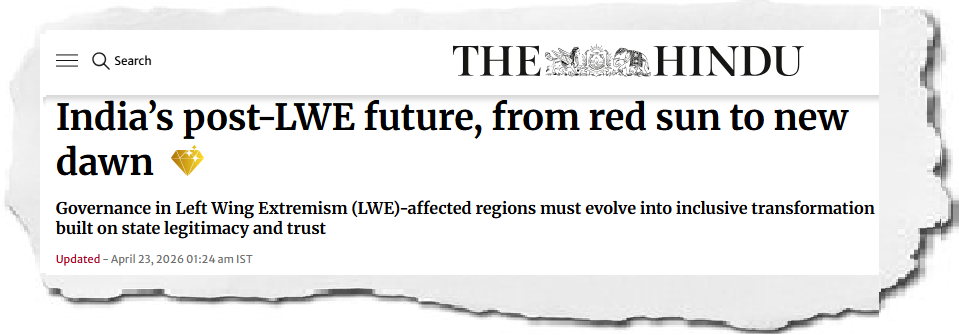
The Union government has indicated that India has largely overcome the threat of Left Wing Extremism (LWE). This marks a transition from a phase dominated by security operations to one focused on governance, development, and long-term stability in affected regions.
UPSC Relevance
GS-II: Governance, Federalism, Welfare Delivery
GS-III: Internal Security, Inclusive Development, Tribal Issues
What is Left Wing Extremism (LWE)?
Left Wing Extremism is an insurgency influenced by ideologies such as Maoism, operating mainly in tribal and forested regions. It emerged due to deep-rooted issues like land alienation, lack of development, and weak state presence. These areas, often called the “Red Corridor,” witnessed parallel authority structures due to governance gaps.
Evolution of LWE in India
Peak Phase of Violence
During the late 2000s, LWE posed a serious internal security threat. The Dantewada Maoist attack 2010 reflected the intensity of insurgent violence and exposed gaps in intelligence and preparedness.
Decline Phase
Over the past decade, violence has declined due to better coordination between the Centre and States, improved intelligence, and sustained security operations. Development programmes in affected districts also helped reduce local support for insurgents.
Security vs Governance
Security measures help restore order, but they do not address underlying grievances. Sustainable peace depends on whether governance delivers justice, development, and dignity. Without this transition, the risk of relapse into conflict remains.
Major Challenges in Post-LWE Regions
1. Weak Governance Presence
In many remote tribal areas, the administrative machinery has historically been absent or inconsistent. This leads to poor delivery of essential services like healthcare, education, and welfare schemes, weakening citizens’ trust in the state.
2. Limited Economic Opportunities
Local economies remain underdeveloped, relying heavily on forest produce and subsistence agriculture. Due to lack of infrastructure, market linkages, and value addition, people earn low incomes and often migrate for work.
3. Tribal Marginalisation and Rights Issues
Despite legal protections like the Forest Rights Act 2006, many tribal communities struggle to secure land and forest rights. Delays in implementation create insecurity and reduce faith in governance systems.
4. Trust Deficit with the State
Years of conflict have created fear and suspicion towards institutions. Even when violence declines, rebuilding trust requires consistent engagement, transparency, and respectful treatment of local communities.
5. Gaps in Justice Delivery
Many individuals from these regions remain undertrials, often for minor offences. Delays in legal processes and lack of legal awareness further alienate communities and weaken the rule of law.
What Has Worked So Far?
Area-Based Development Models
Targeted initiatives in regions like Bastar, Malkangiri, and Jungle Mahal have shown that sustained administrative presence and focused development can reduce vulnerability and improve outcomes over time.
Key Government Initiatives
- The Aspirational Districts Programme has improved governance through real-time monitoring and targeted interventions in backward districts.
- The PM-JANMAN focuses on the development of Particularly Vulnerable Tribal Groups, addressing deep-rooted exclusion.
Post-LWE Transformation: Key Priorities
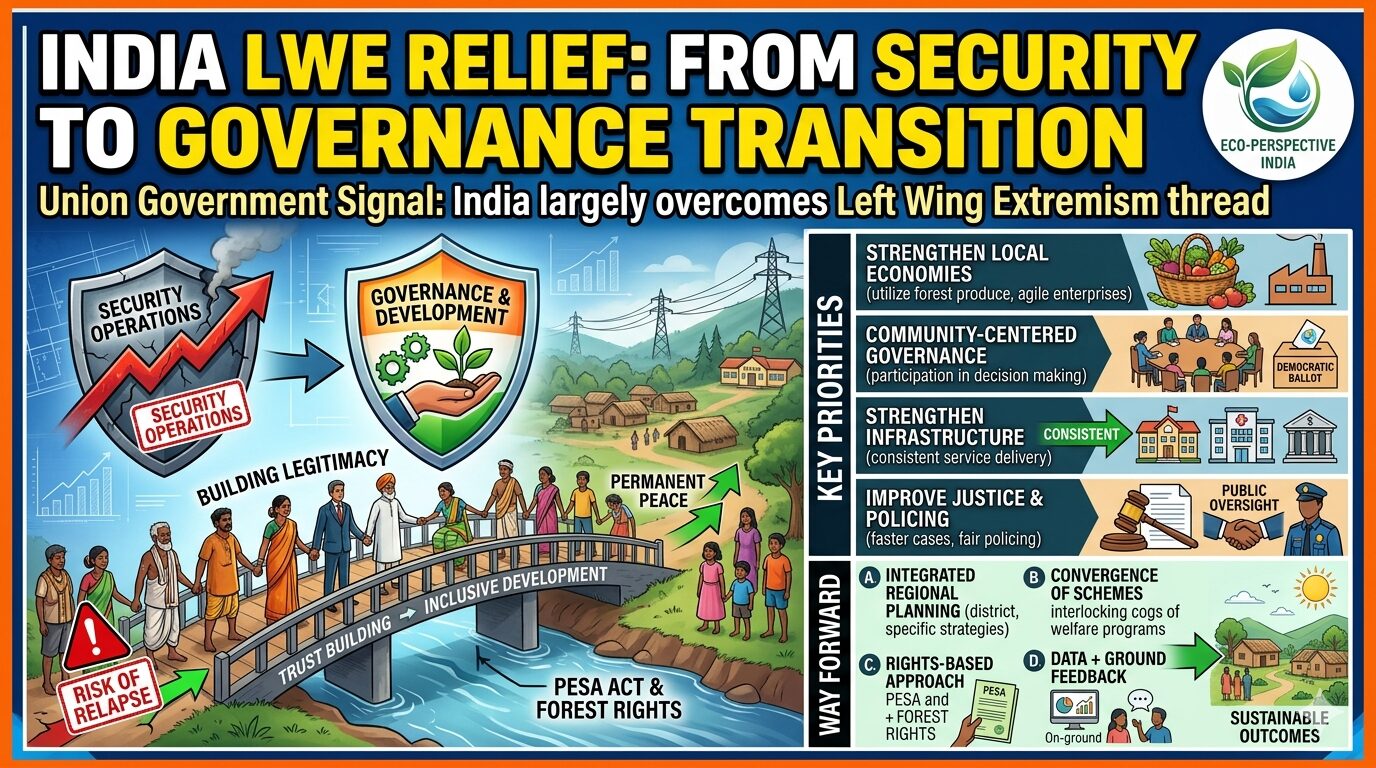
1. Building Local Economies
Development should focus on strengthening local livelihoods through better utilisation of forest produce, agroforestry, and small enterprises. Creating value chains within the region can generate employment and reduce migration.
2. Community-Centred Governance
People should be treated as stakeholders in development rather than passive recipients. Participation in decision-making improves policy effectiveness and strengthens democratic legitimacy.
3. Strengthening Infrastructure and Services
Reliable access to roads, schools, healthcare, and banking is essential for both development and trust-building. Consistent delivery of these services signals the presence and credibility of the state.
4. Empowering Local Institutions
Effective implementation of decentralisation laws like the PESA Act 1996 can give tribal communities control over local governance and resource management, strengthening grassroots democracy.
5. Improving Justice and Policing
A more humane and accessible justice system is required, including faster case disposal, legal aid, and review of long-pending undertrial cases. Fair and transparent policing is key to rebuilding trust.
6. Investing in Youth Aspirations
Providing opportunities in education, skill development, and sports can channel the energy of youth towards constructive activities. This reduces vulnerability to extremist ideologies and builds long-term stability.
Way Forward
- Integrated Regional Planning
Post-LWE regions require district-specific strategies that combine security, development, and governance. A one-size-fits-all approach may not work due to varying local conditions.
2. Convergence of Schemes
India has multiple welfare schemes, but their impact is often diluted due to fragmented implementation. Converging schemes at the local level can ensure better resource utilisation and outcomes.
3. Rights-Based Approach
Ensuring effective implementation of rights-based laws, especially those related to land and forests, is essential for empowering tribal communities and addressing root causes of discontent.
4. Sustained Administrative Presence
Development should not be episodic. Continuous engagement by the administration builds trust and ensures that gains from security operations are not reversed.
5. Data + Ground Feedback
While data-driven monitoring is important, it must be complemented with on-ground feedback. Policies should reflect the lived experiences of people, not just statistical indicators.
Conclusion
India’s success in reducing Left Wing Extremism is a major milestone, but it is only the beginning of a more complex phase. The real challenge lies in transforming these regions through inclusive development, effective governance, and restoration of trust. The shift from security to legitimacy will determine whether peace becomes permanent.
Practice Questions
Prelims
- With reference to Left Wing Extremism (LWE) in India, consider the following statements:
- It is primarily concentrated in tribal and forested regions.
- The Forest Rights Act, 2006 seeks to address some of the root causes of LWE.
- LWE ideology is unrelated to Maoism.
Which of the statements given above is/are correct?
(a) 1 and 2 only
(b) 2 only
(c) 1 and 3 only
(d) 1, 2 and 3
Answer: (a)
Mains
- Security operations can reduce extremism, but governance sustains peace. Discuss in the context of Left Wing Extremism in India.
- Examine the challenges in transitioning from conflict management to development in LWE-affected regions.
- Discuss the role of tribal rights and decentralised governance in addressing internal security challenges.
Source: https://anantamias.com/current-affairs/indias-post-lwe-future-from-red-sun-to-new-dawn/
Fight to Eliminate Cervical Cancer
Why in News?
India now joins 160+ countries offering HPV vaccination as part of national immunisation programmes, advancing global efforts to eliminate cervical cancer.
India has launched a nationwide Human Papillomavirus (HPV) vaccination campaign from Ajmer, Rajasthan, on 28 February 2026, marking a major milestone in India’s fight against cervical cancer.
| UPSC Relevance: GS-2 Social Justice: Health; GS-3 Science and Technology: Biology and Biotechnology Prelims: Cervical Cancer; HPV, CERVAVAC, National HPV Vaccination Campaign, WHO 90-70-90 Strategy, Universal Immunisation Programme (UIP), U-WIN Platform |
Cervical cancer is the second most common cause of cancer deaths among Indian women, following breast cancer. India contributes to nearly one-fourth of the world’s cervical cancer cases. Persistent infection with high risk strains of the Human Papillomavirus (HPV) is the cause of cervical cancer.
What is Human Papillomavirus (HPV)?
- Human papillomavirus (HPV) is a small, double-stranded DNA virus that is associated with cancers of the cervix, vulva, vagina, penis, anus, and throat, and genital warts.
- It infects both men and women and accounts for nearly 5% of cancers globally.
- It is primarily transmitted through intimate skin-to-skin contact, including vaginal, anal, and oral sex. Most infections are cleared naturally by the immune system, but persistent infection with high-risk strains (especially HPV-16 and 18) can lead to cancer.
Can Human Papillomavirus (HPV) infection be cured?
- There is no cure for HPV infection at present.
- HPV vaccines can prevent HPV-related cancers by inducing immunity before exposure.
- HPV vaccines are prophylactic, i.e., they are designed to prevent infection, and not treat existing HPV or HPV-related cancers.
- They work by using virus-like particles (which contain no DNA) to stimulate the body to produce antibodies that neutralise the virus before it can cause cancer.
HPV Vaccine and Cervical Cancer:
- HPV vaccines are 93-100% effective in preventing cervical cancer caused by vaccine-covered HPV types. There have been no negative effects on reproductive performance, fertility rates, congenital malformations or menstrual patterns.
- India’s Indigenous Vaccine ‘CERVAVAC’: Developed by the Serum Institute of India. First indigenously developed HPV vaccine. India’s first Quadrivalent HPV vaccine. It prevents the entry of four of the most common HPV types: 16, 18, 6, and 11. Expected to reduce vaccine costs.
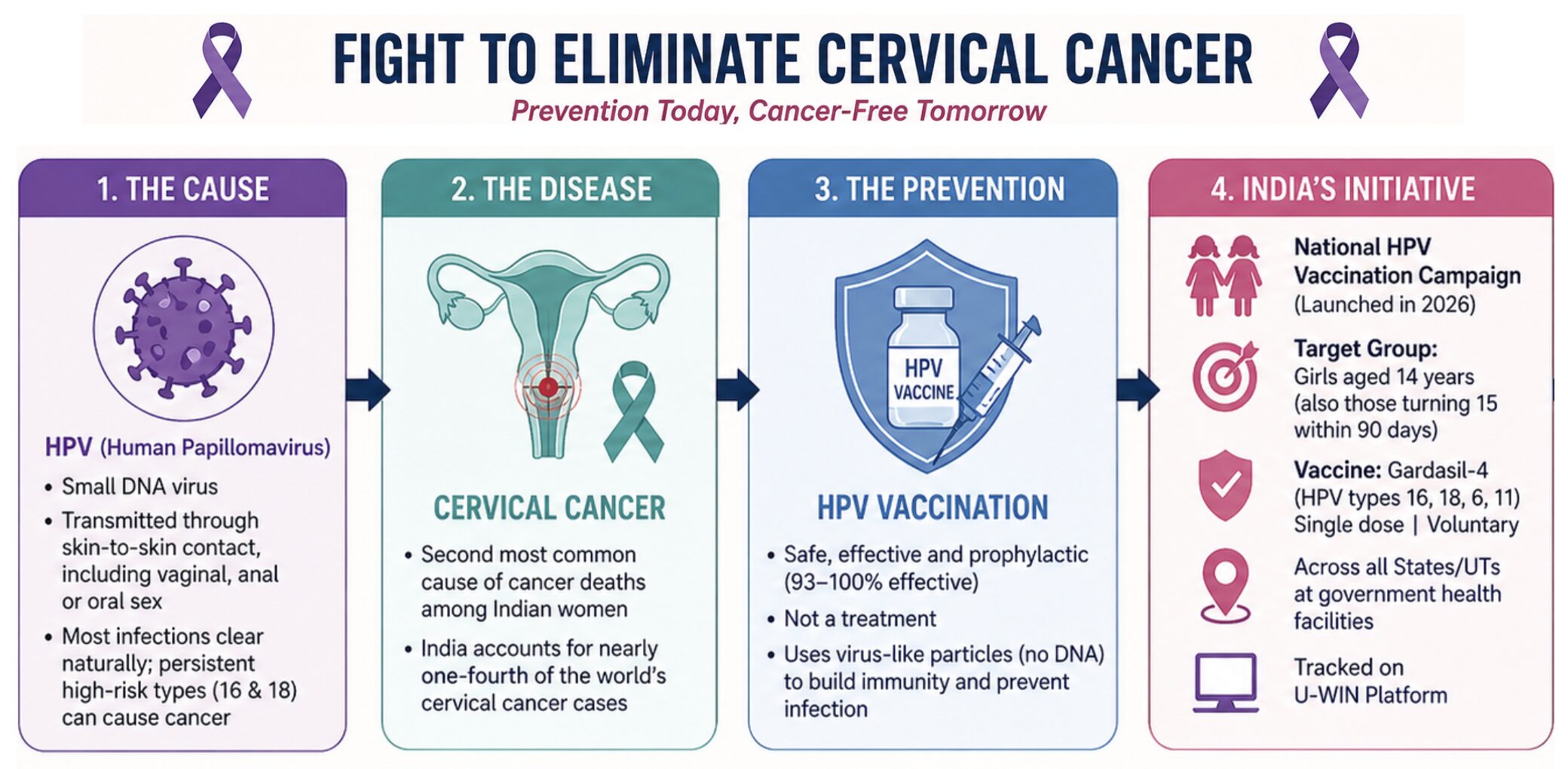
National HPV Vaccination Campaign:
- Launched: 2026
- Target Group: Girls aged 14 years (also those turning 15 within 90 days).
- Coverage: Free of cost vaccine to ~1.15 crore girls across all States/UTs.
- Vaccine Used: Gardasil-4, a quadrivalent vaccine that protects against HPV types 16, 18, 6, and 11, produced by Merck; Single dose.
- Nature: Voluntary. Targeted campaign focuses on girls aged 14 at designated government health facilities.
- Tracking Platform: U-WIN digital platform to ensure rapid coverage.
- Delivery Points: Ayushman Arogya Mandirs, PHCs, CHCs, District Hospitals
WHO’s Cervical Cancer Elimination Initiative:
- In 2018, the WHO announced its Cervical Cancer Elimination Initiative.
- The official “Global Strategy to Accelerate the Elimination of Cervical Cancer” was passed in 2020 by 194 member states (including India).
- The Goal: To reduce cervical cancer incidence to less than 4 per 1,00,000 women.
- The 90-70-90 Targets (by 2030):
- 90% of girls vaccinated against HPV before age 15
- 70% of women screened with an HPV test at ages 35 and 45
- 90% of those detected with lesions receive treatment
Practice MCQ:
Q. Consider the following statements:
1. HPV vaccines use live attenuated virus to generate an immune response.
2. Cervavac is India’s first indigenously developed HPV vaccine.
3. The National HPV Vaccination Campaign is mandatory for all eligible beneficiaries.
Which of the statements given above is/are correct?
(a) 1 and 2 only
(b) 2 only
(c) 1 and 3 only
(d) 2 and 3 only
Answer: (b) Explanation: HPV vaccines do not use live attenuated virus. They are subunit vaccines that consist of highly purified virus-like particles (VLPs) that mimic the virus’s outer shell to elicit an immune response. The vaccines lack the virus’s DNA; they are safe and cannot cause HPV infection.
UPSC PYQ 2020
Q. What is the importance of using Pneumococcal Conjugate Vaccines in India?
1. These vaccines are effective against pneumonia as well as meningitis and sepsis.
2. Dependence on antibiotics that are not effective against drug-resistant bacteria can be reduced.
3. These vaccines have no side effects and cause no allergic reactions.
Select the correct answer using the code given below:
(a) 1 only
(b) 1 and 2 only
(c) 3 only
(d) 1, 2 and 3
Answer: (b)
Source: https://anantamias.com/current-affairs/fight-to-eliminate-cervical-cancer/