Why in News?
India now joins 160+ countries offering HPV vaccination as part of national immunisation programmes, advancing global efforts to eliminate cervical cancer.
India has launched a nationwide Human Papillomavirus (HPV) vaccination campaign from Ajmer, Rajasthan, on 28 February 2026, marking a major milestone in India’s fight against cervical cancer.
| UPSC Relevance: GS-2 Social Justice: Health; GS-3 Science and Technology: Biology and Biotechnology Prelims: Cervical Cancer; HPV, CERVAVAC, National HPV Vaccination Campaign, WHO 90-70-90 Strategy, Universal Immunisation Programme (UIP), U-WIN Platform |
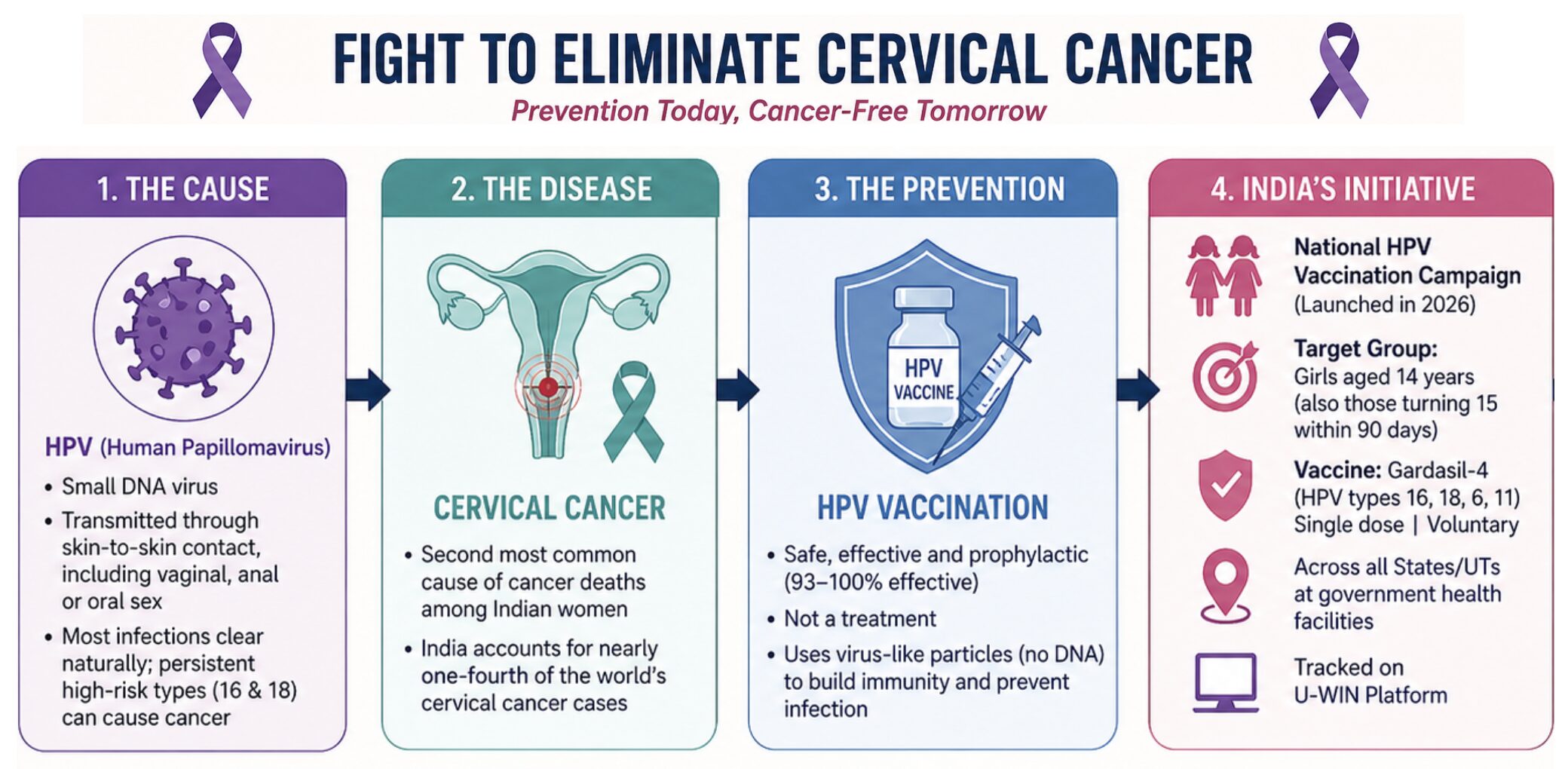
Cervical cancer is the second most common cause of cancer deaths among Indian women, following breast cancer. India contributes to nearly one-fourth of the world’s cervical cancer cases. Persistent infection with high risk strains of the Human Papillomavirus (HPV) is the cause of cervical cancer.
What is Human Papillomavirus (HPV)?
- Human papillomavirus (HPV) is a small, double-stranded DNA virus that is associated with cancers of the cervix, vulva, vagina, penis, anus, and throat, and genital warts.
- It infects both men and women and accounts for nearly 5% of cancers globally.
- It is primarily transmitted through intimate skin-to-skin contact, including vaginal, anal, and oral sex. Most infections are cleared naturally by the immune system, but persistent infection with high-risk strains (especially HPV-16 and 18) can lead to cancer.
Can Human Papillomavirus (HPV) infection be cured?
- There is no cure for HPV infection at present.
- HPV vaccines can prevent HPV-related cancers by inducing immunity before exposure.
- HPV vaccines are prophylactic, i.e., they are designed to prevent infection, and not treat existing HPV or HPV-related cancers.
- They work by using virus-like particles (which contain no DNA) to stimulate the body to produce antibodies that neutralise the virus before it can cause cancer.
HPV Vaccine and Cervical Cancer:
- HPV vaccines are 93-100% effective in preventing cervical cancer caused by vaccine-covered HPV types. There have been no negative effects on reproductive performance, fertility rates, congenital malformations or menstrual patterns.
- India’s Indigenous Vaccine ‘CERVAVAC’: Developed by the Serum Institute of India. First indigenously developed HPV vaccine. India’s first Quadrivalent HPV vaccine. It prevents the entry of four of the most common HPV types: 16, 18, 6, and 11. Expected to reduce vaccine costs.
National HPV Vaccination Campaign:
- Launched: 2026
- Target Group: Girls aged 14 years (also those turning 15 within 90 days).
- Coverage: Free of cost vaccine to ~1.15 crore girls across all States/UTs.
- Vaccine Used: Gardasil-4, a quadrivalent vaccine that protects against HPV types 16, 18, 6, and 11, produced by Merck; Single dose.
- Nature: Voluntary. Targeted campaign focuses on girls aged 14 at designated government health facilities.
- Tracking Platform: U-WIN digital platform to ensure rapid coverage.
- Delivery Points: Ayushman Arogya Mandirs, PHCs, CHCs, District Hospitals
WHO’s Cervical Cancer Elimination Initiative:
- In 2018, the WHO announced its Cervical Cancer Elimination Initiative.
- The official “Global Strategy to Accelerate the Elimination of Cervical Cancer” was passed in 2020 by 194 member states (including India).
- The Goal: To reduce cervical cancer incidence to less than 4 per 1,00,000 women.
- The 90-70-90 Targets (by 2030):
- 90% of girls vaccinated against HPV before age 15
- 70% of women screened with an HPV test at ages 35 and 45
- 90% of those detected with lesions receive treatment
Practice MCQ:
Q. Consider the following statements:
1. HPV vaccines use live attenuated virus to generate an immune response.
2. Cervavac is India’s first indigenously developed HPV vaccine.
3. The National HPV Vaccination Campaign is mandatory for all eligible beneficiaries.
Which of the statements given above is/are correct?
(a) 1 and 2 only
(b) 2 only
(c) 1 and 3 only
(d) 2 and 3 only
Answer: (b) Explanation: HPV vaccines do not use live attenuated virus. They are subunit vaccines that consist of highly purified virus-like particles (VLPs) that mimic the virus’s outer shell to elicit an immune response. The vaccines lack the virus’s DNA; they are safe and cannot cause HPV infection.
UPSC PYQ 2020
Q. What is the importance of using Pneumococcal Conjugate Vaccines in India?
1. These vaccines are effective against pneumonia as well as meningitis and sepsis.
2. Dependence on antibiotics that are not effective against drug-resistant bacteria can be reduced.
3. These vaccines have no side effects and cause no allergic reactions.
Select the correct answer using the code given below:
(a) 1 only
(b) 1 and 2 only
(c) 3 only
(d) 1, 2 and 3
Answer: (b)
Tell Google you want more of this.
Add Anantam IAS as a preferred sourceOne tap, and this site shows up more often in your own Top Stories, AI Overviews and AI Mode. Remove it any time.