
Why in News?
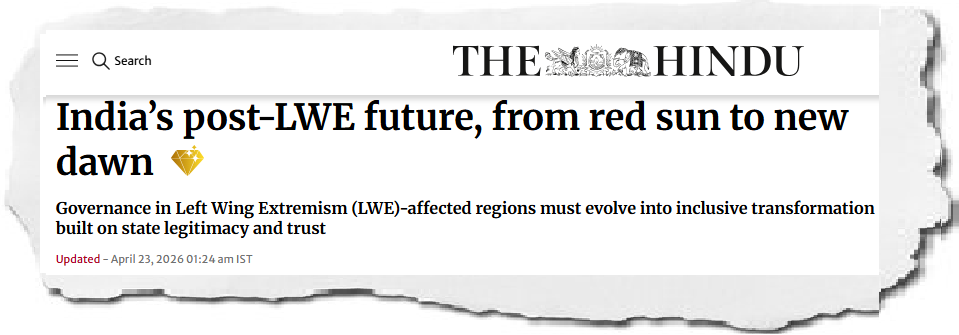
The Union government has indicated that India has largely overcome the threat of Left Wing Extremism (LWE). This marks a transition from a phase dominated by security operations to one focused on governance, development, and long-term stability in affected regions.
UPSC Relevance
GS-II: Governance, Federalism, Welfare Delivery
GS-III: Internal Security, Inclusive Development, Tribal Issues
What is Left Wing Extremism (LWE)?
Left Wing Extremism is an insurgency influenced by ideologies such as Maoism, operating mainly in tribal and forested regions. It emerged due to deep-rooted issues like land alienation, lack of development, and weak state presence. These areas, often called the “Red Corridor,” witnessed parallel authority structures due to governance gaps.
Evolution of LWE in India
Peak Phase of Violence
During the late 2000s, LWE posed a serious internal security threat. The Dantewada Maoist attack 2010 reflected the intensity of insurgent violence and exposed gaps in intelligence and preparedness.
Decline Phase
Over the past decade, violence has declined due to better coordination between the Centre and States, improved intelligence, and sustained security operations. Development programmes in affected districts also helped reduce local support for insurgents.
Security vs Governance
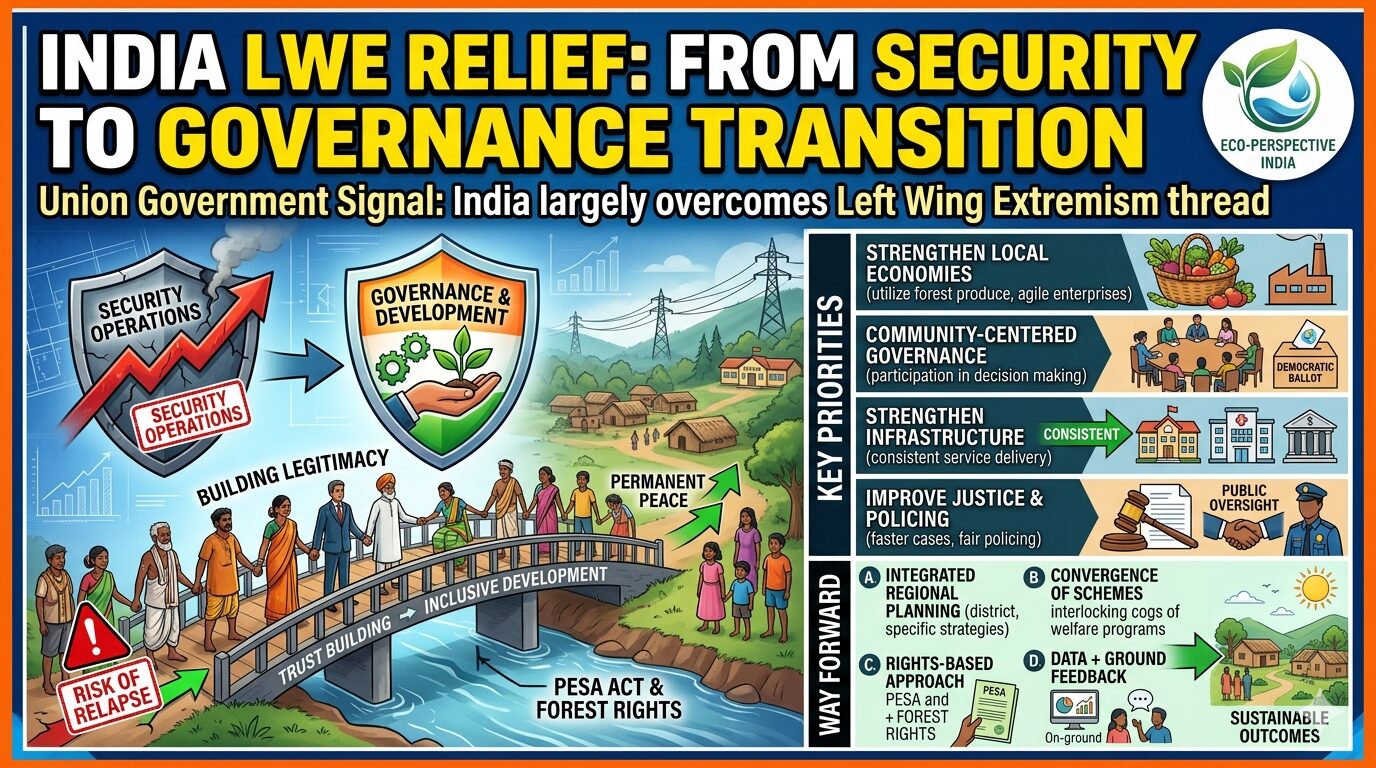
Security measures help restore order, but they do not address underlying grievances. Sustainable peace depends on whether governance delivers justice, development, and dignity. Without this transition, the risk of relapse into conflict remains.
Major Challenges in Post-LWE Regions
1. Weak Governance Presence
In many remote tribal areas, the administrative machinery has historically been absent or inconsistent. This leads to poor delivery of essential services like healthcare, education, and welfare schemes, weakening citizens’ trust in the state.
2. Limited Economic Opportunities
Local economies remain underdeveloped, relying heavily on forest produce and subsistence agriculture. Due to lack of infrastructure, market linkages, and value addition, people earn low incomes and often migrate for work.
3. Tribal Marginalisation and Rights Issues
Despite legal protections like the Forest Rights Act 2006, many tribal communities struggle to secure land and forest rights. Delays in implementation create insecurity and reduce faith in governance systems.
4. Trust Deficit with the State
Years of conflict have created fear and suspicion towards institutions. Even when violence declines, rebuilding trust requires consistent engagement, transparency, and respectful treatment of local communities.
5. Gaps in Justice Delivery
Many individuals from these regions remain undertrials, often for minor offences. Delays in legal processes and lack of legal awareness further alienate communities and weaken the rule of law.
What Has Worked So Far?
Area-Based Development Models
Targeted initiatives in regions like Bastar, Malkangiri, and Jungle Mahal have shown that sustained administrative presence and focused development can reduce vulnerability and improve outcomes over time.
Key Government Initiatives
- The Aspirational Districts Programme has improved governance through real-time monitoring and targeted interventions in backward districts.
- The PM-JANMAN focuses on the development of Particularly Vulnerable Tribal Groups, addressing deep-rooted exclusion.
Post-LWE Transformation: Key Priorities
1. Building Local Economies
Development should focus on strengthening local livelihoods through better utilisation of forest produce, agroforestry, and small enterprises. Creating value chains within the region can generate employment and reduce migration.
2. Community-Centred Governance
People should be treated as stakeholders in development rather than passive recipients. Participation in decision-making improves policy effectiveness and strengthens democratic legitimacy.
3. Strengthening Infrastructure and Services
Reliable access to roads, schools, healthcare, and banking is essential for both development and trust-building. Consistent delivery of these services signals the presence and credibility of the state.
4. Empowering Local Institutions
Effective implementation of decentralisation laws like the PESA Act 1996 can give tribal communities control over local governance and resource management, strengthening grassroots democracy.
5. Improving Justice and Policing
A more humane and accessible justice system is required, including faster case disposal, legal aid, and review of long-pending undertrial cases. Fair and transparent policing is key to rebuilding trust.
6. Investing in Youth Aspirations
Providing opportunities in education, skill development, and sports can channel the energy of youth towards constructive activities. This reduces vulnerability to extremist ideologies and builds long-term stability.
Way Forward
- Integrated Regional Planning
Post-LWE regions require district-specific strategies that combine security, development, and governance. A one-size-fits-all approach may not work due to varying local conditions.
2. Convergence of Schemes
India has multiple welfare schemes, but their impact is often diluted due to fragmented implementation. Converging schemes at the local level can ensure better resource utilisation and outcomes.
3. Rights-Based Approach
Ensuring effective implementation of rights-based laws, especially those related to land and forests, is essential for empowering tribal communities and addressing root causes of discontent.
4. Sustained Administrative Presence
Development should not be episodic. Continuous engagement by the administration builds trust and ensures that gains from security operations are not reversed.
5. Data + Ground Feedback
While data-driven monitoring is important, it must be complemented with on-ground feedback. Policies should reflect the lived experiences of people, not just statistical indicators.
Conclusion
India’s success in reducing Left Wing Extremism is a major milestone, but it is only the beginning of a more complex phase. The real challenge lies in transforming these regions through inclusive development, effective governance, and restoration of trust. The shift from security to legitimacy will determine whether peace becomes permanent.
Practice Questions
Prelims
- With reference to Left Wing Extremism (LWE) in India, consider the following statements:
- It is primarily concentrated in tribal and forested regions.
- The Forest Rights Act, 2006 seeks to address some of the root causes of LWE.
- LWE ideology is unrelated to Maoism.
Which of the statements given above is/are correct?
(a) 1 and 2 only
(b) 2 only
(c) 1 and 3 only
(d) 1, 2 and 3
Answer: (a)
Mains
- Security operations can reduce extremism, but governance sustains peace. Discuss in the context of Left Wing Extremism in India.
- Examine the challenges in transitioning from conflict management to development in LWE-affected regions.
- Discuss the role of tribal rights and decentralised governance in addressing internal security challenges.
Tell Google you want more of this.
Add Anantam IAS as a preferred sourceOne tap, and this site shows up more often in your own Top Stories, AI Overviews and AI Mode. Remove it any time.