Daily Digest
UPSC · Civil Services Examination
Current Affairs · Thursday, 30 April 2026
Current affairs curated and edited by Anantam IAS faculty — pulled from The Hindu, PIB, IDSA, Foreign Affairs and the ministries. Read, annotate, revise.
Old Rajinder Nagar · Delhi 110005 · anantamias.com
Why India should brace for more heatwave spells in the coming months
Why in News?
India is witnessing early and intense heatwave conditions in 2026, with temperatures crossing 40°C in several regions as early as April. The India Meteorological Department (IMD) has issued alerts for multiple regions, indicating a prolonged and severe summer ahead.
UPSC Relevance
GS-I: Geography (Climatology)
GS-II: Governance, Public Health
GS-III: Environment, Disaster Management, Climate Change
Understanding Heatwaves in India
A heatwave is not just high temperature, but a deviation from normal climatic conditions.
- According to IMD:
- Heatwave: Temperature ≥ 5°C above normal for at least 2 days
- Severe heatwave: ≥ 7°C above normal
- These thresholds vary based on geography (plains, coastal areas, hills).
Heatwave-Prone Regions
India has two major heatwave belts:
- Core Heatwave Zone
Covers northwest and central India (Rajasthan, MP, UP, Bihar, Jharkhand).
These areas experience heatwaves due to high-pressure systems causing descending hot air. - Eastern Coastal Zone
Includes Andhra Pradesh and Odisha.
Heatwaves occur due to disruption of sea breezes by hot inland winds.
Traditionally, southern and northeastern India were less affected, but climate projections indicate increasing vulnerability.
Why are Heatwaves Intensifying?
1. Climate Change and Global Warming
Rising global temperatures are increasing:
- Frequency of heatwaves
- Duration of heat spells
- Night-time temperatures (reducing recovery time)
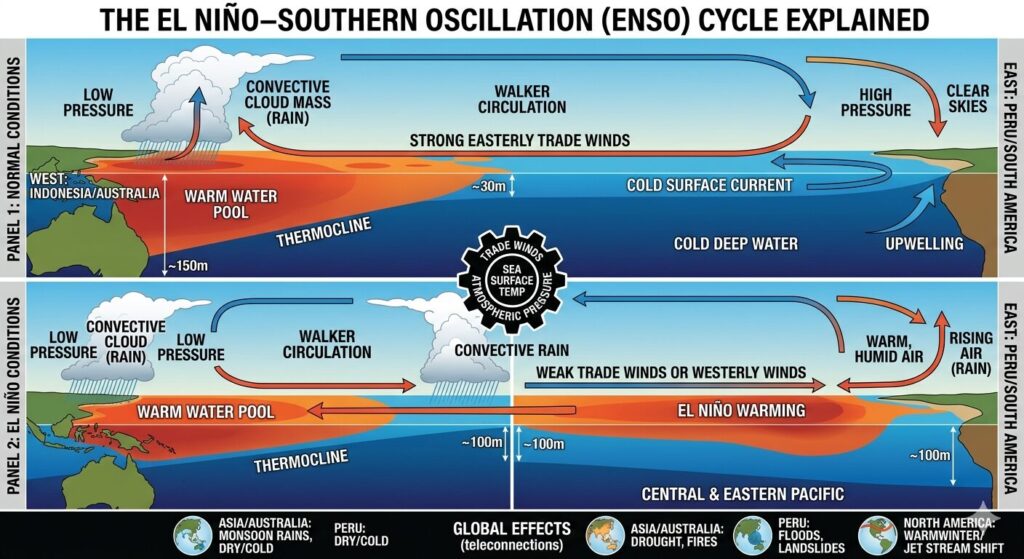
2. Role of El Niño
The El Niño Southern Oscillation plays a crucial role:
- El Niño years → hotter summers, weaker monsoon
- Leads to prolonged and severe heatwaves
- Impact often continues into the following year
3. Atmospheric Conditions
- Lack of western disturbances and thunderstorms reduces natural cooling
- Reduced convection traps heat near the surface
4. Urban Heat Island Effect
Urban areas experience higher temperatures due to:
- Concrete surfaces absorbing heat
- Lack of vegetation
- High population density
5. Changing Land Use
- Loss of green cover
- Expansion of built-up areas
- Reduction in water bodies
Impacts of Heatwaves
1. Health Impacts
- Increased cases of heatstroke, dehydration, and cardiovascular stress
- Warmer nights worsen health outcomes
- Vulnerable groups: elderly, children, outdoor workers
Studies show significant rise in heat-related mortality risks, especially in prolonged heat conditions.
2. Economic Impact
- Around 247 billion work-hours lost globally (2024) due to heat stress
- Most affected sectors:
- Construction
- Agriculture
- Informal sector
This leads to:
- Loss of income
- Reduced productivity
3. Agricultural Impact
- Heat accelerates crop maturity → reduces yield
- Affects rabi crops during harvesting stage
- Can lead to:
- Food insecurity
- Inflationary pressures
4. Social Impact
- Increased burden on healthcare systems
- Disruption of daily activities (schools, work, elections)
- Reduced voter turnout in extreme heat conditions
5. Climate and Habitability Concerns
If current trends continue:
- Some regions may approach human survivability limits
- Heat stress could make outdoor work increasingly unsafe
Heatwaves as a Disaster
Currently, heatwaves are not officially classified as a notified disaster under the Disaster Management Act.
- Recommendation by Finance Commission:
- Include heatwaves as a notified disaster
- Allow use of State Disaster Response Funds (SDRF)
This would improve:
- Relief measures
- Compensation
- Preparedness
Institutional Response: Heat Action Plans (HAPs)
India’s primary policy tool is the Heat Action Plan (HAP).
Key Features
- Early warning systems
- Public awareness campaigns
- Provision of drinking water
- Adjusted work/school timings
- Cooling shelters
Limitations
Most HAPs:
- Focus on short-term emergency response
- Lack funding for long-term structural solutions
They often fail to address:
- Urban planning issues
- Worker safety regulations
- Climate-resilient infrastructure
Recent IMD Advisory
The India Meteorological Department has issued:
- Alerts for northwest, central and peninsular India
- Warning of:
- Temperatures between 40–44°C
- Hot and humid coastal conditions
- Warm nights increasing discomfort
Precautionary Measures Suggested
- Avoid exposure during peak hours
- Stay hydrated
- Wear light clothing
- Special care for vulnerable groups
Way Forward
1. Strengthening Heat Action Plans
Heat Action Plans must move beyond emergency responses and incorporate long-term adaptation strategies. This includes urban re-greening, cool roofing, and climate-sensitive urban planning to reduce heat absorption and improve livability.
2. Legal Protection for Workers
There is a need to introduce heat-safety regulations, especially for informal workers in construction and agriculture. Mandating rest breaks, shaded workspaces, and adjusted working hours can significantly reduce health risks.
3. Recognising Heatwaves as a Disaster
Classifying heatwaves as a notified disaster will enable states to access funds for relief and preparedness. This would strengthen institutional response and improve compensation mechanisms.
4. Urban Planning Reforms
Cities must adopt:
- Green infrastructure (parks, urban forests)
- Reflective materials in buildings
- Preservation of water bodies
This will reduce the urban heat island effect and enhance resilience.
5. Strengthening Healthcare Systems
Public health systems need to:
- Deploy mobile health units during peak heat
- Ensure doorstep delivery of essential services
- Improve heat-related disease surveillance
This reduces both mortality and income loss for vulnerable populations.
6. Climate Mitigation and Global Cooperation
India should actively participate in global initiatives to reduce fossil fuel dependence. This will not only address long-term climate risks but also improve access to climate finance for adaptation measures.
7. Data and Early Warning Systems
Improving forecasting capabilities and dissemination of real-time data will help local administrations take timely preventive actions and reduce casualties.
Conclusion
Heatwaves are no longer seasonal anomalies but structural challenges linked to climate change, urbanisation, and socio-economic vulnerability. Addressing them requires a shift from reactive measures to long-term climate resilience and inclusive policy design.
India’s response must integrate science, governance, and social protection to safeguard both lives and livelihoods in an increasingly warming world.
Practice Questions
Prelims
Q1. With reference to heatwaves in India, consider the following statements:
- A heatwave is declared when temperature rises at least 5°C above normal for two consecutive days.
- Heatwaves are notified disasters under the Disaster Management Act.
- El Niño conditions are associated with increased heatwave intensity in India.
Which of the statements given above are correct?
(a) 1 and 3 only
(b) 2 and 3 only
(c) 1 only
(d) 1, 2 and 3
Answer: (a) 1 and 3 only
Q2. Which of the following regions is known as the core heatwave zone in India?
(a) Northeast India
(b) Northwest and Central India
(c) Coastal Tamil Nadu
(d) Himalayan region
Answer: (b) Northwest and Central India
Mains
Q1. Heatwaves in India are becoming more frequent and intense. Examine the causes and suggest measures to mitigate their impact.
Q2. Critically evaluate the effectiveness of Heat Action Plans in India. What reforms are needed to make them more effective?
Household Social Consumption: Health
Why in News?
The National Statistical Office (NSO), Ministry of Statistics and Programme Implementation (MoSPI) has released a report titled “Household Social Consumption: Health”. The survey on health was conducted during January-December, 2025 as part of the 80th round of the National Sample Survey (NSS).
| UPSC Relevance: GS-2 Social Justice: Health Prelims: Key Findings: Household Social Consumption- Health; National Statistical Office |
The Survey on Household Social Consumption: Health constitutes a significant source of empirical data to compile indicators on morbidity, hospitalisation, childbirth, and households’ out-of-pocket spending on medical and healthcare services in India.
The survey covers over 1.39 lakh households (both rural and urban) in India (except the villages in the Andaman and Nicobar Islands).
Key Findings of Household Social Consumption: Health
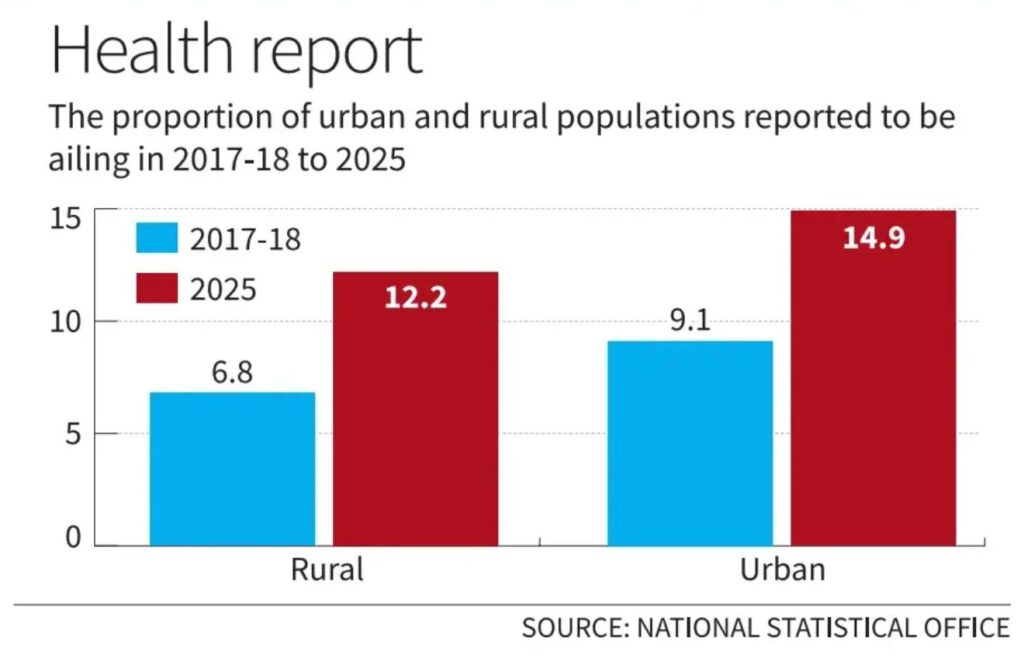
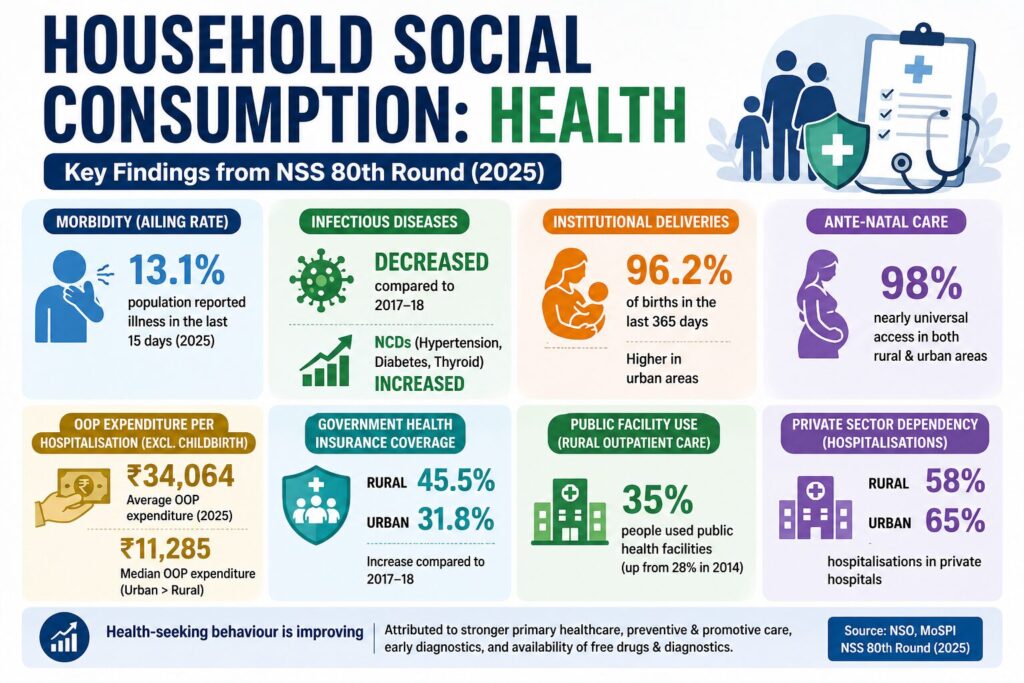
- Morbidity (Ailing Rate): Approximately 13.1% of the population reported illness (ailments) during the last 15-day period in 2025. The reported hospitalisation rate was higher in urban areas than in rural areas.
- Disease Prevalence: Reporting of infectious diseases decreased in 2025 compared to the previous NSS survey (2017-18). Non-communicable diseases (NCDs) such as hypertension, diabetes, and thyroid disorders showed an increase.
- Childbirth & Maternal Health:
- Institutional deliveries accounted for nearly all births (about 96.2%) during the last 365-day period. A higher rate of institutional deliveries is observed in urban areas than in rural areas.
- Both rural and urban areas showed near-universal access to ante-natal care (98%).
- Hospitalisation Expenditure:
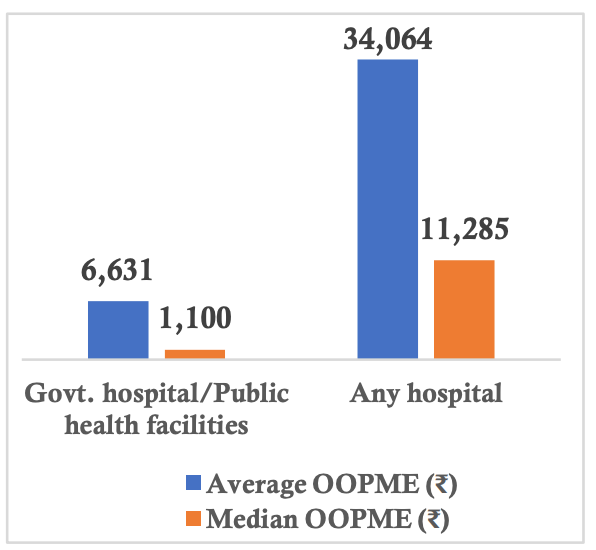
- The estimated average out-of-pocket medical expenditure per hospitalisation case (excluding childbirth) during the last 365 days was about ₹34,064.
- Median out-of-pocket medical expenditure was about ₹11,285 in 2025 (Urban > Rural).
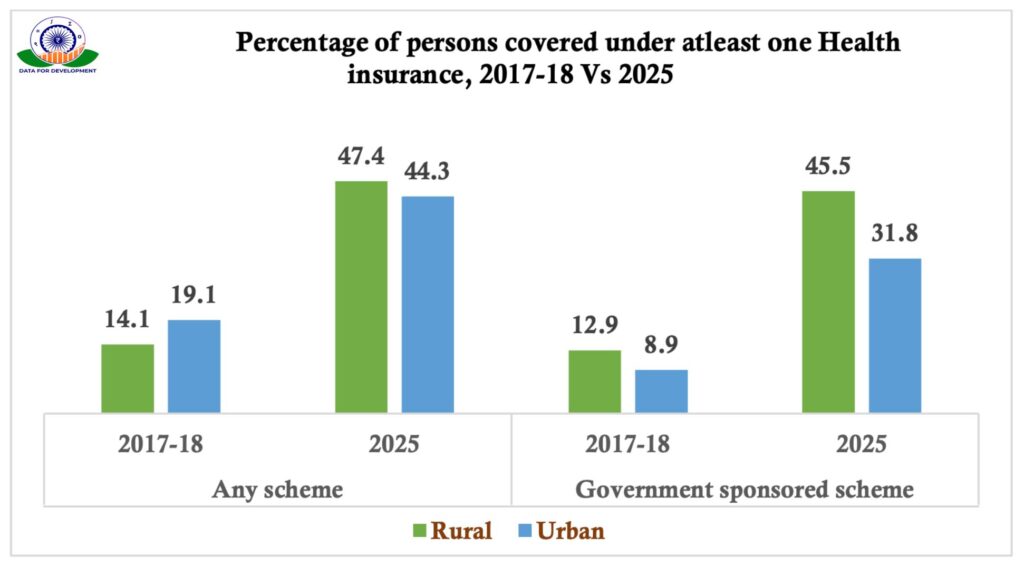
- Insurance Coverage: Government health insurance increased to 45.5% in rural areas and 31.8% in urban areas, compared to the NSS survey (2017-18). It is due to the rapid scaling up of government-financed health insurance coverage, including under the Ayushman Bharat PM Jan Arogya Yojana, and various State schemes.
- Public Facility Utilisation: In rural areas, 35% of people used public health facilities for outpatient care (up from 28% in 2014).
- Concerns: High private-sector dependency remains, with nearly 58% of hospitalisations in rural areas and 65% in urban areas utilising private hospitals.
Healthseeking behaviour in India is improving. This improvement has been attributed to the expansion of comprehensive primary healthcare services, with an emphasis on preventive, promotive, and early diagnostic care, supported by the availability of free drugs and diagnostics.
Practice MCQ:
Q. With reference to the report “Household Social Consumption: Health” released by the National Statistical Office, consider the following statements:
1. Prevalence of infectious diseases has increased compared to 2017-18.
2. Institutional deliveries accounted for more than 95% of births.
3. Public health facility usage in rural outpatient care has increased over time.
Which of the statements given above is/are correct?
(a) 2 and 3 only
(b) 2 only
(c) 1 and 3 only
(d) 1, 2 and 3
Answer: (a)
UPSC PYQ 2018
Q. As per the NSSO 70th Round “Situation Assessment Survey of Agricultural Households”, consider the following statements:
1. Rajasthan has the highest percentage share of agricultural households among its rural households.
2. Out of the total agricultural households in the country, a little over 60 per cent belong to OBCs.
3. In Kerala, a little over 60 per cent of agricultural households reported to have received maximum income from sources other than agricultural activities.
Which of the statements given above is/are correct?
(a) 2 and 3 only
(b) 2 only
(c) 1 and 3 only
(d) 1, 2 and 3
Answer: (c)
Source: https://anantamias.com/current-affairs/household-social-consumption-health/
EPFO to Launch E-PRAAPTI Portal
Why in News?
The Employees’ Provident Fund Organisation (EPFO) is set to launch a new digital facility, the E-PRAAPTI portal, to help members trace and link their old provident fund (PF) accounts with their Universal Account Number (UAN).
| UPSC Relevance: GS-2 Social Justice: Welfare schemes (Social Security); GS-3 Economy: Digital Infrastructure, Inclusive Growth Prelims: E-PRAAPTI portal, Employees’ Provident Fund Organisation, Universal Account Number |
About E-PRAAPTI Portal:
- E-PRAAPTI (EPF Aadhaar-Based Access Portal for Tracking Inoperative Accounts) is a dedicated digital platform that would allow the members to:
- Identify and track old/inoperative EPF accounts
- Link them with Universal Account Number (UAN)
- Enable seamless access and claim settlement
- Significance: Expected to reduce manual intervention, minimise documentation, and enhance transparency and efficiency.
What is the Employees’ Provident Fund Organisation?
- The Employees’ Provident Fund Organisation (EPFO) is a statutory, non-constitutional body under the Ministry of Labour & Employment. It was formed under the Employees’ Provident Fund and Miscellaneous Provisions Act, 1952.
- It provides social security benefits to its members in the form of a provident fund, pension, and insurance. It administers three schemes:
- Employees’ Provident Funds Scheme (retirement savings)
- Employees’ Pension Scheme (EPF)
- Employees’ Deposit Linked Insurance Scheme (EDLS)
- Contribution Structure:
- Employee Contribution (12%): 12% of basic salary and dearness allowance (DA) goes into the EPF account.
- Employer Contribution (12%): Split into the Employees’ Pension Scheme (8.33 %) and the EPF account (remaining).
- EPFO primarily covers organised sector employees (establishments with 20 or more employees). It de facto excludes the unorganised sector (exclusion is not always strict, as voluntary coverage exists).
What is Universal Account Number (UAN)?
- Universal Account Number (UAN) is a unique 12-digit identification number allotted by the EPFO to every salaried employee who is a member of the Employee Provident Fund.
- The UAN will act as an umbrella for the multiple Member IDs allotted to an individual by different establishments (linking all Provident Fund accounts to one ID).
UPSC PYQ 2021
Q. With reference to casual workers employed in India, consider the following statements:
1. All casual workers are entitled for Employees Provident Fund coverage.
2. All casual workers are entitled for regular working hours and overtime payment.
3. The government can, by a notification, specify that an establishment or industry shall pay wages only through its bank account.
Which of the above statements are correct?
(a) 1 and 2 only
(b) 2 and 3 only
(c) 1 and 3 only
(d) 1, 2 and 3
Answer: (d)
Source: https://anantamias.com/current-affairs/epfo-to-launch-e-praapti-portal/
Push for Organic and Natural Farming in India
Why in News?
The Prime Minister of India at the golden jubilee (50th Statehood) celebrations called Sikkim’s model of Organic and Natural farming an inspiration for the entire nation and the world.
Sikkim was officially declared India’s (and the world’s) first 100% Organic state in 2016. The state successfully converted approximately 75,000 hectares (roughly 760 square kilometres) of agricultural land into certified organic cultivation.
| UPSC Relevance: GS-3 Economy: Agriculture Prelims: Paramparagat Krishi Vikas Yojana, National Mission on Natural Farming Mains: Sustainable Agriculture: Need, Advantages, Schemes & Challenges. |
The Green Revolution made India self-sufficient in food grains. On the other side, it has resulted in severe ecological degradation. This necessitates the shift to sustainable farming practices to counteract these long-term negative effects.
Push for Organic and Natural Farming in India
1. Organic Farming: Paramparagat Krishi Vikas Yojana
- PKVY was launched in 2015 under the National Mission for Sustainable Agriculture (NMSA). PKVY is India’s flagship organic farming scheme operating in all States/UTs except the North East (which is covered separately under MOVCDNER).
- Aim: To increase soil fertility and production of healthy food through organic practices without the use of agro-chemicals.
Key Features of PKVY:
- Cluster-Based Approach: Farmers organised into groups with a unit cluster size of 20 hectares (ha) for standardised practices, shared resources, and collective market access. 25 such clusters are converted into one large cluster of about 500 ha to facilitate the marketing of organic produce.
- Financial assistance: Rs. 31,500 per ha to states, out of which, i.e., Rs. 15,000 is given as incentives to a farmer directly through DBT.
- Dual Certification: NPOP (third-party, international standards) for exports; PGS-India (participatory, community-based) for domestic markets.
- Jaivik Kheti Portal: Digital platform for direct farmer-to-consumer organic sales, improving transparency and eliminating intermediaries.
- Unified India Organic Logo (2024): Introduced by FSSAI and APEDA, replacing Jaivik Bharat & India Organic logos for standardised global certification.
2. National Mission on Natural Farming:
- NMNF is a standalone Centrally Sponsored Scheme launched in 2024 under the Ministry of Agriculture & Farmers’ Welfare.
- Aim: To promote chemical-free, ecosystem-based natural farming rooted in traditional knowledge.
Key Features of NMNF:
- Natural Farming Clusters: NMNF envisages the formation of 15,000 natural farming clusters. Each cluster shall be formed of a contiguous area of about 50 ha and approximately 125 farmers. States/UTs conduct the identification of these clusters. New farmers can join the natural farming cluster at the beginning of each crop season.
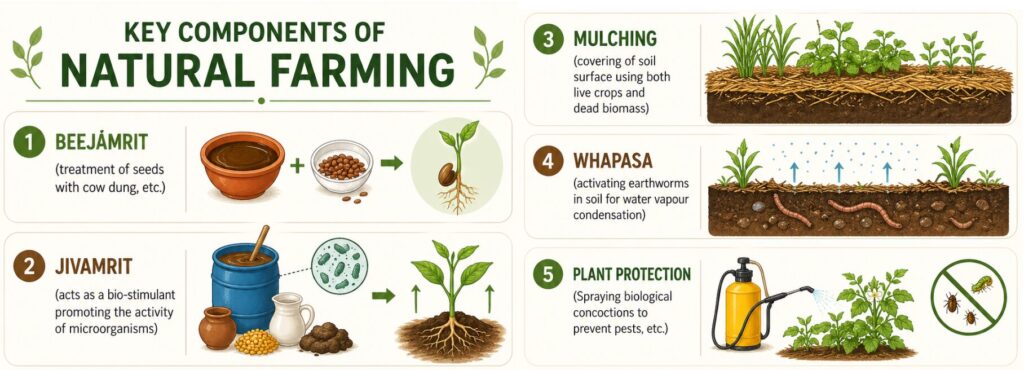
- Bio-Input Resource Centres (BRCs): Setting up 10,000 need-based BRCs for easy availability of Jeevamrit, Beejamrit, and other ready-to-use natural inputs near farmers’ villages.
- Incentive: An output-based incentive of ₹4000 per acre per year per farmer for 2 years (up to 1 acre per farmer) for farmers to practice natural farming, training, upkeep of livestock, preparation of natural farming inputs, etc.
- Krishi Sakhis: 30,000 trained community resource persons for awareness, mobilisation, and handholding of willing farmers in clusters. Generate awareness among 1 crore farmers on natural farming.
- Certification & Branding: Farmers are supported by a simple certification system and common national brand for naturally grown, chemical-free produce to ensure market access and premium pricing.
- Technology: Real-time geo-tagged & referenced monitoring of NMNF implementation shall be done through a dedicated online portal.
Organic Farming vs Natural Farming:
PKVY (organic farming) and NMNF (natural farming) are kept as separate schemes:
- Organic farming allows certified external organic inputs: suited for market-oriented, export-linked farmers.
- Natural farming is fully self-reliant: suited for small/marginal farmers with livestock, reducing input costs to near zero.
Both are complementary to achieve scale and depth in sustainable agriculture.
Need for Sustainable Agriculture in India:
- Land degradation: As per the Desertification and Land Degradation Atlas of India (SAC 2021), approximately 97.85 Mha of land in India was degraded, accounting for ~30% of the country’s total geographical area.
- Nutrient deficiencies: Over 60% cultivated land has nutrient deficiencies (phosphorus, potassium, micronutrients). <5% soils have adequate nitrogen; only 20% have sufficient organic carbon (Soil Health Mission 2025).
- Alarming decline in organic carbon due to monocropping and excess application of fertilisers (especially urea), particularly in green revolution states.
- Groundwater contamination via nitrate leaching; biodiversity loss from pesticide overuse.
- High input costs are a primary driver of farm distress; organic/natural farming can slash these by 30-50%.
- Unsustainable fiscal burden: India’s fertiliser subsidy bill exceeds ₹2 lakh crore annually. 228 districts in 16 states use fertilisers above the national average.
- Forex drain and import dependency: India imports ~50% of its fertiliser requirements.
Advantages of Organic Farming and Natural Farming:
- Soil Regeneration: Restores organic matter, microbial biomass, earthworm populations, and nutrient cycling, thus reversing decades of Green Revolution-era depletion.
- Input Cost Reduction: NMNF’s zero external input model reduces cultivation costs significantly, directly improving small farmers’ net income.
- Climate Resilience: Organic matter improves water retention (withstanding drought) and soil structure (resisting waterlogging/floods); sequesters carbon.
- Food Safety & Public Health: Chemical-free produce reduces toxic residue exposure; linked to lower incidence of cancer, hormonal disorders in farming communities.
- Biodiversity Conservation: Natural farming encourages diverse cropping systems, supports pollinators, beneficial insects, and soil microflora.
- Export Premium & Branding: India’s organic exports were worth ₹5,781 crore (2021-22); the global organic market is growing at ~10% CAGR. Thus, this presents an opportunity for premium Indian exports.
- Fiscal Sustainability: Reducing fertiliser subsidy dependency through PM-PRANAM incentives and NMNF frees fiscal space for productive public investment.
Sikkim as Proof of Concept: Tourism increased by over 50% between 2014-2017 post organic certification; 66,000 farming families benefitted; won FAO’s Future Policy Gold Award 2018.
What are the Challenges?
Challenges associated with Organic Farming:
- Yield Gap (Transitional): Yield decline of 10-20% during the 3-year conversion period; Sikkim saw declines post-transition; some farmers reverted to conventional farming.
- High Certification Cost: NPOP certification is expensive and time-consuming for small holders, limiting market access and export potential despite good produce.
- Market Price Premium not always Realised: Price premium for organic produce is rarely captured by rural smallholders as supply chain gaps persist.
- Input Availability & Quality: Shortage of vermicompost, bio-fertilisers; quality inconsistencies in organic inputs; no standardised bio-input supply chain.
- Awareness Gap: The majority of farmers (especially in non-PKVY districts) are unaware of organic practices, certification processes, and premium markets.
- Fragmented Landholding: India’s 86% small/marginal farmers hold 2 ha or less, thus making cluster formation and certification economically viable is structurally challenging.
- Subsidy Distortion: As long as urea is heavily subsidised at ₹5/kg (vs. market price of ₹60/kg), the economic incentive for farmers to shift to organic remains weak.
Challenges associated with Natural Farming:
- Knowledge Intensity: ZBNF/natural farming requires deep indigenous knowledge and skills (Jeevamrit preparation, multi-cropping design).
- Livestock Dependency: Core natural farming inputs (Jeevamrit, Beejamrit) require access to native breed cattle, which are increasingly unavailable due to declining livestock ownership.
- Scale vs Food Security debate: Critics argue that a nationwide natural farming transition could jeopardise food production targets, and thus requires a phased scaling.
- Limited Scientific Validation at Scale: Controlled studies on Zero Budget Natural Farming (ZBNF) efficacy are sparse; NITI Aayog and ICAR have called for more robust agronomic research.
- Monitoring & Verification: Geo-tagging and real-time monitoring infrastructure for 15,000 GP clusters requires digital readiness that is uneven across states.
- Transition Risk for Marginal Farmers: A 1-3 year income dip during conversion, without robust income support, can push smallholders into debt. The policy needs income bridging.
Way Forward:
- Bridging Income during Transition: Create a dedicated direct benefit transfer (DBT) income support package for farmers in the 1-3 year yield-gap transition window.
- Rationalise Fertiliser Subsidy: Reform urea pricing and redirect saved subsidy to PM-PRANAM incentive pool.
- Strengthen BRC Network: Ensure all 10,000 Bio-Input Resource Centres under NMNF are operational within target timelines, with quality control protocols for Jeevamrit and other inputs.
- Digital Market Linkages: Expand the Jaivik Kheti portal to cover natural farming produce under NMNF; integrate with ONDC (Open Network for Digital Commerce) for scale.
- Soil Health Cards: Use SHC data to target NMNF in high-fertiliser-use districts (228 priority districts) with the greatest soil restoration need.
- Integrated Farming System Convergence: Link organic and natural farming with Integrated Farming Systems (IFS) to maximise small farmer income and build ecosystem resilience simultaneously.
- Sikkim’s Model as Blueprint: Adopt Sikkim’s phased approach: (1) State policy commitment; (2) gradual synthetic input phase-out; (3) alternative input support; (4) certification; (5) market branding, at the national scale through a 15-year roadmap.
UPSC Mains PYQ 2022
Q. What is Integrated Farming System? How is it helpful to small and marginal farmers in India? (15 Marks)
Source: https://anantamias.com/current-affairs/push-for-organic-and-natural-farming-in-india/