Why in News?
The Prime Minister of India at the golden jubilee (50th Statehood) celebrations called Sikkim’s model of Organic and Natural farming an inspiration for the entire nation and the world.
Sikkim was officially declared India’s (and the world’s) first 100% Organic state in 2016. The state successfully converted approximately 75,000 hectares (roughly 760 square kilometres) of agricultural land into certified organic cultivation.
| UPSC Relevance: GS-3 Economy: Agriculture Prelims: Paramparagat Krishi Vikas Yojana, National Mission on Natural Farming Mains: Sustainable Agriculture: Need, Advantages, Schemes & Challenges. |
The Green Revolution made India self-sufficient in food grains. On the other side, it has resulted in severe ecological degradation. This necessitates the shift to sustainable farming practices to counteract these long-term negative effects.
Push for Organic and Natural Farming in India
1. Organic Farming: Paramparagat Krishi Vikas Yojana
- PKVY was launched in 2015 under the National Mission for Sustainable Agriculture (NMSA). PKVY is India’s flagship organic farming scheme operating in all States/UTs except the North East (which is covered separately under MOVCDNER).
- Aim: To increase soil fertility and production of healthy food through organic practices without the use of agro-chemicals.
Key Features of PKVY:
- Cluster-Based Approach: Farmers organised into groups with a unit cluster size of 20 hectares (ha) for standardised practices, shared resources, and collective market access. 25 such clusters are converted into one large cluster of about 500 ha to facilitate the marketing of organic produce.
- Financial assistance: Rs. 31,500 per ha to states, out of which, i.e., Rs. 15,000 is given as incentives to a farmer directly through DBT.
- Dual Certification: NPOP (third-party, international standards) for exports; PGS-India (participatory, community-based) for domestic markets.
- Jaivik Kheti Portal: Digital platform for direct farmer-to-consumer organic sales, improving transparency and eliminating intermediaries.
- Unified India Organic Logo (2024): Introduced by FSSAI and APEDA, replacing Jaivik Bharat & India Organic logos for standardised global certification.
2. National Mission on Natural Farming:
- NMNF is a standalone Centrally Sponsored Scheme launched in 2024 under the Ministry of Agriculture & Farmers’ Welfare.
- Aim: To promote chemical-free, ecosystem-based natural farming rooted in traditional knowledge.
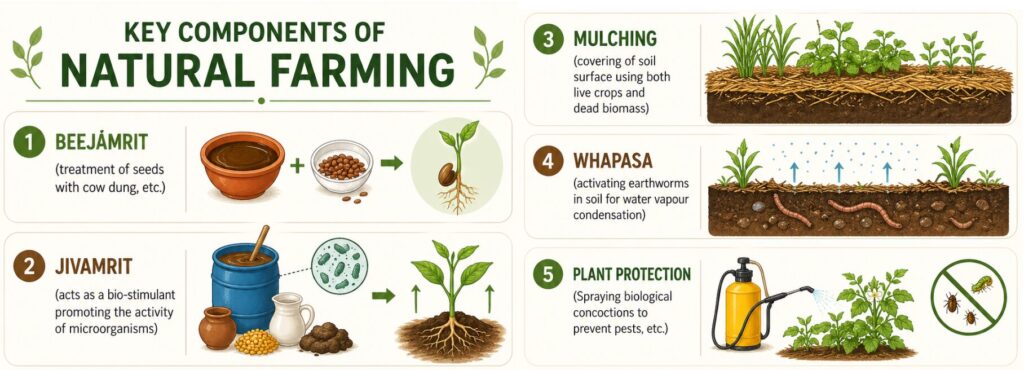
Key Features of NMNF:
- Natural Farming Clusters: NMNF envisages the formation of 15,000 natural farming clusters. Each cluster shall be formed of a contiguous area of about 50 ha and approximately 125 farmers. States/UTs conduct the identification of these clusters. New farmers can join the natural farming cluster at the beginning of each crop season.
- Bio-Input Resource Centres (BRCs): Setting up 10,000 need-based BRCs for easy availability of Jeevamrit, Beejamrit, and other ready-to-use natural inputs near farmers’ villages.
- Incentive: An output-based incentive of ₹4000 per acre per year per farmer for 2 years (up to 1 acre per farmer) for farmers to practice natural farming, training, upkeep of livestock, preparation of natural farming inputs, etc.
- Krishi Sakhis: 30,000 trained community resource persons for awareness, mobilisation, and handholding of willing farmers in clusters. Generate awareness among 1 crore farmers on natural farming.
- Certification & Branding: Farmers are supported by a simple certification system and common national brand for naturally grown, chemical-free produce to ensure market access and premium pricing.
- Technology: Real-time geo-tagged & referenced monitoring of NMNF implementation shall be done through a dedicated online portal.
Organic Farming vs Natural Farming:
PKVY (organic farming) and NMNF (natural farming) are kept as separate schemes:
- Organic farming allows certified external organic inputs: suited for market-oriented, export-linked farmers.
- Natural farming is fully self-reliant: suited for small/marginal farmers with livestock, reducing input costs to near zero.
Both are complementary to achieve scale and depth in sustainable agriculture.
Need for Sustainable Agriculture in India:
- Land degradation: As per the Desertification and Land Degradation Atlas of India (SAC 2021), approximately 97.85 Mha of land in India was degraded, accounting for ~30% of the country’s total geographical area.
- Nutrient deficiencies: Over 60% cultivated land has nutrient deficiencies (phosphorus, potassium, micronutrients). <5% soils have adequate nitrogen; only 20% have sufficient organic carbon (Soil Health Mission 2025).
- Alarming decline in organic carbon due to monocropping and excess application of fertilisers (especially urea), particularly in green revolution states.
- Groundwater contamination via nitrate leaching; biodiversity loss from pesticide overuse.
- High input costs are a primary driver of farm distress; organic/natural farming can slash these by 30-50%.
- Unsustainable fiscal burden: India’s fertiliser subsidy bill exceeds ₹2 lakh crore annually. 228 districts in 16 states use fertilisers above the national average.
- Forex drain and import dependency: India imports ~50% of its fertiliser requirements.
Advantages of Organic Farming and Natural Farming:
- Soil Regeneration: Restores organic matter, microbial biomass, earthworm populations, and nutrient cycling, thus reversing decades of Green Revolution-era depletion.
- Input Cost Reduction: NMNF’s zero external input model reduces cultivation costs significantly, directly improving small farmers’ net income.
- Climate Resilience: Organic matter improves water retention (withstanding drought) and soil structure (resisting waterlogging/floods); sequesters carbon.
- Food Safety & Public Health: Chemical-free produce reduces toxic residue exposure; linked to lower incidence of cancer, hormonal disorders in farming communities.
- Biodiversity Conservation: Natural farming encourages diverse cropping systems, supports pollinators, beneficial insects, and soil microflora.
- Export Premium & Branding: India’s organic exports were worth ₹5,781 crore (2021-22); the global organic market is growing at ~10% CAGR. Thus, this presents an opportunity for premium Indian exports.
- Fiscal Sustainability: Reducing fertiliser subsidy dependency through PM-PRANAM incentives and NMNF frees fiscal space for productive public investment.
Sikkim as Proof of Concept: Tourism increased by over 50% between 2014-2017 post organic certification; 66,000 farming families benefitted; won FAO’s Future Policy Gold Award 2018.
What are the Challenges?
Challenges associated with Organic Farming:
- Yield Gap (Transitional): Yield decline of 10-20% during the 3-year conversion period; Sikkim saw declines post-transition; some farmers reverted to conventional farming.
- High Certification Cost: NPOP certification is expensive and time-consuming for small holders, limiting market access and export potential despite good produce.
- Market Price Premium not always Realised: Price premium for organic produce is rarely captured by rural smallholders as supply chain gaps persist.
- Input Availability & Quality: Shortage of vermicompost, bio-fertilisers; quality inconsistencies in organic inputs; no standardised bio-input supply chain.
- Awareness Gap: The majority of farmers (especially in non-PKVY districts) are unaware of organic practices, certification processes, and premium markets.
- Fragmented Landholding: India’s 86% small/marginal farmers hold 2 ha or less, thus making cluster formation and certification economically viable is structurally challenging.
- Subsidy Distortion: As long as urea is heavily subsidised at ₹5/kg (vs. market price of ₹60/kg), the economic incentive for farmers to shift to organic remains weak.
Challenges associated with Natural Farming:
- Knowledge Intensity: ZBNF/natural farming requires deep indigenous knowledge and skills (Jeevamrit preparation, multi-cropping design).
- Livestock Dependency: Core natural farming inputs (Jeevamrit, Beejamrit) require access to native breed cattle, which are increasingly unavailable due to declining livestock ownership.
- Scale vs Food Security debate: Critics argue that a nationwide natural farming transition could jeopardise food production targets, and thus requires a phased scaling.
- Limited Scientific Validation at Scale: Controlled studies on Zero Budget Natural Farming (ZBNF) efficacy are sparse; NITI Aayog and ICAR have called for more robust agronomic research.
- Monitoring & Verification: Geo-tagging and real-time monitoring infrastructure for 15,000 GP clusters requires digital readiness that is uneven across states.
- Transition Risk for Marginal Farmers: A 1-3 year income dip during conversion, without robust income support, can push smallholders into debt. The policy needs income bridging.
Way Forward:
- Bridging Income during Transition: Create a dedicated direct benefit transfer (DBT) income support package for farmers in the 1-3 year yield-gap transition window.
- Rationalise Fertiliser Subsidy: Reform urea pricing and redirect saved subsidy to PM-PRANAM incentive pool.
- Strengthen BRC Network: Ensure all 10,000 Bio-Input Resource Centres under NMNF are operational within target timelines, with quality control protocols for Jeevamrit and other inputs.
- Digital Market Linkages: Expand the Jaivik Kheti portal to cover natural farming produce under NMNF; integrate with ONDC (Open Network for Digital Commerce) for scale.
- Soil Health Cards: Use SHC data to target NMNF in high-fertiliser-use districts (228 priority districts) with the greatest soil restoration need.
- Integrated Farming System Convergence: Link organic and natural farming with Integrated Farming Systems (IFS) to maximise small farmer income and build ecosystem resilience simultaneously.
- Sikkim’s Model as Blueprint: Adopt Sikkim’s phased approach: (1) State policy commitment; (2) gradual synthetic input phase-out; (3) alternative input support; (4) certification; (5) market branding, at the national scale through a 15-year roadmap.
UPSC Mains PYQ 2022
Q. What is Integrated Farming System? How is it helpful to small and marginal farmers in India? (15 Marks)
Tell Google you want more of this.
Add Anantam IAS as a preferred sourceOne tap, and this site shows up more often in your own Top Stories, AI Overviews and AI Mode. Remove it any time.