Why in News?
The National Statistical Office (NSO), Ministry of Statistics and Programme Implementation (MoSPI) has released a report titled “Household Social Consumption: Health”. The survey on health was conducted during January-December, 2025 as part of the 80th round of the National Sample Survey (NSS).
| UPSC Relevance: GS-2 Social Justice: Health Prelims: Key Findings: Household Social Consumption- Health; National Statistical Office |
The Survey on Household Social Consumption: Health constitutes a significant source of empirical data to compile indicators on morbidity, hospitalisation, childbirth, and households’ out-of-pocket spending on medical and healthcare services in India.
The survey covers over 1.39 lakh households (both rural and urban) in India (except the villages in the Andaman and Nicobar Islands).
Key Findings of Household Social Consumption: Health
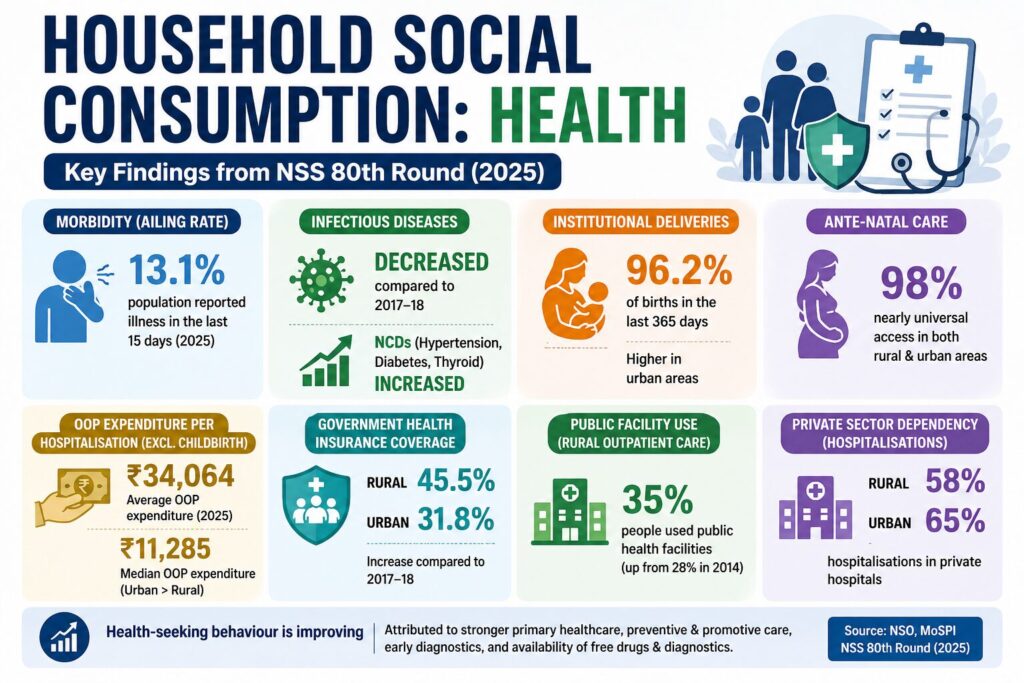
- Morbidity (Ailing Rate): Approximately 13.1% of the population reported illness (ailments) during the last 15-day period in 2025. The reported hospitalisation rate was higher in urban areas than in rural areas.
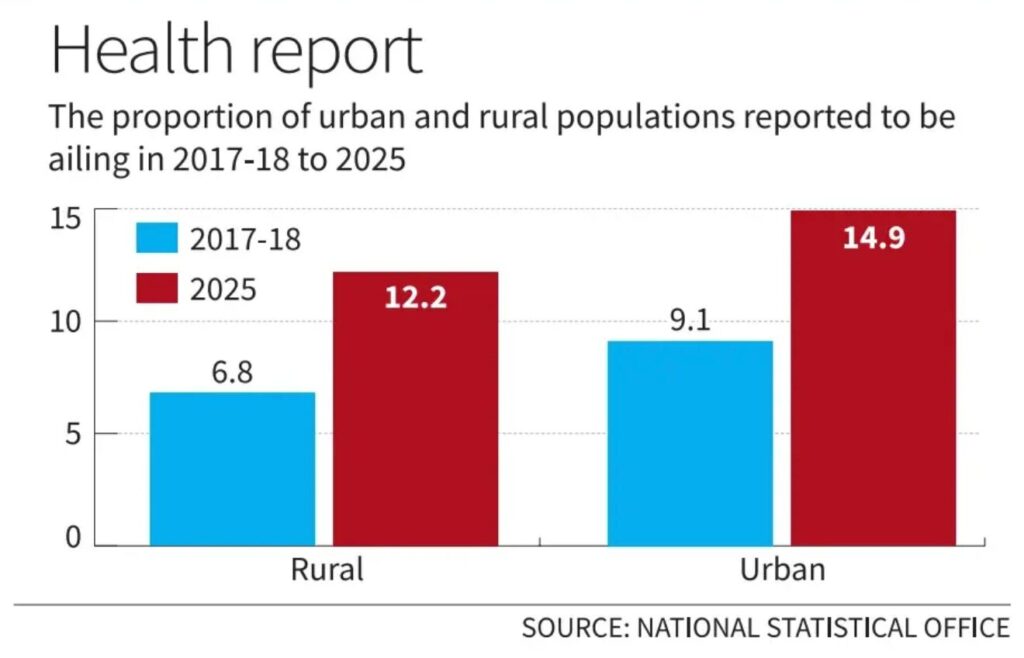
- Disease Prevalence: Reporting of infectious diseases decreased in 2025 compared to the previous NSS survey (2017-18). Non-communicable diseases (NCDs) such as hypertension, diabetes, and thyroid disorders showed an increase.
- Childbirth & Maternal Health:
- Institutional deliveries accounted for nearly all births (about 96.2%) during the last 365-day period. A higher rate of institutional deliveries is observed in urban areas than in rural areas.
- Both rural and urban areas showed near-universal access to ante-natal care (98%).
- Hospitalisation Expenditure:
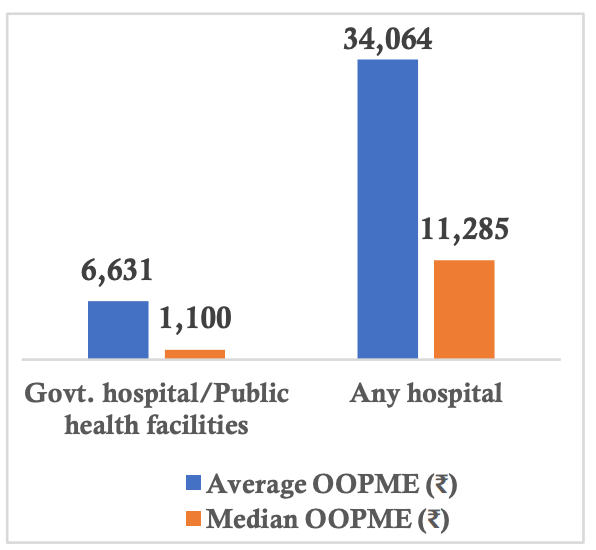
- The estimated average out-of-pocket medical expenditure per hospitalisation case (excluding childbirth) during the last 365 days was about ₹34,064.
- Median out-of-pocket medical expenditure was about ₹11,285 in 2025 (Urban > Rural).
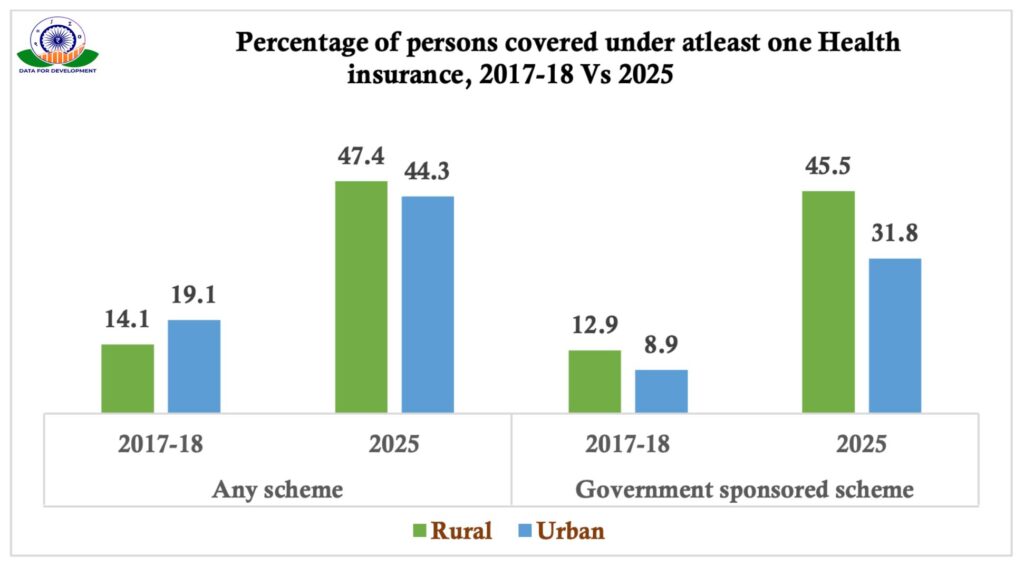
- Insurance Coverage: Government health insurance increased to 45.5% in rural areas and 31.8% in urban areas, compared to the NSS survey (2017-18). It is due to the rapid scaling up of government-financed health insurance coverage, including under the Ayushman Bharat PM Jan Arogya Yojana, and various State schemes.
- Public Facility Utilisation: In rural areas, 35% of people used public health facilities for outpatient care (up from 28% in 2014).
- Concerns: High private-sector dependency remains, with nearly 58% of hospitalisations in rural areas and 65% in urban areas utilising private hospitals.
Healthseeking behaviour in India is improving. This improvement has been attributed to the expansion of comprehensive primary healthcare services, with an emphasis on preventive, promotive, and early diagnostic care, supported by the availability of free drugs and diagnostics.
Practice MCQ:
Q. With reference to the report “Household Social Consumption: Health” released by the National Statistical Office, consider the following statements:
1. Prevalence of infectious diseases has increased compared to 2017-18.
2. Institutional deliveries accounted for more than 95% of births.
3. Public health facility usage in rural outpatient care has increased over time.
Which of the statements given above is/are correct?
(a) 2 and 3 only
(b) 2 only
(c) 1 and 3 only
(d) 1, 2 and 3
Answer: (a)
UPSC PYQ 2018
Q. As per the NSSO 70th Round “Situation Assessment Survey of Agricultural Households”, consider the following statements:
1. Rajasthan has the highest percentage share of agricultural households among its rural households.
2. Out of the total agricultural households in the country, a little over 60 per cent belong to OBCs.
3. In Kerala, a little over 60 per cent of agricultural households reported to have received maximum income from sources other than agricultural activities.
Which of the statements given above is/are correct?
(a) 2 and 3 only
(b) 2 only
(c) 1 and 3 only
(d) 1, 2 and 3
Answer: (c)
Tell Google you want more of this.
Add Anantam IAS as a preferred sourceOne tap, and this site shows up more often in your own Top Stories, AI Overviews and AI Mode. Remove it any time.