Daily Digest
UPSC · Civil Services Examination
Current Affairs · Thursday, 30 October 2025
Current affairs curated and edited by Anantam IAS faculty — pulled from The Hindu, PIB, IDSA, Foreign Affairs and the ministries. Read, annotate, revise.
Old Rajinder Nagar · Delhi 110005 · anantamias.com
Foreign Capital and Indian Banks

Why in the News?
Over the last 24 months, some of the world’s biggest financial institutions-from Dubai’s Emirates NBD to Japan’s Sumitomo Mitsui Banking Corporation (SMBC), Blackstone, and Abu Dhabi’s International Holding Company (IHC) have lined up to acquire significant stakes in Indian banks, insurers and non-banking financial companies (NBFCs).
UPSC Relevance
Provisions and Regulations in Banking are tested in Prelims.
PYQ
2024 Prelims
With reference to the rule/rules imposed by the Reserve Bank of India while treating foreign banks, consider the following statements:
- There is no minimum capital requirement for wholly owned banking subsidiaries in India.
- For wholly owned banking subsidiaries in India, at least 50% of the board members should be Indian nationals.
Which of the statements given above is/are correct?
(a) 1 only
(b) 2 only
(c) Both 1 and 2
(d) Neither 1 nor 2

Surge in Foreign Investment in Indian Financial Sector
- Significant Inflow: Despite a moderation in India’s net foreign direct investment (FDI), the financial sector is experiencing a wave of global money flow.
- Major Global Investors: Large financial institutions have acquired significant stakes in Indian banks, insurers, and Non-Banking Financial Companies (NBFCs) over the last 24 months. Examples include:
- Blackstone acquired a 9.99% stake in Federal Bank for Rs 6,196 crore.
- Emirates NBD (UAE) decided to acquire a 60% stake in RBL Bank for about $3 billion.
- Sumitomo Mitsui Banking Corporation (Japan) acquired a 20% stake in Yes Bank for $1.6 billion.
- Zurich Insurance Group acquired a 70% majority stake in Kotak General Insurance for $670 million.
- Regulatory Flexibility: The Reserve Bank of India (RBI) has shown a positive, cautious stance, even granting special approvals, such as allowing Canada-based Fairfax to hold a majority stake in CSB Bank for five years, deviating from the normal 40% foreign ownership cap.
Why Foreign Investment ?
- Sector Growth & Profitability:
- The banking industry is India’s largest sector by net income, generating $46 billion in 2024, with 31% YoY growth (McKinsey & Company).
- Indian banks show higher profitability than the global average, with ample liquidity, strong capital levels, and reduced credit risk.
- Market Potential: India offers a rapidly expanding financial market with an underbanked population of over 400 million.
- Strategic Advantage: Acquiring stakes in existing Indian entities provides global players with immediate access to customers, licenses, and branch networks, which would otherwise take decades to build.
- Global Diversification: India is seen as the natural alternative for global capital due to geopolitical risks and tightening financial systems in countries like China. It offers scale, political stability, a vast consumer base, and credible regulatory oversight.
Regulatory Environment and Risks
- Relaxed Restrictions: The RBI and the government have gradually relaxed foreign ownership restrictions; for example, private banks are now allowed up to 74% foreign ownership with regulator approval.
- Measured Liberalisation: The message to analysts is that the financial sector welcomes capital, provided control and compliance remain under Indian regulation and the sector stays largely insulated from global shocks.
- Risks Associated with Inflow:
- Shift in Control: Foreign majority ownership could lead to a gradual shift of control over strategic decisions offshore.
- Vulnerability to Global Shocks: Increased foreign ownership can make India’s financial system more vulnerable to global crises (like the 2008-09 financial crisis).
- Distorted Playing Field: Foreign-owned entities may have access to cheaper global funding and more sophisticated risk management systems than domestic counterparts, potentially distorting competition.
- Need for Framework: As deals grow more complex, India requires a clearer framework on the adequate level of foreign control, though the RBI’s decision is currently final in banking acquisitions. The challenge is ensuring this capital inflow strengthens India’s financial independence and stability.
Foreign Bank Entry and Operating Norms
The Reserve Bank of India (RBI) governs the rules and regulations for the entry and operation of foreign banks and the foreign shareholding in both private and public sector Indian banks. The policy approach is often described as calibrated pragmatism, balancing the need for capital and best practices with the imperative of maintaining financial stability and domestic control.
Foreign banks can operate in India through two main channels:
- Branch Presence: This is the traditional and most common route. Foreign banks operate as branches of their overseas parent banks.
- Governing Acts: Foreign banks operating in India must comply with the provisions of the Banking Regulation Act, 1949, the Reserve Bank of India Act, 1934, the Foreign Exchange Management Act (FEMA), 1999, and the Companies Act, 2013 (to the extent applicable).
- Licensing: Every foreign bank branch must obtain a license from the RBI under Section 22 of the Banking Regulation Act, 1949, before commencing business.
- Reciprocity: Permission for entry is generally granted based on the principle of reciprocity, meaning Indian banks should receive similar non-discriminatory treatment in the foreign bank’s home country.
- They are subject to the RBI’s regulations, including capital adequacy, statutory reserves, priority sector lending, and exposure norms, similar to domestic banks.
- Capital: Unlike domestic banks, a foreign bank branch does not have “paid-up capital” in India. Instead, it is required to maintain a specified level of assigned capital and hold certain assets in India.
- The capital requirement for foreign banks in the branch mode is typically an initial minimum of US$25 million.
- Branch Expansion Policy : Opening any new place of business (branch or office) in India requires prior approval from the RBI under Section 23 of the Banking Regulation Act, 1949.
- Wholly Owned Subsidiary (WOS) Model: The RBI introduced this option to encourage greater commitment to the Indian market.
- Licensing and Regulation: A foreign bank establishing a WOS must obtain a license from the RBI under the Banking Regulation Act, 1949. The WOS is treated as a domestic scheduled commercial bank, subjecting it to the same regulatory and supervisory framework as Indian private sector banks.
- Indian Nationals on the Board: A WOS is typically required to have a minimum percentage of Indian nationals on its Board of Directors. It’s often stipulated that at least 50% of the board members should be Indian nationals/NRIs/PIOs subject to the condition that one-third of the directors are Indian nationals resident in India.
- Capital Requirements: Unlike the general minimum capital requirement for some new banking licenses, in the case of foreign bank WOS, there is sometimes no specific minimum capital amount mandated, but the WOS must comply with all capital adequacy norms applicable to domestic banks (like CRAR – Capital to Risk-weighted Assets Ratio).
- For New Entrants: A foreign bank establishing a WOS as a new entrant to the Indian banking system must bring in the entire amount of ₹5 billion upfront.
- For Conversion of Existing Branches: Existing foreign bank branches in India desiring to convert into a WOS must have a minimum net worth of ₹5 billion.
- Branch Expansion: One of the incentives for adopting the WOS model is that the RBI generally allows greater freedom in branch expansion compared to foreign banks operating solely through a branch structure.
- Legal Status: A WOS is a separate legal entity from its parent company. This helps in ring-fencing the parent bank’s liability, meaning the liabilities of the Indian WOS are isolated and do not directly impact the parent bank.
Shareholding Limits for Foreign Institutions in Indian Banks
The limits on foreign investment, including Foreign Direct Investment (FDI) and Foreign Portfolio Investment (FPI), differ significantly between private and public sector banks
1. Private Sector Banks
| Category | Overall Foreign Investment Limit | Route for Investment | Specific Conditions/Notes |
| Total Foreign Investment (FDI + FPI) | Up to 74% of the paid-up capital. | Investment up to 49% is generally allowed through the Automatic Route. Investment above 49% up to 74% requires Government Approval. | The RBI maintains strict control over acquisitions. Any stake of 5% and above generally requires prior RBI approval. |
| Voting Rights | Capped at 26% of the total voting rights for any single shareholder, regardless of the actual equity stake held. | This is a crucial regulatory safeguard to ensure domestic control of the bank’s management and strategic decisions, even if a foreign entity holds a majority of the equity. | |
| Individual/Non-Promoter Shareholder | Capped at 15% (extendable with specific approval). | Majority ownership (above 15%) is permitted only in exceptional cases, such as a strategic revival or recapitalisation of a weak bank, subject to specific regulatory conditions and a lock-in period. |
2. Public Sector Banks (PSBs)
| Category | Current Foreign Investment Limit | Proposed Limit (Under Discussion) | Notes |
| Total Foreign Investment (FDI + FPI) | Capped at 20% of the paid-up capital. | 49% (A proposal to increase the limit is currently under discussion between the Government and the RBI to attract more capital and reduce the gap with private banks). | The government aims to retain a minimum 51% stake to maintain the public sector character of the bank. The 20% cap is statutory. |
| Voting Rights | Capped at 10% for a single shareholder. | This safeguard is expected to remain in place even if the FDI limit is raised. | This is a stricter control measure compared to private sector banks. |
Regulatory Stance and Recent Trend
- The RBI’s policy has evolved from strict conservatism to a more liberal stance, particularly in recent years, to facilitate recapitalisation and the infusion of global best practices
- Recent significant foreign acquisitions and stakes in private banks demonstrate the RBI’s case-by-case pragmatic approach, allowing foreign entities to take substantial equity, provided they are deemed “fit and proper” and the transaction aligns with financial stability goals.
- Prior Approval: Acquisition of significant stakes (usually 5% or more) requires mandatory prior approval from the RBI
- Compliance: Foreign-owned entities are required to comply with all domestic regulations, including capital adequacy norms, priority sector lending targets, and corporate governance standards.
Source: https://anantamias.com/current-affairs/foreign-capital-and-indian-banks/
The Constitution (One Hundred and ThirtiethAmendment) Bill, 2025

Context: The Constitution (One Hundred and Thirtieth Amendment) Bill, 2025 seeks to usher in a new era of ethical governance by mandating the automatic removal of the Prime Minister, Chief Ministers, or other Ministers if detained for 30 consecutive days on serious criminal charges (punishable by ≥5 years).
This landmark proposal—amending Articles 75, 164 and 239AA—has ignited a national debate between “moral accountability” and “constitutional prudence.” It attempts to legally institutionalize what the Supreme Court once urged as moral restraint in Manoj Narula v. Union of India (2014) — that holders of public office must exemplify the highest standards of integrity.
UPSC Relevance
GS II syllabus:
Structure, organization & functioning of the Executive
- Discusses collective responsibility, moral eligibility, and ministerial ethics—key parts of the GS II line item on the “structure, organisation and functioning of the Executive.”
- Goes to the heart of Union and State Executives, defining appointment and removal of Ministers.
Key Constitutional Amendments and Context
- Amends: Articles 75 (Union), 164 (State), and 239AA (Delhi).
- Extended to: Puducherry (via Government of UTs Amendment Bill, 2025) and Jammu & Kashmir (via J&K Reorganization Amendment Bill, 2025).
- Examined by: A Joint Parliamentary Committee (JPC) for constitutional scrutiny.
Contextual Case Study – “Governance from Jail”:
In 2017, Lalu Prasad Yadav continued to influence Bihar politics despite conviction in the fodder scam; similarly, in 2022, Arvind Kejriwal’s ministers faced arrest under excise probes yet remained in office. The Bill seeks to prevent such ethical anomalies.
Salient Provisions
1. Grounds for Removal
- Arrest and detention for 30 consecutive days for an offence punishable by five years or more.
- Applies equally to PM, CMs, and all Ministers.
Case Insight:
In 2021, Tamil Nadu’s Minister Senthil Balaji faced prolonged custody but remained in office. The incident triggered debates on ministerial accountability during detention—a direct precursor to this amendment.
2. Procedure for Removal
| Category | Authority | Advice Mechanism | Automatic Effect |
|---|---|---|---|
| Union Ministers | President | On PM’s advice (by 31st day) | If no advice → automatic cessation |
| State Ministers | Governor | On CM’s advice | Same |
| Delhi Ministers | President | On CM’s advice | Same |
| PM/CM | — | Must resign by 31st day | Else ceases office automatically |
Case Insight – Constitutional Convention: In 1954, Finance Minister T.T. Krishnamachari resigned following the Mundhra Scandal after parliamentary censure despite no legal compulsion. The Bill seeks to codify such conventions into enforceable law.
3. Reappointment Clause
- A removed Minister may be reappointed after release from custody.
Comparative Study: In Pakistan (Nawaz Sharif case, 2017), the Supreme Court permanently disqualified the PM under moral corruption charges. In contrast, India’s proposal allows reappointment post-release, balancing morality with political rehabilitation.
Rationale and Need for Reform
1. Bridging Legal Gaps in Disqualification
Under Representation of the People Act, 1951, disqualification occurs only upon conviction.
However, prolonged custody (without conviction) allows “governance from jail,” eroding public faith.
Case Study – Madhu Koda (2009): The Jharkhand CM faced corruption allegations but remained in office until conviction, showcasing the gap between arrest and disqualification that this Bill aims to fill.
2. Promoting Constitutional Morality
The Supreme Court in Manoj Narula v. Union of India (2014) emphasized moral restraint in appointments, holding that “the Prime Minister must act in accordance with constitutional morality.” The Bill seeks to translate this advisory principle into a binding constitutional mandate.
3. Ensuring Administrative Parity
Civil servants are suspended after 48 hours in custody (Rule 10, CCS Rules). Ministers, as higher public servants, should not enjoy lower ethical thresholds.
Case in Point – IAS Suspension (Anil Deshmukh Case, 2021):
When Maharashtra’s Home Minister was arrested, bureaucrats below him were suspended promptly. The asymmetry between executive accountability and ministerial privilege was stark.
Arguments in Favour of the Bill
1. Upholding Public Trust & Constitutional Morality
- Aligns with People’s Union for Civil Liberties (PUCL) v. Union of India (2013), where the SC held that democracy demands transparency and integrity in public life.
- The Bill institutionalizes the principle that public office is not private entitlement but public trust.
2. Preventing “Governance from Jail”
- Prevents manipulation of portfolios from judicial custody—seen in Jayalalithaa’s tenure (2001) when she continued despite conviction before being unseated by the Supreme Court.
- 30-day rule aims to balance frivolous arrests vs. judicial scrutiny
3. Strengthening Good Governance
- Reinforces the principle of Rule of Law, echoing A.K. Kraipak v. Union of India (1970) which underlined that “no authority is above fairness and accountability.”
4. Ethical Parity
- Matches civil service norms—thereby removing the perception that political class enjoys immunity from moral scrutiny.
Arguments Against the Bill
1. Threat to Federalism & Political Misuse
- Arrests by central agencies (ED, CBI) may become political tools against state governments.
- Case Study – Hemant Soren (2024): His arrest before the Lok Sabha polls was alleged to be politically timed.
- May violate the “Basic Structure” doctrine under Kesavananda Bharati (1973) if used to weaken state autonomy.
2. Erosion of “Presumption of Innocence”
- Detention ≠ guilt. The Bill reverses this core tenet of criminal jurisprudence.
- SC Precedent – Lily Thomas v. Union of India (2013): Disqualification valid only after conviction, not during trial.
- Also contradicts Public Interest Foundation v. Union of India (2018) where SC refused to add new grounds of disqualification.
3. Inconsistency between Legislators and Ministers
- Paradox: An MLA under detention could remain legislator, yet lose ministership under this Bill.
- May violate Article 14 (Equality before Law)—similar situations treated unequally.
Case Study – Anil Deshmukh vs Nawab Malik (2022):
Both were MLAs; both jailed under PMLA; one resigned, the other remained legislator—illustrating legal asymmetry.
4. Revolving Door and Political Instability
- Provision for reappointment post-release could lead to repeated resignations and reinstatements, like Jharkhand CM Hemant Soren’s cycle (2024–25)—creating governance uncertainty.
5. Absence of Safeguards
- No mechanism to verify whether arrests are politically motivated. Breaches constitutional design of removal “on advice” (Arts. 75, 164, 239AA); offends Articles 14/19/21 by equating detention with guilt; invites executive overreach. The Indian Express
- Distinguishes RPA disqualification (post-conviction) from ministerial removal (custody-based) proposed here. The Indian Express+2
- Data Point: Of ~5,000 ED cases (2019–24), conviction rate < 10% — raising fears of executive misuse of detention-based disqualification.
Judicial & Legal Precedents
| Case / Institution | Key Takeaway |
|---|---|
| Lily Thomas (2013) | Disqualification only upon conviction; Parliament must amend law for pre-conviction disqualification. |
| Manoj Narula (2014) | PM/CMs should avoid appointing tainted persons; constitutional morality must guide appointments. |
| Public Interest Foundation (2018) | Judiciary cannot add disqualification criteria; Parliament must legislate. |
| ECI (2016 Recommendation) | Bar candidates once charges framed for offences ≥5 years imprisonment. |
| A.K. Kraipak (1970) | Administrative fairness applies to all organs, including the executive. |
Broader Constitutional and Political Dimensions
1. Constitutional Morality vs Federal Autonomy
- Promotes morality but risks central dominance over states.
- Case Reference: S.R. Bommai v. Union of India (1994)—Federalism is part of Basic Structure; any misuse may invite judicial review.
2. Collective Responsibility of Cabinet
- Automatic cessation of PM/CM may create a vacuum in collective responsibility (Article 75(3)), necessitating constitutional safeguards for continuity of governance.
3. Rule of Law and Natural Justice
- Maneka Gandhi v. Union of India (1978) emphasized “procedure established by law must be just, fair and reasonable.”
- Bill’s automatic removal clause may be challenged as arbitrary (Article 14) for bypassing judicial confirmation.
Way Forward
1. Judicial Review Mechanism
- Establish an Independent Tribunal or Review Board (chaired by a retired SC judge) to verify the legitimacy of arrest and custody before automatic removal.
Precedent: The U.K. Ministerial Code (2010) mandates independent inquiry into ministerial misconduct.
2. Interim Suspension Instead of Removal
- Allow temporary suspension of ministerial powers during judicial custody—similar to civil service model—to balance accountability and continuity.
3. Fast-Tracking Criminal Trials
- Supreme Court in Ashwini Upadhyay PIL (2023) directed establishment of Special Courts for cases against MPs/MLAs; must be operationalized effectively.
4. Political Party Reforms
- Enforce ECI guidelines (2020) requiring parties to publicize criminal antecedents of candidates.
Example: In Bihar Assembly Elections 2020, 68% winners had criminal cases—demonstrating urgency of reform.
5. Legal Harmonization
- Amend RPA, 1951 to align disqualification standards for legislators and ministers—ensuring legal parity.
Conclusion
The Constitution (130th Amendment) Bill, 2025 embodies a historic attempt to reconcile ethical governance with constitutional accountability. While its intent—to end governance from jail—is noble, its design risks political weaponization, federal friction, and erosion of due process if unaccompanied by judicial safeguards.
India’s democracy requires not just clean politics, but also fair mechanisms to ensure cleanliness. The challenge lies in ensuring that constitutional morality does not transform into majoritarian morality.
As Dr. Ambedkar observed —
“Constitutional morality is not a natural sentiment. It has to be cultivated.”
Hence, the success of this reform depends not merely on law, but on the ethical conduct of those entrusted with power.
Summary of important cases:
| Dimension | Case Study / Example | Insight |
|---|---|---|
| Constitutional Morality | Manoj Narula (2014) | Ministers must uphold ethics, not just legality |
| Rule of Law | A.K. Kraipak (1970) | Fairness extends to the executive |
| Federalism | S.R. Bommai (1994) | Prevent misuse of Union power |
| Accountability | T.T. Krishnamachari (1954) | Moral resignation precedent |
| Governance from Jail | Lalu Prasad, Jayalalithaa cases | Need for legal remedy |
| Due Process | Maneka Gandhi (1978) | Any law must be fair and non-arbitrary |
| Political Misuse | Hemant Soren, ED data | Highlight need for independent review |
World Trade Organization and its issue

Context:
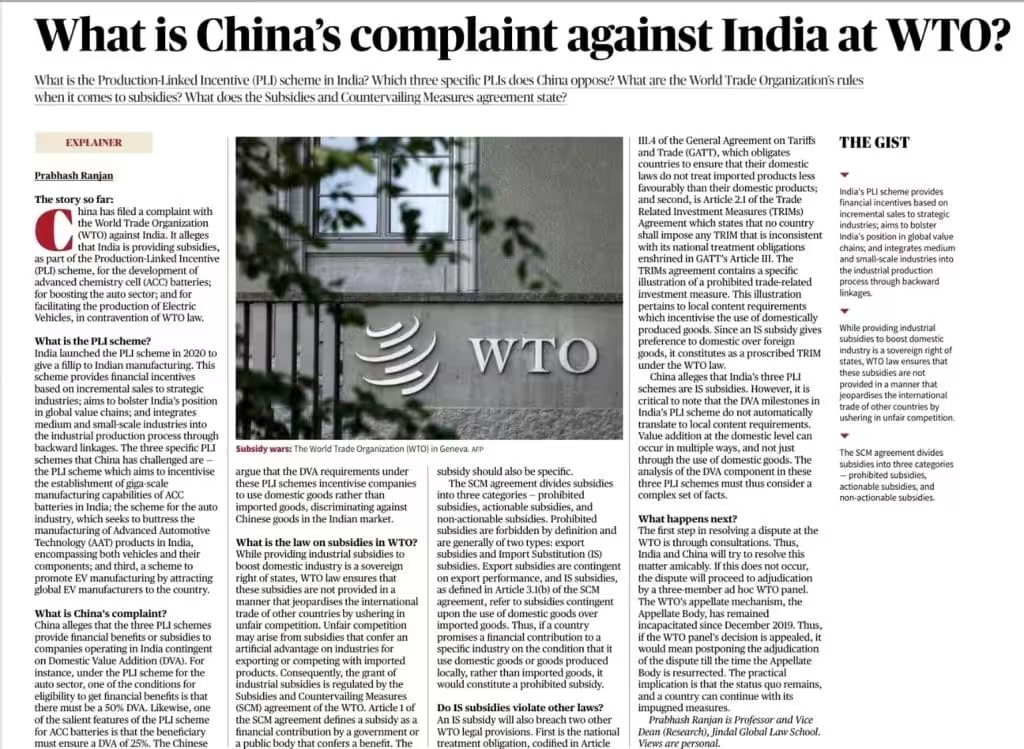
China has filed a complaint with the World Trade Organization (WTO) against India’s Production Linked Incentive (PLI) schemes. This schemes discriminate against imported goods (including Chinese products) by providing subsidies linked to Domestic Value Addition (DVA) — allegedly violating WTO subsidy norms.
UPSC Relevance:
Economy (International Organization and it’s related issues)
UPSC PYQ:
Q1. What are the key areas of reform if the WTO has to survive in the present context of ‘Trade War’, especially keeping in mind the interest of India? (2018)
China’s Core Complaint:
China file a complaint against India at WTO particularly target the India’s Production Linked Incentive (PLI) schemes. These schemes discriminate against imported goods:
- PLI for Advanced Chemistry Cell (ACC) batteries
- PLI for Auto and Advanced Automotive Technology (AAT)
- PLI for Electric Vehicles (EVs)
India’s PLI schemes make financial benefits contingent upon using domestic goods — thus constituting Import Substitution (IS) subsidies.
Example:
- ACC battery PLI: requires 25% DVA.
- Auto sector PLI: requires 50% DVA.
About WTO:
The World Trade Organization (WTO) is the only international organization dealing with the rules of trade between nations. At its heart are the WTO agreements, negotiated and signed by the bulk of the world’s trading nations and ratified in their parliaments. The fundamental goal of the WTO, as set out in the organization’s founding agreement, is to use trade as a means to improve people’s living standards, create better jobs and promote sustainable development.
- The WTO, established in 1995 under the Marrakesh Agreement (1994), following the Uruguay Round of negotiations 1986-94.It succeeded the GATT, which had regulated global trade since 1948.
- It’s headquartered in Geneva, Switzerland.
- The WTO is run by its member governments. All major decisions are made by the membership as a whole, either by ministers (who meet at least once every two years)
- The WTO has 166 members, accounting for 98% of world trade.
- WTO Secretariat: The WTO has approximately 630 staff on its regular budget and is headed by a Director-General.
- The working languages of the WTO are English, French and Spanish.
Functions:
- Administering WTO trade agreements
- Forum for trade negotiations
- Handling trade disputes
- Monitoring national trade policies
- Technical assistance and training for developing countries
- Cooperation with other international organizations
Organization:
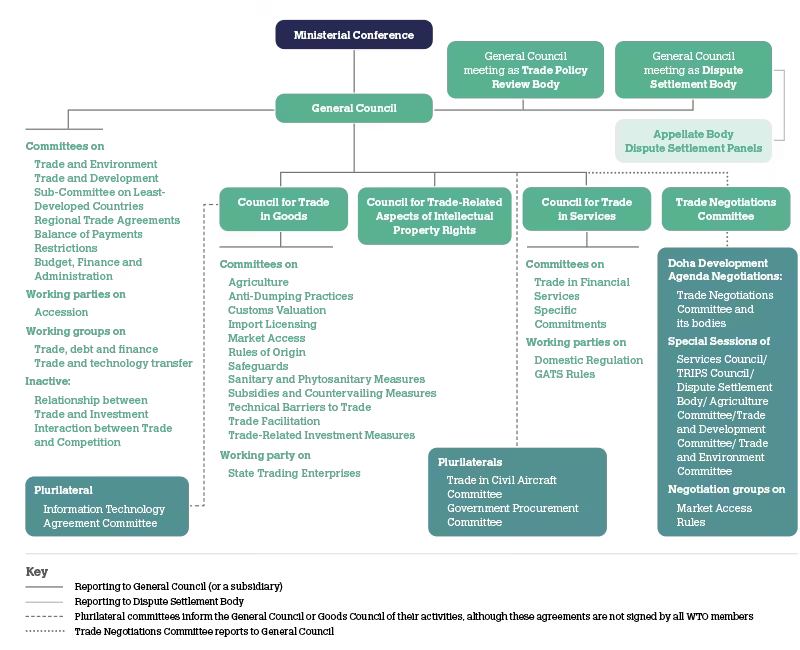
WTO Law on Subsidies:
Governed by the Subsidies and Countervailing Measures (SCM) Agreement.
Subsidy Definition (Article 1): A financial contribution by a government or public body that confers a benefit and is specific to an enterprise or industry.
Types of Subsidies under SCM:
| Type | Description | Legal Status |
|---|---|---|
| Prohibited Subsidies | 1. Export subsidies (linked to export performance) 2. Import substitution (IS) subsidies (linked to use of domestic goods) | Illegal under WTO |
| Actionable Subsidies | May be challenged if they harm another country’s trade interests (e.g., injury to domestic industry). | Allowed but can be contested. |
| Non-actionable Subsidies | For general welfare purposes like R&D or environment-friendly projects. | Permitted. |
India’s Possible Defence:
- PLI’s DVA clause ≠ Local Content Requirement:
- Value addition can arise from assembly, technology transfer, innovation, or skill enhancement, not just domestic inputs.
- Legitimate Industrial Policy Objective:
- To attract investment, build domestic capacity, and support the green transition (e.g., EVs, batteries).
- Precedent: Many developed countries (e.g., US with Inflation Reduction Act) have adopted green subsidies with domestic production incentives — which China itself has criticized globally.
WTO Dispute Settlement Process:
| Stage | Description |
|---|---|
| 1. Consultations | India and China discuss the issue bilaterally. |
| 2. WTO Panel | If unresolved, a three-member panel is constituted to adjudicate. |
| 3. Appeal | The losing party can appeal to the Appellate Body — but it has been non-functional since Dec 2019, leading to procedural deadlocks. |
| 4. Practical Implication: Status quo continues until the Appellate Body resumes functioning. |
Source: https://anantamias.com/current-affairs/world-trade-organization-and-its-issue/
Delhi Winters and Air Pollution
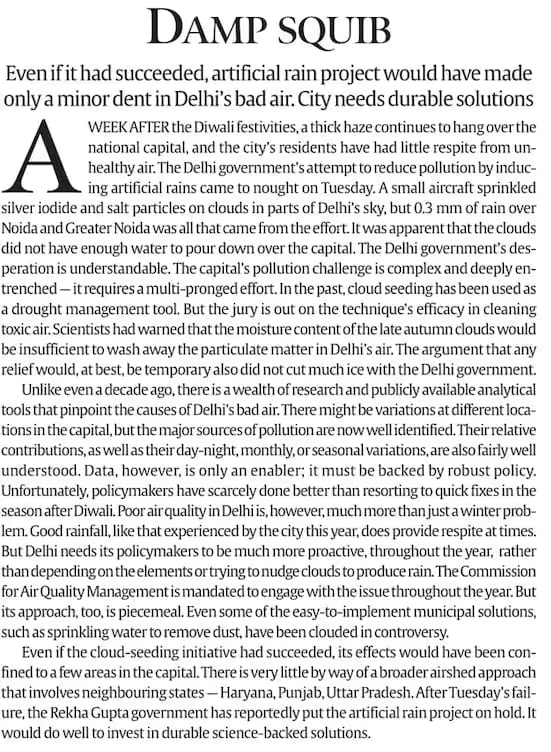
UPSC PYQ (2015)
Mumbai, Delhi and Kolkata are the three Megacities of the country but the air pollution is a much more serious problem in Delhi as compared to the other two. Why is this so?
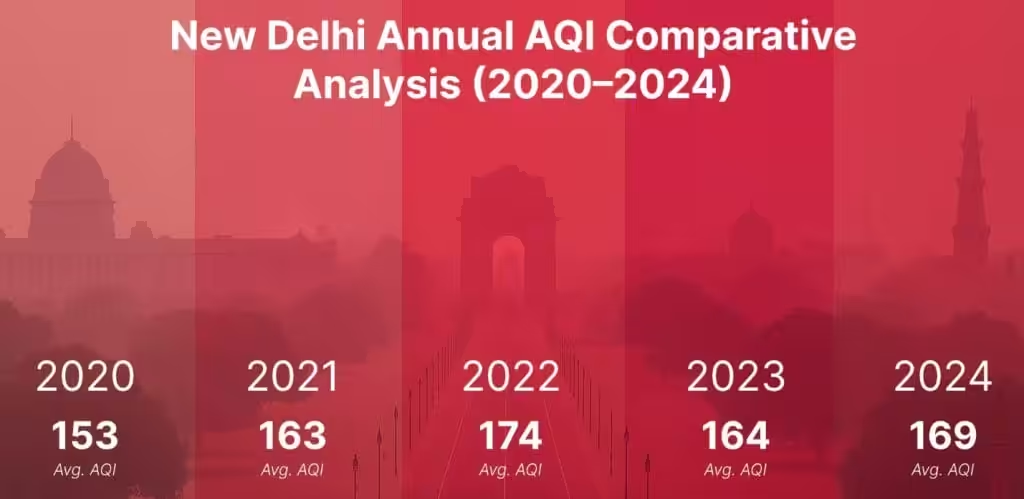
Why Delhi experiences higher Air pollution especially in winters?
Delhi or for that matter entire North India, experiencing higher Air Pollution during winters is due to mix of Natural as well as Anthropogenic factors.
Natural Factors:
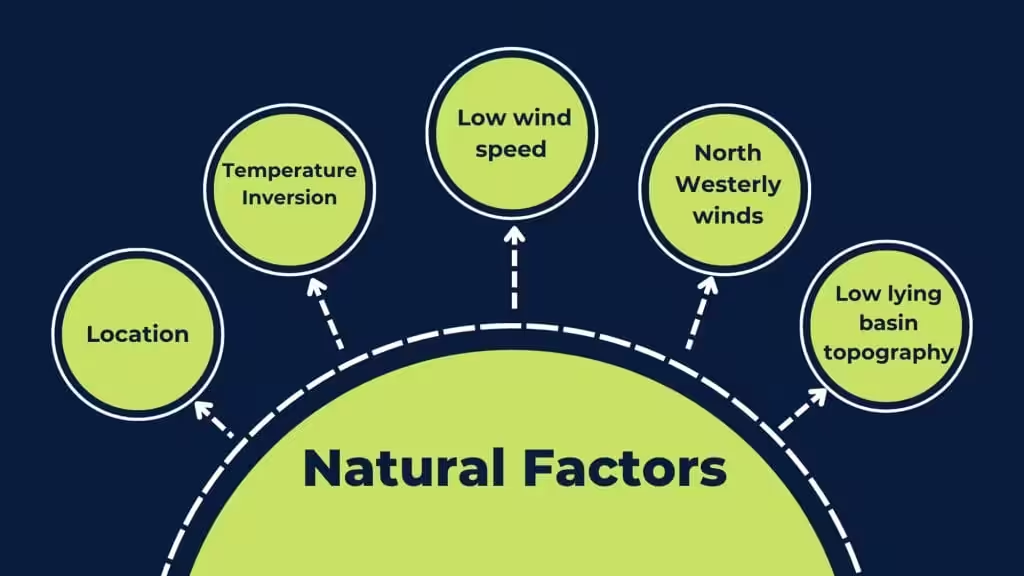
- Location of Delhi: Delhi is located far from the maritime influence of the Indian Ocean and therefore Delhi experiences dry weather especially in winters.
- Temperature Inversion: CPCB Annual air quality report 2022 mentions that in winter, cool air near the surface gets trapped under warmer air, stopping vertical mixing. The mixing height falls from ~1,500 m (summer) to under 300 m (winter), trapping pollutants near the ground.
- Low wind speed & calm conditions: Winds weaken to below 5 km/hr in winter, causing air stagnation therefore pollutants from local and nearby regions remain suspended for longer periods.
- North Westerly winds: The region experiences North Westerly winds from Central Asian region during winter which carry the dust particles along with it.
- Low lying basin topography: IITM published a report in 2021 detailing the outcomes of basin topography of of Delhi. According to that report, Delhi lies in a bowl-shaped basin bounded by the Himalayas and the Aravallis. This natural topography restricts horizontal air movement, allowing pollutants to accumulate.
- Lack of rainfall & foggy conditions: Winter is dry; no rain means no natural “washout” of pollutants. Dense fog combines with pollutants forming smog, further reducing visibility.
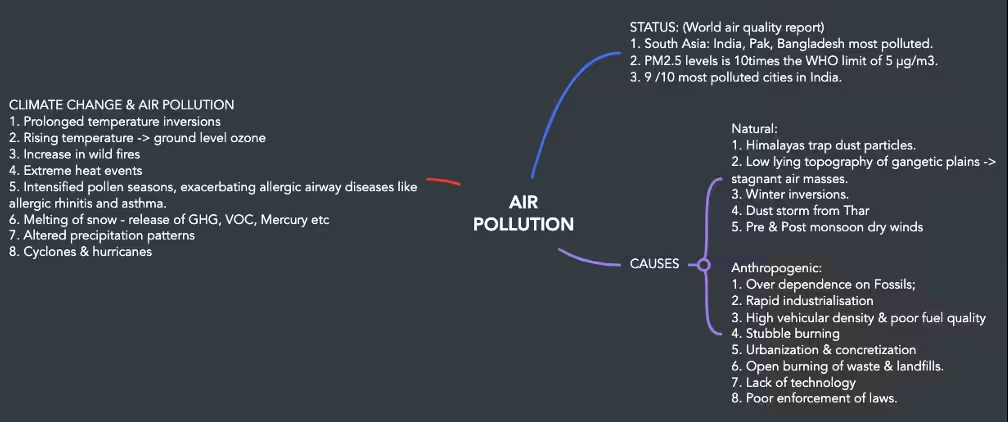
Anthropogenic Factors:
- Stubble burning in Punjab & Haryana: According to SAFAR, Ministry of Earth Sciences 2023, stubble burning contributes 25–40% of Delhi’s PM₂.₅ concentration during peak burning season.
- Vehicular emissions (CPCB & TERI, 2022): Diesel and idling emissions are major culprits, especially during cold, dense air conditions contributing ~40% of PM₂.₅ load.
- Biomass & waste burning (CSE, 2021): Centre for Science and Environment, 2021 said that open burning of household waste and biomass for heating increases in winter nights adding 7–9% of total PM₂.₅ levels.
- Industrial emissions & construction Dust: Thermal power plants, brick kilns, and dust from construction sites also contribute large PM loads.
- Governance gaps & reactive policy: NITI Aayog Air Quality Report said that current measures like GRAP and odd-even schemes are short-term and reactive. Crop diversification, clean transport, and regional coordination remain under-implemented.
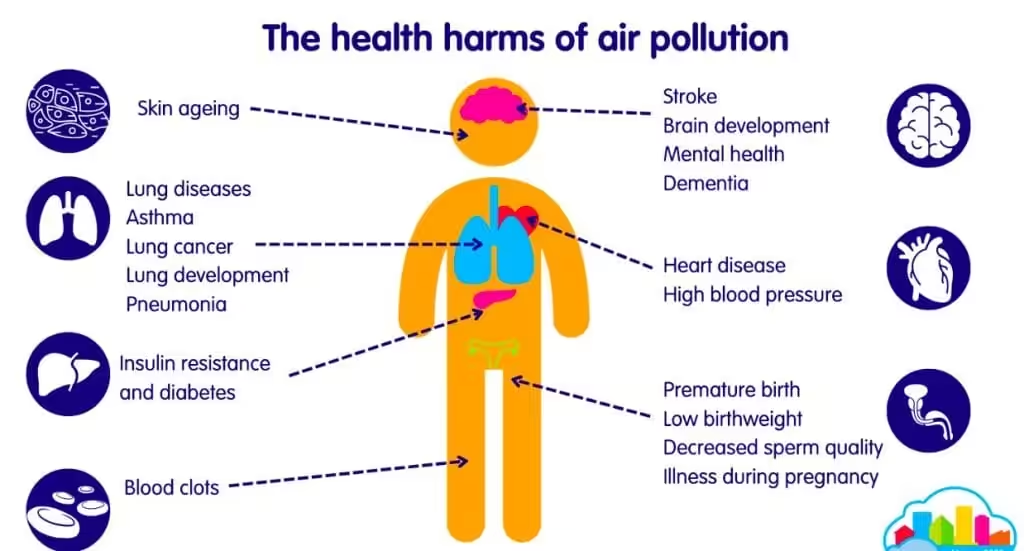
What are the health impacts of Air pollution?
Indian initiatives to tackle air pollution (including 2024–25 updates)
| Initiative | Year / Launch | Target / Scope | Key Features & Status |
| National Ambient Air Quality Standards (NAAQS) | 2009 | Set permissible limits for pollutants (PM₂.₅, PM₁₀, SO₂, NO₂ etc.) | Provides benchmark regulatory standards used in monitoring and enforcement. |
| National Air Quality Index (NAQI) | 2015 | Real‑time air quality grading across cities | Enables public awareness and timely data dissemination. |
| Graded Response Action Plan (GRAP) – Delhi‑NCR | 2017 | Trigger actions at different AQI levels | Allows short‑term crisis measures like construction bans, traffic curbs in Delhi‑NCR. |
| National Clean Air Programme (NCAP) | 2019 | Reduce PM levels 20‑30% by 2024 (now 40% by 2026) | Implemented in 131 cities; ₹13,000 cr released; 97 cities improved air quality (2024). |
| BS‑VI Emission Standards | 2020 | Leap in fuel/vehicle emission norms | Major reduction of vehicular NOx and PM emissions. |
| Crop Residue & Waste Burning Management | 2021–Ongoing | Curb stubble & open waste burning | Promotes in‑situ management and bans open burning; targets major anthropogenic sources. |
| NCAP 130 City‑Specific Plans | 2025 | City‑specific clean air plans for 130+ cities | Targets dust, transport, construction; enhanced monitoring and fund release. |
| Fund Utilisation Review & Accountability | 2025 | Improve implementation of NCAP funds | Focus on utilisation (e.g., Delhi ~32.65%); directive to states for better execution. |
| Life Expectancy Gain Study | 2025 | Assess health gains from NCAP | 40% PM reduction could extend life expectancy by ~2 years in 130 cities. |
Practice Question:
Delhi’s air pollution is not just a local governance issue but a regional atmospheric phenomenon.” Discuss. (10 Marks, 150 words)
Source: https://anantamias.com/current-affairs/delhi-winters-and-air-pollution/
Maritime Sector in India
Why in the News?
PM launches initiatives worth ₹2.2 lakh crore for shipping and shipbuilding sectors at Maritime Leaders’ Conclave.


UPSC Relevance
GS3, Infrastructure: Energy, Ports, Roads, Airports, Railways etc.
PYQ
2024
What is the need for expanding the regional air connectivity in India? In this context, discuss the government’s UDAN Scheme and its achievements.
Opportunities for India in the Maritime Sector
- Port Achievements:
- Doubled Port Capability: The capability of major ports has doubled, and cargo movement in inland areas has increased by 700%
- The Vizhinjam deep water transit hub has become operational.
- JNPT (Jawaharlal Nehru Port Trust) has doubled its handling capability, making it India’s biggest container port.
- Kandla port and JNPT have shown great capabilities.
- Global Maritime Hub: The India Maritime Week has grown from a maiden event in 2016 to a global summit with 85 participating countries, signaling world confidence in India’s maritime capabilities. Indian ports are now considered among the best in the developing world. The Memoranda of Understanding (MoUs) signed at the event show global confidence in India.
- Improved Logistics Performance: India is ranked 38th in the World Bank’s 2023 Logistics Performance Index (LPI), an improvement from its previous 44th position.
- India ranked 22nd for International Shipments, and its number of seafarers has increased, placing it among the top three globally in terms of seafarer numbers.
- The average turnaround time for ships at Indian ports has significantly improved, falling to less than one day, or approximately 48 hours, from an average of over 4 days in previous years.
- Global Shipping Hub: India is a crucial hub for trade, shipbuilding, and ship recycling, with growing technological and digital capacity in the sector.
- Growing Shipbuilding Capacity: As the global market reaches capacity, India’s rapidly growing position as a builder of the global fleet creates opportunities for new orders and partnerships. For example, 10% of ships ordered by members of the Norwegian Shipowners’ Association are built in India.
- Trusted Shipbuilding Partner: Indian yards, such as Cochin Shipyard, have secured major orders, including 14 vessel orders from Norway’s Wilson ASA, demonstrating trust and quality.
- Sustainable Practices: India is an excellent partner in the development of environmentally sound and safe ship recycling.
- Forward-Looking Strategy: India’s Maritime India Vision 2030 and Amrit Kaal 2047 provide a clear, forward-looking strategy for the sector.
- A Need for Stability: The world is experiencing “rough seas” and “global tensions,” which are causing trade headwinds. Amid these tensions, the world is looking for a “steady lighthouse,” a role India is positioned to play “very strongly.”
Challenges Ahead
- Infrastructure and Connectivity Gaps
- Port Modernization: While port capacity has increased, some ports still lack modern facilities and technology needed for world-class efficiency
- Hinterland Connectivity: There are persistent connectivity deficits between ports and the hinterland, especially concerning road and rail bottlenecks. This is a major factor in India’s high logistics costs.
- Multimodal Integration: Weak integration between different modes of transport (road, rail, water) and storage networks creates inefficiencies and “hidden costs” in the supply chain.
- Shipping Capacity and Self-Reliance
- Low Indian Flagged Tonnage: A major challenge is that a large percentage of India’s trade cargo (around 80%) is still carried on foreign-flagged or foreign-owned vessels. This results in significant foreign exchange spending (estimated at $70-75 billion annually)
- Need for Shipbuilding Capital: Developing a robust, self-reliant shipbuilding and ship-owning industry requires a massive influx of capital, an issue being addressed through new financial models and funds like the Maritime Development Fund (MDF)
- Piracy and Security: Incidents of pirate attacks in the Arabian Sea and Indian Ocean pose a serious threat to the safety of Indian seafarers and ships, as well as sea-borne trade.
- Sustainability
- Decarbonization Investment: Meeting global maritime targets for decarbonization (such as cutting emissions by 30% by 2030) requires massive investment in green technology, alternative fuel infrastructure (like hydrogen and ammonia), and port-side power
- Social and Environmental Balance: Ensuring that port-led development is equitable and inclusive, and that it aligns with environmental protection and social goals, especially concerning coastal communities and Indigenous Peoples, remains a delicate balancing act.
- For Example, Activists have raised concerns over tribal rights in the Great Nicobar Project.
- Achieving Net-Zero: A major international challenge is the need for member states to unite and ensure the International Maritime Organization’s Net-Zero Framework becomes a reality.
- Marine Pollution and Sustainable Management: The ongoing focus remains on sustainable ocean management and mitigation of marine pollution.
- Workforce
- Inclusion in Maritime Professions: Globally, women are a minority in maritime professions, and increasing gender equality and inclusion is a goal for both countries.
- Skilled Workforce: There is an ongoing need for a larger and more trained professional workforce in the maritime sector to manage modern, complex, and technology-driven operations
How the Norway-India Partnership Can Help?
- Boost from TEPA: The entry into force of the India-EFTA Trade and Economic Partnership Agreement (TEPA) provides a major boost to the partnership.
- Ocean Dialogue and Task Force: The India-Norway Task Force on Blue Economy focuses on sustainable ocean management, mitigating marine pollution, and green shipping.
- Shared Expertise in Green Shipping: Norway brings its comprehensive maritime cluster and experience in reducing domestic emissions by 50% by 2030 (compared to 2005 levels), exploring fuels like ammonia and hydrogen, and using autonomous and fully electric vessels (e.g., Yara Birkeland).
- Joint Working Group Discussions: The 10th Joint Working Group Maritime discussed green shipping, maritime training and security, and ship recycling.
- Maritime Training and Seafarer Opportunities: Through TEPA, both countries have agreed to facilitate on-board training opportunities for their respective seafarers.
- Gender Equality: Norway is a committed partner in advancing women’s participation, supporting initiatives like the Maritime SheEO Conference since 2019, and sharing best practices to make the industry more inclusive.
Government’s Initiatives
The Prime Minister announced and detailed major government reforms and investment plans:
- Massive Investment: PM Modi launched initiatives worth ₹2.2 lakh crore for the shipping and shipbuilding sectors at the Maritime Conclave.
- This includes the acquisition of 437 vessels.
- One Nation, One Port Process: This initiative aims to standardize procedures and reduce documentation requirements across all ports, enhancing the Ease of Doing Business (EODB).
- Shipbuilding Priority: Shipbuilding is a top priority, with the government planning to offer new alternatives for finance and easy credit.
Read more on Shipbuilding Industry
- Legal and Regulatory Reforms:
- Modern and futuristic laws have been implemented, and old laws have been scrapped.These laws strengthen sustainability, enhance digitization in ports, improve port safety, and boost ease of business.
| New Legislation | Colonial Law Replaced | Key Impact of Reform |
| The Indian Ports Act, 2025 (Replaces 1908 Act) | Indian Ports Act, 1908 | Establishes the Maritime State Development Council (MSDC) as a statutory body for Centre-State coordination. Mandates Global Green Norms and Disaster Readiness for ports. Empowers State Maritime Boards to manage non-major ports. |
| The Merchant Shipping Act, 2025 (Replaces 1958 Act) | Merchant Shipping Act, 1958 | Aligns Indian laws with international conventions (like MLC, MARPOL), enhances seafarer welfare (certification, training), and simplifies vessel registration (including electronic and bareboat charter-cum-demise). |
| The Coastal Shipping Act, 2025 | Part of old laws | Simplifies trade procedures for coastal shipping, strengthens supply chain security, and encourages the use of coastal waters for balanced development. |
| Admiralty (Jurisdiction and Settlement of Maritime Claims) Act, 2017 | Repealed five archaic admiralty laws | Unified admiralty law across India and harmonized it with international best practices for quick resolution of maritime claims and disputes. |
- Partnerships and Incentives:
- Encouraging Public-Private Partnerships (PPP), which are increasing.
- Giving incentives to States to attract investment.
- New Mega Ports: Projects include the construction of the Vadhavan Port in Maharashtra (estimated cost ₹76,000 crore and the operationalization of the Vizhinjam Port (India’s first deep-water international trans-shipment hub)
- Green Port Development: Launching India’s first megawatt-scale indigenous green hydrogen facility at Kandla Port
- Inland Waterways: Cargo movement on inland waterways has increased by over 700% with the number of operational waterways rising from three to32, supported by projects like the Jal Marg Vikas Project
Source: https://anantamias.com/current-affairs/maritime-sector-in-india/