Daily Digest
UPSC · Civil Services Examination
Current Affairs · Saturday, 4 July 2026
Current affairs curated and edited by Anantam IAS faculty — pulled from The Hindu, PIB, IDSA, Foreign Affairs and the ministries. Read, annotate, revise.
Old Rajinder Nagar · Delhi 110005 · anantamias.com
AI Hiring Outpaces Overall IT Recruitment in India
Why in News?
Job portal Naukri’s monthly JobSpeak report, released on 4 July 2026, showed that hiring for artificial-intelligence roles within India’s IT sector rose even as overall IT recruitment shrank, pointing to a structural reorientation of the country’s white-collar labour market.
The Hindu reported that AI hiring climbed 16% year-on-year in June while overall IT jobs declined 3%, based on job listings collated from more than 150,000 firms on Naukri’s platform. Overall white-collar hiring still grew 6% for the month, led by AI roles and insurance.
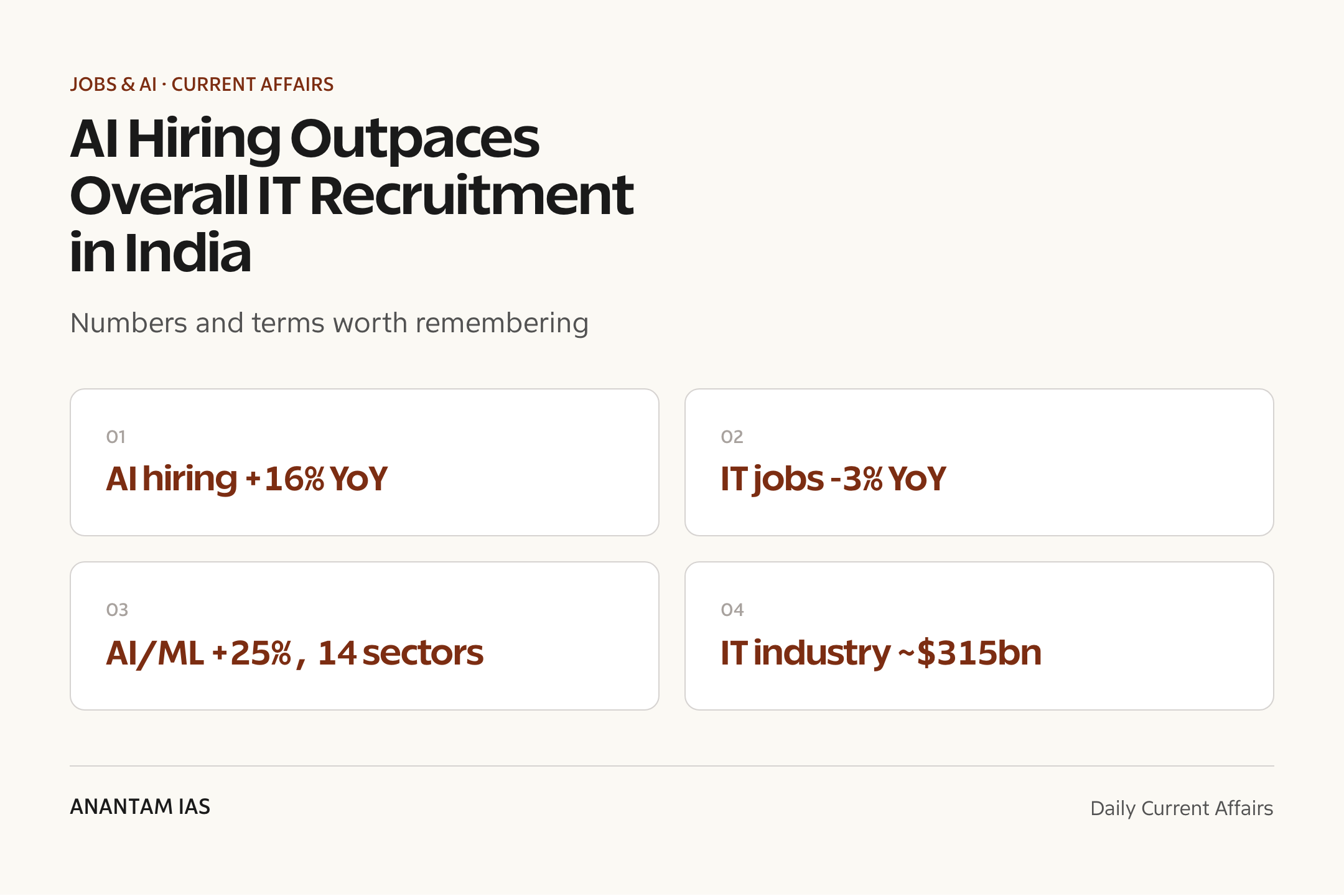
- AI hiring in India’s IT sector rose 16% year-on-year in June 2026.
- Overall IT recruitment in the same industry fell 3% over the year.
- Across 14 sectors, AI and machine-learning jobs increased 25%.
- Insurance led sectoral growth at 16%, followed by FMCG (7%), telecom (6%) and real estate (5%).
- Aggregate white-collar hiring rose 6%, drawn from listings by over 150,000 firms on the Naukri JobSpeak index.
The development matters in the context of:
- The divergence signals that tech firms are still investing, but only in specialised, senior AI talent, not broad-based hiring.
- It sharpens the debate on automation-led jobless growth in India’s flagship services-export sector.
UPSC Relevance
Prelims Relevance
- Naukri JobSpeak — a private monthly hiring index run by Info Edge; tracks white-collar job listings, not government data.
- Info Edge owns Naukri; its CEO is Hitesh Oberoi.
- India’s IT industry is valued at roughly $315 billion.
- Periodic Labour Force Survey (PLFS) — the official MoSPI survey measuring employment and unemployment.
- IndiaAI Mission — approved 2024 to build compute, datasets, skilling and safe-AI capacity.
- FutureSkills Prime — a MeitY-Nasscom digital-skilling platform for emerging tech.
- Demographic dividend — the growth window from a large working-age population.
- WEF Future of Jobs Report 2025 — projects a net 78 million new jobs globally by 2030.
- Distinguish frictional, structural and technological unemployment.
Mains Relevance
GS Paper 3
- Effects of automation and AI on employment, growth and the services sector.
- India’s IT industry under pressure from weak global demand and AI disruption.
GS Paper 2
- Government skilling and AI-capacity interventions (IndiaAI Mission, FutureSkills Prime) and their adequacy.
Essay
- Technology should serve people, not the other way round — automation and the future of work.
- A demographic dividend can turn into a demographic burden without reskilling.
Background and Context
What Naukri JobSpeak is and what it measures
The headline number comes from a private hiring index, not an official statistic, so its scope must be understood before its signal.
- JobSpeak is a monthly index published by Naukri (owned by Info Edge) that tracks the volume of new white-collar job listings on its portal, benchmarked against a base value.
- The June reading pooled postings from more than 150,000 firms, making it a fast, high-frequency read on hiring sentiment.
- As a platform-based index it captures formal, online-advertised jobs — it says little about informal, gig, agricultural or blue-collar work, which dominate India’s workforce.
- It measures hiring demand (listings), not people actually placed, and skews toward urban, English-medium, salaried roles.
- It is a leading indicator of demand, useful alongside official data such as the PLFS and company results rather than a substitute for them.
JobSpeak vs official employment data
A private index and a household survey answer different questions, and conflating them is a common analytical error.
- The Periodic Labour Force Survey (PLFS), run by MoSPI, is a large household survey giving the official unemployment rate, labour-force participation and worker-population ratios across formal and informal work.
- PLFS is representative of the whole labour market but released with a lag; JobSpeak is timely but narrow, covering only advertised white-collar demand.
- JobSpeak reports relative change in listings, not absolute headcount, so a high percentage can sit on a small base of jobs.
- For UPSC, the takeaway is triangulation — read high-frequency private indices alongside PLFS, EPFO payroll data and corporate results, never in isolation.
The divergence: AI up, IT down
The story is not that hiring rose or fell, but that the two moved in opposite directions.
- AI-role hiring in IT rose 16% year-on-year; overall IT hiring fell 3%.
- Info Edge CEO Hitesh Oberoi called the gap important because it shows where firms are still investing, with AI becoming a core capability area.
- Demand is shifting toward senior and specialised talent rather than volume hiring of freshers.
- Beyond IT, across 14 sectors AI and machine-learning roles grew 25% year-on-year.
- Insurance led sectoral hiring growth at 16%, ahead of FMCG (7%), telecom (6%) and real estate (5%), lifting the overall white-collar index 6%.
Why India's IT sector is under strain
The reorientation is happening against a difficult backdrop for the services-export engine.
- India’s $315 billion IT industry faces clients holding back technology spend amid a weak global macroeconomic environment.
- Generative AI threatens the traditional labour-arbitrage and code-and-maintain business model that built the sector.
- Tata Consultancy Services (TCS), the top exporter, expects IT firms to slow hiring and is moving toward parity between employees and AI agents.
- TCS announced cuts of around 12,000 roles in July 2025 as part of a restructuring for AI-led delivery.
- Its net headcount fell by more than 23,000 in the fiscal year ended March 2026, ending FY26 at about 584,500 employees.
Automation and the future of work
The data feeds a long-running debate about technology, productivity and jobs.
- Technological unemployment arises when automation displaces tasks faster than new roles are created.
- AI tends to hollow out routine mid-skill work while raising demand at the specialised, high-skill end — widening wage gaps.
- The concern of jobless growth: output and profits can rise while net employment stagnates or shifts to fewer, higher-paid roles.
- New task categories — prompt engineering, AI auditing, model-ops — emerge, but the transition costs fall hardest on entry-level and mid-career workers.
- The skill premium rises: those who can pair domain knowledge with AI tools gain, while narrowly routine profiles lose bargaining power.
The demographic-dividend stake
For India the shift is not abstract — it collides with a fast-growing young workforce.
- India adds millions of job-seekers a year and depends on its demographic dividend — a young median age and large working-age share — for growth.
- IT and IT-enabled services have long been a prime aspirational employer for engineering and general graduates.
- A slowdown in volume hiring of freshers narrows a key on-ramp into the formal, salaried economy.
- White-collar disruption is politically sensitive because it hits the educated middle class, not only low-skill labour.
- Without reskilling, a demographic dividend risks becoming a demographic burden of educated under-employment.
The policy and skilling response
Government programmes aim to move workers toward the skills the market now rewards.
- The IndiaAI Mission funds compute, datasets, safe-AI research and AI skilling to build domestic capability and reduce dependence on imported talent and models.
- FutureSkills Prime, a MeitY-Nasscom platform, offers reskilling and certification in AI, data science and emerging technologies.
- Skill India and the National Education Policy 2020 push vocational integration, multidisciplinary learning and continuous upskilling.
- Global Capability Centres (GCCs) in India are absorbing high-end AI, analytics and R&D roles, offering an alternative white-collar on-ramp.
- The core challenge is speed and scale — reskilling must keep pace with how fast AI is reshaping task demand.
The global AI-jobs context
India’s divergence mirrors a worldwide churn that international bodies are already quantifying.
- The WEF Future of Jobs Report 2025 projects 170 million new roles created and 92 million displaced globally by 2030 — a net gain of about 78 million.
- It estimates roughly 39% of core skills will change by 2030, with AI and big data the fastest-growing skill category.
- The pattern globally is churn, not simple destruction — jobs are reshaped and relocated across roles more than eliminated in aggregate.
- Countries that invest early in reskilling and AI infrastructure are better placed to capture the created jobs rather than absorb the displaced ones.
How to read the number carefully
A single private index deserves caution before it becomes a headline conclusion.
- A 3% dip is modest and reflects a reallocation within IT more than an outright collapse — aggregate white-collar hiring still rose 6%.
- Year-on-year AI growth starts from a small base, so high percentages can overstate absolute numbers.
- Platform indices skew to formal, urban, advertised roles and can miss the wider labour market.
- The signal to watch is durable direction and composition, cross-checked against PLFS, EPFO payroll data and company results.
Way Forward
Reskilling at scale
- Expand and simplify access to FutureSkills Prime and the IndiaAI Mission skilling tracks for both freshers and mid-career workers, with subsidised or free entry-level pathways.
- Tie industry certification to hiring so reskilled workers have credible on-ramps into AI-adjacent roles, and fund short, stackable credentials over long degrees.
Rethink the graduate pipeline
- Embed AI literacy, data fluency and applied problem-solving in engineering and general degrees under NEP 2020, moving beyond rote coding.
- Broaden employment beyond IT services into manufacturing, GCCs, deep-tech and the care economy to diversify where the demographic dividend lands.
Strengthen the data and safety net
- Pair private indices such as JobSpeak with timely official PLFS and EPFO releases, so policy responds to structural shifts in near real time rather than in hindsight.
- Build transition support — portable benefits, income cushions and career counselling — for workers whose routine roles are automated first.
Frame AI as a complement to labour in public policy: incentivise firms to redeploy and retrain displaced workers rather than simply cut headcount, so productivity gains widen opportunity instead of concentrating it.
Conclusion
The June JobSpeak reading captures a quiet but consequential shift: India’s IT engine is not simply hiring less, it is hiring differently — fewer generalists, more specialised AI talent. The 16% rise against a 3% dip, set within an overall 6% gain in white-collar hiring, is a signal of reallocation, not just contraction.
The divergence rhymes with the global picture the WEF has sketched — a churn that creates more jobs than it destroys, but only for economies that reskill fast enough to catch them. For India, banking on its demographic dividend, the task is to make sure workers can cross the bridge that automation is building.
That turns on reskilling delivered at scale and speed, a broader base of employment beyond IT services, and labour data timely enough to steer by. Handled well, AI expands opportunity for a young workforce; handled poorly, it narrows the on-ramp into the formal economy just as millions arrive at it.
UPSC Practice Questions
Prelims MCQ 1
With reference to the Naukri JobSpeak index, consider the following statements:
- It is an official employment survey conducted by the Ministry of Statistics.
- It is a monthly index based on job listings on a private recruitment platform.
- It primarily tracks formal, online-advertised white-collar hiring.
How many of the above statements are correct?
(a) Only one (b) Only two (c) All three (d) None
Answer: (b) Only two
Explanation:
JobSpeak is a private index run by Info Edge (Naukri), not an official MoSPI survey, so statement 1 is wrong. Statements 2 and 3 are correct — it tracks formal, advertised white-collar listings monthly.
Prelims MCQ 2
According to the June 2026 JobSpeak report, which of the following best describes the trend in India’s IT sector?
(a) Both AI hiring and overall IT hiring rose sharply (b) AI hiring rose while overall IT hiring declined (c) Both AI hiring and overall IT hiring declined (d) AI hiring declined while overall IT hiring rose
Answer: (b) AI hiring rose while overall IT hiring declined
Explanation:
AI hiring within IT rose 16% year-on-year in June while overall IT jobs declined 3%, indicating a reallocation of demand toward specialised AI talent.
UPSC Mains Questions
- The divergence between rising AI hiring and falling overall IT recruitment reflects a structural shift in India’s labour market. Examine the implications for employment and the country’s demographic dividend, and suggest measures to manage the transition.
- “Automation need not mean fewer jobs, but it does mean different jobs.” In the light of trends in India’s IT sector, discuss the role of reskilling and government initiatives such as the IndiaAI Mission in shaping the future of work.
Source: The Hindu (Technology).
Frequently Asked Questions
What is Naukri JobSpeak?
JobSpeak is a monthly hiring index published by Naukri, owned by Info Edge. It tracks the volume of new white-collar job listings on its platform, pooling postings from over 150,000 firms. It is a private, high-frequency read on hiring sentiment rather than an official government statistic like the PLFS.
What did the June 2026 report show?
It showed that AI-role hiring within India’s IT sector rose 16% year-on-year in June, while overall IT recruitment in the industry fell 3%. Across 14 sectors, AI and machine-learning jobs grew 25%, and overall white-collar hiring rose 6%, with insurance leading sectoral growth at 16%.
Why is AI hiring rising while IT hiring falls?
Firms are reorienting toward AI as a core capability and hiring specialised, senior talent, while trimming broad volume recruitment. A weak global economy and AI’s threat to the traditional labour-arbitrage model have squeezed the wider $315 billion IT industry, so investment is narrowing to AI-adjacent roles.
What does this mean for India’s demographic dividend?
IT services have long absorbed large numbers of graduates. A slowdown in volume hiring of freshers narrows a key on-ramp into the formal economy. Without large-scale reskilling, a young workforce risks educated under-employment, turning the demographic dividend into a burden.
Which government schemes address AI skilling?
The IndiaAI Mission funds compute, datasets, safe-AI research and AI skilling. FutureSkills Prime, a MeitY-Nasscom platform, offers reskilling in AI and data. Skill India and NEP 2020 push vocational integration and continuous learning to align workers with emerging demand.
Should a single private index be treated as conclusive?
No. A 3% dip is modest and reflects reallocation within IT more than collapse, and AI growth starts from a small base, so percentages can overstate absolute numbers. Platform indices skew to formal, advertised, urban roles, so the trend should be cross-checked against PLFS and company results.
Source: https://anantamias.com/current-affairs/ai-hiring-outpaces-it-recruitment-jobspeak/
LokOS: A Digital Backbone for Rural Self-Help Groups and Livelihoods
Why in News?
The Ministry of Rural Development has been scaling LokOS (Lok Operating System) as the digital backbone for India’s Self-Help Group (SHG) ecosystem under the Deendayal Antyodaya Yojana – National Rural Livelihoods Mission (DAY-NRLM). Official Digital India Corporation material describes it as a profile-management and financial-operational system for rural Community-Based Organisations (CBOs), built on a federated microservices architecture that feeds the national NRLM management information system.
The platform now supports end-to-end digitisation of SHG savings, internal lending and repayments across the country, is designed to capture SHG financial transactions of the order of ₹2 lakh crore a year, and is being positioned as the data engine behind the government’s Lakhpati Didi drive to raise women’s household incomes.
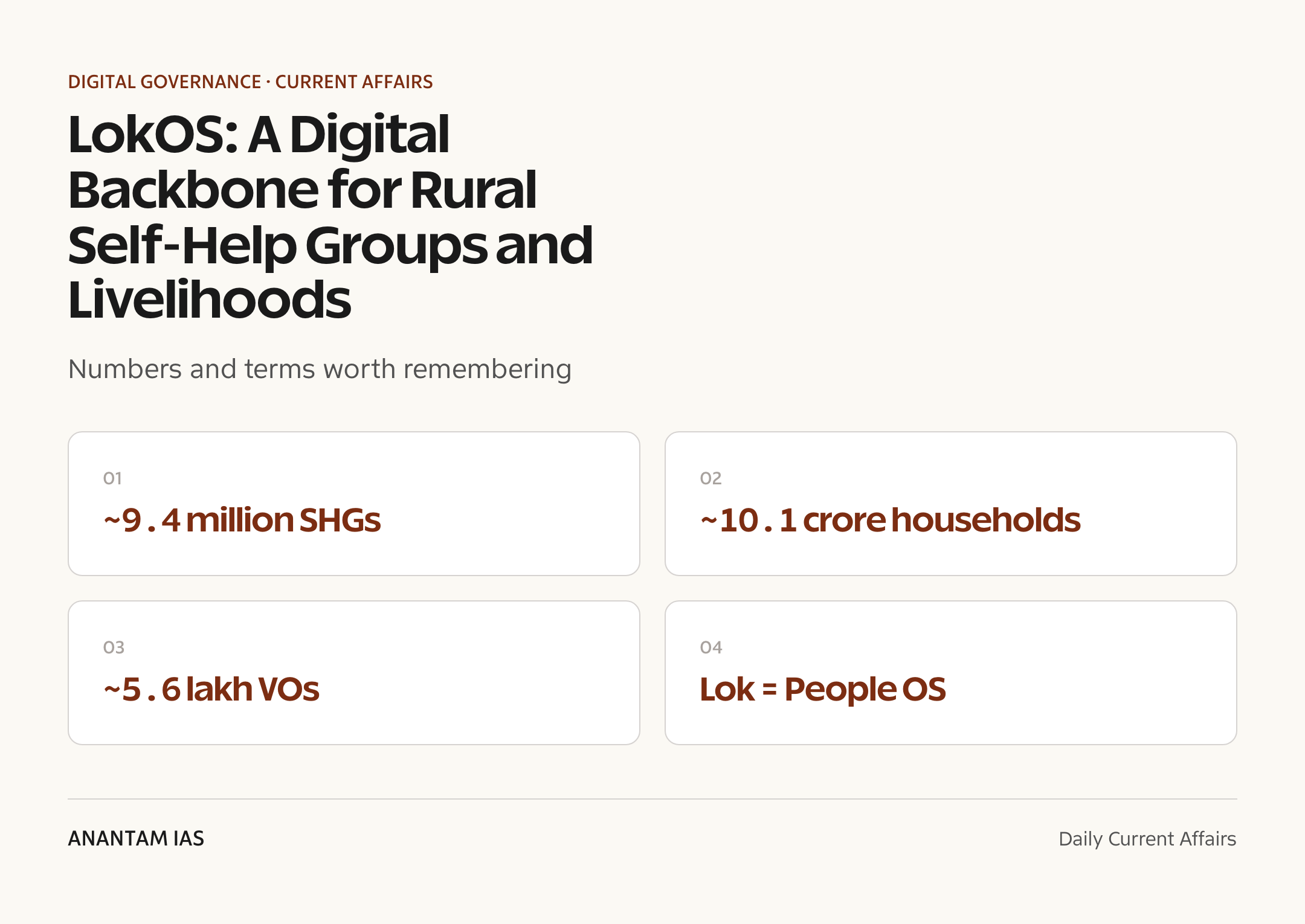
- LokOS stands for Lok (People) Operating System, a national CBO platform under NRLM, Ministry of Rural Development.
- Digital India Corporation figures put coverage at about 9.4 million SHGs and roughly 5.6 lakh Village Organisations.
- Around 10.1 crore households have been mobilised into the SHG network the platform serves.
- Built as paired web and mobile apps on a federated microservices design, it records field-level transactions and approvals in near real time and strengthens the NRLM MIS.
- It is built to handle SHG money flows worth about ₹2 lakh crore a year — member savings, DAY-NRLM assistance and bank loans.
- It feeds the Lakhpati Didi target of women SHG members earning over ₹1 lakh a year.
The development matters in the context of:
- SHG-led financial inclusion is a flagship of the JAM (Jan Dhan-Aadhaar-Mobile) and Digital Public Infrastructure agenda.
- Digitised books make SHG finances auditable, easing SHG-bank linkage and collateral-free credit.
- The platform sits at the intersection of governance, women’s economic empowerment and rural poverty reduction.
UPSC Relevance
Prelims Relevance
- LokOS full form: Lok (People) Operating System
- Parent scheme: DAY-NRLM under Ministry of Rural Development
- CBO hierarchy: SHG then Village Organisation (VO) then Cluster Level Federation (CLF)
- Implementing tech partner: Digital India Corporation
- Lakhpati Didi: SHG woman earning over ₹1 lakh/year
- DAY-NRLM finance tools: Revolving Fund, Community Investment Fund (CIF), collateral-free loans
- DAY-NRLM launched in 2011 (relaunched as DAY-NRLM in 2015)
- Scale markers: ~9.4 million SHGs, ~10.1 crore households mobilised
Mains Relevance
GS Paper 2
- Role of digital platforms and e-governance in delivery of welfare to the rural poor.
- SHG-based community institutions as instruments of participatory development and social capital.
GS Paper 3
- Financial inclusion, SHG-bank linkage and inclusive growth through microfinance.
- Women’s economic empowerment and rural livelihood diversification via DAY-NRLM.
Essay
- Empowering the last woman: technology, credit and dignity in rural India.
- Data as public infrastructure: can digitisation deepen grassroots democracy?
Background and Context
What LokOS is
LokOS is a purpose-built operating system for India’s community institutions, not a consumer app.
- It is a profile-management and financial-operational system for rural Community-Based Organisations (CBOs) — the SHGs and their federations that DAY-NRLM builds.
- Runs under the National Rural Livelihoods Mission (NRLM), Ministry of Rural Development, with Digital India Corporation handling development, operations and management.
- The name unpacks as Lok (people) plus OS (operating system) — a shared operating layer for the SHG movement rather than a single scheme portal.
- Pairs a web application for administrators, e-bookkeepers and transaction approvers with a mobile app used by field functionaries at the group level.
- The web side creates and approves SHGs, Village Organisations and Cluster Level Federations; the app records transactions and meetings on the ground.
- It is built on a federated microservices architecture so that States and UTs can plug in and scale independently while feeding one national data spine.

What it digitises
The core value is turning handwritten group ledgers into structured, auditable digital books.
- Captures member and group profiles, meeting attendance and the CBO’s organisational data in one place.
- Records the SHG money cycle end to end: savings, internal lending and repayments within the group.
- Tracks fund flows such as the Revolving Fund and Community Investment Fund routed from the mission to the groups.
- Consolidates SHG financial activity of the order of ₹2 lakh crore a year — savings, DAY-NRLM assistance and bank loans — into a single system.
- Introduces the e-bookkeeper role, replacing error-prone manual registers with validated entries and approval workflows.
- Because the books are structured and time-stamped, they can be audited and reconciled far more easily than paper registers.
The DAY-NRLM engine behind it
LokOS is a tool; DAY-NRLM is the mission it serves.
- DAY-NRLM (Deendayal Antyodaya Yojana – National Rural Livelihoods Mission) mobilises poor rural women into SHGs and their federations.
- The mission was launched as the National Rural Livelihoods Mission in 2011 and renamed DAY-NRLM in 2015, drawing on the earlier SHG-bank linkage tradition.
- It provides seed money through the Revolving Fund and the larger Community Investment Fund (CIF), plus interest-subvention that makes bank credit cheaper for SHGs.
- The three-tier design (SHG then VO then CLF) builds social capital and a delivery channel for credit, skills, entitlements and enterprise support.
- Federations also act as a bridge to banks, government schemes and markets, so a single woman is never negotiating the system alone.
- Sustained budgetary backing for the mission signals a political bet on the SHG model as a route out of rural poverty.
Scale and reach
The numbers explain why a single digital rail matters.
- Digital India Corporation figures cite about 9.4 million SHGs on the platform.
- Roughly 5.6 lakh Village Organisations sit above these groups as the second tier.
- Around 10.1 crore rural households have been mobilised into the wider SHG network.
- Because most SHG members are women, this makes it one of the largest women-centred financial networks anywhere.
- The system is designed to work across all States and Union Territories, each adopting it on its own timeline and to local needs.
- Managing a network this large by paper is impractical — the case for a common digital rail is scale itself.
SHG-bank linkage and financial inclusion
Digitisation is meant to deepen the decades-old SHG-bank linkage story.
- SHG-bank linkage lets groups with a good repayment track record access collateral-free institutional credit at concessional rates.
- Clean, auditable digital books make a group’s credit history legible to banks, lowering the cost and friction of lending.
- Anchoring SHG accounts in the JAM (Jan Dhan-Aadhaar-Mobile) trinity eases account-linked disbursals, subsidies and repayments.
- This pulls poor households out of the grip of informal moneylenders and into the formal financial system.
- Better data also supports evidence-based targeting and reduced leakage in a programme spread across the whole country.
Link to Lakhpati Didi
Digitised group data is the measurement layer for the income-lifting drive.
- Lakhpati Didi aims to make SHG women earn over ₹1 lakh a year through diversified, sustainable livelihoods.
- The original target of 3 crore Lakhpati Didis (set for 2027) was reported achieved by 2025, and the government has raised the goal to 6 crore by 2029-30.
- The next phase is harder: the early gains came from women already near the threshold, while lifting the lowest earners needs deeper support.
- Reliable group-level financial data helps identify who is close to the threshold and channel skills, credit and market links accordingly.
- It strengthens women’s economic standing by making their savings and credit history visible to banks and scheme designers.
- So LokOS is not just a bookkeeping tool but the measurement and targeting layer for a headline welfare promise.
A grassroots Digital Public Infrastructure
LokOS is a working example of Digital Public Infrastructure reaching the poorest institutions.
- Digital Public Infrastructure (DPI) means shared, interoperable digital rails — like Aadhaar, UPI and Jan Dhan — that many services can build on.
- LokOS extends the DPI idea from individuals to community institutions, giving SHGs and federations portable, structured digital records.
- Real-time data feeds the NRLM management information system, supporting monitoring, planning and course-correction from block to Centre.
- It shifts community institutions from paper dependence toward transparent, portable digital records that survive staff turnover.
- Layering welfare, credit and enterprise services on one data rail illustrates the governance logic of platform-based delivery.
Women's economic empowerment
The deeper stake is agency and dignity for rural women, not just software.
- Nearly all SHG members are women, so digitising the network directly advances women’s economic empowerment.
- Owning a visible savings and credit record gives women stronger standing within the household and with banks.
- SHG federations double as platforms for collective bargaining, awareness and access to entitlements and public services.
- Rising, recorded incomes under Lakhpati Didi convert group membership into measurable gains in household welfare.
- The model treats poor women as economic agents and producers, not merely as beneficiaries of transfers.
Concerns and limits
Digitisation at this scale carries familiar last-mile risks.
- Uneven digital literacy and patchy connectivity in remote blocks can slow real adoption on the ground.
- Dependence on trained e-bookkeepers creates a human-capacity bottleneck; a shortage can stall whole clusters.
- Data privacy and security of sensitive financial records of poor households need strong, enforceable safeguards.
- A push to hit targets can tempt data inflation or over-reporting unless entries are independently validated.
- Digital records help only if matched by real market access, skills and demand for SHG products — data alone does not raise incomes.
Way Forward
Capacity and literacy
- Invest in training e-bookkeepers and community cadres so the app is used, not bypassed at the group level.
- Pair rollout with sustained digital-literacy drives for SHG members in low-connectivity districts.
- Build offline-first and vernacular features so weak networks do not lock the poorest groups out.
Data trust and interoperability
- Codify data privacy, consent and grievance-redress norms for sensitive SHG financial data.
- Make LokOS interoperable with banking, UPI and wider DPI rails to deepen SHG-bank linkage and cut friction.
- Add independent validation and audit trails to guard against over-reporting and data inflation.
From data to incomes
- Use LokOS analytics to target the lowest-earning members who are furthest from the Lakhpati Didi threshold.
- Link groups to markets, credit and enterprise support so recorded data translates into real livelihood gains.
Ultimately the platform must be judged by outcomes on the ground — rising, resilient household incomes and stronger community institutions — not by the volume of transactions it records.
Conclusion
LokOS shows how Digital Public Infrastructure can reach the poorest community institutions, turning informal group ledgers into transparent, auditable records that banks and administrators can trust across nearly ten million SHGs.
By anchoring SHG finance in the JAM trinity and feeding the NRLM MIS, it can deepen financial inclusion, ease collateral-free credit and give rural women a visible economic identity.
Its promise still rests on the last mile: literacy, connectivity, data safeguards and real markets. Handled well, LokOS can make DAY-NRLM and Lakhpati Didi more accountable, more measurable and more genuinely empowering for rural women.
UPSC Practice Questions
Prelims MCQ 1
With reference to LokOS, consider the following statements:
- It is a digital platform for Community-Based Organisations under the National Rural Livelihoods Mission.
- It is implemented by the Reserve Bank of India as a microfinance regulator.
- It digitises savings, internal lending and repayments of Self-Help Groups.
How many of the above statements are correct?
(a) Only one (b) Only two (c) All three (d) None
Answer: (b) Only two
Explanation:
LokOS runs under NRLM (Ministry of Rural Development) with Digital India Corporation, not the RBI, so statement 2 is wrong. Statements 1 and 3 are correct.
Prelims MCQ 2
The ‘Lakhpati Didi’ initiative is most directly associated with which of the following?
(a) Free legal aid for rural women (b) SHG women members earning over one lakh rupees a year under DAY-NRLM (c) A crop insurance scheme for women farmers (d) A housing subsidy for below-poverty-line families
Answer: (b) SHG women members earning over one lakh rupees a year under DAY-NRLM
Explanation:
Lakhpati Didi targets women in DAY-NRLM Self-Help Groups earning above ₹1 lakh annually through diversified livelihoods; LokOS data supports its tracking.
UPSC Mains Questions
- Digital platforms like LokOS promise to transform grassroots financial institutions. Examine how digitisation of Self-Help Groups under DAY-NRLM can advance financial inclusion, and the risks that must be managed.
- Self-Help Groups have emerged as a key vehicle of women’s economic empowerment in rural India. Discuss the role of the DAY-NRLM architecture, including Community Investment Funds and initiatives like Lakhpati Didi, in this transformation.
Sources: Digital India Corporation, Ministry of Rural Development (LokOS) and LokOS portal, DoRD / NRLM.
Frequently Asked Questions
What is the full form of LokOS?
LokOS stands for Lok Operating System, where ‘Lok’ means people. It is a national digital platform for rural Community-Based Organisations under the National Rural Livelihoods Mission, run by the Ministry of Rural Development with Digital India Corporation as the technology partner.
Which ministry runs LokOS?
The Ministry of Rural Development runs LokOS through the Deendayal Antyodaya Yojana – National Rural Livelihoods Mission (DAY-NRLM). Digital India Corporation handles the platform’s development, operations and management, while community cadres and e-bookkeepers use it in the field.
What does LokOS actually digitise?
It digitises the profiles and finances of Self-Help Groups and their federations. This includes member data, meeting records, savings, internal lending, repayments and fund flows such as the Revolving Fund and Community Investment Fund, replacing handwritten ledgers with auditable digital books.
How is LokOS linked to Lakhpati Didi?
Lakhpati Didi aims to help SHG women earn over one lakh rupees a year. Reliable digital group data from LokOS helps identify members near this income threshold and channel skills, credit and market links to them, making the drive easier to monitor and target.
What is the CBO hierarchy under DAY-NRLM?
Poor rural women first form Self-Help Groups. Several SHGs federate into a Village Organisation, and Village Organisations combine into a Cluster Level Federation. This three-tier structure builds social capital and serves as a channel for credit, skills, and livelihood support under the mission.
Why does digitising SHGs matter for financial inclusion?
Auditable digital records make SHG finances transparent to banks, easing SHG-bank linkage and collateral-free lending. Combined with the JAM trinity, this deepens financial inclusion, reduces leakage, and gives poor women a visible savings and credit history that supports their access to formal finance.
Source: https://anantamias.com/current-affairs/lokos-digital-platform-shg-rural-livelihoods/
Bengal’s Two New Laws: Preventive Detention and Public Property Recovery
Why in News?
The West Bengal Assembly on 29 June 2026 passed two laws marking the first big legislative move by the state’s new government: the West Bengal Public Safety and Control of Anti-social Activities Bill, 2026, a standalone preventive-detention statute, and the West Bengal Maintenance of Public Order (Amendment) Bill, 2026, which builds a money-recovery mechanism for property damaged in riots and protests.
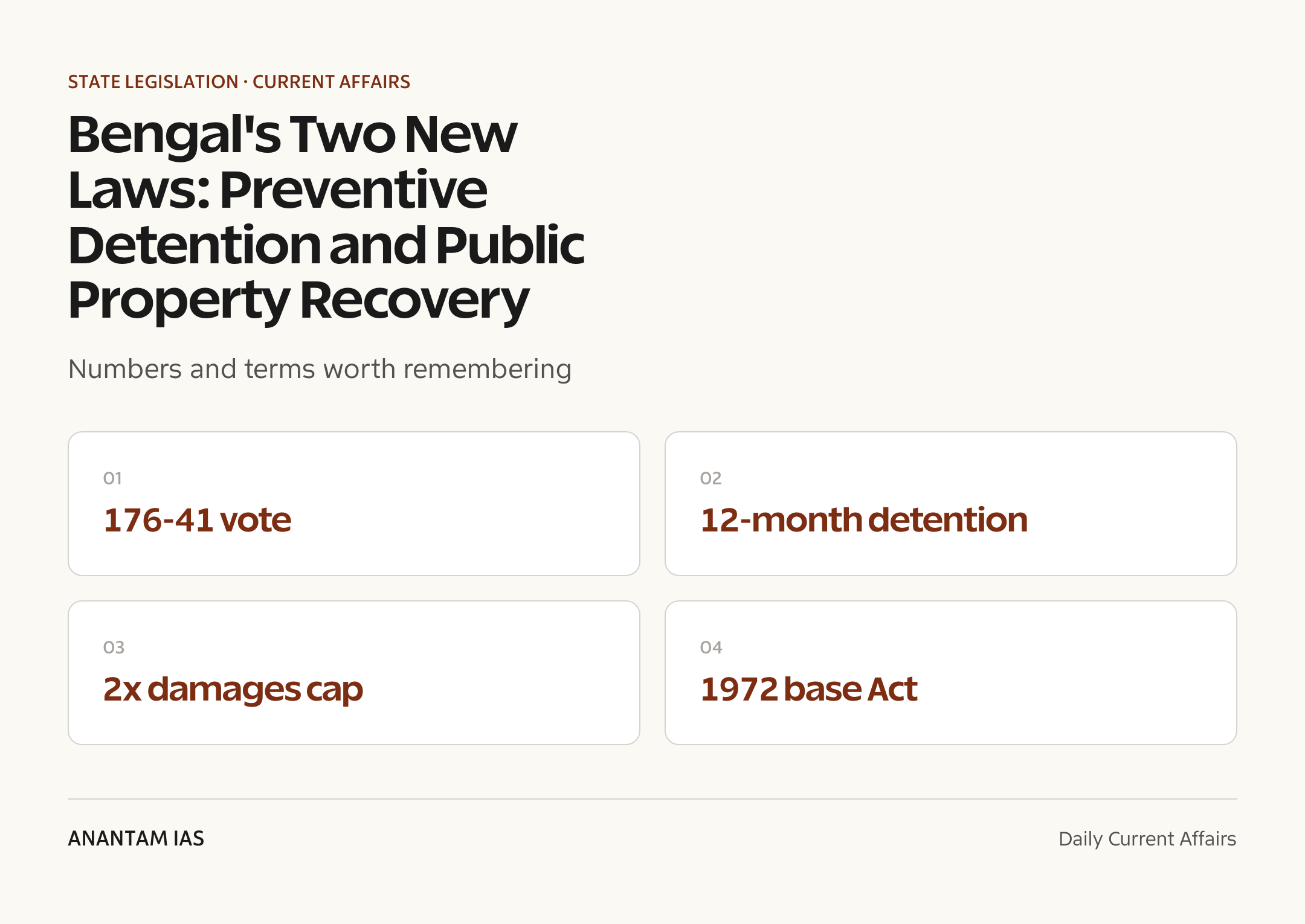
Both cleared the House after a stormy debate, the Public Safety Bill passing by 176 votes to 41, and both follow a template that began in Uttar Pradesh and has since spread across several states.
- The **Public Safety Bill** targets **goondas** and **anti-social activities**, both defined expansively, allowing detention of up to **12 months**.
- The **Public Order (Amendment) Bill** amends the **West Bengal Maintenance of Public Order Act, 1972** to recover the cost of damage during riots, arson and vandalism.
- It sets up a **Claims Commission** headed by an officer of at least **Additional District Magistrate** rank, armed with **civil-court powers**.
- The recovery law applies **strict liability**, can award **exemplary damages up to twice** the compensation, and makes every award **final with no appeal**.
- **Preventive detention** is permitted under **Article 22** and legislated under the **public order** entry, a State List subject.
The development matters in the context of:
- The laws test the constitutional limits on **personal liberty (Article 21)** and the **safeguards in Article 22(4)-(7)** for preventive detention.
- The recovery model echoes the **UP recovery law** that the **Supreme Court** repeatedly reined in for making the state ‘complainant, adjudicator and prosecutor’.
UPSC Relevance
Prelims Relevance
- **Article 22** — protection against arrest and detention; clauses (4)-(7) govern preventive detention.
- **Advisory Board** — required before detention beyond **three months**; members qualified to be **High Court judges**.
- **Preventive detention** appears in both the **Union List** (Entry 9) and **Concurrent List** (Entry 3); **public order** and **police** are **State List** subjects (Entries 1-2).
- **National Security Act, 1980** — central preventive-detention law; states also run their own.
- **Prevention of Damage to Public Property Act, 1984** — the base central statute on public-property damage.
- **Gujarat PASA (Prevention of Anti-Social Activities Act), 1985** — a model ‘goonda’ law.
- **Bharatiya Nyaya Sanhita** — carries provisions on organised crime.
- **Strict liability** and **exemplary damages** — civil-law concepts applied by the Claims Commission.
- **Externment** — removing a person from an area, allowed up to a year under the Bengal law.
- **Governor’s assent** — a State Bill becomes law only after assent (Article 200).
Mains Relevance
GS Paper 2
- Preventive detention and the tension between **state security** and **personal liberty** under Articles 21 and 22.
- Federalism and the use of **State List** powers (public order, police) to enact parallel detention and recovery regimes.
- **Judicial review** of tribunals whose awards are made final and beyond appeal.
GS Paper 3
- Balancing **internal security** and the right to protest while deterring damage to **public property**.
Essay
- Liberty versus order: how far may a democratic state pre-empt harm before an offence is proved?
Background and Context
The Public Safety Bill: a preventive-detention statute
The first law lets the state detain a person to prevent future ‘anti-social’ conduct, not to punish a proved crime.
- The **state government**, a **District Magistrate** or a **Police Commissioner**, once notified, may order a person detained to stop anti-social activity.
- A **goonda** is defined as one who ‘generally’ engages in such conduct; an **anti-social activity** covers acts causing alarm, danger to life or property, disturbance of public order, unlawful dispossession, or illegal mining and quarrying that drains the exchequer.
- Ordinarily the person must have a **conviction in the preceding seven years** or at least **three separate charge-sheets**.
- Detention **cannot exceed 12 months**; the law also allows **externment** (removal from an area) for up to a year.
- It permits **search and seizure**, punishes **harbouring** a detained or externed person, grants officials **good-faith immunity**, and makes offences **cognizable and non-bailable**.
- West Bengal already had a preventive-detention law from the **1970s**; the new statute is **wider in ambit**.
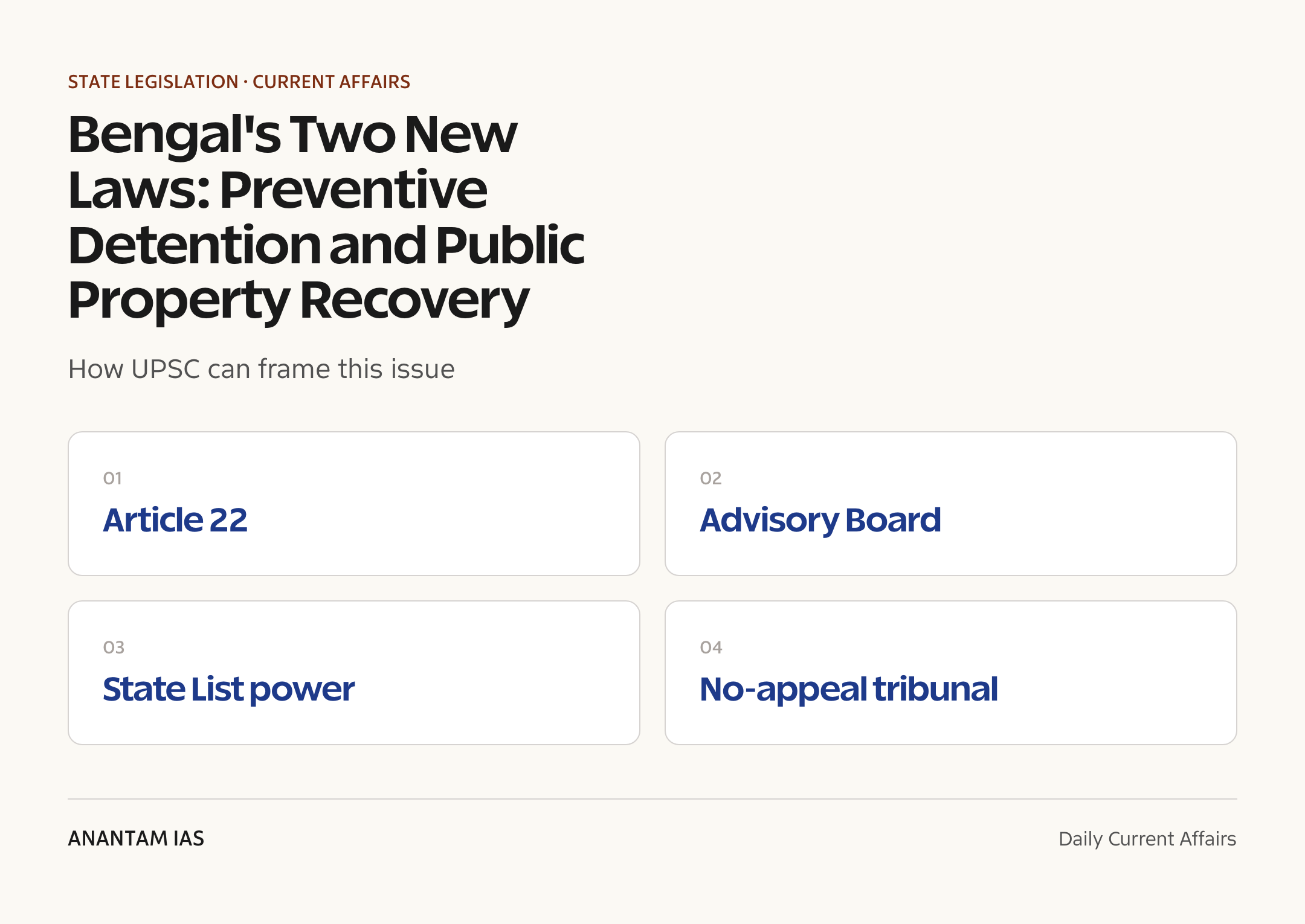
Article 22 and the constitutional safeguards
Preventive detention is expressly allowed, but the Constitution hedges it with time limits and review.
- **Article 22(3)** removes the ordinary arrest safeguards (Articles 22(1)-(2)) for a preventive detainee, then re-inserts special protections.
- **Article 22(4)** bars detention beyond **three months** unless an **Advisory Board** of persons qualified to be **High Court judges** reports sufficient cause.
- The **detaining authority** must communicate the **grounds of detention** as soon as may be and give the detainee an opportunity to **make a representation** (Article 22(5)).
- **Personal liberty (Article 21)** means any such law must follow a ‘procedure established by law’ that is fair and reasonable, per the post-**Maneka Gandhi** reading.
- **Judicial review** survives: courts test whether the grounds are relevant, real and not vague, and whether the procedure was followed.
The recovery law: a no-appeal Claims Commission
The second law creates a machinery to make rioters and their backers pay for the damage they cause.
- The **Maintenance of Public Order (Amendment) Bill** sets up a **Claims Commission** with the **powers of a civil court**, headed by a bureaucrat.
- After damage, the **District Magistrate** or **Police Commissioner** files a claim for public-property losses; **private owners** may file their own.
- The Commission applies **strict liability** once a link between the incident and the damage is shown, and can fix liability on those who **instigated, financed or harboured** the offenders, not only those who acted.
- It may award **exemplary damages up to twice** the compensation; compensation cannot fall below the property’s **market value**.
- Unpaid amounts are recovered as **arrears of land revenue**, so property can be **attached and auctioned**.
- Every award is **final, with no appeal to any court**, and **civil courts are barred** from the subject matter.
The UP template and the Supreme Court's pushback
Both laws copy a model pioneered in Uttar Pradesh, which the courts have twice curbed.
- The UP recovery regime grew out of the **anti-CAA protests of December 2019**, when the state put up **’name-and-shame’ hoardings** of alleged vandals.
- The **Allahabad High Court** ordered the posters removed, and the **Supreme Court** noted there was then **no law** to support the action.
- UP promulgated an ordinance, later the **UP Recovery of Damages to Public and Private Property Act, 2020**, with claims tribunals whose decisions could not be challenged.
- In **February 2022** the **Supreme Court** forced UP to withdraw **274 recovery notices** and refund money, holding the state had acted as ‘complainant, adjudicator and prosecutor’.
- UP withdrew the 2020 law and enacted a **2022 version** placing a **retired district judge** at the head of the tribunal; that law too is **under challenge** before the Supreme Court.
The wider legal landscape
Neither idea is new; comparable statutes and Supreme Court guidelines already exist.
- ‘Goonda’ laws run in several states, most notably **Gujarat’s PASA, 1985**; central preventive detention sits in the **National Security Act, 1980**.
- The **Prevention of Damage to Public Property Act, 1984** already criminalises such damage; the **Bharatiya Nyaya Sanhita** adds organised-crime provisions.
- In **In Re: Destruction of Public & Private Properties v. State of A.P.**, the Supreme Court held that, absent legislation, a High Court could set up machinery to assess damage and fix liability.
- In **Kodungallur Film Society v. Union of India (2018)**, the Court laid down riot-control guidelines and allowed **conditional bail on depositing the quantified loss** caused.
- The recurring judicial theme is that recovery must run through an **independent, appealable process**, not an executive-run tribunal that is judge in its own cause.
The core criticism and the federal debate
Rights advocates and the opposition read both laws as tools that could chill lawful dissent.
- The open-ended definitions of **’goonda’** and **’anti-social activity’** give the executive wide discretion to detain without a proved offence, raising a **vagueness** objection.
- Barring **appeal** and ousting **civil-court jurisdiction** collides with the basic-structure principle that **judicial review** cannot be wholly excluded.
- **Strict liability** on financiers and ‘harbourers’ risks sweeping in organisers of peaceful protest, testing the right to **assemble** under **Article 19(1)(b)**.
- Supporters argue the laws deter **arson and vandalism** and put a price on **mob damage**, protecting the public exchequer and ordinary citizens.
- The larger question is federal design: a state can legislate on **public order** and **police**, but the **Governor’s assent** and, on some heads, **Presidential assent** and later **judicial scrutiny** remain the checks on how far it may go.
Way Forward
Build in independent review
- Place a **sitting or retired judge** at the head of the Claims Commission, as the Supreme Court pressed UP to do.
- Provide a **right of appeal** to a High Court so that no award is truly final, protecting **Article 226** review.
Tighten the definitions
- Narrow the vague terms **’goonda’** and **’anti-social activity’** so detention rests on concrete, provable conduct, not open-ended labels.
- Ensure the **Advisory Board** and **grounds-of-detention** safeguards under Article 22 are written into the operating rules, not left to practice.
Separate the roles of investigator, adjudicator and recovery agent so the state does not sit in judgment over claims it has itself filed, the flaw the Supreme Court flagged in the UP litigation.
Conclusion
The two Bengal laws sit at the fault line of Indian constitutionalism: the state’s undoubted power over **public order** and **police**, weighed against the individual’s **personal liberty** under Articles 21 and 22.
Their fate will turn on the fine print of independent review and appeal. On the recovery side, a no-appeal, executive-run Claims Commission invites the same judicial correction that trimmed the UP model; on detention, the Advisory Board and grounds safeguards remain the decisive test of validity.
UPSC Practice Questions
Prelims MCQ 1
With reference to preventive detention under the Constitution of India, consider the following statements:
- Detention beyond three months requires the opinion of an Advisory Board.
- Preventive detention finds place only in the Union List.
- Article 22 provides safeguards specific to preventive detainees.
How many of the above statements are correct?
(a) Only one (b) Only two (c) All three (d) None
Answer: (b) Only two
Explanation:
Statements 1 and 3 are correct. Article 22(4) requires an Advisory Board for detention beyond three months, and Article 22 carries special safeguards for detainees. Statement 2 is wrong: preventive detention appears in the Union List (Entry 9) and the Concurrent List (Entry 3), so states can legislate too.
Prelims MCQ 2
The West Bengal Maintenance of Public Order (Amendment) Bill, 2026 is most closely modelled on a recovery law first pioneered in which state?
(a) Gujarat (b) Uttar Pradesh (c) Madhya Pradesh (d) Haryana
Answer: (b) Uttar Pradesh
Explanation:
The Claims Commission mechanism follows the Uttar Pradesh format, where district magistrates issued recovery notices for damage to public property; the Supreme Court later forced UP to withdraw 274 such notices.
UPSC Mains Questions
- Preventive detention is a necessary evil, but its safeguards define a constitutional democracy. In the light of Articles 21 and 22, examine the concerns raised by state-level ‘public safety’ detention laws.
- State laws that let an executive-run commission recover the cost of protest-related damage, with no appeal to any court, raise questions of separation of powers and judicial review. Critically discuss.
- Discuss how India’s federal scheme allows states to legislate on public order and police, and the limits the Constitution and the Supreme Court place on such power.
Sources: Indian Express, Explained and Constitution of India, Article 22.
Frequently Asked Questions
What are the two new West Bengal laws?
The West Bengal Assembly passed the Public Safety and Control of Anti-social Activities Bill, 2026, a preventive-detention statute against ‘goondas’, and the Maintenance of Public Order (Amendment) Bill, 2026, which sets up a Claims Commission to recover the cost of property damaged during riots and protests. Both were passed on 29 June 2026.
What is preventive detention?
Preventive detention means holding a person to stop them from committing a future offence, rather than punishing a proved crime. It is expressly permitted under Article 22 of the Constitution, but only with safeguards: an Advisory Board must approve detention beyond three months, and the detainee must be told the grounds and allowed to make a representation.
Why is the Claims Commission controversial?
The Commission is headed by a bureaucrat, applies strict liability, can award exemplary damages up to twice the compensation, and its awards are final with no appeal to any court. Critics say this makes the state complainant, adjudicator and recovery agent at once, the very flaw the Supreme Court corrected in the Uttar Pradesh recovery cases.
Can states make their own detention laws?
Yes. Preventive detention appears in the Union List and the Concurrent List, and public order and police are State List subjects. So states can enact their own preventive-detention and public-order laws, subject to the safeguards of Article 22 and to judicial review by the courts.
What did the Supreme Court say about the UP recovery law?
In February 2022 the Supreme Court forced Uttar Pradesh to withdraw 274 recovery notices and refund the money, holding that the state had acted as ‘complainant, adjudicator and prosecutor’. UP then replaced its 2020 law with a 2022 version headed by a retired district judge, which is itself now under challenge.
Does the Constitution allow externment?
Externment, removing a person from a specified area for a period, is a form of restriction on movement that states impose under public-order powers. The Bengal law allows externment for up to a year. Such restrictions must still meet the reasonableness test under Article 19 and the fair-procedure requirement flowing from Article 21.
Source: https://anantamias.com/current-affairs/bengal-preventive-detention-public-property-laws/
Tianwen-2: China’s Probe to Sample Asteroid Kamo’oalewa, a Possible Moon Fragment
Why in News?
China’s deep-space probe Tianwen-2 has reached the near-Earth asteroid 469219 Kamo’oalewa and, per The Hindu (republished from The Conversation), is expected to begin its most important science operations on or around July 4, 2026. Ground-station tracking from Bochum, Germany, indicated a main engine burn on 7 June to enter orbit around the object.
Launched by the China National Space Administration (CNSA) in May 2025, the mission’s headline goal is to collect surface and sub-surface samples of Kamo’oalewa and return them to Earth, settling a long-standing debate over whether the asteroid is a fragment of the Moon or an ordinary stony asteroid.
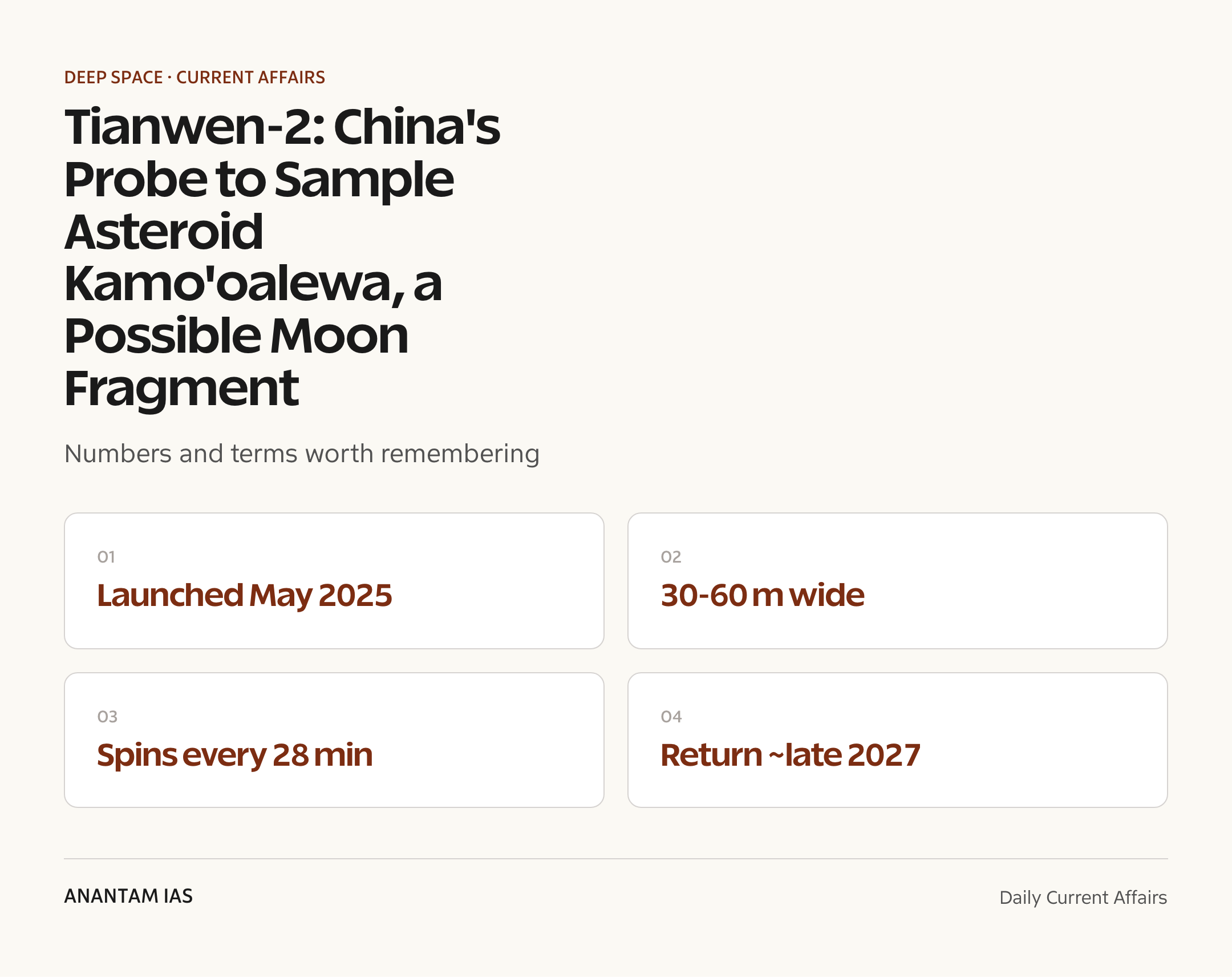
- Kamo’oalewa (also catalogued 2016 HO3) is one of only eight known quasi-satellites of Earth, measuring roughly 30-60 metres across.
- It rotates once every 28 minutes, making a touchdown and sampling technically demanding.
- Tianwen-2 will hover to suck up dust, briefly touch down for a rock sample, and fire robotic extensions into sub-surface layers.
- The sample capsule is slated to return to Earth around late 2027; the spacecraft then heads for main-belt comet 311P/PANSTARRS by 2035.
- It is China’s first asteroid sample-return mission, following its lunar returns.
The development matters in the context of:
- Sample-return missions like OSIRIS-REx and Hayabusa2 have shown that lab analysis reveals what even the best telescopes cannot infer.
- Understanding near-Earth objects (NEOs) feeds directly into planetary defence and solar-system origins research.
UPSC Relevance
Prelims Relevance
- Tianwen-2 — CNSA deep-space asteroid/comet mission (Tianwen series after Mars probe Tianwen-1).
- 469219 Kamo’oalewa (2016 HO3) — quasi-satellite of Earth; possible lunar fragment or LL chondrite.
- Quasi-satellite / co-orbital — bound to the Sun, not Earth; appears to accompany Earth.
- Near-Earth objects (NEOs) — asteroids/comets with orbits close to Earth’s.
- Sample-return missions: OSIRIS-REx (Bennu, USA), Hayabusa2 (Ryugu, Japan), Chang’e-6 (Moon far side, China).
- 311P/PANSTARRS — main-belt comet, Tianwen-2’s second target.
- LL chondrite — a common stony (ordinary chondrite) asteroid class.
- CNSA — China National Space Administration; launched via Long March 3B.
Mains Relevance
GS Paper 3
- Developments in space technology and India’s stakes in the asteroid/deep-space race.
- Sample-return as a scientific tool for planetary science and planetary defence.
GS Paper 2
- China’s growing space capability and its bearing on international relations and strategic competition.
Essay
- What we do not know about our own cosmic neighbourhood.
- Science as a slow verdict: why sampling beats speculation.
Background and Context
What Tianwen-2 is and where it fits
Tianwen-2 is CNSA’s first attempt to bring an asteroid sample home, extending a series that began with Mars.
- Tianwen (“questions to heaven”) is China’s planetary-exploration series; Tianwen-1 put an orbiter, lander and the Zhurong rover at Mars in 2021.
- Tianwen-2 launched in May 2025 on a Long March 3B from Xichang, carrying 11 scientific instruments.
- It is a dual-target mission — sample Kamo’oalewa, then, after dropping the capsule on Earth, rendezvous with comet 311P/PANSTARRS around 2035.
- The probe has sent back a self-portrait with Earth in the background and reported healthy operations millions of kilometres out.
What is a quasi-satellite?
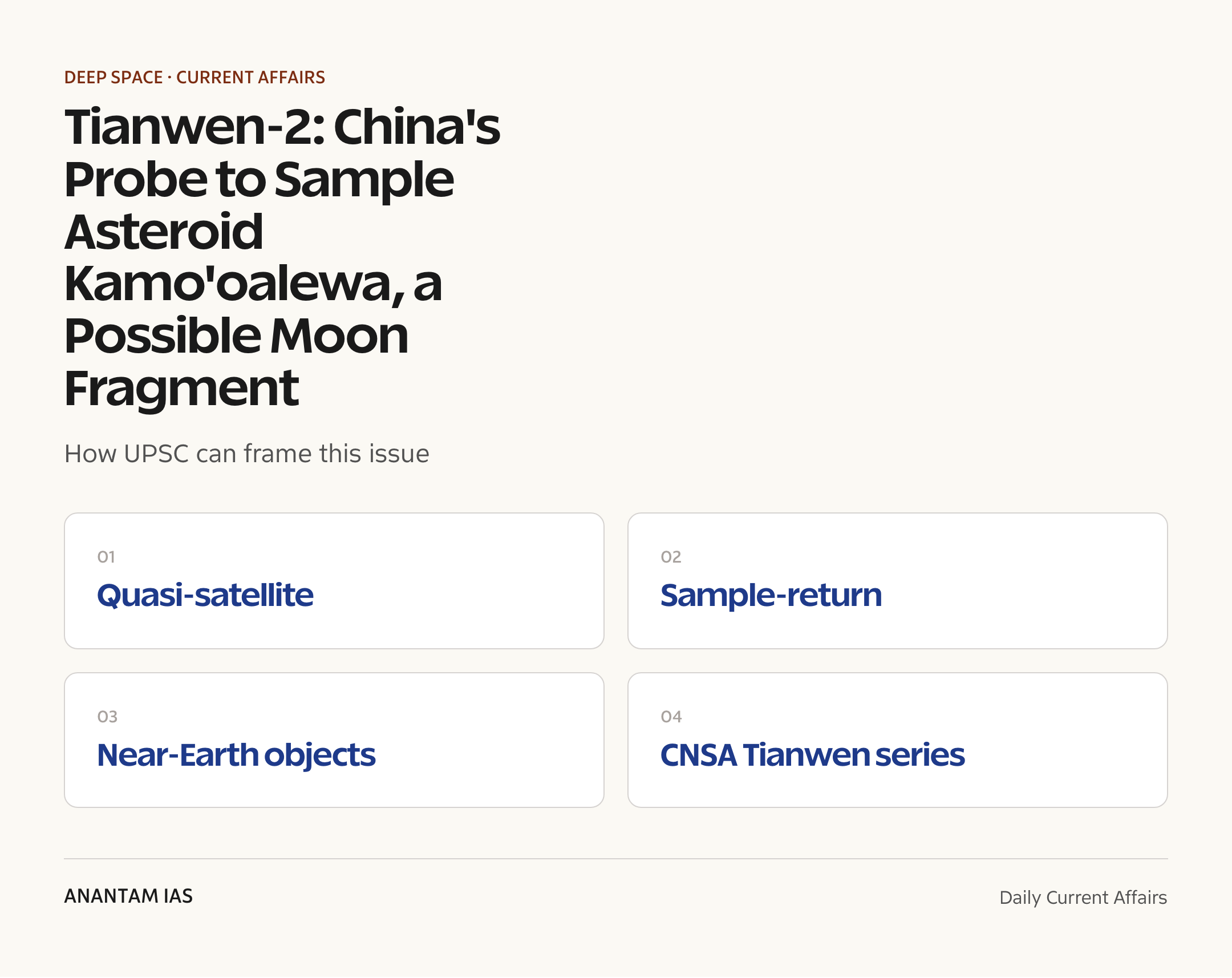
Kamo’oalewa is not a moon in the true sense — it is a quasi-satellite, a distinct dynamical class worth understanding.
- A quasi-satellite orbits the Sun, not Earth, but stays in near lockstep with Earth, completing one solar orbit in about a year.
- From our viewpoint it appears to loop around Earth, sometimes for centuries — yet it is never gravitationally captured, so it never becomes a real moon.
- Earth currently has about eight known quasi-satellites; the name Kamo’oalewa means “oscillating celestial object” in Hawaiian.
- The asteroid entered its present quasi-satellite orbit roughly 100 years ago; its closest approach on 27 December 1923 was still about 12.44 million km away.
The Moon-fragment mystery
The central science question is whether Kamo’oalewa is a chip of the Moon or an ordinary asteroid in disguise.
- Early spectra — the fingerprint of reflected light — resembled lunar surface materials, hinting the rock was flung off the Moon by a meteor impact.
- Newer analysis suggests it may simply be a common stony LL chondrite whose surface has been altered by space weathering.
- From a distance, telescopes read only the weathered surface; a sub-surface sample is the only reliable test of true composition and origin.
- Either verdict is valuable — ruling out a popular hypothesis can matter as much as confirming one.
Why sampling is hard here
Collecting material from a tiny, fast-spinning rock in deep space stretches engineering to its limits.
- Kamo’oalewa is small (30-60 m) and spins once every 28 minutes, giving very weak gravity and a moving target.
- The plan uses several approaches — hover-and-vacuum for dust, a brief touchdown for rock, and robotic anchors for sub-surface material.
- Science operations are timed to begin in the first week of July 2026, with departure planned around April 2027.
- The return capsule is expected to reach Earth in late 2027, after which a gravity assist redirects the craft toward comet 311P.
Global sample-return heritage
Tianwen-2 stands on the shoulders of a short but decisive line of sample-return successes.
- Japan’s Hayabusa2 returned grains from asteroid Ryugu in 2020; the original Hayabusa returned Itokawa dust in 2010.
- NASA’s OSIRIS-REx gathered material from asteroid Bennu (collected October 2020) and delivered it to Earth in 2023.
- China’s Chang’e-5 (2020) and Chang’e-6 (2024) returned lunar samples, the latter the first from the Moon’s far side.
- Each mission surfaced mineral and isotopic details impossible to measure from Earth, validating the sample-return approach.
India's context and stakes
India is not part of this mission, but the science and strategy touch several national programmes.
- ISRO‘s Chandrayaan-3 soft-landed near the lunar south pole in 2023; a future Chandrayaan-4 is planned as India’s own lunar sample-return.
- The NISAR mission, a NASA-ISRO Earth-observation satellite, reflects India’s deepening space collaboration.
- India tracks NEOs and planetary-defence questions through ISRO and its network institutions.
- China’s advancing deep-space capability sharpens the strategic backdrop against which India frames its own ambitions.
Why asteroids matter
Beyond one rock’s identity, asteroids are time capsules of the early Solar System.
- Asteroids preserve pristine material from the Solar System’s formation, largely untouched by planetary geology.
- Studying them informs planetary defence — the science of detecting and, if needed, deflecting hazardous NEOs.
- Kamo’oalewa’s origin could reveal fresh clues about the Earth-Moon system‘s evolution and early inner-Solar-System dynamics.
- Sample analysis also feeds long-range interest in asteroid resources and future deep-space operations.
Way Forward
For the mission
- Successful sampling, capsule return and lab analysis will resolve the lunar-fragment question and set a benchmark for small-body operations.
For India
- Sustained investment in Chandrayaan sample-return, NEO tracking and international science partnerships keeps India in the emerging small-body research field.
Open sharing of sample data across nations would let planetary defence and origins science advance faster than any single programme could manage alone.
Conclusion
Tianwen-2 turns a decades-old telescope puzzle into a solvable laboratory question — is Kamo’oalewa a piece of the Moon, or a weathered ordinary asteroid wearing a lunar mask?
Either answer enriches our picture of the Earth-Moon system, and the mission cements sample-return as the decisive tool of modern planetary science, with India’s own lunar-return ambitions the natural next chapter to watch.
UPSC Practice Questions
Prelims MCQ 1
With reference to 469219 Kamo’oalewa, consider the following statements:
- It is a quasi-satellite of Earth, gravitationally bound to the Sun rather than to Earth.
- It is being studied by China’s Tianwen-2 mission for sample return.
- It is confirmed to be a fragment of the Moon.
How many of the above statements are correct?
(a) Only one (b) Only two (c) All three (d) None
Answer: (b) Only two
Explanation:
Statements 1 and 2 are correct. Kamo’oalewa’s lunar-fragment origin is only a hypothesis that Tianwen-2’s samples aim to test, so statement 3 is not confirmed.
Prelims MCQ 2
Which of the following pairs of sample-return mission and its target body is correctly matched?
(a) OSIRIS-REx — Ryugu (b) Hayabusa2 — Bennu (c) Chang’e-6 — Moon (far side) (d) Tianwen-1 — Kamo’oalewa
Answer: (c) Chang'e-6 — Moon (far side)
Explanation:
OSIRIS-REx targeted Bennu and Hayabusa2 targeted Ryugu (options a and b are swapped). Kamo’oalewa is the target of Tianwen-2, not Tianwen-1 (a Mars mission). Chang’e-6 returned the first samples from the Moon’s far side.
UPSC Mains Questions
- Sample-return missions have become the decisive tool of modern planetary science. In light of missions such as OSIRIS-REx, Hayabusa2 and Tianwen-2, discuss their scientific value and India’s readiness to undertake one.
- Near-Earth objects pose both a scientific opportunity and a planetary-defence challenge. Examine how the study of asteroids like Kamo’oalewa advances our understanding of the Solar System’s origins.
- China’s rapidly expanding deep-space programme has strategic as well as scientific dimensions. Analyse its implications for India’s space policy and international space cooperation.
Sources: The Hindu, Science and The Conversation (republished in The Hindu).
Frequently Asked Questions
What is Tianwen-2?
Tianwen-2 is a deep-space probe launched by the China National Space Administration (CNSA) in May 2025. Its main goal is to collect samples from the near-Earth asteroid Kamo’oalewa and return them to Earth, after which it will travel on to rendezvous with the main-belt comet 311P/PANSTARRS around 2035.
What is a quasi-satellite?
A quasi-satellite is a small body that orbits the Sun in near lockstep with a planet, so it appears to accompany that planet without ever being gravitationally captured by it. Kamo’oalewa is one of about eight known quasi-satellites of Earth. Unlike the Moon, it stays bound to the Sun, not to Earth.
Why do scientists think Kamo’oalewa may be a Moon fragment?
Early observations of the light reflected from Kamo’oalewa resembled the spectra of lunar surface materials, suggesting it could be a chunk of the Moon ejected by a meteor impact. Newer analysis hints it may instead be an ordinary stony asteroid altered by space weathering, which the returned samples should finally settle.
How is Kamo’oalewa different from the Moon?
The Moon is gravitationally bound to Earth and orbits it directly. Kamo’oalewa orbits the Sun and only appears to accompany Earth from our viewpoint. It is also tiny, roughly 30 to 60 metres across, and never comes closer than several million kilometres to Earth.
How does Tianwen-2 compare with OSIRIS-REx and Hayabusa2?
All three are asteroid sample-return missions. NASA’s OSIRIS-REx sampled asteroid Bennu and Japan’s Hayabusa2 sampled Ryugu, both proving the value of bringing material home for lab study. Tianwen-2 is China’s first asteroid sample-return attempt, targeting the quasi-satellite Kamo’oalewa.
Does India have a similar mission?
India has no asteroid sample-return mission yet, but its Chandrayaan-3 soft-landed near the lunar south pole in 2023, and a future Chandrayaan-4 is planned as India’s own lunar sample-return effort. India also collaborates internationally, for example on the NASA-ISRO NISAR Earth-observation satellite.
Source: https://anantamias.com/current-affairs/tianwen-2-asteroid-kamooalewa-moon-fragment/
AI-Fabricated Precedents: The Supreme Court’s Warning on Manufactured Justice
Why in News?
The Supreme Court of India has set aside orders of the National Company Law Tribunal and its appellate body after finding that the tribunal had relied on fictitious, AI-generated legal citations in an insolvency matter. The Court, per an editorial in The Hindu, treated the lapse as far graver than an ordinary error and quashed the decisions rather than merely correcting them.
A Bench of Justices P.S. Narasimha and Alok Aradhe likened AI hallucinations creeping into judicial reasoning to methyl isocyanate, the gas behind the 1984 Bhopal tragedy, calling such contamination ‘invisible, insidious, and catastrophic by the time anyone notices’. The editorial framed the episode as the latest in a series of 2026 interventions cautioning against fabricated precedents in court proceedings.
- The Court held that any judgment influenced by even ‘an iota’ of fake or hallucinated AI material is ‘no decision in the eyes of law’.
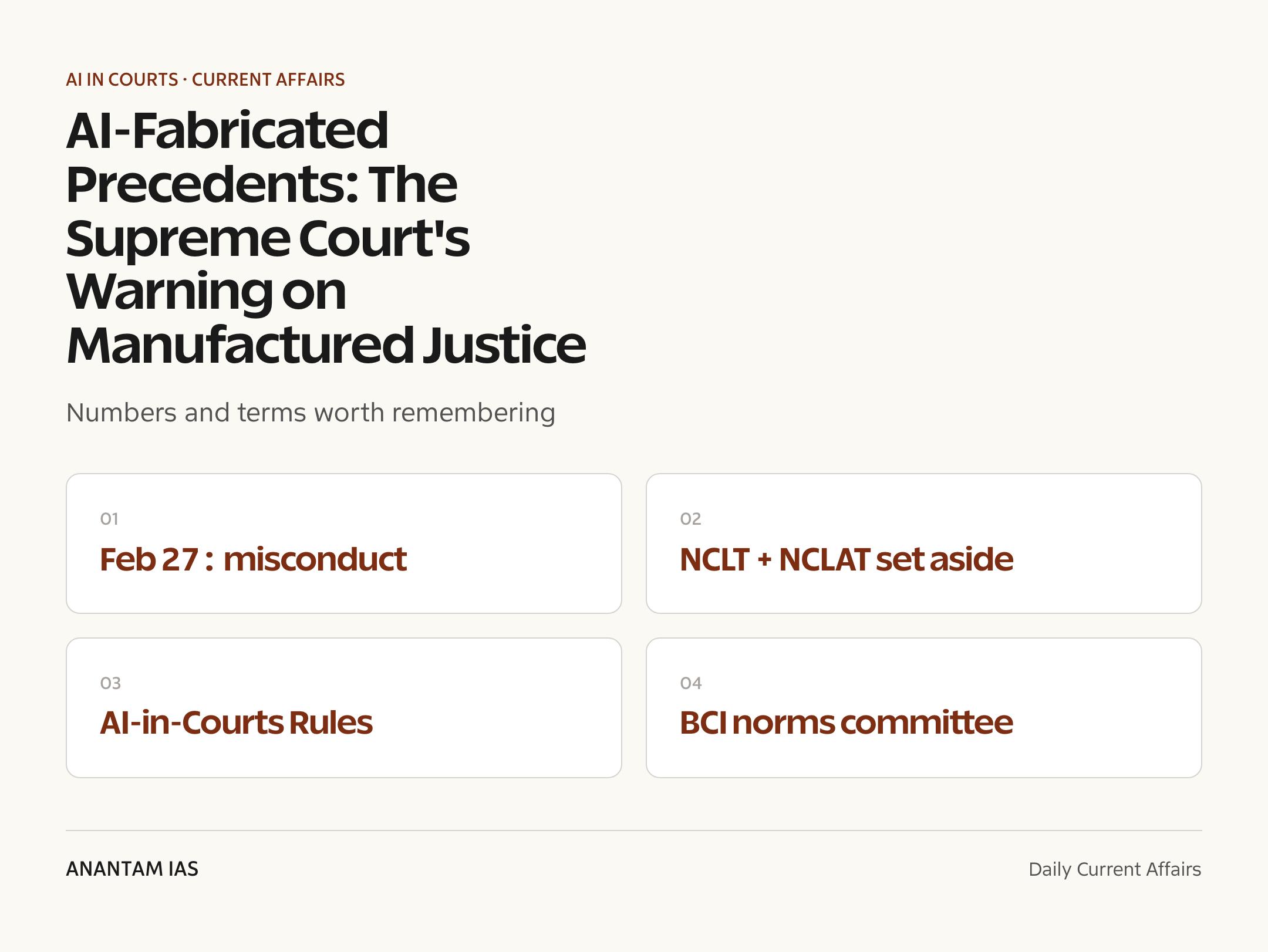
- On February 27, the same Bench flagged a trial court’s reliance on AI-generated fictitious case laws as judicial ‘misconduct’, not merely ‘an error in decision-making’.
- Presenting fabricated, machine-generated ‘judgments’ was ruled professional misconduct for advocates and a serious lapse of duty for judges.
- The draft ‘Regulations for Use of Artificial Intelligence (AI) in Courts, 2026’ are open for public consultation.
- The Court directed the Bar Council of India to set up a dedicated committee to frame strict norms and disciplinary action for lawyers citing unverified AI material.
- The editorial closed with the line that justice must be done and seen, not hallucinated.
The development matters in the context of:
- This is the latest in a run of 2026 interventions where the top court has cautioned against AI-generated fictitious precedents entering the record.
- It crystallises the line between AI as an assistive tool for efficiency and AI as a substitute for independent human reasoning, which the Court forbids.
- The Court read the risk not as a stray glitch but as a structural feature of generative AI that demands institutional safeguards, not ad-hoc correction.
UPSC Relevance
Prelims Relevance
- AI hallucination — an AI system producing confident but fabricated output (here, non-existent case citations).
- NCLT and NCLAT — tribunals adjudicating insolvency and company-law matters under the IBC and Companies Act, 2013.
- Bar Council of India (BCI) — statutory body under the Advocates Act, 1961, regulating legal practice and professional conduct.
- Professional misconduct — ground for disciplinary action against advocates under the Advocates Act, 1961.
- Draft Regulations for Use of AI in Courts, 2026 — bars AI from adjudication, sentencing, bail eligibility and credibility assessment.
- SUPACE (Supreme Court Portal for Assistance in Court Efficiency) and SUVAS (Supreme Court Vidhik Anuvaad Software) — the judiciary’s own AI-assist systems.
- Contempt of court and criminal-misconduct exposure for filing fabricated material.
- 1984 Bhopal gas tragedy — methyl isocyanate leak, used here as an analogy for latent, invisible harm.
- Automation bias — the human tendency to over-trust confident machine output and skip verification.
Mains Relevance
GS Paper 2
- Regulating emerging technologies in the justice-delivery system: opportunities, risks and the assistive-versus-substitutive line.
- Role of the Bar Council of India and the Advocates Act, 1961 in enforcing professional accountability for AI misuse.
GS Paper 4
- Integrity, objectivity and accountability of public servants when technology can fabricate authority.
- Ethical use of AI in governance: human oversight as the essential counter to automation bias.
Essay
- Technology can inform judgement, but it cannot replace the burden of judging.
- In the age of the machine, integrity is the last human safeguard.
Background and Context
What actually happened
The trigger was an insolvency appeal that exposed how easily fabricated authority can slip through layers of review.
- The NCLT relied on fictitious AI-generated citations in an insolvency case; the NCLAT overlooked the lapse on appeal.
- The Supreme Court set aside both orders, treating the reliance on hallucinated precedent as fatal to the decision, not a defect that could be patched.
- The Bench used a stark analogy — methyl isocyanate, the Bhopal gas — to convey that the harm is latent and visible only after damage is done.
- A judgment tainted by fabricated AI material is ‘no decision in the eyes of law’, so it must be quashed rather than merely corrected.
- The lapse surfaced in an insolvency matter, where the wrong precedent could have skewed the outcome for creditors and the corporate debtor alike.
- The failure at two levels — trial-stage reliance plus appellate oversight — showed the risk is systemic, not confined to one careless bench.
- The editorial noted this is one in a series of 2026 interventions where the Court has taken a strict, cautionary line on AI in the justice-delivery system.
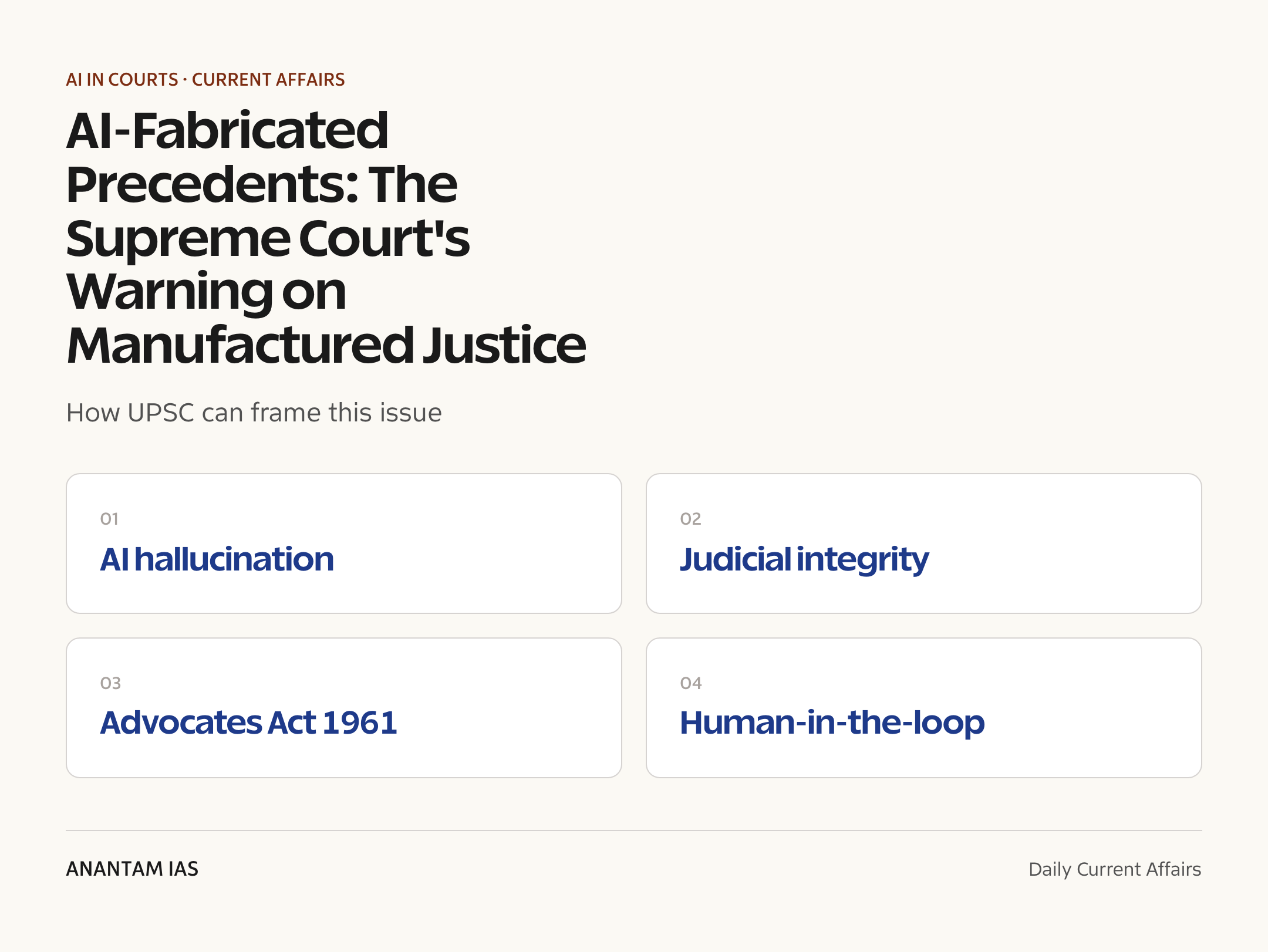
How AI hallucination works
The controversy rests on a well-documented failure mode of generative AI that predates this case.
- Hallucination is when a language model generates plausible-sounding but false content — invented cases, quotes, statutes or citations.
- Large language models predict the next likely word from patterns, so they can fabricate a case name, citation number and holding that read as authentic but never existed.
- The output carries no in-built signal of truth or falsity, so a fake citation looks identical to a real one unless it is checked against an official law reporter.
- The globally cited example is Mata v. Avianca (US, 2023), where lawyers filed a brief with non-existent AI-generated citations and were sanctioned by a federal court.
- Indian High Courts and trial courts have flagged similar fabricated filings, making this a recurring risk, not an isolated slip.
The Court’s assistive-not-substitutive line
The rulings draw a firm boundary around where AI may and may not operate in a courtroom.
- AI may act as an assistive tool to improve efficiency — legal search, summarisation, translation, listing and case-file processing.
- AI can never replace independent human reasoning, judicial discretion or professional accountability, the Court held.
- The draft rules reserve adjudication, sentencing, bail eligibility and the assessment of a party’s or witness’s credibility for humans.
- Human oversight is framed as the essential counter to AI’s dangers, not an optional add-on.
- The editorial cast AI disruption as a ‘known unknown’ — everyone sees it happening, but no one can yet gauge its full extent — which is precisely why caution is warranted.
The regulatory response taking shape
Judicial observations are being converted into written norms and institutional duties.
- The draft Regulations for Use of AI in Courts, 2026 prohibit AI in core adjudicatory functions and are open for public consultation.
- The Bar Council of India has been directed to form a committee to frame strict norms and disciplinary action for lawyers citing unverified AI material.
- Under the Advocates Act, 1961, the BCI and State Bar Councils already hold disciplinary jurisdiction over professional misconduct — the AI directive plugs into this existing machinery.
- Existing judicial-AI tools such as SUPACE and SUVAS already model the ‘assist, don’t decide’ principle — SUPACE aids case-file processing, SUVAS translates judgments into regional languages.
- Filing fabricated material can expose an advocate to professional misconduct proceedings and, potentially, contempt and cost consequences.
Why this is a GS4 ethics case, not just law
The episode is a live study in integrity, accountability and the misuse of technology.
- Integrity and objectivity: a citation must be verified before it is relied upon; convenience is no defence for skipping the check.
- Accountability: the duty to check the record cannot be outsourced to a machine, and the human who signs the order owns the outcome.
- Non-maleficence: a fabricated precedent can wrongly decide liberty, property, solvency or livelihood — real harm to real people.
- Automation bias is the ethical trap — deferring to a confident machine erodes the professional’s own judgement and diligence.
- The fiduciary duty of an officer of the court is personal and non-transferable; a tool cannot bear the moral weight of a wrong decision.
- Ethical failure here is a mix of negligence (skipped verification) and, at worst, deliberate deception when fake authority is knowingly passed off as real.
How other jurisdictions have responded
India’s caution echoes a wider global reckoning with AI in courts.
- In the United States, the Mata v. Avianca sanctions prompted several federal judges to issue standing orders requiring disclosure and certification of AI-assisted filings.
- Courts in the United Kingdom have issued judicial guidance warning that legal professionals remain personally responsible for material generated with AI tools.
- The common thread is human accountability — AI use is not banned, but the professional who files or signs cannot hide behind the tool.
- India’s draft AI-in-Courts Regulations, 2026 sit within this global move toward trustworthy, verifiable AI in high-stakes public decisions.
Wider stakes for AI in governance
Courts are one arena; the same tension runs across the administrative state.
- Automated decision-support is spreading into welfare targeting, policing, taxation and revenue systems, where a hallucinated input carries real cost.
- The judgment strengthens the case for human-in-the-loop design and auditable trails in every public-sector AI system.
- It signals that explainability and verifiability, not raw speed, are the true tests for AI in high-stakes governance.
- The reasoning applies equally to algorithmic bias and opaque ‘black-box’ models that citizens cannot challenge or appeal.
- A wrong AI-driven welfare or revenue decision may go unnoticed for months, echoing the Court’s latent-harm warning far beyond the courtroom.
- India’s approach sits alongside global debates on trustworthy AI and the emerging idea of AI-specific professional standards.
Way Forward
Verification duty
- Mandate that every cited authority be independently checked against an official reporter or database before filing.
- Require counsel to certify the provenance of AI-assisted research in the pleading itself, so responsibility is documented.
- Build citation-verification into standard legal-education and continuing-education modules so diligence becomes habit, not afterthought.
Institutional guardrails
- Finalise the AI-in-Courts Regulations, 2026 after consultation, keeping adjudication, sentencing and bail firmly human.
- Operationalise the BCI committee with clear disciplinary consequences, reporting channels and training for advocates.
- Extend the same ‘assist, don’t decide’ rule to tribunals such as the NCLT and NCLAT, where this lapse originated.
Systemic design
- Deploy court-approved, source-linked AI tools that surface citations only with verifiable links to genuine judgments.
- Build human-in-the-loop checkpoints, audit logs and provenance trails into any AI used across governance.
- Prefer explainable systems whose outputs can be traced and challenged over opaque models in any decision affecting rights.
Conclusion
The Supreme Court’s intervention reframes AI hallucination from a technical curiosity into a question of judicial integrity. By treating a tainted order as no decision at all, it puts the burden of verification back where it belongs — on the human who signs the judgment, not the tool that drafted it.
The Bhopal analogy is deliberate. Like a leaked gas, a fabricated citation does its damage quietly and is often noticed only after a wrong outcome has already touched someone’s liberty or livelihood. That is why the Court favours prevention — verification duties, disciplinary norms and firm limits on where AI may operate — over after-the-fact correction.
The larger lesson travels beyond the courtroom. Wherever AI enters public decision-making, speed cannot substitute for accountability, and oversight is the price of using the tool at all. Justice, as the editorial put it, must be done and seen — not hallucinated.
UPSC Practice Questions
Prelims MCQ 1
With reference to the use of Artificial Intelligence in India’s judicial system, consider the following statements:
- The draft Regulations for Use of AI in Courts, 2026 permit AI to decide bail eligibility to reduce pendency.
- The Supreme Court has held that a judgment influenced by hallucinated AI material is ‘no decision in the eyes of law’.
- The Bar Council of India has been directed to frame norms and disciplinary action for lawyers citing unverified AI material.
How many of the above statements are correct?
(a) Only one (b) Only two (c) All three (d) None
Answer: (b) Only two
Explanation:
Statements 2 and 3 are correct. Statement 1 is wrong — the draft regulations prohibit AI in adjudication, sentencing and bail eligibility, reserving these for humans.
Prelims MCQ 2
The bodies whose orders the Supreme Court set aside for relying on fictitious AI-generated citations were the:
(a) CAT and the High Court (b) NCLT and the NCLAT (c) SEBI and the SAT (d) NGT and its appellate bench
Answer: (b) NCLT and the NCLAT
Explanation:
The National Company Law Tribunal relied on fabricated AI citations in an insolvency case, and the National Company Law Appellate Tribunal missed the lapse; the Supreme Court set aside both orders.
UPSC Mains Questions
- “AI in the courtroom may assist efficiency but can never replace independent human reasoning.” In light of recent Supreme Court observations, examine the risks of AI hallucination in judicial decision-making and the safeguards needed.
- Fabricated, machine-generated citations raise questions of professional ethics as much as of law. Discuss the ethical duties of advocates and judges in verifying authority, and the role of the Bar Council of India in enforcing accountability.
- Human oversight is described as the essential counter to the dangers of AI in governance. Analyse how a human-in-the-loop principle can be built into public-sector decision-making systems in India.
Sources: The Hindu, Editorial and Supreme Court of India.
Frequently Asked Questions
What is an AI hallucination in this context?
It is when a generative AI tool produces confident but false content — here, legal citations for cases that do not exist. Because the output looks authentic, it can be relied upon without verification, which is exactly the risk the Supreme Court flagged when fabricated precedents entered tribunal orders.
Why did the Supreme Court compare it to Bhopal gas?
The Bench likened AI hallucinations in judicial reasoning to methyl isocyanate, the gas behind the 1984 Bhopal tragedy — ‘invisible, insidious, and catastrophic by the time anyone notices’. The analogy stresses that the harm is latent and often detected only after a wrong decision has already caused damage.
Is using AI banned for judges and lawyers?
No. The Court holds that AI may serve as an assistive tool for efficiency, such as search and translation. What is barred is letting AI substitute for human reasoning — adjudication, sentencing, bail and credibility assessment remain human functions under the draft AI-in-Courts Regulations, 2026.
What can happen to a lawyer who cites fake AI cases?
Presenting fabricated machine-generated material was ruled professional misconduct for advocates. The Supreme Court directed the Bar Council of India to set up a committee to frame strict norms and disciplinary action, and such conduct can also invite contempt and cost consequences.
What are SUPACE and SUVAS?
They are the judiciary’s own AI-assist tools. SUPACE (Supreme Court Portal for Assistance in Court Efficiency) helps process case files and information, while SUVAS translates judgments into regional languages. Both illustrate the ‘assist, do not decide’ principle the Court endorses.
Why is this an ethics issue for UPSC GS4?
It tests integrity, objectivity and accountability. A citation must be verified before reliance, and that duty cannot be outsourced to a machine. The failure combines negligence with, at worst, deception, making human oversight the ethical safeguard against AI misuse in governance.
Source: https://anantamias.com/current-affairs/ai-fabricated-precedents-judiciary-ethics/
India’s Language Conundrum: CBSE’s NEP Three-Language Formula from Class 6
Why in News?
In April 2026, the Central Board of Secondary Education (CBSE) directed all affiliated schools, covering roughly 40 lakh students, to implement the NEP 2020 three-language formula from Class 6 in the 2026-27 session, with two of the three languages required to be native Indian tongues.
The hurried rollout, a mid-session May 15 circular extending the switch to Class 9, and a June 25 partial relaxation by the Education Minister have thrown CBSE schools into curriculum disruption, teacher displacement and a fresh centre-state language debate.
- CBSE counts English as a foreign language, so English-medium schools must add a second Indian language alongside Hindi or a regional tongue.
- Many schools dropped French and German as the third language, often defaulting to Sanskrit where regional-language teachers were unavailable.
- The May 15 circular forced Class 9 students to switch mid-session; parents moved the Supreme Court, which refused a stay.
- On June 25, Education Minister Dharmendra Pradhan relaxed the rule for existing Classes 7, 8 and 9 students, who may keep their foreign language but must still add a native Indian one.
- The framework applies prospectively from Class 6 in 2026-27 and extends to Class 10 by 2030-31, effectively phasing foreign languages out of CBSE schools.
The development matters in the context of:
- Language policy sits at the intersection of federalism, education-as-a Concurrent-List subject, and the constitutional protection of linguistic minorities.
- The friction revives a six-decade tension traced to the Kothari Commission and Tamil Nadu’s long-standing resistance to a mandated third language.
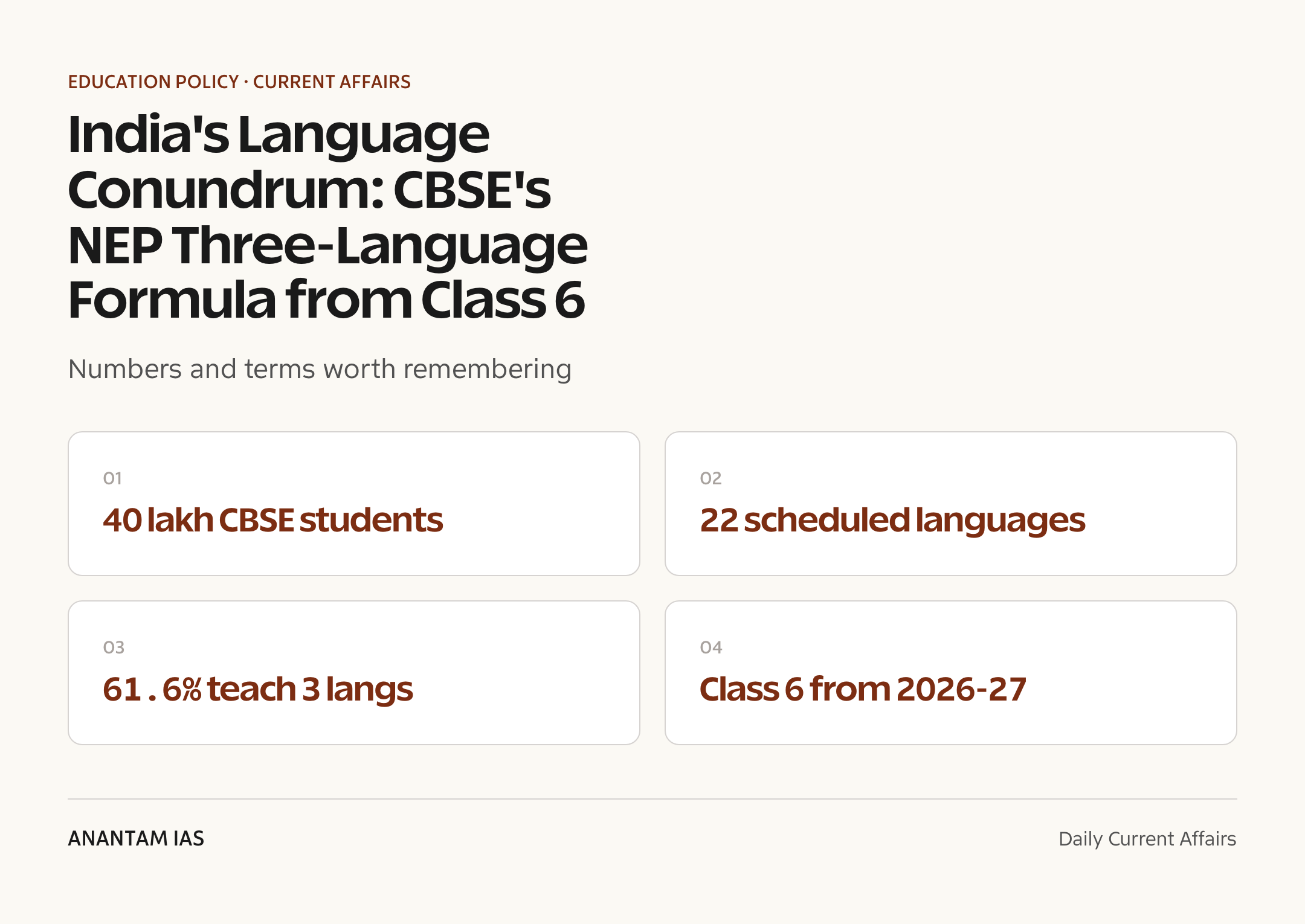
UPSC Relevance
Prelims Relevance
- Three-language formula: origin in the Kothari Commission (1964-66), formalised by the National Policy on Education 1968.
- NEP 2020 version: at least two of three languages native to India; greater flexibility, no language imposed on any State.
- Eighth Schedule of the Constitution lists 22 scheduled languages.
- Article 343-351 deal with official language; Hindi in Devanagari is the official language of the Union under Article 343.
- Article 350A — instruction in the mother tongue at the primary stage for linguistic minorities.
- Article 29 protects the right of any section to conserve its language, script or culture.
- UDISE 2023-24: 61.6% of schools teach three languages.
- Tamil Nadu follows a two-language formula (mother tongue + English); Tamil Nadu Tamil Learning Act, 2006.
- Education is on the Concurrent List (moved by the 42nd Amendment, 1976).
Mains Relevance
GS Paper 2
- Cooperative federalism and centre-state friction in education policy, a Concurrent-List subject.
- Government policies for the education sector and issues arising from their design and implementation.
GS Paper 1
- Salient features of Indian society: linguistic diversity, the role of language in national integration and regional identity.
Essay
- Unity in diversity: can a single language policy hold a multilingual nation together?
- The medium of the message: language, opportunity and social mobility.
Background and Context
What the three-language formula is
The formula is a decades-old device to balance a link language, the mother tongue and a wider Indian language.
- It originated with the Kothari Commission (1964-66) and was formalised by the National Policy on Education, 1968.
- The 1968 formula prescribed Hindi, English and a modern Indian language (preferably a southern one) in Hindi-speaking States, and Hindi, English and the regional language elsewhere.
- NEP 2020 reframed it: students learn three languages, of which at least two must be native to India, with the choice left to States, regions and students.
- NEP 2020 claims no language will be imposed on any State, positioning the formula as flexible rather than a Hindi mandate.
- The stated aims are multilingual competence, cognitive benefits of early language learning, and stronger national integration across a linguistically plural country.
- In practice the formula has always carried political weight, because the choice of a third language signals identity, mobility and the reach of Hindi.
The CBSE rollout and the chaos it caused
A rushed directive, a mid-session tightening, and a partial rollback left schools improvising.
- CBSE’s April 2026 directive told all affiliated schools to run the formula from Class 6, treating English as a foreign language.
- English-medium schools that offered French or German as the third language issued circulars in May discontinuing them.
- With regional-language teachers scarce, most schools defaulted to Sanskrit, calling other Indian languages ‘not logistically viable’.
- The May 15 circular extended the rule to Class 9 mid-session; parents challenged it in the Supreme Court, which declined to stay it.
- On June 25, Minister Dharmendra Pradhan relaxed the switch for existing Classes 7, 8 and 9 — they keep the foreign language but still add a native Indian one.
- The relaxation is transitional only: fresh Class 6 entrants get no exemption, so foreign languages will be squeezed out as the cohort moves up.
- Parents and teachers criticised the repeated reversals as ad-hoc governance, with children asked to abandon chapters already completed in April.
Teacher shortage and displacement
The binding constraint is not policy intent but the supply of qualified language teachers.
- Schools in Mangaluru, Gurugram and elsewhere let go of French teachers or reassigned them to other subjects.
- A Karnataka school dropped Konkani because no qualified teacher could be found, offering only English, Hindi, Kannada and Sanskrit.
- In Uttar Pradesh, State Board data showed just 17 Kannada, 10 Tamil and 133 Telugu registrations in 2025-26, forcing students to sit as private candidates.
- About 4.5 lakh students study French and 1.5 lakh study German in Indian schools; roughly 11,000 take the DELF French exams each year.
- The French and German embassies, which fund teaching infrastructure worth millions of euros, pushed back through diplomatic channels.
- In Puducherry, where French enjoys constitutional recognition, dropping French from the 2026-27 curriculum threatened the livelihoods of French teachers.
- Certified qualifications such as the DELF and DALF, issued by the French Ministry of Education, are valued for study and work abroad and are now at risk of losing their school pipeline.
Constitutional and federal frame
Language sits inside a dense web of constitutional guarantees and a shared centre-state mandate.
- The Eighth Schedule recognises 22 languages; Articles 343-351 govern the Union’s official language.
- Article 350A directs States to provide primary-stage instruction in the mother tongue for linguistic-minority children.
- Article 29 protects any group’s right to conserve its language, script and culture.
- Education moved to the Concurrent List via the 42nd Amendment (1976), making language policy a joint centre-state responsibility.
- CBSE’s classification of English as ‘foreign’ jars with English being an associate official language used across administration, higher courts and inter-State communication.
- Because education is shared between the Centre and States, a CBSE circular that overrides State language choices raises questions of cooperative federalism.
- The official Languages Act, 1963 continued English alongside Hindi for Union purposes, underlining that English is woven into India’s public life.
State-level friction and Tamil Nadu's stance
Implementation varies sharply by State, and some have opposed the formula outright.
- Tamil Nadu has rejected a mandated third language since the pre-Independence era and follows a two-language formula — mother tongue and English, not merely Tamil and English.
- The Tamil Nadu Tamil Learning Act, 2006 exempts minority-language schools, such as Urdu-medium ones, from compulsory Tamil.
- Kerala, generally supportive, faces uncertainty as elite schools lose the option to offer French, German or Arabic in place of Hindi or Malayalam.
- Nagaland, with over 30 linguistic backgrounds in its classrooms, resists the formula and finds Sanskrit an unhelpful default for children.
- Telangana sees the CBSE directive as leverage to fully enforce its Compulsory Teaching of Telugu Act, 2018.
Why the debate endures
The conundrum is structural: identity, opportunity and administrative capacity pull in different directions.
- UDISE 2023-24 shows only 61.6% of schools teach three languages, exposing a wide implementation gap.
- Parents value foreign languages for higher-education and migration pathways to Germany and French-speaking countries.
- The last national survey of school language preferences was an NCERT 2009 study, leaving policy to run on stale data.
- The Centre’s move sits awkwardly beside its own push for an Indo-German higher-education roadmap and skilled-migration ties with Europe.
- Elite and low-fee schools face the same rule differently: well-resourced schools can hire Sanskrit or regional teachers, while smaller schools simply drop options.
- The underlying tension is that a genuinely flexible formula demands administrative capacity that most States and boards do not yet possess.
Way Forward
Fix the teacher pipeline first
- Sequence any mandate to the supply of trained language teachers and vernacular learning material, rather than the reverse.
- Fund shared regional-language teacher pools and digital instruction for low-enrolment languages like Kannada or Tamil in Hindi-belt States.
Respect genuine flexibility
- Honour NEP 2020’s own promise that no language is imposed, letting States and students choose within the two-native-languages rule.
- Keep space for foreign languages as an additional option so higher-education and migration aspirations are not foreclosed.
Consult and evidence
- Route curriculum changes through State governments and school boards before mid-session directives, honouring the Concurrent-List spirit.
- Commission a fresh national survey of school language preferences to replace the 2009 NCERT baseline.
Conclusion
India’s language conundrum is less about which tongue and more about how policy is made: hurried CBSE circulars, mid-session switches and reactive relaxations have converted a reasonable multilingual aim into avoidable disruption for 40 lakh children.
The durable lesson is that a multilingual federation needs its language policy built on teacher capacity, State consultation and honest flexibility. Get the sequencing right, and the three-language formula can widen horizons rather than shrink choices.
UPSC Practice Questions
Prelims MCQ 1
With reference to the three-language formula in India, consider the following statements:
- It was first recommended by the Kothari Commission and formalised in the National Policy on Education, 1968.
- Under NEP 2020, at least two of the three languages must be native to India.
- Education is a subject exclusively on the Union List of the Constitution.
How many of the above statements are correct?
(a) Only one (b) Only two (c) All three (d) None
Answer: (b) Only two
Explanation:
Statements 1 and 2 are correct. Statement 3 is wrong: education is on the Concurrent List, moved there by the 42nd Amendment, 1976.
Prelims MCQ 2
Which Article of the Constitution provides for instruction in the mother tongue at the primary stage for children of linguistic minority groups?
(a) Article 29 (b) Article 343 (c) Article 350A (d) Article 351
Answer: (c) Article 350A
Explanation:
Article 350A directs every State to provide adequate facilities for mother-tongue instruction at the primary stage to linguistic-minority children. Article 343 concerns the Union’s official language; Article 351 concerns the development of Hindi.
UPSC Mains Questions
- The three-language formula was designed to promote national integration but has repeatedly become a site of centre-state friction. Examine the constitutional and federal dimensions of language policy in school education in India. (250 words)
- “A language policy is only as good as the teachers who can deliver it.” In the light of the recent CBSE rollout of the NEP 2020 three-language formula, discuss the implementation challenges and suggest a way forward. (250 words)
- Discuss how India’s linguistic diversity shapes both national unity and regional identity, with reference to constitutional safeguards for languages. (150 words)
Sources: The Hindu, Education and Ministry of Education, NEP 2020.
Frequently Asked Questions
What is the three-language formula?
It is a school-education policy, first recommended by the Kothari Commission and formalised in the 1968 National Policy on Education, under which students learn three languages. NEP 2020 recast it to require that at least two of the three be native to India, while promising that no specific language would be imposed on any State.
What did CBSE direct in 2026?
In April 2026, CBSE told affiliated schools, covering about 40 lakh students, to implement the NEP 2020 three-language formula from Class 6, with two of three languages native to India. A May 15 circular extended it to Class 9 mid-session, and a June 25 clarification relaxed the switch for existing Classes 7 to 9 students.
Why is English treated as a foreign language?
CBSE classifies English as a foreign language for the purpose of the two-native-languages rule. So an English-medium school must offer two Indian languages in addition to English, which is why many schools dropped French or German and added Sanskrit or a regional language as the third language.
Why does Tamil Nadu oppose it?
Tamil Nadu has resisted a mandated third language since before Independence, seeing it as an attempt to introduce Hindi. It follows a two-language formula of the mother tongue and English. Its position hardened around the 1968 draft and continues today, with the State insisting students learn only two languages.
Which constitutional provisions relate to language?
The Eighth Schedule recognises 22 languages. Articles 343 to 351 govern the Union’s official language, with Hindi in Devanagari as the Union’s official language. Article 350A provides for mother-tongue instruction at the primary stage, and Article 29 protects the right to conserve one’s language and script.
What are the main implementation problems?
The biggest hurdles are a shortage of trained language teachers and a lack of learning material in regional languages, forcing many schools to default to Sanskrit. Foreign-language teachers face displacement, State practice varies widely, and policy is being made on a language-preference baseline last surveyed by NCERT in 2009.
Source: https://anantamias.com/current-affairs/cbse-nep-three-language-formula-conundrum/
India-Israel Bilateral Investment Treaty Comes Into Force
Why in News?
The India-Israel Bilateral Investment Treaty (BIT) has entered into force, the Department of Economic Affairs (DEA) under the Ministry of Finance confirmed. Signed in New Delhi on 8 September 2025 by Finance Minister Nirmala Sitharaman and Israel’s Finance Minister Bezalel Smotrich, it is the first Indian investment treaty to take effect built on the revised Model BIT template with a partner from the developed world.
The headline point: Israel is the first OECD member to accept India’s post-2016 investment-treaty architecture, including Investor-State Dispute Settlement (ISDS) only after five years of exhausting local remedies, and broad carve-outs for taxation and national security.
- Signed in New Delhi on 8 September 2025; now in force after both sides completed internal ratification.
- Replaces the earlier 1996 India-Israel BIT, which India had terminated in 2017.
- Israel becomes the first OECD country to sign onto India’s post-2016 treaty design.
- Investors must exhaust local remedies for five years before invoking ISDS arbitration.
- Carve-outs shield taxation, national security, government procurement, subsidies and compulsory licences.
- India-Israel bilateral trade stands near USD 4 billion (about Rs 35,212 crore) a year, per DEA figures.
- Positioned by DEA as a template for future BIT talks with the UK, EU and OECD economies.
The development matters in the context of:
- Follows India’s 2016-17 mass termination of nearly 75 old-style BITs after adverse arbitral awards.
- Signals India can win developed-economy buy-in for its more state-protective treaty model.
- Feeds the wider India-Israel economic track alongside defence, agriculture and I2U2.
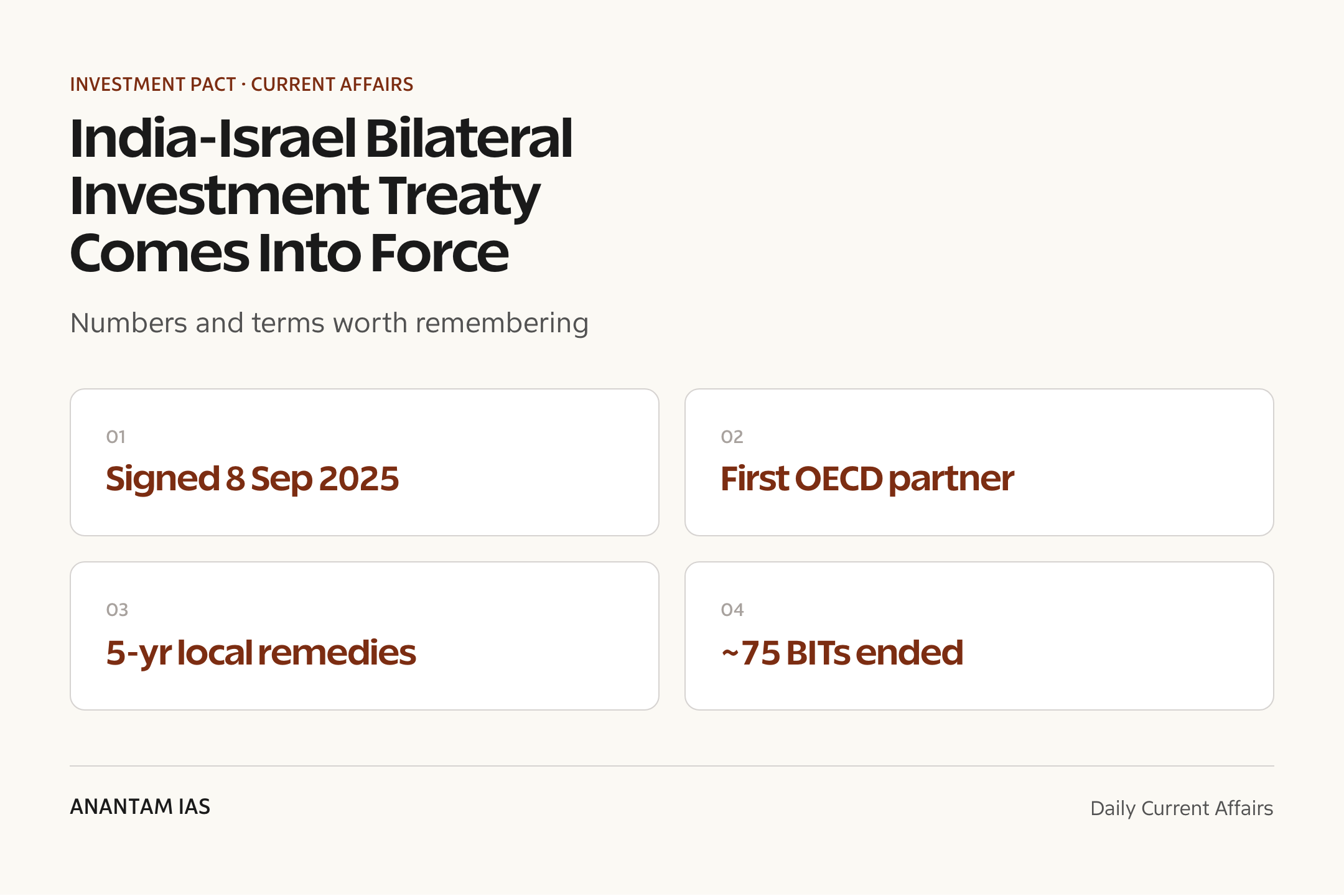
UPSC Relevance
Prelims Relevance
- Bilateral Investment Treaty (BIT): a pact protecting cross-border investors against unfair treatment and expropriation.
- Model BIT 2016: India’s template treaty adopted after adverse ISDS awards.
- ISDS (Investor-State Dispute Settlement): arbitration allowing an investor to sue a host state.
- Exhaustion of local remedies: pursuing domestic courts for five years before international arbitration.
- Department of Economic Affairs (DEA) under the Ministry of Finance is the nodal body for BITs.
- India terminated around 75 BITs from 2016-17 onward.
- The old 1996 India-Israel BIT was terminated in 2017.
- OECD: Organisation for Economic Co-operation and Development; Israel is a member.
- The Model BIT 2016 drops the MFN clause and uses an enterprise-based investment definition.
- I2U2: India, Israel, UAE and the US grouping.
- National treatment and expropriation are core BIT protections.
Mains Relevance
GS Paper 2
- India-Israel bilateral ties and the significance of a developed-economy partner adopting India’s treaty model.
- How investment treaties shape India’s engagement with groupings and agreements affecting its interests.
GS Paper 3
- Investment climate, FDI framework and the trade-off between investor confidence and regulatory sovereignty.
- ISDS reform, the 2016 Model BIT and lessons from adverse arbitral awards for India.
Essay
- Sovereignty and openness: can a state protect its policy space while courting foreign capital?
Background and Context
What a Bilateral Investment Treaty does
A BIT is a reciprocal pact that gives investors from one country legal protections when they invest in the other.
- Core guarantees usually cover fair and equitable treatment, protection against expropriation without adequate compensation, and free transfer of funds.
- Many treaties add national treatment (treating a foreign investor no worse than a domestic one) and, in older models, a most-favoured-nation (MFN) clause extending better terms granted to third countries.
- The signature enforcement tool is ISDS — an investor can take a host government to international arbitration rather than relying only on domestic courts.
- BITs aim to de-risk cross-border capital, lowering the perceived political risk of investing in a partner economy and, in theory, drawing more long-term FDI.
- The flip side is regulatory chill — governments worry that broad protections expose legitimate public-policy measures to costly arbitration claims.
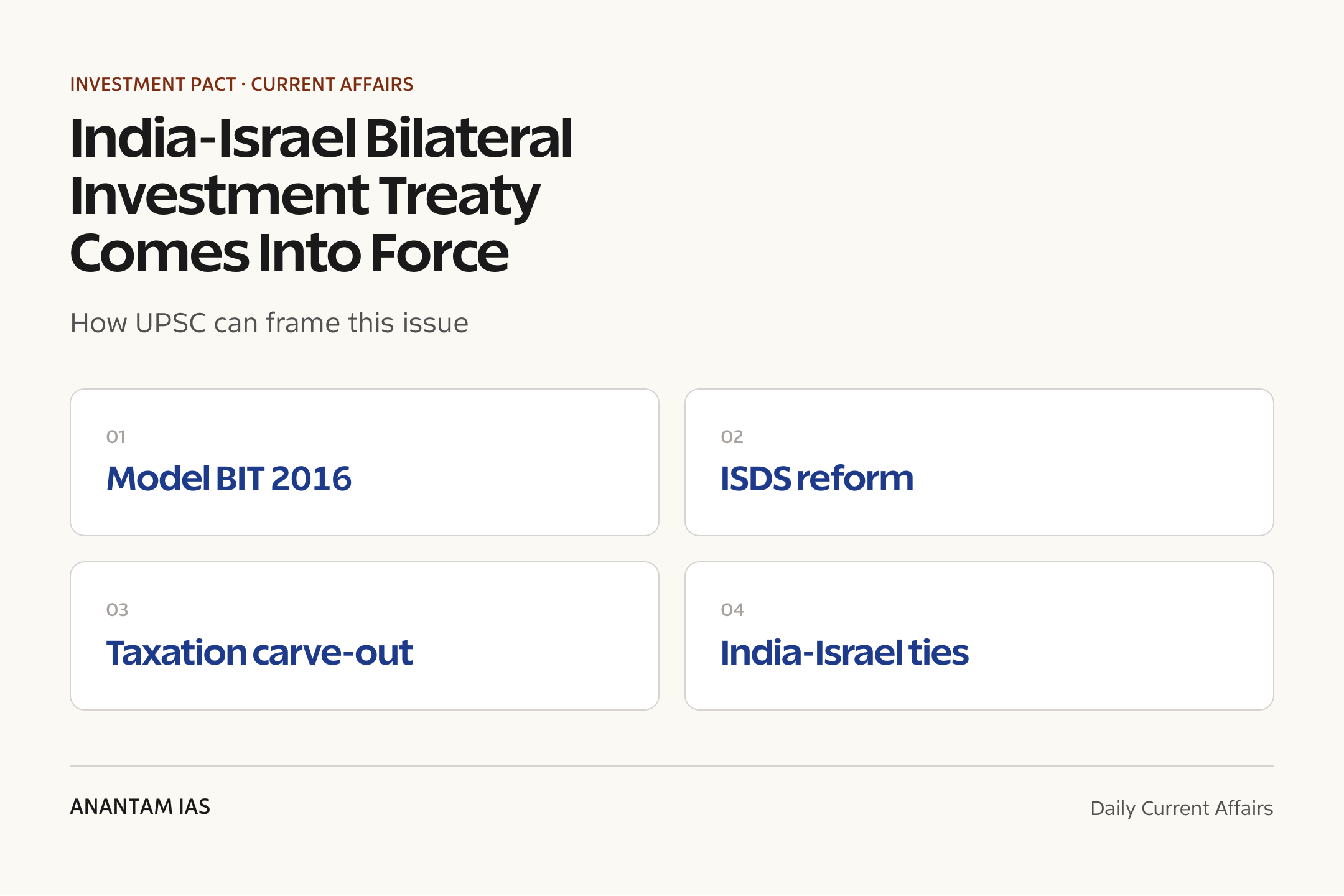
ISDS explained — the core of the debate
Investor-State Dispute Settlement is the mechanism that turns a treaty promise into an enforceable claim, and it is where most of the controversy sits.
- Under classic ISDS, a foreign investor can bypass a host country’s courts and sue the state directly before an international arbitral tribunal.
- Awards can run into hundreds of millions of dollars and are difficult to appeal, which critics say tilts the field toward large investors.
- Broadly worded clauses on fair and equitable treatment (FET) and expropriation have historically been read expansively by tribunals, catching routine regulation.
- The Model BIT 2016 tries to tame this by narrowing FET, tightening the expropriation test, and inserting the five-year local-remedies gate before ISDS can begin.
Why India rewrote its treaty model
India’s shift to a state-protective template grew directly out of arbitration losses in the early-to-mid 2010s.
- The White Industries award of 2011 — where a tribunal held India liable, partly for delays in its own courts — was the trigger that exposed weaknesses in India’s old treaties.
- Later high-profile tax disputes, including the Vodafone and Cairn cases, deepened India’s exposure to large ISDS claims under investor-friendly BITs.
- In response India adopted the Model BIT 2016, a markedly more restrictive template drafted around India’s regulatory interests and its right to regulate.
- From 2016-17 India issued termination notices for close to 75 existing BITs, seeking to renegotiate them on the new terms; the old 1996 India-Israel BIT was among those wound down, terminated in 2017.
- The result: for years India had almost no live investment treaties with major partners, and negotiations to sign fresh ones on the tougher template made slow progress.
Defining features of the Model BIT 2016
The 2016 template is deliberately narrower than the treaties it replaced, tilting the balance toward the host state’s regulatory autonomy.
- ISDS after local remedies: an investor must first pursue Indian courts and tribunals for at least five years before triggering international arbitration.
- Enterprise-based investment: protection is limited to investments made as a genuine business enterprise complying with Indian law, filtering out speculative or shell holdings.
- No MFN clause: the model drops most-favoured-nation treatment to stop investors ‘treaty-shopping’ for better terms from India’s other pacts.
- Narrowed FET: instead of an open-ended fair-and-equitable-treatment guarantee, it lists a closed set of protections such as denial of justice and manifestly abusive treatment.
- Carve-outs: taxation, national security, government procurement, subsidies and compulsory licences sit outside the treaty’s obligations.
- The design preserves the state’s right to regulate for public welfare — health, environment and safety — without those measures automatically counting as expropriation.
Why the OECD-member angle matters
The politically significant fact is not the bilateral flow itself but who agreed to the terms.
- Israel is a member of the OECD, the club of largely high-income economies, and is the first such member to accept India’s post-2016 template.
- Developed-economy investors and their governments have often resisted India’s model as too restrictive on ISDS and too generous to state defences.
- Israel’s acceptance gives India a working precedent to point to in stalled talks with the United Kingdom, the European Union and other OECD partners.
- The DEA frames the pact as a reusable template, signalling India will not dilute its core red lines to close future deals.
The wider India-Israel economic and strategic track
The BIT slots into a relationship that has broadened well beyond defence, with the numbers still modest but rising.
- Annual bilateral trade sits near USD 4 billion (about Rs 35,212 crore); India’s cumulative overseas direct investment in Israel is around USD 443 million and Israeli FDI into India about USD 334 million, per DEA data.
- Defence remains the anchor, with Israel a major supplier of missiles, drones and radar systems to India.
- Agriculture and water cooperation runs through Centres of Excellence and drip-irrigation and precision-farming know-how.
- Both are partners in I2U2 (India, Israel, UAE, US), linking them to food-security and clean-energy projects.
- A settled investment-protection regime is meant to draw private capital into technology, water, agri-tech and manufacturing tie-ups.
Where the BIT sits in India's FDI framework
A BIT is a protection layer that sits on top of, not in place of, India’s domestic FDI rules.
- Entry of foreign capital is still governed by India’s FDI policy and the FEMA regime administered by the RBI and the government.
- The BIT chiefly governs the post-establishment treatment of an investment already made under those rules — how the state may or may not act once the money is in.
- It complements, rather than substitutes for, the wider trade and economic agreements India is negotiating, whose investment chapters often mirror the same red lines.
- A predictable treaty is intended to reinforce India’s pitch as a stable destination amid global supply-chain shifts and China-plus-one relocation.
A template for the pacts still on the table
The Israel treaty matters most as a proof of concept for the far larger deals India is chasing.
- India is negotiating or firming up investment terms with the EFTA bloc, the European Union and the United Kingdom, where investment protection has been a sticking point.
- Each of these carries an investment chapter or a linked BIT, and partners have pushed back on the five-year local-remedies rule and the dropped MFN and FET protections.
- With an OECD economy now inside the tent, India can argue the model is workable, not a deal-breaker, and hold its line in the tougher talks.
- The pattern also fits India’s broader pivot to free-trade and economic-partnership agreements that bundle goods, services and investment in one package.
The criticism and the open debate
Not everyone reads a state-protective treaty as an unqualified win; the design has trade-offs.
- Critics argue the five-year local-remedies gate, given the backlog in Indian courts, can make ISDS a near-dead letter and blunt the treaty’s appeal to cautious investors.
- Dropping the MFN clause and narrowing FET removes protections that developed-economy investors are used to, which some fear could deter capital at the margin.
- Supporters counter that a treaty India can defend is better than a generous one that keeps exposing the exchequer to nine-figure awards.
- The honest verdict is not yet in: whether the restrictive model attracts or quietly discourages FDI will only show up in investment flows over several years, not in the signing ceremony.
Way Forward
Use it as a template
- Leverage the Israel precedent in ongoing BIT and trade talks with the UK, EU, EFTA and other OECD economies, pointing to a live, workable deal.
- Publish the treaty text promptly so investors and arbitration counsel can price the new terms with certainty rather than guessing at the carve-outs.
Balance protection with openness
- Pair the state-protective model with faster, more credible domestic dispute resolution so the five-year local-remedies rule is not seen as a dead end.
- Strengthen commercial courts and arbitration infrastructure so the local-remedies clause reflects a genuine forum, not a delay.
- Track investor sentiment and FDI data to ensure the restrictive design does not quietly deter capital India wants to attract.
Build negotiating and defence capacity
- Deepen institutional capacity within the DEA and the law ministry to defend and negotiate treaties, so India argues from strength rather than reacting to claims.
- Keep the Model BIT under periodic review so it stays credible to partners without surrendering the regulatory space India fought to protect.
Conclusion
The India-Israel BIT coming into force is a modest number on paper but a notable marker of policy: a developed, OECD-member economy has signed up to the treaty model India rebuilt after its arbitration setbacks of the 2010s.
It validates India’s bet that it can protect regulatory space and still find willing partners, and hands negotiators a concrete precedent to wave in the harder rooms.
The real test lies ahead — whether the same terms can unlock the larger, long-stalled deals with the UK, the EU and EFTA, and whether a deliberately tougher treaty ends up attracting the capital it was designed to reassure or quietly holding some of it back.
UPSC Practice Questions
Prelims MCQ 1
With reference to the India-Israel Bilateral Investment Treaty that has come into force, consider the following statements:
- It requires an investor to exhaust local remedies for five years before invoking international arbitration.
- Israel is the first OECD member country to accept India’s post-2016 treaty model.
- It removes taxation and national security matters from carve-outs, bringing them under treaty obligations.
How many of the above statements are correct?
(a) Only one (b) Only two (c) All three (d) None
Answer: (b) Only two
Explanation:
Statements 1 and 2 are correct. Statement 3 is wrong: taxation and national security are carved OUT of the treaty’s obligations, not brought under them.
Prelims MCQ 2
The Model BIT 2016 and the mass termination of India’s older bilateral investment treaties are best explained by which of the following?
(a) India’s exit from the World Trade Organization (b) Adverse Investor-State Dispute Settlement (ISDS) arbitration awards against India (c) A Supreme Court ruling banning foreign investment (d) India joining the OECD as a full member
Answer: (b) Adverse Investor-State Dispute Settlement (ISDS) arbitration awards against India
Explanation:
Losses and exposure in ISDS cases such as White Industries (2011) pushed India to adopt the restrictive Model BIT 2016 and terminate around 75 old-style treaties from 2016-17.
UPSC Mains Questions
- India’s post-2016 investment-treaty model prioritises the state’s right to regulate over expansive investor protections. Examine the trade-offs this creates for attracting foreign capital, using the India-Israel BIT as a reference point.
- Explain how adverse arbitration outcomes reshaped India’s approach to bilateral investment treaties. What lessons does the India-Israel treaty offer for India’s negotiations with OECD economies?
Source: PIB, Department of Economic Affairs, Ministry of Finance.
Frequently Asked Questions
What is the India-Israel Bilateral Investment Treaty?
It is a reciprocal pact protecting investors from each country in the other, covering fair treatment and protection against arbitrary expropriation. Signed in New Delhi on 8 September 2025, it has now entered into force, replacing the earlier 1996 treaty that India terminated in 2017.
Why is Israel being the first OECD country significant?
Developed economies often resisted India’s post-2016 treaty model as too restrictive. Israel, an OECD member, accepting these terms gives India a working precedent it can cite in stalled negotiations with the United Kingdom, the European Union and other high-income partners.
What is ISDS and how does this treaty limit it?
ISDS, or Investor-State Dispute Settlement, lets an investor take a host government to international arbitration. Under this treaty an investor must first exhaust local remedies in Indian courts for at least five years before invoking ISDS arbitration.
What are the treaty’s carve-outs?
Certain areas sit outside the treaty’s obligations. These include taxation and national security, along with government procurement, subsidies and compulsory licences, preserving the government’s policy space in sensitive domains.
Why did India terminate its older BITs?
After adverse ISDS awards, notably the 2011 White Industries case, exposed India to large claims, India adopted the more state-protective Model BIT 2016 and issued termination notices for close to 75 older, investor-friendly treaties from 2016-17, aiming to renegotiate them.
Does the BIT replace India’s FDI rules?
No. Foreign investment entry is still governed by India’s FDI policy and the FEMA regime. The BIT mainly protects the post-establishment treatment of investments already made under those domestic rules, adding a protection layer rather than replacing them.
Source: https://anantamias.com/current-affairs/india-israel-bilateral-investment-treaty-in-force/
Indus Waters Treaty in Abeyance: India Ties Restoration to End of Cross-Border Terror
Why in News?
India has said the Indus Waters Treaty (IWT) of 1960 will remain in abeyance until Pakistan “credibly and irrevocably” stops supporting cross-border terrorism. The External Affairs Ministry made the statement on July 3, 2026, in New Delhi, responding to a recent international conference Pakistan hosted seeking the treaty’s restoration.
As reported by The Hindu, official spokesperson Randhir Jaiswal said the treaty stays suspended “with immediate effect” and reiterated Prime Minister Narendra Modi’s position that “water and blood cannot flow together”, firmly linking any revival to an end of terror sponsorship. The restatement lands amid a severe heatwave in Pakistan and fresh protests in Pakistan-Occupied Kashmir.
- India first placed the IWT in abeyance on April 23, 2025, a day after the Pahalgam terror attack that killed 26 civilians and injured dozens.
- The decision was taken by the Cabinet Committee on Security (CCS), India’s apex national-security body chaired by the Prime Minister.
- The attack led to Indian strikes on terror targets inside Pakistan and Pakistan-Occupied Kashmir under Operation Sindoor.
- At a Pakistan conference this week, its Foreign Minister and Deputy PM Ishaq Dar called the IWT vital for “regional peace, stability and cooperation”.
- India has rejected a Court of Arbitration pondage award, calling the parallel proceedings illegal while the treaty is in abeyance.
- On May 13, 2025 the MEA had argued that climate change, demographic shifts and technological changes have “created new realities on the ground” that justify a review.
The development matters in the context of:
- The move reframes a 66-year-old water-sharing pact from a technical arrangement into an instrument of strategic leverage.
- It tests the durability of one of the world’s most-cited transboundary water treaties, brokered by the World Bank.
- The treaty survived the 1965, 1971 and 1999 wars, so abeyance signals a decisive break from six decades of insulating water from wider hostility.
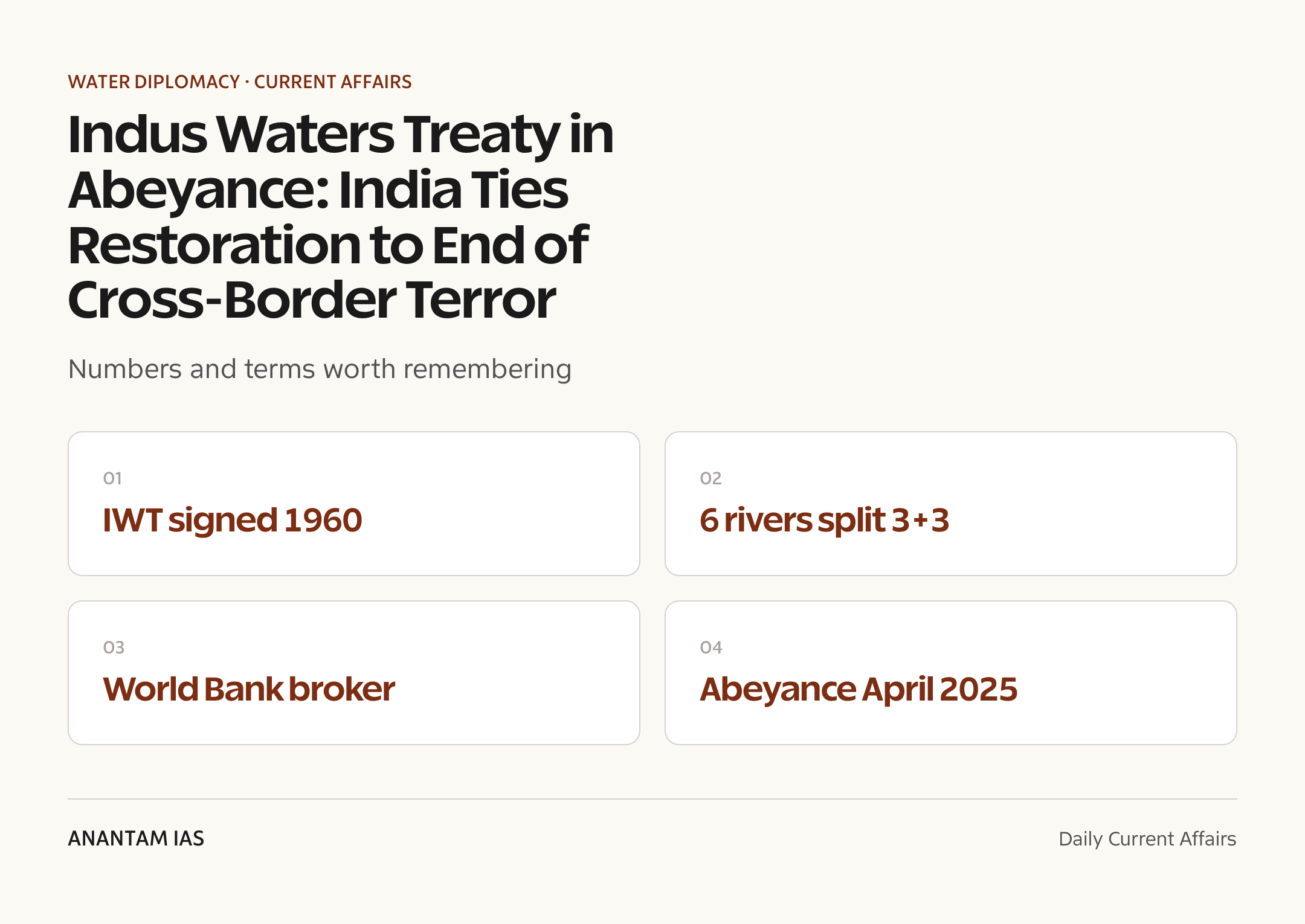
UPSC Relevance
Prelims Relevance
- Indus Waters Treaty signed 1960; brokered by the World Bank; signatories Jawaharlal Nehru and Ayub Khan
- Eastern rivers (Ravi, Beas, Sutlej) allocated to India; western rivers (Indus, Jhelum, Chenab) allocated to Pakistan
- Permanent Indus Commission (PIC): one commissioner from each country
- Three-tier dispute ladder: Permanent Indus Commission -> Neutral Expert -> Court of Arbitration
- Neutral Expert appointed by the World Bank; Court of Arbitration seated at The Hague
- Kishenganga (Jhelum tributary) and Ratle (Chenab) hydro projects are the live disputes
- ‘Abeyance’ is not withdrawal; IWT has no unilateral exit clause
- Cabinet Committee on Security placed the treaty in abeyance after the Pahalgam attack (April 2025)
- Article 62, Vienna Convention on the Law of Treaties (VCLT): fundamental change of circumstances
Mains Relevance
GS Paper 2
- India-Pakistan relations and the use of a water-sharing treaty as diplomatic leverage
- India’s stand on treaty obligations, dispute-resolution mechanisms, and the World Bank’s guarantor role
GS Paper 3
- Cross-border terrorism and the security-development linkage in bilateral engagement
- Water security, hydro-project development, and infrastructure on the western rivers
Essay
- Water can be a bridge or a weapon in inter-state relations
- Sovereignty, security, and the limits of treaty commitments
Background and Context
The 1960 treaty and how it divides the rivers
The IWT is a World Bank-brokered pact splitting the six Indus-system rivers between the two countries after nine years of negotiation.
- Signed on September 19, 1960 in Karachi by PM Jawaharlal Nehru and Pakistan President Ayub Khan, after talks that began in 1951 under World Bank auspices.
- The World Bank (then IBRD) is itself a signatory to the treaty and stands as the guarantor and facilitator for dispute resolution, though it has no adjudicating power of its own.
- The three eastern rivers (Ravi, Beas, Sutlej) are allocated to India for unrestricted use, carrying roughly 33 million acre-feet.
- The three western rivers (Indus, Jhelum, Chenab) are allocated to Pakistan, carrying about 135 million acre-feet, with India permitted only limited non-consumptive, domestic, agricultural and run-of-river hydropower use.
- Pakistan receives roughly 80% of the basin’s total water, reflecting the downstream dependence of its Punjab and Sindh agriculture.
- A 10-year transition period and a World Bank-administered fund financed Pakistani link canals and storage so it could switch off the eastern rivers.
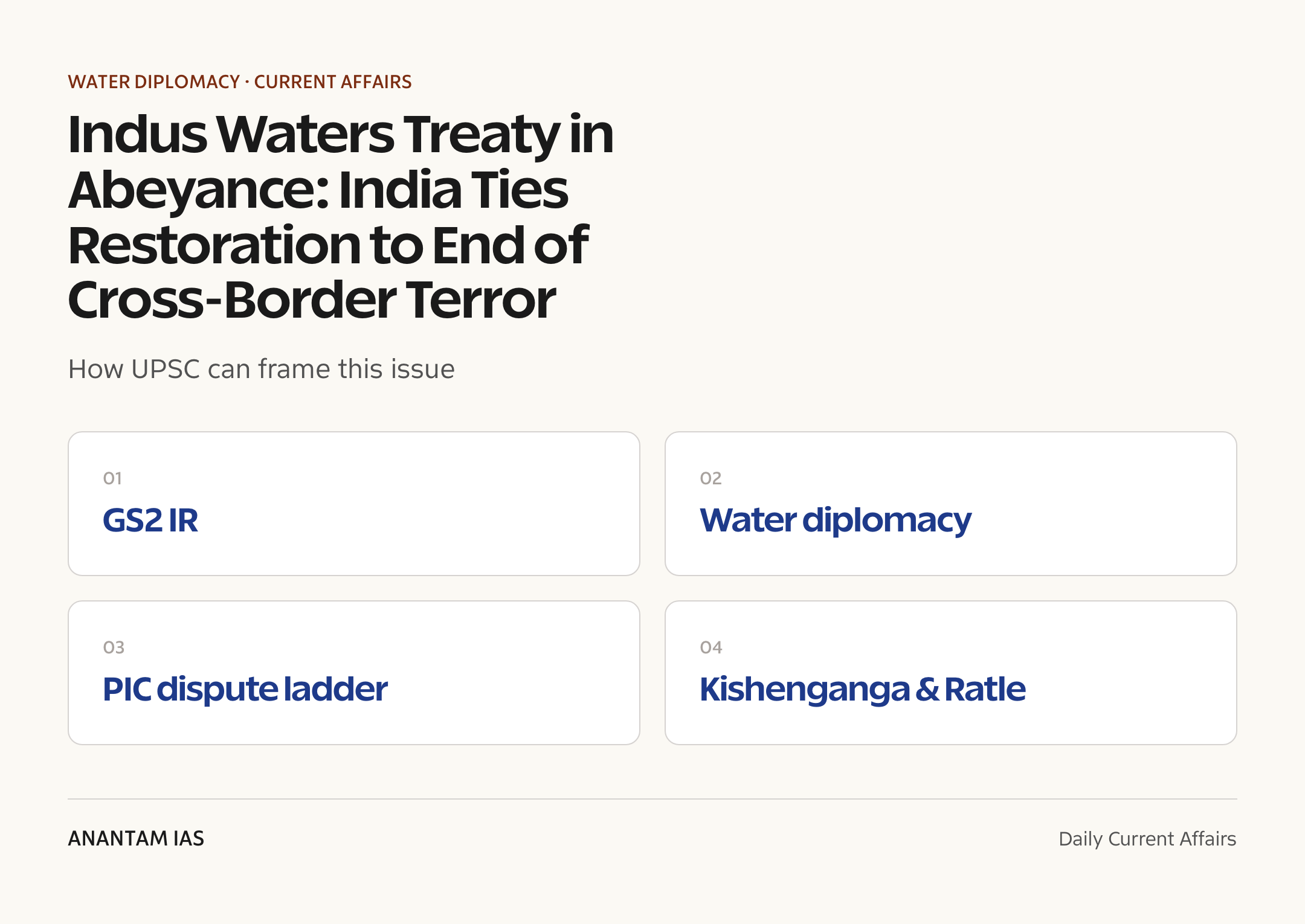
Institutional machinery: the Permanent Indus Commission
The treaty runs on a standing bilateral commission backed by a graded, three-tier dispute ladder.
- The Permanent Indus Commission (PIC) has one commissioner from each country and must meet at least once a year, alternately in India and Pakistan.
- It exchanges hydrological data, inspects works, gives advance notice of new projects, and settles routine ‘questions’ of implementation.
- Unresolved technical ‘differences’ escalate to a Neutral Expert appointed by the World Bank, whose ruling on the seven listed technical matters is final.
- Legal or interpretive ‘disputes’ go to a seven-member Court of Arbitration, historically seated at The Hague.
- This graded design let the treaty survive the 1965, 1971 and 1999 conflicts and the 2001-02 standoff without a single missed PIC cycle until 2025.
Abeyance versus abrogation: what India actually did
Abeyance is a suspension of performance, legally distinct from termination or abrogation.
- The IWT has no unilateral exit clause; Article XII(4) says the treaty continues until terminated by a mutually ratified agreement between the two governments.
- Abrogation would be an outright cancellation; India has deliberately avoided it and chosen the softer, reversible language of abeyance.
- By declaring abeyance, India signals it will not perform treaty duties such as data-sharing, advance notifications and annual PIC meetings, while stopping short of formal withdrawal.
- This preserves India’s legal high ground and keeps a diplomatic off-ramp open, since a suspension can be lifted more easily than a treaty can be re-negotiated.
- Critics note the term ‘abeyance’ does not appear in the treaty text, making its precise legal status contestable in any future forum.
The legal basis: VCLT, changed circumstances and material breach
India grounds the suspension in customary treaty law rather than the IWT’s own text.
- New Delhi has cited fundamentally changed circumstances, invoking climate change, demographic shifts and technological change as new ground realities.
- This mirrors Article 62 of the Vienna Convention on the Law of Treaties (VCLT), the doctrine of rebus sic stantibus, though India is not a party to the VCLT and relies on it as customary international law.
- India also frames Pakistan’s decades of cross-border terrorism as a violation of the treaty’s preambular “spirit of goodwill and friendship”, echoing Article 60 VCLT on suspension for material breach.
- The MEA has argued the treaty was concluded in good faith that Pakistan itself “held in abeyance” through terror sponsorship.
- Legal scholars caution that rebus sic stantibus is narrowly construed and rarely upheld, so India’s strongest lever remains political and hydrological rather than purely juridical.
Kishenganga, Ratle and the parallel-track dispute
The pre-2025 friction centred on two Indian run-of-river hydro projects on the western rivers.
- The Kishenganga project (330 MW) on a Jhelum tributary and the Ratle project (850 MW) on the Chenab are the core technical disputes over pondage, spillway and drawdown design.
- In 2022 the World Bank controversially appointed both a Neutral Expert (at India’s request) and a Court of Arbitration (at Pakistan’s request) on the same issue.
- India rejects this parallel-track process as legally untenable and does not recognise the Court of Arbitration, whose competence it disputes.
- The Court’s supplemental (pondage) award asserting jurisdiction was rejected by India as illegal and void.
- In an earlier 2013 award, a Court of Arbitration had largely upheld India’s right to build Kishenganga while capping drawdown, showing the ladder can favour either side.
The security trigger: Pahalgam and Operation Sindoor
The suspension is rooted in the 2025 terror escalation, not routine river management.
- The Pahalgam attack of April 22, 2025 killed 26 civilians and injured dozens in Jammu and Kashmir.
- The Cabinet Committee on Security, chaired by PM Narendra Modi, placed the IWT in abeyance the very next day as part of a wider package of measures.
- India later struck terror targets inside Pakistan and PoK under Operation Sindoor, marking a sharp escalation.
- On May 22, 2025 India offered to discuss the modality of gaining custody of listed terrorists as a condition of any engagement.
- The July 2026 restatement keeps the treaty frozen amid a heatwave in Pakistan and fresh protests and police crackdowns in Pakistan-Occupied Kashmir.
Leverage, hydrological limits and the internationalisation attempt
Abeyance offers real strategic leverage but faces hard hydrological and legal ceilings, which shapes Pakistan’s response.
- India currently lacks the storage and diversion infrastructure to fully hold back or redirect the vast western-river flows.
- Existing Indian projects on the western rivers are run-of-river with minimal live storage, so an immediate large-scale cut-off of Pakistan’s supply is not physically feasible.
- Suspension does free India from data-sharing, advance-notice and inspection duties, letting it accelerate reservoir flushing, desilting and new storage without Pakistani objection.
- Pakistan calls the move ‘weaponisation of water’, insists the treaty is valid, binding and operative, and has sought to internationalise the issue via the World Bank, the Court of Arbitration and multilateral forums.
- Islamabad, heavily dependent on the Indus for irrigation and hydropower, has warned any diversion would be treated as an act of war, raising the escalation stakes.
- The standoff carries wider consequences for transboundary water governance, upstream-downstream norms and treaty credibility across South Asia and beyond.
Way Forward
Build absorptive capacity on the western rivers
- Fast-track storage, canal and hydropower works on the Chenab and Jhelum so leverage on paper becomes usable capacity on the ground.
- Complete stalled projects, de-silt reservoirs and carry out drawdown flushing that the treaty had constrained, while inspection duties stay suspended.
Hold a firm, calibrated legal line
- Keep restoration tied to a verifiable, irreversible end to cross-border terrorism, avoiding open-ended ambiguity that could be read as bad faith.
- Sustain the position that parallel arbitration is inadmissible, while signalling readiness to use the treaty’s own graded dispute ladder if talks resume.
Manage the international narrative
- Engage the World Bank and key partners to explain the terror-linked rationale and pre-empt Pakistan’s ‘water weaponisation’ framing.
- Anchor any future revival in updated realities of climate change, sedimentation and basin data, pressing for a modernised rather than a frozen 1960 template.
Insulate humanitarian floors
- Keep messaging that abeyance targets treaty obligations, not civilian survival, to hold the moral and legal high ground.
- Avoid steps that could be cast as collective punishment of downstream populations, which would erode India’s upstream credibility on the Brahmaputra and elsewhere.
Prepare a modernised template
- Ready a technical case for a renegotiated treaty that accounts for sedimentation, glacial melt and today’s storage needs, so any revival is on updated terms.
- Invest in basin-wide monitoring and modelling so India negotiates from data, not from the 1950s assumptions frozen into the original text.
Conclusion
India’s insistence that the IWT stays in abeyance until Pakistan ends cross-border terrorism marks a decisive shift from treating water as a purely technical, insulated pact to using it as calibrated strategic leverage.
The chosen path, abeyance rather than abrogation, is deliberately reversible: it keeps India’s legal position defensible, avoids an outright breach, and preserves a diplomatic off-ramp while raising the cost of Pakistan’s terror sponsorship.
The real test lies ahead, in converting suspension into absorptive infrastructure, holding a credible legal line on the disputes ladder, and keeping the door to restoration conditional yet genuine without inviting charges of coercion or humanitarian harm.
UPSC Practice Questions
Prelims MCQ 1
With reference to the Indus Waters Treaty, 1960, consider the following statements:
- The waters of the eastern rivers Ravi, Beas and Sutlej were allocated to India.
- The World Bank is a signatory to the treaty.
- The treaty contains a clause allowing either party to unilaterally withdraw.
How many of the above statements are correct?
(a) Only one (b) Only two (c) All three (d) None
Answer: (b) Only two
Explanation:
Statements 1 and 2 are correct. The eastern rivers go to India and the World Bank is a signatory-guarantor. Statement 3 is wrong: the treaty has no unilateral exit clause; it can be modified only by a further ratified treaty.
Prelims MCQ 2
In the Indus Waters Treaty’s dispute-resolution mechanism, a ‘difference’ that cannot be settled by the Permanent Indus Commission is referred to which authority?
(a) The International Court of Justice (b) A Neutral Expert appointed by the World Bank (c) The United Nations Security Council (d) A joint tribunal of both Prime Ministers
Answer: (b) A Neutral Expert appointed by the World Bank
Explanation:
The treaty’s three-tier ladder routes ‘questions’ to the PIC, technical ‘differences’ to a Neutral Expert appointed by the World Bank, and legal ‘disputes’ to a Court of Arbitration.
UPSC Mains Questions
- India has placed the Indus Waters Treaty in abeyance and tied its restoration to an end of cross-border terrorism. Examine the legal basis and strategic rationale of this decision, and assess its implications for India-Pakistan relations.
- The Indus Waters Treaty is often cited as a model of transboundary water cooperation that survived multiple wars. In light of recent developments, critically evaluate the strengths and limits of its dispute-resolution architecture.
- Discuss how water can function as both a confidence-building measure and an instrument of coercion in inter-state relations, with reference to the Indus basin.
Sources: The Hindu, National and Ministry of External Affairs.
Frequently Asked Questions
What does ‘abeyance’ of the Indus Waters Treaty mean?
Abeyance means India has suspended its performance of treaty obligations, such as sharing hydrological data and holding Permanent Indus Commission meetings, without formally terminating or withdrawing from the pact. The treaty is not cancelled; it is held in a frozen, non-operative state until India decides otherwise, which it has linked to an end of cross-border terrorism.
When and why did India place the treaty in abeyance?
India’s Cabinet Committee on Security placed the treaty in abeyance on April 23, 2025, one day after the Pahalgam terror attack that killed 26 civilians. The suspension was a direct response to the attack and to what India calls Pakistan’s decades-long sponsorship of cross-border terrorism, which it says violates the treaty’s founding spirit of goodwill.
How does the Indus Waters Treaty divide the rivers?
The 1960 treaty, brokered by the World Bank, gives India unrestricted use of the three eastern rivers, Ravi, Beas and Sutlej. Pakistan receives the three western rivers, Indus, Jhelum and Chenab, which carry the bulk of the basin’s water. India may still use the western rivers for limited non-consumptive, agricultural and run-of-river hydropower purposes.
What are the Kishenganga and Ratle disputes?
Both are Indian run-of-river hydro projects on western rivers, Kishenganga on a Jhelum tributary and Ratle on the Chenab. Pakistan alleges treaty violations over their design. In 2022 the World Bank controversially appointed both a Neutral Expert and a Court of Arbitration on the same issue, a parallel process India rejects as legally untenable.
Can India stop water to Pakistan immediately?
Not fully. India currently lacks the large-scale storage and canal infrastructure to divert or hold back the western rivers, and its existing projects are run-of-river with limited storage. Abeyance mainly frees India from data-sharing and inspection duties and creates room to build capacity over time, rather than enabling an instant cut-off.
Why does this matter for UPSC preparation?
It links GS Paper 2 international relations, treaty law and dispute mechanisms with GS Paper 3 internal security and water resources. The topic tests the treaty’s structure, the Permanent Indus Commission, the Neutral Expert and Court of Arbitration ladder, and the strategic use of water diplomacy, making it a high-value current-affairs anchor to durable syllabus concepts.
Source: https://anantamias.com/current-affairs/indus-waters-treaty-in-abeyance-india-position/