

Why in News?
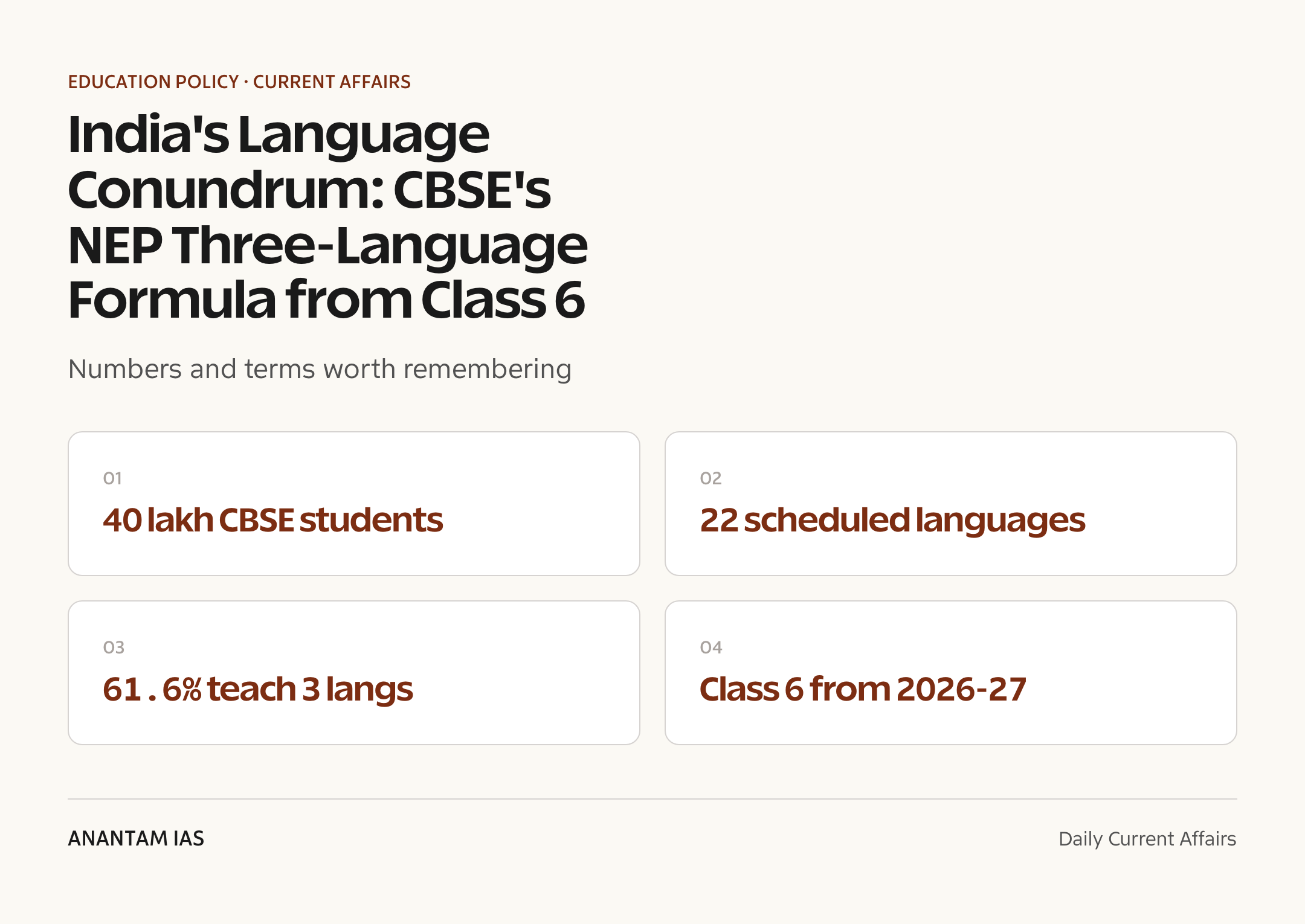
In April 2026, the Central Board of Secondary Education (CBSE) directed all affiliated schools, covering roughly 40 lakh students, to implement the NEP 2020 three-language formula from Class 6 in the 2026-27 session, with two of the three languages required to be native Indian tongues.
The hurried rollout, a mid-session May 15 circular extending the switch to Class 9, and a June 25 partial relaxation by the Education Minister have thrown CBSE schools into curriculum disruption, teacher displacement and a fresh centre-state language debate.
- CBSE counts English as a foreign language, so English-medium schools must add a second Indian language alongside Hindi or a regional tongue.
- Many schools dropped French and German as the third language, often defaulting to Sanskrit where regional-language teachers were unavailable.
- The May 15 circular forced Class 9 students to switch mid-session; parents moved the Supreme Court, which refused a stay.
- On June 25, Education Minister Dharmendra Pradhan relaxed the rule for existing Classes 7, 8 and 9 students, who may keep their foreign language but must still add a native Indian one.
- The framework applies prospectively from Class 6 in 2026-27 and extends to Class 10 by 2030-31, effectively phasing foreign languages out of CBSE schools.
The development matters in the context of:
- Language policy sits at the intersection of federalism, education-as-a Concurrent-List subject, and the constitutional protection of linguistic minorities.
- The friction revives a six-decade tension traced to the Kothari Commission and Tamil Nadu’s long-standing resistance to a mandated third language.
UPSC Relevance
Prelims Relevance
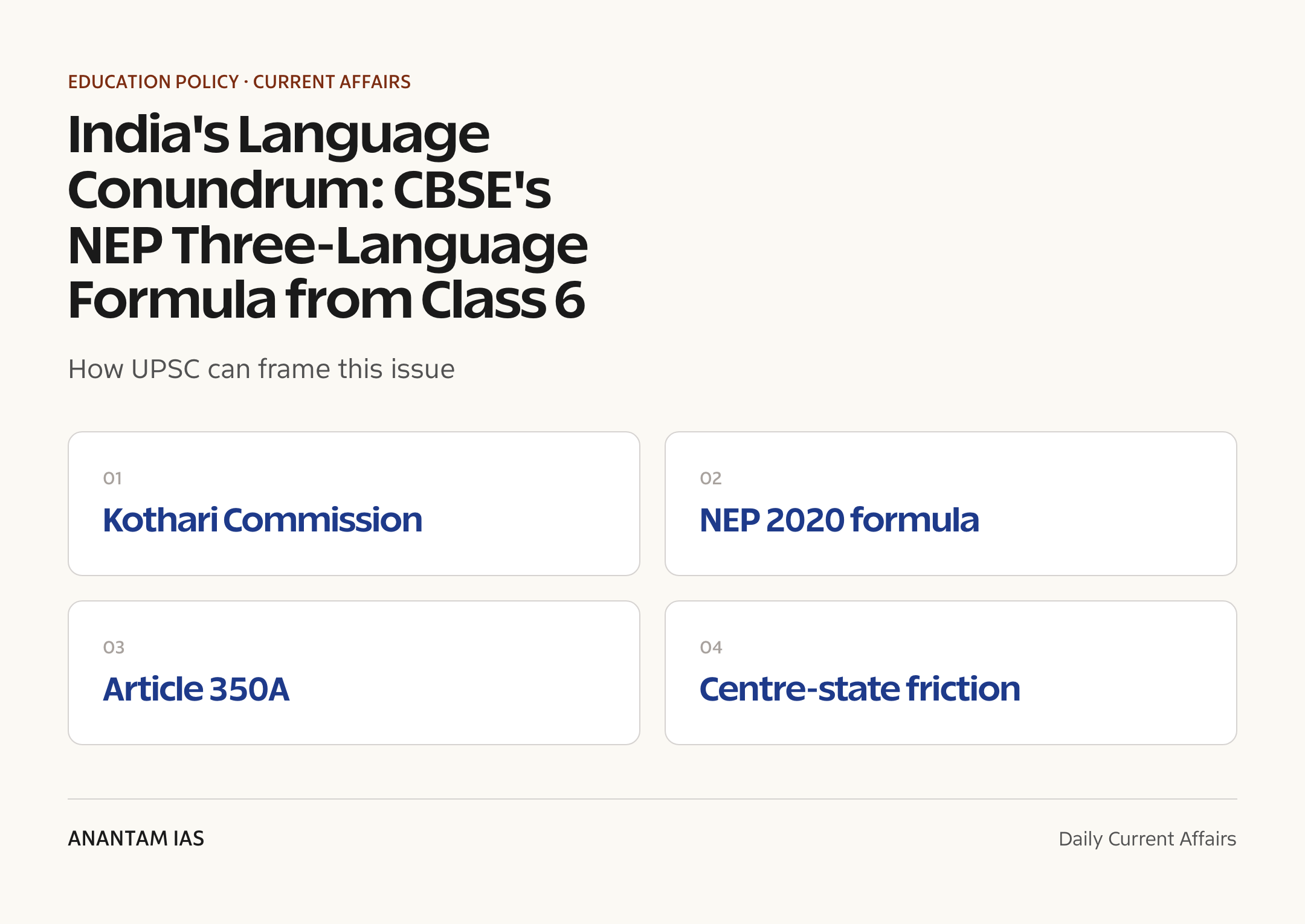
- Three-language formula: origin in the Kothari Commission (1964-66), formalised by the National Policy on Education 1968.
- NEP 2020 version: at least two of three languages native to India; greater flexibility, no language imposed on any State.
- Eighth Schedule of the Constitution lists 22 scheduled languages.
- Article 343-351 deal with official language; Hindi in Devanagari is the official language of the Union under Article 343.
- Article 350A — instruction in the mother tongue at the primary stage for linguistic minorities.
- Article 29 protects the right of any section to conserve its language, script or culture.
- UDISE 2023-24: 61.6% of schools teach three languages.
- Tamil Nadu follows a two-language formula (mother tongue + English); Tamil Nadu Tamil Learning Act, 2006.
- Education is on the Concurrent List (moved by the 42nd Amendment, 1976).
Mains Relevance
GS Paper 2
- Cooperative federalism and centre-state friction in education policy, a Concurrent-List subject.
- Government policies for the education sector and issues arising from their design and implementation.
GS Paper 1
- Salient features of Indian society: linguistic diversity, the role of language in national integration and regional identity.
Essay
- Unity in diversity: can a single language policy hold a multilingual nation together?
- The medium of the message: language, opportunity and social mobility.
Background and Context
What the three-language formula is
The formula is a decades-old device to balance a link language, the mother tongue and a wider Indian language.
- It originated with the Kothari Commission (1964-66) and was formalised by the National Policy on Education, 1968.
- The 1968 formula prescribed Hindi, English and a modern Indian language (preferably a southern one) in Hindi-speaking States, and Hindi, English and the regional language elsewhere.
- NEP 2020 reframed it: students learn three languages, of which at least two must be native to India, with the choice left to States, regions and students.
- NEP 2020 claims no language will be imposed on any State, positioning the formula as flexible rather than a Hindi mandate.
- The stated aims are multilingual competence, cognitive benefits of early language learning, and stronger national integration across a linguistically plural country.
- In practice the formula has always carried political weight, because the choice of a third language signals identity, mobility and the reach of Hindi.
The CBSE rollout and the chaos it caused
A rushed directive, a mid-session tightening, and a partial rollback left schools improvising.
- CBSE’s April 2026 directive told all affiliated schools to run the formula from Class 6, treating English as a foreign language.
- English-medium schools that offered French or German as the third language issued circulars in May discontinuing them.
- With regional-language teachers scarce, most schools defaulted to Sanskrit, calling other Indian languages ‘not logistically viable’.
- The May 15 circular extended the rule to Class 9 mid-session; parents challenged it in the Supreme Court, which declined to stay it.
- On June 25, Minister Dharmendra Pradhan relaxed the switch for existing Classes 7, 8 and 9 — they keep the foreign language but still add a native Indian one.
- The relaxation is transitional only: fresh Class 6 entrants get no exemption, so foreign languages will be squeezed out as the cohort moves up.
- Parents and teachers criticised the repeated reversals as ad-hoc governance, with children asked to abandon chapters already completed in April.
Teacher shortage and displacement
The binding constraint is not policy intent but the supply of qualified language teachers.
- Schools in Mangaluru, Gurugram and elsewhere let go of French teachers or reassigned them to other subjects.
- A Karnataka school dropped Konkani because no qualified teacher could be found, offering only English, Hindi, Kannada and Sanskrit.
- In Uttar Pradesh, State Board data showed just 17 Kannada, 10 Tamil and 133 Telugu registrations in 2025-26, forcing students to sit as private candidates.
- About 4.5 lakh students study French and 1.5 lakh study German in Indian schools; roughly 11,000 take the DELF French exams each year.
- The French and German embassies, which fund teaching infrastructure worth millions of euros, pushed back through diplomatic channels.
- In Puducherry, where French enjoys constitutional recognition, dropping French from the 2026-27 curriculum threatened the livelihoods of French teachers.
- Certified qualifications such as the DELF and DALF, issued by the French Ministry of Education, are valued for study and work abroad and are now at risk of losing their school pipeline.
Constitutional and federal frame
Language sits inside a dense web of constitutional guarantees and a shared centre-state mandate.
- The Eighth Schedule recognises 22 languages; Articles 343-351 govern the Union’s official language.
- Article 350A directs States to provide primary-stage instruction in the mother tongue for linguistic-minority children.
- Article 29 protects any group’s right to conserve its language, script and culture.
- Education moved to the Concurrent List via the 42nd Amendment (1976), making language policy a joint centre-state responsibility.
- CBSE’s classification of English as ‘foreign’ jars with English being an associate official language used across administration, higher courts and inter-State communication.
- Because education is shared between the Centre and States, a CBSE circular that overrides State language choices raises questions of cooperative federalism.
- The official Languages Act, 1963 continued English alongside Hindi for Union purposes, underlining that English is woven into India’s public life.
State-level friction and Tamil Nadu's stance
Implementation varies sharply by State, and some have opposed the formula outright.
- Tamil Nadu has rejected a mandated third language since the pre-Independence era and follows a two-language formula — mother tongue and English, not merely Tamil and English.
- The Tamil Nadu Tamil Learning Act, 2006 exempts minority-language schools, such as Urdu-medium ones, from compulsory Tamil.
- Kerala, generally supportive, faces uncertainty as elite schools lose the option to offer French, German or Arabic in place of Hindi or Malayalam.
- Nagaland, with over 30 linguistic backgrounds in its classrooms, resists the formula and finds Sanskrit an unhelpful default for children.
- Telangana sees the CBSE directive as leverage to fully enforce its Compulsory Teaching of Telugu Act, 2018.
Why the debate endures
The conundrum is structural: identity, opportunity and administrative capacity pull in different directions.
- UDISE 2023-24 shows only 61.6% of schools teach three languages, exposing a wide implementation gap.
- Parents value foreign languages for higher-education and migration pathways to Germany and French-speaking countries.
- The last national survey of school language preferences was an NCERT 2009 study, leaving policy to run on stale data.
- The Centre’s move sits awkwardly beside its own push for an Indo-German higher-education roadmap and skilled-migration ties with Europe.
- Elite and low-fee schools face the same rule differently: well-resourced schools can hire Sanskrit or regional teachers, while smaller schools simply drop options.
- The underlying tension is that a genuinely flexible formula demands administrative capacity that most States and boards do not yet possess.
Way Forward
Fix the teacher pipeline first
- Sequence any mandate to the supply of trained language teachers and vernacular learning material, rather than the reverse.
- Fund shared regional-language teacher pools and digital instruction for low-enrolment languages like Kannada or Tamil in Hindi-belt States.
Respect genuine flexibility
- Honour NEP 2020’s own promise that no language is imposed, letting States and students choose within the two-native-languages rule.
- Keep space for foreign languages as an additional option so higher-education and migration aspirations are not foreclosed.
Consult and evidence
- Route curriculum changes through State governments and school boards before mid-session directives, honouring the Concurrent-List spirit.
- Commission a fresh national survey of school language preferences to replace the 2009 NCERT baseline.
Conclusion
India’s language conundrum is less about which tongue and more about how policy is made: hurried CBSE circulars, mid-session switches and reactive relaxations have converted a reasonable multilingual aim into avoidable disruption for 40 lakh children.
The durable lesson is that a multilingual federation needs its language policy built on teacher capacity, State consultation and honest flexibility. Get the sequencing right, and the three-language formula can widen horizons rather than shrink choices.
UPSC Practice Questions
Prelims MCQ 1
With reference to the three-language formula in India, consider the following statements:
- It was first recommended by the Kothari Commission and formalised in the National Policy on Education, 1968.
- Under NEP 2020, at least two of the three languages must be native to India.
- Education is a subject exclusively on the Union List of the Constitution.
How many of the above statements are correct?
(a) Only one (b) Only two (c) All three (d) None
Answer: (b) Only two
Explanation:
Statements 1 and 2 are correct. Statement 3 is wrong: education is on the Concurrent List, moved there by the 42nd Amendment, 1976.
Prelims MCQ 2
Which Article of the Constitution provides for instruction in the mother tongue at the primary stage for children of linguistic minority groups?
(a) Article 29 (b) Article 343 (c) Article 350A (d) Article 351
Answer: (c) Article 350A
Explanation:
Article 350A directs every State to provide adequate facilities for mother-tongue instruction at the primary stage to linguistic-minority children. Article 343 concerns the Union’s official language; Article 351 concerns the development of Hindi.
UPSC Mains Questions
- The three-language formula was designed to promote national integration but has repeatedly become a site of centre-state friction. Examine the constitutional and federal dimensions of language policy in school education in India. (250 words)
- “A language policy is only as good as the teachers who can deliver it.” In the light of the recent CBSE rollout of the NEP 2020 three-language formula, discuss the implementation challenges and suggest a way forward. (250 words)
- Discuss how India’s linguistic diversity shapes both national unity and regional identity, with reference to constitutional safeguards for languages. (150 words)
Sources: The Hindu, Education and Ministry of Education, NEP 2020.
Frequently Asked Questions
What is the three-language formula?
It is a school-education policy, first recommended by the Kothari Commission and formalised in the 1968 National Policy on Education, under which students learn three languages. NEP 2020 recast it to require that at least two of the three be native to India, while promising that no specific language would be imposed on any State.
What did CBSE direct in 2026?
In April 2026, CBSE told affiliated schools, covering about 40 lakh students, to implement the NEP 2020 three-language formula from Class 6, with two of three languages native to India. A May 15 circular extended it to Class 9 mid-session, and a June 25 clarification relaxed the switch for existing Classes 7 to 9 students.
Why is English treated as a foreign language?
CBSE classifies English as a foreign language for the purpose of the two-native-languages rule. So an English-medium school must offer two Indian languages in addition to English, which is why many schools dropped French or German and added Sanskrit or a regional language as the third language.
Why does Tamil Nadu oppose it?
Tamil Nadu has resisted a mandated third language since before Independence, seeing it as an attempt to introduce Hindi. It follows a two-language formula of the mother tongue and English. Its position hardened around the 1968 draft and continues today, with the State insisting students learn only two languages.
Which constitutional provisions relate to language?
The Eighth Schedule recognises 22 languages. Articles 343 to 351 govern the Union’s official language, with Hindi in Devanagari as the Union’s official language. Article 350A provides for mother-tongue instruction at the primary stage, and Article 29 protects the right to conserve one’s language and script.
What are the main implementation problems?
The biggest hurdles are a shortage of trained language teachers and a lack of learning material in regional languages, forcing many schools to default to Sanskrit. Foreign-language teachers face displacement, State practice varies widely, and policy is being made on a language-preference baseline last surveyed by NCERT in 2009.
Tell Google you want more of this.
Add Anantam IAS as a preferred sourceOne tap, and this site shows up more often in your own Top Stories, AI Overviews and AI Mode. Remove it any time.






