Why in News?
Job portal Naukri’s monthly JobSpeak report, released on 4 July 2026, showed that hiring for artificial-intelligence roles within India’s IT sector rose even as overall IT recruitment shrank, pointing to a structural reorientation of the country’s white-collar labour market.
The Hindu reported that AI hiring climbed 16% year-on-year in June while overall IT jobs declined 3%, based on job listings collated from more than 150,000 firms on Naukri’s platform. Overall white-collar hiring still grew 6% for the month, led by AI roles and insurance.
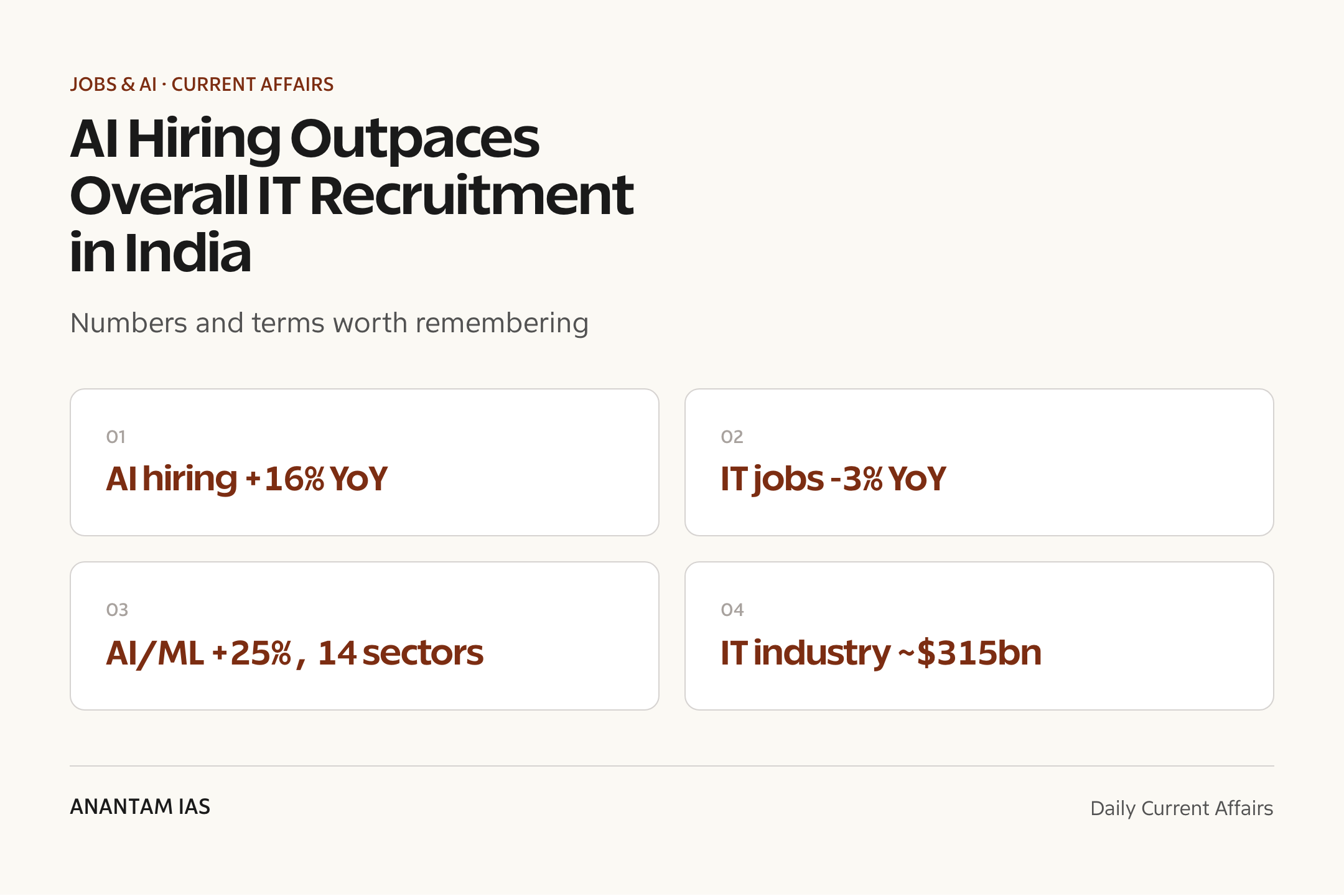
- AI hiring in India’s IT sector rose 16% year-on-year in June 2026.
- Overall IT recruitment in the same industry fell 3% over the year.
- Across 14 sectors, AI and machine-learning jobs increased 25%.
- Insurance led sectoral growth at 16%, followed by FMCG (7%), telecom (6%) and real estate (5%).
- Aggregate white-collar hiring rose 6%, drawn from listings by over 150,000 firms on the Naukri JobSpeak index.
The development matters in the context of:
- The divergence signals that tech firms are still investing, but only in specialised, senior AI talent, not broad-based hiring.
- It sharpens the debate on automation-led jobless growth in India’s flagship services-export sector.
UPSC Relevance
Prelims Relevance
- Naukri JobSpeak — a private monthly hiring index run by Info Edge; tracks white-collar job listings, not government data.
- Info Edge owns Naukri; its CEO is Hitesh Oberoi.
- India’s IT industry is valued at roughly $315 billion.
- Periodic Labour Force Survey (PLFS) — the official MoSPI survey measuring employment and unemployment.
- IndiaAI Mission — approved 2024 to build compute, datasets, skilling and safe-AI capacity.
- FutureSkills Prime — a MeitY-Nasscom digital-skilling platform for emerging tech.
- Demographic dividend — the growth window from a large working-age population.
- WEF Future of Jobs Report 2025 — projects a net 78 million new jobs globally by 2030.
- Distinguish frictional, structural and technological unemployment.
Mains Relevance
GS Paper 3
- Effects of automation and AI on employment, growth and the services sector.
- India’s IT industry under pressure from weak global demand and AI disruption.
GS Paper 2
- Government skilling and AI-capacity interventions (IndiaAI Mission, FutureSkills Prime) and their adequacy.
Essay
- Technology should serve people, not the other way round — automation and the future of work.
- A demographic dividend can turn into a demographic burden without reskilling.
Background and Context
What Naukri JobSpeak is and what it measures
The headline number comes from a private hiring index, not an official statistic, so its scope must be understood before its signal.
- JobSpeak is a monthly index published by Naukri (owned by Info Edge) that tracks the volume of new white-collar job listings on its portal, benchmarked against a base value.
- The June reading pooled postings from more than 150,000 firms, making it a fast, high-frequency read on hiring sentiment.
- As a platform-based index it captures formal, online-advertised jobs — it says little about informal, gig, agricultural or blue-collar work, which dominate India’s workforce.
- It measures hiring demand (listings), not people actually placed, and skews toward urban, English-medium, salaried roles.
- It is a leading indicator of demand, useful alongside official data such as the PLFS and company results rather than a substitute for them.
JobSpeak vs official employment data
A private index and a household survey answer different questions, and conflating them is a common analytical error.
- The Periodic Labour Force Survey (PLFS), run by MoSPI, is a large household survey giving the official unemployment rate, labour-force participation and worker-population ratios across formal and informal work.
- PLFS is representative of the whole labour market but released with a lag; JobSpeak is timely but narrow, covering only advertised white-collar demand.
- JobSpeak reports relative change in listings, not absolute headcount, so a high percentage can sit on a small base of jobs.
- For UPSC, the takeaway is triangulation — read high-frequency private indices alongside PLFS, EPFO payroll data and corporate results, never in isolation.
The divergence: AI up, IT down
The story is not that hiring rose or fell, but that the two moved in opposite directions.
- AI-role hiring in IT rose 16% year-on-year; overall IT hiring fell 3%.
- Info Edge CEO Hitesh Oberoi called the gap important because it shows where firms are still investing, with AI becoming a core capability area.
- Demand is shifting toward senior and specialised talent rather than volume hiring of freshers.
- Beyond IT, across 14 sectors AI and machine-learning roles grew 25% year-on-year.
- Insurance led sectoral hiring growth at 16%, ahead of FMCG (7%), telecom (6%) and real estate (5%), lifting the overall white-collar index 6%.
Why India's IT sector is under strain
The reorientation is happening against a difficult backdrop for the services-export engine.
- India’s $315 billion IT industry faces clients holding back technology spend amid a weak global macroeconomic environment.
- Generative AI threatens the traditional labour-arbitrage and code-and-maintain business model that built the sector.
- Tata Consultancy Services (TCS), the top exporter, expects IT firms to slow hiring and is moving toward parity between employees and AI agents.
- TCS announced cuts of around 12,000 roles in July 2025 as part of a restructuring for AI-led delivery.
- Its net headcount fell by more than 23,000 in the fiscal year ended March 2026, ending FY26 at about 584,500 employees.
Automation and the future of work
The data feeds a long-running debate about technology, productivity and jobs.
- Technological unemployment arises when automation displaces tasks faster than new roles are created.
- AI tends to hollow out routine mid-skill work while raising demand at the specialised, high-skill end — widening wage gaps.
- The concern of jobless growth: output and profits can rise while net employment stagnates or shifts to fewer, higher-paid roles.
- New task categories — prompt engineering, AI auditing, model-ops — emerge, but the transition costs fall hardest on entry-level and mid-career workers.
- The skill premium rises: those who can pair domain knowledge with AI tools gain, while narrowly routine profiles lose bargaining power.
The demographic-dividend stake
For India the shift is not abstract — it collides with a fast-growing young workforce.
- India adds millions of job-seekers a year and depends on its demographic dividend — a young median age and large working-age share — for growth.
- IT and IT-enabled services have long been a prime aspirational employer for engineering and general graduates.
- A slowdown in volume hiring of freshers narrows a key on-ramp into the formal, salaried economy.
- White-collar disruption is politically sensitive because it hits the educated middle class, not only low-skill labour.
- Without reskilling, a demographic dividend risks becoming a demographic burden of educated under-employment.
The policy and skilling response
Government programmes aim to move workers toward the skills the market now rewards.
- The IndiaAI Mission funds compute, datasets, safe-AI research and AI skilling to build domestic capability and reduce dependence on imported talent and models.
- FutureSkills Prime, a MeitY-Nasscom platform, offers reskilling and certification in AI, data science and emerging technologies.
- Skill India and the National Education Policy 2020 push vocational integration, multidisciplinary learning and continuous upskilling.
- Global Capability Centres (GCCs) in India are absorbing high-end AI, analytics and R&D roles, offering an alternative white-collar on-ramp.
- The core challenge is speed and scale — reskilling must keep pace with how fast AI is reshaping task demand.
The global AI-jobs context
India’s divergence mirrors a worldwide churn that international bodies are already quantifying.
- The WEF Future of Jobs Report 2025 projects 170 million new roles created and 92 million displaced globally by 2030 — a net gain of about 78 million.
- It estimates roughly 39% of core skills will change by 2030, with AI and big data the fastest-growing skill category.
- The pattern globally is churn, not simple destruction — jobs are reshaped and relocated across roles more than eliminated in aggregate.
- Countries that invest early in reskilling and AI infrastructure are better placed to capture the created jobs rather than absorb the displaced ones.
How to read the number carefully
A single private index deserves caution before it becomes a headline conclusion.
- A 3% dip is modest and reflects a reallocation within IT more than an outright collapse — aggregate white-collar hiring still rose 6%.
- Year-on-year AI growth starts from a small base, so high percentages can overstate absolute numbers.
- Platform indices skew to formal, urban, advertised roles and can miss the wider labour market.
- The signal to watch is durable direction and composition, cross-checked against PLFS, EPFO payroll data and company results.
Way Forward
Reskilling at scale
- Expand and simplify access to FutureSkills Prime and the IndiaAI Mission skilling tracks for both freshers and mid-career workers, with subsidised or free entry-level pathways.
- Tie industry certification to hiring so reskilled workers have credible on-ramps into AI-adjacent roles, and fund short, stackable credentials over long degrees.
Rethink the graduate pipeline
- Embed AI literacy, data fluency and applied problem-solving in engineering and general degrees under NEP 2020, moving beyond rote coding.
- Broaden employment beyond IT services into manufacturing, GCCs, deep-tech and the care economy to diversify where the demographic dividend lands.
Strengthen the data and safety net
- Pair private indices such as JobSpeak with timely official PLFS and EPFO releases, so policy responds to structural shifts in near real time rather than in hindsight.
- Build transition support — portable benefits, income cushions and career counselling — for workers whose routine roles are automated first.
Frame AI as a complement to labour in public policy: incentivise firms to redeploy and retrain displaced workers rather than simply cut headcount, so productivity gains widen opportunity instead of concentrating it.
Conclusion
The June JobSpeak reading captures a quiet but consequential shift: India’s IT engine is not simply hiring less, it is hiring differently — fewer generalists, more specialised AI talent. The 16% rise against a 3% dip, set within an overall 6% gain in white-collar hiring, is a signal of reallocation, not just contraction.
The divergence rhymes with the global picture the WEF has sketched — a churn that creates more jobs than it destroys, but only for economies that reskill fast enough to catch them. For India, banking on its demographic dividend, the task is to make sure workers can cross the bridge that automation is building.
That turns on reskilling delivered at scale and speed, a broader base of employment beyond IT services, and labour data timely enough to steer by. Handled well, AI expands opportunity for a young workforce; handled poorly, it narrows the on-ramp into the formal economy just as millions arrive at it.
UPSC Practice Questions
Prelims MCQ 1
With reference to the Naukri JobSpeak index, consider the following statements:
- It is an official employment survey conducted by the Ministry of Statistics.
- It is a monthly index based on job listings on a private recruitment platform.
- It primarily tracks formal, online-advertised white-collar hiring.
How many of the above statements are correct?
(a) Only one (b) Only two (c) All three (d) None
Answer: (b) Only two
Explanation:
JobSpeak is a private index run by Info Edge (Naukri), not an official MoSPI survey, so statement 1 is wrong. Statements 2 and 3 are correct — it tracks formal, advertised white-collar listings monthly.
Prelims MCQ 2
According to the June 2026 JobSpeak report, which of the following best describes the trend in India’s IT sector?
(a) Both AI hiring and overall IT hiring rose sharply (b) AI hiring rose while overall IT hiring declined (c) Both AI hiring and overall IT hiring declined (d) AI hiring declined while overall IT hiring rose
Answer: (b) AI hiring rose while overall IT hiring declined
Explanation:
AI hiring within IT rose 16% year-on-year in June while overall IT jobs declined 3%, indicating a reallocation of demand toward specialised AI talent.
UPSC Mains Questions
- The divergence between rising AI hiring and falling overall IT recruitment reflects a structural shift in India’s labour market. Examine the implications for employment and the country’s demographic dividend, and suggest measures to manage the transition.
- “Automation need not mean fewer jobs, but it does mean different jobs.” In the light of trends in India’s IT sector, discuss the role of reskilling and government initiatives such as the IndiaAI Mission in shaping the future of work.
Source: The Hindu (Technology).
Frequently Asked Questions
What is Naukri JobSpeak?
JobSpeak is a monthly hiring index published by Naukri, owned by Info Edge. It tracks the volume of new white-collar job listings on its platform, pooling postings from over 150,000 firms. It is a private, high-frequency read on hiring sentiment rather than an official government statistic like the PLFS.
What did the June 2026 report show?
It showed that AI-role hiring within India’s IT sector rose 16% year-on-year in June, while overall IT recruitment in the industry fell 3%. Across 14 sectors, AI and machine-learning jobs grew 25%, and overall white-collar hiring rose 6%, with insurance leading sectoral growth at 16%.
Why is AI hiring rising while IT hiring falls?
Firms are reorienting toward AI as a core capability and hiring specialised, senior talent, while trimming broad volume recruitment. A weak global economy and AI’s threat to the traditional labour-arbitrage model have squeezed the wider $315 billion IT industry, so investment is narrowing to AI-adjacent roles.
What does this mean for India’s demographic dividend?
IT services have long absorbed large numbers of graduates. A slowdown in volume hiring of freshers narrows a key on-ramp into the formal economy. Without large-scale reskilling, a young workforce risks educated under-employment, turning the demographic dividend into a burden.
Which government schemes address AI skilling?
The IndiaAI Mission funds compute, datasets, safe-AI research and AI skilling. FutureSkills Prime, a MeitY-Nasscom platform, offers reskilling in AI and data. Skill India and NEP 2020 push vocational integration and continuous learning to align workers with emerging demand.
Should a single private index be treated as conclusive?
No. A 3% dip is modest and reflects reallocation within IT more than collapse, and AI growth starts from a small base, so percentages can overstate absolute numbers. Platform indices skew to formal, advertised, urban roles, so the trend should be cross-checked against PLFS and company results.
Tell Google you want more of this.
Add Anantam IAS as a preferred sourceOne tap, and this site shows up more often in your own Top Stories, AI Overviews and AI Mode. Remove it any time.