Daily Digest
UPSC · Civil Services Examination
Current Affairs · Wednesday, 5 August 2026
Current affairs curated and edited by Anantam IAS faculty — pulled from The Hindu, PIB, IDSA, Foreign Affairs and the ministries. Read, annotate, revise.
Old Rajinder Nagar · Delhi 110005 · anantamias.com
BRICS Summit in New Delhi: India’s 2026 Chairship Agenda
Why in News?
India’s 2026 chairship of BRICS is moving toward the 18th BRICS Summit planned in New Delhi in September.
- India assumed the BRICS chairship on 1 January 2026.
- The 18th BRICS Summit is planned for New Delhi in September 2026.
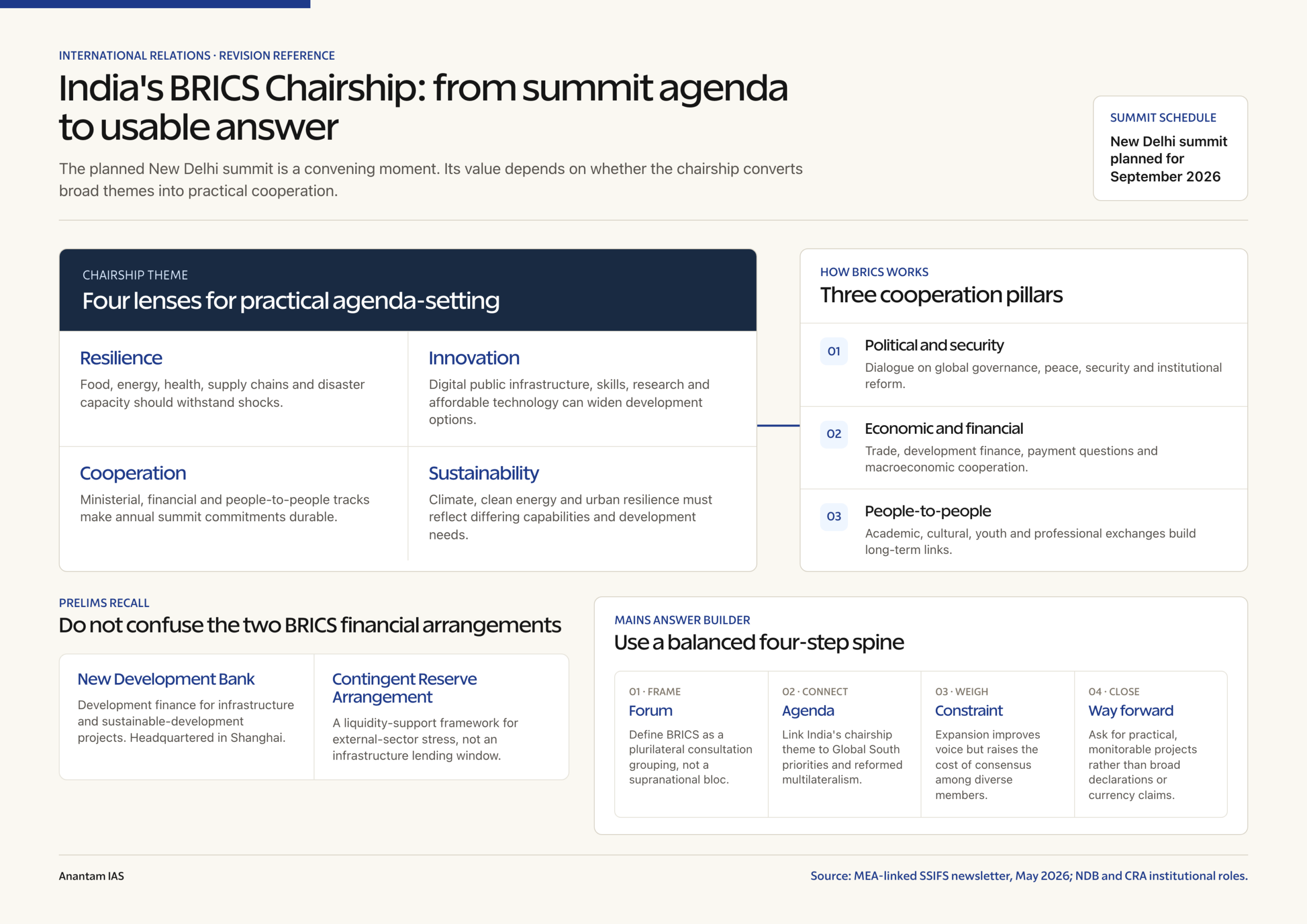
- The official training programme describes three continuing cooperation pillars: political and security, economic and financial, and cultural and people-to-people cooperation.
- The BRICS Young Diplomats Forum held in May 2026 brought diplomats from Brazil, China, Egypt, Ethiopia, India, Indonesia, Iran, Russia and South Africa into the chairship process.
- The immediate exam task is to distinguish a summit agenda and chairship priority from a binding treaty, a formal international organisation, or a common-currency announcement.
- It tests how India can use a plurilateral forum to argue for reformed multilateralism while retaining strategic autonomy.
- It connects summit diplomacy with the practical institutions and ministerial tracks that make cooperation durable between annual leaders’ meetings.
- It offers an answer-building case on whether wider representation can improve the legitimacy of global economic and political governance.
UPSC Relevance
Prelims Relevance
- BRICS began as BRIC and became BRICS after South Africa joined the grouping in 2010.
- BRICS is a plurilateral grouping; it is not created by a constituent treaty comparable to the UN Charter.
- The grouping’s cooperation is commonly organised around political and security, economic and financial, and people-to-people pillars.
- The New Development Bank was established by BRICS countries in 2014 and is headquartered in Shanghai.
- The Contingent Reserve Arrangement is a liquidity-support arrangement, not a development-lending institution.
- India’s BRICS chairship in this cycle began on 1 January 2026.
Mains Relevance
GS Paper 2
- Assess BRICS as an instrument for India’s reformed multilateralism and Global South engagement.
- Analyse how a larger forum can widen representation while making consensus-building more difficult.
GS Paper 3
- Use the New Development Bank and the Contingent Reserve Arrangement to explain alternative sources of development finance and financial safety nets.
- Discuss the limits of financial cooperation where members have unequal economic structures, sanctions exposure, and different currency preferences.
Essay
- A stable international order needs both representation and the capacity to convert common principles into implementable cooperation.
Background and Context
What BRICS Is and What It Is Not
BRICS is best understood as a flexible political and economic consultation forum among major emerging economies. Its value lies in agenda-setting, regular ministerial and technical tracks, and institution-building.
- The original BRIC formulation referred to Brazil, Russia, India and China. South Africa joined in 2010, after which the grouping used the name BRICS.
- Leaders’ summits provide political direction, but much of the substantive work occurs through foreign ministers, finance officials, sectoral ministers, working groups, business forums and academic or civil-society exchanges.
- BRICS has no parliament, no directly enforceable legal code, and no permanent secretariat with powers comparable to those of the European Commission. Its outputs depend heavily on consensus and follow-through by member governments.
- A declaration, a ministerial communique, an institutional arrangement, and a domestic policy announcement are different instruments. A good answer should not treat each summit phrase as an automatically enforceable obligation.
- The grouping has expanded its external reach through outreach formats and institutional links. Enlargement can strengthen voice and reach, but it also enlarges the range of interests that must be accommodated.
India's 2026 Chairship and the Summit Agenda
A chairship gives the host an opportunity to convene, sequence meetings, frame priorities, and seek practical deliverables. It does not give the chair unilateral authority to define BRICS.
- The official chairship theme, Building Resilience, Innovation, Cooperation and Sustainability, offers a four-part frame rather than a pre-negotiated summit outcome.
- Resilience can include supply-chain reliability, disaster preparedness, food and energy security, public-health capacity, and the capacity of institutions to manage shocks.
- Innovation can cover digital public infrastructure, science cooperation, skills, research networks, responsible use of emerging technologies, and the diffusion of affordable solutions across developing economies.
- Cooperation must be read across the grouping’s three pillars. It includes political dialogue, economic and financial coordination, and people-to-people exchanges such as academic, cultural, youth, and professional networks.
- Sustainability can connect development finance, climate action, clean-energy transitions, urban resilience, and the principle that climate responsibilities reflect differing capabilities and development needs.
Institutions and Economic Cooperation
BRICS is often associated with debates on currencies and finance, but its most concrete institutional achievements are better assessed through the mandates of the New Development Bank and.
- The New Development Bank, established in 2014 and headquartered in Shanghai, finances infrastructure and sustainable-development projects. It is distinct from the World Bank and is not a replacement for all multilateral development banks.
- The Contingent Reserve Arrangement is designed as a liquidity-support framework for balance-of-payments pressures. It is not a normal project-finance window and should not be confused with the NDB.
- Debate on the greater use of local currencies should be separated from claims of an agreed common BRICS currency. Settlement arrangements, payment connectivity, reserve-currency choices, and a shared currency involve different degrees of policy coordination.
- For developing countries, a wider menu of finance and payment options can improve resilience. The gain depends on project quality, debt sustainability, transparent procurement, and the ability to manage exchange-rate and sanctions-related risks.
- An exam answer should recognise both the attraction of diversified finance and the operational limits created by unequal economic sizes, divergent monetary policies, and geopolitical tensions among members.
Expansion, Representation and the Global South
BRICS expansion has made the forum more representative of regions and development experiences that were under-represented in earlier global-governance arrangements. Representation alone, however, does not create a common.
- The May 2026 BRICS Young Diplomats Forum involved Brazil, China, Egypt, Ethiopia, India, Indonesia, Iran, Russia and South Africa, illustrating the wider diplomatic canvas within which India is preparing the summit.
- More participating states can deepen South-South exchanges on development, technology, trade, health, food systems, and climate adaptation. It can also create more channels for raising concerns about reform of the UN Security Council and international financial.
- A larger membership makes agenda management harder. Members differ on regional conflicts, relations with Western economies, energy choices, trade interests, and the pace or form of institutional reform.
- India’s useful position is not to reduce BRICS to an anti-West bloc. It can argue for a multipolar and rules-based order in which developing countries gain agency while dialogue with all major powers remains possible.
- The quality test for any summit outcome is practical follow-up: clear institutional ownership, capacity-building, finance where needed, and measurable cooperation rather than only broad political language.
Way Forward
Keep Deliverables Practical
- Prioritise projects where members have a clear shared interest, such as disaster-resilient infrastructure, affordable health technologies, skilling, food-security research, and clean-energy finance.
- Set timelines, lead institutions, and review mechanisms for feasible initiatives instead of relying on expansive but untracked declarations.
- Use the New Development Bank’s development mandate carefully, with attention to environmental safeguards, debt sustainability, and public value.
Conclusion
- The planned New Delhi summit is a chance to judge BRICS by what it can implement, not by the scale of the claims made around it.
- For UPSC answers, begin with BRICS as a plurilateral forum, identify its three cooperation pillars and financial institutions, then weigh the promise of wider representation against the challenge of consensus among diverse members.
UPSC Practice Questions
Prelims MCQ 1
With reference to BRICS, consider the following statements:
- The New Development Bank is headquartered in Shanghai.
- The Contingent Reserve Arrangement is primarily a project-finance institution for infrastructure.
- South Africa joined the original BRIC grouping in 2010.
How many of the above statements are correct?
(a) Only one (b) Only two (c) All three (d) None
Answer: (b) Only two
Explanation:
Statements 1 and 3 are correct. The Contingent Reserve Arrangement is a liquidity-support framework, whereas the New Development Bank is the BRICS development-finance institution.
Prelims MCQ 2
Which one of the following correctly distinguishes the two BRICS financial arrangements?
(a) The NDB manages elections while the CRA conducts trade negotiations (b) The NDB provides development finance while the CRA is a liquidity-support arrangement (c) The NDB is a UN agency while the CRA is a WTO body (d) The NDB is a common currency while the CRA is a customs union
Answer: (b) The NDB provides development finance while the CRA is a liquidity-support arrangement
Explanation:
The New Development Bank finances infrastructure and sustainable-development projects. The Contingent Reserve Arrangement is intended to provide a liquidity-support framework during external-sector stress.
UPSC Mains Questions
- India’s BRICS chairship can advance the cause of reformed multilateralism, but enlargement also raises the cost of consensus. Discuss.
- How do the New Development Bank and the Contingent Reserve Arrangement expand the policy options of emerging economies? Examine their potential and limitations.
Sources: MEA, Sushma Swaraj Institute of Foreign Service and The Hindu Explained.
Frequently Asked Questions
What is BRICS?
BRICS is a plurilateral forum of major emerging economies that coordinates through leaders’ summits, ministerial meetings and sectoral tracks. It is not a supranational organisation with a common legislature or enforceable legal code. Its influence comes from political consultation, agenda-setting.
When will the 18th BRICS Summit be held?
An MEA-linked Sushma Swaraj Institute of Foreign Service newsletter states that the 18th BRICS Summit is planned in New Delhi in September 2026. A planned summit date should be treated as the current official schedule, not as evidence that any.
What is India’s BRICS chairship theme for 2026?
India’s 2026 chairship theme is Building Resilience, Innovation, Cooperation and Sustainability. The theme is a framework for meetings and possible deliverables. It can be read through economic and financial cooperation, political and security dialogue, and cultural and people-to-people exchanges.
What is the difference between the NDB and the CRA?
The New Development Bank is a development-finance institution that supports infrastructure and sustainable-development projects. The Contingent Reserve Arrangement is a liquidity-support framework intended to help members facing external-sector or balance-of-payments pressures. They serve different purposes and should not be used.
Does BRICS have a common currency?
No common BRICS currency should be presumed from discussions about local-currency settlement or payment cooperation. Local-currency use, payment connectivity, reserve diversification and a shared currency are distinct policy choices. Each would require different levels of institutional, monetary and political coordination.
Source: https://anantamias.com/current-affairs/brics-summit-new-delhi-2026-india-chairship/
E20 Petrol: India’s Ethanol-Blending Policy and the Debate Ahead
Why in News?
The Union government stated in July 2026 that India has achieved average 20% ethanol blending in petrol in Ethanol Supply Year 2025-26, five years ahead of the earlier target.
- Average ethanol blending rose from about 12% in 2022-23 to about 14.6% in 2023-24, 19.2% in 2024-25 and 20% during November-June of 2025-26.
- The Ministry says E85 has been introduced only for certified Flex Fuel Vehicles and does not raise the nationwide base blending level above E20.
- Any proposal for blends above E20 is to follow detailed scientific and technical studies with automobile manufacturers, oil marketing companies and research institutions.
- The EBP Programme is linked to energy security, lower crude-oil use, emissions reduction and additional income opportunities in the farm economy.
- For UPSC, distinguish a nationwide E20 petrol specification from an E85 fuel meant for a vehicle designed and certified for that fuel.
- The issue connects biofuel policy with crude-oil import dependence, agricultural markets, water management, air quality and consumer protection.
- It is a useful case for judging a transition through lifecycle safeguards and institutional capacity, not only through a single blending percentage.
- A balanced answer can assess the gains from domestic renewable fuel while examining distributional and ecological trade-offs.
UPSC Relevance
Prelims Relevance
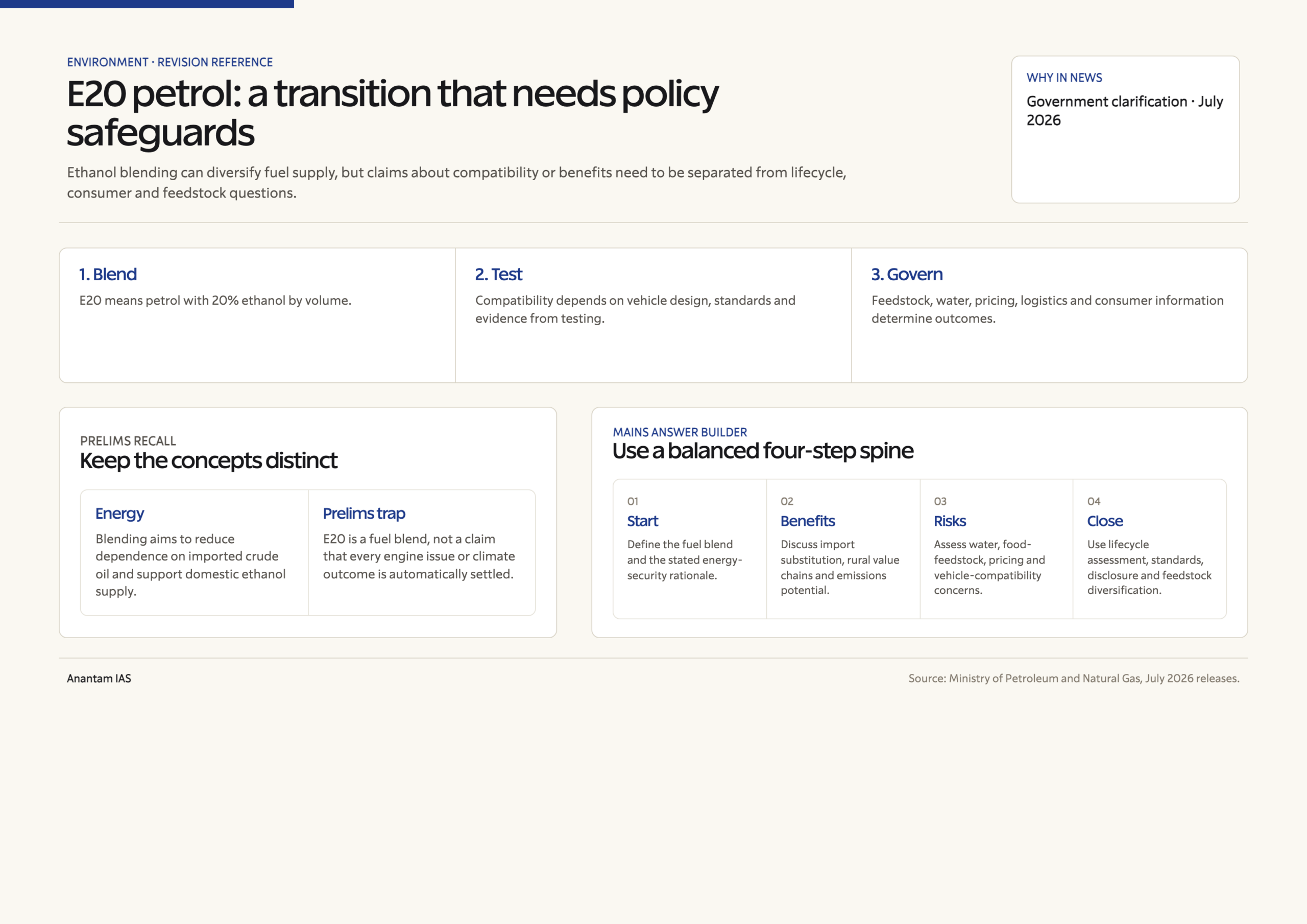
- E20 denotes petrol containing 20% ethanol and 80% petrol by volume.
- E85 is intended for Flex Fuel Vehicles designed and certified to run on that blend; it is not the general nationwide petrol standard.
- The Ethanol Blended Petrol Programme is administered in the energy-policy space and draws on coordination among oil marketing companies, automobile makers and technical institutions.
- A higher octane rating and a lower energy content are separate fuel properties; neither alone settles real-world mileage or compatibility questions.
- Feedstock and sustainability questions remain relevant because biofuel outcomes depend on procurement rules, land and water conditions, and food-security safeguards.
- The government has said no decision has yet been taken to increase the base national blend beyond E20.
Mains Relevance
GS Paper 3
- Examine ethanol blending as an energy-security measure that can reduce exposure to imported crude oil and external price shocks.
- Evaluate the trade-offs among farm incomes, feedstock diversification, water use, food security and lifecycle environmental outcomes.
GS Paper 2
- Use the programme to explain cooperative implementation involving Union ministries, oil marketing companies, research bodies, manufacturers and state-level agricultural systems.
- Assess the role of evidence-based regulation and accountable public grievance mechanisms in a mass consumer transition.
Essay
- A transition becomes durable when its benefits are measurable and its costs are openly governed.
Background and Context
What E20 Means
E20 is petrol blended with 20% ethanol. Ethanol is an alcohol fuel that can be produced through industrial processing of permitted agricultural feedstocks, and the Ethanol Blended Petrol.
- The blending percentage is a fuel specification. It should not be confused with the share of all transport energy supplied by ethanol, nor with a mandate for every vehicle to use any higher blend.
- The Ministry reported average blending of about 12% in 2022-23, 14.6% in 2023-24, 19.2% in 2024-25 and 20% in November-June of 2025-26.
- E15-plus fuel had already been in widespread use for over three-and-a-half years and E19-E20 for over two-and-a-half years when the July 2026 clarification was issued.
- E85 contains 85% ethanol and 15% petrol. The government says it is restricted to Flex Fuel Vehicles designed and certified for E85, so it is not evidence of a nationwide move beyond.
- The relevant policy question is not whether ethanol is simply good or bad. It is whether the chosen blend, feedstock, vehicle standard and delivery system are appropriate for the public purpose claimed.
Why India Promotes Ethanol Blending
India imports a large share of the crude oil it consumes. Replacing part of petrol with domestically produced ethanol can diversify the fuel basket, reduce exposure to external.
- The July 2026 policy note reports more than ₹1.97 lakh crore in foreign-exchange savings, nearly 316 lakh metric tonnes of crude oil substituted, around 952 lakh metric tonnes of carbon-dioxide emissions reduced and more than.
- These are programme-level government estimates and should be read as indicators of the policy’s stated national gains, not as a substitute for transparent lifecycle assessment across feedstocks and regions.
- Ethanol can have a high octane number. The Ministry cites cleaner combustion and anti-knock characteristics as part of the technical rationale for E20 in vehicles using the prescribed fuel specifications.
- The programme can support diversification of farm-linked demand, but farmer benefit depends on procurement design, timely payments, price signals and the availability of feedstocks that do not undermine local food or water security.
- Import substitution is useful for energy security, yet it cannot remove the need for fuel efficiency, public transport, electrification, better urban design and a broader clean-energy transition.
Vehicle Compatibility and Consumer Protection
A fuel transition reaches households through vehicles, retail pumps, warranties and repair systems. Technical validation and clear public communication are as important as the aggregate blending target.
- The Ministry says E20 was evaluated through a phased process involving NITI Aayog, oil marketing companies, the Automotive Research Association of India, the Society of Indian Automobile Manufacturers, the Indian Institute of Petroleum and manufacturers.
- It reports no verified evidence of widespread engine failure attributable to ethanol blending across more than 20 crore two-wheelers and over 3 crore petrol cars operating on E15-plus or E19-E20 fuel.
- For certain vehicles designed for E10, the government cites a generally limited fuel-economy reduction of about 3-5%, while stressing that driving conditions, maintenance and driving habits also affect mileage.
- This does not eliminate the need for consumers to follow manufacturer guidance. Fuel labels, vehicle manuals, warranty communication, complaint channels and accessible repair information reduce avoidable uncertainty.
- The Ministry says public-sector oil marketing companies maintain grievance channels at retail outlets, through customer care, websites, mobile applications, social media, email and CPGRAMS. A credible transition requires that these channels resolve documented cases promptly.
The Sustainability Test
Biofuel policy is environmentally useful only when it is judged across the whole chain: feedstock production, land and water use, processing energy, transport, blending and the alternatives displaced.
- The policy note says a plant uses about 3-5 litres of processed water per litre of ethanol and refers to zero-liquid-discharge systems in modern distilleries. Plant water use is not the same as the full agricultural.
- Food-security safeguards are central when food grains are part of the supply chain. The note says diversion of surplus rice is subject to permission after national food-security requirements are considered.
- Feedstock choices must respond to local agro-climatic conditions. A procurement strategy that ignores groundwater stress or monoculture risks can shift environmental costs from oil imports to rural landscapes.
- Lifecycle emissions depend on how feedstocks are cultivated and processed. Energy used in distilleries, residue management and transport logistics matter alongside tailpipe performance.
- The next phase should be assessed through verifiable safeguards: feedstock traceability, regional water accounting, transparent emissions methods, efficient distilleries and regular public reporting rather than broad claims alone.
Way Forward
Measure the Whole Transition
- Publish regular, feedstock-wise and region-wise data on water conditions, procurement, lifecycle emissions, distillery energy use and grievance resolution.
- Use transparent sustainability criteria so that energy security does not produce avoidable pressure on food systems, groundwater or local ecosystems.
- Treat higher blends as a separate regulatory decision, supported by fresh testing and phased deployment rather than automatic extrapolation from E20.
Conclusion
- India’s achievement of E20 blending is a significant energy-policy milestone, but it is not a reason to stop asking hard questions.
- For UPSC, frame the debate as a governed transition: explain E20 and E85, state the energy-security rationale, then test the policy against vehicle compatibility, consumer protection, food and water safeguards and credible lifecycle evidence.
UPSC Practice Questions
Prelims MCQ 1
With reference to ethanol-blended petrol in India, consider the following statements:
- E20 contains 20% ethanol by volume.
- E85 is the nationwide base petrol standard for all vehicles in India.
- The Government has stated that a move beyond E20 would require detailed studies and consultations.
How many of the above statements are correct?
(a) Only one (b) Only two (c) All three (d) None
Answer: (b) Only two
Explanation:
Statements 1 and 3 are correct. E85 has been introduced for Flex Fuel Vehicles designed and certified for it; it is not the nationwide base petrol standard.
Prelims MCQ 2
Which one of the following is the most appropriate policy distinction between E20 and E85?
(a) E20 is a vehicle class and E85 is an agricultural input (b) E20 is a petrol blend while E85 is intended for certified Flex Fuel Vehicles (c) E20 is a crude-oil grade and E85 is a refinery tax (d) E20 is a subsidy scheme and E85 is a carbon market
Answer: (b) E20 is a petrol blend while E85 is intended for certified Flex Fuel Vehicles
Explanation:
E20 denotes petrol containing 20% ethanol. The government says E85 is exclusively for Flex Fuel Vehicles designed and certified to use it.
UPSC Mains Questions
- Ethanol blending can advance India’s energy security, but its sustainability depends on how feedstock, water, food security and consumers are governed. Discuss.
- Why should the move from E20 to any higher nationwide ethanol blend be treated as a fresh policy decision? Examine.
Sources: Ministry of Petroleum and Natural Gas, PIB and Ministry of Petroleum and Natural Gas, Ethanol Blending in India policy note.
Frequently Asked Questions
What is E20 petrol?
E20 is petrol blended with 20% ethanol by volume. It is the nationwide base blend discussed in the government’s July 2026 clarification. It is different from a higher-blend fuel designed for a particular vehicle category.
Has India decided to increase ethanol blending beyond E20?
No. The Ministry of Petroleum and Natural Gas said in July 2026 that no decision had been taken to increase the nationwide base blend beyond 20%. It said any future move would follow scientific and technical studies and consultation with.
What is the difference between E20 and E85?
E20 contains 20% ethanol. E85 contains 85% ethanol and is meant for Flex Fuel Vehicles designed and certified for that fuel. E85 availability for such vehicles does not mean that it is the standard fuel for every petrol vehicle.
Does E20 reduce mileage?
The government says any reduction in fuel economy for certain E10-designed vehicles is generally about 3-5%, while real-world fuel economy also depends on driving conditions, maintenance and driving habits. Drivers should follow manufacturer guidance for their particular vehicle.
Why is ethanol blending important for India?
Ethanol blending can reduce part of the demand for imported crude oil, diversify the transport-fuel basket and create a market linked to agricultural feedstocks. The policy must still be assessed for ecological safeguards and consumer outcomes.
Source: https://anantamias.com/current-affairs/e20-ethanol-blended-petrol-policy-debate/
Khelo India Mission: Building India’s Sports Ecosystem
Why in News?
A Ministry of Youth Affairs and Sports overview released through the Press Information Bureau in July 2026 set out the scale and design of the Khelo India programme.
- Khelo India was launched in 2017 as a unified sports-development framework.
- It merged the Rajiv Gandhi Khel Abhiyan, Urban Sports Infrastructure Scheme and National Sports Talent Search Scheme.
- The Mission envisages a Khelo India Training Centre in every district, to be developed through State and Union Territory plans.
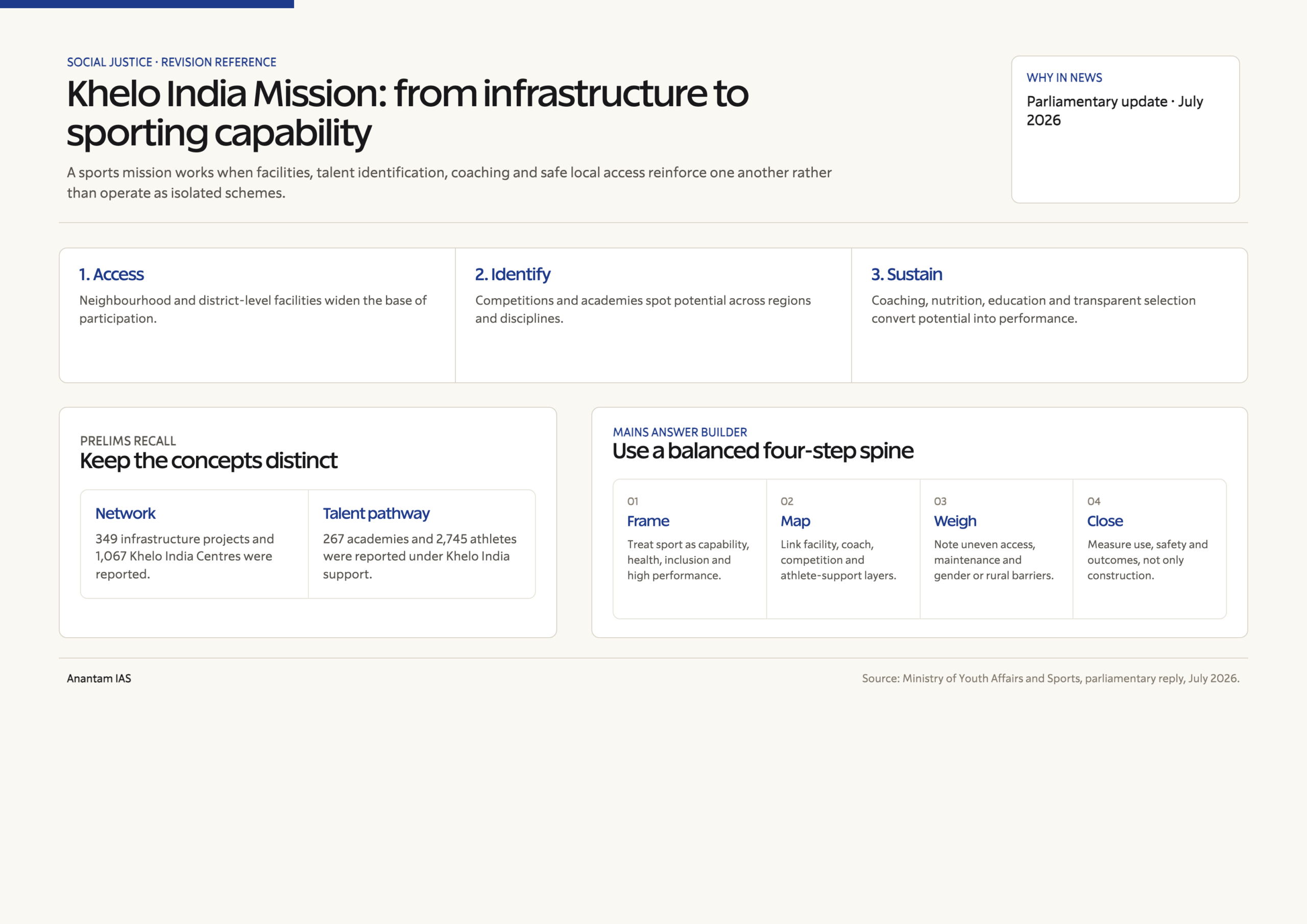
- The PIB release records 349 approved new sports-infrastructure projects worth ₹3,176 crore as of July 2026.
- It records 1,067 Khelo India Centres and 2,745 Khelo India Athletes as of July 2026.
- It is a case study in cooperative federalism because facilities and athlete pathways require coordination between the Union, States, local institutions, schools, universities and sports bodies.
- It connects human development with public infrastructure, nutrition, coaching, sports science, inclusion and opportunities for girls and para-athletes.
- It helps distinguish mass participation, talent identification, elite support and international performance: related objectives, but not interchangeable ones.
UPSC Relevance
Prelims Relevance
- Khelo India was launched in 2017 as a sports-development framework.
- It brought together the Rajiv Gandhi Khel Abhiyan, Urban Sports Infrastructure Scheme and National Sports Talent Search Scheme.
- A Khelo India Centre is a grassroots training and athlete-support facility; it should not be confused with a one-time sporting event.
- The Mission envisages one Khelo India Training Centre in every district through State and Union Territory plans.
- Khelo India Games include youth, university, winter and para-sport formats, alongside beach games, water-sports festivals and tribal games mentioned in the PIB overview.
- The Target Olympic Podium Scheme is a separate athlete-support initiative; the PIB release says it was launched in 2014 and revamped in 2018.
Mains Relevance
GS Paper 2
- Use Khelo India to discuss cooperative federalism and the role of public institutions in widening access to opportunity.
- Analyse sports as a social-development domain involving gender equity, disability inclusion, youth development and local public infrastructure.
GS Paper 3
- Link sporting performance with sports science, nutrition, coaching, data systems, manufacturing of equipment and long-term human-capital investment.
- Assess why capital spending alone cannot create elite outcomes without maintenance, trained personnel and competition exposure.
Essay
- A sporting nation is built not only in stadiums but in the ordinary institutions that allow children to practise safely, repeatedly and with dignity.
Background and Context
What Khelo India Seeks to Solve
India’s sporting challenge is not simply the absence of talented individuals. It is the uneven conversion of interest and raw talent into sustained training, competition and support. Khelo.
- Launched in 2017, the scheme consolidated the Rajiv Gandhi Khel Abhiyan, the Urban Sports Infrastructure Scheme and the National Sports Talent Search Scheme. Consolidation matters because disconnected schemes can leave gaps between facility creation, talent identification.
- The programme’s stated approach is to build training centres, use sports science and technology, develop infrastructure and guide athletes toward professional excellence. These are complementary inputs: a facility without coaches or a selected athlete without competition.
- The Mission’s aspiration of one Khelo India Training Centre in every district makes district access the key governance test. A national announcement is not equivalent to usable local access, particularly for rural athletes, girls, persons with.
- A sound answer should distinguish broad-based participation from elite performance. Mass participation improves the pool from which talent can emerge, while elite outcomes require specialised coaching, recovery, nutrition, psychology, travel support and competition against high-quality opponents.
- The sports ecosystem also extends beyond athletes. Teachers, community coaches, physiotherapists, sports-science personnel, local bodies, schools, universities, federations and equipment makers influence whether public spending becomes durable sporting capability.
The Institutional Pathway: Centre, States and Districts
Sports is delivered where people live and train. The Union can set broad norms, finance programmes and create national platforms, but State governments, local institutions and sports bodies.
- The PIB overview places the proposed district training-centre network within State and Union Territory plans. This makes implementation a cooperative-federal task, not a centrally administered chain of identical facilities.
- State-specific planning should respond to geography, existing facilities, local sporting cultures, school networks and the availability of qualified coaches. A mountain district, a coastal district and a dense city need different facility mixes and different maintenance.
- Transparent criteria are needed for selecting centres, athletes and disciplines. Without published selection processes, grievance redressal and periodic audits, a talent scheme can reproduce social and regional exclusion rather than reduce it.
- Infrastructure has a life-cycle cost. Building a playing surface or centre is only the first stage; safety, repair, equipment replacement, electricity, water, transport access and trained staff determine whether it stays functional.
- Convergence with schools, colleges and community facilities can improve utilisation. It can also prevent public assets from becoming venues used only for occasional events rather than daily training.
Facilities, Centres and Competition Are Different Inputs
The July 2026 figures are useful only when read by function. Approved infrastructure projects, Khelo India Centres and athletes supported through the programme measure different points in the.
- The PIB release records 349 approved new infrastructure projects with a total investment of ₹3,176 crore. Approval and investment commitment are not by themselves proof that every facility is completed, maintained or equally accessible; monitoring must.
- It also records 1,067 Khelo India Centres. Centres are intended to strengthen grassroots training and athlete support, so their performance should be assessed through coach availability, attendance, progression, safety and inclusion as well as through.
- The release lists 2,745 Khelo India Athletes. Athlete support is valuable when it is linked to transparent identification, individual development plans and reliable support for training, nutrition, equipment and competition.
- The Khelo India Games provide a competitive stage. The release says that more than 63,000 athletes have participated since 2018 and identifies youth, university, winter and para-sport formats among the expanding events.
- Competition is not merely a showcase. It offers performance feedback, exposes athletes to rules and pressure, allows selectors to observe progress, and can connect local training with higher-level pathways.
From Sports Policy to Human Development
A sports policy has a wider public value when it treats physical activity, agency and inclusion as development outcomes. Medals can inspire participation, but policy should also be.
- Girls may face constraints linked to safety, travel, sanitation, family expectations and the scarcity of women coaches. Facility design, transport arrangements and safeguarding systems can affect participation as much as an event calendar.
- Para-athletes need accessible venues, trained support staff, appropriate equipment and competitive opportunities. The presence of Khelo India Para Games in the wider programme shows why disability inclusion must be built into routine infrastructure rather than added.
- Sports science, psychology and nutrition are not luxuries reserved for a few national athletes. Age-appropriate coaching, injury prevention, recovery and mental-health support protect young athletes from burnout and unsafe practices.
- Data-enabled athlete tracking can help identify gaps and personalise support, but it requires clear consent, data protection, non-discriminatory use and trained human judgement. A dashboard should strengthen coaching decisions, not replace them.
- The strongest measure of success is a credible progression route: a child can move from a local facility to trained coaching and regular competition, with support based on merit and need rather than on personal connections.
Way Forward
Measure Access and Quality, Not Only Assets
- Publish district-level data on project completion, operating hours, coach vacancies, participation by gender and disability, maintenance status and grievance resolution, while protecting individual athlete data.
- Use independent facility audits and social audits where feasible to verify that centres are open, usable and equipped for their stated disciplines.
- Link future funding to a balanced set of indicators: access, utilisation, athlete retention, safety, competition exposure and progression, rather than medal counts alone.
Conclusion
- Khelo India is most useful as a policy lens when it is seen as a chain: facilities, trained people, fair selection, sustained support and meaningful competition must reinforce one another.
- For UPSC answers, begin with Khelo India’s ecosystem approach, separate infrastructure, centres, competition and athlete support, then evaluate the cooperative-federal, inclusion and accountability conditions that turn a sports scheme into durable human development.
UPSC Practice Questions
Prelims MCQ 1
With reference to the Khelo India programme, consider the following statements:
- It was launched in 2017 as a unified sports-development framework.
- It brought together the Rajiv Gandhi Khel Abhiyan, Urban Sports Infrastructure Scheme and National Sports Talent Search Scheme.
- The Mission envisages a Khelo India Training Centre in every district through State and Union Territory plans.
How many of the above statements are correct?
(a) Only one (b) Only two (c) All three (d) None
Answer: (c) All three
Explanation:
All three statements are correct. The PIB overview describes the 2017 scheme, the three programmes it integrated, and the Mission’s district training-centre vision through State and Union Territory plans.
Prelims MCQ 2
Which one of the following correctly matches the July 2026 Khelo India figures reported by the Press Information Bureau?
(a) 349 approved infrastructure projects, ₹3,176 crore investment, 1,067 Khelo India Centres and 2,745 Khelo India Athletes (b) 349 Khelo India Centres, ₹1,067 crore investment, 2,745 projects and 3,176 athletes (c) 1,067 approved projects, ₹2,745 crore investment, 349 centres and 3,176 athletes (d) 2,745 approved projects, ₹349 crore investment, 3,176 centres and 1,067 athletes
Answer: (a) 349 approved infrastructure projects, ₹3,176 crore investment, 1,067 Khelo India Centres and 2,745 Khelo India Athletes
Explanation:
The July 2026 PIB overview gives these four distinct figures. They refer respectively to approved infrastructure projects, their investment, Khelo India Centres and Khelo India Athletes.
UPSC Mains Questions
- Sports policy must be assessed as a human-development and governance question, not merely through medal tallies. Discuss with reference to Khelo India.
- How can cooperative federalism improve the effectiveness and equity of district-level sports infrastructure and athlete-development programmes in India?
Source: Press Information Bureau, Ministry of Youth Affairs and Sports.
Frequently Asked Questions
What is Khelo India?
Khelo India is a national sports-development framework launched in 2017. It integrated the Rajiv Gandhi Khel Abhiyan, Urban Sports Infrastructure Scheme and National Sports Talent Search Scheme. Its approach links facilities, training centres, talent identification, athlete support, sports science and.
What is the Khelo India Mission’s district goal?
The Mission envisages one Khelo India Training Centre in every district through State and Union Territory plans. This is an aspiration for a training network, not proof that every district already has a fully functional centre. UPSC answers should distinguish.
What were the Khelo India figures reported in July 2026?
The PIB overview reported 349 approved new sports-infrastructure projects with a total investment of ₹3,176 crore, 1,067 Khelo India Centres and 2,745 Khelo India Athletes as of July 2026. These are different measures and should not be treated as a.
How are Khelo India Centres different from Khelo India Games?
Khelo India Centres are intended to provide grassroots training and athlete support. Khelo India Games are competitive platforms that include youth, university, winter and para-sport formats among others. Centres are part of day-to-day development; games provide competition, exposure and performance.
Why is Khelo India relevant for GS2?
It is relevant to governance, cooperative federalism, youth development, gender equity, disability inclusion and public-service delivery. A good GS2 answer can assess how the Union, States, local institutions, schools and sports bodies must coordinate to convert a national scheme into.
Source: https://anantamias.com/current-affairs/khelo-india-mission-sports-governance/
Special Intensive Revision of Electoral Rolls: Meghalaya’s 2026 Exercise
Why in News?
The Election Commission of India (ECI) has published the draft-roll schedule for a Special Intensive Revision of electoral rolls in Meghalaya.
- A revision of an electoral roll concerns the list of eligible electors, not the conduct or result of a poll.
- The ECI’s published Meghalaya schedule makes the draft-roll stage a live example of verification, public notice and correction in electoral administration.
- An intensive revision calls attention to both sides of roll integrity: preventing wrongful inclusion and preventing exclusion of a qualified elector.
- The legally significant safeguard is an opportunity to make a claim, raise an objection and seek correction through the prescribed electoral-registration process.
- The topic links constitutional democracy with state capacity, local field verification, accessible documentation and procedural fairness.
- A credible electoral roll is the entry point to adult suffrage. A person cannot vote in a constituency merely because an election is being held there; their name must be entered in the relevant roll under.
- Roll revision is a continuing administrative task, not a one-time clean-up. Population movement, deaths, new eligibility, address change and clerical mistakes require lawful updating.
- A strong Mains answer should pair accuracy with inclusion, transparency, appeal and public confidence rather than treating verification as an end in itself.
UPSC Relevance
Prelims Relevance
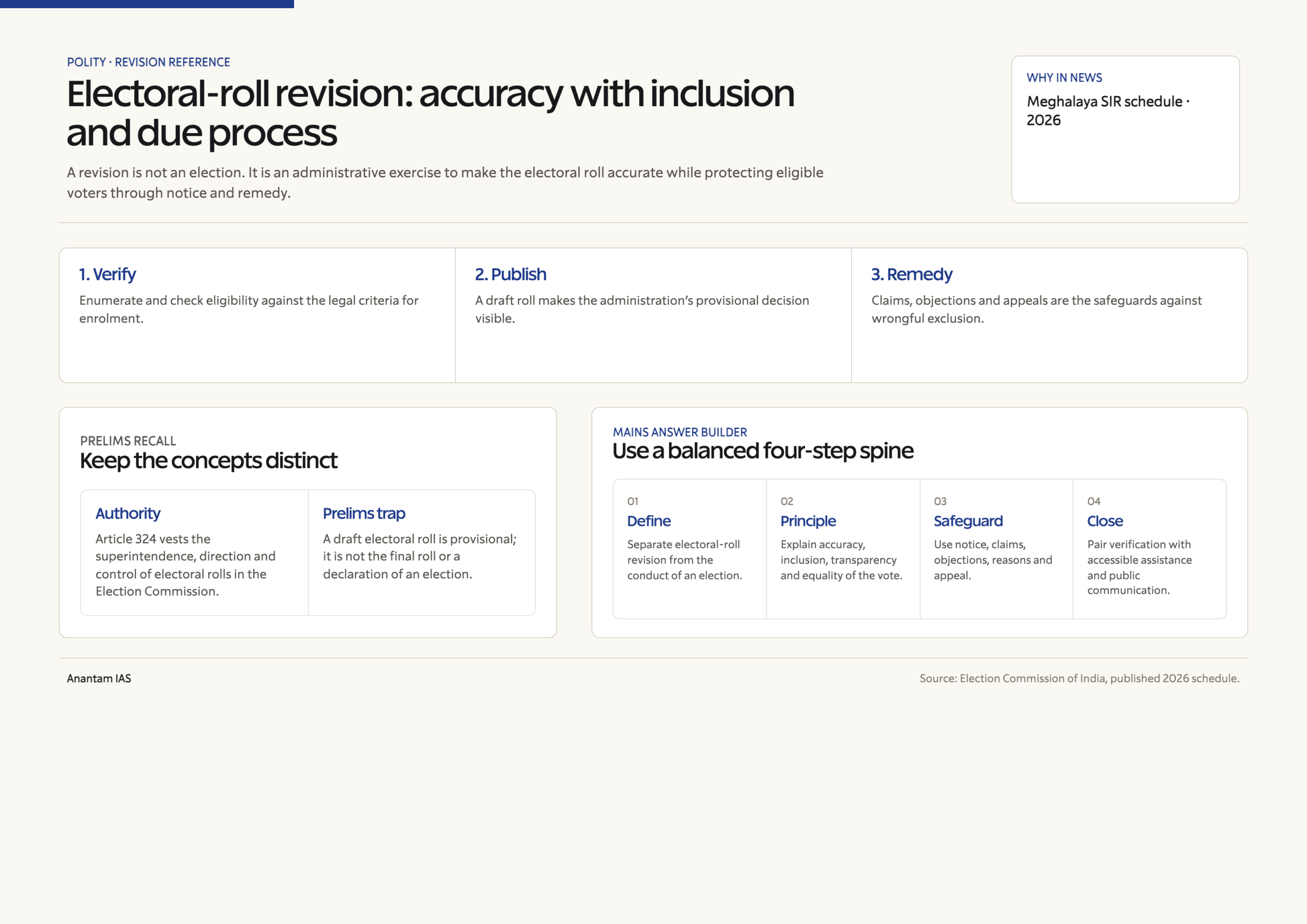
- Article 324 vests the superintendence, direction and control of elections in the Election Commission of India, including the preparation of electoral rolls.
- The Representation of the People Act, 1950 is central to the preparation and revision of electoral rolls; the Representation of the People Act, 1951 deals mainly with the conduct of elections and related matters.
- The qualifying age for registration as an elector is 18 years, subject to the statutory conditions for inclusion in a constituency roll.
- Electoral rolls are prepared constituency-wise and are maintained through prescribed registration machinery and procedures.
- A draft roll is a provisional public stage at which claims, objections and correction requests can be made under the applicable procedure.
- A person cannot be registered in more than one constituency or more than once in the same constituency electoral roll.
Mains Relevance
GS Paper 2
- Use electoral-roll revision to discuss the institutional conditions needed for free and fair elections: accurate registers, equal access, transparent procedures and remedies.
- Examine the role of the ECI and electoral-registration authorities in balancing administrative verification with a citizen’s right to participate in representative democracy.
GS Paper 2
- Assess how public notice, claims, objections and appellate remedies give procedural content to inclusion in an electoral roll.
- Discuss the challenges of migration, remote habitations, disability access, language, documentation and digital exclusion in maintaining accurate rolls.
Essay
- Democracy is sustained not only by the day of voting but also by the quieter public institutions that make participation possible.
Background and Context
What an Electoral Roll Does
An electoral roll is the constituency-wise register of persons entitled to vote. It is foundational to adult suffrage because voting rights are exercised through a lawful entry in.
- The roll performs an inclusion function: it identifies persons who meet the legal conditions for registration in a constituency. It also performs an integrity function by helping prevent multiple or ineligible entries.
- A revision should not be confused with an election. The Meghalaya exercise concerns the preparation and correction of the voter list; it does not announce polling, candidates or an electoral outcome.
- The published draft-roll schedule is important because a draft is not the final word. It creates a public stage at which citizens and other affected persons can use the prescribed process to seek inclusion, correction or.
- For an exam answer, begin with this distinction. Electoral integrity requires a reliable register before the campaign and polling stages can be meaningful.
- Roll management is continuous. Young citizens become eligible, residents change address, people move for work or education, and records can acquire duplications or inaccuracies. The register must respond to these changes through law-bound processes.
Constitutional and Statutory Architecture
The constitutional anchor is Article 324, which assigns the ECI superintendence, direction and control over elections, including preparation of electoral rolls. The statutory framework turns that mandate into.
- The Representation of the People Act, 1950 provides the core legal framework for allocation of seats and electoral rolls. It should be distinguished from the Representation of the People Act, 1951, which is associated with election.
- Article 326 establishes elections to the Lok Sabha and State Legislative Assemblies on the basis of adult suffrage, subject to the Constitution and laws made by the appropriate legislature. The minimum voting age is 18 years.
- The electoral-registration system applies statutory tests such as age, citizenship and ordinary residence. It must do so through defined authorities and procedures rather than through informal assumptions about a person’s social standing or property ownership.
- A person is not entitled to appear more than once in the same electoral roll or in rolls for more than one constituency. This rule protects equality among electors and the one-person-one-vote principle.
- This framework shows why revision is both an administrative and constitutional task. An inaccurate roll can dilute equal participation, while an unfair process of correction can exclude a person from the democratic process.
Draft Roll, Claims and Objections
The draft-roll stage makes revision visible and contestable. It allows the register to be checked before final publication and gives procedural space to people whose interests are affected.
- The ECI’s Meghalaya notice makes the published draft-roll schedule the present hook. Its larger lesson is that a revision must contain a genuine opportunity for public scrutiny rather than an opaque back-end data exercise.
- A qualified person who finds their name missing, wrongly recorded or assigned to an incorrect constituency needs a clear route to make a claim or request correction. The process should be understandable in local languages and.
- An objection to an existing entry concerns a different risk: the roll may contain a duplicate, a person not ordinarily resident in the constituency, or another entry that requires scrutiny under law. An objection should not.
- Officials must record and assess material under the prescribed procedure. Public confidence increases when decisions are communicated, reasons are available where required, and a person knows the next remedial step.
- The UPSC framing is due process in electoral administration: notice, opportunity, evidence, an impartial decision and a remedy work together to protect both accuracy and inclusion.
Intensive Revision and Field-Level Capacity
An intensive revision places particular emphasis on verification and updating. Its credibility depends not only on a formal schedule but also on implementation capacity close to the voter.
- Field-level outreach can help identify address changes, new eligible citizens and factual errors. It must be accompanied by training, supervision and respectful engagement, especially where households are remote or records are incomplete.
- Meghalaya’s varied terrain and settlement patterns make accessibility a useful analytical lens. The article does not infer any particular local outcome from the schedule; it highlights why the last mile matters in every revision exercise.
- Digital tools can make searching, filing and tracking easier for many citizens. They cannot be the sole route. Assisted offline options are vital for people facing connectivity constraints, disability barriers, language barriers or limited digital familiarity.
- Data handling requires restraint. Electoral databases contain personal details and their collection, verification and disclosure should follow a defined public purpose, secure processes and proportionate access.
- Verification gains legitimacy when it is rule-based and reviewable. A target-driven deletion exercise, or an unexamined reliance on automated matching, can create errors that are difficult for citizens to discover and correct.
Way Forward
Design Revision Around the Citizen
- Publish simple, multilingual guidance on eligibility, ordinary residence, the distinction between a claim and an objection, and the available correction channels.
- Maintain assisted offline access through local electoral staff and accessible help points, while allowing digital search and tracking where it helps.
- Plan outreach for first-time voters, migrant workers, remote communities and persons with disabilities without presuming that one document or one channel fits every legitimate case.
Conclusion
- The ECI’s published Meghalaya draft-roll schedule is a reminder that elections depend on work done well before polling day.
- Its democratic test is twofold: protect the roll against error and duplication, while ensuring that every eligible citizen can understand the process, be heard and obtain a fair decision.
UPSC Practice Questions
Prelims MCQ 1
With reference to electoral rolls in India, consider the following statements:
- Article 324 includes preparation of electoral rolls within the Election Commission of India’s constitutional domain.
- The Representation of the People Act, 1950 is central to preparation and revision of electoral rolls.
- A person may be registered in more than one constituency if that person owns property in each constituency.
How many of the above statements are correct?
(a) Only one (b) Only two (c) All three (d) None
Answer: (b) Only two
Explanation:
Statements 1 and 2 are correct. Article 324 covers preparation of electoral rolls, and the Representation of the People Act, 1950 governs their statutory framework. Property ownership does not permit multiple registrations; a person cannot be registered in more than one constituency or more than once in the same constituency.
Prelims MCQ 2
Which one of the following best distinguishes electoral-roll revision from delimitation?
(a) Roll revision updates eligible electors, whereas delimitation concerns constituency boundaries and allocation of seats. (b) Roll revision is conducted only after a general election, whereas delimitation is conducted before every election. (c) Roll revision determines the number of seats in Parliament, whereas delimitation registers voters. (d) Roll revision is a judicial function, whereas delimitation is an executive function.
Answer: (a) Roll revision updates eligible electors, whereas delimitation concerns constituency boundaries and allocation of seats.
Explanation:
Electoral-roll revision concerns the constituency-wise register of electors. Delimitation concerns the territorial boundaries of constituencies and allocation of seats; the two processes are distinct.
UPSC Mains Questions
- An accurate electoral roll is necessary but not sufficient for free and fair elections. Discuss the institutional and procedural safeguards needed to reconcile roll integrity with inclusive adult suffrage.
- Explain the constitutional and statutory basis of electoral-roll revision in India. How do claims, objections and accessible remedies strengthen electoral democracy?
Source: Election Commission of India.
Frequently Asked Questions
What is a Special Intensive Revision of electoral rolls?
It is a focused electoral-roll revision that places emphasis on verification and updating of the constituency-wise voter register under the electoral-registration framework. The immediate Meghalaya news hook is the Election Commission’s published draft-roll schedule. The process is about the voter.
Why is the draft-roll stage important?
A draft roll is a provisional public stage before final publication. It gives eligible citizens an opportunity to check whether their name and particulars are correctly recorded and to use the prescribed process for a claim or correction. It also.
Which law governs electoral rolls in India?
The Representation of the People Act, 1950 is central to the preparation and revision of electoral rolls. It operates within the constitutional framework of Article 324, which assigns the Election Commission superintendence, direction and control over elections, including electoral rolls.
Can a voter be registered in two constituencies?
No. A person cannot be registered in more than one constituency or more than once in the same constituency electoral roll. The rule protects the equal value of each vote. Registration depends on statutory conditions, including ordinary residence; it is.
How can electoral-roll revision remain inclusive?
Revision needs clear public notice, multilingual guidance, local assistance and workable routes for claims, objections and corrections. Offline support matters alongside digital services for people facing connectivity, disability, language or documentation barriers. Accuracy improves when eligible citizens can find and.
Source: https://anantamias.com/current-affairs/meghalaya-special-intensive-revision-electoral-rolls/
National Career Service Portal: AI, Employment Matching and Public Delivery
Why in News?
In a written Lok Sabha reply on 3 August 2026 , the Ministry of Labour and Employment set out the scale and recent technological upgrades of the National Career Service (NCS) portal.
- NCS offers jobs from private and government sectors, job fairs, job search and matching, career counselling, vocational guidance, and information on skill and training programmes.
- The upgraded platform is cloud-based and uses an open architecture, with integration across public and private job and skill portals.
- The listed AI-enabled functions are intelligent job matching, skill-gap analysis, personalized job recommendations and an AI interview coach.
- The portal includes multilingual support through Bhashini, verification mechanisms, cloud-based applications for jobseekers and employers, and a mobile application.
- More than 40 MoUs with public and private employers, portals and platforms are intended to broaden employment opportunities and related services.
- The issue connects digital service delivery with the older public function of collecting vacancies, registering jobseekers and providing career guidance.
- It helps distinguish a platform that facilitates matching and information from a programme that itself creates every job displayed on it.
- It raises an answer-writing question: how should public systems combine scale, accessibility, verification and human support when AI-assisted recommendations are introduced?
UPSC Relevance
Prelims Relevance
- The Ministry of Labour and Employment implements the National Employment Service, which has been transformed into the National Career Service.
- NCS is a digital platform for employment assistance, career counselling, vocational guidance, job fairs and information on skill and training programmes.
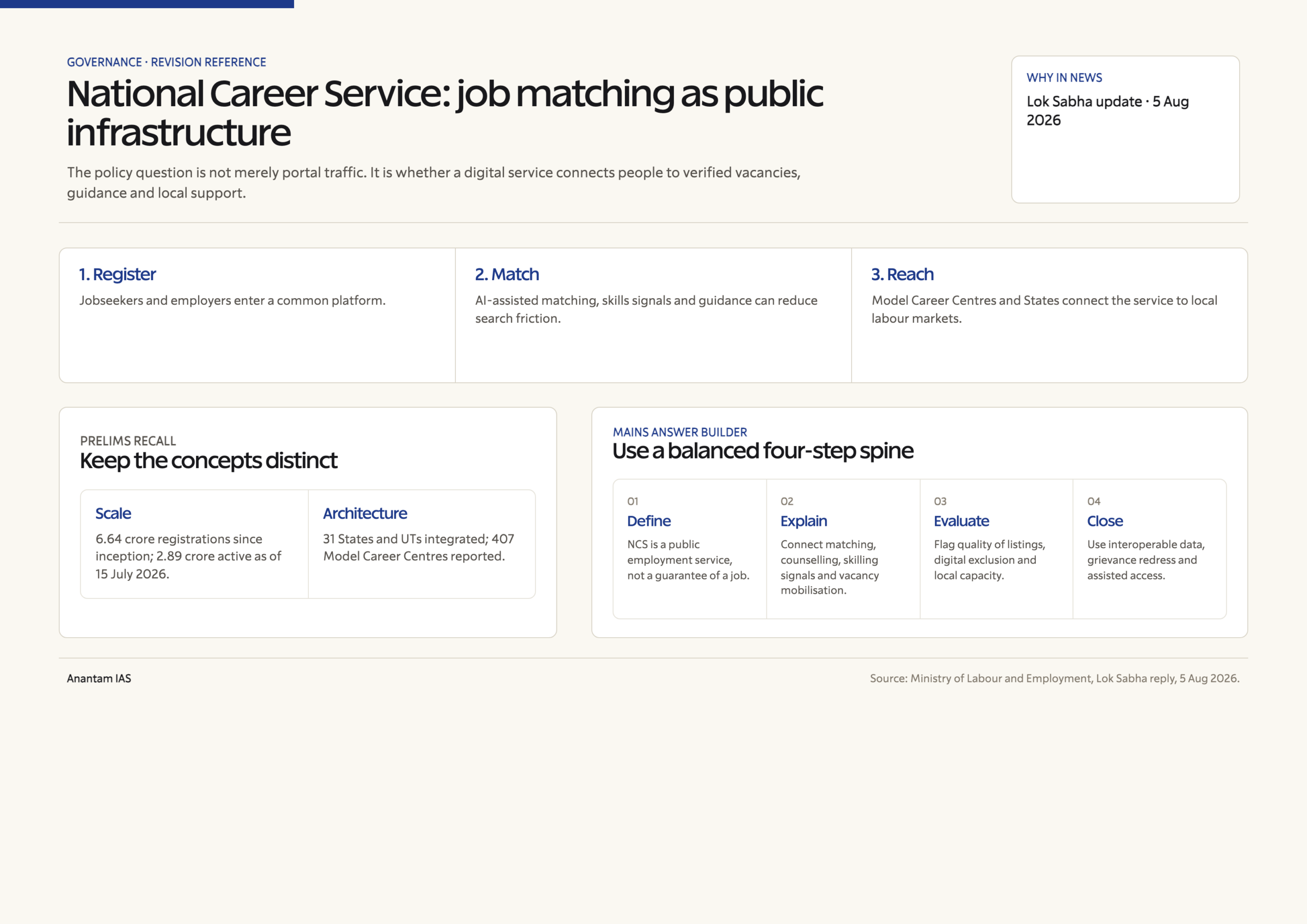
- As on 15 July 2026, the ministry reported more than 6.64 crore registered jobseekers since inception and 2.89 crore active jobseekers.
- As on the same date, more than 10.05 crore vacancies had been mobilized since inception and 17.68 lakh vacancies were active.
- The portal has been upgraded to a cloud-based, open-architecture platform.
- Its stated AI features include intelligent matching, AI skill-gap analysis, personalized recommendations and an AI interview coach.
Mains Relevance
GS Paper 2
- Examine digital public-service delivery as a means to improve access to information, counselling and grievance-responsive employment assistance.
- Assess the importance of multilingual access, verification and local outreach in preventing a digital platform from excluding those who need public support most.
GS Paper 3
- Use NCS to discuss labour-market intermediation, employability information and the connection between skilling and employment opportunities.
- Evaluate AI-assisted job matching through the lenses of data quality, transparency, bias, privacy, accountability and human counselling.
Essay
- Technology improves public capacity only when it expands a citizen’s ability to understand choices, access services and question an unsuitable decision.
Background and Context
From Employment Exchanges to a Career-Service Platform
The official reply places NCS in a longer public-employment-service continuum. The National Employment Service has been transformed into NCS, but the underlying functions remain recognisable: bring jobseekers and.
- The portal brings together private- and government-sector job information, online and offline job fairs, search and matching, career counselling, vocational guidance, and information about skill-development courses and training programmes.
- This is why NCS should not be described merely as a job-listing website. Its declared function includes employment assistance, career-related information and guidance alongside the display of vacancies.
- At the same time, a platform’s record of vacancies mobilized is not identical to a count of jobs created by government. It records vacancies brought onto the portal; placement, retention and job quality require separate evidence.
- For UPSC, this distinction is useful. Employment policy includes job creation, labour-market information, employer outreach, counselling, skilling, mobility and social-security linkages. NCS sits mainly at the intermediation and information layer while connecting users to several of.
- The portal model can reduce information gaps between a person looking for work and an employer looking for workers. Its public value depends on whether information is current, accessible and understandable, and whether users can obtain.
Scale: Read the Portal Numbers Carefully
The 3 August reply gives both cumulative and active figures. Reading the two columns separately is essential because a cumulative count since inception answers a different question from.
- More than 6.64 crore jobseekers had registered on NCS since inception. Of these, 2.89 crore were reported as active jobseekers as on 15 July 2026.
- More than 10.05 crore vacancies had been mobilized since inception, while 17.68 lakh were active vacancies on 15 July 2026.
- Cumulative figures show the scale of participation and activity over time. Active figures are more useful for understanding the immediate pool visible on a specified date. Neither number by itself establishes the number of people placed.
- This is not a criticism of the portal’s reported figures; it is a basic rule of policy analysis. A Mains answer should avoid converting registrations into employment outcomes without a verified placement indicator.
- The reply also notes that portal improvement is a continuous and dynamic process, with changes planned in response to evolving requirements. That makes periodic evaluation important: policymakers need to know who is using the platform, which.
Open Architecture, Interoperability and Local Access
NCS has been upgraded to a cloud-based, open-architecture platform. In public delivery, this design matters because a person seeking work may also need identity documents, skill information, social-security.
- The ministry lists integration with Udyam, eShram, Skill India Digital Hub, EPFO, ESIC, MHRD and DigiLocker. It also records linkages with bodies such as UPSC, SSC, ASRB and Railway Recruitment Boards.
- Interoperability can reduce repeated data entry and make a public service easier to navigate. It should be built with clear purpose limitation, user awareness and secure handling of personal information, especially where employment history, skills or.
- The reply records more than 40 MoUs with employers, portals and platforms. Such partnerships can widen the pool of information and service options, but public systems still need robust verification mechanisms so that users can trust.
- Digital reach cannot eliminate the value of proximate guidance. The NCS project envisages Model Career Centres that organize job fairs, mobilize employers and provide online or offline career counselling with States and other institutions.
- The government has approved 407 MCCs, including 370 employment exchanges upgraded as MCCs. This shows an important design choice: retain a local institutional route while a national digital platform expands its reach.
AI-Enabled Matching: Opportunity With Public Safeguards
The latest upgrades add intelligent job matching, AI skill-gap analysis, personalized recommendations and an AI interview coach. These tools can help users sort a large volume of information.
- Intelligent matching can compare the information supplied by jobseekers and employers. Its usefulness depends on complete and accurate descriptions of skills, location, experience, workplace conditions and vacancies.
- AI skill-gap analysis may point a user toward relevant training. The advice needs to remain intelligible: a candidate should know why a recommendation was made and should be able to seek human guidance where the result.
- Personalized recommendations can make a large portal easier to use, while an AI interview coach may help a candidate prepare. Neither function should conceal a lack of access, poor data quality or discrimination in a labour.
- The reply pairs AI features with multilingual support through Bhashini, robust verification mechanisms and a mobile application. This combination is significant because a public platform must address language and access as well as technical sophistication.
- A balanced answer can welcome AI as an aid to scale while insisting on data protection, transparent criteria, regular bias checks, grievance channels, human review and independent evaluation. These safeguards make the system more reliable for.
Way Forward
Measure Outcomes, Not Only Activity
- Separate cumulative registrations and mobilized vacancies from date-specific active figures, and publish clear definitions for each indicator.
- Track verified vacancies, completed matches, repeat use, satisfaction and accessibility outcomes without turning a single dashboard number into a substitute for employment-quality assessment.
- Use regular review before Finance Commission cycles, as stated in the reply, to identify services that need redesign or additional support.
Conclusion
- The National Career Service illustrates a practical transition from an employment-exchange model to a digital public employment service .
- For UPSC, the strongest conclusion is balanced: AI-enabled matching and personalised guidance can improve navigation of employment information, but public value rests on verified vacancies, meaningful access, privacy, fairness, explainability and a human route for counselling and redress.
UPSC Practice Questions
Prelims MCQ 1
With reference to the National Career Service portal, consider the following statements:
- It is the transformed form of the National Employment Service.
- It has been upgraded to a cloud-based open-architecture platform.
- The portal’s stated services include information on online and offline job fairs.
How many of the above statements are correct?
(a) Only one (b) Only two (c) All three (d) None
Answer: (c) All three
Explanation:
All three statements are correct according to the Ministry of Labour and Employment’s 3 August 2026 Lok Sabha reply. NCS is the transformed National Employment Service and offers career-related services, including job-fair information, on a cloud-based open-architecture platform.
Prelims MCQ 2
Which one of the following was specifically listed as an AI-enabled feature of the National Career Service portal in the 3 August 2026 Lok Sabha reply?
(a) Automatic issuance of employment contracts (b) AI skill-gap analysis (c) Algorithmic adjudication of labour disputes (d) Automated approval of social-security claims
Answer: (b) AI skill-gap analysis
Explanation:
The reply lists intelligent job matching, AI skill-gap analysis, personalized job recommendations and an AI interview coach. It does not state that NCS performs the other listed functions.
UPSC Mains Questions
- Digital public employment services can reduce information gaps, but they cannot be evaluated by registration counts alone. Discuss with reference to the National Career Service portal.
- How can AI-assisted job matching improve employment-service delivery? Examine the safeguards needed to ensure fairness, transparency, privacy and meaningful human support.
Sources: PIB, Ministry of Labour and Employment and PIB, Lok Sabha written reply.
Frequently Asked Questions
What is the National Career Service portal?
The National Career Service, or NCS, is the digital form of the National Employment Service. It provides employment assistance and career-related services, including job search and matching, job-fair information, career counselling, vocational guidance and information on skill and training programmes.
How many jobseekers and vacancies are on NCS?
In its 3 August 2026 Lok Sabha reply, the Ministry of Labour and Employment reported more than 6.64 crore registered jobseekers and more than 10.05 crore vacancies mobilized since inception. As on 15 July 2026, it reported 2.89 crore active.
What AI features does the NCS portal use?
The ministry lists intelligent job matching, AI skill-gap analysis, personalized job recommendations and an AI interview coach. The upgraded platform also has multilingual support through Bhashini, verification mechanisms and a mobile application. These are decision-support and navigation tools; accountable public.
What are Model Career Centres?
Model Career Centres are part of the NCS project and are intended to transform employment exchanges into local delivery points. They can organize job fairs, mobilize employers and provide online or offline career counselling in collaboration with States and other.
Which government systems are linked with NCS?
The ministry reports integration with Udyam, eShram, Skill India Digital Hub, EPFO, ESIC, MHRD and DigiLocker. NCS also has linkages with recruitment bodies including UPSC, SSC, ASRB and Railway Recruitment Boards. Such connections can make service journeys easier, provided data.
Source: https://anantamias.com/current-affairs/national-career-service-ai-employment-platform/
NATO’s Ankara Summit: Defence Production and Allied Resilience
Why in News?
NATO’s 2026 Ankara Summit reviewed progress after the 2025 Hague summit and placed defence production, joint procurement, resilient fuel logistics and implementation of higher defence-investment commitments at the centre of allied security planning.
- NATO states that Allies reaffirmed their commitment to collective defence under Article 5 and to a 360-degree approach to deterrence and defence.
- According to NATO, European Allies and Canada had increased core defence investments by more than USD 139 billion since the 2025 commitment to reach 5% of GDP by 2035.
- The Ankara announcements included a EUR 27 billion investment to modernise fuel storage and distribution infrastructure, including facilities and pipelines extending to the Alliance’s eastern part.
- NATO says Allies pledged EUR 70 billion in military equipment, assistance and training for Ukraine in 2026, with a commitment to sustain at least an equivalent level in 2027.
- The NATO Summit Defence Industry Forum on 7 July 2026 focused on turning the 5% investment plan into increased production, cooperation and joint procurement.
- The development connects security studies with the defence-industrial base, critical-infrastructure resilience and the political economy of armaments.
- It offers a comparison point for India’s own pursuit of defence manufacturing, supply-chain resilience and strategic autonomy without treating NATO’s alliance model as directly transferable to India.
- It helps distinguish a treaty-based collective-defence alliance from looser security dialogues, ad hoc coalitions and international organisations with universal membership.
UPSC Relevance
Prelims Relevance
- NATO is the North Atlantic Treaty Organization, a collective-defence alliance founded on the 1949 Washington Treaty.
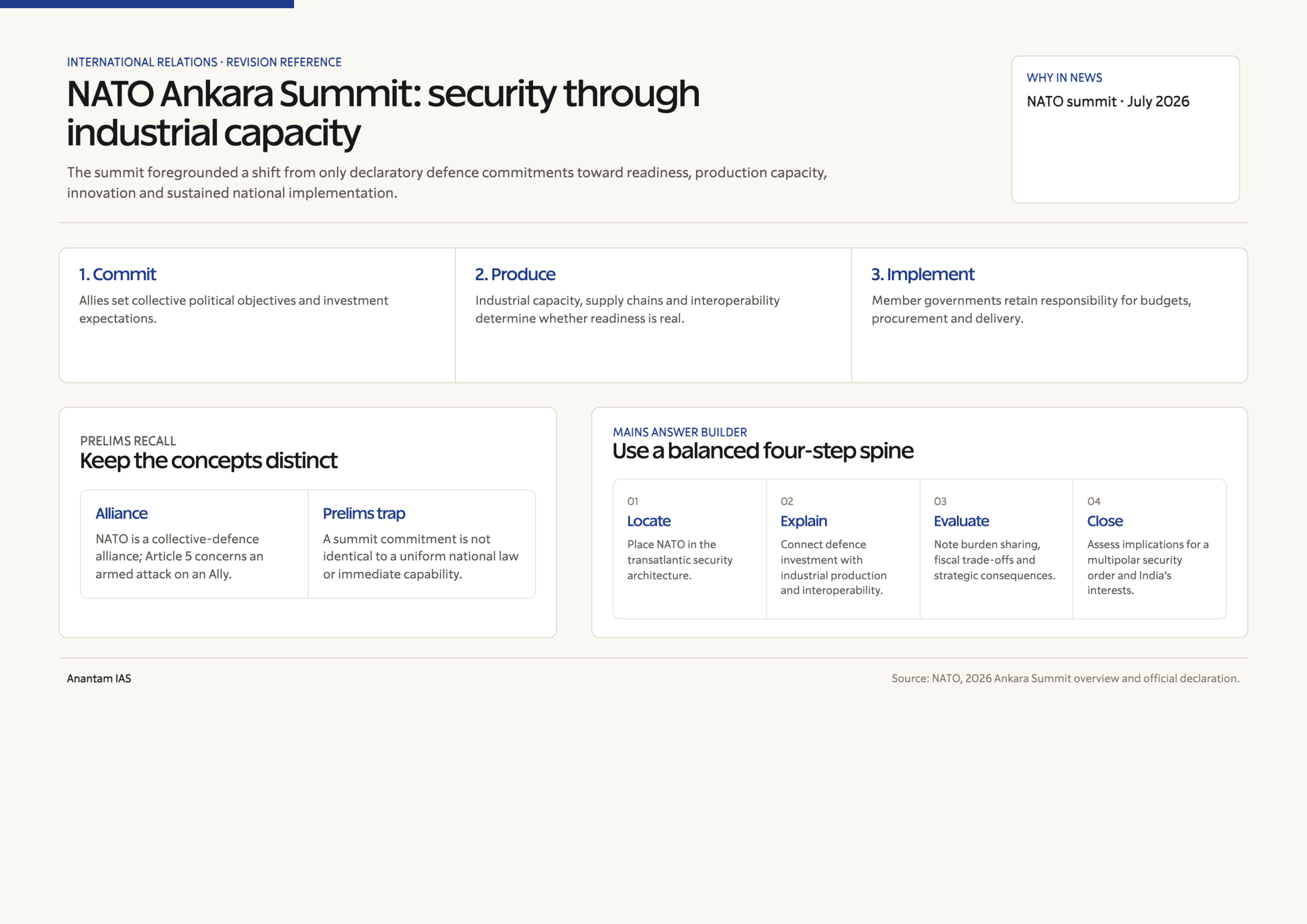
- Article 5 provides that an armed attack against one or more Allies is considered an attack against them all; the response is determined by each Ally in accordance with the treaty.
- NATO identifies three core tasks: deterrence and defence, crisis prevention and management, and cooperative security.
- The 2025 Hague declaration set a target for Allies to invest 5% of GDP annually by 2035 in core defence and defence- and security-related spending.
- Under that 2025 formulation, at least 3.5% of GDP is for core defence requirements, while up to 1.5% may be counted for resilience, critical infrastructure, networks, innovation and the defence-industrial base.
- The 2025 plan calls for annual national plans and a review of its trajectory and balance in 2029.
Mains Relevance
GS Paper 2
- Explain how alliances translate political commitments into credible deterrence through institutions, interoperability and burden-sharing.
- Assess the implications of a stronger Euro-Atlantic defence-industrial ecosystem for India’s security partnerships and strategic autonomy.
GS Paper 3
- Analyse defence production, resilient logistics and critical infrastructure as parts of national-security capacity.
- Discuss why procurement reform, technology partnerships and domestic industrial depth matter alongside headline defence expenditure.
Essay
- Security in an interdependent world rests as much on the capacity to sustain systems as on the capacity to deploy force.
Background and Context
NATO and the Meaning of Collective Defence
NATO is a treaty-based regional alliance, not a world government or a universal collective-security institution. Its central political commitment is that an armed attack against one Ally is.
- Article 5 of the Washington Treaty is NATO’s collective-defence clause. It creates an obligation to assist, but it does not prescribe one identical military response for every Ally.
- Deterrence aims to persuade a potential adversary that aggression will fail or impose unacceptable costs. It works through credible capabilities, readiness, communication and alliance cohesion.
- NATO’s stated 360-degree approach means that threats and vulnerabilities are assessed across directions and domains, rather than only through a single geographic front.
- The Alliance’s core tasks combine deterrence and defence, crisis prevention and management, and cooperative security. This wider agenda includes partnership, resilience and interoperability as well as conventional military capability.
- For an Indian answer, NATO should be described accurately as a regional alliance. India is not a NATO Ally, and its strategic-autonomy doctrine differs from membership in a collective-defence bloc.
From a Spending Target to Usable Capability
A spending promise is an input. Its security value depends on whether money is converted into deployable, interoperable and sustainable capability.
- The 2025 Hague declaration committed Allies to invest 5% of GDP annually by 2035 in core defence requirements and defence- and security-related spending. It also required annual national plans showing a credible incremental path.
- The declaration distinguishes at least 3.5% of GDP for core defence requirements from up to 1.5% for critical infrastructure, networks, civil preparedness, resilience, innovation and the defence-industrial base.
- This distinction matters because ammunition production, secure communications, ports, railways, energy networks and repair capacity can determine whether forces can move and endure during a crisis.
- The planned 2029 review recognises that targets need reassessment against the strategic environment and capability requirements. A target is not self-executing merely because leaders announce it.
- Fiscal pressure, procurement delays, shortages of skilled labour, competing domestic priorities and fragmented standards can all slow the conversion of expenditure into operational readiness.
Why the Defence-Industrial Base Matters
The defence-industrial base comprises the public and private capacity to design, manufacture, maintain, repair and replenish military equipment and enabling systems.
- The Ankara Defence Industry Forum focused on increased production, cooperation and joint procurement. Joint demand can help producers plan capacity, standardise equipment and reduce duplication, though it also requires agreement on specifications and sharing of industrial.
- Industrial deterrence is the ability to replace stocks, repair systems and scale output in time. It becomes especially important when a conflict is prolonged and consumes munitions, spare parts, fuel and electronic components faster than peacetime.
- Innovation is relevant when it improves reliable production, secure software, sensing, communications, air defence, cyber resilience or maintenance. It should not be reduced to a slogan about new technology.
- Private investment may be necessary for expansion, but governments still shape the market through procurement certainty, export controls, standards, security clearances and long-term demand signals.
- For India, the comparable policy questions are domestic design capability, quality assurance, test infrastructure, supply chains, maintenance ecosystems and technology partnerships, not replication of NATO’s institutional structure.
Resilient Logistics and Fuel Security
Military capability cannot be separated from the civilian systems that supply energy, transport equipment and keep networks functioning.
- NATO’s announced EUR 27 billion fuel investment covers modernised storage and distribution infrastructure and new facilities, including pipelines extending to the Alliance’s eastern part.
- Fuel logistics illustrate a basic security principle: a platform may be technically advanced but cannot operate without predictable access to fuel, spares, transport routes and protected storage.
- Resilience involves redundancy, dispersed storage, repair capacity, cyber protection, alternative routes and the ability to shift rapidly from peacetime logistics to crisis requirements.
- Critical infrastructure has dual-use value. Ports, rail corridors, pipelines, power systems, data networks and warehouses may serve civilian economic activity in normal times and become vital to defence mobility during emergencies.
- Large infrastructure announcements need careful evaluation. The relevant questions are implementation timelines, environmental safeguards, vulnerability to disruption, cost-sharing and whether systems are interoperable across jurisdictions.
Way Forward
Measure Delivery, Not Only Announcements
- Publish credible national investment paths, procurement schedules and capacity targets while protecting legitimate security-sensitive details.
- Track production lead times, stockpile availability, maintenance capacity, interoperability and logistics resilience instead of using expenditure alone as the measure of preparedness.
- Use the 2029 review to correct imbalances between core capability, civil resilience and industrial support.
Conclusion
- The Ankara summit underlines that deterrence in a prolonged period of insecurity is an industrial and logistical problem as well as a military one.
- In a UPSC answer, connect the summit to the distinction between collective defence and strategic autonomy, then show how finance, production, infrastructure and institutional follow-through shape real security capacity.
UPSC Practice Questions
Prelims MCQ 1
With reference to NATO’s 2025 Hague defence-investment commitment, consider the following statements:
- Allies committed to invest 5% of GDP annually by 2035 in core defence requirements and defence- and security-related spending.
- At least 3.5% of GDP was intended for core defence requirements.
- The trajectory and balance of the plan are to be reviewed in 2029.
How many of the above statements are correct?
(a) Only one (b) Only two (c) All three (d) None
Answer: (c) All three
Explanation:
The Hague declaration sets a 5% target by 2035, allocates at least 3.5% to core defence requirements, and provides for a 2029 review of the plan’s trajectory and balance.
Prelims MCQ 2
Which one of the following best explains why fuel storage, pipelines and transport corridors are relevant to deterrence?
(a) They replace the need for military personnel (b) They make all security commitments legally binding (c) They sustain the mobility and endurance of forces and can reduce logistical vulnerability (d) They convert a regional alliance into a universal international organisation
Answer: (c) They sustain the mobility and endurance of forces and can reduce logistical vulnerability
Explanation:
Military readiness depends on energy, transport, protected storage, repair and supply routes. Resilient logistics supports capability but does not replace personnel, law or diplomacy.
UPSC Mains Questions
- Deterrence is increasingly shaped by industrial capacity and logistics, not only by force levels. Discuss with reference to NATO’s Ankara Summit.
- Differentiate collective defence from collective security. How does the distinction help assess contemporary alliance commitments?
Sources: NATO, 2026 NATO Summit in Ankara and NATO, The Hague Summit Declaration.
Frequently Asked Questions
What was the focus of NATO’s Ankara Summit in 2026?
NATO’s Ankara summit reviewed progress after the 2025 Hague meeting and highlighted collective defence, higher investment, defence production, joint procurement and resilient logistics. NATO also linked these themes to support for Ukraine. The announcements describe Alliance priorities; delivery still relies.
What is NATO Article 5?
Article 5 is the collective-defence clause of the 1949 Washington Treaty. It treats an armed attack against one or more NATO Allies as an attack against all. Each Ally must assist, but the treaty does not dictate one uniform form.
What is NATO’s 5% defence-investment commitment?
At the 2025 Hague summit, Allies committed to invest 5% of GDP annually by 2035 in core defence requirements and defence- and security-related spending. At least 3.5% is directed to core defence requirements, while up to 1.5% can cover resilience.
Why does a defence-industrial base matter?
A defence-industrial base provides the ability to design, manufacture, maintain, repair and replenish equipment and enabling systems. In a long crisis, available stocks, production lead times, skilled workers, components, quality assurance and supply routes can be as consequential as the.
Why did NATO announce investment in fuel infrastructure?
NATO announced investment in modernised fuel storage and distribution, including pipelines and facilities in the Alliance’s eastern part. The purpose is logistical resilience: forces need dependable fuel, protected storage and transport networks to move and operate. Such infrastructure also needs.
Source: https://anantamias.com/current-affairs/nato-ankara-summit-defence-industrial-cooperation/
Southwest Monsoon Warnings: From Forecast to Disaster Management
Why in News?
The India Meteorological Department’s monsoon information issued on 4 August 2026 indicated the likelihood of isolated heavy to very heavy rainfall over parts of northeast and east India.
- IMD’s 4 August 2026 outlook flagged isolated heavy to very heavy rainfall in parts of northeast and east India.
- The same outlook flagged isolated heavy rainfall over Kerala and coastal and south interior Karnataka.
- A rainfall warning expresses probability and expected intensity for a place and period; it is not itself proof of a flood, landslide or loss of life.
- The UPSC value lies in the chain from forecast to last-mile action: warning communication, evacuation readiness, drainage and reservoir decisions, and accountable relief.
- A sound answer separates weather forecasting, disaster response, risk reduction and long-term climate adaptation while showing how they connect.
- India’s monsoon risk is shaped by exposure as much as by rainfall: floodplains, unstable slopes, dense urban surfaces, blocked drainage, vulnerable housing and weak warning access can convert a hazard into a disaster.
- Disaster management is a continuous cycle of prevention, mitigation, preparedness, response, relief, recovery and reconstruction, not merely rescue after an event.
- Forecast quality has public value only when it reaches the right person in a usable form and is linked to a pre-decided operating response.
UPSC Relevance
Prelims Relevance
- The India Meteorological Department is the national meteorological service and issues weather and rainfall forecasts and warnings.
- A forecast estimates expected weather conditions, whereas a warning communicates a potentially hazardous condition and calls for risk-sensitive action.
- The Disaster Management Act, 2005 provides the statutory framework for institutions such as the National Disaster Management Authority and State Disaster Management Authorities.
- The National Disaster Response Force is a specialised response force; it does not replace the primary role of State and district authorities in local preparedness and response.
- The Ministry of Home Affairs has a central coordinating role in disaster-management arrangements, while line departments retain sectoral responsibilities.
- Floods, landslides, lightning, urban waterlogging, disruption of transport and water-borne disease risks may require distinct local contingency plans even when the common trigger is heavy rain.
Mains Relevance
GS Paper 3
- Explain why early warning must be joined to local preparedness, land-use planning, resilient infrastructure and public communication to reduce hydro-meteorological disaster risk.
- Use the forecast-to-action chain to discuss coordination among IMD, State departments, district administration, urban local bodies, water-resource agencies, health services and communities.
GS Paper 2
- Discuss cooperative federalism in disaster management: national scientific and response capacity must strengthen, not displace, State and local accountability.
- Examine how transparent, accessible and multilingual risk communication can improve trust and inclusion during weather emergencies.
Essay
- Technology is most humane when it enlarges the time available for collective judgment and protective action.
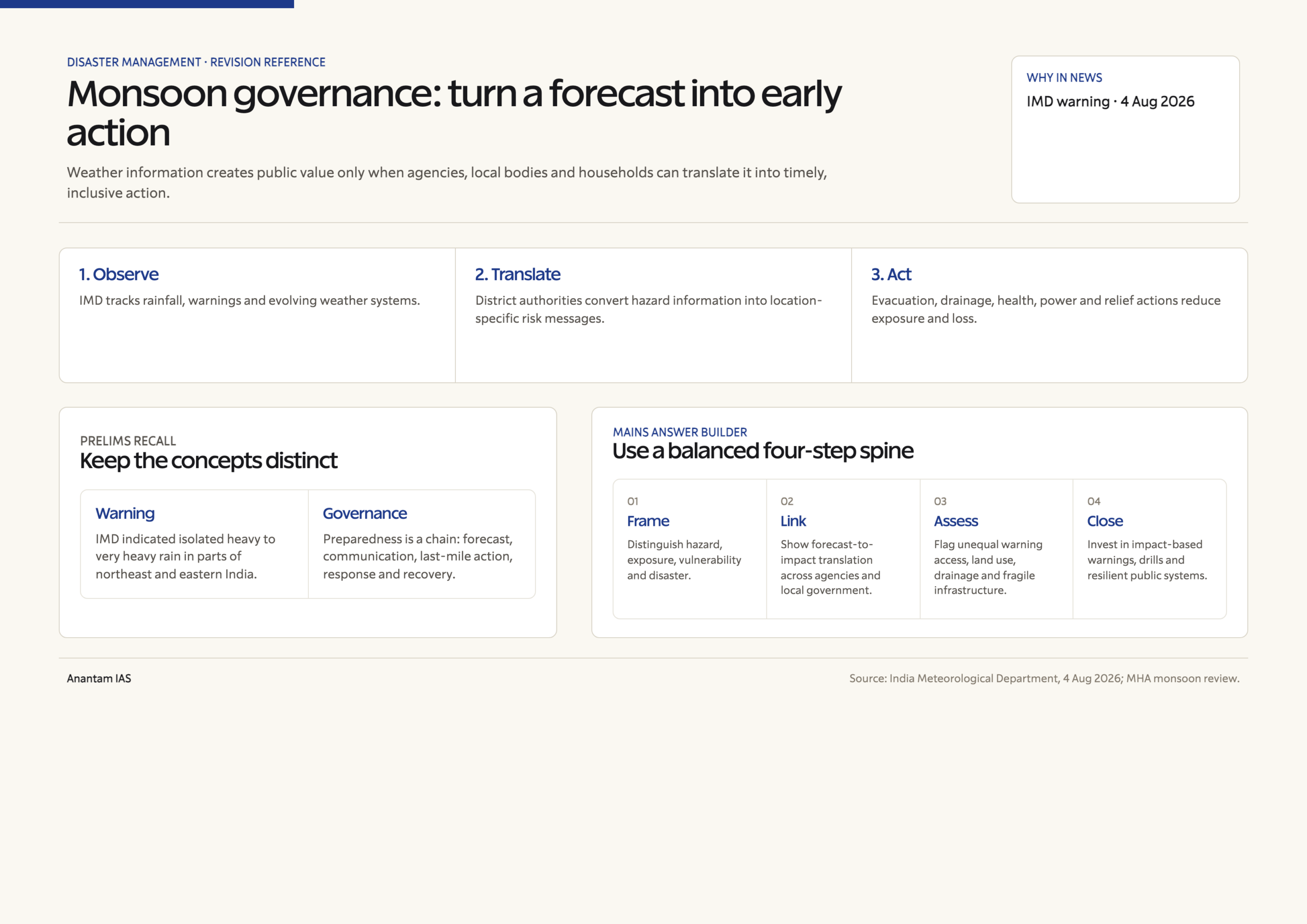
Background and Context
Read the Warning Correctly
A monsoon outlook is valuable precisely because it is forward-looking. It should prompt preparation, not retrospective storytelling about impacts that have not been verified.
- IMD’s 4 August 2026 monsoon information indicated isolated heavy to very heavy rainfall over parts of northeast and east India. It also indicated isolated heavy rainfall over Kerala and coastal and south interior Karnataka during the.
- The word isolated matters. It signals that significant rainfall may occur at some locations rather than uniformly across every district or State named in a broad regional outlook.
- Rainfall intensity, location, duration, antecedent soil moisture, reservoir levels, tide conditions, slope stability and the condition of urban drains together determine actual impact. One weather label cannot predict every local consequence.
- Administrations need to track successive bulletins, nowcasting where available, local gauges and field intelligence. A single bulletin is a trigger for vigilance, not a substitute for situational assessment.
- For an examination answer, distinguish a weather forecast from a flood forecast, a landslide alert and a formal damage assessment. Mixing these categories produces factual error and weakens analysis.
From Hazard to Disaster: The Risk Equation
Heavy rainfall is a natural hazard. It becomes a disaster when it intersects with people, assets and systems that are exposed and vulnerable, while the capacity to cope.
- A practical risk frame is: disaster risk rises with hazard, exposure and vulnerability, and falls as coping capacity improves. The frame explains why similar rainfall can produce very different outcomes in two districts.
- Floodplain settlement, silted channels, impermeable urban surfaces, inadequate culverts, hillside road cutting, deforestation, unsafe buildings and fragile power or telecom networks can amplify risk.
- Vulnerability is also social. Older persons, persons with disabilities, children, migrant workers, people without secure housing and communities with weak access to information may face greater difficulty in acting on a warning.
- Reducing risk requires more than emergency boats and relief camps. It requires risk-sensitive planning, maintenance of drainage and embankments, safe shelters, accessible communication and livelihood recovery.
- Climate variability and changing extremes increase the need for preparedness, but climate language should not obscure local governance failures that can be corrected now.
The Forecast-to-Action Chain
The central governance question is not only whether a warning was issued, but whether it led to a timely and proportionate decision by the institution closest to the.
- First, scientific agencies observe atmospheric conditions, issue forecasts and update warnings. Their products need to be translated into district-specific, action-oriented language rather than circulated as technical jargon alone.
- Second, an emergency operations centre should map likely hotspots: low-lying wards, river crossings, landslide-prone roads, construction sites, schools, hospitals, power installations and settlements with limited evacuation options.
- Third, departments need standard operating procedures. Urban bodies may clear drains and position pumps; road agencies may regulate vulnerable routes; water managers may communicate reservoir operations; health teams may protect drinking water and disease surveillance.
- Fourth, local leaders and community networks must receive warnings through multiple channels, including local language messages, sirens, radio, mobile alerts and door-to-door support where digital access is unreliable.
- Finally, decisions should be recorded and reviewed. This makes it possible to learn whether an alert reached residents, whether shelters were accessible, and whether false alarms or delays reduced trust.
Institutions and Federal Coordination
India’s disaster-management architecture works across levels of government. National capability is essential, but effective protection is necessarily local and sector-specific.
- The Disaster Management Act, 2005 provides the statutory architecture for national, State and district authorities. It places preparedness and planning alongside response and relief.
- The Ministry of Home Affairs coordinates national disaster-management arrangements and can facilitate support. Scientific agencies, the National Disaster Response Force, armed forces when requisitioned, and central ministries contribute according to their mandates.
- States and districts are not passive recipients. They must maintain contingency plans, control rooms, local resource inventories, evacuation arrangements and communication links with municipalities, panchayats and communities.
- Interdepartmental coordination is especially important because waterlogging, a blocked road, power failure and unsafe drinking water can rapidly become a compound emergency. No single department owns the entire risk.
- Financial and operational assistance should be paired with transparent needs assessment, public information and post-event learning so that recovery builds resilience rather than merely restoring the earlier vulnerability.
Way Forward
Make Warnings Usable
- Expand impact-based, district-level communication and link it to clear triggers for school safety, route management, pump deployment, evacuation readiness and health precautions.
- Use multilingual, accessible and redundant channels so that a network outage, language barrier or disability does not exclude people from protective information.
- Build feedback loops from local responders and residents into forecast communication, so that advisories improve with actual ground conditions.
Conclusion
- IMD’s current monsoon warning is best treated as an opportunity for anticipatory governance.
- For UPSC, build the answer around the hazard-exposure-vulnerability-capacity frame, then show the forecast-to-action chain and conclude with risk-sensitive planning that reduces avoidable losses before the next intense-rainfall episode.
UPSC Practice Questions
Prelims MCQ 1
With reference to disaster risk, consider the following statements:
- A weather forecast and a verified damage assessment are the same category of information.
- Exposure and vulnerability can influence the impact of a heavy-rainfall event.
- The Disaster Management Act, 2005 provides a statutory framework for disaster-management institutions in India.
How many of the above statements are correct?
(a) Only one (b) Only two (c) All three (d) None
Answer: (b) Only two
Explanation:
Statements 2 and 3 are correct. A forecast is a forward-looking assessment of likely conditions, whereas a damage assessment documents observed impact after an event.
Prelims MCQ 2
Which one of the following best describes impact-based forecasting?
(a) Replacing meteorological observations with social-media reports (b) Linking a predicted hazard with likely local effects and recommended actions (c) Declaring a disaster whenever heavy rain is forecast (d) Restricting warning communication to technical agencies
Answer: (b) Linking a predicted hazard with likely local effects and recommended actions
Explanation:
Impact-based forecasting connects weather or climate information with likely consequences for people, infrastructure or sectors, helping authorities and communities take protective action.
UPSC Mains Questions
- Early warning systems save lives only when they are translated into local action. Discuss with reference to India’s monsoon disaster-management challenges.
- Heavy rainfall becomes a disaster through the interaction of hazard, exposure and vulnerability. Analyse the role of risk-sensitive development in reducing monsoon losses.
Sources: India Meteorological Department and Ministry of Home Affairs.
Frequently Asked Questions
What did IMD’s 4 August 2026 monsoon update say?
IMD’s monsoon information indicated the likelihood of isolated heavy to very heavy rainfall over parts of northeast and east India, and isolated heavy rainfall over Kerala and coastal and south interior Karnataka during the stated forecast period. It is a.
What is the difference between a forecast and a warning?
A forecast estimates expected weather conditions for a period and area. A warning highlights potentially hazardous weather and is intended to support protective action. Both must be read with location, timing, probability and updates; neither should be confused with a.
Why can the same rainfall produce different impacts?
Impact depends on the intensity and duration of rain as well as local exposure and vulnerability. Drainage condition, slope stability, floodplain occupation, reservoir operations, soil moisture, housing quality, access to warnings and response capacity can all alter the outcome.
What is impact-based forecasting?
Impact-based forecasting links an expected weather hazard to possible effects on people, infrastructure, transport, agriculture or services, and pairs that assessment with recommended action. It helps convert a technical bulletin into a practical decision tool for administrations and communities.
What is the role of the Ministry of Home Affairs in disaster management?
The Ministry of Home Affairs coordinates national disaster-management arrangements and related response support, while scientific agencies, central ministries, States, districts and local bodies perform their own statutory or sectoral roles. Effective response depends on coordination rather than on one institution.
Source: https://anantamias.com/current-affairs/southwest-monsoon-disaster-management-2026/