Why in News?
The Election Commission of India (ECI) has published the draft-roll schedule for a Special Intensive Revision of electoral rolls in Meghalaya.
- A revision of an electoral roll concerns the list of eligible electors, not the conduct or result of a poll.
- The ECI’s published Meghalaya schedule makes the draft-roll stage a live example of verification, public notice and correction in electoral administration.
- An intensive revision calls attention to both sides of roll integrity: preventing wrongful inclusion and preventing exclusion of a qualified elector.
- The legally significant safeguard is an opportunity to make a claim, raise an objection and seek correction through the prescribed electoral-registration process.
- The topic links constitutional democracy with state capacity, local field verification, accessible documentation and procedural fairness.
- A credible electoral roll is the entry point to adult suffrage. A person cannot vote in a constituency merely because an election is being held there; their name must be entered in the relevant roll under.
- Roll revision is a continuing administrative task, not a one-time clean-up. Population movement, deaths, new eligibility, address change and clerical mistakes require lawful updating.
- A strong Mains answer should pair accuracy with inclusion, transparency, appeal and public confidence rather than treating verification as an end in itself.
UPSC Relevance
Prelims Relevance
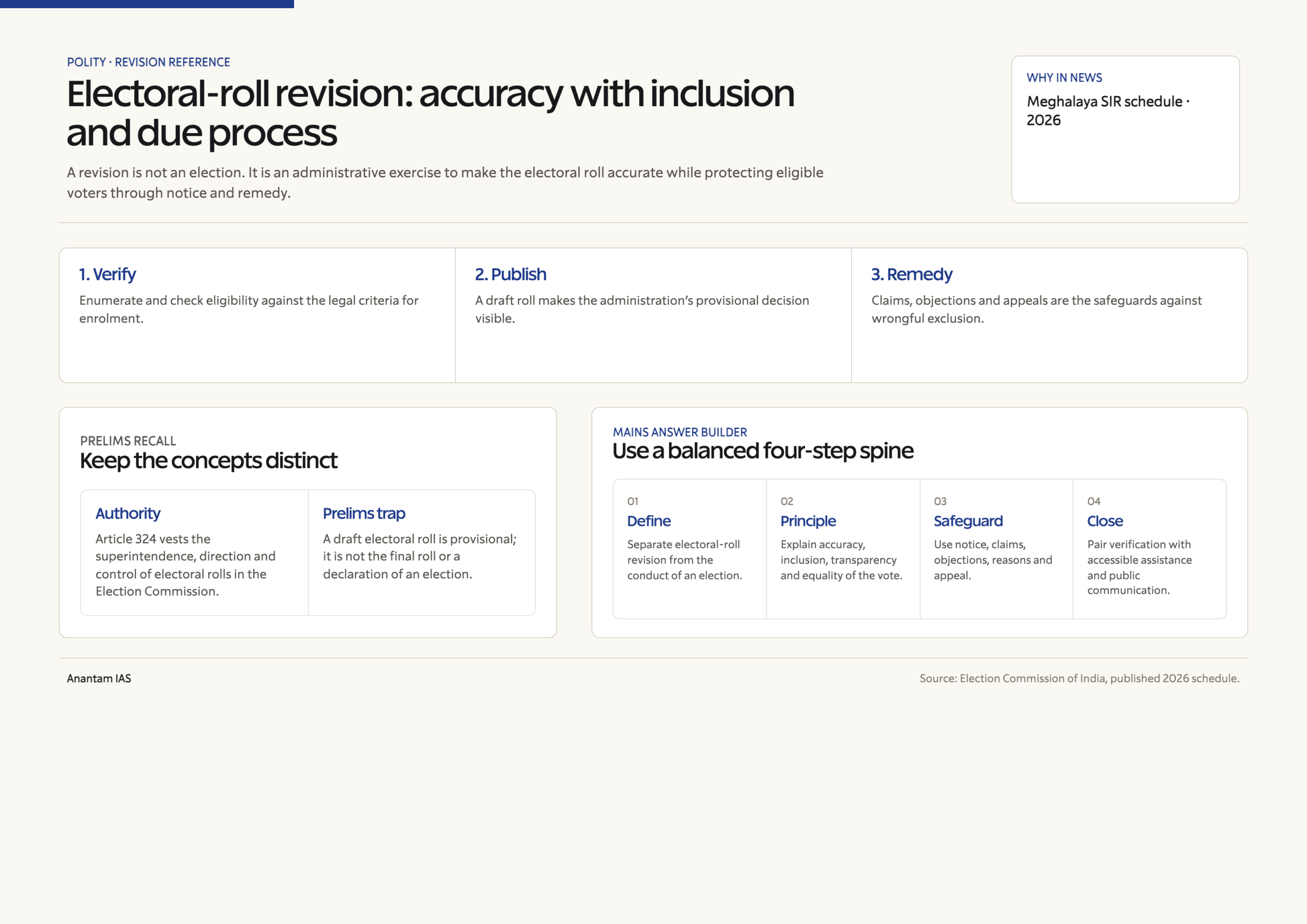
- Article 324 vests the superintendence, direction and control of elections in the Election Commission of India, including the preparation of electoral rolls.
- The Representation of the People Act, 1950 is central to the preparation and revision of electoral rolls; the Representation of the People Act, 1951 deals mainly with the conduct of elections and related matters.
- The qualifying age for registration as an elector is 18 years, subject to the statutory conditions for inclusion in a constituency roll.
- Electoral rolls are prepared constituency-wise and are maintained through prescribed registration machinery and procedures.
- A draft roll is a provisional public stage at which claims, objections and correction requests can be made under the applicable procedure.
- A person cannot be registered in more than one constituency or more than once in the same constituency electoral roll.
Mains Relevance
GS Paper 2
- Use electoral-roll revision to discuss the institutional conditions needed for free and fair elections: accurate registers, equal access, transparent procedures and remedies.
- Examine the role of the ECI and electoral-registration authorities in balancing administrative verification with a citizen’s right to participate in representative democracy.
GS Paper 2
- Assess how public notice, claims, objections and appellate remedies give procedural content to inclusion in an electoral roll.
- Discuss the challenges of migration, remote habitations, disability access, language, documentation and digital exclusion in maintaining accurate rolls.
Essay
- Democracy is sustained not only by the day of voting but also by the quieter public institutions that make participation possible.
Background and Context
What an Electoral Roll Does
An electoral roll is the constituency-wise register of persons entitled to vote. It is foundational to adult suffrage because voting rights are exercised through a lawful entry in.
- The roll performs an inclusion function: it identifies persons who meet the legal conditions for registration in a constituency. It also performs an integrity function by helping prevent multiple or ineligible entries.
- A revision should not be confused with an election. The Meghalaya exercise concerns the preparation and correction of the voter list; it does not announce polling, candidates or an electoral outcome.
- The published draft-roll schedule is important because a draft is not the final word. It creates a public stage at which citizens and other affected persons can use the prescribed process to seek inclusion, correction or.
- For an exam answer, begin with this distinction. Electoral integrity requires a reliable register before the campaign and polling stages can be meaningful.
- Roll management is continuous. Young citizens become eligible, residents change address, people move for work or education, and records can acquire duplications or inaccuracies. The register must respond to these changes through law-bound processes.
Constitutional and Statutory Architecture
The constitutional anchor is Article 324, which assigns the ECI superintendence, direction and control over elections, including preparation of electoral rolls. The statutory framework turns that mandate into.
- The Representation of the People Act, 1950 provides the core legal framework for allocation of seats and electoral rolls. It should be distinguished from the Representation of the People Act, 1951, which is associated with election.
- Article 326 establishes elections to the Lok Sabha and State Legislative Assemblies on the basis of adult suffrage, subject to the Constitution and laws made by the appropriate legislature. The minimum voting age is 18 years.
- The electoral-registration system applies statutory tests such as age, citizenship and ordinary residence. It must do so through defined authorities and procedures rather than through informal assumptions about a person’s social standing or property ownership.
- A person is not entitled to appear more than once in the same electoral roll or in rolls for more than one constituency. This rule protects equality among electors and the one-person-one-vote principle.
- This framework shows why revision is both an administrative and constitutional task. An inaccurate roll can dilute equal participation, while an unfair process of correction can exclude a person from the democratic process.
Draft Roll, Claims and Objections
The draft-roll stage makes revision visible and contestable. It allows the register to be checked before final publication and gives procedural space to people whose interests are affected.
- The ECI’s Meghalaya notice makes the published draft-roll schedule the present hook. Its larger lesson is that a revision must contain a genuine opportunity for public scrutiny rather than an opaque back-end data exercise.
- A qualified person who finds their name missing, wrongly recorded or assigned to an incorrect constituency needs a clear route to make a claim or request correction. The process should be understandable in local languages and.
- An objection to an existing entry concerns a different risk: the roll may contain a duplicate, a person not ordinarily resident in the constituency, or another entry that requires scrutiny under law. An objection should not.
- Officials must record and assess material under the prescribed procedure. Public confidence increases when decisions are communicated, reasons are available where required, and a person knows the next remedial step.
- The UPSC framing is due process in electoral administration: notice, opportunity, evidence, an impartial decision and a remedy work together to protect both accuracy and inclusion.
Intensive Revision and Field-Level Capacity
An intensive revision places particular emphasis on verification and updating. Its credibility depends not only on a formal schedule but also on implementation capacity close to the voter.
- Field-level outreach can help identify address changes, new eligible citizens and factual errors. It must be accompanied by training, supervision and respectful engagement, especially where households are remote or records are incomplete.
- Meghalaya’s varied terrain and settlement patterns make accessibility a useful analytical lens. The article does not infer any particular local outcome from the schedule; it highlights why the last mile matters in every revision exercise.
- Digital tools can make searching, filing and tracking easier for many citizens. They cannot be the sole route. Assisted offline options are vital for people facing connectivity constraints, disability barriers, language barriers or limited digital familiarity.
- Data handling requires restraint. Electoral databases contain personal details and their collection, verification and disclosure should follow a defined public purpose, secure processes and proportionate access.
- Verification gains legitimacy when it is rule-based and reviewable. A target-driven deletion exercise, or an unexamined reliance on automated matching, can create errors that are difficult for citizens to discover and correct.
Way Forward
Design Revision Around the Citizen
- Publish simple, multilingual guidance on eligibility, ordinary residence, the distinction between a claim and an objection, and the available correction channels.
- Maintain assisted offline access through local electoral staff and accessible help points, while allowing digital search and tracking where it helps.
- Plan outreach for first-time voters, migrant workers, remote communities and persons with disabilities without presuming that one document or one channel fits every legitimate case.
Conclusion
- The ECI’s published Meghalaya draft-roll schedule is a reminder that elections depend on work done well before polling day.
- Its democratic test is twofold: protect the roll against error and duplication, while ensuring that every eligible citizen can understand the process, be heard and obtain a fair decision.
UPSC Practice Questions
Prelims MCQ 1
With reference to electoral rolls in India, consider the following statements:
- Article 324 includes preparation of electoral rolls within the Election Commission of India’s constitutional domain.
- The Representation of the People Act, 1950 is central to preparation and revision of electoral rolls.
- A person may be registered in more than one constituency if that person owns property in each constituency.
How many of the above statements are correct?
(a) Only one (b) Only two (c) All three (d) None
Answer: (b) Only two
Explanation:
Statements 1 and 2 are correct. Article 324 covers preparation of electoral rolls, and the Representation of the People Act, 1950 governs their statutory framework. Property ownership does not permit multiple registrations; a person cannot be registered in more than one constituency or more than once in the same constituency.
Prelims MCQ 2
Which one of the following best distinguishes electoral-roll revision from delimitation?
(a) Roll revision updates eligible electors, whereas delimitation concerns constituency boundaries and allocation of seats. (b) Roll revision is conducted only after a general election, whereas delimitation is conducted before every election. (c) Roll revision determines the number of seats in Parliament, whereas delimitation registers voters. (d) Roll revision is a judicial function, whereas delimitation is an executive function.
Answer: (a) Roll revision updates eligible electors, whereas delimitation concerns constituency boundaries and allocation of seats.
Explanation:
Electoral-roll revision concerns the constituency-wise register of electors. Delimitation concerns the territorial boundaries of constituencies and allocation of seats; the two processes are distinct.
UPSC Mains Questions
- An accurate electoral roll is necessary but not sufficient for free and fair elections. Discuss the institutional and procedural safeguards needed to reconcile roll integrity with inclusive adult suffrage.
- Explain the constitutional and statutory basis of electoral-roll revision in India. How do claims, objections and accessible remedies strengthen electoral democracy?
Source: Election Commission of India.
Frequently Asked Questions
What is a Special Intensive Revision of electoral rolls?
It is a focused electoral-roll revision that places emphasis on verification and updating of the constituency-wise voter register under the electoral-registration framework. The immediate Meghalaya news hook is the Election Commission’s published draft-roll schedule. The process is about the voter.
Why is the draft-roll stage important?
A draft roll is a provisional public stage before final publication. It gives eligible citizens an opportunity to check whether their name and particulars are correctly recorded and to use the prescribed process for a claim or correction. It also.
Which law governs electoral rolls in India?
The Representation of the People Act, 1950 is central to the preparation and revision of electoral rolls. It operates within the constitutional framework of Article 324, which assigns the Election Commission superintendence, direction and control over elections, including electoral rolls.
Can a voter be registered in two constituencies?
No. A person cannot be registered in more than one constituency or more than once in the same constituency electoral roll. The rule protects the equal value of each vote. Registration depends on statutory conditions, including ordinary residence; it is.
How can electoral-roll revision remain inclusive?
Revision needs clear public notice, multilingual guidance, local assistance and workable routes for claims, objections and corrections. Offline support matters alongside digital services for people facing connectivity, disability, language or documentation barriers. Accuracy improves when eligible citizens can find and.
Tell Google you want more of this.
Add Anantam IAS as a preferred sourceOne tap, and this site shows up more often in your own Top Stories, AI Overviews and AI Mode. Remove it any time.