

Why in News?
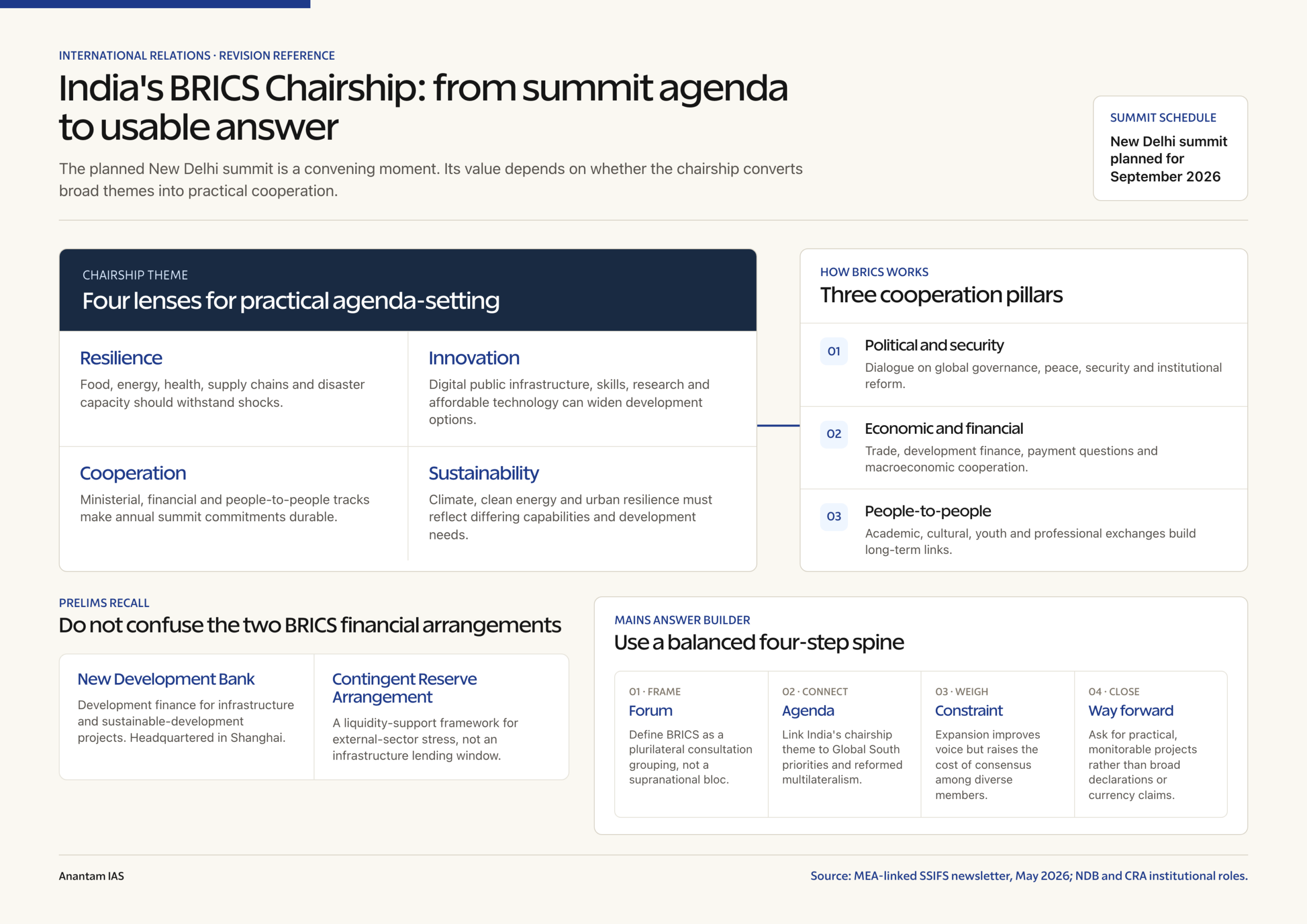
India’s 2026 chairship of BRICS is moving toward the 18th BRICS Summit planned in New Delhi in September.
- India assumed the BRICS chairship on 1 January 2026.
- The 18th BRICS Summit is planned for New Delhi in September 2026.
- The official training programme describes three continuing cooperation pillars: political and security, economic and financial, and cultural and people-to-people cooperation.
- The BRICS Young Diplomats Forum held in May 2026 brought diplomats from Brazil, China, Egypt, Ethiopia, India, Indonesia, Iran, Russia and South Africa into the chairship process.
- The immediate exam task is to distinguish a summit agenda and chairship priority from a binding treaty, a formal international organisation, or a common-currency announcement.
- It tests how India can use a plurilateral forum to argue for reformed multilateralism while retaining strategic autonomy.
- It connects summit diplomacy with the practical institutions and ministerial tracks that make cooperation durable between annual leaders’ meetings.
- It offers an answer-building case on whether wider representation can improve the legitimacy of global economic and political governance.
UPSC Relevance
Prelims Relevance
- BRICS began as BRIC and became BRICS after South Africa joined the grouping in 2010.
- BRICS is a plurilateral grouping; it is not created by a constituent treaty comparable to the UN Charter.
- The grouping’s cooperation is commonly organised around political and security, economic and financial, and people-to-people pillars.
- The New Development Bank was established by BRICS countries in 2014 and is headquartered in Shanghai.
- The Contingent Reserve Arrangement is a liquidity-support arrangement, not a development-lending institution.
- India’s BRICS chairship in this cycle began on 1 January 2026.
Mains Relevance
GS Paper 2
- Assess BRICS as an instrument for India’s reformed multilateralism and Global South engagement.
- Analyse how a larger forum can widen representation while making consensus-building more difficult.
GS Paper 3
- Use the New Development Bank and the Contingent Reserve Arrangement to explain alternative sources of development finance and financial safety nets.
- Discuss the limits of financial cooperation where members have unequal economic structures, sanctions exposure, and different currency preferences.
Essay
- A stable international order needs both representation and the capacity to convert common principles into implementable cooperation.
Background and Context
What BRICS Is and What It Is Not
BRICS is best understood as a flexible political and economic consultation forum among major emerging economies. Its value lies in agenda-setting, regular ministerial and technical tracks, and institution-building.
- The original BRIC formulation referred to Brazil, Russia, India and China. South Africa joined in 2010, after which the grouping used the name BRICS.
- Leaders’ summits provide political direction, but much of the substantive work occurs through foreign ministers, finance officials, sectoral ministers, working groups, business forums and academic or civil-society exchanges.
- BRICS has no parliament, no directly enforceable legal code, and no permanent secretariat with powers comparable to those of the European Commission. Its outputs depend heavily on consensus and follow-through by member governments.
- A declaration, a ministerial communique, an institutional arrangement, and a domestic policy announcement are different instruments. A good answer should not treat each summit phrase as an automatically enforceable obligation.
- The grouping has expanded its external reach through outreach formats and institutional links. Enlargement can strengthen voice and reach, but it also enlarges the range of interests that must be accommodated.
India's 2026 Chairship and the Summit Agenda
A chairship gives the host an opportunity to convene, sequence meetings, frame priorities, and seek practical deliverables. It does not give the chair unilateral authority to define BRICS.
- The official chairship theme, Building Resilience, Innovation, Cooperation and Sustainability, offers a four-part frame rather than a pre-negotiated summit outcome.
- Resilience can include supply-chain reliability, disaster preparedness, food and energy security, public-health capacity, and the capacity of institutions to manage shocks.
- Innovation can cover digital public infrastructure, science cooperation, skills, research networks, responsible use of emerging technologies, and the diffusion of affordable solutions across developing economies.
- Cooperation must be read across the grouping’s three pillars. It includes political dialogue, economic and financial coordination, and people-to-people exchanges such as academic, cultural, youth, and professional networks.
- Sustainability can connect development finance, climate action, clean-energy transitions, urban resilience, and the principle that climate responsibilities reflect differing capabilities and development needs.
Institutions and Economic Cooperation
BRICS is often associated with debates on currencies and finance, but its most concrete institutional achievements are better assessed through the mandates of the New Development Bank and.
- The New Development Bank, established in 2014 and headquartered in Shanghai, finances infrastructure and sustainable-development projects. It is distinct from the World Bank and is not a replacement for all multilateral development banks.
- The Contingent Reserve Arrangement is designed as a liquidity-support framework for balance-of-payments pressures. It is not a normal project-finance window and should not be confused with the NDB.
- Debate on the greater use of local currencies should be separated from claims of an agreed common BRICS currency. Settlement arrangements, payment connectivity, reserve-currency choices, and a shared currency involve different degrees of policy coordination.
- For developing countries, a wider menu of finance and payment options can improve resilience. The gain depends on project quality, debt sustainability, transparent procurement, and the ability to manage exchange-rate and sanctions-related risks.
- An exam answer should recognise both the attraction of diversified finance and the operational limits created by unequal economic sizes, divergent monetary policies, and geopolitical tensions among members.
Expansion, Representation and the Global South
BRICS expansion has made the forum more representative of regions and development experiences that were under-represented in earlier global-governance arrangements. Representation alone, however, does not create a common.
- The May 2026 BRICS Young Diplomats Forum involved Brazil, China, Egypt, Ethiopia, India, Indonesia, Iran, Russia and South Africa, illustrating the wider diplomatic canvas within which India is preparing the summit.
- More participating states can deepen South-South exchanges on development, technology, trade, health, food systems, and climate adaptation. It can also create more channels for raising concerns about reform of the UN Security Council and international financial.
- A larger membership makes agenda management harder. Members differ on regional conflicts, relations with Western economies, energy choices, trade interests, and the pace or form of institutional reform.
- India’s useful position is not to reduce BRICS to an anti-West bloc. It can argue for a multipolar and rules-based order in which developing countries gain agency while dialogue with all major powers remains possible.
- The quality test for any summit outcome is practical follow-up: clear institutional ownership, capacity-building, finance where needed, and measurable cooperation rather than only broad political language.
Way Forward
Keep Deliverables Practical
- Prioritise projects where members have a clear shared interest, such as disaster-resilient infrastructure, affordable health technologies, skilling, food-security research, and clean-energy finance.
- Set timelines, lead institutions, and review mechanisms for feasible initiatives instead of relying on expansive but untracked declarations.
- Use the New Development Bank’s development mandate carefully, with attention to environmental safeguards, debt sustainability, and public value.
Conclusion
- The planned New Delhi summit is a chance to judge BRICS by what it can implement, not by the scale of the claims made around it.
- For UPSC answers, begin with BRICS as a plurilateral forum, identify its three cooperation pillars and financial institutions, then weigh the promise of wider representation against the challenge of consensus among diverse members.
UPSC Practice Questions
Prelims MCQ 1
With reference to BRICS, consider the following statements:
- The New Development Bank is headquartered in Shanghai.
- The Contingent Reserve Arrangement is primarily a project-finance institution for infrastructure.
- South Africa joined the original BRIC grouping in 2010.
How many of the above statements are correct?
(a) Only one (b) Only two (c) All three (d) None
Answer: (b) Only two
Explanation:
Statements 1 and 3 are correct. The Contingent Reserve Arrangement is a liquidity-support framework, whereas the New Development Bank is the BRICS development-finance institution.
Prelims MCQ 2
Which one of the following correctly distinguishes the two BRICS financial arrangements?
(a) The NDB manages elections while the CRA conducts trade negotiations (b) The NDB provides development finance while the CRA is a liquidity-support arrangement (c) The NDB is a UN agency while the CRA is a WTO body (d) The NDB is a common currency while the CRA is a customs union
Answer: (b) The NDB provides development finance while the CRA is a liquidity-support arrangement
Explanation:
The New Development Bank finances infrastructure and sustainable-development projects. The Contingent Reserve Arrangement is intended to provide a liquidity-support framework during external-sector stress.
UPSC Mains Questions
- India’s BRICS chairship can advance the cause of reformed multilateralism, but enlargement also raises the cost of consensus. Discuss.
- How do the New Development Bank and the Contingent Reserve Arrangement expand the policy options of emerging economies? Examine their potential and limitations.
Sources: MEA, Sushma Swaraj Institute of Foreign Service and The Hindu Explained.
Frequently Asked Questions
What is BRICS?
BRICS is a plurilateral forum of major emerging economies that coordinates through leaders’ summits, ministerial meetings and sectoral tracks. It is not a supranational organisation with a common legislature or enforceable legal code. Its influence comes from political consultation, agenda-setting.
When will the 18th BRICS Summit be held?
An MEA-linked Sushma Swaraj Institute of Foreign Service newsletter states that the 18th BRICS Summit is planned in New Delhi in September 2026. A planned summit date should be treated as the current official schedule, not as evidence that any.
What is India’s BRICS chairship theme for 2026?
India’s 2026 chairship theme is Building Resilience, Innovation, Cooperation and Sustainability. The theme is a framework for meetings and possible deliverables. It can be read through economic and financial cooperation, political and security dialogue, and cultural and people-to-people exchanges.
What is the difference between the NDB and the CRA?
The New Development Bank is a development-finance institution that supports infrastructure and sustainable-development projects. The Contingent Reserve Arrangement is a liquidity-support framework intended to help members facing external-sector or balance-of-payments pressures. They serve different purposes and should not be used.
Does BRICS have a common currency?
No common BRICS currency should be presumed from discussions about local-currency settlement or payment cooperation. Local-currency use, payment connectivity, reserve diversification and a shared currency are distinct policy choices. Each would require different levels of institutional, monetary and political coordination.
Tell Google you want more of this.
Add Anantam IAS as a preferred sourceOne tap, and this site shows up more often in your own Top Stories, AI Overviews and AI Mode. Remove it any time.






