Daily Digest
UPSC · Civil Services Examination
Current Affairs · Tuesday, 6 January 2026
Current affairs curated and edited by Anantam IAS faculty — pulled from The Hindu, PIB, IDSA, Foreign Affairs and the ministries. Read, annotate, revise.
Old Rajinder Nagar · Delhi 110005 · anantamias.com
Payments Regulatory Board: Reshaping Oversight of India’s Digital Payments
Why in News?
The Reserve Bank of India (RBI) notified the constitution of the Payments Regulatory Board (PRB), a new statutory body that replaces the older Board for Regulation and Supervision of Payment and Settlement Systems (BPSS) as the apex authority for regulating and supervising payment systems in India.
The PRB takes over the powers exercised under the Payment and Settlement Systems Act, 2007, and will set policy for systems such as UPI, cards, prepaid instruments, and large-value settlement rails like RTGS and NEFT.
- The PRB is chaired by the RBI Governor, with the Deputy Governor in charge of payments as the vice-chair.
- Its membership includes three nominees of the Central Government, alongside RBI members and experts.
- It supersedes the BPSS, which was a sub-committee of the RBI’s Central Board with no government nominees.
- The board’s mandate covers authorisation, oversight and standard-setting for all payment and settlement systems.
The development matters in the context of:
- Sets up a recurring tension between regulatory independence and government representation in financial-sector bodies.
- Comes as India’s UPI volumes cross record monthly transactions, making payments oversight systemically important.
- Reflects a broader shift in how the Finance Ministry and the RBI share institutional authority over the digital-payments stack.
UPSC Relevance
Prelims Relevance
- Payment and Settlement Systems Act, 2007 — the parent statute for payments regulation in India.
- Payments Regulatory Board (PRB) — replaces the BPSS; chaired by the RBI Governor.
- Board for Regulation and Supervision of Payment and Settlement Systems (BPSS) — the earlier RBI sub-committee.
- Reserve Bank of India as the designated authority for payment systems under the Act.
- National Payments Corporation of India (NPCI) — operates UPI, RuPay, IMPS and NACH.
- Unified Payments Interface (UPI), RTGS, NEFT and Prepaid Payment Instruments (PPIs) as regulated payment systems.
- Composition: RBI Governor, Deputy Governor, RBI nominees and three Central Government nominees.
- Distinction between a statutory regulator and an internal RBI committee.
Mains Relevance
GS Paper 3
- Role of the RBI in regulating India’s payment and settlement systems and the implications of the PRB for financial stability.
- How the digital-payments ecosystem (UPI, cards, PPIs) shapes financial inclusion and the formalisation of the economy.
GS Paper 2
- Debates on regulatory autonomy versus government representation in independent financial-sector bodies.
Essay
- Independence of regulators in a developmental state — balancing accountability with autonomy.
- Technology and trust — governing India’s digital public infrastructure.
Background and Context
Why payments needed a dedicated regulator
Payment systems sit at the core of financial stability, and India built a statutory base for their oversight nearly two decades ago.
- The Payment and Settlement Systems Act, 2007 designated the RBI as the authority to regulate and supervise payment systems and to authorise their operation.
- Under the Act, the RBI set up the BPSS in 2005 as a sub-committee of its Central Board to discharge these powers.
- A ‘payment system’ under the Act covers any system enabling payment between a payer and a beneficiary — cards, UPI, money transfers, clearing and settlement.
- As volumes scaled, the case grew for a more formal, statutorily defined board rather than an internal committee.
From BPSS to the Payments Regulatory Board
The PRB is a statutory upgrade of the body that previously governed payments inside the RBI.
- The BPSS had only RBI members and reported within the central bank’s governance structure.
- The PRB is constituted as the apex decision-making body for payments policy, replacing the BPSS entirely.
- Chair: the RBI Governor; vice-chair: the Deputy Governor overseeing the payments portfolio.
- Members: RBI officials and experts plus three nominees of the Central Government, a structural change from the BPSS.
What the PRB regulates
The board’s remit spans the full payments stack, from retail rails to systemically important settlement systems.
- UPI — the interoperable real-time retail rail operated by NPCI, now India’s dominant payment mode.
- Card networks and Prepaid Payment Instruments (PPIs) such as wallets.
- Large-value and bulk systems: RTGS (real-time gross settlement) and NEFT.
- Standard-setting, authorisation of operators, and oversight of risk, security and interoperability.
The autonomy-versus-representation debate
The inclusion of government nominees has reopened a long-running question about how independent India’s financial regulators should be.
- Supporters of regulatory autonomy argue payments policy benefits from insulation from short-term political and fiscal pressures.
- The presence of government nominees on the board is read by critics as a dilution of the RBI’s operational independence.
- Earlier drafts proposing an independent payments regulator separate from the RBI were debated and then dropped in favour of an RBI-anchored board.
- The episode echoes wider questions about independent regulatory bodies, where central banks usually retain primacy over payment-system oversight.
Why the stakes are high now
Payments are no longer a back-office function; they are critical digital public infrastructure.
- UPI processes billions of transactions a month, making any oversight gap a systemic concern.
- Outages, fraud and data-security incidents in payment rails carry economy-wide spillovers.
- A clear regulatory anchor matters for cross-border payment linkages and for fintech innovation.
- Strong oversight underpins public trust in cashless transactions and continued financial inclusion.
Way Forward
Safeguard regulatory independence
- Codify clear decision rules so the RBI retains primacy over technical and prudential payments matters.
- Keep the role of government nominees advisory on policy direction rather than operational supervision.
Strengthen oversight capacity
- Invest in monitoring of fraud, outages and cyber-risk across UPI, cards and PPIs.
- Ensure transparent, consultative standard-setting with operators such as NPCI and banks.
Build accountability by publishing the board’s decisions and review processes, so that autonomy is paired with transparency rather than opacity.
Conclusion
The Payments Regulatory Board formalises and elevates the governance of a payments system that now touches almost every Indian transaction. By replacing the BPSS with a statutory board, it signals that digital payments are systemically important and deserve a dedicated apex authority.
The unresolved question is institutional design. Keeping the RBI at the centre while admitting government nominees will test whether India can combine democratic accountability with the regulatory independence that financial stability requires.
UPSC Practice Questions
Prelims MCQ 1
With reference to the Payments Regulatory Board (PRB), consider the following statements:
- It is constituted under the Payment and Settlement Systems Act, 2007.
- It replaces the Board for Regulation and Supervision of Payment and Settlement Systems (BPSS).
- It is chaired by the Union Finance Minister.
How many of the above statements are correct?
(a) Only one (b) Only two (c) All three (d) None
Answer: (b) Only two
Explanation:
Statements 1 and 2 are correct: the PRB derives from the Payment and Settlement Systems Act, 2007, and replaces the BPSS. Statement 3 is wrong — the PRB is chaired by the RBI Governor, not the Finance Minister.
Prelims MCQ 2
Which of the following payment systems falls within the regulatory remit of the RBI’s payments board?
(a) Unified Payments Interface (UPI) only (b) RTGS and NEFT only (c) Prepaid Payment Instruments (PPIs) only (d) UPI, cards, PPIs and RTGS/NEFT
Answer: (d) UPI, cards, PPIs and RTGS/NEFT
Explanation:
The board’s mandate spans the full payments stack — UPI, card networks, prepaid instruments and large-value settlement systems such as RTGS and NEFT.
UPSC Mains Questions
- The Payments Regulatory Board replaces the BPSS as the apex authority for India’s payment systems. Examine its significance for financial stability and the digital-payments ecosystem. (250 words)
- Government representation on financial-sector boards is often defended as democratic accountability and criticised as a threat to regulatory autonomy. Critically discuss with reference to the Payments Regulatory Board. (250 words)
- India’s digital public infrastructure, led by UPI, has transformed payments. Discuss the regulatory challenges this scale creates and how a dedicated payments board can address them. (150 words)
Sources: Reserve Bank of India and The Hindu.
Frequently Asked Questions
What is the Payments Regulatory Board?
The Payments Regulatory Board (PRB) is a statutory body constituted by the Reserve Bank of India to regulate and supervise payment and settlement systems in India. It replaces the older Board for Regulation and Supervision of Payment and Settlement Systems (BPSS) and sets policy for systems such as UPI, cards and prepaid instruments.
Which body did the PRB replace?
The PRB replaces the Board for Regulation and Supervision of Payment and Settlement Systems (BPSS), which was a sub-committee of the RBI’s Central Board. Unlike the BPSS, the PRB is constituted as a formal statutory board and includes Central Government nominees alongside RBI members.
Under which law is the PRB constituted?
The PRB exercises powers under the Payment and Settlement Systems Act, 2007. This Act designates the Reserve Bank of India as the authority to regulate, supervise and authorise payment systems operating in the country, providing the statutory basis for the board’s functions.
Who chairs the Payments Regulatory Board?
The Payments Regulatory Board is chaired by the RBI Governor, with the Deputy Governor in charge of payments acting as vice-chair. Its membership combines RBI officials and experts with three nominees of the Central Government, which is the change driving the autonomy debate.
Why is the PRB linked to a debate on RBI autonomy?
The inclusion of Central Government nominees on the board has revived concerns about regulatory independence. Critics argue it could dilute the RBI’s operational autonomy over payments, while supporters frame it as democratic accountability over a systemically important public infrastructure.
What payment systems does the PRB oversee?
The board oversees the full payments stack, including the Unified Payments Interface (UPI), card networks, Prepaid Payment Instruments such as wallets, and large-value settlement systems like RTGS and NEFT. Its work covers authorisation, standard-setting, security and risk oversight.
Source: https://anantamias.com/current-affairs/payments-regulatory-board-prb-2026/
Somnath Temple at a Millennium: Iconoclasm, Reconstruction and National Memory
Why in News?
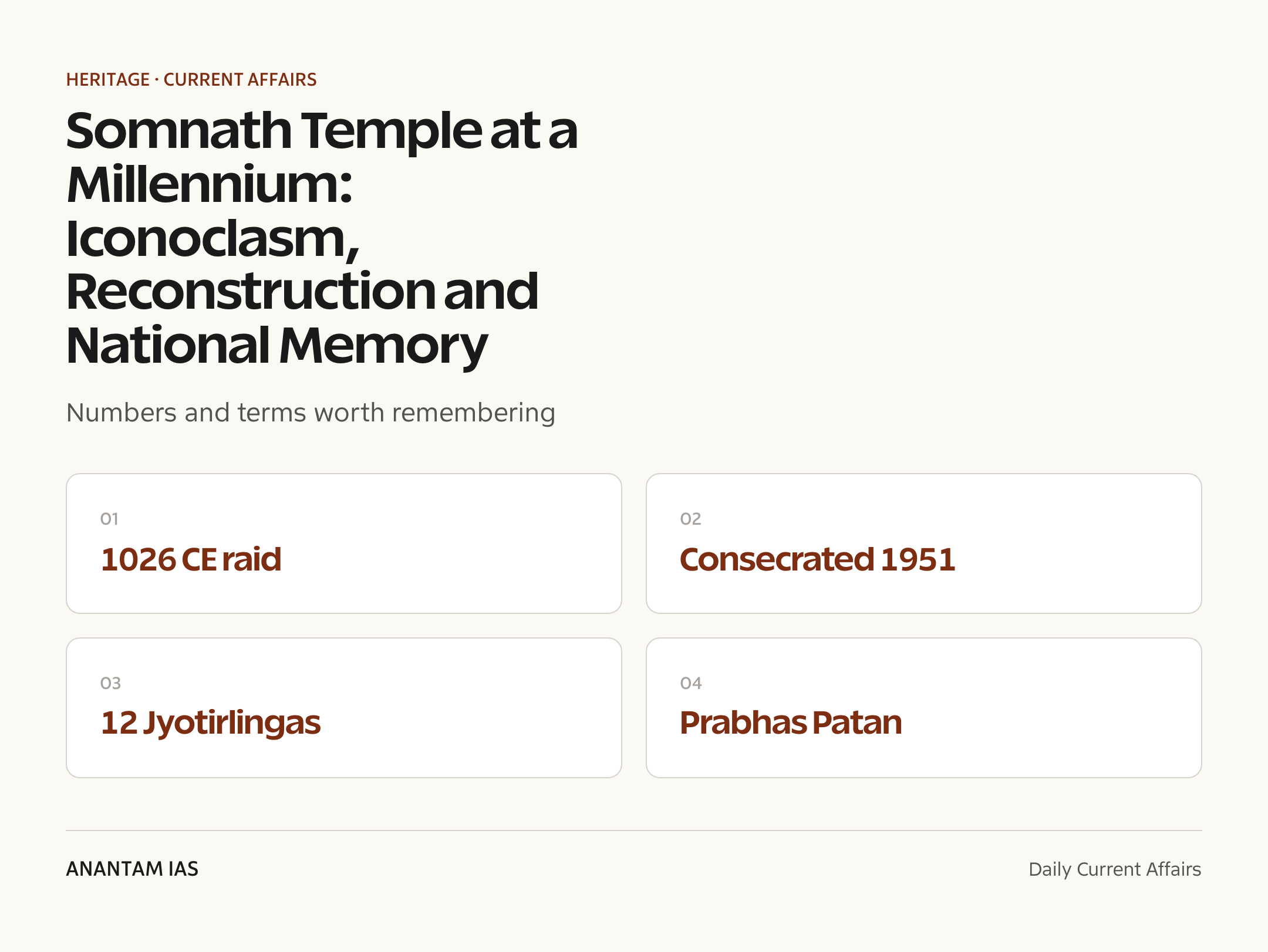
The year 2026 marks roughly a thousand years since the raid on the Somnath temple at Prabhas Patan, on the Saurashtra coast of Gujarat, by Mahmud of Ghazni in 1026 CE — an event that turned a regional shrine into a recurring symbol in debates over iconoclasm, cultural memory and restoration.
The anniversary has revived attention on Somnath’s long destruction-and-reconstruction cycle and on its post-Independence rebuilding, which was driven by Sardar Vallabhbhai Patel and K.M. Munshi and consecrated in 1951.
- Somnath is counted among the twelve Jyotirlinga shrines of Shiva, the holiest class of Shaivite sites in India.
- The temple stands on the coast at Prabhas Patan near Veraval, in Gir Somnath district of Gujarat.
- Mahmud of Ghazni’s raid of 1026 CE is the most cited of several attacks the shrine endured between the 11th and 18th centuries.
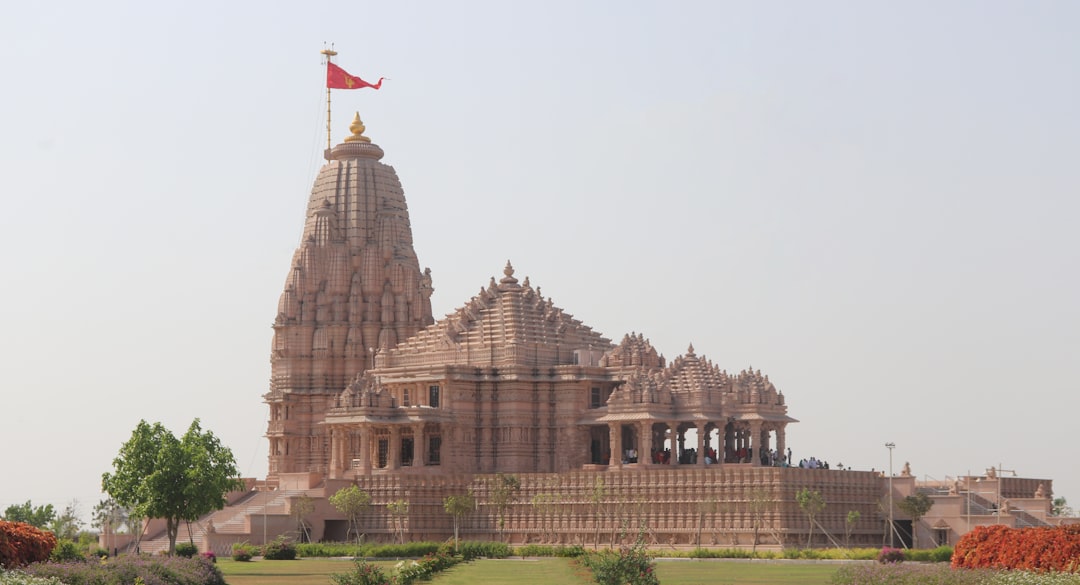
- The present structure, in the Maru-Gurjara (Solanki) style, was completed and consecrated on 11 May 1951 by President Rajendra Prasad.
- The rebuilding was steered by the Somnath Trust, set up at the initiative of Sardar Patel after Independence.
The development matters in the context of:
- Somnath sits at the intersection of three durable syllabus themes — temple architecture styles, medieval iconoclasm, and the politics of heritage restoration.
- Its history is a case study in how a single monument is read very differently across communities and centuries, making it a recurring essay and interview theme.
UPSC Relevance
Prelims Relevance
- Jyotirlinga — twelve shrines of Shiva; Somnath traditionally listed first
- Maru-Gurjara (Solanki / Chaulukya) temple architecture — features and other examples
- Nagara style of temple architecture and its sub-schools
- Mahmud of Ghazni — raids on India, c. 1000–1027 CE
- Prabhas Patan / Veraval / Gir Somnath — location on the Saurashtra coast
- Sardar Vallabhbhai Patel and K.M. Munshi — role in reconstruction
- Rajendra Prasad — consecrated the rebuilt temple in 1951
- Chaulukya / Solanki dynasty of Gujarat and its temple-building
Mains Relevance
GS Paper 1
- Salient features of Indian temple architecture, with the Maru-Gurjara style as an illustration.
- Medieval iconoclasm and the historiography around the destruction of temples — how historians read the Somnath raids.
GS Paper 1
- Cultural heritage as a tool of nation-building after Independence, with Somnath’s reconstruction as a case study.
Essay
- Monuments as memory: how a nation chooses to remember loss and renewal.
- Heritage, identity and the uses of the past in a plural society.
Background and Context
Where Somnath stands and what it is
Somnath is a coastal Shaivite shrine whose sanctity and seaward position together shaped its history.
- It lies at Prabhas Patan, near the port of Veraval, in Gir Somnath district on the southern coast of the Saurashtra peninsula.
- It is venerated as the first of the twelve Jyotirlinga — shrines where Shiva is worshipped as a self-manifest pillar of light.
- Pilgrimage traditions and a coastal trade economy made it wealthy, which in turn made it a target during the medieval period.
- Its name links it to Prabhasa, a tirtha mentioned in early texts as the place associated with the moon-god Soma.
Chaulukya temple-building and the Maru-Gurjara style
The architectural lineage Somnath belongs to is the western-Indian Maru-Gurjara school perfected under the Solankis.
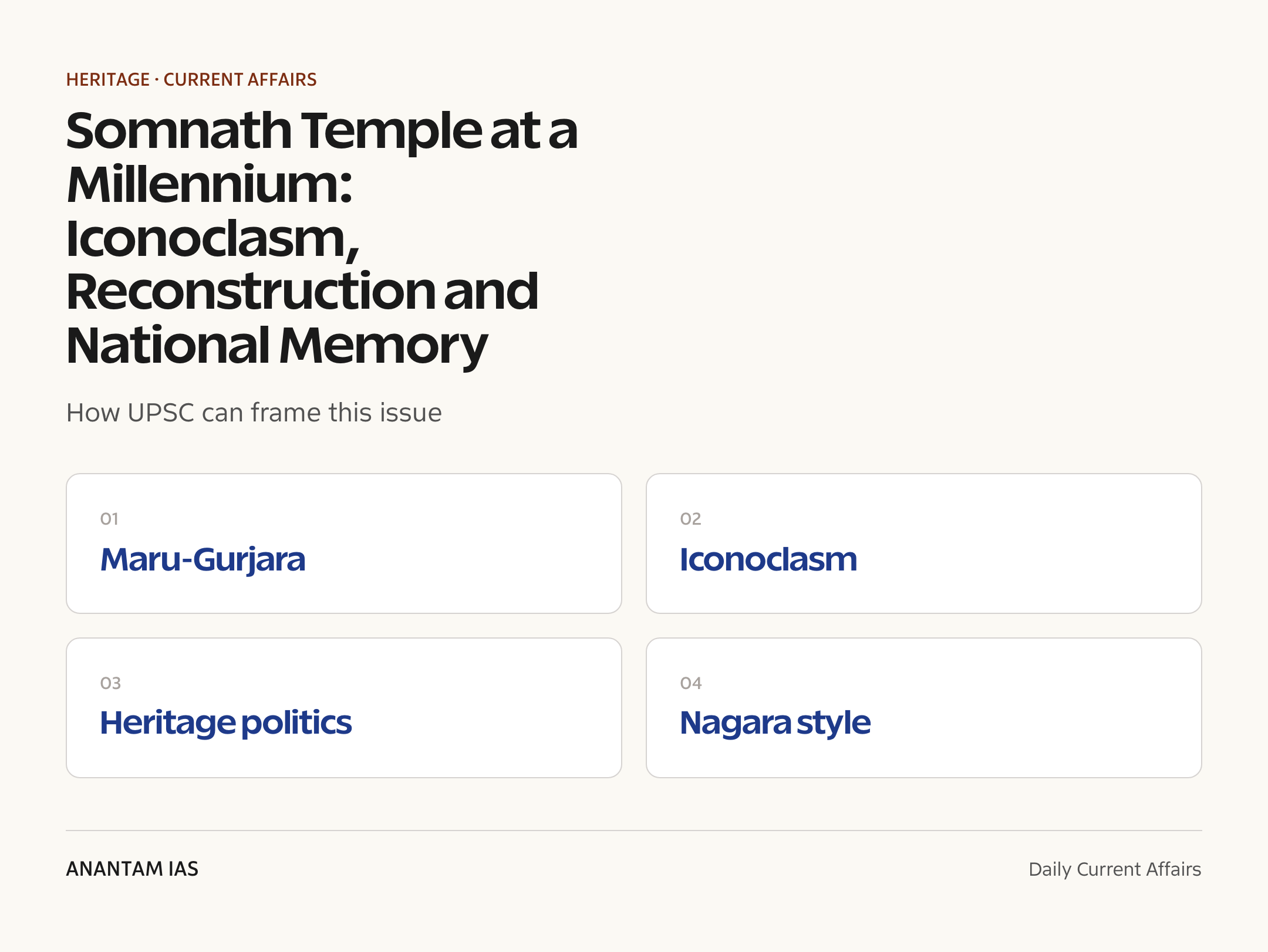
- The Chaulukya (Solanki) rulers of Gujarat patronised a distinctive idiom now called Maru-Gurjara, a regional form of the broader Nagara tradition.
- Its signatures are a soaring curvilinear shikhara, intricately carved exterior walls, ornate ceilings, and pillared halls (mandapas) richly decorated with sculpture.
- Sister monuments of the style include the Sun Temple at Modhera, the Rani ki Vav stepwell at Patan, and many Jain temples of Dilwara.
- The rebuilt 1951 Somnath was designed in this Maru-Gurjara idiom by the architect Prabhashankar Sompura, drawing on traditional temple-craft (the Sompura guild).
The destruction-and-reconstruction cycle
Somnath’s defining historical feature is that it was repeatedly damaged and repeatedly rebuilt over centuries.
- Tradition holds that successive temples occupied the site; the structure standing in the early 11th century was raided by Mahmud of Ghazni in 1026 CE.
- It was rebuilt and again attacked across the medieval period, with further damage attributed to forces under Alauddin Khalji‘s general and, later, under Aurangzeb.
- Each rebuilding drew on local patronage — rulers, merchants and devotees — a tradition of temple-renewal echoed centuries later by figures such as Ahilyabai Holkar.
- By the colonial era the medieval temple lay largely in ruin, setting the stage for a planned 20th-century reconstruction.
Reading the iconoclasm debate
How historians interpret the 1026 raid is itself a major historiographical theme.
- Older accounts treated the raid mainly as religious zeal aimed at idol-breaking, an image amplified in later Persian and colonial retellings.
- Scholars such as Romila Thapar have argued the event was layered — driven substantially by plunder of temple wealth — and that its symbolism was magnified much later, including in 19th-century British debates over the so-called gates of Somnath.
- The point for answers is to distinguish the historical event from its later mythologisation, and to weigh economic, political and religious motives together.
- It is a textbook example of how the past is reinterpreted to serve later political needs — a recurring essay theme on memory and identity.
Post-Independence rebuilding and heritage politics
The 1951 reconstruction made Somnath a case study in cultural restoration as nation-building.
- Sardar Vallabhbhai Patel championed rebuilding the temple soon after the integration of Junagadh into India in 1947–48.
- K.M. Munshi, then a Union minister and a writer-historian, drove the project and the Somnath Trust that funded it from public donations rather than the state exchequer.
- President Rajendra Prasad performed the consecration on 11 May 1951, framing it as a revival of cultural confidence.
- The episode also opened a lasting debate on the relationship between a secular state and the restoration of religious heritage, a tension still discussed in GS Paper 1 and Paper 2 contexts.
Conservation and the site today
Beyond the working temple, the surrounding Prabhas Patan zone is an archaeological and pilgrimage landscape.
- The Archaeological Survey of India protects monuments and remains in the Prabhas Patan area, distinct from the living temple managed by the Trust.
- The site combines an active place of worship with layered remains of earlier structures, raising standard conservation questions about restoration versus authenticity.
- Somnath features in heritage-tourism circuits alongside other Saurashtra sites, linking pilgrimage with regional development.
- It remains a reference point in discussions of how India presents contested heritage to domestic and international visitors.
Way Forward
Distinguish history from memory
- Teach and present Somnath with the documented record alongside its later symbolism, so that the monument informs rather than inflames.
- Use the site to explain how historians weigh plunder, politics and faith as overlapping motives.
Conserve with rigour
- Sustain ASI-led scientific conservation of the Prabhas Patan remains while respecting the living temple’s role.
- Document the Maru-Gurjara craft traditions and the Sompura guild knowledge that made the 1951 rebuild possible.
Frame heritage restoration as inclusive nation-building — celebrating cultural revival while keeping the state even-handed across communities, and integrating pilgrimage with sustainable coastal tourism.
Conclusion
A thousand years after 1026, Somnath is less a single event than a long argument about loss, renewal and how a society chooses to remember. Its stones carry the Maru-Gurjara craft of the Solankis, the scars of medieval raids, and the optimism of a republic that rebuilt it in 1951.
For the UPSC aspirant the value lies in the durable threads behind the anniversary — temple architecture, the Jyotirlinga tradition, the historiography of iconoclasm, and heritage as a project of identity — each of which outlasts any single news cycle.
UPSC Practice Questions
Prelims MCQ 1
With reference to the Somnath temple, consider the following statements:
- It is traditionally counted among the twelve Jyotirlinga shrines of Shiva.
- It is located on the Saurashtra coast of Gujarat near Veraval.
- Its present structure was built in the Dravidian style of temple architecture.
How many of the above statements are correct?
(a) Only one (b) Only two (c) All three (d) None
Answer: (b) Only two
Explanation:
Statements 1 and 2 are correct — Somnath is a Jyotirlinga on the Saurashtra coast near Veraval. Statement 3 is wrong: the temple is in the Maru-Gurjara (Solanki) idiom, a regional form of the Nagara style, not Dravidian.
Prelims MCQ 2
The reconstruction of the Somnath temple that was consecrated in 1951 is most closely associated with which of the following figures?
(a) Jawaharlal Nehru and Maulana Azad (b) Sardar Vallabhbhai Patel and K.M. Munshi (c) B.R. Ambedkar and Rajagopalachari (d) Syama Prasad Mookerjee and G.B. Pant
Answer: (b) Sardar Vallabhbhai Patel and K.M. Munshi
Explanation:
Patel initiated the rebuilding after Junagadh’s integration; K.M. Munshi drove the project through the Somnath Trust. President Rajendra Prasad performed the 1951 consecration.
UPSC Mains Questions
- The Somnath temple has been described as a monument of repeated destruction and renewal. Examine how its architecture and history illustrate the salient features of western-Indian temple-building and the wider Nagara tradition.
- Historians distinguish the medieval raids on Somnath from their later mythologisation. Critically discuss how interpretations of iconoclasm have been shaped by colonial and post-colonial concerns.
- Evaluate the reconstruction of the Somnath temple in 1951 as an exercise in cultural heritage and nation-building, and the questions it raised about the secular state’s relationship with religious restoration.
Sources: Archaeological Survey of India, Ministry of Culture and The Hindu.
Frequently Asked Questions
Why is Somnath in the news in 2026?
The year marks roughly a thousand years since Mahmud of Ghazni’s raid on the Somnath temple in 1026 CE. The anniversary has revived interest in the shrine’s long cycle of destruction and rebuilding, its Maru-Gurjara architecture, and its reconstruction after Independence in 1951.
Where is the Somnath temple located?
It stands at Prabhas Patan, near the port town of Veraval, in Gir Somnath district on the southern coast of the Saurashtra peninsula in Gujarat. Its coastal position and pilgrimage wealth shaped much of its history.
What architectural style is the Somnath temple built in?
The present temple, completed in 1951, follows the Maru-Gurjara or Solanki idiom, a regional form of the Nagara tradition. It features a tall curvilinear shikhara, richly carved walls and pillared mandapas, designed by the temple architect Prabhashankar Sompura.
What is a Jyotirlinga and where does Somnath fit?
A Jyotirlinga is one of twelve especially sacred shrines where Shiva is worshipped as a self-manifest pillar of light. Somnath is traditionally listed first among the twelve, which is why it ranks among the holiest Shaivite sites in India.
Who rebuilt the Somnath temple after Independence?
Sardar Vallabhbhai Patel championed the reconstruction after Junagadh’s integration, and K.M. Munshi steered the project through the Somnath Trust, funded by public donations. President Rajendra Prasad performed the consecration on 11 May 1951.
Why do historians debate the 1026 raid?
Older accounts framed it mainly as religious idol-breaking, while later scholars such as Romila Thapar stressed plunder of temple wealth and showed how the event’s symbolism was magnified much later, including in 19th-century British debates. The debate is a model of distinguishing history from memory.
Source: https://anantamias.com/current-affairs/somnath-temple-millennium-2026/