
The current RBI Governor is Sanjay Malhotra, who assumed charge as the 26th Governor of the Reserve Bank of India on 11 December 2024 for a three-year term. The Governor is the chief executive of India's central bank and chairs the Monetary Policy Committee (MPC), making the office one of the most consequential economic positions in the Indian state. This guide explains how the RBI Governor is appointed, the powers and duties of the office, the institutional structure of the Reserve Bank, and why the post matters for UPSC Civil Services preparation across Prelims and Mains.
Who Is the Current RBI Governor
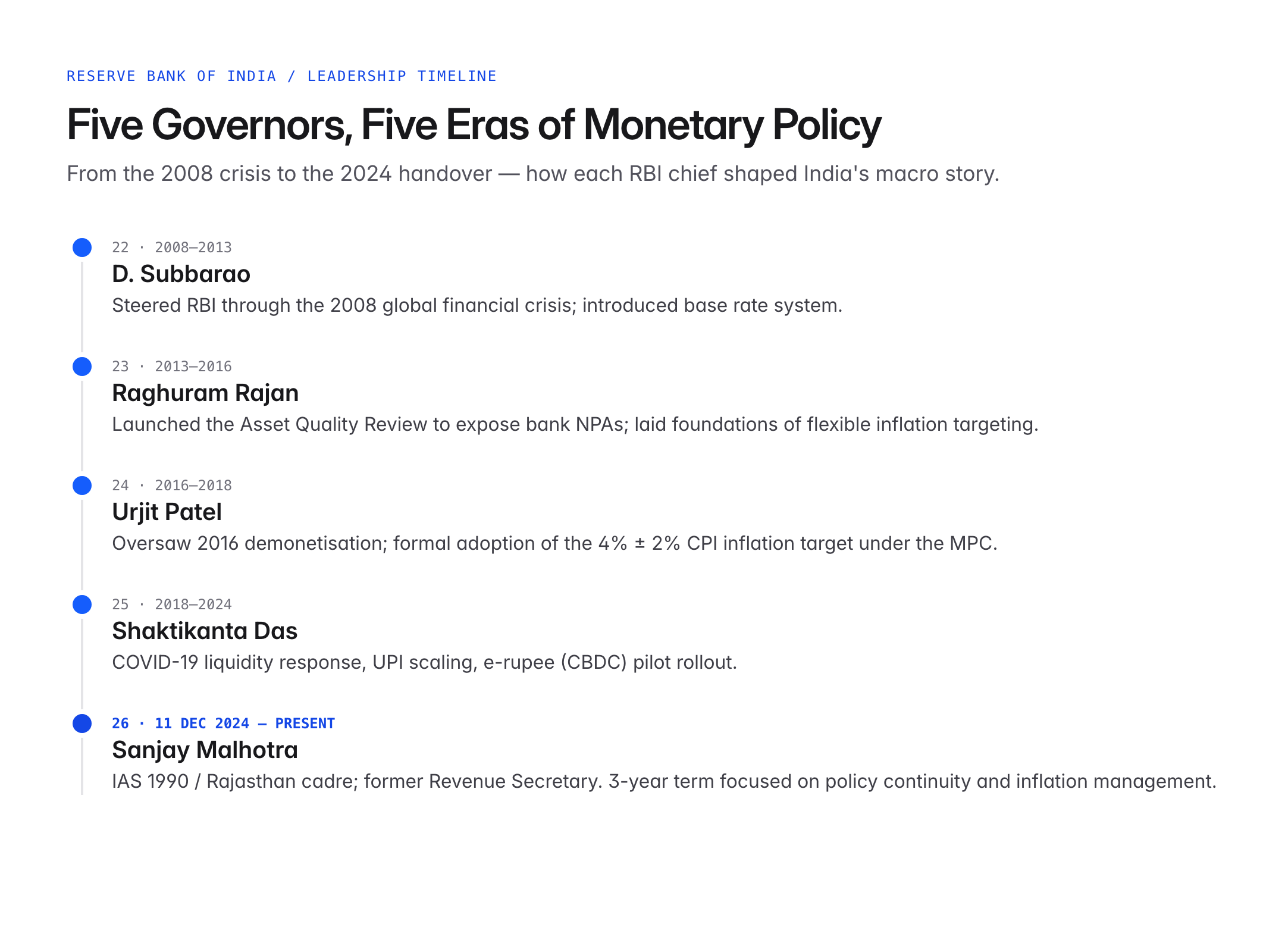
Sanjay Malhotra, a 1990-batch IAS officer of the Rajasthan cadre, was appointed RBI Governor by the Appointments Committee of the Cabinet and took office on 11 December 2024, succeeding Shaktikanta Das. Before this appointment, Malhotra served as the Revenue Secretary, Government of India. His standard tenure is three years, extendable, in line with past practice.
Key points about the current Governor:
- 26th Governor of the Reserve Bank of India
- Took charge: 11 December 2024
- Predecessor: Shaktikanta Das (served December 2018 – December 2024)
- Background: IAS officer, former Revenue Secretary, Department of Financial Services
Constitutional and Legal Basis
The RBI itself was established by the Reserve Bank of India Act, 1934, and commenced operations on 1 April 1935. The Act is the primary legal framework governing the Governor's office.
- Section 8 of the RBI Act provides for the Central Board of Directors, including the Governor and Deputy Governors.
- The Governor is appointed by the Central Government under recommendations routed through the Financial Sector Regulatory Appointments Search Committee (FSRASC) and final clearance from the Appointments Committee of the Cabinet (ACC) headed by the Prime Minister.
- The standard term is up to five years, though most Governors are appointed for three years, with possible extension.
- The Governor can be removed by the Central Government as per the Act.
The RBI was nationalised in 1949 under the Reserve Bank (Transfer to Public Ownership) Act, 1948, making it fully government-owned.
Powers and Functions of the RBI Governor
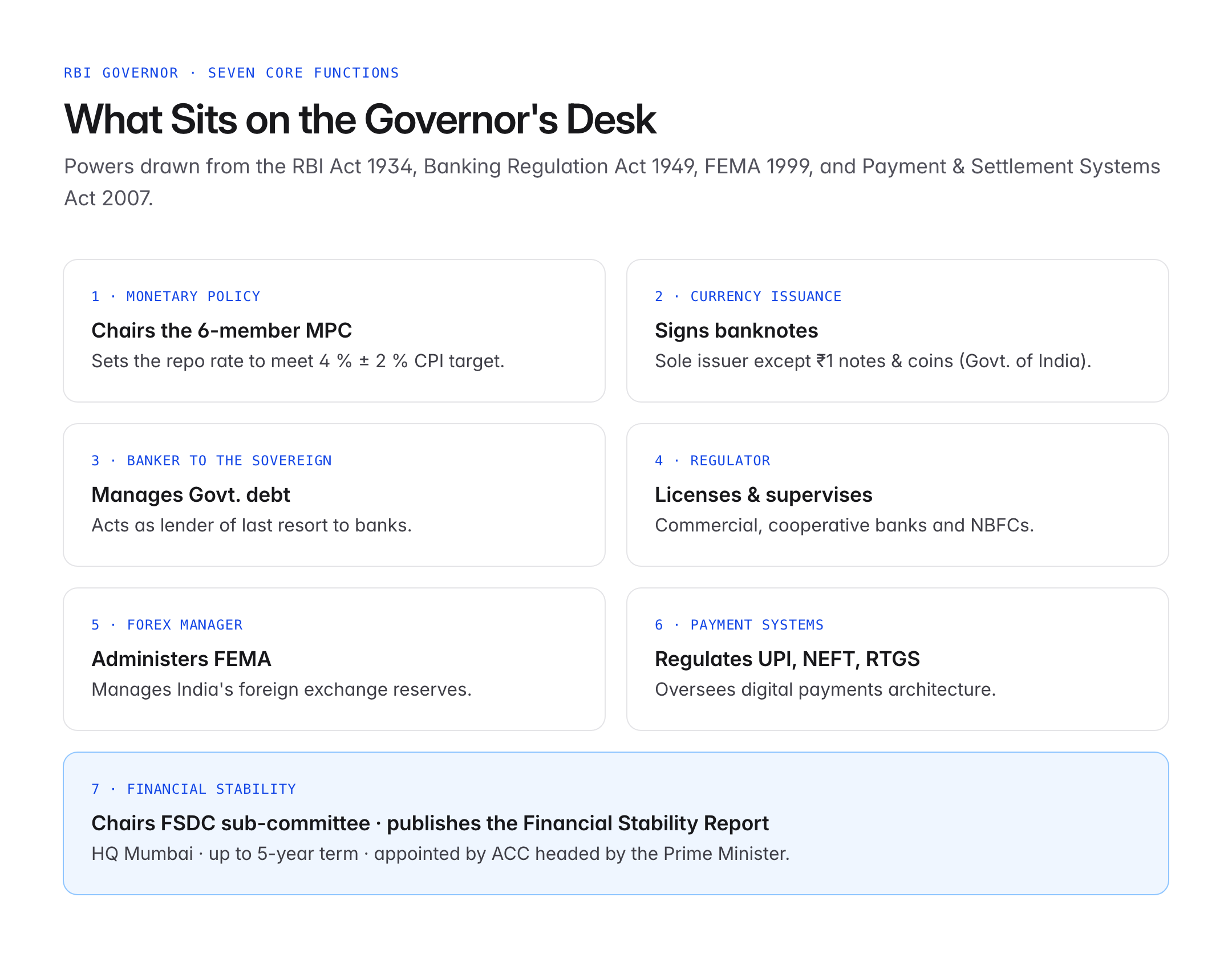
As head of the RBI, the Governor exercises authority delegated under the RBI Act, the Banking Regulation Act, 1949, FEMA 1999, and the Payment and Settlement Systems Act, 2007.
Core functions include:
- Monetary policy: Chairs the six-member Monetary Policy Committee (MPC) set up under the amended RBI Act (2016) to set the policy repo rate to achieve a 4% ± 2% CPI inflation target.
- Currency issuance: Signs banknotes; the RBI is the sole issuer of currency (except one-rupee notes and coins, issued by the Government of India).
- Banker to government and banks: Manages the government's debt and acts as lender of last resort.
- Regulation and supervision: Licences, regulates, and supervises commercial banks, cooperative banks, and NBFCs.
- Foreign exchange management: Administers FEMA, manages India's forex reserves.
- Payment systems: Regulates UPI, NEFT, RTGS, and the broader payments ecosystem.
- Financial stability: Chairs the Financial Stability and Development Council sub-committee and publishes the Financial Stability Report.
List of Recent RBI Governors
| # | Governor | Tenure |
|---|---|---|
| 22 | D. Subbarao | 2008–2013 |
| 23 | Raghuram Rajan | 2013–2016 |
| 24 | Urjit Patel | 2016–2018 |
| 25 | Shaktikanta Das | 2018–2024 |
| 26 | Sanjay Malhotra | 2024– |
The first Governor was Sir Osborne Smith (1935–1937). Sir C. D. Deshmukh became the first Indian Governor in 1943. Dr. Manmohan Singh served as Governor from 1982 to 1985 before becoming Finance Minister and later Prime Minister.
Monetary Policy Committee and the Governor
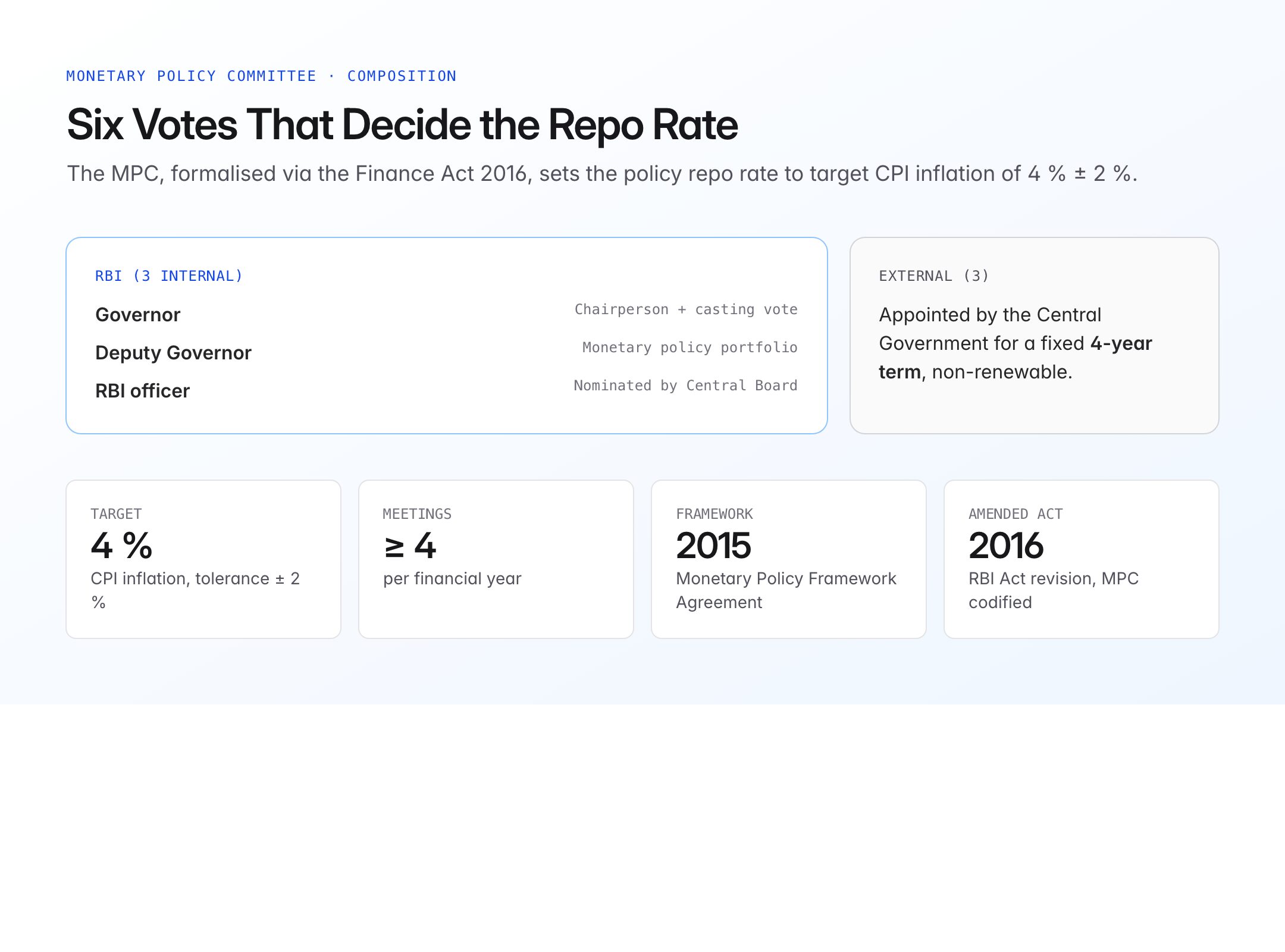
The MPC was formalised through the Finance Act, 2016, which amended the RBI Act. It meets at least four times a year.
MPC composition (6 members):
- RBI Governor (Chairperson)
- Deputy Governor in charge of monetary policy
- One RBI officer nominated by the Central Board
- Three external members appointed by the Central Government for four years
In case of a tied vote, the Governor has a casting vote. The committee decides the policy repo rate to meet the flexible inflation targeting mandate of 4% CPI inflation with a tolerance band of ±2%, set under the Monetary Policy Framework Agreement (2015) and codified in the RBI Act.
Organisational Structure of the RBI
The RBI is headquartered in Mumbai and is governed by a Central Board of Directors appointed by the Government of India for a four-year term.
- Governor: Chief Executive, up to 5-year term
- Deputy Governors: Up to four, in charge of key portfolios such as monetary policy, regulation, and payment systems
- Executive Directors: Head specialised departments
- Local Boards: Four, in Mumbai, Kolkata, Chennai, and New Delhi
The Preamble of the RBI mandates it "to regulate the issue of Bank notes and keeping of reserves with a view to securing monetary stability in India and generally to operate the currency and credit system of the country to its advantage."
Significance for the Indian Economy
The RBI Governor's signature on currency, decisions on the repo rate, and regulatory circulars directly shape lending rates, inflation expectations, exchange rate movements, and credit availability across the economy. Recent governors have handled:
- Demonetisation (2016) – Urjit Patel
- Asset Quality Review and NPA clean-up – Raghuram Rajan
- COVID-19 liquidity response and digital payments push – Shaktikanta Das
- Policy continuity and inflation management post-2024 – Sanjay Malhotra
The Governor's autonomy, while balanced with accountability to Parliament through the Finance Ministry, is widely seen as a pillar of macroeconomic credibility.
UPSC Relevance
Prelims focus:
- Name of the current Governor (Sanjay Malhotra, 26th Governor, took charge 11 December 2024)
- Year of RBI establishment (1935), nationalisation (1949), RBI Act (1934)
- MPC composition: 6 members, 3 external, Governor has casting vote
- Inflation target: 4% ± 2% CPI
Mains GS angle (GS Paper III – Economy):
- Role of central bank autonomy in macroeconomic stability
- Effectiveness of flexible inflation targeting in India
- RBI's evolving role in financial regulation, digital payments (UPI, CBDC), and forex management
- Government–RBI relations and the surplus transfer debate
Sample PYQ angle: Past UPSC questions have asked about the functions of the RBI, objectives of monetary policy, the MPC, and tools such as repo rate, reverse repo, CRR, SLR, and open market operations. Expect current-affairs-linked questions on the new Governor, inflation targeting review, and Central Bank Digital Currency (e-rupee).
Tell Google you want more of this.
Add Anantam IAS as a preferred sourceOne tap, and this site shows up more often in your own Top Stories, AI Overviews and AI Mode. Remove it any time.