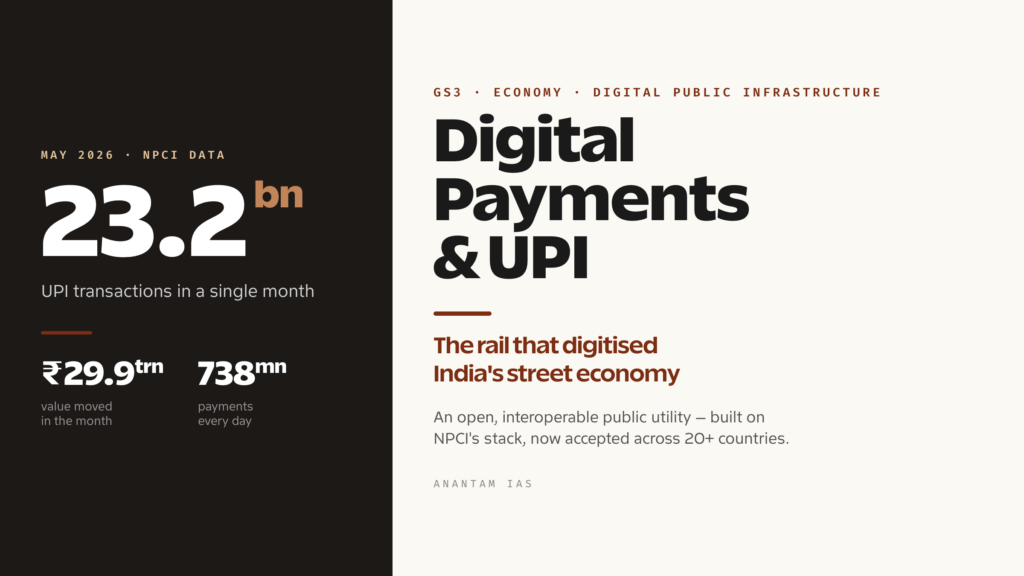
In May 2026, India did something no country had done before: it ran 23.2 billion payments through a single rail in one month. That is the National Payments Corporation of India’s count for the Unified Payments Interface — 23.20 billion transactions worth about Rs 29.9 trillion, or close to Rs 30 lakh crore, in thirty-one days. Strip that down and it means roughly 738 million UPI payments every single day, moving about Rs 84,000 crore daily, and the figure climbs almost every month. To put it in scale, the older Immediate Payment Service handled 358 million transactions in the same month. UPI did more than that before lunch.
And here is what makes it matter beyond the headline: these are not big-ticket bank transfers. They are the ten-rupee chai, the vegetable cart, the autorickshaw, the kirana shop — small payments that used to be the exclusive territory of cash. UPI didn’t digitise the rich; it digitised the street. For a UPSC aspirant, this is one of the most examinable economy stories of the decade, because it sits at the meeting point of three big themes — digital public infrastructure, financial inclusion, and the internationalisation of an Indian-built system. Understand the plumbing beneath that 23-billion number and you can answer almost any question the examiner throws at digital payments.
How UPI Actually Works
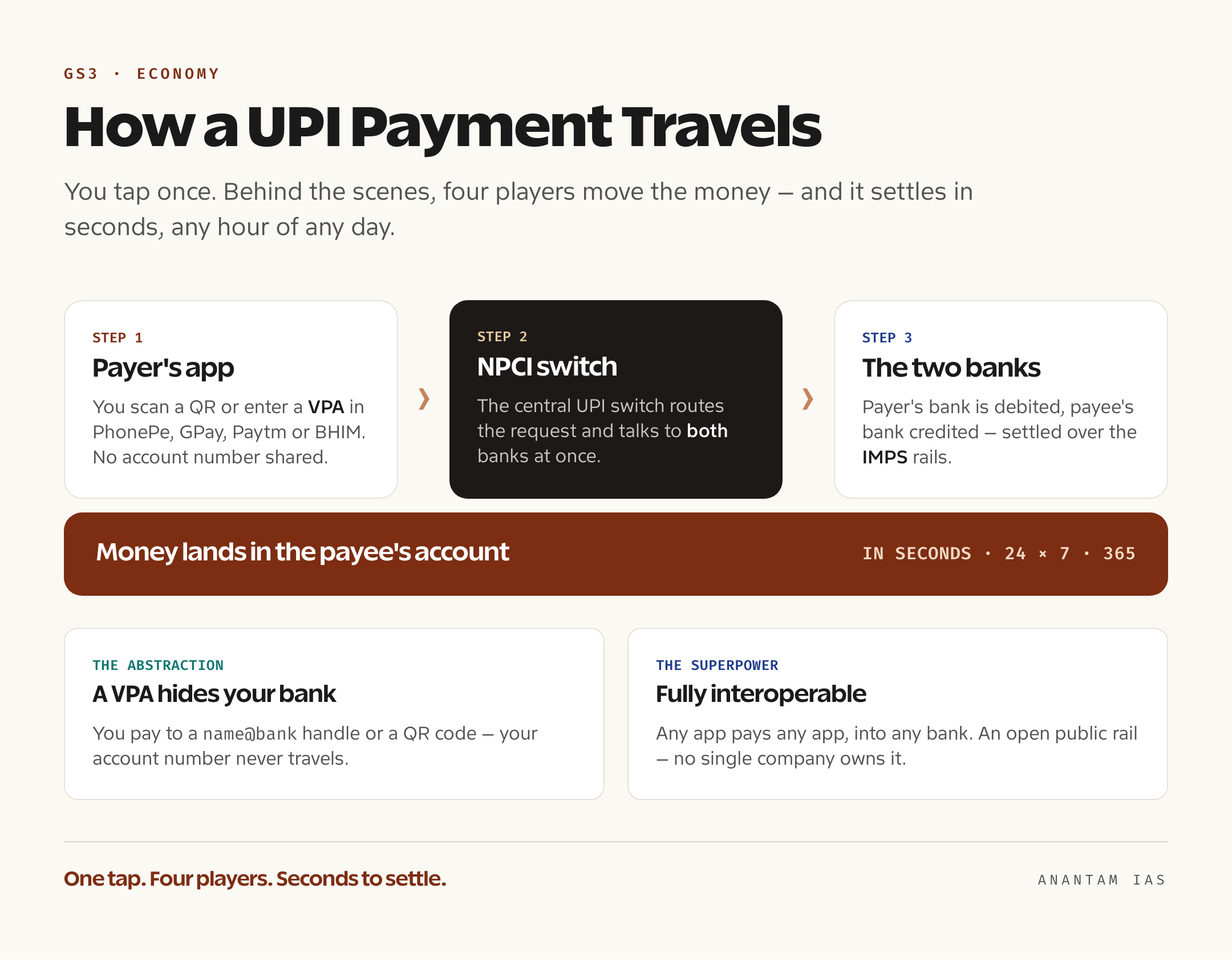
Start with the trick that made UPI different, because the whole thing turns on one idea: you never hand over your bank details. Before UPI, sending money meant typing an account number, an IFSC code and a name, then waiting. UPI replaced all of that with a Virtual Payment Address — your name@bank handle, or simply a scanned QR code — and built the rest of the machinery to hide underneath it. You pay a person or a shop using a string that reveals nothing about where your money actually lives. That single abstraction is why a street vendor can accept payments with a printed QR code and no card-swiping machine at all.
Underneath, UPI is an open software layer that the NPCI built on top of the existing Immediate Payment Service, the round-the-clock interbank rail that already let banks move money instantly. Launched in 2016 and regulated by the Reserve Bank of India, UPI rides those IMPS rails but opens them up through standardised APIs. The architecture has four players. You and the shopkeeper sit at the two ends. Your payment app — a Payment Service Provider like PhonePe, Google Pay, Paytm or BHIM — is the front end you touch. Behind each app is a sponsor bank, and at the very centre sits the NPCI switch, which routes the request, talks to both banks, and confirms the debit and credit in seconds, any hour of any day. That is what lets UPI enable real-time fund transfer between bank accounts around the clock.
The feature that turns this from a clever app into national infrastructure is interoperability. Any UPI app can pay any other UPI app, into any bank, regardless of who built it. A Google Pay user pays a PhonePe merchant whose money lands in a third bank, and nobody notices the seams. This is the opposite of the closed-loop wallets common elsewhere, where money trapped in one app can’t reach another. Because UPI is an open, interoperable public utility rather than a private network, no single company owns the rail — and that design choice is what let it scale to a billion-plus users without a winner-takes-all monopoly. But the same scale is also a reminder that digital payments are never weightless: they still ride on smartphones, data centres, telecom towers and a live internet connection, which is precisely why the claim that digital payments need no physical infrastructure is false.
The Payments Stack Behind the App
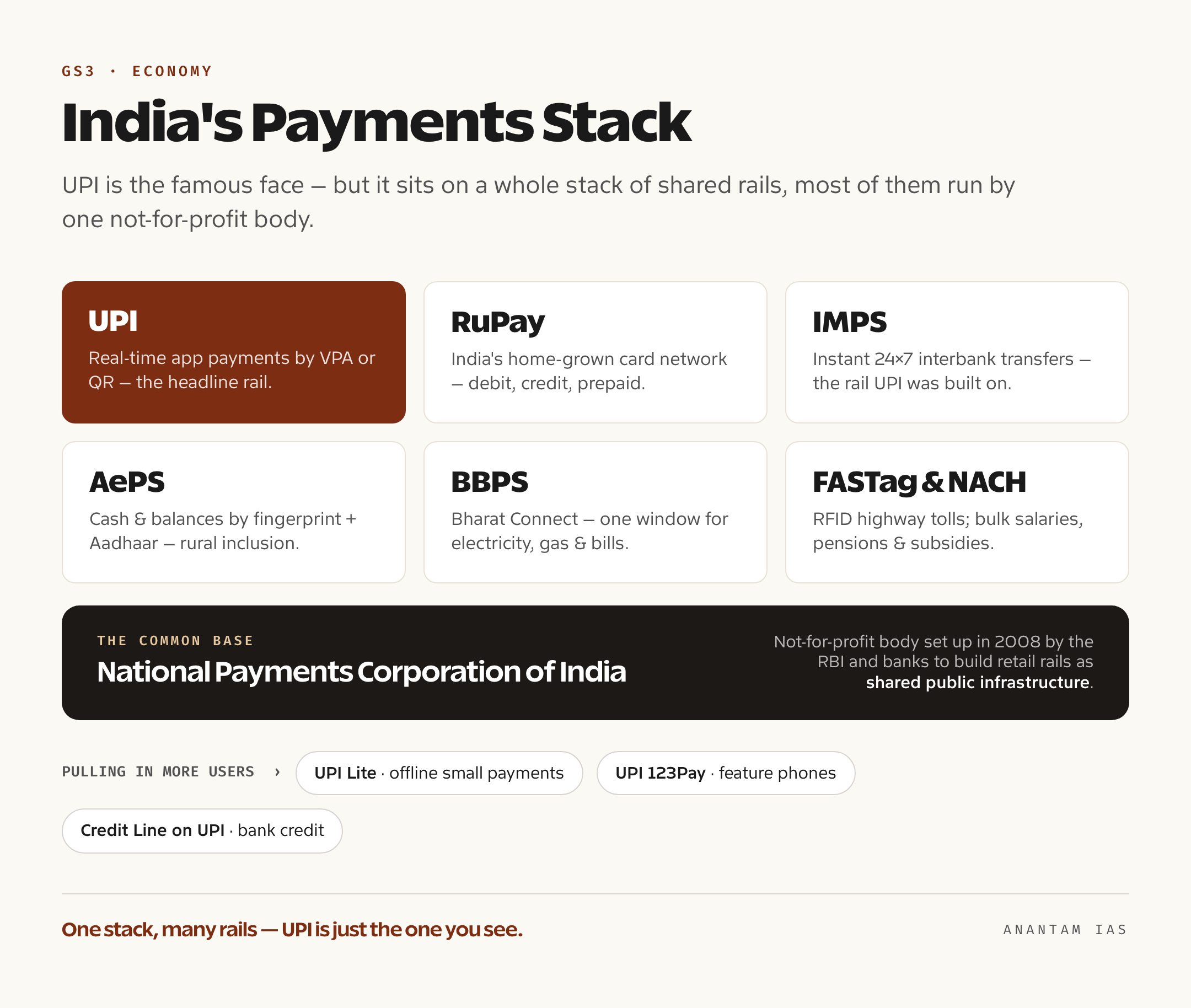
UPI gets the attention, but it is only one rail in a much larger system, and the answer that names the whole stack reads far stronger than one that stops at UPI. Almost all of it is run by the NPCI, an umbrella organisation set up in 2008 by the RBI and a clutch of banks as a not-for-profit company to build India’s retail payment rails as shared public infrastructure rather than private fiefdoms. Think of NPCI as the workshop that built most of the pipes through which India’s small payments now flow.
Run down the rails and you have a full toolkit. RuPay is India’s home-grown card network — the domestic answer to Visa and Mastercard — issuing debit, credit and prepaid cards, and crucially keeping the transaction data and the network fees inside the country. IMPS is the instant interbank transfer service that UPI was built on top of. For larger or scheduled bank transfers there are the older RBI-run rails — NEFT, which now settles continuously, and RTGS, which handles high-value transfers in real time. AePS, the Aadhaar Enabled Payment System, lets a person in a village withdraw cash or check a balance using just a fingerprint and an Aadhaar number through a banking agent — no card, no smartphone — which is the quiet workhorse of rural financial inclusion. BBPS, now branded Bharat Connect, is a single interoperable window for paying electricity, gas, water, DTH and dozens of other bills. FASTag clears highway tolls automatically over RFID. And NACH handles the bulk, repetitive flows — salaries, pensions and, most importantly, the direct-benefit-transfer subsidies the government pushes straight into bank accounts.
The system also keeps evolving at the edges. UPI Lite now lets you make small offline payments from a pre-loaded on-device wallet without even touching the bank server, easing the load for tiny transactions. UPI 123Pay brings the same payments to basic feature phones, no internet needed, for users who never owned a smartphone. And Credit Line on UPI plugs pre-sanctioned bank credit into the UPI flow, so a small borrower can spend a sanctioned line as easily as scanning a QR code. Each addition pulls a new slice of the population — the offline, the feature-phone user, the thin-file borrower — into the same interoperable grid.
Going Global: UPI Beyond India’s Borders
What began as a domestic rail is now an export. Through its international arm, NPCI International Payments Limited, India has been carrying UPI abroad on two tracks, and this is the freshest, most quotable angle for an answer. The first track is acceptance: letting an Indian traveller scan a local QR code overseas and pay straight from their home UPI app. UPI acceptance is now live across more than twenty international markets, including the UAE, Singapore, France, Sri Lanka, Mauritius, Nepal, Bhutan and the UK, aimed squarely at the destinations Indian tourists, students and workers frequent. France was a landmark, the first European country to take UPI.
The second, deeper track is rail-to-rail linkage — connecting UPI directly to another country’s own instant-payment system so money can cross the border in real time, in both directions. The flagship here is the live linkage between UPI and Singapore’s PayNow, which lets people in the two countries send money to each other almost instantly and far more cheaply than a traditional remittance. More linkages are being built or explored — with the UAE’s domestic system, the UK’s Faster Payments, and even a route into the EU’s instant-transfer framework — and NPCI has signalled a strong push into South-East Asia. Cross-border UPI transactions have multiplied many times over in a single year off a small base.
Why does any of this matter for India? Three reasons worth carrying into an answer. It slashes the cost of remittances for a huge diaspora that sends home more money than almost any country on earth. It exports an Indian-built digital public good, turning UPI into a tool of economic diplomacy and soft power. And it offers a route to settle more trade and transfers outside the dominant card and correspondent-banking networks, nudging India’s wider goal of internationalising the rupee. A rail that India owns, running between countries, is leverage as much as it is convenience.
Why UPI Is Digital Public Infrastructure That Drove Financial Inclusion
The last piece of the story is the one examiners love most, because it ties payments to development. UPI is the headline layer of what India calls the India Stack — the set of open digital public infrastructure that also includes Aadhaar (a digital identity for over a billion people) and the consent-based data layer. The logic runs through the JAM trinity: Jan Dhan bank accounts gave the poor a place to keep money, Aadhaar gave them a verifiable identity to open and use those accounts, and the mobile phone gave them the device to transact. UPI is what makes that account come alive — turning a dormant Jan Dhan account into a live, usable payment instrument that costs almost nothing to operate.
The development payoff is large and concrete. Direct benefit transfers now drop subsidies, pensions and wages straight into bank accounts over these rails, cutting out the middlemen and ghost beneficiaries who used to skim cash hand-outs, saving the exchequer enormous sums in plugged leakages. A vegetable seller who once dealt only in cash now has a digital transaction trail, which over time can become the basis for a small formal loan — pulling informal livelihoods toward the formal, taxable, credit-worthy economy. Cash handling costs fall for everyone. And the sheer reach is what sets India apart: real-time digital payments here are not a premium service for the urban middle class but a default for the street vendor and the daily-wage worker, which is why India accounts for a striking share of all real-time digital transactions on the planet.
None of this is risk-free, and a balanced answer should say so. Heavy concentration in a couple of private apps raises questions about systemic risk and data control. Outages, fraud and social-engineering scams scale exactly as fast as the system does. The rural-urban and digital-literacy divide means the most vulnerable are also the easiest to defraud. And the rails depend utterly on cheap data, reliable power and working phones — the physical backbone that is easy to forget until it fails. The task ahead is to keep the system open, safe and inclusive even as it carries an ever-larger share of the economy.
For Your Mains Answer
This is a high-value topic for GS Paper 3, which covers the Indian economy, mobilisation of resources, infrastructure, and the role of technology in development. It speaks directly to questions on digital public infrastructure, financial inclusion, the formalisation of the economy, and even cyber-security and data governance. It also gives the Essay paper a clean, data-rich example of an Indian innovation with global reach. The skill that earns marks is the one this article models: anchor the argument in a few exact figures, then trace a clear chain from a clever design choice to a development outcome.
How to Build the Answer
Move in layers, from the visible to the structural. Open with the scale (23.2 billion monthly transactions). Explain the design that made it possible (VPA abstraction, the open API layer on IMPS rails, the four-player NPCI architecture, interoperability). Widen to the full payments stack (RuPay, AePS, BBPS, NACH) so the answer isn’t UPI-only. Then connect it to outcomes — financial inclusion via JAM, direct benefit transfers, formalisation. Add the global dimension (acceptance in 20-plus markets, the PayNow linkage). Close with a balanced note on risks. That arc — scale, design, stack, inclusion, global, risk — fits almost any digital-payments question.
Common Mistakes to Avoid
Don’t treat UPI and digital payments as the same thing; UPI is one rail within NPCI’s larger stack. Don’t claim digital payments need no physical infrastructure — they ride on phones, telecom and data centres, and saying otherwise is a factual error. Don’t credit UPI to a single private company; its strength is that it’s an open, interoperable public utility no one owns. And don’t list achievements without the risks — concentration, fraud and the digital divide are what turn a one-sided answer into a balanced one.
A Compact Answer Spine
UPI = open API layer on IMPS rails, launched 2016, run by NPCI, regulated by RBI → VPA/QR hides bank details, four-player architecture (payer app + sponsor bank + NPCI switch + payee bank), fully interoperable → scale: 23.2 bn transactions / ~Rs 29.9 trn in May 2026 → wider stack: RuPay, AePS, BBPS, NACH, FASTag, NEFT/RTGS/IMPS → inclusion engine via JAM + direct benefit transfers + formalisation → going global: 20-plus markets, UPI-PayNow (Singapore) linkage → risks: concentration, fraud, digital divide, physical-infrastructure dependence → verdict: a model of inclusive digital public infrastructure that must stay open and safe.
Diagram or Flowchart Idea
Draw the four-player flow: payer app → NPCI switch → (payee bank + payer bank) → settled over IMPS, with a clock marking “seconds, 24×7”. Beside it, sketch a small stack of labelled rails — UPI, RuPay, AePS, BBPS, NACH — sitting on a common NPCI base. The flow shows how a payment moves; the stack shows that UPI is one of many. Together they communicate the whole architecture at a glance.
A Balanced-Conclusion Line
A line that lands the marks: “India’s payments revolution is less about an app and more about a public good — an open, interoperable rail that turned a billion bank accounts into live instruments, formalised the street economy, and is now being exported as a tool of digital diplomacy, even as it must guard against concentration, fraud and the divides it has not yet closed.”
How to Use Data Without Cramming
You need only four anchors: 23.2 billion (monthly UPI transactions, May 2026), ~Rs 29.9 trillion (their value), 2016 (the launch year), and 20-plus (international markets accepting UPI). Drop those into the right sentences and the answer reads as current and authoritative. Attribute them plainly — “as NPCI’s data for May 2026 showed” — rather than scattering numbers loose.
FAQ
What is UPI and who runs it? UPI, the Unified Payments Interface, is a real-time payment system that lets you move money instantly between bank accounts using a simple Virtual Payment Address or a QR code, without sharing your account number. It was launched in 2016, is operated by the National Payments Corporation of India (NPCI), and is regulated by the Reserve Bank of India. Apps like PhonePe, Google Pay, Paytm and BHIM are front ends that connect to the same shared, interoperable rail.
How is UPI different from the rest of India’s payments stack? UPI is the best-known rail, but it is one of several run by NPCI. RuPay is India’s domestic card network; IMPS, NEFT and RTGS handle instant and bank-to-bank transfers; AePS lets people transact with just a fingerprint and Aadhaar; BBPS (Bharat Connect) is a single window for paying bills; FASTag clears tolls; and NACH moves bulk payments like salaries and subsidies. Together they form India’s retail payments stack, with UPI as its public face.
Is UPI used outside India? Yes. Through NPCI International, UPI is now accepted in more than twenty markets, including the UAE, Singapore, France, Sri Lanka, Mauritius, Nepal, Bhutan and the UK, letting Indian travellers pay with their home app. Deeper rail-to-rail linkages also exist — most notably UPI’s connection with Singapore’s PayNow — enabling near-instant, low-cost cross-border transfers, with more linkages under development.
How did UPI help financial inclusion? UPI activated the bank accounts opened under the Jan Dhan scheme by giving the JAM trinity — Jan Dhan, Aadhaar, Mobile — a cheap, instant way to transact. It let the government route direct benefit transfers straight into accounts, cutting leakages, and gave small vendors a digital trail that can support formal credit, pulling informal livelihoods toward the formal economy.
Practice Questions
Prelims MCQs
- With reference to the Unified Payments Interface (UPI), consider the following:
(a) It was launched in 2016 and is operated by NPCI
(b) It is built as an open layer on the IMPS rails
(c) It uses a Virtual Payment Address so users need not share account details
(d) All of the above
Answer: (d) UPI, launched in 2016 and run by NPCI, is an open API layer over IMPS that uses a VPA or QR code so bank details stay hidden. - Which institution operates UPI, RuPay, IMPS, AePS and BBPS?
(a) The Reserve Bank of India directly
(b) The National Payments Corporation of India
(c) The Securities and Exchange Board of India
(d) The Ministry of Electronics and IT
Answer: (b) All of these retail payment rails are operated by NPCI, the not-for-profit umbrella body set up in 2008; the RBI is the regulator, not the operator. - Which statement about digital payments in India is correct?
(a) UPI enables real-time fund transfer between bank accounts
(b) Digital payments eliminate the need for any physical infrastructure
(c) QR codes require a card-swiping machine to work
(d) UPI is a closed-loop wallet usable on only one app
Answer: (a) UPI does enable real-time transfers; digital payments still depend on phones, telecom and data centres, QR codes need no card machine, and UPI is fully interoperable, not closed-loop. - The Aadhaar Enabled Payment System (AePS) primarily allows a user to:
(a) Pay highway tolls automatically over RFID
(b) Withdraw cash or check balances using a fingerprint and Aadhaar through a banking agent
(c) Pay multiple utility bills through a single window
(d) Move high-value transfers in real time
Answer: (b) AePS lets a person transact with only a fingerprint and Aadhaar number via a business correspondent — a key rural financial-inclusion tool. FASTag does tolls, BBPS does bills, and RTGS does high-value transfers. - The UPI-PayNow linkage connects India’s UPI with the instant payment system of which country?
(a) United Arab Emirates
(b) France
(c) Singapore
(d) Sri Lanka
Answer: (c) PayNow is Singapore’s instant payment system; its live linkage with UPI enables near-instant, low-cost cross-border transfers between India and Singapore.
Mains Practice Questions
- Explain the architecture of the Unified Payments Interface (UPI) and discuss how its design choices — interoperability and the open API layer — enabled it to scale into the world’s largest real-time payment system. (15 marks, 250 words)
- “UPI is the visible face of a much larger payments stack.” Discuss the role of the National Payments Corporation of India and its rails (RuPay, AePS, BBPS, NACH) in building India’s digital public infrastructure. (15 marks, 250 words)
- Examine how UPI and the wider digital payments ecosystem have advanced financial inclusion and the formalisation of India’s economy. (15 marks, 250 words)
- Discuss the international expansion of UPI. How can exporting a home-grown digital public good serve India’s economic and strategic interests? (10 marks, 150 words)
- “The strengths of India’s digital payments system are also the source of its risks.” Critically evaluate the systemic, security and equity challenges that accompany the rapid growth of UPI. (15 marks, 250 words)
Tell Google you want more of this.
Add Anantam IAS as a preferred sourceOne tap, and this site shows up more often in your own Top Stories, AI Overviews and AI Mode. Remove it any time.