Daily Digest
UPSC · Civil Services Examination
Current Affairs · Tuesday, 6 October 2026
Current affairs curated and edited by Anantam IAS faculty — pulled from The Hindu, PIB, IDSA, Foreign Affairs and the ministries. Read, annotate, revise.
Old Rajinder Nagar · Delhi 110005 · anantamias.com
Fleet Support Ships: Extending Naval Endurance at Sea
Why in News?
On 5 October 2026, the Ministry of Defence announced the first Fleet Support Ship’s launch and the fifth ship’s keel laying for 6 October at Hindustan Shipyard Limited, Visakhapatnam.
- The first vessel belongs to a programme of five Fleet Support Ships being built for the Indian Navy.
- The announcement describes launch and keel laying as scheduled events; it does not establish completed launch, delivery or commissioning.
- The ships are intended to replenish warships at sea, extending naval endurance and reach across the Indian Ocean Region.
- A warship’s deployment depends on logistics as well as combat equipment: consumable supplies can constrain how long it remains away from harbour.
- Construction progress and operational availability answer different questions. A launch milestone cannot establish that the Navy already has an additional deployable support ship.
UPSC Relevance
Prelims Relevance
- Fleet Support Ship: a vessel intended to replenish deployed naval ships.
- Replenishment: resupplying fuel, water, ammunition and stores at sea.
- Launch: placing a ship’s hull afloat, distinct from commissioning.
- Keel laying: a ship-construction milestone, distinct from launch.
- Hindustan Shipyard Limited: the Visakhapatnam shipyard building this fleet support programme.
Mains Relevance
GS Paper 3
- Naval logistics as an enabler of maritime reach and sustained presence.
- Domestic shipbuilding capability and the distinction between construction milestones and usable defence capacity.
Essay
- Sustained capability depends on support systems that are less visible than frontline assets.
Background and Context
Why Warships Need Replenishment at Sea
Fleet support ships address a practical constraint: a deployed warship consumes supplies and cannot sustain its mission indefinitely without replenishment.
- The Ministry’s acquisition announcement identifies fuel, water, ammunition and stores as supplies the vessels will carry to naval ships at sea, enabling longer operations without returning to harbour for those replenishment needs.
- Endurance concerns how long a ship can sustain its activity. Replenishment supports that endurance by restoring consumable supplies; it does not imply that the receiving vessel can operate indefinitely without maintenance or crew support.
- Operational reach also depends on sustaining ships after they arrive in an area. A vessel may be able to sail a considerable distance, yet its continuing presence still requires a dependable supply arrangement.
- The useful comparison is between returning to harbour for supplies and receiving them at sea. Avoiding a supply-driven return can preserve time in the operating area, although actual benefits depend on the deployment.
- These ships provide a support function for the fleet. Their strategic contribution should be explained through sustained operations, rather than assuming that greater supply capacity automatically adds the combat capabilities of a frontline warship.

Launch Is a Construction Milestone
The same shipbuilding programme can contain vessels at different stages; a planned launch and a keel laying do not describe equivalent progress.
- Keel laying marks progress in construction of a ship’s structure. The scheduled event for the fifth vessel belongs to this stage; it must not be reported as the fifth ship entering water or service.
- Launch places a hull afloat. The current announcement describes the first vessel entering the Bay of Bengal, but a hull reaching water does not establish that all equipment is integrated or operationally accepted.
- Fitting out involves completing and integrating shipboard equipment and systems. The Ministry’s Taragiri launch release, for example, explicitly places outfitting after launch on the route towards delivery to the Navy.
- Trials check ship and system performance, while commissioning marks entry into naval service. These are distinct milestones; individual programmes can still have further integration or operational work after commissioning, as official carrier documentation illustrates.
- For this news item, the verified status is scheduled construction milestones. The announcement supplies no basis to claim completed delivery, commissioning or operational deployment of the first ship, nor completion of the entire programme.
What Support Ships Change, and What They Do Not
Assess the programme through its intended logistics function and the evidence of progress, while keeping promised capability separate from capability already available.
- The intended benefit is sustained naval presence across the Indian Ocean Region. Replenishment capacity helps explain this objective, but the announcement does not quantify additional patrol days, transfer rates or mission-specific gains in endurance.
- Fleet readiness depends on the availability of the support vessel as well as the receiving ships. A replenishment capability is useful only when ships, supplies and personnel can be brought together for the required operation.
- The shipyard’s construction capacity matters for building successive large vessels. Facilities and production milestones demonstrate industrial progress; they are not interchangeable with acceptance of completed ships or evidence that the fleet’s operational availability has increased.
- Series construction means several vessels progress through production, potentially at different stages. The first ship’s scheduled launch alongside the fifth ship’s keel laying illustrates that distinction without showing when every vessel will become available.
- Use evidence matched to the claim: construction releases for building progress, delivery or commissioning announcements for induction, and deployment evidence for actual employment. This avoids turning a planned ceremony into proof of an operational capability.
Way Forward
Track Capability Beyond the Ceremony
- Report launch, delivery and commissioning separately, updating the ship’s status only when the relevant milestone is confirmed.
- Evaluate replenishment readiness through available ships, trained personnel, usable systems and dependable supplies, rather than the hull count alone.
- Assess industrial progress alongside the completion and acceptance of successive vessels, keeping projected deployment benefits distinct from demonstrated outcomes.
Conclusion
- Fleet Support Ships matter because maritime presence requires continued supply. Their value lies in helping warships stay deployed for longer, connecting naval reach with the practical ability to sustain operations away from harbour.
- The present development remains an announced launch and keel laying. An accurate answer should explain the logistics mechanism while distinguishing shipbuilding progress from delivery, commissioning and the later availability of an operational support capability.
UPSC Practice Questions
Prelims MCQ 1
With reference to Fleet Support Ships, consider the following statements:
- They can support prolonged naval deployments by replenishing ships at sea.
- A ship’s launch automatically establishes its commissioning into naval service.
- The Ministry identifies fuel, water, ammunition and stores among the supplies these ships will provide.
How many of the above statements are correct?
(a) Only one (b) Only two (c) All three (d) None
Answer: (b) Only two
Explanation:
Statements 1 and 3 describe the intended support role. Launch and commissioning are separate milestones; placing a hull afloat does not establish induction into service.
Prelims MCQ 2
Which best explains the strategic contribution of replenishment at sea?
(a) It eliminates every future maintenance requirement (b) It converts all support ships into frontline combatants (c) It helps deployed ships sustain operations without returning to harbour for replenishment (d) It makes ship trials unnecessary after launch
Answer: (c) It helps deployed ships sustain operations without returning to harbour for replenishment
Explanation:
Restoring consumable supplies can extend deployed endurance. It does not remove maintenance, trials or the distinction between combat and logistics roles.
UPSC Mains Questions
- Explain how replenishment at sea contributes to naval endurance and strategic reach. Why should logistics capability be assessed alongside frontline combat assets?
- Distinguish launch, fitting out, trials and commissioning in naval shipbuilding. Discuss the risks of treating construction milestones as evidence of operational readiness.
Sources: PIB, Ministry of Defence and PIB, Ministry of Defence: Fleet Support Ship Acquisition.
Frequently Asked Questions
What is a Fleet Support Ship?
It is a naval support vessel intended to replenish deployed ships with fuel, water, ammunition and stores. This logistics role helps the fleet operate for longer without returning to harbour for replenishment.
Has the first ship already been commissioned?
The verified announcement schedules a launch for 6 October; it does not report commissioning. Launch places a hull afloat, while commissioning is a separate milestone marking entry into naval service.
Why does replenishment at sea matter?
It restores supplies consumed during deployment and can reduce the need to return to harbour for replenishment. This supports endurance, although maintenance and other operational requirements continue to limit sustained activity.
Is keel laying the same as launch?
No. Keel laying marks structural construction progress, while launch places a hull afloat. The announced events concern different vessels at different stages: the first ship’s launch and the fifth ship’s keel laying.
Does launch mean the vessel is fully ready?
No. Fitting out, integration, trials and acceptance can remain after launch. Readiness must be assessed through the relevant later evidence rather than inferred from the hull entering water alone.
Source: https://anantamias.com/current-affairs/fleet-support-ships-replenishment-sea-endurance/
Great Nicobar PIL: Judicial Review and Tribal Rights
Why in News?
The Hindu reported that on October 5, 2026, the Supreme Court declined the Centre’s request to halt Calcutta High Court proceedings challenging the Great Nicobar project.
- The Supreme Court sought an expeditious hearing in the High Court; it did not stay the project itself.
- The petitions allege Forest Rights Act violations and threats to tribal culture; these remain contested claims, not established findings.
- A judge’s oral observation about protecting culture should not be presented as a new final constitutional holding.
- Maintainability concerns whether a court can entertain a case; the merits concern whether the challenged action is lawful.
- A procedural decision preserving a hearing neither establishes a rights violation nor finally approves the project.
UPSC Relevance
Prelims Relevance
- Article 226: High Court writ jurisdiction.
- Article 29(1): conservation of distinct language, script or culture.
- Forest Rights Act: individual and community rights.
- Gram Sabha: initiation of forest-rights claims.
- Shompen: a Particularly Vulnerable Tribal Group.
Mains Relevance
GS Paper 2
- Access to judicial review and protection of vulnerable communities.
- Distinguishing constitutional safeguards from disputed factual claims.
GS Paper 3
- Environmental decision-making and forest-dependent livelihoods.
Essay
- Development requires institutions capable of hearing those who bear its costs.
Background and Context
What the Constitution Protects
The constitutional framework explains why a development dispute can raise questions about legal remedies and cultural continuity, beyond engineering or investment decisions.
- Article 226 authorizes High Courts to issue directions, orders and writs for fundamental rights and other purposes; its text reaches beyond fundamental-right enforcement alone. See the official Constitution.
- Territorial connection matters: a High Court may exercise writ power where the cause of action arises wholly or partly, even when the relevant authority’s seat lies outside that territory.
- Article 29(1) protects the conservation of a distinct language, script or culture by any section of citizens residing in India. Its wording is broader than a guarantee confined to religious minorities.
- Cultural protection and a particular project’s legality are different questions. Identifying a constitutional right supplies a legal standard; deciding whether conduct violates it still requires examination of facts and applicable law.
- Judicial review should be discussed as scrutiny through constitutional remedies. The existence of writ powers does not mean every allegation succeeds or that every policy choice must receive the same judicial response.
Forest Rights Extend Beyond Individual Plots
Forest-dependent life can involve shared resources, customary access and habitat, so checking only individual land possession leaves important statutory protections out of the analysis.
- The Forest Rights Act recognizes both individual and community rights, subject to its conditions. Its coverage includes habitation, livelihood resources and customary relationships with forests, rather than ownership claims alone.
- Habitat rights are expressly recognized for the groups described in the Act as primitive tribal groups and pre-agricultural communities. Current official usage refers to Particularly Vulnerable Tribal Groups, or PVTGs.
- The Gram Sabha initiates determination of forest rights by receiving, consolidating and verifying claims and mapping recommended areas. Its resolution moves through statutory committees, making community-level evidence integral to the recognition process.
- The District Level Committee finally approves the forest-rights record after examination at the sub-divisional level. This distinction prevents confusing the Gram Sabha’s initiating role with the final administrative determination under the Act.
- The Act protects eligible forest dwellers against eviction or removal before recognition and verification are complete, subject to its provisions. Applying that safeguard to a dispute requires evidence about occupation and procedural compliance.

Read Tribal Safeguards and Litigation Carefully
A sound assessment identifies the affected community, the right invoked and the evidence required, instead of treating all tribal groups or judicial statements as interchangeable.
- The Ministry of Tribal Affairs’ official PVTG list includes Shompen. This is a specific community classification; it must not be extended automatically to every Scheduled Tribe living in the same island territory.
- Shompen and Nicobarese are distinct communities. Nicobarese do not appear in that official PVTG list, so collective references to island tribes should never erase the difference when discussing the applicable administrative category.
- Community forest resources may carry rights to protect, regenerate, conserve or manage them for sustainable use. A forest-rights inquiry must examine these shared entitlements alongside individual claims and the relevant statutory conditions.
- Habitat recognition requires attention to traditional institutions: the forest-rights rules direct district committees to ensure PVTG habitat claims are pursued through consultation. A generic statement of welfare cannot substitute for examining that process.
- Rights and responsibilities coexist: the Act empowers rights holders and Gram Sabhas to protect wildlife, forests, biodiversity and habitat. This makes community participation relevant to conservation, not merely compensation after development decisions.
Way Forward
Make the Rights Record Reviewable
- Place claims, verification records and reasoned decisions before the competent institutions so compliance can be assessed against the applicable legal requirements.
- Identify community-specific impacts and consult relevant traditional institutions without assuming a single representative process fits every group.
- Keep public communication precise about allegations, oral observations and operative orders, allowing students and citizens to distinguish a pending dispute from a concluded ruling.
Conclusion
- Development assessment must address legally recognized community relationships with forests as well as physical construction. Constitutional remedies and statutory rights-recognition procedures provide different routes for testing whether public decisions respect those relationships.
- For a Mains answer, connect cultural continuity, community evidence and accountable decision-making. Specify the legal safeguard and the institution responsible for applying it, while keeping a pending case’s procedural stage separate from its eventual outcome.
UPSC Practice Questions
Prelims MCQ 1
With reference to constitutional protection and forest rights, consider the following statements:
- Article 226 confines High Court writ jurisdiction solely to enforcement of fundamental rights.
- Article 29(1) refers to any section of citizens having a distinct language, script or culture.
- The Gram Sabha initiates determination of individual and community forest rights under the Forest Rights Act.
How many of the above statements are correct?
(a) Only one (b) Only two (c) All three (d) None
Answer: (b) Only two
Explanation:
Statements 2 and 3 are correct. Article 226 covers fundamental rights and other purposes; it is not confined to fundamental-right enforcement.
Prelims MCQ 2
Which body finally approves the record of forest rights under the Forest Rights Act?
(a) Gram Sabha alone (b) District Level Committee (c) Union Cabinet (d) National Green Tribunal
Answer: (b) District Level Committee
Explanation:
The Gram Sabha initiates the claims process; the District Level Committee finally approves the record prepared through the statutory process.
UPSC Mains Questions
- How can judicial review and forest-rights recognition improve accountability in development projects affecting tribal communities? Discuss.
- Explain why tribal cultural protection requires attention to community habitat and traditional institutions, beyond individual land compensation.
Sources: The Hindu and Ministry of Tribal Affairs: Forest Rights Act.
Frequently Asked Questions
Did the Supreme Court stop the Great Nicobar project?
The reported decision concerned the Centre’s request to halt High Court proceedings. Refusing that request did not itself stop the project or finally decide the legality of its clearances.
What is the difference between maintainability and merits?
Maintainability addresses whether a court can entertain a case. Merits concern whether the legal and factual challenge succeeds. Keeping a hearing open should not be confused with accepting the petitioner’s allegations.
Does Article 29(1) protect only religious minorities?
Its wording covers any section of citizens residing in India with a distinct language, script or culture. It protects conservation of that identity and is not textually confined to religious minorities.
Are Shompen and Nicobarese both PVTGs?
They are distinct communities. The official Ministry of Tribal Affairs PVTG list includes Shompen, while Nicobarese are not listed. A shared island location does not make their administrative classifications identical.
What does the Gram Sabha do under the Forest Rights Act?
It initiates determination of individual and community forest rights by receiving and verifying claims and passing a resolution. The process proceeds through statutory committees, with final approval of the record at district level.
Source: https://anantamias.com/current-affairs/great-nicobar-pil-maintainability-tribal-rights/
Household Travel Survey: Measuring Everyday Commuting
Why in News?
On 5 October 2026, MoSPI released findings from the first National Household Travel Survey, covering July 2025 to June 2026 and documenting everyday journeys for education and work.
- Two-wheelers were the primary mode for 42.6% of workers aged fifteen and above who reported qualifying trips to fixed or non-fixed workplaces.
- Walking was the primary mode for 37.0% of students aged six and above who reported qualifying journeys to their educational institution.
- The NSO survey measures travel purpose, mode, time and expenditure across rural and urban India, giving transport planners a national household perspective.
- Observed commuting describes journeys people make; it does not directly measure destinations they cannot reach or trips they abandon.
- Survey definitions determine which journeys enter an estimate, so interpreting the denominator matters as much as remembering the headline result.
UPSC Relevance
Prelims Relevance
- NSO: National Statistics Office under MoSPI.
- Travel threshold: at least one kilometre under the conceptual appendix.
- Primary mode: the mode covering the longest distance in a trip.
- Travel-day: 3:00 AM to 2:59 AM the next calendar day.
- Current weekly status: CWS is the classification specified for students and workers in the participation tables.
Mains Relevance
GS Paper 3
- Using household mobility evidence for transport investment and service planning.
GS Paper 2
- Distinguishing measured travel from equitable access to education and employment.
Essay
- A journey observed is not the same as an opportunity accessible.
Background and Context
What the Survey Counts as Travel
The survey uses operational definitions to make different household journeys comparable, but those definitions also establish the limits of its coverage.
- The conceptual appendix defines travel as movement over at least one kilometre. Journeys below that threshold are excluded, including short walks that may still matter for school access or neighbourhood services.
- A travel-day runs from 3:00 AM until 2:59 AM the following calendar day. This statistical boundary differs from midnight, so late-night movement must be interpreted using the survey clock rather than ordinary calendar labels.
- Within-travel-day trips do not keep a household member away from home for longer than twenty-four hours. They may span consecutive travel-days, making absence duration relevant alongside the time at which a trip ends.
- The participation tables classify students and workers according to current weekly status. Keep that classification attached to the estimates; substituting usual status would describe a differently defined population and could distort a comparison.
- School-related estimates concern attendance at an institution for the basic course, while worker estimates distinguish fixed and non-fixed workplaces. These are purpose-specific measures, so neither should be read as a complete account of personal mobility.
Why the Denominator and Primary Mode Matter
Two separate questions are being answered: who undertakes a qualifying commute, and which mode those commuters mainly use to complete it.
- A participation rate uses the relevant student or worker population as its base. A mode share uses those reporting qualifying trips; confusing these bases turns a commuting statistic into an unsupported claim about all residents.
- The primary mode is whichever transport mode covers the longest distance. It is not necessarily the first mode boarded, the most expensive leg, or the leg consuming the largest amount of journey time.
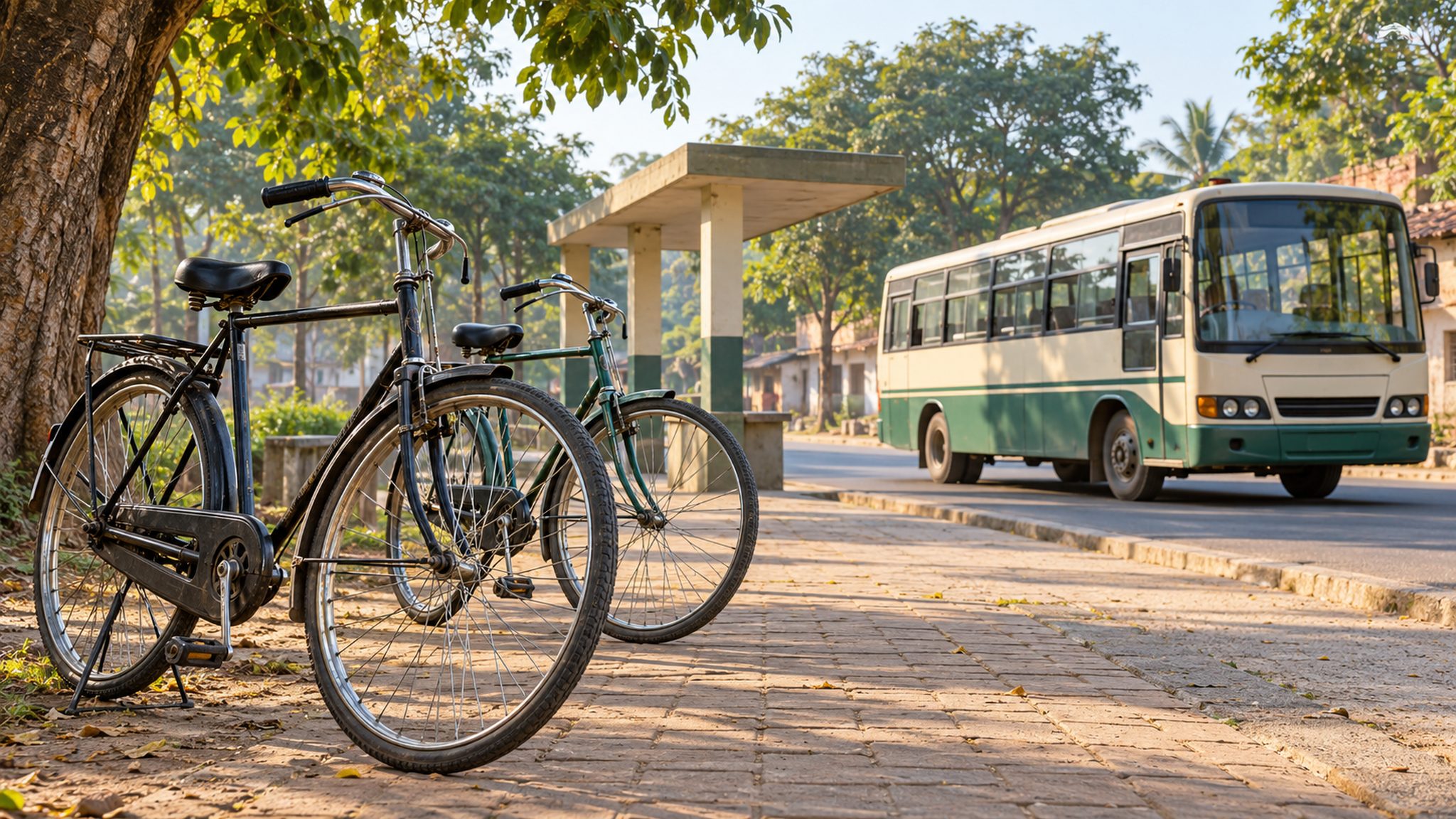
- For example, a commuter may walk to a bus stop and then travel farther by bus. The bus becomes the primary mode even though a usable footpath remains necessary to complete the same journey.
- A worker travelling to a changing worksite still belongs within the fixed or non-fixed workplace mode table when the trip qualifies. Do not narrow that table to office employees or regular travel to a single address.
- The longest-distance rule compresses a journey involving several modes into one category. Planners should retain attention to transfers and access legs rather than assume the primary-mode label describes every part of the commute.
From Measured Trips to Better Access
The findings can guide service decisions, but a national travel snapshot cannot by itself establish whether every household enjoys adequate transport access.
- Short trips missing from the survey are outside its definition, not proof of immobility. A person walking to a nearby school can have useful access without appearing among those making a qualifying school commute.
- Non-participation can reflect different circumstances, including no qualifying journey or work located at home. It cannot be equated automatically with unemployment, social exclusion or a lack of transport without examining the relevant household circumstances.
- An observed mode choice may reflect available services, cost or distance rather than a freely preferred option. High use of a vehicle category alone cannot establish that users would reject a reliable alternative service.
- Average journey time summarises existing travel, but cannot reveal every missed opportunity or unusually difficult route. Transport assessment should also examine reliability, affordability and whether essential destinations are reachable at the times people need.
- For planning, combine household evidence with local route and service information. The useful question is where schedules, transfers or pedestrian connections obstruct an actual journey, rather than which national headline looks most impressive.
Way Forward
Use Definitions Before Designing Services
- Publish denominators and coverage rules beside every local summary so officials do not compare unlike populations or confuse primary-mode shares with participation.
- Check access legs and transfers when adjusting routes; a bus service may remain unusable if the walk to its stop is unsafe or disconnected.
- Supplement the national findings with local access enquiries about missed journeys, service hours and affordability before selecting transport improvements.
Conclusion
- The survey provides a baseline for everyday mobility: its value lies in linking journeys to purpose, mode and household circumstances. Use the reported definitions before drawing conclusions about transport demand or access.
- In an answer, separate trip participation, primary-mode share and accessibility. This distinction explains why better transport policy needs both evidence about completed journeys and information about opportunities people cannot currently reach.
UPSC Practice Questions
Prelims MCQ 1
With reference to the National Household Travel Survey, consider the following statements:
- Its conceptual appendix includes travel of one kilometre or more.
- The primary mode is the mode covering the longest distance during a trip.
- A travel-day begins at midnight.
How many of the above statements are correct?
(a) Only one (b) Only two (c) All three (d) None
Answer: (b) Only two
Explanation:
The first two statements are correct. The survey travel-day begins at 3:00 AM and ends at 2:59 AM the next calendar day.
Prelims MCQ 2
The worker primary-mode shares in the NHTS appendix are calculated among which group?
(a) All residents irrespective of work status (b) All households owning a vehicle (c) Workers reporting qualifying within-travel-day workplace trips (d) Only employees attending a fixed office
Answer: (c) Workers reporting qualifying within-travel-day workplace trips
Explanation:
The table covers workers aged fifteen and above reporting trips to fixed or non-fixed workplaces. It is not a distribution across all residents or vehicle owners.
UPSC Mains Questions
- How do trip thresholds, population denominators and primary-mode definitions shape the interpretation of household commuting statistics?
- Discuss how household travel evidence can inform equitable transport planning. What additional information is needed to assess accessibility?
Source: PIB, Ministry of Statistics and Programme Implementation.
Frequently Asked Questions
What is the National Household Travel Survey?
It is the NSO household survey whose first national findings cover July 2025 to June 2026. It records travel purposes, modes, duration and expenditure to support transport planning.
How does the survey identify the primary mode?
The primary mode is the transport mode used for the longest distance during a trip. A journey combining walking and bus travel can consequently be classified as a bus trip.
Are journeys shorter than one kilometre included?
The conceptual appendix excludes journeys below one kilometre. Their absence from the travel estimates should not be interpreted as proof that a person did not travel or lacked nearby access.
Does a mode share describe everyone in India?
No. The school and work mode tables describe the relevant students or workers reporting qualifying trips. Their denominators differ from the population bases used to measure participation in commuting.
Source: https://anantamias.com/current-affairs/household-travel-survey-commuting-measurement/
India-Japan JCM: From Climate Projects to Accounted Credits
Why in News?
On 5 October 2026, the Environment Ministry announced that India and Japan had launched their Joint Crediting Mechanism Operational Manual on 30 September.
- The Operational Manual covers procedures from submitting a Project Idea Note through issuance and authorization of JCM credits.
- The framework supports low-carbon technology, climate finance and emission reductions or removals in India.
- This is an implementation milestone; the announcement does not establish that credits have already been issued or emissions reduced.
- A carbon project requires both credible mitigation and clear rules about who may claim its climate benefit.
- Bilateral cooperation under Article 6.2 connects project activity with countries’ national climate commitments.
UPSC Relevance
Prelims Relevance
- Joint Crediting Mechanism: India-Japan bilateral climate cooperation.
- Article 6.2: cooperative approaches and internationally transferred mitigation outcomes.
- NDC: nationally determined contribution under the Paris Agreement.
- Corresponding adjustments: avoiding double counting between participating countries.
- Article 6.4: the separate UNFCCC crediting mechanism.
Mains Relevance
GS Paper 3
- Environmental integrity and international carbon-market accounting.
- Technology cooperation and the difference between finance mobilization and achieved mitigation.
GS Paper 2
- Bilateral institutions implementing multilateral climate commitments.
Background and Context
What the JCM Manual Changes
The announcement concerns the procedures for implementing bilateral climate projects, rather than a report of completed emission reductions.
- The Joint Crediting Mechanism aims to connect Japanese technology cooperation and climate finance with mitigation activities in India. Its stated purpose includes both reducing emissions and removing greenhouse gases from the atmosphere.
- A Project Idea Note is the starting point identified in the announcement. An idea entering a procedure must be distinguished from a project having generated an established, internationally usable climate benefit.
- The Operational Manual supplies a procedural framework across the project cycle, according to PIB. This gives participating institutions and prospective project developers a common basis for moving proposals forward.
- Issuance and authorization are separately named endpoints in the announced framework. An issued credit and permission for its specified international use are distinct questions when evaluating a carbon-market claim.
- The release does not identify completed projects, issued quantities or achieved reductions. Treat those as outcomes requiring further evidence; a functioning procedure alone cannot demonstrate the environmental performance of future activities.
Why International Transfers Need Accounting
The location of a mitigation activity and the country using its outcome towards a climate commitment can differ.
- Article 6.2 provides accounting and reporting guidance for countries using internationally transferred mitigation outcomes, or ITMOs, towards their nationally determined contributions. These national contributions set out countries’ climate commitments under the Paris Agreement.
- Double counting would arise if both cooperating countries claimed the same transferred outcome towards their targets. International cooperation must preserve a single consistent account of that outcome, even when finance crosses borders.
- A corresponding adjustment changes the accounting used to track national commitments. For emissions-based accounting, the transferring country adds the relevant quantity to its emissions balance; the country using it subtracts it.
- This accounting adjustment does not mean the transferring country physically releases additional pollution. Distinguish the real-world change in greenhouse gases from the adjusted balance used to assess progress against a national commitment.
- The UNFCCC overview distinguishes Article 6.2 cooperative approaches from the Article 6.4 mechanism. A bilateral arrangement does not become the latter merely because both operate within the Paris Agreement.
How to Judge the Implementation Claim
The useful test is whether a procedure can support credible outcomes, transparent claims and benefits relevant to the host country.
- Technology deployment is the practical starting point: cooperation should enable equipment or practices that lower emissions. Purchasing machinery, spending finance and announcing a partnership are inputs; none independently measures the resulting climate benefit.
- Project performance needs evidence from actual operation. A proposal may describe expected savings, but expected savings should not be presented as achieved reductions before the activity has produced a measurable result.
- Accounting integrity answers who claims an outcome; environmental integrity asks whether the underlying mitigation is credible. Sound bookkeeping cannot compensate for a project whose claimed climate benefit does not exist.
- For India, implementation quality also concerns whether cooperation serves domestic development needs. Assess technology suitability and institutional capacity alongside potential credit revenue, rather than treating international market participation as sufficient evidence of success.
- For an exam answer, separate announcement, procedure and performance. The present news establishes a procedural milestone; claims about specific approvals, credit-sharing formulas or verified results require documents beyond this short official announcement.
Way Forward
Make Project Claims Auditable
- Publish clear project-level information that distinguishes proposals, issued credits and authorized international uses.
- Evaluate measured mitigation alongside development benefits before describing implementation as successful.
- Keep national accounting consistent with transfers so that cooperation does not permit duplicate climate claims.
Conclusion
- The India-Japan JCM Manual advances the procedural side of climate cooperation. Its eventual significance depends on activities producing credible mitigation and institutions documenting how the resulting outcomes are issued, authorized and used.
- Use this development to explain the distinction between project implementation and international accounting. A climate partnership becomes convincing when its physical results and national claims can both withstand scrutiny, rather than when a manual is launched.
UPSC Practice Questions
Prelims MCQ 1
With reference to international carbon cooperation, consider the following statements:
- Article 6.2 concerns cooperative approaches involving internationally transferred mitigation outcomes.
- Corresponding adjustments help avoid counting the same transferred outcome towards two national commitments.
- A corresponding adjustment necessarily increases physical emissions in the transferring country.
How many of the above statements are correct?
(a) Only one (b) Only two (c) All three (d) None
Answer: (b) Only two
Explanation:
Statements 1 and 2 are correct. An adjustment changes the accounting balance used to track commitments; it does not itself change physical emissions.
Prelims MCQ 2
What does the announced India-Japan JCM Operational Manual establish?
(a) Proof that all proposed projects have reduced emissions (b) A replacement for the Paris Agreement (c) A procedural framework spanning project ideas through credit issuance and authorization (d) Automatic approval of every low-carbon technology project
Answer: (c) A procedural framework spanning project ideas through credit issuance and authorization
Explanation:
PIB describes procedures across the project cycle. It does not report automatic project approvals or demonstrate achieved reductions.
UPSC Mains Questions
- Explain why international carbon cooperation requires both credible mitigation and accounting safeguards against double counting.
- Discuss how the India-Japan JCM Operational Manual can support bilateral climate cooperation. What evidence would be needed to judge implementation success?
Sources: PIB, Ministry of Environment, Forest and Climate Change and UNFCCC.
Frequently Asked Questions
What is the India-Japan Joint Crediting Mechanism?
It is a bilateral framework intended to promote low-carbon technology, climate finance and emission reductions or removals in India. Its implementation forms part of cooperation under Article 6.2 of the Paris Agreement.
When was the JCM Operational Manual launched?
The manual was launched on 30 September 2026. The Environment Ministry announced the development through PIB on 5 October. The announcement describes a procedural milestone, not evidence that credits have already been issued.
What is a corresponding adjustment?
It is an adjustment to the accounting used to track national climate commitments when mitigation outcomes are internationally transferred and used. Its purpose is to avoid both countries claiming the same outcome.
Does issuing a carbon credit prove international authorization?
Issuance and authorization concern distinct matters. The announcement names both within the procedural framework. Do not assume that a credit is authorized for a particular international use simply because it has been issued.
Source: https://anantamias.com/current-affairs/india-japan-jcm-operational-manual-carbon-accounting/
India-Switzerland Mobility: Temporary Access With Defined Rules
Why in News?
India and Switzerland signed a Migration and Mobility Partnership MoU and a Young Professionals Agreement during the Swiss President’s visit on 5 October 2026.
- The mobility partnership addresses equal treatment, regular migration and cooperation against irregular migration, exploitation and trafficking under national laws.
- Its announced provisions include multiple-entry visas valid up to five years, with stays up to six months per visit, and renewable one-year student permits.
- The young-professionals exchange covers temporary employment to develop professional and language skills: 300 participants annually from each country, potentially increasing to 500.
- The official outcome list records signed instruments; it does not establish that applications have opened or that every applicant qualifies.
- Mobility cooperation connects education and professional experience with legal entry and residence conditions; easier travel does not remove immigration controls.
- Safe recruitment and clear information matter because an announced opportunity can otherwise be misrepresented as a guaranteed job or settlement route.
UPSC Relevance
Prelims Relevance
- Migration and Mobility Partnership: bilateral cooperation governed by national laws.
- Multiple-entry visa validity differs from the permitted duration of each stay.
- Young Professionals Agreement: reciprocal temporary employment for professional and language skills.
- Renewable student permission does not mean unconditional renewal.
- Signed cooperation instruments differ from an open application process.
Mains Relevance
GS Paper 2
- Migration diplomacy, reciprocal opportunities and protection against exploitation.
- Implementation of international agreements through clear domestic procedures.
Essay
- International opportunity depends on usable rules and enforceable protections.
Background and Context
What the Two Instruments Cover
The partnership establishes a wider migration framework, while the professional exchange addresses a narrower form of temporary work and learning.
- The Migration and Mobility Partnership brings facilitation and protection into the same framework. Its stated equal-treatment principles coexist with cooperation against irregular migration, human exploitation and trafficking, in accordance with national laws.
- The Young Professionals Agreement concerns people taking temporary employment in the other country to improve professional and language skills within their field. It is an exchange framework, not an unrestricted labour-market opening.
- Reciprocity means the announced exchange operates in both directions. The published annual provision applies separately to participants from each country, rather than describing one combined pool shared between Indian and Swiss applicants.
- The official outcome list describes different instruments for different purposes. Keep the mobility MoU distinct from transport cooperation and research arrangements; their inclusion in one visit does not merge their rules.
- Cooperation is not individual entitlement: signing establishes a bilateral commitment, but a person still needs the relevant permission. The announcement alone cannot establish that a particular worker, student or researcher is eligible.
Why Visa Validity and Permitted Stay Differ
A permission can remain valid for repeated journeys without allowing its holder to live or work abroad continuously throughout that period.
- Visa validity describes the period for which the visa remains usable under its conditions. The announced multiple-entry provision must not be read as permission for one uninterrupted stay lasting the entire validity period.
- Permitted stay concerns the duration of an individual visit. The announced ceiling per visit is separate from the longer visa-validity window, so a traveller must understand both limits before making education or employment plans.
- Renewable student permits provide for possible continuation beyond an initial permission. The word renewable does not establish automatic extension; the outcome summary supplies neither a complete renewal checklist nor a guarantee for every student.
- Temporary employment under the professional exchange has a stated skills-development purpose. Its announcement does not create an unrestricted right to take any job, remain permanently, or convert every other visa into work permission.
- Signature and implementation are different stages, as the India-New Zealand FTA note also illustrates. That comparison concerns implementation discipline; trade and migration instruments retain their own legal requirements and procedures.
What Successful Mobility Requires
The policy’s value will depend on transparent procedures and useful experience, alongside safeguards against misleading promises and unequal treatment.
- Clear eligibility guidance should precede recruitment claims. Applicants need authoritative information on qualifying fields, required documents and applicable conditions; this release does not justify inventing age bands, educational thresholds or an application opening date.
- Skills gained are a better outcome measure than merely counting departures. Like training-to-employment programmes, the exchange should be assessed through the quality and relevance of experience, while retaining its distinct international purpose.
- Equal treatment must be understood within the agreed framework and national laws. The short outcome summary cannot establish identical rights in every field or remove the distinction between a temporary visitor and a resident.
- Protection against exploitation needs practical attention to truthful recruitment information, understandable employment terms and accessible help. These are implementation priorities, not claims that the announcement has already created a particular complaint mechanism.
- Future expansion remains conditional: a possible increase in the exchange provision is not today’s operative larger quota. Assessment should distinguish what was signed, what authorities subsequently implement and what participants actually experience.

Way Forward
Make the Opportunity Usable
- Publish official eligibility and application guidance before applicants make financial commitments to recruiters or training providers.
- Explain visa validity, visit limits and work permission separately, using examples that prevent confusion about continuous residence.
- Track relevant learning and participant protection, alongside exchange uptake; publish accessible routes for clarification when procedures become operational.
Conclusion
- Mobility agreements can widen lawful education and professional opportunities, but their value depends on usable procedures and protection. A longer-valid visa, a permitted visit and a temporary job describe different legal situations.
- For an analytical answer, connect reciprocal access with national regulation and equal treatment. Evaluate implementation and participant experience without converting a signed framework into a promise of automatic entry, employment or permanent settlement.
UPSC Practice Questions
Prelims MCQ 1
With reference to the announced India-Switzerland mobility arrangements, consider the following statements:
- The full validity period of a multiple-entry visa necessarily permits one continuous stay of the same duration.
- The Young Professionals Agreement concerns temporary employment for professional and language skill development.
- The announced professional exchange is reciprocal.
How many of the above statements are correct?
(a) Only one (b) Only two (c) All three (d) None
Answer: (b) Only two
Explanation:
Statements 2 and 3 are correct. Visa validity and the permitted duration of each visit are different; the announcement specifies a shorter per-visit limit.
Prelims MCQ 2
Which interpretation of a renewable student permit is most appropriate?
(a) Renewal is unconditional once the initial permit is issued. (b) The permit automatically authorises permanent settlement. (c) Continuation may be possible, subject to the applicable conditions. (d) Every student permit automatically becomes a professional work permit.
Answer: (c) Continuation may be possible, subject to the applicable conditions.
Explanation:
Renewable describes the possibility of extending permission; the outcome summary does not guarantee renewal or establish automatic conversion to another status.
UPSC Mains Questions
- Explain how bilateral mobility agreements can expand professional opportunities while preserving national immigration regulation. (150 words)
- Distinguish an agreement’s announced access provisions from successful implementation. Discuss the safeguards needed to protect participants in temporary international work exchanges. (250 words)
Sources: PIB, Prime Minister's Office and PIB, Prime Minister's Office.
Frequently Asked Questions
What did India and Switzerland sign on 5 October 2026?
They signed a Migration and Mobility Partnership MoU and a Young Professionals Agreement. The official outcome list describes wider migration cooperation alongside a reciprocal temporary-employment exchange intended to improve professional and language skills.
Does a five-year visa allow a five-year continuous stay?
No. The announced multiple-entry visa validity extends up to five years, while each visit may last up to six months. Visa validity and the duration of an individual permitted stay are separate conditions.
Does the agreement guarantee a job in Switzerland?
No. It describes a temporary professional exchange, not a job guarantee or unrestricted work permission. Individual applicants must follow applicable procedures; the announcement does not establish that applications have opened.
Has the young-professionals quota already increased to 500?
The published provision is 300 participants annually from each country, with a possible increase to 500. The larger figure is conditional and should not be described as an already implemented annual quota.
Are student permits automatically renewed?
The outcome list refers to renewable one-year student permits. It does not say renewal is unconditional or provide a complete application checklist. Applicants need the relevant authorities’ current procedures and conditions.
Source: https://anantamias.com/current-affairs/india-switzerland-mobility-young-professionals/
VB-G RAM G Works: Linking Employment to Durable Rural Assets
Why in News?
The Ministry of Rural Development announced a newly notified Schedule of Permissible Works under VB-G RAM G on 6 October 2026, widening the rural asset planning framework.
- The Schedule covers 375 permissible works under the existing Viksit Bharat–Guarantee for Rozgar and Ajeevika Mission (Gramin) Act, 2025.
- Works are to originate in Viksit Gram Panchayat Plans, based on local needs and approved by the Gram Sabha.
- The Ministry links digital asset tracking with convergence across Central, State and local schemes and avoiding duplication.
- An expanded eligible works list gives villages more choices; selecting useful assets still requires identifying local constraints and feasible solutions.
- The key governance question is whether wage employment creates assets that remain usable after construction, rather than merely expanding the range of approved categories.
UPSC Relevance
Prelims Relevance
- Permissible works: categories allowed under the notified Schedule.
- Gram Sabha: approves the locally prepared Viksit Gram Panchayat Plan.
- Convergence: coordinating investments across schemes around related local needs.
- Asset tracking: records intended to help identify works and avoid duplication.
Mains Relevance
GS Paper 2
- Decentralised planning and accountability in rural development.
- Distinguishing policy eligibility from implementation and service delivery.
GS Paper 3
- Connecting employment with water security, rural productivity and disaster preparedness.
Essay
- Local participation can improve public investment when community choices are matched with technical feasibility.
Background and Context
What Does a Permissible Work Mean?
The new development concerns the scope of eligible works under an existing law, rather than the enactment of a new employment law.
- The Ministry’s announcement identifies permissible works as the activities included in the Schedule. Inclusion establishes a planning option; it does not establish that a particular village has selected or completed that work.
- Permissible, sanctioned and completed describe different stages. An eligible category is not the same as approval of a specific project, and project approval is not evidence that construction or service delivery has occurred.
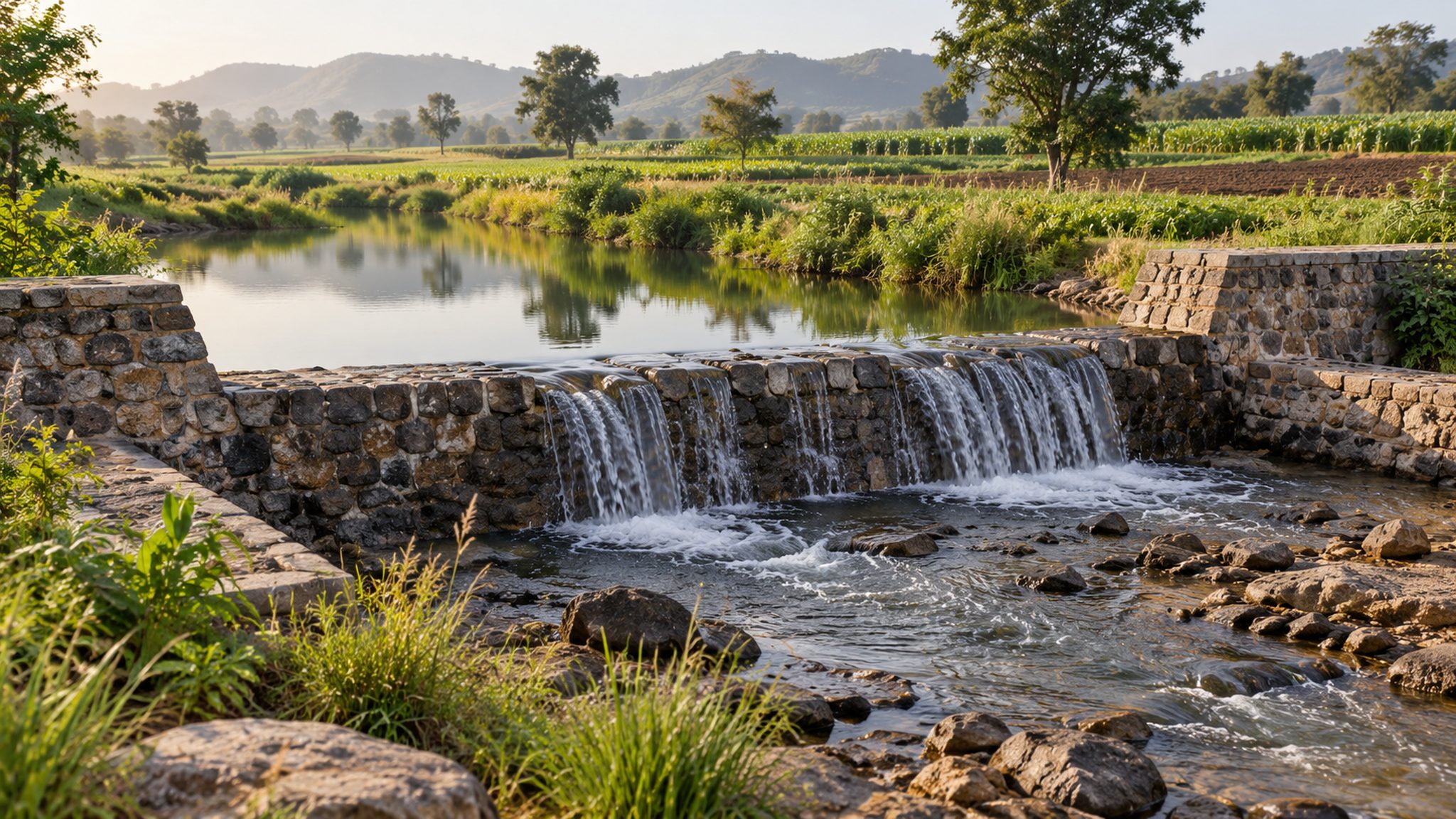
- A check dam, for example, is among the listed water works. Its eligibility alone says nothing about a proposed site’s suitability, the structure’s eventual condition or water availability for households and farms downstream.
- The Ministry’s stated objective connects wage employment with durable assets. These are related but separate results: labour creates the structure, while continued usability determines whether that structure provides an enduring public benefit.
- The announcement reports a notified framework, not measured development outcomes. Claims that the change has already raised incomes, prevented floods or improved groundwater would require separate evidence from implementation and subsequent local observation.
How Local Priorities Shape the Asset Choice
The announced planning route starts with local needs and a Gram Sabha-approved village plan, making selection as consequential as the expanded list.
- The Viksit Gram Panchayat Plan provides the stated route for originating works. Gram Sabha approval links the plan to village deliberation; it should not be confused with automatic approval of every eligible project everywhere.
- Useful needs assessment asks what prevents an existing service from working. A village with a damaged water-distribution channel may need restoration more urgently than another new structure chosen simply because it is now permissible.
- The Schedule includes repair and maintenance of Jal Jeevan Mission infrastructure. This matters because asset planning can address deteriorating services alongside new construction; a larger stock of structures alone does not demonstrate better access.
- For livelihood infrastructure, the announcement includes processing and storage facilities. Their value depends on a local production need and usable connections to the surrounding economy, rather than the existence of a building in isolation.
- Inclusive selection should consider who can actually use the proposed asset. The Ministry identifies accessibility provisions and infrastructure for women’s collectives; evaluating usability is more informative than treating all residents as equally served by construction.
What Convergence and Tracking Can Establish
Coordinating schemes can make investments complement one another, but records and intentions must be distinguished from verified results on the ground.
- The Ministry says digital tracking will support convergence across Central, State and local schemes. The practical purpose is to relate investments to the same local needs while reducing the risk of duplicating existing works.
- Convergence is useful when related investments address different constraints. For example, restoring a water asset and repairing its distribution channel can be complementary; this illustrates planning logic, not an announced project or guaranteed funding arrangement.
- Duplication means repeating investment without a justified additional function. Two similar assets are not necessarily wasteful if they serve different settlements; reviewers need location, purpose and existing capacity before judging whether proposals overlap.
- An asset record can show what has been entered and tracked. It cannot, by itself, establish construction quality, equitable access or lasting usefulness; those questions require checking the physical asset and the service it provides.
- The distinction between outputs and outcomes is central. Completing a structure is an output; dependable use is an outcome. Assessing employment generation and asset performance separately prevents one achievement from being presented as proof of both.
Way Forward
Make Project Selection Reviewable
- Record the local problem, intended users and existing assets before selecting a permissible work.
- Match each proposal with site suitability and a practical maintenance responsibility, especially for water and shared livelihood assets.
- Review overlapping investments across schemes, then assess completed structures for actual usability rather than relying only on digital entries.
Conclusion
- The expanded Schedule creates more planning options; its value depends on selecting works that solve identifiable village problems and remain useful after construction, with the Gram Sabha-approved plan connecting local choices to public investment.
- For policy analysis, keep eligibility, approval, completion and outcomes distinct. Use convergence to explain complementary investments, and demand separate evidence before claiming that a notified works framework has already improved livelihoods or resilience.
UPSC Practice Questions
Prelims MCQ 1
With reference to the newly announced VB-G RAM G works framework, consider the following statements:
- Works are to originate through Viksit Gram Panchayat Plans approved by the Gram Sabha.
- Inclusion in the permissible works Schedule establishes that every village has completed that work.
- Digital tracking is intended to support convergence and avoid duplication.
How many of the above statements are correct?
(a) Only one (b) Only two (c) All three (d) None
Answer: (b) Only two
Explanation:
Statements 1 and 3 reflect the Ministry’s announcement. Permissibility identifies an eligible category; it does not establish project completion.
Prelims MCQ 2
Which example best illustrates convergence in rural asset planning?
(a) Counting a listed work as already completed (b) Repeating the same investment without checking existing assets (c) Coordinating related investments to address connected local service needs (d) Treating digital registration as proof of increased household income
Answer: (c) Coordinating related investments to address connected local service needs
Explanation:
Convergence coordinates investments around related needs. It is distinct from automatic completion, duplication or an unverified outcome claim.
UPSC Mains Questions
- How can Gram Sabha-approved local planning improve the connection between wage employment and durable rural assets? Discuss the implementation challenges.
- Distinguish permissible works, project completion and development outcomes. Explain how convergence and asset tracking can strengthen rural investment without replacing field verification.
Source: PIB, Ministry of Rural Development.
Frequently Asked Questions
What changed in the VB-G RAM G works framework?
The Ministry announced a new Schedule of Permissible Works under the existing Act. It expands planning options and links locally selected works with durable assets, convergence and digital tracking.
Does a permissible work automatically become a completed project?
No. Permissibility concerns an eligible category. Selection and project approval are separate from completion, while evidence of a useful, functioning asset requires checking what has actually been delivered.
What role does the Gram Sabha have?
The Ministry states that works will originate through Viksit Gram Panchayat Plans based on local needs and approved by the Gram Sabha. This places village deliberation within the planning process.
What does convergence mean in this context?
Convergence coordinates investments across Central, State and local schemes so related works address local needs together. Tracking is intended to help identify existing investments and avoid unnecessary duplication.
Does the notification prove better livelihoods or disaster resilience?
No. Those are intended benefits of the framework. Establishing results requires evidence about implemented works, their condition, who uses them and whether they provide useful services over time.
Source: https://anantamias.com/current-affairs/vb-gramg-permissible-works-local-asset-planning/
Vision SoCs: Bringing Image Processing Closer to the Camera
Why in News?
On 5 October 2026, the Technology Development Board announced an agreement with BigEndian Semiconductors to develop Project VeerAI, a camera-focused AI Vision System-on-Chip.
- The proposed Vision SoC initially targets CCTV and surveillance applications.
- The platform aims to combine AI processing with security, privacy and connectivity capabilities.
- Development, validation, integration, testing and scale-up remain necessary; commercial readiness is a project objective.
- An application-specific chip addresses a defined workload, connecting semiconductor design to practical equipment requirements.
- A sovereign platform objective does not independently establish manufacturing location or guarantee the security of deployed devices.
UPSC Relevance
Prelims Relevance
- SoC: System-on-Chip, integrating multiple system functions.
- Image sensor: converts incoming light into electrical signals.
- Application-specific processing: design focused on a defined class of tasks.
- Edge processing: computation performed near the source of data.
- IoT security: includes access controls, data protection and secure software updates.
Mains Relevance
GS Paper 3
- Semiconductor design capabilities and application-specific technology development.
- Security and privacy requirements for connected surveillance devices.
Background and Context
From Light to Useful Information
A camera must capture an image before a computing system can interpret it; these are related but different tasks.
- An image sensor contains light-sensitive picture elements, or pixels. Incoming light produces electrical signals that can be assembled into an image, as NASA explains in its account of digital camera technology.
- Image processing works on captured information to make it usable for a task. Producing a recognizable picture and extracting information from that picture are distinct functions within the broader camera system.
- A smart camera can process images inside the device before sending results onward. NASA’s smart-camera example demonstrates this approach; it provides technical background, not specifications for the proposed Indian chip.
- A System-on-Chip brings several system functions into an integrated semiconductor device. The phrase does not mean that every component of a complete camera, including its lens and power supply, must occupy one chip.
- The useful conceptual sequence is capture, process and output. What reaches another computer may be processed information rather than every captured frame; the actual data flow depends on the device design and application requirements.

Why a Camera-Focused Chip Is Different
VeerAI targets a defined family of imaging applications rather than presenting itself as a processor for every computing task.
- Application-specific design starts with the work a device needs to perform. For a camera-focused platform, imaging requirements shape design priorities; a general-purpose processor is intended to support a much broader variety of computing workloads.
- The official announcement identifies CCTV and surveillance as the initial use. Defence, automotive, industrial and medical applications are part of an envisaged roadmap, not evidence of deployments already completed in those sectors.
- AI processing can support interpretation of image information, but the release does not disclose VeerAI’s precise capabilities. It does not justify inventing recognition features, processing speeds, memory capacity or the chip’s manufacturing process.
- Local processing may reduce the information that must travel to another computer, as the smart-camera example shows. Benefits depend on which tasks remain local and which data the product still sends over a network.
- The proposed platform combines processing, connectivity and security objectives. Whether those objectives work together in a deployable product requires validation and testing; an agreement to develop the technology is not equivalent to a demonstrated product.
Security Requires More Than an Indigenous Label
A domestic design can be strategically valuable while still requiring careful assessment of the complete device and its operation.
- Technology sovereignty concerns control and dependence across a technology ecosystem. The stated ambition to reduce external reliance does not establish that every tool, component or fabrication stage involved in the eventual product will be Indian.
- Data protection includes information stored on a device and information transmitted from it. NIST’s IoT guidance also identifies access restrictions and secure software updates as device capabilities, showing why chip origin alone cannot establish security.
- Privacy benefits from local processing are conditional. Sending less raw video can limit exposure, but retaining detailed recordings or permitting broad access can still create risks; the release does not establish VeerAI’s final data-handling architecture.
- Testing must evaluate the integrated product under its intended conditions. A useful procurement question is whether its declared functions, update arrangements and access controls work reliably, rather than whether it carries an attractive technology label.
- Commercial readiness remains a goal: the announcement describes progress from TRL-5 towards TRL-9. The exam-relevant distinction is between supporting development and establishing a validated product, rather than memorizing the funding instrument or treating readiness as achieved.
Way Forward
Evaluate the Complete Device
- Require evidence for performance claims under the intended imaging conditions before large deployments.
- Specify access controls, update support and data retention alongside hardware requirements when procuring connected cameras.
- Assess domestic capability across design, validation and production without assuming that success in one stage proves independence in every stage.
Conclusion
- Project VeerAI illustrates how application-specific semiconductor design can connect domestic engineering capability with practical camera requirements. Its significance will depend on tested functionality and deployable products, rather than the agreement alone.
- For an answer, connect sensor capture, image processing and system security. Keep the proposed chip’s ambitions separate from verified architecture, completed manufacturing and measured performance; these are distinct claims requiring distinct evidence.
UPSC Practice Questions
Prelims MCQ 1
With reference to camera-focused semiconductor systems, consider the following statements:
- An image sensor converts incoming light into electrical signals.
- Processing images locally guarantees that a connected camera cannot create privacy risks.
- A System-on-Chip necessarily contains every component of a complete camera, including its lens.
How many of the above statements are correct?
(a) Only one (b) Only two (c) All three (d) None
Answer: (a) Only one
Explanation:
Only statement 1 is correct. Local processing does not remove every privacy risk, and a SoC need not include the camera lens or every external component.
Prelims MCQ 2
Which statement best describes the VeerAI announcement?
(a) A proven deployment across all proposed sectors (b) An agreement supporting development of an application-specific AI Vision SoC (c) Certification that every production stage is located in India (d) Publication of measured chip performance benchmarks
Answer: (b) An agreement supporting development of an application-specific AI Vision SoC
Explanation:
The release announces development support and further validation and scale-up work. It does not demonstrate the other claims.
UPSC Mains Questions
- Explain how application-specific semiconductor design can support domestic technology capabilities. Use camera-focused Vision SoCs as an example.
- Discuss why indigenous design and local image processing are insufficient, by themselves, to establish the security and privacy of connected surveillance devices.
Sources: PIB, Department of Science and Technology and NASA Spinoff.
Frequently Asked Questions
What is Project VeerAI?
Project VeerAI is a proposed camera-focused AI Vision System-on-Chip being developed by BigEndian Semiconductors with Technology Development Board support. It initially targets CCTV and surveillance, with other sectors envisaged in its roadmap.
What does a System-on-Chip do?
A System-on-Chip integrates multiple system functions within a semiconductor device. The particular functions depend on its design. It does not necessarily include every physical component needed to build the complete camera or other product.
Does processing video locally guarantee privacy?
No. Local processing may reduce raw information transmitted elsewhere, but privacy also depends on collection, storage and access. The VeerAI announcement does not establish the final architecture or retention practices of future devices.
Has VeerAI already reached commercial readiness?
The announcement describes further development, validation, integration, testing and scale-up intended to advance the technology towards commercial readiness. It should not be read as confirmation that the final product has already achieved that goal.
Source: https://anantamias.com/current-affairs/veerai-vision-soc-application-specific-processing/
Why is Buxa bringing Tigers back?
Why in News?
A three-year-old tigress, T138, was translocated from Valmiki Tiger Reserve, Bihar, and introduced into Buxa Tiger Reserve, West Bengal. This initiates a phased programme to establish a viable, self-sustaining tiger population. Buxa had experienced a prolonged absence of a stable resident tiger population.
| UPSC Relevance: GS-3 Environment and Biodiversity: Conservation, Protected Areas, Species in News Prelims: Tiger, Keystone species, Buxa Tiger Reserve Mains: Conservation of Keystone species |
About Buxa Tiger Reserve:
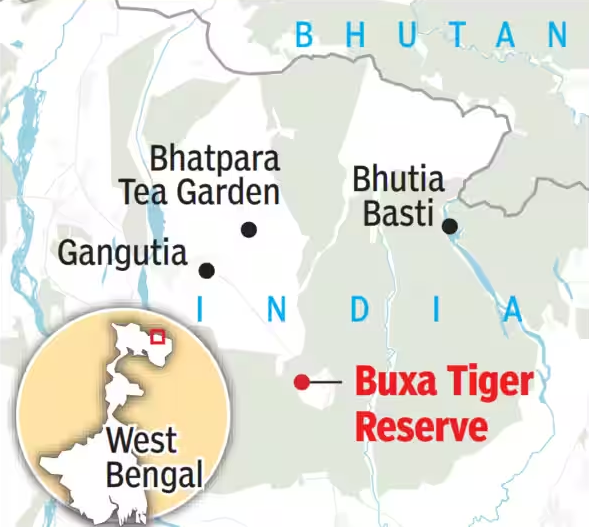
- Location: Alipurduar district of West Bengal, in the eastern Himalayan foothills and the Dooars landscape.
- Establishment: Established under Project Tiger in 1983.
- Extent: Approximately 760 sq. km, encompassing Buxa National Park, Buxa Wildlife Sanctuary and adjoining forests.
- Habitats: A mosaic of moist deciduous and semi-evergreen forests, sal forests, subtropical wet hill forests and riverine grasslands.
- Major rivers: Sankosh, Raidak and Jayanti
- Historical association: The reserve derives its name from Buxa Fort, associated with the detention of freedom fighters during British rule.
- Important fauna: Asian elephant, leopard, clouded leopard, dhole, gaur, sambar, chital and barking deer, besides tigers.
- Landscape connectivity:
- North: Forests of Bhutan, including the Phibsoo landscape.
- East: Ripu-Kochugaon forests of Assam, linking towards Manas landscape.
- West: Jaldapara through the intervening forest and corridor network, including Chilapata.
These connections make Buxa significant for tiger dispersal and elephant movement across State and international boundaries.
Tiger- a Keystone Species:
- A keystone species has an ecological influence disproportionately large relative to its abundance. Its disappearance can substantially alter the ecosystem’s structure, food web and functioning.
- It need not be the most abundant or largest species. It need not be a predator; some species exert their influence by modifying habitats.
- Its loss can transform an ecosystem, but does not invariably make the entire ecosystem cease to exist.
- Conservation status of Tiger:
- IUCN Red List: Endangered
- Wildlife (Protection) Act, 1972: Schedule I
- CITES: Appendix I
- In 2022, the last census estimated a total of 3682 tigers across the country, with Madhya Pradesh topping the list with 785 tigers.
Significance of Keystone Species Conservation:
- Maintains Food-Web Balance: Top predators regulate prey abundance and behaviour. This triggers trophic cascades (effects that spread across different levels of a food web) that keep the entire food web healthy and stable.
- Prevents Biodiversity Loss: They stop single species from dominating. E.g., Sea otters eat sea urchins, which prevents the overgrazing and destruction of kelp forests.
- Restores Ecological Processes: Conservation brings back natural predation and habitat engineering. However, reintroduction alone is not enough; the root causes of ecosystem decay must also be fixed.
- Safeguards Ecosystem Services: Protecting these species and their habitats secures vital natural benefits like water regulation, soil fertility, carbon storage, and genetic diversity.
- Supports Local Economies: Sustainable wildlife tourism creates jobs for guides, transport, and homestays. Success requires fair revenue sharing and strict limits on ecological disturbance.
Why was Valmiki Tiger Reserve selected?
- Valmiki Tiger Reserve lies at the eastern end of the Terai Arc Landscape and offers terrain and habitat conditions more comparable to Buxa.
- Sundarbans tigers were considered less suitable because their tidal mangrove habitat differs substantially from Buxa’s foothill forests.
Selection of source animals requires ecological compatibility, alongside veterinary assessment and management preparedness.
Buxa’s Tiger Recovery Programme:
The preparatory work has been undertaken since 2018, involving the West Bengal government, National Tiger Conservation Authority (NTCA) and Wildlife Institute of India:
- Release of more than 800 chital to supplement the prey base.
- Restoration or conversion of approximately 380 hectares of grassland.
- Engagement with 64 Eco-Development Committees/Joint Forest Management Committees.
- Post-release monitoring through telemetry, camera traps and field observations.
Lessons from Tiger Reintroduction in India:
- Successful recovery: Sariska, Rajasthan (2008) and Panna, Madhya Pradesh (2009) demonstrate the potential of scientifically managed tiger restoration.
- Uneven outcomes: Satkosia, Odisha, illustrates how inadequate preparedness and human-tiger conflict can undermine translocation efforts. Releasing animals alone does not ensure population recovery.
Key Challenges in the Buxa Tiger Reintroduction:
- Habitat Fragmentation: Settlements, tea estates, and expanding infrastructure (like railways and roads) have cut off vital wildlife corridors.
- Low Prey Availability: A lack of natural prey like chital may force tigers to hunt livestock, triggering severe human-wildlife conflict.
- Shrinking Grasslands: Overgrown forest canopies are choking out sunlight, reducing the grass needed to sustain grazing herbivores.
- Community & Livelihood Clashes: Relocating villages to create a human-free core area threatens forest-dwellers’ land rights and local ecotourism income.
- Uncertain Establishment: Inadequate prey and persistent disturbance may hinder settlement and breeding. Dispersal into neighbouring forests is natural; concern arises when animals fail to establish or enter conflict-prone areas.
- Sustained Management Requirements: Monitoring, protection, habitat restoration and conflict mitigation require long-term funding and trained personnel. Reintroduction cannot compensate for unresolved habitat degradation.
Way Forward:
- Restore Habitats and Prey First: Revive degraded grasslands and boost wild herbivore numbers before releasing more tigers.
- Secure Wildlife Corridors: Protect migration paths linking to Bhutan and Assam, and add safe eco-crossings to reduce road and railway accidents.
- Partner with Local Communities: Respect forest land rights, secure informed consent before any village relocation, and share ecotourism profits fairly.
- Mitigate Human-Wildlife Conflict: Protect livestock with better fencing, deploy rapid-response teams, and ensure quick, fair compensation for losses.
- Track Long-Term Recovery Success: Measure conservation success by tiger survival, breeding rates, and genetic health, not just the initial number of animals released.
Buxa’s tiger recovery can strengthen an important transboundary wildlife landscape. Lasting success requires secure habitats, sufficient prey, connected corridors and community partnership, alongside carefully monitored releases.
Practice Prelims MCQ:
Q. With reference to Buxa Tiger Reserve, consider the following statements:
- It is located in northern West Bengal.
- It has ecological connectivity with forests of Bhutan and Assam.
- The absence of a stable resident tiger population necessarily means that no tiger moves through the reserve.
Which of the statements given above are correct?
(a) 1 and 2 only
(b) 2 and 3 only
(c) 1 and 3 only
(d) 1, 2 and 3
Answer: (a)
UPSC PYQ 2018
Q. In which one of the following States is Pakhui Wildlife Sanctuary located?
(a) Arunachal Pradesh
(b) Manipur
(c) Meghalaya
(d) Nagaland
Answer: (a)
Source: https://anantamias.com/current-affairs/why-is-buxa-bringing-tigers-back/
Bird islands: India’s conservation efforts must go beyond symbolism
Why in news?
Two captive-bred male Great Indian Bustards were released into the wild at Desert National Park, Jaisalmer, raising questions about species-centric conservation.
UPSC Relevance –
Prelims: Great Indian Bustard.
Mains GS3: Conservation, environmental pollution and degradation, environmental impact assessment.
The editorial’s argument
- India’s conservation is ‘captive to symbolism’, as the focus has been on building islands for a few flagship species while landscapes and common birds decline. Landscapes, not species, should be the unit of conservation.
- This is quite visible in celebration of breeding programmes for Great Indian Bustard while the major threats to habitat and landscapes continue such as hunting (even into the late 1970s), conversion of grasslands into irrigated, pesticide-heavy farmland, roads and, most recently, high-tension power lines.
Conservation policy in India – the elaborate legal framework
Constitutional provisions
- Article 48A (DPSP): The State shall protect and improve the environment and safeguard forests and wildlife.
- Article 51A(g) (Fundamental Duty): Every citizen must protect the natural environment and have compassion for living creatures.
- 42nd Amendment (1976): Added both articles and moved ‘Forests’ and ‘Protection of wild animals and birds’ from the State List to the Concurrent List.
- In M.K. Ranjitsinh v. Union of India (2024), the GIB case, the Supreme Court recognised a right against the adverse effects of climate change under Articles 14 and 21.
Laws and policies
- Wild Life (Protection) Act, 1972: Protected areas, schedules of species, ban on hunting. The 2022 amendment cut the schedules to four and brought CITES into domestic law.
- Forest (Conservation) Act, 1980: Renamed Van (Sanrakshan Evam Samvardhan) Adhiniyam in 2023, with exemptions for some linear and security projects.
- Environment (Protection) Act, 1986 and EIA Notification: Clearances for projects.
- Biological Diversity Act, 2002 (amended 2023): Access and benefit sharing; Biodiversity Management Committees at local level.
- National Wildlife Action Plan (2017-2031): The third plan. It explicitly calls for a landscape approach and conservation outside protected areas.
- Updated National Biodiversity Action Plan (2024): Aligned with the Kunming-Montreal Global Biodiversity Framework (2022), which includes the ’30 by 30′ target (protect 30% of land and sea by 2030).
- Species-centric programs – Project Tiger, Project Elephant, Project Cheetah, GIB conservation breeding
Challenges in conservation
- Flagship bias: Money and attention go to a few charismatic animals. Common birds are crashing quietly. The State of India’s Birds report (2023) found most species with long-term data in decline; the article notes skylarks fell about 80% and Indian rollers 30% in 12 years.
- ‘Fortress’ or island conservation: Animals are protected inside walls and captive breeding, but is of little use if the wild habitat where tgey eventually return, has no safe place for them.
- Grasslands treated as ‘wastelands’: Open natural ecosystems like grasslands and scrub are often marked as wasteland and given away for farms, solar parks or plantations. Very little of this habitat is protected.
- Green vs green conflict: Solar and wind parks in Thar and Kutch, with their transmission lines, are vital for India’s 500 GW clean energy target but sit in GIB habitat. The Supreme Court’s changing orders show this tension.
- Linear infrastructure: Highways, railways, canals and power lines cut through corridors; train hits and electrocution are major causes of elephant and bird deaths.
- Wrong restoration: Planting non-native or unsuitable trees (like peepal and banyan on the dry Delhi Ridge, or monoculture plantations under compensatory afforestation) does not restore native ecology.
- Dilution of safeguards: Exemptions under the 2023 forest law amendment and faster clearances raise fears of habitat loss outside protected areas.
- Exclusion of communities: Displacement and poor implementation of the Forest Rights Act create hostility, though communities like the Bishnois show how local people can protect wildlife.
- Climate change: Shifts in rainfall and temperature are changing habitats faster than reserves can adapt.
Way forward
- Landscapes, not species: Plan at the scale of whole landscapes, as with the Terai Arc Landscape, and secure corridors between protected areas.
- Protect open ecosystems: Remove grasslands from ‘wasteland’ classifications, and create a national grassland policy with community grazing rules.
- Biodiversity-friendly energy: Mark ‘go/no-go’ zones for solar and wind; bury lines or fit bird diverters in critical habitat; place parks on degraded land outside key habitats.
- Safe infrastructure: Follow the Wildlife Institute of India guidelines on linear infrastructure, with underpasses, overpasses and speed limits in corridors.
- Conservation beyond protected areas: Use community reserves, sacred groves and OECMs (other effective area-based conservation measures) to meet the 30 by 30 target. Examples: the demoiselle cranes protected by villagers at Khichan (Rajasthan) and the pelicans at Kokkare Bellur (Karnataka).
- Fund the unglamorous: Expand the Species Recovery Programme to less-known birds, reptiles, amphibians and insects; regular monitoring of common species.
- Native restoration: Restore ecosystems with native species suited to the local ecology.
- People at the centre: Implement the Forest Rights Act properly and share benefits with local communities through Biodiversity Management Committees.
India’s conservation success will be judged not by the number of animals in enclosures, but by how many can survive in the open alongside people.
Great Indian Bustard (GIB)
- Status: IUCN Critically Endangered; Schedule I of the Wild Life (Protection) Act, 1972; CITES Appendix I; CMS Appendix I.
- Identity: One of the heaviest flying birds; State bird of Rajasthan, locally called ‘Godawan’. Salim Ali wanted it as the national bird.
- Range: Mainly Jaisalmer and Barmer (Desert National Park); small numbers in Gujarat (Kutch), Maharashtra, Karnataka and Andhra Pradesh.
- Indicator species: Its presence signals healthy dry grasslands, which also support the lesser florican, chinkara, desert fox and Indian wolf.
Practice MCQ
Q1. Consider the following statements about the Great Indian Bustard:
- It is classified as Critically Endangered on the IUCN Red List.
- It is the State bird of Rajasthan.
- It is listed in Schedule II of the Wild Life (Protection) Act, 1972.
How many of the above statements are correct?
(a) 1 and 2
(b) 2 and 3
(c) 1 and 3
(d) 1, 2 and 3
Answer: (a). Statement 3 is incorrect. The GIB is listed in Schedule I, which gives the highest level of protection.
Mains Practice Question
Q. “India’s conservation policy has saved flagship species but often at the cost of wider landscapes.” Critically examine this statement with suitable examples, and suggest measures to move towards a landscape-based approach to conservation. (15 marks, 250 words)
The Looming Crisis of World Unemployment
Why in news?
The World Bank warns 1.2 billion youth in the Global South will reach working age this decade, but only 400 million jobs may exist.
UPSC Relevance
Mains GS3: Indian economy – mobilisation of resources, growth, development and employment; inclusive growth.
The global unemployment crisis
- World Bank : Over the next decade, about 1.2 billion young people in the Global South will be ready to work, while the world economy may create only around 400 million viable jobs. That leaves a gap of nearly 800 million.
- The old blueprint for growth is failing: East Asia turned its young population into growth through labour-intensive factories. That ladder is weaker today because automation and robotics have cut the number of workers needed in manufacturing.
- The warning for India: With a median age under 30, India must create jobs fast, or its demographic dividend could turn into a demographic disaster.
How the dividend leads to economic growth ? (Ideal case)
- United Nations Population Fund (UNFPA) defines the demographic dividend as the economic growth potential that comes from changes in a population’s age structure, mainly when the share of the working-age population (15-64) is larger than the share of dependants (children and the elderly).
- More workers, fewer dependants: Higher output per head and more household savings.
- Savings to investment: Higher savings fund capital formation and growth.
- Women’s entry into work: Smaller families free women to join the labour force.
- Example: Studies such as Bloom and Williamson (1998) estimated that the demographic dividend explained roughly one-third of East Asia’s ‘miracle’ growth. But it worked only because of mass education, health and export-oriented factory jobs.
- The dividend is not automatic. It is only an opportunity, and it needs jobs, skills and health to be realised.
India’s position
- Age profile: Median age is under 30; India is the most populous country. Total Fertility Rate has fallen to 2.0 (NFHS-5), below the replacement level of 2.1.
- Uneven window: Southern States like Kerala and Tamil Nadu are already ageing, while Bihar, Uttar Pradesh and Madhya Pradesh will have young populations for longer. So the dividend is region-specific.
- Ageing ahead: The India Ageing Report 2023 (UNFPA) projects that about one-fifth of Indians will be 60+ by 2050. Thus, India risks ‘growing old before growing rich’.
Why the dividend is not turning into jobs? (Reality)
- Weak structural transformation: Workers left farms but mostly went to construction and low-paid informal services, not factories. Manufacturing employs only around 11-12% of the workforce.
- Automation and capital-intensive growth: New factories need fewer workers. Even labour-intensive sectors like garments and footwear face competition from Bangladesh and Vietnam.
- Educated unemployment: The ILO-IHD India Employment Report 2024 found that youth made up about 83% of the unemployed, and the share of educated youth among them rose sharply over two decades.
- Skills mismatch: The Economic Survey 2023-24 noted that only about half of graduates are readily employable. Formal vocational training reaches a small share of the workforce.
- Informality: Close to 90% of workers are in the informal sector, with no written contract or social security.
- Women left out: Despite recent gains, much of women’s work is unpaid or low-productivity. Safety, mobility, care burden and social norms keep them out of better jobs.
- MSME constraints: Small firms, which create most jobs, face costly credit, delayed payments and compliance burden. Many firms stay small to avoid regulation (the ‘missing middle’).
- Rise of gig work: NITI Aayog (2022) estimated 77 lakh gig workers in 2020-21, rising to about 2.35 crore by 2029-30. It gives flexibility but not security.
Drawbacks of rising unemployment
- Social unrest: Large numbers of frustrated, educated youth can fuel crime, extremism and agitation. Protests for quotas in government jobs are one sign.
- Distress migration: Rural to urban, and from the Global South to the Global North, causing political tension abroad and pressure on Indian cities.
- Fiscal pressure: Fewer earners mean lower tax base and more spending on welfare and freebies.
- Lost window: If not used before 2040s, India will face ageing without the wealth to support it.
Way forward
- Labour-intensive manufacturing: Focus on apparel, footwear, toys, food processing and electronics assembly, not just capital-heavy sectors.
- Sector strategies (as the article suggests): Agri-value chains (cold chains, food processing), the care economy (nurses, elder care, childcare), tourism and culture, and green jobs (solar, EVs).
- Skills that match markets: Industry-linked apprenticeships, the NEP 2020 push to integrate vocational education in schools, and outcome-based funding for training.
- Help MSMEs grow: Easier credit, timely payments, and simpler compliance so firms can expand and hire.
- Bring women in: Crèches, safe transport, working women’s hostels and flexible work.
- Invest in health and education: A healthy, educated workforce is the base of any dividend.
- State-specific plans: Young States need jobs; ageing States need elder care and pension planning. Labour mobility between the two can help both.
India’s demographic dividend is a window, not a permanent gift. If the next 15 years are spent creating decent jobs at scale, India can follow East Asia. If not, the same young population could become its biggest challenge.
Practice MCQ
Q1. Consider the following statements:
- The Periodic Labour Force Survey (PLFS) is conducted by the National Statistics Office under the Ministry of Statistics and Programme Implementation.
- Under the Current Weekly Status approach, a person is treated as employed if he or she worked for at least one hour on any day of the reference week.
- A demographic dividend arises when the Total Fertility Rate rises above the replacement level.
How many of the above statements are correct?
(a) Only one
(b) Only two
(c) All three
(d) None
Answer: (b). Statement 3 is incorrect. The dividend arises when fertility falls, which raises the share of working-age people relative to dependants.
Q2. Consider the following statements:
Statement-I: Manufacturing in India has not absorbed surplus farm labour on the scale seen in East Asian economies.
Statement-II: Automation and capital-intensive production have reduced the labour intensity of modern manufacturing.
Which one of the following is correct in respect of the above statements?
(a) Both Statement-I and Statement-II are correct and Statement-II explains Statement-I
(b) Both Statement-I and Statement-II are correct, but Statement-II does not explain Statement-I
(c) Statement-I is correct, but Statement-II is incorrect
(d) Statement-I is incorrect, but Statement-II is correct
Answer: (a). Falling labour intensity of manufacturing is a key reason behind ‘premature deindustrialisation’, which explains why factories have not absorbed farm workers as they did in East Asia.
Mains Practice Question
Q. “India’s demographic dividend is a time-bound opportunity that can turn into a demographic burden without job-rich growth.” Examine the reasons for the weak link between economic growth and employment in India, and suggest sector-specific measures to address it. (15 marks, 250 words)
Source: https://anantamias.com/current-affairs/the-looming-crisis-of-world-unemployment/
First international cargo vessel leaves Assam since 1947
Why in news?
A barge carrying 540 tonnes of methanol left Bogibeel (Dibrugarh) for Bangladesh via the Brahmaputra (National Waterway 2), which is Assam’s first international cargo since Independence.
UPSC Relevance –
- Prelims: National Waterways, IWAI, Indo-Bangladesh Protocol Route.
- Mains GS3: Infrastructure – ports, waterways; inclusive growth; Internal security and development of border areas (North-East connectivity).
Inland Water Transport (IWT) in India
IWT means moving goods and people on rivers, canals, backwaters and creeks. India has around 14,500 km of navigable waterways, yet IWT carries only about 2% of the country’s freight, far lower than in China, the USA or Europe.
Constitutional and legal framework
- Union List, Entry 24: Shipping and navigation on inland waterways declared by Parliament as national waterways (for mechanically propelled vessels).
- State List, Entry 13: Inland waterways and traffic on them, subject to Lists I and III. So waterways not declared ‘national’ remain largely with States.
- Inland Waterways Authority of India (IWAI): Statutory body set up in 1986 under the IWAI Act, 1985, under the Ministry of Ports, Shipping and Waterways. It develops and maintains NWs.
- National Waterways Act, 2016: Declared 106 new waterways, taking the total to 111 NWs.
- Inland Vessels Act, 2021: Replaced the colonial Inland Vessels Act, 1917. Brought a single all-India registration and certificate for vessels in place of State-wise rules.
- Indo-Bangladesh Protocol on Inland Water Transit and Trade (PIWTT)
- Origin: First signed in 1972. Since 2015 it renews automatically every five years.
- What it allows: Vessels of both countries use designated routes in each other’s territory for trade and transit. The route links Kolkata–Haldia with Assam (NW-2 via Dhubri) and Karimganj (NW-16) through rivers of Bangladesh.
Important National Waterways
| National Waterway | Stretch | Why it matters |
| NW-1 (Ganga–Bhagirathi–Hooghly) | Haldia to Prayagraj, about 1,620 km | Longest NW ; Jal Marg Vikas Project (World Bank support) |
| NW-2 (Brahmaputra) | Sadiya to Dhubri, 891 km (declared 1988) | Lifeline of Assam; terminals at Pandu, Jogighopa, Bogibeel, Dhubri |
| NW-3 (West Coast Canal) | Kottapuram to Kollam, Kerala | Among the first three NWs; tourism and local cargo |
| NW-16 (Barak) | Lakhipur to Bhanga, about 121 km | Connects south Assam, Mizoram, Manipur and Tripura to the protocol route via Karimganj |
Why waterways matter – especially for the North-East
- Cheap and fuel-efficient: One horsepower moves about 4,000 kg on water against roughly 500 kg by rail and 150 kg by road. Lower cost per tonne-km for bulk goods like coal, cement, fertiliser, food grains and petroleum products.
- Beating the ‘chicken’s neck’: The North-East is linked to the rest of India by the narrow Siliguri corridor (about 22 km at its narrowest). Rivers through Bangladesh give a shorter and alternative route.
- Act East and regional links: Waterways can tie in with Bangladesh Bhutan India Nepal (BBIN) cooperation and the Kaladan Multimodal Project (Kolkata–Sittwe port–Kaladan river–Mizoram) with Myanmar.
- Local economy: New market for the region’s products (tea, petrochemicals, fertiliser, bamboo, cement), jobs at terminals and revival of river towns like Dibrugarh.
- Greener: Less fuel burnt per tonne and fewer trucks on highways. Helps India’s net zero 2070 goal and decongests roads.
- Diplomacy: Shared use of rivers builds interdependence with Bangladesh and earns it transit revenue.
Challenges
- Nature of the Brahmaputra: A braided, heavily silt-laden river that keeps shifting its channel. Lean-season depth falls, so frequent dredging is needed. The region is also seismically active (the 1950 quake changed the river bed).
- Draft and navigation aids: Inadequate depth on several stretches, limited night navigation and river information systems.
- Last-mile connectivity: Weak road and rail links to terminals; cargo needs multiple handling which adds cost and time.
- Lack of return cargo: Vessels often come back empty, making trips costly. Traders still prefer trucks for speed and door-to-door delivery.
- Dependence on Bangladesh: The route works only as long as the political climate in Dhaka is favourable. Relations have seen ups and downs since 2024. Navigability of Bangladeshi stretches also depends on their dredging.
- Too many ‘paper’ waterways: Many of the 111 NWs are not yet navigable; only a few carry most of the traffic.
- Ecological concerns: Dredging and heavy traffic can harm species such as the Gangetic river dolphin (National Aquatic Animal) and wetland habitats.
- Shortage of vessels and trained crew in the region, and slow private investment.
Government initiatives
- Jal Marg Vikas Project: Capacity building of NW-1 (Haldia–Varanasi) with World Bank help.
- Jalvahak scheme (2024): Cargo promotion scheme that reimburses up to 35% of operating costs for long-distance cargo on NW-1, NW-2 and NW-16, along with fixed scheduled services.
- Maritime India Vision 2030 and Maritime Amrit Kaal Vision 2047: Targets a big jump in waterway cargo. Cargo on NWs has already risen from about 18 million tonnes (2013-14) to around 145 million tonnes (2024-25).
- Harit Nauka guidelines (2024): Roadmap for shifting inland vessels to green fuels.
- Terminals and Customs points in the North-East such as Pandu, Jogighopa, Bogibeel, Dhubri and Karimganj have been operationalised.
Way forward
- Assured depth: Year-round fairway with regular, scientific dredging and river training works, done in consultation with Bangladesh.
- Multimodal integration: Connect terminals to rail and highways under PM Gati Shakti so cargo moves smoothly.
- Anchor cargo: Tie up long-term contracts with PSUs (oil, fertiliser, cement, food grains) so vessels run full both ways.
- Make river diplomacy stable: Keep waterway cooperation insulated from short-term political swings. The Ganga Water Treaty (1996), due for renewal in December 2026, is part of the same larger picture.
- Local shipbuilding and skilling: Encourage river vessel building and training of crew from the region.
- Ecology first: Environmental impact studies before dredging and speed limits in dolphin habitats.
The Bogibeel shipment is small in size but big in meaning. Whether it becomes a regular corridor will depend less on the river and more on steady policy, dependable depth and good relations with Bangladesh.
Practice MCQ
Q1. Consider the following pairs:
| National Waterway | River/Canal |
| NW-1 | Ganga–Bhagirathi–Hooghly |
| NW-2 | Brahmaputra |
| NW-3 | Mahanadi |
| NW-16 | Barak |
How many of the pairs given above are correctly matched?
(a) Only one
(b) Only two
(c) Only three
(d) All four
Answer: (c). NW-3 is the West Coast Canal in Kerala (Kottapuram–Kollam), not Mahanadi.
Q2. Consider the following statements regarding transit infrastructure in North-East India:
- National Waterway-2 connects directly to the Bay of Bengal through the Indo-Bangladesh Protocol Route.
- Dibrugarh served as an active inland river port connected by regular steamship services to Kolkata prior to the 1947 Partition.
Which of the statements given above is/are correct?
(a) 1 only
(b) 2 only
(c) Both 1 and 2
(d) Neither 1 nor 2
Answer: (c)
Explanation: Statement 1 is correct: NW-2 connects to the Indo-Bangladesh Protocol route at the border, allowing movement toward Bangladeshi ports and international maritime routes.
Statement 2 is correct: Government-run steamers connected Dibrugarh with Kolkata as early as 1856, carrying tea, timber, and cargo until border shifts and conflict halted regular operations.
Mains Practice Question
“Inland water transport can reduce the North-East’s dependence on the Siliguri corridor, but its success depends as much on diplomacy as on dredging.” Discuss the potential and challenges of developing the Inland Water Transport in India. (15 marks, 250 words)
Source: https://anantamias.com/current-affairs/first-international-cargo-vessel-leaves-assam-since-1947/
We need to foster a Middle Power approach
Why in news?
France’s Minister for European Affairs called for India-France ‘middle power coalitions’ to hedge against U.S.-China uncertainty and uphold multilateralism.
UPSC Relevance –
Mains GS2: Bilateral, regional and global groupings and agreements involving India; effect of policies and politics of developed and developing countries on India’s interests; important international institutions and their mandate.
Who is a middle power?
There is no fixed definition. Scholars use three broad lenses:
- Capability: States with significant economic, military and diplomatic weight, below the superpowers but above most others.
- Behaviour: States that prefer multilateral solutions, coalition-building and mediation.
- Identity: States that see themselves, and are seen by others, as bridge-builders.
- Traditional middle powers: Canada, Australia, Norway, Sweden, Netherlands. Mostly Western, aligned with the U.S.-led order.
- Emerging middle powers: India, Brazil, Indonesia, South Africa, Türkiye, Saudi Arabia, Mexico. Some analysts call them ‘swing states’ because their choices can tilt global outcomes.
Why middle powers are rising today
1. Changes at the top of the system
- U.S.-China rivalry: A sharpening contest in trade, technology and security pushes other countries to avoid choosing sides and keep options open.
- Russia’s war in Ukraine: A permanent UNSC member violating the sovereignty of a neighbour has weakened the basic norms of the UN Charter.
2. Paralysis of multilateral institutions
- UN Security Council: Repeated vetoes on Ukraine and West Asia have left it unable to act.
- WTO: The Appellate Body has been non-functional since December 2019 as the U.S. blocked appointments.
- Outdated representation: Bretton Woods institutions and the UNSC still reflect 1945 power realities, not today’s economic weight of the Global South.
3. Weaponisation of interdependence
- Economic coercion: Sanctions, export controls, secondary tariffs and control over payment systems are now used as weapons. Middle powers want to reduce exposure to any single power.
- Supply chain diversification: ‘China plus one’, friend-shoring and de-risking give countries like India, Vietnam and Mexico a bigger economic role.
4. Growing capacity of the Global South
- Economic weight: Emerging economies now account for the larger part of world GDP in purchasing power terms.
- Diplomatic confidence: India’s G20 presidency, the Voice of the Global South Summits and an expanded BRICS show more willingness to set the agenda.
- Mediation role: Gulf states, Türkiye and India have become channels between warring parties.
5. New global problems no single power can solve
- Climate change, pandemics, AI governance, cyber security and debt crises need wide coalitions, not just great power deals.
How middle powers can strengthen a rules-based order
- Bridge-builders: They can talk to both sides. India’s G20 New Delhi Declaration (2023) reached consensus despite deep divisions over Ukraine and Türkiye’s role in the Black Sea Grain Initiative show their value as trusted channels.
- Norm entrepreneurs: They can create new rules where great powers are unwilling. Examples include the landmine ban, the Rome Statute of the ICC and the Responsibility to Protect idea (from a Canada-backed commission in 2001).
- Saving institutions from collapse: Stop-gap arrangements like the Multi-Party Interim Appeal Arbitration Arrangement (MPIA) at the WTO keep the rules working until reform is possible.
- Pushing reform: The G4 (India, Brazil, Germany, Japan) push for UNSC expansion; demands for IMF quota and World Bank reform; the African Union’s G20 membership.
- Building new institutions and public goods: International Solar Alliance, Coalition for Disaster Resilient Infrastructure, and India’s Digital Public Infrastructure model shared with other countries.
- Rules for new domains: AI, space and cyber. India and France co-chaired the AI Action Summit in Paris (February 2025), and India hosted the AI Impact Summit in 2026.
- Open trade by example: Agreements like the India-EU FTA show that trade can grow through rules and negotiation, not coercion.
- Peacekeeping and humanitarian help: India is among the largest contributors to UN peacekeeping; it also acts as a first responder in its region (Operation Dost in Türkiye, 2023).
Limits and challenges
- Not a single bloc: Middle powers differ in values, interests and regional rivalries (India-China, Saudi Arabia-Iran). Coalitions are issue-based and often short-lived.
- Dependence on great powers: European security still leans heavily on NATO and the U.S., even though France has its own nuclear deterrent; India still sources key defence items from Russia and technology from the U.S.
- Pressure and coercion: Middle powers face secondary tariffs and sanctions threats, as India did over Russian oil imports.
- Double standards: Rules applied strictly to some and ignored for others (as the interviewer’s question on Iran shows) weaken the credibility of a ‘rules-based order’. Many in the Global South see it as a Western-made order.
- Disagreement within: India and France differ on Ukraine; India avoids condemning Russia, while Europe seeks India’s pressure on Moscow.
- Limited capacity: Middle powers lack the military reach and money to enforce rules on their own.
Way forward for India
- Issue-based coalitions: Work with like-minded partners on climate, AI, supply chains and maritime security rather than forming fixed blocs.
- Consistent rules: Middle powers will be credible only if they call out violations equally, whoever commits them.
- Reform from within: Use platforms like G20 and BRICS to push for UNSC, WTO and IMF reform instead of building rival orders.
- Economic resilience: Diversified supply chains, trade agreements and domestic manufacturing reduce exposure to coercion.
- Global South first: Bring the concerns of developing countries (debt, climate finance, technology access) to the centre of global rules.
The rise of middle powers reflects both the weakening of the post-1945 order and an effort to renew it. If they act together and with consistency, they can keep the world from sliding into a contest of raw power. India, with its size, democratic credentials and ties with all sides, is well placed to lead this effort.
Practice MCQ
Q1. Consider the following pairs:
| Grouping | Members |
| IBSA | India, Brazil, South Africa |
| G4 | India, Brazil, Germany, South Africa |
| MIKTA | Mexico, Indonesia, Republic of Korea, Türkiye, Australia |
How many of the pairs given above are correctly matched?
(a) Only one
(b) Only two
(c) All three
(d) None
Answer: (b). Pair 2 is incorrect. The G4, which seeks permanent UNSC membership, consists of India, Brazil, Germany and Japan.
Mains Practice Question
Q. “The rise of middle power coalitions reflects both the decline of the post-1945 order and an attempt to renew it.” Discuss the factors behind the growing role of middle powers and examine how India can use such coalitions to promote a fair, rules-based world order. (15 marks, 250 words)
Source: https://anantamias.com/current-affairs/we-need-to-foster-a-middle-power-approach/
Nobel Prize in Medicine for ‘controlling’ Neurons with Light
Why in News?
The 2026 Nobel Prize in Physiology or Medicine has been awarded jointly to Karl Deisseroth, Peter Hegemann, and Georg Nagel by the Nobel Assembly at Karolinska Institutet for their discoveries concerning light-gated ion channels and optogenetics- a revolutionary bioengineering technique that enables scientists to control selected nerve cells using light.

| UPSC Relevance: GS-3 Science and Technology: Biology and Biotechnology Prelims: Optogenetics, Nobel Prize in Medicine, Microbial opsins, Viral vectors (AAV) |
What is Optogenetics?
- Optogenetics combines genetic engineering and optical technologies (light) to activate or inhibit selected cells (particularly neurons) with millisecond precision.
- Scientists introduce genes encoding light-sensitive proteins called opsins into target cells. Illumination with a suitable wavelength of light then changes these cells’ electrical activity (switching their electrical activity ON or OFF).
This enables researchers to examine how specific neural circuits influence complex functions like movement, memory and behaviour.
Scientific Basis: Light-Gated Ion Channels:
- Light-gated ion channels are specialised proteins embedded in cell membranes that act as gates for charged particles (sodium, potassium, calcium, or chloride ions). When a particular wavelength of light hits the protein, it changes shape and opens. Charged particles (ions) can then flow through the channel.
- Channelrhodopsins: These proteins were discovered in the green microalga Chlamydomonas reinhardtii, and serve as the foundation of optogenetics. Channelrhodopsin-2 allows positively charged ions (Na⁺ and Ca²⁺) to enter a cell when illuminated, helping trigger a nerve impulse (firing the neuron).
| Contributions of the Laureates: Peter Hegemann: Investigated how Chlamydomonas senses light and proposed that its light-sensitive protein could itself function as an ion channel. Georg Nagel: Working with Hegemann, demonstrated the function of channelrhodopsin-1 and channelrhodopsin-2. Karl Deisseroth: His team demonstrated light-driven activation of mammalian neurons in 2005, subsequently extending the technique to specific neurons in living animals. |
Controlling Neurons with Light: How does it work?
- Gene Delivery: The genetic code for a specific light-sensitive protein (opsin) is inserted into an engineered viral vector (e.g., Adeno-Associated Virus) and injected into selected neural cells.
- Cell-Specific Expression: The chosen subtype of cells synthesises the opsin protein and embeds it into their cell membranes.
- Light Stimulation: An appropriate wavelength of light is delivered to the target area, often via implanted micro-LEDs or fibre-optic cannulas.
- Cellular response: Ion movement changes electrical activity, enabling activation or inhibition depending on the protein used.
- Observation: Real-time structural, behavioural, or physiological changes are mapped continuously.
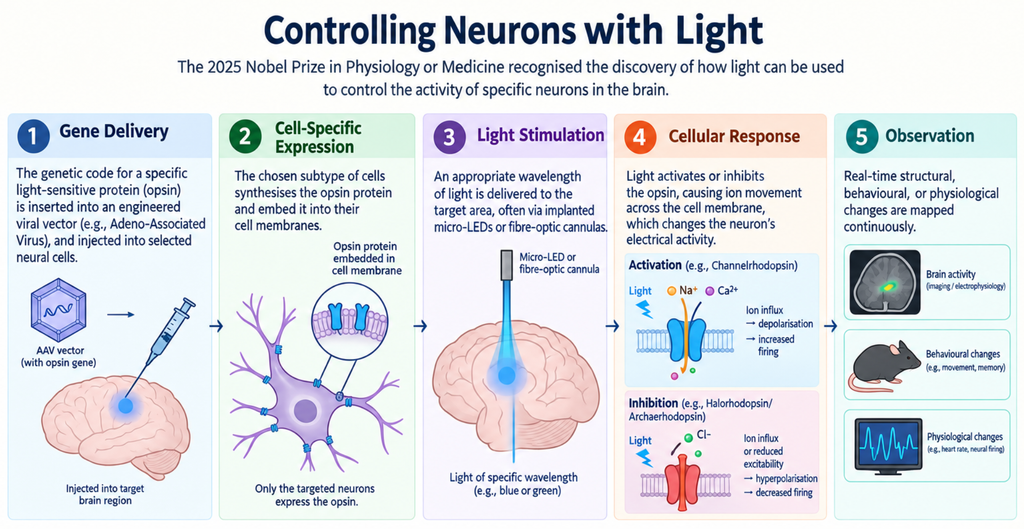
Why is it a Breakthrough?
- Traditional methods (like functional MRI or pharmacology) either just observe active regions or affect the whole brain. Optogenetics isolates a single circuit to prove if it directly causes a specific behaviour or symptom.
- It successfully differentiates between diverse neural cell types even when they are tightly intermingled in the same brain structure.
Major Applications:
- Understanding Brain Circuits: Identifying networks involved in pain, sleep, reward, attention, memory and social behaviour.
- Disease Research (Neuropsychiatric and movement disorders): Studying abnormal circuits associated with Parkinson’s disease, depression, schizophrenia and other neurological or psychiatric conditions; helping identify potential treatment targets.
- Sensory Restoration (Clinical Milestones):
- Vision: Early clinical trials demonstrated partial recovery of visual function in a patient with retinitis pigmentosa, using optogenetic gene therapy and specialised light-amplifying goggles.
- Hearing: Development of experimental optical cochlear implants that use light instead of electricity to stimulate auditory neurons.
Limitations and Ethical Concerns:
- Invasive Infrastructure: Effective deep-brain delivery requires structural gene therapy and the surgical implantation of hardware like fibre-optic cables.
- Biosafety risks: Potential long-term cellular toxicity, insertional mutagenesis from viral vectors, immunogenic reactions to foreign algal proteins, and localised tissue heating.
- Clinical translation: Results in animal models do not automatically translate into safe, effective human treatments.
- Ethics: Human applications require informed consent, protection of autonomy and safeguards against misuse.
The therapeutic promise of Optogenetics requires rigorous clinical validation and responsible oversight.
Practice Prelims MCQ:
Q. Consider the following statements regarding optogenetics:
- It uses genetically introduced light-sensitive proteins called opsins to control the electrical activity of specific cells.
- Adeno-associated virus (AAV) can be used as a vector to deliver the genetic code for an opsin to selected neural cells.
- Stimulation of neurons with light always results in their activation, irrespective of the type of opsin expressed.
- Optogenetics can enable precise and reversible manipulation of neural circuits and help study their role in behaviour and physiological processes.
Which of the statements given above are correct?
(a) 1, 2 and 4 only
(b) 1 and 3 only
(c) 2, 3 and 4 only
(d) 1, 2, 3 and 4
Answer: (a) 1, 2 and 4 only
Explanation: Optogenetics combines genetic engineering and light stimulation to control specific cells. Opsins are light-sensitive membrane proteins; AAV vectors can deliver the relevant genes to targeted neurons. Depending on the opsin, light can activate or inhibit neuronal activity. For example, channelrhodopsins generally depolarise neurons, whereas inhibitory opsins such as halorhodopsins can suppress neuronal firing. Thus, Statement 3 is incorrect.
Source: https://anantamias.com/current-affairs/nobel-prize-in-medicine-for-controlling-neurons-with-light/