Why in News?
On 5 October 2026, the Technology Development Board announced an agreement with BigEndian Semiconductors to develop Project VeerAI, a camera-focused AI Vision System-on-Chip.
- The proposed Vision SoC initially targets CCTV and surveillance applications.
- The platform aims to combine AI processing with security, privacy and connectivity capabilities.
- Development, validation, integration, testing and scale-up remain necessary; commercial readiness is a project objective.
- An application-specific chip addresses a defined workload, connecting semiconductor design to practical equipment requirements.
- A sovereign platform objective does not independently establish manufacturing location or guarantee the security of deployed devices.
UPSC Relevance
Prelims Relevance
- SoC: System-on-Chip, integrating multiple system functions.
- Image sensor: converts incoming light into electrical signals.
- Application-specific processing: design focused on a defined class of tasks.
- Edge processing: computation performed near the source of data.
- IoT security: includes access controls, data protection and secure software updates.
Mains Relevance
GS Paper 3
- Semiconductor design capabilities and application-specific technology development.
- Security and privacy requirements for connected surveillance devices.
Background and Context
From Light to Useful Information
A camera must capture an image before a computing system can interpret it; these are related but different tasks.
- An image sensor contains light-sensitive picture elements, or pixels. Incoming light produces electrical signals that can be assembled into an image, as NASA explains in its account of digital camera technology.
- Image processing works on captured information to make it usable for a task. Producing a recognizable picture and extracting information from that picture are distinct functions within the broader camera system.
- A smart camera can process images inside the device before sending results onward. NASA’s smart-camera example demonstrates this approach; it provides technical background, not specifications for the proposed Indian chip.
- A System-on-Chip brings several system functions into an integrated semiconductor device. The phrase does not mean that every component of a complete camera, including its lens and power supply, must occupy one chip.
- The useful conceptual sequence is capture, process and output. What reaches another computer may be processed information rather than every captured frame; the actual data flow depends on the device design and application requirements.
Why a Camera-Focused Chip Is Different
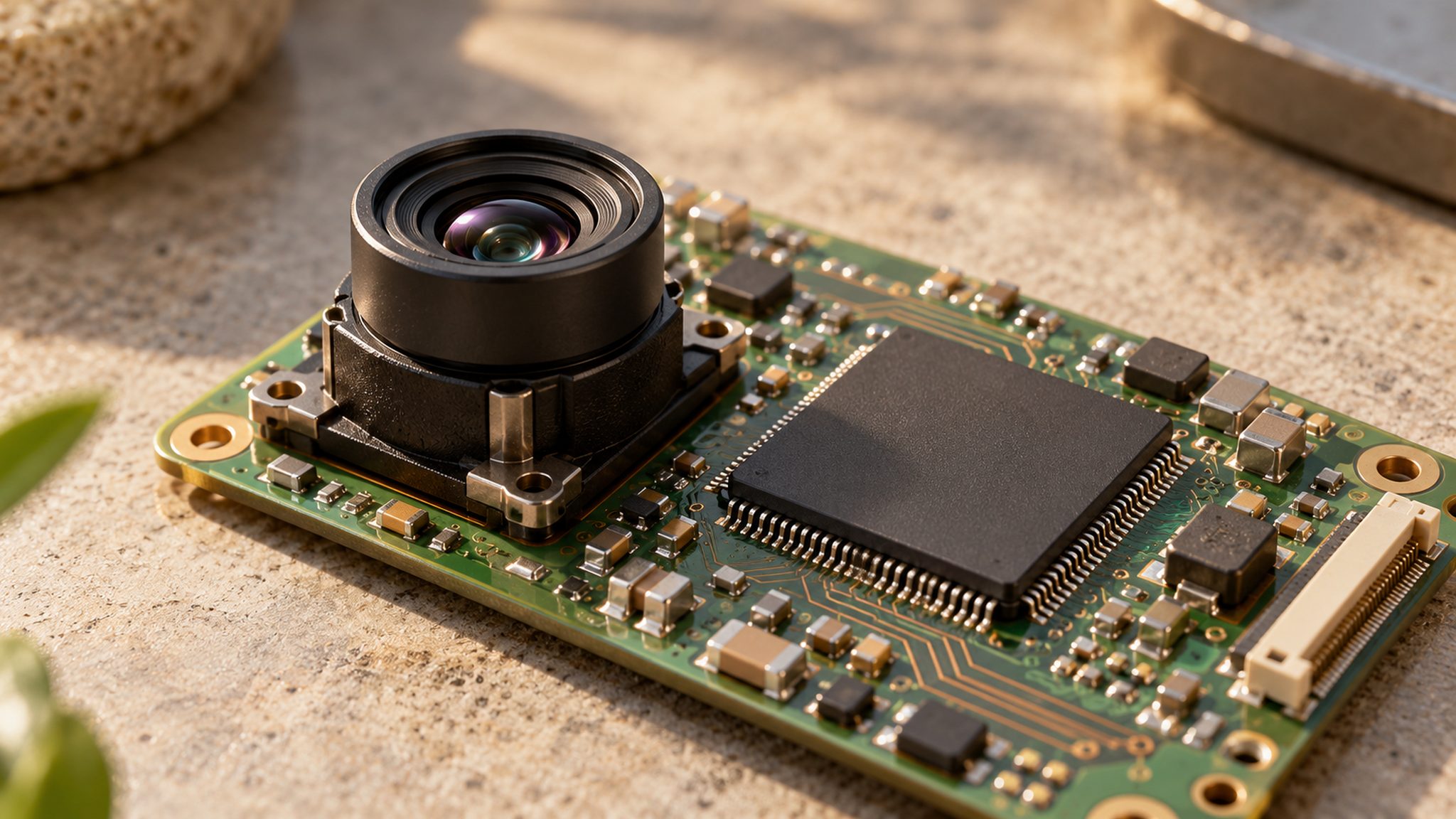
VeerAI targets a defined family of imaging applications rather than presenting itself as a processor for every computing task.
- Application-specific design starts with the work a device needs to perform. For a camera-focused platform, imaging requirements shape design priorities; a general-purpose processor is intended to support a much broader variety of computing workloads.
- The official announcement identifies CCTV and surveillance as the initial use. Defence, automotive, industrial and medical applications are part of an envisaged roadmap, not evidence of deployments already completed in those sectors.
- AI processing can support interpretation of image information, but the release does not disclose VeerAI’s precise capabilities. It does not justify inventing recognition features, processing speeds, memory capacity or the chip’s manufacturing process.
- Local processing may reduce the information that must travel to another computer, as the smart-camera example shows. Benefits depend on which tasks remain local and which data the product still sends over a network.
- The proposed platform combines processing, connectivity and security objectives. Whether those objectives work together in a deployable product requires validation and testing; an agreement to develop the technology is not equivalent to a demonstrated product.
Security Requires More Than an Indigenous Label
A domestic design can be strategically valuable while still requiring careful assessment of the complete device and its operation.
- Technology sovereignty concerns control and dependence across a technology ecosystem. The stated ambition to reduce external reliance does not establish that every tool, component or fabrication stage involved in the eventual product will be Indian.
- Data protection includes information stored on a device and information transmitted from it. NIST’s IoT guidance also identifies access restrictions and secure software updates as device capabilities, showing why chip origin alone cannot establish security.
- Privacy benefits from local processing are conditional. Sending less raw video can limit exposure, but retaining detailed recordings or permitting broad access can still create risks; the release does not establish VeerAI’s final data-handling architecture.
- Testing must evaluate the integrated product under its intended conditions. A useful procurement question is whether its declared functions, update arrangements and access controls work reliably, rather than whether it carries an attractive technology label.
- Commercial readiness remains a goal: the announcement describes progress from TRL-5 towards TRL-9. The exam-relevant distinction is between supporting development and establishing a validated product, rather than memorizing the funding instrument or treating readiness as achieved.
Way Forward
Evaluate the Complete Device
- Require evidence for performance claims under the intended imaging conditions before large deployments.
- Specify access controls, update support and data retention alongside hardware requirements when procuring connected cameras.
- Assess domestic capability across design, validation and production without assuming that success in one stage proves independence in every stage.
Conclusion
- Project VeerAI illustrates how application-specific semiconductor design can connect domestic engineering capability with practical camera requirements. Its significance will depend on tested functionality and deployable products, rather than the agreement alone.
- For an answer, connect sensor capture, image processing and system security. Keep the proposed chip’s ambitions separate from verified architecture, completed manufacturing and measured performance; these are distinct claims requiring distinct evidence.
UPSC Practice Questions
Prelims MCQ 1
With reference to camera-focused semiconductor systems, consider the following statements:
- An image sensor converts incoming light into electrical signals.
- Processing images locally guarantees that a connected camera cannot create privacy risks.
- A System-on-Chip necessarily contains every component of a complete camera, including its lens.
How many of the above statements are correct?
(a) Only one (b) Only two (c) All three (d) None
Answer: (a) Only one
Explanation:
Only statement 1 is correct. Local processing does not remove every privacy risk, and a SoC need not include the camera lens or every external component.
Prelims MCQ 2
Which statement best describes the VeerAI announcement?
(a) A proven deployment across all proposed sectors (b) An agreement supporting development of an application-specific AI Vision SoC (c) Certification that every production stage is located in India (d) Publication of measured chip performance benchmarks
Answer: (b) An agreement supporting development of an application-specific AI Vision SoC
Explanation:
The release announces development support and further validation and scale-up work. It does not demonstrate the other claims.
UPSC Mains Questions
- Explain how application-specific semiconductor design can support domestic technology capabilities. Use camera-focused Vision SoCs as an example.
- Discuss why indigenous design and local image processing are insufficient, by themselves, to establish the security and privacy of connected surveillance devices.
Sources: PIB, Department of Science and Technology and NASA Spinoff.
Frequently Asked Questions
What is Project VeerAI?
Project VeerAI is a proposed camera-focused AI Vision System-on-Chip being developed by BigEndian Semiconductors with Technology Development Board support. It initially targets CCTV and surveillance, with other sectors envisaged in its roadmap.
What does a System-on-Chip do?
A System-on-Chip integrates multiple system functions within a semiconductor device. The particular functions depend on its design. It does not necessarily include every physical component needed to build the complete camera or other product.
Does processing video locally guarantee privacy?
No. Local processing may reduce raw information transmitted elsewhere, but privacy also depends on collection, storage and access. The VeerAI announcement does not establish the final architecture or retention practices of future devices.
Has VeerAI already reached commercial readiness?
The announcement describes further development, validation, integration, testing and scale-up intended to advance the technology towards commercial readiness. It should not be read as confirmation that the final product has already achieved that goal.
Tell Google you want more of this.
Add Anantam IAS as a preferred sourceOne tap, and this site shows up more often in your own Top Stories, AI Overviews and AI Mode. Remove it any time.