Daily Digest
UPSC · Civil Services Examination
Current Affairs · Wednesday, 9 September 2026
Current affairs curated and edited by Anantam IAS faculty — pulled from The Hindu, PIB, IDSA, Foreign Affairs and the ministries. Read, annotate, revise.
Old Rajinder Nagar · Delhi 110005 · anantamias.com
PM-SETU: Industry Partnerships Move Into ITI Implementation
Why in News?
PIB reported on 8 September that PM-SETU’s steering committee approved investment plans and witnessed the Bhiwadi cluster agreement at its 7 September meeting.
- The Shareholders’ Agreement between H.G. Infra Engineering Limited, Rajasthan and the Union skill ministry formally begins implementation activities for the Bhiwadi cluster.
- Approved Strategic Investment Plans cover Bhiwadi, Medchal and Meerut clusters, with a combined project outlay of ₹735.70 crore.
- Government ITI Bhiwadi is the hub; Government ITIs at Alwar, Neemrana, Tijara and Kishangarh Bas are its four spokes.
- The Medchal proposal received approval after clarifications on operational and financial matters that had led to its earlier deferral.
- Industry participation can connect workshop training with actual production requirements; public oversight must still protect educational quality and student access.
- Investment approval creates an implementation opportunity. It does not establish that equipment, courses or employment outcomes have already improved.
UPSC Relevance
Prelims Relevance
- PM-SETU: Pradhan Mantri Skilling and Employability Transformation through Upgraded ITIs.
- Nodal ministry: Ministry of Skill Development and Entrepreneurship.
- Cluster design: A hub ITI linked with spoke ITIs.
- Approval sequence: State Steering Committee evaluation and recommendation precede National Steering Committee consideration.
- Bhiwadi agreement: H.G. Infra, Rajasthan and the Union skill ministry are the named parties.
Mains Relevance
GS Paper 2
- Centre-State-industry coordination in public training institutions.
- Accountability when government institutions involve external delivery partners.
GS Paper 3
- Industry-relevant skills, employability and the difference between capital spending and productive workforce capability.
Essay
- Education serves development when institutional capacity becomes usable opportunity.
Background and Context
How the hub-and-spoke model works
The cluster is the unit of coordinated upgrading, connecting institutions instead of treating each workshop as an isolated investment.
- PM-SETU aims to transform government Industrial Training Institutes through industry partnerships, improved infrastructure and upgraded training programmes, with employability as the intended result of these changes.
- A hub ITI works with a network of spoke ITIs. The official design links their modernisation and industry-relevant training through a common cluster approach rather than unrelated institutional projects.
- For Bhiwadi, the named hub and surrounding government ITIs make this arrangement concrete: one cluster contains several teaching locations, rather than replacing them with a single new institute.
- The practical rationale for sharing capacity is to make specialised resources useful across institutions. Whether students can actually access shared facilities depends on timetabling, travel and operational arrangements.
- A hub-and-spoke label alone does not prove resource sharing works. An implementation assessment should check which services reach spoke students and whether access extends beyond the hub’s own intake.
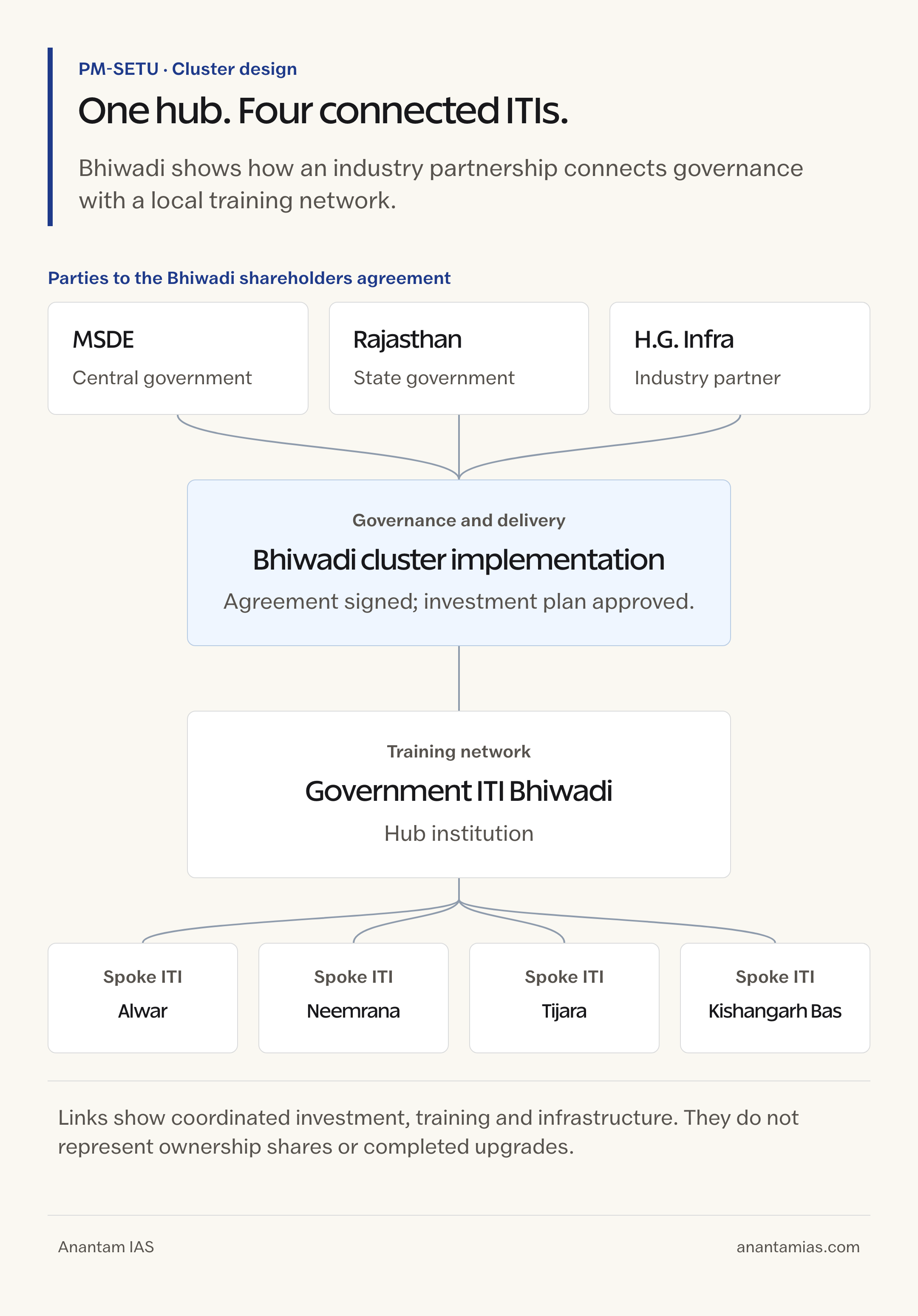
Who shapes and scrutinises the investment
Industry involvement operates alongside a State-to-national review process; submitting a plan is different from securing its approval.
- Strategic Investment Plans specify the proposed upgrading package. The approved plans cover infrastructure, existing trades, new long-term and short-term courses, and stronger operational capabilities within the participating clusters.
- The respective State Steering Committees evaluate and recommend proposals before they reach the National Steering Committee. This establishes a review sequence connecting State involvement with national approval.
- The Medchal proposal illustrates substantive scrutiny: approval followed satisfactory responses about course structure, financial calculations, eligibility, documentation and civil works after an earlier committee had deferred consideration.
- An industry partner can help identify changing workplace requirements. The educational test is whether proposed courses build useful capabilities, rather than simply attaching an employer’s name to existing training.
- Public oversight should examine the connection between spending and teaching: proposed machinery needs suitable courses, instructors and operational support if an approved investment is to become a functioning learning resource.

What the Bhiwadi agreement establishes
The signed agreement is an implementation milestone, not evidence that the cluster’s transformation has already been completed.
- The Bhiwadi Shareholders’ Agreement brings together H.G. Infra Engineering Limited, the Government of Rajasthan and the Ministry of Skill Development and Entrepreneurship in the reported implementation arrangement.
- According to the official release, signing marks the formal commencement of implementation activities. This is the concrete development that distinguishes the news from a general statement supporting industry participation.
- The agreement’s name does not establish shareholding percentages, asset-transfer terms or private ownership of government ITIs. Those conclusions require the agreement or other authoritative documentation beyond this release.
- Approval, implementation and outcomes are separate stages. A sanctioned plan can begin execution without demonstrating that upgraded workshops are operational or that students have obtained better employment.
How employability accountability should work
Evaluation must follow the link from resources to learning and then to work, rather than stop at expenditure.
- Inputs include equipment and infrastructure; delivery concerns usable courses and instruction. An illustrative monitoring question is whether installed equipment is regularly used by learners in the intended trades.
- Learning outcomes require evidence of practical competence. Course enrolment or completion alone cannot establish whether graduates can safely and independently perform the tasks that training claims to teach.
- Employment outcomes should examine job relevance and sustained work, alongside placement. These are suggested evaluation criteria, not new reporting requirements or measured achievements announced in the PIB release.
- Equity belongs in cluster evaluation: stronger hub facilities should benefit students across participating institutions. Comparisons between hub and spoke access can reveal whether coordinated investment is spreading useful opportunities.
Way Forward
Make cluster delivery observable
- Publish implementation milestones that distinguish procurement, workshop readiness, instructor preparation and course delivery, allowing students and oversight bodies to see where progress has stalled.
- Specify shared-access arrangements for spoke learners, including practical-session schedules and travel needs; a common cluster plan should translate into usable teaching opportunities.
- Track competence and employment after training, with transparent definitions and follow-up periods. Report limitations so initial placement figures are not mistaken for lasting employability.
Conclusion
- PM-SETU’s implementation lesson is institutional: industry input, State scrutiny and national approval must connect with actual training delivery across the cluster.
- Use the case to distinguish governance milestones from development results. The signed Bhiwadi arrangement begins implementation; stronger skills and employment remain outcomes to demonstrate.
UPSC Practice Questions
Prelims MCQ 1
With reference to PM-SETU implementation reported in September 2026, consider the following statements:
- The scheme uses a hub-and-spoke ITI cluster model.
- State Steering Committees evaluate and recommend investment plans before national consideration.
- Signing the Bhiwadi Shareholders’ Agreement proves that its workshop upgrades are complete.
How many of the above statements are correct?
(a) Only one (b) Only two (c) All three (d) None
Answer: (b) Only two
Explanation:
The first two statements match the official design and review sequence. Signing formally begins Bhiwadi implementation; it does not demonstrate completed upgrades.
Prelims MCQ 2
Which development formally began implementation activities for the Bhiwadi ITI cluster?
(a) Transfer of all ITIs to private ownership (b) Publication of verified graduate earnings (c) Signing an agreement among H.G. Infra, Rajasthan and the Union skill ministry (d) Completion of every proposed workshop
Answer: (c) Signing an agreement among H.G. Infra, Rajasthan and the Union skill ministry
Explanation:
PIB identifies the Shareholders’ Agreement among these parties as the formal commencement of implementation activities. It does not report the other developments.
UPSC Mains Questions
- Explain how an industry-led hub-and-spoke model can improve public vocational training. What safeguards would make its benefits accessible to spoke institutions? (150 words)
- Distinguish investment approval, implementation progress and employability outcomes in evaluating PM-SETU. Suggest an accountability framework. (250 words)
Source: PIB, Ministry of Skill Development and Entrepreneurship.
Frequently Asked Questions
What is PM-SETU?
PM-SETU is Pradhan Mantri Skilling and Employability Transformation through Upgraded ITIs. It aims to improve government ITIs through industry partnerships, infrastructure upgrades and training programmes organised around connected hub-and-spoke clusters.
What happened at Bhiwadi?
H.G. Infra Engineering Limited, Rajasthan and the Union skill ministry signed a Shareholders’ Agreement at the 7 September meeting. PIB reported that this formally began Bhiwadi cluster implementation activities.
Does the agreement mean ITIs have been privatised?
The release does not establish private ownership of ITIs or publish shareholding percentages and asset-transfer provisions. The agreement’s title alone cannot support those conclusions; its documented implementation role is narrower.
Why is the Medchal decision useful for governance analysis?
Medchal’s plan had been deferred for operational and financial clarifications. Its later approval after satisfactory responses shows the distinction between submitting an investment proposal and completing the scrutiny needed for approval.
Source: https://anantamias.com/current-affairs/pm-setu-industry-iti-cluster-implementation/
FCI Performance Framework: Linking Depot Quality to Food Security
Why in News?
On 8 September 2026, the Department of Food and Public Distribution and FCI signed their annual performance MoU, linking some targets to depot performance.
- The FY 2026-27 framework covers storage losses, capacity utilisation, logistics and quality control.
- A proportion of annual targets is linked to depot infrastructure and operational performance through Depot Darpan.
- The agreement also emphasises digitisation and employee skills to support modern foodgrain management.
- The release gives no numerical thresholds or target weightings; it announces a framework, not measured efficiency gains.
- Food security requires grain to remain usable and reach the distribution system; procurement alone cannot establish successful delivery.
- Depot accountability connects local storage and handling conditions with organisation-wide performance and public resource use.
UPSC Relevance
Prelims Relevance
- FCI: established in 1965 under the Food Corporations Act, 1964.
- Core operations: procurement, storage, movement and distribution of foodgrains on behalf of the Government of India.
- Depot Darpan: web-based assessment of depot infrastructure and operational efficiency.
- Performance MoU: annual parameters for institutional accountability; distinct from a household food entitlement.
Mains Relevance
GS Paper 3
- Food security, storage constraints and supply-chain efficiency.
- Cost-effective use of food subsidy through operational improvements.
GS Paper 2
- Outcome-based accountability and verification of administrative performance data.
Essay
- Public institutions should be judged by reliable delivery, not activity alone.
Background and Context
Why a depot matters to food security
A depot connects grain acquisition with onward delivery, making storage conditions and handling decisions important beyond the warehouse itself.
- Procurement brings foodgrain into public operations; storage preserves it until movement or distribution. Buying adequate grain does not by itself establish that the stock remains suitable for its intended use.
- Quality control concerns the condition of grain, while storage capacity utilisation concerns the use of available space. A full warehouse is not sufficient evidence of well-managed or usable food stocks.
- Movement links stored grain with the places requiring supply. Storage planning and dispatch decisions must work together because stocks held in one location do not automatically meet requirements elsewhere in the system.
- Storage losses reduce the grain available from resources already committed to procurement and handling. Preventing avoidable losses can improve resource use without treating a reduction in food support as the policy objective.
- FCI’s mandate spans procurement, storage, movement and distribution on the government’s behalf. Depot performance is one operational component of this chain, rather than a complete measure of household access to food.

How depot assessment enters annual accountability
The MoU connects organisation-wide annual parameters with performance at the facilities where grain is stored and handled.
- Annual parameters turn broad goals such as efficient foodgrain management into an assessment framework. The signed agreement identifies operational priorities, giving performance review a focus beyond simply reporting the volume of activity undertaken.
- Depot Darpan assesses depot infrastructure and operational efficiency through a web-based platform. Linking a proportion of targets to these assessments brings facility-level conditions into the wider institutional performance framework for FCI.
- Infrastructure benchmarks concern the physical capacity to handle grain; operational benchmarks concern how that capacity functions. Reviewing both helps distinguish a facility constraint from a problem in everyday management or execution.
- Digitisation can make records easier to monitor, but entering data is not the final outcome. Its administrative value depends on whether information helps identify storage, quality or logistics problems requiring corrective action.
- Employee capacity building supports adoption of modern systems. Staff must understand the information they record and the decisions it informs; technology procurement alone cannot establish better handling practices or accountability within depots.
What a performance framework does not prove
The announcement establishes an accountability design; judging its success requires evidence about implementation and actual operational change.
- Targets are commitments, not reported achievements. The release does not demonstrate that storage losses have already fallen, delivery has accelerated or subsidy expenditure has declined because of the newly signed agreement.
- Target weightings and thresholds are not published in the release. It is accurate to say some targets are depot-linked, but not to assign a percentage or invent a passing score.
- Data verification is an evaluation requirement: recorded improvements should correspond to physical stock and operating conditions. Otherwise, better reporting could be mistaken for better grain preservation or more reliable movement and delivery.
- Balanced assessment should examine cost alongside quality and service reliability. A cheaper handling arrangement is not necessarily an improvement if it compromises usable stocks or creates avoidable delays elsewhere in the supply chain.
- Institutional performance and food entitlements answer different questions. This MoU concerns how FCI operates; the announcement does not establish a new household entitlement, eligibility category or change in the quantity of food assistance.
Way Forward
Make assessment lead to corrective action
- Use physical verification to check whether reported depot improvements match grain conditions and operational records.
- Review quality, losses and movement together so that gains in one indicator do not conceal deterioration elsewhere.
- Assign responsibility for corrective action when assessment identifies a depot constraint, and review whether the remedy improves operations.
Conclusion
- Depot-linked accountability makes the condition and operation of storage facilities part of FCI’s wider performance assessment, connecting food security with the quality of public administration.
- In a Mains answer, connect procurement, preservation and delivery, then distinguish the announced framework from verified results; efficiency matters when it protects usable grain and reliable supply.
UPSC Practice Questions
Prelims MCQ 1
With reference to FCI’s FY 2026-27 performance framework, consider the following statements:
- A proportion of MoU targets is linked to depot performance.
- Depot Darpan assesses depot infrastructure and operational efficiency.
- The announcement establishes a new household foodgrain entitlement.
How many of the above statements are correct?
(a) Only one (b) Only two (c) All three (d) None
Answer: (b) Only two
Explanation:
The first two statements describe the announced framework. The MoU concerns FCI’s institutional performance and does not announce a new household entitlement.
Prelims MCQ 2
Which finding would best demonstrate a substantive improvement in foodgrain management?
(a) More entries on a monitoring platform without physical verification (b) Higher warehouse occupancy regardless of grain quality (c) Verified reduction in avoidable losses while maintaining grain quality and delivery reliability (d) Publication of annual targets without evidence of implementation
Answer: (c) Verified reduction in avoidable losses while maintaining grain quality and delivery reliability
Explanation:
Substantive improvement requires evidence of better operations. More reporting, higher occupancy or target publication alone cannot establish such an outcome.
UPSC Mains Questions
- Explain how linking depot performance to FCI’s annual assessment can improve foodgrain management. What safeguards are needed against misleading performance reporting?
- Food security depends on preservation and movement as well as procurement. Discuss with reference to the efficient use of food subsidy resources.
Source: PIB, Department of Food and Public Distribution.
Frequently Asked Questions
What is new in the FCI performance MoU?
The FY 2026-27 MoU links a proportion of annual targets to depot performance, connecting facility infrastructure and operational efficiency with FCI’s wider institutional accountability framework.
What does Depot Darpan assess?
Depot Darpan is a web-based platform for assessing depot infrastructure and operational efficiency. Its assessments provide the depot-level connection for a proportion of targets in the announced performance framework.
Has the MoU already reduced storage losses?
The announcement identifies reduction of storage losses as a priority but provides no measured reduction attributable to the agreement. Targets and intended improvements should be distinguished from demonstrated results.
Why is capacity utilisation insufficient as a performance measure?
Capacity utilisation indicates how storage space is used. It cannot alone establish grain quality, avoidable losses or timely movement, so these operational dimensions should be considered alongside occupancy when assessing performance.
Source: https://anantamias.com/current-affairs/fci-depot-linked-performance-foodgrain-management/
India-Japan Forest Roadmap: Trees Outside Forests and Better Inventories
Why in News?
India and Japan endorsed a 2027-2031 forest cooperation roadmap at their Joint Working Group meeting in Bengaluru on 8 September 2026.
- The roadmap operates under the existing Memorandum of Cooperation; both delegations also signed the meeting’s minutes.
- Discussions covered trees outside forests, forest genetics, and forest inventory, stock assessment and geospatial monitoring.
- The PIB release reports endorsement, but does not supply numerical planting targets, financing commitments or the complete roadmap text.
- Forest policy also concerns farm trees and scattered tree resources, making agricultural landscapes relevant to resource assessment and livelihoods.
- Cooperation can connect resource location, planting material and measurement; these solve different problems and should not be treated as interchangeable achievements.
UPSC Relevance
Prelims Relevance
- Recorded forest area versus forest cover
- Tree cover versus trees outside forests
- Forest inventory and growing stock
- Germplasm conservation and tree breeding
- India-Japan forest cooperation
Mains Relevance
GS Paper 3
- Integrating agroforestry, biodiversity conservation and resource monitoring
- Limits of canopy area as a measure of ecological quality
GS Paper 2
- Technical cooperation as an instrument of bilateral relations
Essay
- What we measure shapes what we conserve.
Background and Context
Recorded forests, forest cover and trees outside forests
These terms answer different questions: where land is recorded, where canopy exists, and which trees grow outside recorded forest areas.
- Recorded forest area concerns land recorded as forest in government records. It is not a satellite estimate, and every part need not currently support dense tree canopy.
- Forest cover, under FSI’s assessment definition, includes qualifying canopy patches irrespective of ownership or legal status. Mapping a plantation as cover does not itself change the land’s legal classification.
- Trees outside forests are tree resources outside recorded forest areas. Some occur in large patches counted as forest cover; others occur as smaller patches or scattered trees.
- Tree cover is the separately estimated canopy outside recorded forest areas that is not already counted as forest cover. It is narrower than the overall trees-outside-forests resource.
- Exam trap: a rise in mapped canopy does not establish an equal rise in natural forest, protected habitat or legally recorded forest land. Check which measure the question uses.
Agroforestry connects trees with working farms
Trees outside forests matter because tree management extends beyond forest departments’ conventional territorial focus.
- Agroforestry integrates trees with crops or livestock on the same land-management unit. Farm trees can supply useful products while retaining an agricultural function in the wider landscape.
- Resource assessment must capture scattered trees and linear plantings as well as larger patches. Looking only at continuous canopy can miss resources important to individual farming households.
- Management choices include species selection, spacing and harvesting cycles. For farmers, the relevant question is whether trees fit existing production needs, rather than how many seedlings are distributed.
- Site suitability matters: trees interact with crops through shade, water and nutrient use. A planting model suitable in one locality should not automatically become a universal prescription.
- Policy implication: evaluate farm-tree programmes through survival, usable produce and household returns alongside canopy gains. Planting activity alone cannot demonstrate durable ecological or livelihood benefits.

Forest genetics concerns the quality of planting material
Genetic cooperation addresses which biological resources are conserved and propagated, not simply where more trees can be planted.
- Genetic resource conservation protects variation within tree species. That variation matters when selecting material for different environments instead of assuming all seedlings of a species perform identically.
- Tree breeding seeks desirable inherited traits, while improved planting material carries selected characteristics into planting programmes. Improvement should be judged against the intended site and management objective.
- Germplasm is biological material used to conserve or reproduce genetic resources. Its conservation supports future research and breeding rather than serving merely as a stockpile for immediate planting.
- Productivity and diversity are separate concerns. Selecting material for a particular trait does not remove the need to conserve broader genetic resources or protect existing natural ecosystems.
Inventory turns canopy observations into resource evidence
Measurement is a distinct workstream: locating trees does not reveal everything about their condition or the resources they contain.
- Geospatial monitoring helps identify canopy distribution and changes across landscapes. Comparable observations are valuable, but a mapped green patch does not independently establish its species composition or ecological quality.
- Forest inventory adds measurements of tree resources. Field observations complement mapped cover when estimating growing stock and interpreting what a change in canopy actually represents.
- Growing stock concerns standing tree volume, whereas forest cover concerns canopy area. Equal areas can contain different resource volumes; the two measures answer different management questions.
- Implementation test: useful cooperation should improve comparable methods, field capacity and interpretation. The endorsed roadmap is a framework for work, not evidence that these improvements have already occurred.
Way Forward
Connect planting decisions with reliable assessment
- Match planting material to local conditions and evaluate survival and farmer outcomes after establishment.
- Combine field inventories with geospatial observations; document definitions so reported changes remain comparable.
- Protect genetic diversity and natural habitats while developing productive farm-tree systems; assess these objectives separately.
Conclusion
- Forest cooperation is strongest when it connects where trees grow, which genetic resources are maintained and how those resources are measured.
- In an answer, distinguish canopy, legal status and ecological quality; use the roadmap to illustrate technical cooperation without claiming unreported targets or completed outcomes.
UPSC Practice Questions
Prelims MCQ 1
With reference to forest assessment in India, consider the following statements:
- Forest cover can occur outside recorded forest areas.
- All trees outside forests are counted only under the separate tree-cover estimate.
- Mapping an area as forest cover does not itself change its legal classification.
How many of the above statements are correct?
(a) Only one (b) Only two (c) All three (d) None
Answer: (b) Only two
Explanation:
Statements 1 and 3 are correct. Trees outside recorded forests include qualifying patches counted as forest cover as well as resources represented in the separate tree-cover estimate.
Prelims MCQ 2
Which distinction best explains why forest inventory complements canopy mapping?
(a) Inventory automatically converts agricultural land into forest land (b) Canopy mapping alone establishes every tree’s genetic quality (c) Inventory adds tree-resource measurements beyond canopy area (d) Inventory makes field observations unnecessary
Answer: (c) Inventory adds tree-resource measurements beyond canopy area
Explanation:
Canopy area and growing stock measure different features. Inventory provides resource measurements that complement spatial observations of cover.
UPSC Mains Questions
- Explain why trees outside forests require different assessment and management approaches from a policy focused only on recorded forest areas. (150 words)
- How can cooperation in forest genetics and resource inventories strengthen forest governance? Discuss the limitations of canopy area as a standalone performance measure. (250 words)
Sources: PIB, Ministry of Environment, Forest and Climate Change and Forest Survey of India, India State of Forest Report 2023.
Frequently Asked Questions
What did India and Japan endorse?
They endorsed a forest cooperation roadmap for 2027-2031 at the Bengaluru Joint Working Group meeting. The reported workstreams concern trees outside forests, forest genetics, and inventory and monitoring technologies.
Are trees outside forests the same as tree cover?
No. Trees outside forests include tree resources outside recorded forest areas, including qualifying patches counted as forest cover. Tree cover is a separate estimate excluding the canopy already counted as forest cover.
Does forest cover establish legal forest status?
No. Forest cover is an assessment of qualifying canopy, irrespective of ownership or legal status. It should not be confused with recorded forest land or used alone to establish legal classification.
Why does the roadmap discuss forest genetics?
Genetic cooperation concerns conserving tree genetic resources, breeding and improved planting material. These address biological quality and variation, while inventories and geospatial monitoring address resource measurement and spatial distribution.
Source: https://anantamias.com/current-affairs/india-japan-forest-roadmap-trees-outside-forests/
Administrative Data: Making Government Datasets Comparable
Why in News?
On 8 September, MoSPI launched a progress-reporting mechanism for administrative-data harmonisation, covering dataset inventories, metadata, common standards and quality checks across Central ministries and departments.
- The Quarterly Progress Report mechanism records progress in identifying and cataloguing datasets prepared for dissemination, documenting metadata and applying common standards.
- It covers classifications and common unique identifiers in machine-readable data, alongside departmental quality checks using the Statistical Quality Assurance Framework.
- The mechanism includes automated validation and cross-verification with the NMDS portal; these functions support monitoring, rather than proving that every dataset is already harmonised.
- The workshop explicitly supported distributed data systems, preserving departmental ownership while enabling responsible sharing through common standards and governance arrangements.
- Data exchange can move records between departments without resolving differences in definitions, reporting periods or geography. Policy analysis needs agreement about what those records mean.
- Administrative data can support service monitoring and outcome assessment, but information gathered for operating a programme needs scrutiny before being reused for wider statistical conclusions.
UPSC Relevance
Prelims Relevance
- MoSPI: Ministry of Statistics and Programme Implementation.
- Structural interoperability: Compatible organisation and formats that allow systems to exchange and process data.
- Semantic interoperability: Shared meaning of concepts, definitions and classifications across systems.
- Metadata: Documentation explaining a dataset’s content, scope, definitions and other interpretive details.
- SQAF: Statistical Quality Assurance Framework, referenced for departmental quality checks.
- Distributed interoperability: Data can remain with departments while agreed standards enable useful linkage and sharing.
Mains Relevance
GS Paper 2
- Administrative-data quality in welfare monitoring and evidence-based governance.
- Departmental ownership, privacy and accountability in government data sharing.
GS Paper 3
- Semantic interoperability and the foundations of reliable AI-assisted public analysis.
Essay
- More information improves governance only when its meaning and limitations are understood.
Background and Context
Why administrative records need harmonisation
A record useful for running one programme does not automatically become a comparable statistic for another department.
- Administrative data arises from operating services and programmes. Reusing these records can support policy formulation, monitoring and assessment, but requires understanding the purpose and coverage of the original collection.
- Data harmonisation aligns concepts, definitions, classifications, identifiers, geographies, metadata and structures. MoSPI’s workshop connected these elements because compatibility depends on more than making a file downloadable or machine-readable.
- A dataset inventory helps departments discover existing information before requesting it again. A useful catalogue must describe available data sufficiently for another department to assess whether it fits the intended question.
- Metadata makes interpretation possible by documenting what fields represent. Without definitions and coverage information, an analyst may treat unlike records as equivalent merely because their column headings look similar.
- Reuse requires judgment: a programme’s registered participants are not automatically the entire population eligible for support. Analysts should establish who is represented before drawing conclusions about wider social conditions.
Structural versus semantic interoperability
Structural compatibility lets systems process each other’s records; semantic compatibility helps users interpret those records consistently.
- Structural interoperability concerns compatible data organisation and formats. Systems might exchange records successfully while still applying different definitions to an apparently identical field, leaving the statistical comparison misleading.
- Semantic interoperability concerns shared meaning. Agreement about definitions, classifications and reporting geography is needed before observations from separate departments can support a coherent comparison or combined policy assessment.
- In a hypothetical example, one department’s beneficiary count means registered people while another means people actually served. Identical spreadsheets would not make these different measures directly comparable without further qualification.
- Common identifiers help recognise the same entity across systems. They do not, by themselves, resolve differences between registration and service receipt; the linked variables still require clear definitions and interpretation.
- Harmonisation may reveal that two measures should remain separate. The correct analytical result can be an explicit distinction, rather than forcing unlike categories into a combined total that conceals their differences.
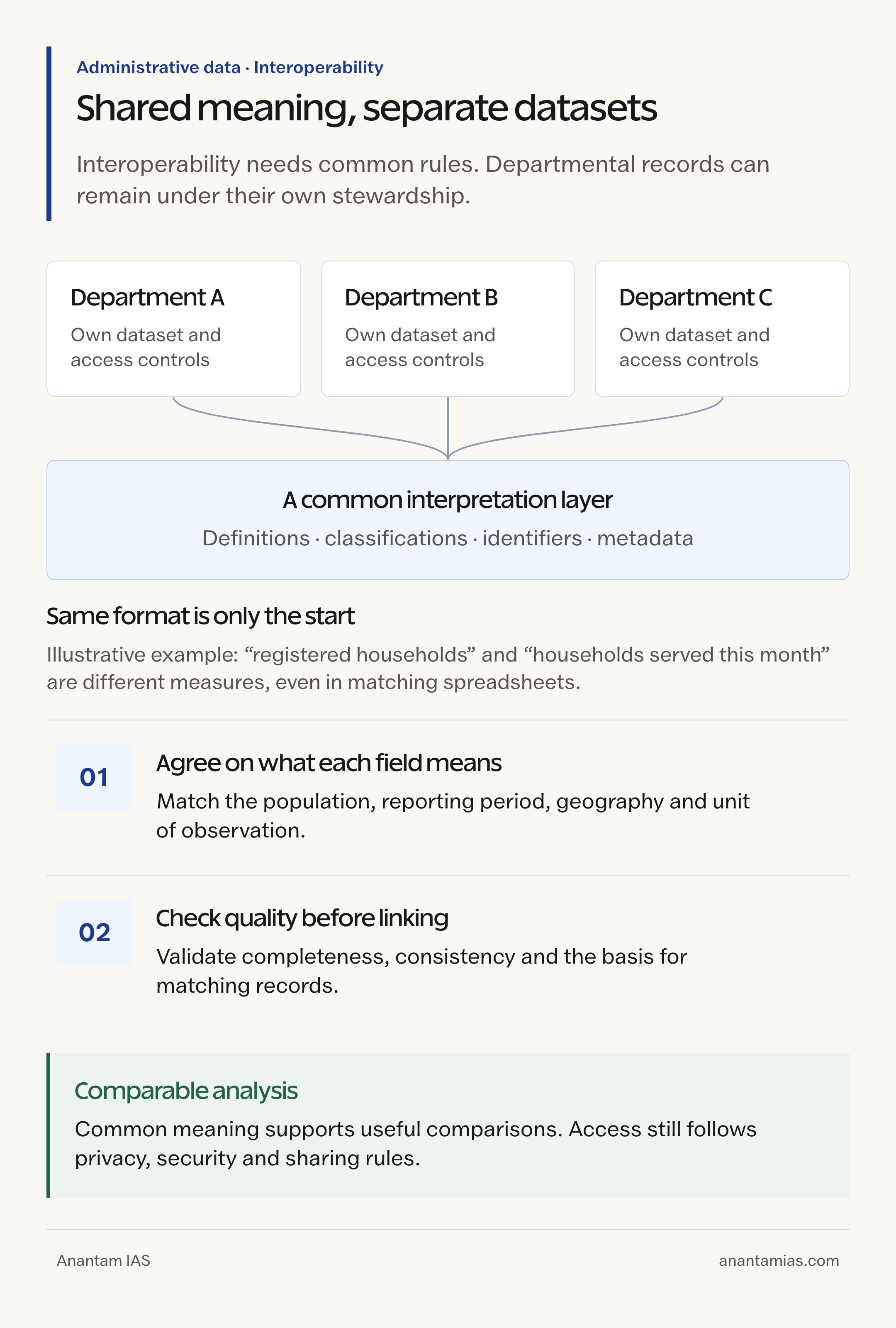
What quality assurance adds
Shared terminology improves comparability, but analysts must also assess whether the underlying records are dependable for their intended use.
- The new mechanism records departmental progress on quality checks under SQAF. It also supports automated validation and cross-verification with NMDS, linking reporting on harmonisation with checks on the submitted information.
- Automated validation can support consistency checks, but the release does not specify every rule. It should not be presented as certification that all underlying administrative records are accurate or complete.
- Statistical Advisers provide statistical leadership and quality assurance, while Chief Data Officers contribute data governance and interoperability. These complementary roles connect interpretive expertise with the organisation of data systems.
- AI readiness requires well-documented, quality-assured information. Feeding inconsistent categories into an automated system does not solve their meaning; it can spread the original ambiguity into more analyses and decisions.
Interoperability without centralising ownership
Shared standards can connect departmental systems without requiring all government data to be placed in one central repository.
- The workshop explicitly stated that data need not be centralised to generate value. Common standards, identifiers, APIs and governance mechanisms can support interoperability while information remains in distributed departmental systems.
- Departmental ownership remains compatible with responsible sharing. Decisions about access must still account for privacy and security; technical ability to retrieve a record is not itself permission to disclose it.
- Calls to establish Data Governance Committees and publish sharing frameworks were workshop recommendations. The release does not establish a new statutory mandate or show that every department has completed these steps.
- The evidence boundary matters: launching progress reporting does not prove universal interoperability, open access to all datasets or completion of statistical-framework transitions discussed during the workshop’s technical sessions.
Way Forward
Define meaning before combining records
- Maintain live inventories and metadata that document definitions, coverage and revisions, helping users identify suitable data and avoid requesting information already available through authorised channels.
- Agree on definitions and identifiers for priority use cases, explicitly recording measures that cannot be combined. Test a limited linkage before extending it across more departments.
- Combine automated checks with statistical review, assign responsibility for corrections and specify authorised access. Report unresolved quality limitations alongside analytical results instead of hiding them.
Conclusion
- Government data becomes comparable through shared meaning, not merely compatible files. Definitions, metadata, identifiers and quality assurance perform different but connected functions.
- Use this case to show how distributed ownership and interoperability can coexist. A progress-reporting mechanism supports that transition; reliable analysis remains a result to establish through continuing checks.
UPSC Practice Questions
Prelims MCQ 1
With reference to administrative-data harmonisation, consider the following statements:
- Structural compatibility alone guarantees that two datasets use identical definitions.
- Common identifiers can help recognise the same entity across systems.
- Interoperability can function while departments retain ownership of their datasets.
How many of the above statements are correct?
(a) Only one (b) Only two (c) All three (d) None
Answer: (b) Only two
Explanation:
Statements two and three are correct. Compatible structures enable exchange, but semantic interoperability additionally requires consistent meaning, definitions and classifications.
Prelims MCQ 2
Two departments exchange identically formatted files, but one counts registrations and the other counts completed services. Which issue most directly prevents comparison?
(a) Absence of a single central database (b) Excessive machine readability (c) Different meanings of the reported measure (d) Departmental ownership itself
Answer: (c) Different meanings of the reported measure
Explanation:
The problem is semantic: registration and completed service are different concepts. Centralising or reformatting the files would not by itself resolve that difference.
UPSC Mains Questions
- Distinguish structural and semantic interoperability in government data systems. Explain their significance for using administrative data in policy assessment. (150 words)
- Can government datasets become interoperable without centralising their ownership? Discuss standards, quality assurance and responsible access with reference to administrative-data harmonisation. (250 words)
Source: PIB, Ministry of Statistics and Programme Implementation.
Frequently Asked Questions
What is administrative-data harmonisation?
It aligns definitions, classifications, identifiers, geography, metadata and data structures so records from different systems can be interpreted appropriately. Its purpose is useful comparability, rather than simply transferring files between departments.
How is semantic interoperability different from structural interoperability?
Structural interoperability concerns compatible formats and organisation for exchanging data. Semantic interoperability concerns shared meaning, such as whether a beneficiary field represents registration or actual service receipt across the systems being compared.
Does harmonisation require a central government database?
No. The workshop explicitly recognised that common standards, identifiers, APIs and governance mechanisms can connect distributed systems. Departmental ownership can remain intact while authorised sharing supports analysis, subject to privacy and security.
What does the new progress mechanism monitor?
It covers dataset identification and cataloguing, metadata preparation, common standards, classifications, identifiers and departmental quality checks. Automated validation and cross-verification support monitoring; launch alone does not prove that all datasets are already harmonised.
Source: https://anantamias.com/current-affairs/administrative-data-harmonisation-quality-interoperability/
Lumpy Skin Disease: Vaccination, Vectors and Movement Control
Why in News?
On 8 September 2026, DAHD reported strengthened vaccination, surveillance and containment measures against Lumpy Skin Disease following sporadic infections reported since July.
- DAHD’s 8 September assessment reported 3,461 active cases and described the national situation as under control, with reduced severity and mortality.
- Reported active cases were mainly among young and unvaccinated animals and animals with co-morbidities.
- DAHD reported more than 36.18 crore cattle vaccinated/re-vaccinated; this cumulative figure must not be read as a count of distinct animals immunised.
- States and Union Territories were advised to combine vaccination, vector control and movement precautions with isolation, sanitation, quarantine and timely reporting.
- Livestock protection requires both disease prevention and the ability to identify and contain infections when they occur.
- Layered containment addresses animal susceptibility, opportunities for spread and delays in detection; no single activity describes the entire response.
UPSC Relevance
Prelims Relevance
- Lumpy Skin Disease: a viral disease affecting cattle and buffaloes.
- Principal transmission: arthropod vectors, according to DAHD.
- Isolation: separation of affected animals; distinguish it from quarantine of newly introduced animals.
- Ring vaccination: targeted vaccination around an affected area to support containment.
- DAHD: coordinates technical guidance, vaccination and diagnostic support with States and Union Territories.
Mains Relevance
GS Paper 3
- Livestock disease control and protection of the animal-husbandry economy.
- Vaccination, vector management and disease surveillance as complementary measures.
GS Paper 2
- Centre-State coordination and timely reporting in veterinary service delivery.
Essay
- Preparedness depends on the connections between services, not merely the availability of individual tools.
Background and Context
Read the current situation without losing the risk
The official assessment describes a controlled situation while retaining a targeted response for animals and locations where infections continue.
- Lumpy Skin Disease affects cattle and buffaloes and is transmitted mainly through arthropod vectors. This makes management of the surrounding disease environment relevant alongside measures directed at the animals themselves.
- Young and unvaccinated animals feature prominently in DAHD’s current case assessment. The response specifically emphasises timely vaccination of heifers and young cattle, rather than assuming earlier campaigns have closed every protection gap.
- Under control is DAHD’s assessment as reported on 8 September, not a declaration that infections have disappeared. Continuing active cases explain why surveillance and preventive measures remain part of the response.
- Low reported severity should not be converted into a promise about every affected animal. The national assessment describes the reported situation; individual outcomes cannot be inferred from that broad administrative description alone.
- Vaccination and revaccination totals describe cumulative programme activity. Repeated vaccination means the headline total cannot independently establish the number of distinct protected animals or reveal gaps among young cattle in particular locations.

How the containment measures work together
The measures address different parts of containment: susceptible animals, opportunities for spread, and the information needed to organise a response.
- Vaccination is the preventive component directed at animal susceptibility. Ring vaccination focuses protection around affected areas; the release does not prescribe a universal operational radius or announce a new vaccine approval.
- Vector control addresses the principal transmission mechanism identified by DAHD. It complements vaccination because disease management must consider opportunities for vector-mediated spread as well as the protection of animals at risk.
- Isolation and movement control address the management of affected animals and their movement between locations. These precautions belong within the wider containment plan and do not replace action against arthropod vectors.
- Quarantine of newly introduced animals addresses entry into an existing animal group. It differs from isolation of animals already affected, so the two terms should not be treated as interchangeable containment measures.
- Timely reporting gives authorities information to assess the situation and organise action. Vaccination, movement precautions and vector control become harder to target when local disease incidents remain absent from official reporting channels.
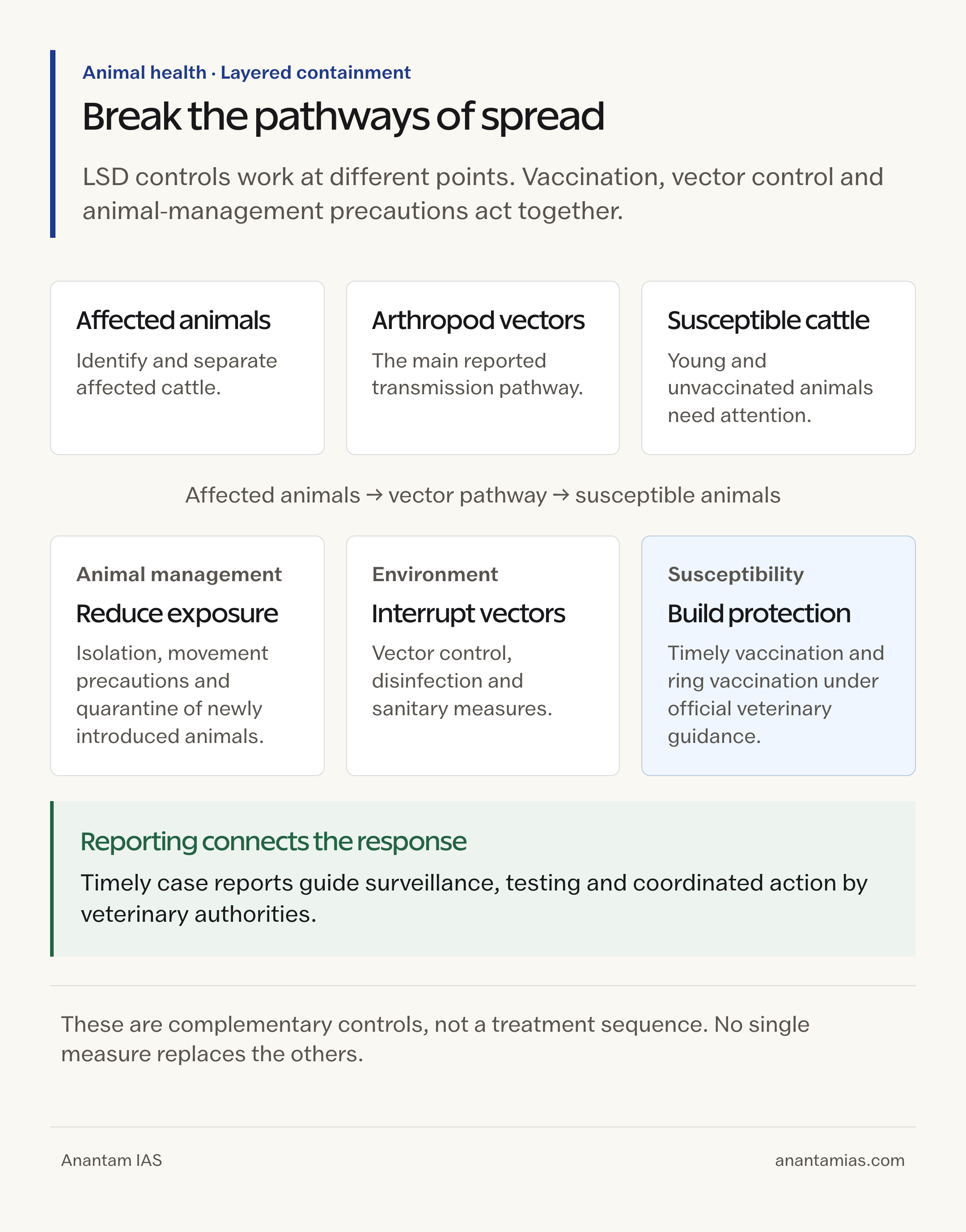
Turn surveillance into a coordinated response
Surveillance is useful when information leads to field assessment, diagnostic support and practical follow-up across administrative boundaries.
- Centre-State coordination links national technical guidance with implementation in States and Union Territories. DAHD describes ongoing review, vaccination support and assistance for veterinary capacity, rather than a response confined to one affected district.
- Diagnostic capacity supports the investigation of disease reports. DAHD identifies technical support from ICAR-NIHSAD, Bhopal, and a laboratory network; recording a report and establishing its diagnostic basis are related but distinct tasks.
- Field assessment can check whether reported conditions match the operational response. The central expert team’s deployment to Uttar Pradesh illustrates how technical oversight can connect national monitoring with conditions encountered by State authorities.
- Transparent reporting should support early action rather than be judged solely by low case totals. An apparent absence of cases is less informative if reporting and diagnostic access are weak in that location.
- Preparedness in unaffected areas remains part of DAHD’s approach. Preventive measures outside currently affected locations recognise that response planning must consider newly introduced animals and continuing susceptibility, not only the existing case list.
Way Forward
Close the gap between reporting and field action
- Review local vaccination gaps, especially among young animals, instead of relying only on the cumulative vaccination/revaccination total.
- Connect incident reports with diagnostic and field follow-up so authorities can target containment measures to the actual situation.
- Assess vaccination, vector control and movement precautions together; completion of one activity should not stand in for the full containment response.
Conclusion
- LSD containment combines protection of susceptible animals, precautions against spread and timely information. Its strength lies in coordinated implementation of complementary measures across veterinary and administrative services.
- In an answer, distinguish programme activity from protection gaps and the dated national assessment from local risk; use the response to explain why surveillance must lead to targeted action.
UPSC Practice Questions
Prelims MCQ 1
With reference to India’s Lumpy Skin Disease response, consider the following statements:
- DAHD identifies arthropod vectors as the principal means of transmission.
- A cumulative vaccination and revaccination total necessarily equals the number of distinct animals immunised.
- Quarantine of newly introduced animals differs from isolation of affected animals.
How many of the above statements are correct?
(a) Only one (b) Only two (c) All three (d) None
Answer: (b) Only two
Explanation:
Statements 1 and 3 are correct. A total that includes revaccination cannot be treated as a count of distinct animals immunised.
Prelims MCQ 2
Why are vaccination and vector control complementary in the LSD response?
(a) Both are only methods for reporting cases (b) Vector control establishes the number of animals vaccinated (c) They address animal susceptibility and opportunities for vector-mediated spread respectively (d) Vaccination eliminates the need for surveillance
Answer: (c) They address animal susceptibility and opportunities for vector-mediated spread respectively
Explanation:
The response combines prevention in animals with action against the vectors involved in transmission. Reporting and surveillance remain necessary to guide containment.
UPSC Mains Questions
- Explain why livestock disease containment requires vaccination, vector control, movement precautions and surveillance to work together.
- A large cumulative vaccination total does not establish the absence of local protection gaps. Discuss with reference to India’s Lumpy Skin Disease response.
Source: PIB, Department of Animal Husbandry and Dairying.
Frequently Asked Questions
What did DAHD report on 8 September 2026?
DAHD reported 3,461 active LSD cases and described the situation as under control, while continuing vaccination, surveillance and containment measures. This is a dated official assessment, not a declaration of elimination.
Does the vaccination figure count distinct cattle?
DAHD’s figure includes vaccination and revaccination. It should not be presented as a count of distinct cattle immunised, nor used alone to establish that local protection gaps have disappeared.
Why is vector control part of the response?
DAHD identifies arthropod vectors as the principal transmission mechanism. Vector control addresses opportunities for spread and complements measures directed at animals, including vaccination, isolation and movement precautions within the containment response.
How does reporting support containment?
Timely and transparent reporting helps authorities assess where disease incidents occur and organise follow-up. Its value lies in connecting information with diagnostic support, field assessment and appropriately targeted containment measures.
Source: https://anantamias.com/current-affairs/lumpy-skin-disease-vaccination-surveillance-response/
Mithun Behaviour AI: What a Single-Farm Study Can Establish
Why in News?
PIB reported on 8 September 2026 that ICAR-NRC on Mithun, Nagaland, developed a camera-based AI framework for detecting and tracking Mithun behaviour.
- The framework combines YOLOv8n for behaviour detection with DeepSORT for tracking individual animals across video frames.
- Its dataset contains 3,000 annotated images covering feeding, standing, lying and mounting at one research farm.
- The release reports 99.5% [email protected], a detection evaluation metric; this is not an estimate of disease-diagnosis accuracy or performance across farmers’ herds.
- Researchers identify wider validation and quantitative evaluation of identity tracking as outstanding work; proposed health and breeding uses remain potential applications.
- Mithun has social, cultural and economic importance for tribal communities in Northeast India, linking livestock research with locally important livelihoods.
- Manual observation is difficult to maintain continuously. Camera monitoring could extend observation, but useful interpretation still requires evidence about the animal and its setting.
UPSC Relevance
Prelims Relevance
- Mithun and Northeast Indian livelihoods
- YOLOv8n behaviour detection
- DeepSORT identity tracking
- Annotated training images
- Single-farm validation and generalisation
Mains Relevance
GS Paper 3
- Precision livestock farming and animal welfare
- Evaluating AI performance before wider deployment
- Locally relevant agricultural research and rural livelihoods
Essay
- Seeing more is not the same as knowing more.

Background and Context
Detection asks what; tracking asks which animal
The system joins two tasks that must work together to turn separate camera frames into information about individual animals.
- Behaviour detection identifies the activity visible in an image. Here, YOLOv8n distinguishes feeding, standing, lying and mounting, rather than recognising every possible behaviour an animal can perform.
- Identity tracking links an animal’s appearances across successive frames. DeepSORT assigns persistent identities so observations can be associated with an individual rather than treated as unrelated detections.
- Illustrative example: detecting a feeding animal in successive frames answers what is happening. Maintaining the same identity across those frames helps establish which animal is being observed.
- Separate errors can occur: the activity label may be wrong, or observations may be assigned to the wrong animal. Strong behaviour detection does not independently demonstrate reliable identity tracking.
- Human-reviewed interpretation is a sensible management safeguard: use a behaviour record to guide inspection and husbandry decisions, instead of treating every detected activity as an automatic instruction.
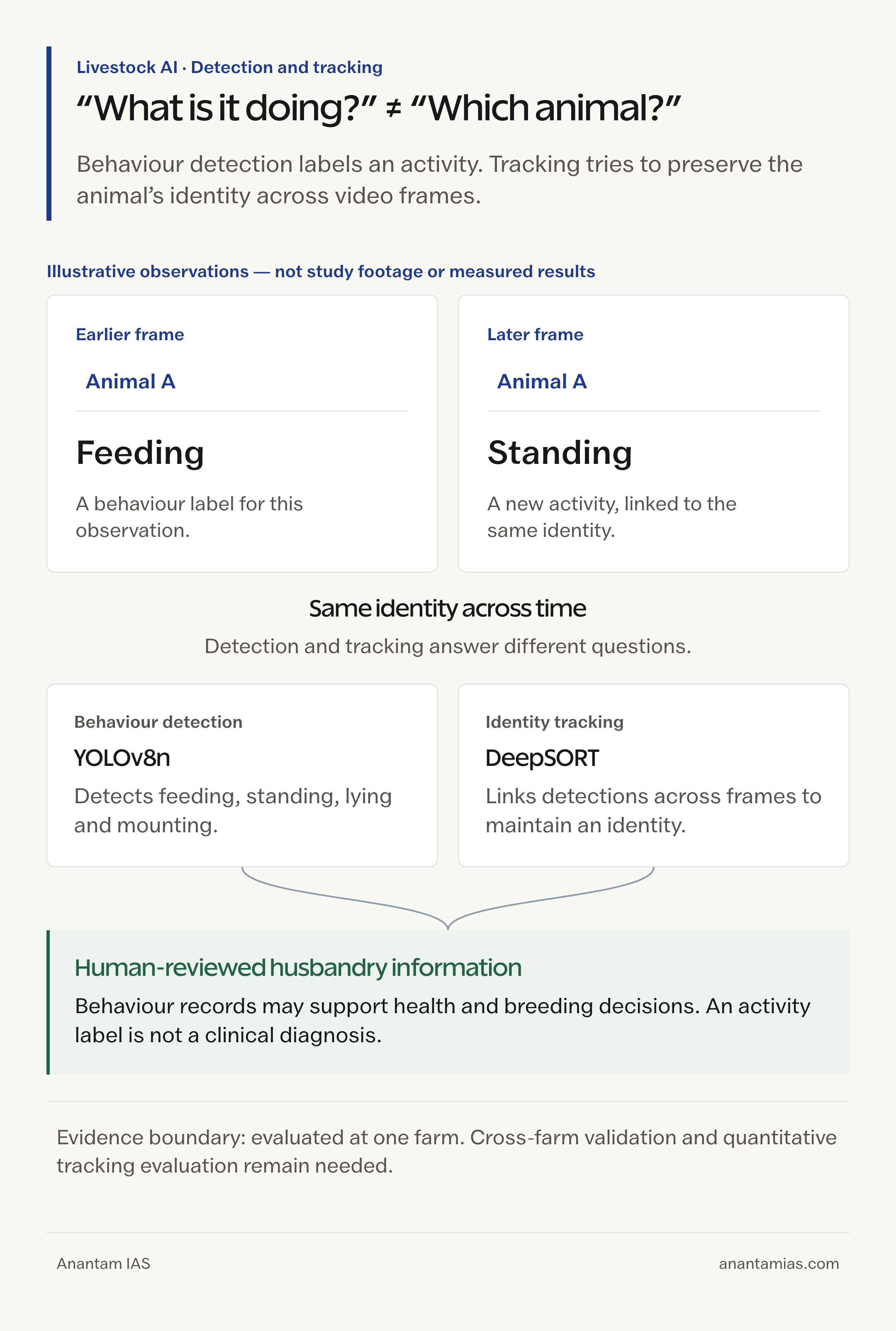
What the research actually evaluated
The reported achievement is a non-contact framework evaluated in a natural farm environment, with explicit limits on what its results establish.
- Annotated images provide examples with human-assigned labels. The model learns from this dataset; the scope and variety of its examples matter when assessing what it has been taught.
- Farm conditions included shadows, clutter, motion blur and nighttime infrared footage. Testing these challenges is useful evidence, but it does not make the study geographically or seasonally representative.
- Reported mAP summarises detection performance under the study’s evaluation. It should retain its metric name and context, rather than being rewritten as a universal percentage of correct farm decisions.
- Tracking evidence remains incomplete: researchers call for quantitative assessment using standard tracking metrics. Persistent identity labels in a demonstration cannot substitute for systematic measurement of tracking performance.
Behaviour is a management signal, not a diagnosis
Observed activities may help managers notice changes, but the same visible change can require further interpretation.
- Feeding, standing and lying patterns can provide information relevant to comfort, nutrition and health. The study detects activities; it does not establish a validated diagnosis for a named disease.
- Mounting behaviour could support reproductive management by drawing attention to events. Detection alone should not be equated with a confirmed reproductive assessment or evidence of improved breeding outcomes.
- Continuous observation can reduce gaps left by occasional manual checks, especially at night. Its practical value depends on whether managers receive interpretable information they can act on.
- Decision quality is a separate evaluation question: researchers would need to test whether using the information improves welfare or management, rather than infer benefits solely from detecting behaviours.
Why deployment needs validation beyond one farm
A model’s performance in its research setting does not establish dependable performance under every farmer’s operating conditions.
- Generalisation means performing usefully in settings beyond those already evaluated. Different farms, regions and seasons may present appearances and conditions that the original examples do not adequately represent.
- Camera arrangements and stocking density change how animals appear and overlap. Wider validation must examine these differences rather than assume that the original camera setting represents ordinary deployment.
- Severe occlusion, where animals are substantially hidden, remains a limitation. Missing visual information can disrupt detection and identity continuity, so uncertainty should be visible to the operator.
- Future work includes additional behaviours, larger datasets and possible edge-device deployment. These are research directions, not capabilities or low-cost installations already demonstrated by the reported study.
Way Forward
Validate the full observation-to-decision chain
- Test on independent farms across seasons, camera layouts and herd densities, reporting where performance deteriorates.
- Evaluate detection and identity tracking separately; measure errors relevant to individual animal records.
- Develop human-reviewed alerts and test their usefulness before making health, welfare or reproductive-benefit claims.
- Assess deployment requirements, including equipment, maintenance and operator capacity, before recommending wider farm adoption.
Conclusion
- Mithun behaviour AI illustrates a useful combination of activity detection and identity tracking, supported by promising but bounded evidence from one research farm.
- For an answer, separate model performance, deployment reliability and management outcomes. Progress at the first level cannot automatically establish success at the other two.
UPSC Practice Questions
Prelims MCQ 1
With reference to the reported Mithun AI framework, consider the following statements:
- YOLOv8n detects the studied behaviours.
- DeepSORT tracks individual animals across video frames.
- A high detection mAP alone establishes clinically validated disease diagnosis.
How many of the above statements are correct?
(a) Only one (b) Only two (c) All three (d) None
Answer: (b) Only two
Explanation:
Statements 1 and 2 are correct. A detection metric measures a particular model task; it does not establish clinical diagnosis or performance across other farms.
Prelims MCQ 2
Which next step would best address the Mithun study’s stated generalisation limitation?
(a) Replacing the metric name with field accuracy (b) Assuming every mounting event establishes a reproductive diagnosis (c) Evaluating independent farms across seasons and camera arrangements (d) Treating more frames from the same setup as proof of geographic reliability
Answer: (c) Evaluating independent farms across seasons and camera arrangements
Explanation:
The system has been evaluated at one farm. Independent settings test whether performance transfers beyond that context, while separately assessing tracking remains necessary.
UPSC Mains Questions
- Distinguish behaviour detection from identity tracking in precision livestock farming. Explain why both require separate evaluation. (150 words)
- A high model evaluation score does not automatically establish successful agricultural deployment. Discuss with reference to the reported Mithun behaviour study. (250 words)
Source: PIB, Ministry of Agriculture and Farmers Welfare.
Frequently Asked Questions
What does the Mithun AI system observe?
It detects feeding, standing, lying and mounting from camera footage and tracks individual animals across frames. The reported framework is non-contact and was evaluated at the ICAR research farm in Nagaland.
How do YOLOv8n and DeepSORT differ?
YOLOv8n detects the studied behaviours in images. DeepSORT links individual animals across successive frames using persistent identities. Correct activity detection and correct identity continuity are related but separate performance questions.
Does 99.5% mAP mean 99.5% field accuracy?
No. It is the reported detection metric at [email protected] under the study’s evaluation. It does not establish that proportion of correct farm decisions, accurate disease diagnoses or successful identity tracking.
Why is more validation needed?
The evaluation covered one farm. Different regions, seasons, camera arrangements and stocking densities may affect performance. Severe occlusion remains a challenge, and quantitative evaluation using standard identity-tracking metrics is still needed.
Source: https://anantamias.com/current-affairs/mithun-ai-behaviour-detection-validation/
India-Morocco Defence Ties: From MoU to Joint Committee
Why in News?
India and Morocco held their inaugural Joint Defence Committee meeting in New Delhi on 8 September, activating an institutional forum under their September 2025 defence-cooperation MoU.
- The Joint Defence Committee discussed training, education, peacekeeping, military exercises, medical cooperation, cyber defence and defence industries.
- The Moroccan delegation interacted with Indian defence industries; both sides agreed to explore co-production, joint ventures, technology collaboration, maintenance and sustainment.
- The meeting forms part of the institutional mechanism established through the bilateral defence MoU signed in September 2025.
- A visit to Army Hospital (Research & Referral) remained planned in the release. It should not be counted as a completed medical-cooperation outcome.
- A joint committee gives an existing cooperation framework a working forum. Its significance lies in connecting agreed areas with officials and institutions capable of pursuing them.
- Defence cooperation covers professional and institutional relationships as well as equipment. Training, medicine and peacekeeping can matter even when no procurement contract is announced.
UPSC Relevance
Prelims Relevance
- Partner country: Morocco.
- Institution: India-Morocco Joint Defence Committee, with its inaugural meeting in New Delhi.
- Framework: Defence-cooperation MoU signed in September 2025.
- Agenda: Training, peacekeeping, exercises, medicine, cyber defence and defence industries.
- Evidence distinction: Exploring co-production is different from concluding a production agreement.
Mains Relevance
GS Paper 2
- Institutional mechanisms that sustain bilateral relations beyond high-level visits.
- Distinguishing defence cooperation from mutual-defence commitments.
GS Paper 3
- Defence-industrial dialogue, co-production possibilities and maintenance cooperation.
Essay
- International partnerships become useful through sustained institutional work.
Background and Context
From a cooperation framework to a working forum
The new development is the inaugural committee meeting under an existing MoU, rather than a newly announced defence treaty.
- The September 2025 MoU established a defence-cooperation framework between India and Morocco. The official release identifies the Joint Defence Committee as part of the institutional mechanism created through that understanding.
- The inaugural meeting brought the mechanism into use through discussion of agreed areas. Its institutional importance is that cooperation now has a bilateral forum beyond the original signing and diplomatic announcement.
- A joint committee can help translate broad intentions into practical discussions among responsible officials. This is an analytical explanation of its value, not evidence that every discussed activity has already been approved.
- India’s delegation included military, production, research, medical and diplomatic representatives. That breadth matched an agenda extending across professional training and industrial cooperation, rather than focusing exclusively on one equipment acquisition.
- An MoU’s precise obligations depend on its text. This release confirms the framework and committee relationship, but does not establish a mutual-defence commitment, automatic military assistance or collective-security guarantee between the countries.
Why the cooperation agenda spans several institutions
Different defence functions require different professional relationships; the meeting’s broad agenda makes coordination across institutions relevant.
- Training and education concern professional capability, while military exercises concern practical interaction. Both appeared on the agenda, but the release does not announce a new exercise schedule or completed training programme.
- Peacekeeping cooperation was a distinct discussion area. It places professional military cooperation alongside wider international responsibilities; the announcement does not identify a new joint deployment or a specific peacekeeping mission commitment.
- Military medicine offers a separate channel for institutional learning. The proposed Army Hospital visit would provide exposure to Indian capabilities, but remained a future activity when the official account was issued.
- Cyber defence was discussed alongside these professional fields. No operational arrangement, data-sharing protocol or joint cyber unit was announced, so analysis should retain the distinction between an agenda item and an implemented mechanism.
- Institutional coordination matters because industrial, medical and military discussions involve different expertise. A common forum can connect these strands while allowing the relevant agencies to examine what particular cooperation would require.
Reading defence-industrial signals accurately
Industry engagement creates possibilities; stronger claims about production, technology or procurement need evidence of specific subsequent agreements.
- The delegation’s interaction with defence industries exposed it to Indian manufacturing capabilities. Both sides agreed to explore cooperation, making the industrial engagement substantive without converting it into an announced sale or production contract.
- Co-production concerns producing together, while a joint venture concerns a shared business arrangement. Exploring these avenues does not settle partners, ownership, facilities, quantities or financing; the release provides none of those project terms.
- Technology collaboration can encompass different arrangements. Its appearance among possible cooperation areas cannot establish a completed technology transfer, a manufacturing licence or permission to use particular intellectual property in either country.
- Maintenance and sustainment concern keeping equipment usable over time. Their inclusion shows an agenda wider than initial manufacture, although no platform, service contract or delivery commitment is specified in the official announcement.
- To assess follow-through, look for subsequently documented programmes, agreed responsibilities or concrete industrial arrangements. These would provide stronger evidence of delivery than treating the inaugural meeting itself as proof of every anticipated benefit.
Way Forward
Turn discussions into assessable cooperation
- Identify responsible institutions for selected training, medical or industrial activities and agree on practical follow-up, so a broad committee agenda produces manageable work.
- Distinguish exploration, agreement and delivery in public reporting. Announce a programme or contract when its terms are settled, rather than attributing final outcomes to preliminary discussions.
- Evaluate industrial proposals on their specific technology, production and sustainment terms. A partnership’s value depends on workable arrangements, not the number of cooperation fields listed.
Conclusion
- The India-Morocco committee gives the existing MoU an institutional forum spanning professional and industrial cooperation. That is the verified advance in this announcement.
- In a Mains answer, separate framework, working mechanism and delivered outcome. The committee strengthens the middle stage; specific programmes and contracts require further evidence before being presented as achievements.
UPSC Practice Questions
Prelims MCQ 1
With reference to the India-Morocco Joint Defence Committee meeting, consider the following statements:
- The committee is part of an institutional mechanism under the September 2025 defence MoU.
- The meeting’s agenda included military medicine and peacekeeping.
- The announcement confirms a signed co-production contract.
How many of the above statements are correct?
(a) Only one (b) Only two (c) All three (d) None
Answer: (b) Only two
Explanation:
The first two statements are supported by the official release. The sides agreed to explore co-production and other industrial avenues; no production contract was announced.
Prelims MCQ 2
What best describes the institutional significance of the inaugural India-Morocco Joint Defence Committee meeting?
(a) Creation of an automatic military-assistance guarantee (b) Completion of a technology transfer (c) Use of a working forum established under an existing cooperation MoU (d) Announcement of a joint combat deployment
Answer: (c) Use of a working forum established under an existing cooperation MoU
Explanation:
PIB links the committee to the mechanism set up through the 2025 MoU. The announcement establishes none of the other listed outcomes.
UPSC Mains Questions
- How do joint committees help translate bilateral understandings into sustained cooperation? Explain using the India-Morocco defence mechanism. (150 words)
- Defence diplomacy extends beyond arms sales. Discuss with reference to professional, medical and industrial cooperation, distinguishing exploratory dialogue from implemented commitments. (250 words)
Source: PIB, Ministry of Defence.
Frequently Asked Questions
What is new in India-Morocco defence cooperation?
The countries held their inaugural Joint Defence Committee meeting on 8 September in New Delhi. The committee is part of the institutional mechanism created through their September 2025 defence-cooperation MoU.
Which areas did the committee discuss?
The agenda covered training and education, peacekeeping, military exercises, medical cooperation, cyber defence and defence industries. These are reported discussion areas, not evidence that specific projects in every area are operational.
Was a co-production agreement signed?
The release says both sides agreed to explore co-production, joint ventures, technology collaboration, maintenance and sustainment. It does not announce a signed production contract or provide partners, quantities, financing or delivery terms.
Does the committee create a military alliance?
The announcement describes a defence-cooperation mechanism, not a mutual-defence pact. It does not establish automatic assistance or collective-security obligations; such claims would require evidence beyond the reported committee meeting and MoU reference.
Source: https://anantamias.com/current-affairs/india-morocco-joint-defence-committee-mechanism/
Census 2027
Why in news?
The expansion of the Census questionnaire (incorporating 40 questions) and its departure from traditional demographic data collection toward collecting individual identity markers has raised concerns among experts.
UPSC Relevance
Prelims
Mains, GS1, Population
GS 2, Significant Provisions and Basic Structure – Citizenship
Statutory, Regulatory and various Quasi-judicial Bodies.
Departures in Census 2027 Questionnaire
- Collection of Granular Identifiers: Introduction of questions regarding parents’ and spouses’ names, permanent address, place of COVID-19 vaccination, total bank accounts, mobile number, passport number, driving license availability, and official identification markers (e.g., voter ID).
- Shift from Statistical Aggregates to Individual Profiling: Historically, Census data focused purely on anonymous, aggregate demographic and socio-economic data. The new format incorporates traceable personal parameters.
Governance, Privacy, and Constitutional Concerns
- Violation of Statistical Confidentiality:
- UN Fundamental Principles of Official Statistics (Principle 6): Individual data collected for statistical compilation must remain strictly confidential and used exclusively for statistical purposes.
- Data Siloing Risk: Utilizing statistical census machinery to extract individual details for potential cross-departmental sharing undermines the fundamental trust between citizens and statistical agencies.
- Convergence with the National Population Register (NPR):
- Parameters like parental details, permanent address, and declared nationality closely align with data requirements for updating the NPR (the basis for the National Register of Citizens – NRC).
- Legal & Federal Friction: While the Census is governed by the Census Act, 1948, the NPR falls under the Citizenship Act, 1955. Utilizing state-level enumerators appointed under Section 4(2) of the Census Act for NPR-aligned data collection without clear, transparent statutory mandates risks center-state administrative friction.
- Right to Privacy Considerations: Under the framework established in K.S. Puttaswamy v. Union of India (2017), state data collection must satisfy the tests of legality, necessity, and proportionality. Collecting traceable personal identity numbers under a statistical exercise raises questions regarding proportionality and purpose limitation.
Comparative Global Practices
- United States: Census data is strictly protected under Title 13 of the US Code, preventing non-statistical use. Historic individual census records are unsealed only after 72 years for genealogical research.
- India’s Traditional Model: Names served solely as temporary field placeholders to prevent double-counting during enumeration and were never computerized or stored in public/master databases.
Way Forward
- Adherence to Purpose Limitation: Re-anchor the Census exclusively to socio-economic data collection, maintaining a strict firewall between statistical data gathering and administrative population registers (NPR/NRC).
- Streamlining the Questionnaire: Reduce redundant queries to mitigate enumerator workload and respondent fatigue, ensuring higher data accuracy.
- Transparent Legal Frameworks: If the state requires population registers, the process should be undertaken through separate, transparent statutory mechanisms that comply with data protection norms rather than leveraging statistical surveys.
Differentiating Census, National Population Register (NPR), and National Register of Citizens (NRC)
| Feature | Census | National Population Register (NPR) | National Register of Citizens (NRC) |
| Primary Purpose | To collect detailed, aggregated statistical data on the entire population (demographics, social, economic, housing). This data is used for government planning, policy formulation, and research. | To create a comprehensive identity database of all usual residents of the country. This register is meant for better governance, delivery of government schemes, and security. | To identify and document all legal citizens of India and distinguish them from illegal immigrants. The primary goal is to verify citizenship status. |
| Legal Backing | The Census Act, 1948. This act makes it mandatory for every person to truthfully provide information and guarantees confidentiality. | The Citizenship Act, 1955 and the Citizenship (Registration of Citizens and Issue of National Identity Cards) Rules, 2003. | The Citizenship Act, 1955 and the Citizenship (Registration of Citizens and Issue of National Identity Cards) Rules, 2003. |
| People Included | All individuals residing within the geographical boundaries of India at the time of enumeration. This includes both citizens and non-citizens. | All “usual residents” of the country, defined as a person who has resided in an area for the past six months or more, or who intends to reside there for the next six months or more. | Exclusively Indian citizens. |
| Criteria for Inclusion | Based on physical presence at the time of enumeration. Information is primarily based on self-declaration, without a requirement for documentary proof. | Any person who has been living in an area or locality for six months or more or intends to live in an area/locality for the next six months at the time of a survey is considered a resident. While based on self-declaration, it is the initial step for creating a comprehensive identity database. It collects demographic and, potentially, biometric data. | Requires documentary proof of citizenship. In the case of the Assam NRC, this involved proving that a person or their ancestors were in India before a specific cut-off date (e.g., March 24, 1971). A nationwide NRC would also require similar documentary evidence. |
| Who Conducts | The Office of the Registrar General and Census Commissioner, under the Ministry of Home Affairs. Field operations are a joint effort with state governments. | The Office of the Registrar General and Census Commissioner, under the Ministry of Home Affairs. It is often conducted simultaneously with the houselisting phase of the Census. | The Office of the Registrar General and Census Commissioner, under the Ministry of Home Affairs. The Assam NRC was a Supreme Court-monitored exercise. |
| Confidentiality | Data collected about an individual is strictly confidential and cannot be shared with any government department or individual. The Census Act guarantees this confidentiality. | The data collected can be shared with other government departments for the implementation of welfare schemes and for security purposes. The information is not considered confidential in the same way as census data. | The register is intended to be a public document to verify citizenship status and is not confidential. |
| Frequency | Decennial (once every 10 years). The last complete census was conducted in 2011. The 2021 Census has been postponed. | Was first prepared in 2010 and updated in 2015. It is designed to be a dynamic, continuously updated register. | The only nationwide NRC was prepared in 1951. An updated NRC has been conducted only in Assam. A nationwide NRC has been proposed but not yet implemented. |
| Last Conducted | 2011 (Complete Census) | Updated in 2015 | The final list for the Assam NRC was published in 2019. |
| Relationship to Each Other | A completely separate and independent exercise from both the NPR and the NRC. | The NPR can be seen as the foundational step for the NRC. The Citizenship Rules, 2003, explicitly state that the NPR data can be used to prepare the NRC after a verification process to determine citizenship. | The NRC is the final outcome of the citizenship verification process, potentially using the NPR as the base list of residents. It is the end goal for identifying legal citizens. |
The Indian Census
- Historical Context and Significance: It has a history spanning over 130 years, with the first census conducted non-synchronously in 1872 and then the decennial Census since 1881. This decennial exercise provides valuable insights into the demographic, economic, and social characteristics of India’s people.
- From 1881 to 2011, the census exercise was conducted uninterruptedly every ten years except 2021.
- Administrative Authority: The responsibility for conducting the census lies with the Office of the Registrar General and Census Commissioner of India (RGI), which operates under the Ministry of Home Affairs.
- Evolution of the Census Organization:
- Prior to 1951, the census organization was set up on an ad-hoc basis for each enumeration.
- The Census Act of 1948 was enacted to provide a legal framework for conducting the census and to define the duties and responsibilities of census officers.
- In May 1949, the government established the Office of the RGI and ex-officio Census Commissioner within the Ministry of Home Affairs to systematically collect data on population and vital statistics.
- Later, this office was also tasked with implementing the Birth and Death Registration Act, 1969.
- Organizational Structure: The census organization in India consists of its headquarters in New Delhi and a network of 34 Directorates of Census Operations that function in different states and union territories.
Census 2027
- The main census, set to be completed in 2027, will be the first since 2011. It will be conducted in two phases:
- Houselisting and Housing Schedule (HLO)
- Population Enumeration
- The exercise is scheduled to run from April 1, 2026, to February 28, 2027.
Key Innovations: The upcoming census introduces several new features:
- It will be the first digital census.
- It will be the first time since independence that caste will be enumerated.
- A mobile app will be used for data collection for the first time.
- The pre-test will also try out self-enumeration, digital mapping tools, and a web-based portal for real-time monitoring.
National Population Register (NPR):
- The government has stated that no decision has been made to update the NPR during the 2027 Census exercise.
- The NPR, which contains details of 119 crore residents, was first created in 2010 and updated in 2015-16.
- According to the Citizenship Rules, 2003, the NPR is the first step toward creating a National Register of Citizens (NRC).
Practice MCQ
Consider the following statements regarding the Census, National Population Register (NPR), and National Register of Citizens (NRC):
- While the Census is governed by the Census Act, 1948, both the NPR and NRC are prepared under the provisions of the Citizenship Act, 1955.
- Individual-level data collected under the Census Act is confidential and inadmissible as evidence in court, unlike NPR data.
- The NPR is a mandatory register containing demographic and biometric details exclusively of Indian citizens residing in the country.
Which of the statements given above are correct?
(a) 1 and 2 only
(b) 2 and 3 only
(c) 1 and 3 only
(d) 1, 2 and 3
Correct Answer: (a) 1 and 2 only
Practice Question
The conduct of the delayed Census 2027 goes beyond a routine demographic counting exercise, as it carries profound political and socio-economic ramifications. In light of this, analyze the major debates surrounding Census 2027 and its implications for Indian federalism and policy design. (10 Marks, 150 Words)
Capital Punishment
Why in news?
Muzaffarnagar Additional District and Sessions Judge Ravi Kumar Diwakar has said that he would rather “die than be called a coward” while awarding capital punishment in a dowry death case, the 23rd death sentence handed down by him in the last five months.
UPSC Relevance
Prelims
Mains, GS2
Capital Punishment in India
Capital punishment (the death penalty) is the highest legal penalty awarded by the state for heinous offences. In India, it operates under the principle of procedural fairness under Article 21 of the Constitution, balancing state severity against individual rights.
Statutory & Legal Status in India
- Constitutional Validity: The death penalty is constitutionally valid under Article 21 (“no person shall be deprived of their life or personal liberty except according to a procedure established by law“).
- Substantive Framework (BNSS & BNS):
- Under the Bharatiya Nyaya Sanhita (BNS), 2023 (which replaced the IPC), capital punishment is retained for severe crimes, including aggravated murder, acts of terrorism, gang rape of a minor, and mob lynching resulting in death.
- Section 393(5) of the Bharatiya Nagarik Suraksha Sanhita (BNSS), 2023 governs the execution process (hanging by the neck until dead).
- Procedural Safeguards:
- Confirmation by High Court: A death sentence awarded by a Sessions Court must be mandatorily confirmed by the High Court.
- Special Reasons: The trial court must explicitly provide “special reasons” in writing for awarding the death penalty instead of life imprisonment.
- Exemptions: Juveniles, pregnant women, and individuals suffering from severe mental illness are legally exempt from execution.
- Pardoning power
- President’s Power (Article 72): The President can grant a full pardon, reprieve, or commute any death sentence.
- The President acts on the advice of the Union Council of Ministers.
- Governor’s Power (Article 161): The Governor cannot grant a complete pardon for a death sentence. However, a Governor can commute or remit a death sentence.
- President’s Power (Article 72): The President can grant a full pardon, reprieve, or commute any death sentence.
Case Laws & Judicial Evolution
| Case Law | Legal Doctrine Established |
| Jagmohan Singh v. State of UP (1973) | Upheld the constitutionality of the death penalty, ruling it does not violate Article 19 or Article 21. |
| Bachan Singh v. State of Punjab (1980) | Formulated the “Rarest of Rare Cases” doctrine. Stated that life imprisonment is the rule, and the death penalty is an exception. Courts must weigh Aggravating vs. Mitigating circumstances before deciding. |
| Machhi Singh v. State of Punjab (1983) | Broadened the “Rarest of Rare” framework by outlining 5 categories (manner of crime, motive, anti-social nature, magnitude, and personality of victim). |
| Kehar Singh v. Union of India (1989) | Affirmed that the President’s exercise of pardoning power under Article 72 is subject to judicial review against arbitrary decisions. |
| Swami Shraddhananda v. State of Karnataka (2008) | Created an intermediate sentencing option: “Special Category Life Imprisonment” without remission for 20–30 years (or life) as an alternative to execution. |
| Shatrughan Chauhan v. Union of India (2014) | Ruled that inordinate and unexplained delay in deciding mercy petitions is a valid ground for commuting a death sentence to life imprisonment due to psychological torture (“Death Row Phenomenon“). |
| Manoj v. State of MP (2022) | Mandated that trial courts must systematically collect psychological, socio-economic, and behavioural reports of the convict before considering the death penalty. |
Arguments In Favour (Pro-Retention)
- Retributive Justice: Satisfies societal outrage and provides moral closure to victims’ families for atrocious crimes (“lex talionis” or eye for an eye).
- Deterrence Theory: The severity of the penalty serves as a powerful deterrent against severe national threats and brutal violent crimes.
- National Security & Public Safety: Essential for combating state-sponsored terrorism, high treason, and organised violence that undermines sovereignty.
- Proportionality of Punishment: Preserves the faith of society in the criminal justice system by matching the gravity of the punishment to the brutality of the offence.
Arguments Against (Pro-Abolition)
- Irreversibility & Judicial Error: Fallibility in the judicial system poses the risk of executing innocent individuals, which cannot be undone.
- Lack of Empirical Evidence: Global studies and reports (such as the Justice Verma Committee, 2013) show no direct correlation between the death penalty and lower crime rates.
- Socio-Economic Bias: Death row statistics show that marginalised, illiterate, and poor defendants often lack access to top legal representation, bearing a disproportionate impact.
- Focus on Reformative Justice: Focuses purely on retribution rather than rehabilitation, violating human dignity.
- Judicial Vagueness: “Rarest of rare” remains subjectively applied across different benches, leading to inconsistency.
Global precedents on capital punishment
- UN Treaties: The ICCPR (Article 6) restricts executions to only “most serious crimes,” while the CRC (Article 37a) strictly prohibits the death penalty for juveniles.
- Abolitionist Protocols: The Second Optional Protocol to the ICCPR and Protocol 13 to the European Convention on Human Rights (ECHR) aim for total abolition.
- Global Trend: Over 70% of nations have legally or practically abolished capital punishment, supported by recurring UN General Assembly resolutions calling for a universal moratorium.
Law Commission Recommendations
- 35th Report (1967): Recommended retaining the death penalty, citing the need to maintain law and order.
- 262nd Report (2015): Recommended abolishing the death penalty for all crimes except terrorism-related offences and waging war against the state. It highlighted that the death penalty serves no penological purpose beyond retribution.
Way Forward
- Strict Adherence to Mitigation: Trial courts must strictly follow the Manoj (2022) guidelines by requesting psychological evaluations before passing sentences.
- Expanding Intermediate Options: Courts should rely more on “special category life imprisonment” (Shraddhananda case) without remission to avoid executing convicts while ensuring safety.
- Systemic Criminal Reforms for real deterrence: Focus on police investigation quality, forensic capabilities, and victim support mechanisms rather than relying on capital punishment as a silver bullet.
Practice MCQ
Q. With reference to the statutory and procedural framework governing capital punishment in India, consider the following statements:
- Under the Bharatiya Nagarik Suraksha Sanhita (BNSS), a criminal court is required to record “special reasons” in writing when awarding the death penalty instead of life imprisonment.
- The legal framework provides a statutory exemption barring the execution of death sentences on pregnant women and juveniles.
- The President’s power to grant pardon to a death sentence under Article 72 is entirely beyond the purview of judicial review.
Which of the statements given above is/are correct?
(a) 1 and 2 only
(b) 2 only
(c) 1 and 3 only
(d) 1, 2, and 3
Correct Option: (a) 1 and 2 only
Practice Question
What is the constitutional position on Capital punishment in India? How does the Rarest of Rare doctrine limit judicial discretion in death sentences? Analyse with recent judicial guidelines. (10 marks)
Source: https://anantamias.com/current-affairs/capital-punishment/
Perilous retreat : GramSabha’s power on tribal land
Why in news?
Gram Sabhas’ power over tribal land is in the news as the Union Ministry of Tribal Affairs (MoTA) has explicitly stated that there is “no provision” in the Forest Rights Act (FRA), 2006 requiring Gram Sabha consent for forest land diversion, distancing itself from the forest clearance process.
UPSC Relevance
Prelims
Mains, GS2
Issues and Challenges Pertaining to the Federal Structure, Devolution of Powers and Finances up to Local Levels and Challenges Therein.
Mechanisms, Laws, Institutions and Bodies constituted for the Protection and Betterment of these Vulnerable Sections.
The Ministry of Tribal Affairs’ Stand
The Union Ministry of Tribal Affairs (MoTA) informed the Power Ministry that the Scheduled Tribes and Other Traditional Forest Dwellers (Recognition of Forest Rights) Act, 2006 (FRA) contains no legal provision requiring Gram Sabha consent for stage-II forest diversion. MoTA stated that such matters do not fall within its regulatory purview, creating a significant inter-ministerial shift regarding the governance of forest-dependent tribal lands.
- MoTA’s Position: Asserts that the FRA does not mandate Gram Sabha consent for forest diversion, leaving the issue outside its operational mandate.
- Forest Conservation Act (FCA) Framework: Rules under the FCA, 1980 mandate that before forest land is formally diverted for non-forestry use, all FRA rights must be recognized/vested and a No-Objection Certificate (NOC) must be secured from the affected Gram Sabhas.
- Inter-Ministerial Vacuum: MoTA’s refusal to claim jurisdiction over diversion consent creates a regulatory gap between MoTA (the nodal ministry for FRA) and the Ministry of Environment, Forest and Climate Change (MoEFCC).
Stand of the Parliamentary Standing Committee
- Delays in Infrastructure: A report by the Committee on Public Undertakings highlighted that forest clearances for NHPC hydel projects average 106 months, citing 100% Gram Sabha consent requirements as a major bottleneck (e.g., stalling the Teesta-IV Hydroelectric Project).
- Proposed “Super-Majority” Dilution: The committee endorsed a proposal to replace unanimous Gram Sabha consent with a 70–75% qualified super-majority for projects of national importance.
Implications
- Undermining Democratic Autonomy: Transitioning from individual village consent to a collective 70–75% threshold risks reducing Gram Sabhas from self-governing constitutional bodies into minority-ruled stakeholders.
- Bypassing Directly Impacted Villages: A developer could obtain consent from peripheral, less-affected villages while bypassing the explicit veto of a village designated for total submergence.
- Erosion of ‘Historical Injustice’ Mandate: Bypassing localized consent weakens the core objective of the FRA 2006, which was enacted to correct historical alienation of forest dwellers.
Judicial Precedents & Legal Foundations
- Niyamgiri Judgment (Orissa Mining Corporation v. MoEF, 2013): The Supreme Court held that the Gram Sabha is a quasi-judicial authority empowered to decide whether industrial projects infringe upon religious, cultural, and community forest rights.
- Constitutional Alignment: Article 243M, read with the Fifth Schedule, protects tribal self-governance and land rights.
Statutory Provisions
| Act | Statutory Power Granted to Gram Sabha |
| PESA Act, 1996 | Mandatory consultation prior to land acquisition in Scheduled Areas. |
| LARR Act, 2013 | Requires prior informed consent of Gram Sabhas for land acquisition in Fifth Schedule areas. |
| FRA, 2006 | Empowers Gram Sabha to preserve habitats, cultural heritage, and community forest resources. |
International Commitments
- UNDRIP (Art. 19): Free, Prior, and Informed Consent (FPIC) for indigenous peoples regarding projects affecting their lands.
- UNCBD & Paris Agreement: Tribal and forest-dependent communities act as vital carbon sinks and primary guardians of biodiversity.
Way Forward
- Democratizing Policy Revisions: Any structural change to forest clearance procedures must be executed via open legislative or transparent rule-making processes rather than procedural recusal by nodal ministries.
- Strengthening Institutional Capacity: Streamline bureaucratic timelines for forest clearance without diluting localized consent procedures.
- Balanced Development & Rights: Align national infrastructure goals with the constitutional mandate of tribal self-governance, ensuring development does not result in involuntary dispossession.
- Virginius Xaxa Committee (High-Level Committee, 2014)
- Absolute Consent & Veto Power: Recommended that Gram Sabha consent must be made mandatory for all land acquisitions and forest land diversions in Scheduled Areas.
- Strict Enforcement of PESA & FRA: Emphasized that bypassing Gram Sabhas for large linear projects or mining breaches the spirit of the Panchayats (Extension to Scheduled Areas) Act, 1996 (PESA) and Forest Rights Act, 2006 (FRA).
- “Land for Land” Rehabilitation: Opposed cash compensation for tribal land diversion, recommending direct land-to-land restoration in the command area of developmental projects to prevent dispossession.
Harmonizing tribal rights with national infrastructure is crucial for Viksit Bharat @2047. True sustainable development requires democratic, decentralised governance where Gram Sabha autonomy and clean energy goals progress together.
Practice MCQ
UPSC Civil Services Prelims 2012
Q. In the areas covered under the Panchayat (Extension to the Scheduled Areas) Act, 1996 (PESA), what is the role/power of Gram Sabha?
- Gram Sabha has the power to prevent the alienation of land in the Scheduled Areas.
- Gram Sabha has the ownership of minor forest produce.
- Recommendation of Gram Sabha is required for granting prospecting license or mining lease for any mineral in the Scheduled Areas.
Which of the statements given above is/are correct?
(a) 1 and 2 only
(b) 2 and 3 only
(c) 1 and 3 only
(d) 1, 2, and 3
Correct Answer: (a) 1 and 2 only
Practice MCQ
With reference to the governance of forest land and rights of forest-dwelling communities in India, consider the following statements:
- The requirement of obtaining a No-Objection Certificate (NOC) from Gram Sabhas prior to stage-II forest clearance originates explicitly from the provisions of the Forest Rights Act (FRA), 2006.
- The Ministry of Tribal Affairs (MoTA) is the designated statutory nodal ministry for the implementation of the Forest Rights Act, 2006.
- Under the FRA, 2006, the Gram Sabha is the primary authority to initiate the process of determining the nature and extent of individual and community forest rights.
Which of the statements given above is/are correct?
(a) 1 and 2 only
(b) 2 and 3 only
(c) 3 only
(d) 1, 2, and 3
Correct Answer: (b) 2 and 3 only
Practice Question
Q. Critically analyze the statutory and regulatory conflicts surrounding Gram Sabha consent for forest diversion. How can India balance ecological conservation, tribal rights, and critical infrastructure development? (15 marks)
Source: https://anantamias.com/current-affairs/perilous-retreat-gramsabhas-power-on-tribal-land/
Western Dedicated Freight Corridor
Why in News?
Recently, the remaining three sections of the Western Dedicated Freight Corridor (WDFC) were inaugurated, marking its completion. These sections cover 326 route kilometres, developed at over ₹20,700 crore. They include-
- New Sanand North (Gujarat)- New Makarpura (Gujarat)
- New Umbergaon (Gujarat)- New Saphale (Maharashtra)
- New Saphale (Maharashtra) -New JNPT (Maharashtra)
| UPSC Relevance: GS-3 Economy: Infrastructure Prelims: Western Dedicated Freight Corridor, Eastern Dedicated Freight Corridor Mains: Dedicated Freight Corridor: Significance and Policy Measures |
Together, the 1,506-km Western Dedicated Freight Corridor (WDFC) and 1,337-km Eastern Dedicated Freight Corridor (EDFC) constitute the completed 2,843-km network. Further corridors remain proposed or under development.
What is a Dedicated Freight Corridor?
- A Dedicated Freight Corridor is a railway line built specifically to transport goods, with infrastructure suited to heavier loads, longer trains, and reliable freight movement.
- On conventional railway lines, passenger and freight trains share tracks. Differences in their speeds, frequent passenger stops and scheduling priorities constrain capacity. Separating freight traffic allows both networks to operate more efficiently.
- The implementing agency is the Dedicated Freight Corridor Corporation of India Limited (DFCCIL), under the Ministry of Railways.
The corridors connect northern industrial and consumption centres with western ports and eastern resource-producing regions.
Note: The original EDFC proposal extended to Dankuni, West Bengal, but the completed 1,337-km corridor terminates at Sonnagar, Bihar.
What makes the WDFC technologically significant?
WDFC is the world’s first high-capacity railway corridor designed and built for routine, heavy-haul, double-stack container train operations at speeds up to 100 km/h.
- Electrified double-stack operations: Two containers are stacked vertically on a wagon, increasing carrying capacity without proportionately increasing train length.
- High-rise overhead equipment: Wires approximately 7.5 metres above the track, together with high-reach pantographs, provide clearance for stacked containers while supplying electricity.
- Heavy-haul infrastructure: Provision for 25-tonne axle loads, with infrastructure designed for higher loads, enables more cargo per wagon.
- Longer and faster trains: Infrastructure accommodates trains up to 1.5 km long, with a maximum freight operating speed of 100 km/h.
- Powerful locomotives: The 12,000-HP WAG-12B, manufactured at Madhepura, Bihar, supports heavy freight movement and uses regenerative braking to recover energy.
The completion of the WDFC makes India the world’s only country with a fully electrified dedicated freight corridor built for routine double-stack container operations.
Why Dedicated Freight Corridors Matter?
- Lower logistics and inventory costs: Faster, predictable deliveries can reduce warehouse holding, demurrage and the working capital tied up in goods in transit. Reliability helps manufacturers plan production and meet shipping schedules. India’s estimated logistics cost is 7.97% of GDP for 2023-24.
- Stronger export competitiveness: Direct connectivity to Jawaharlal Nehru Port improves movement between industrial centres and international shipping networks, particularly for containerised exports and imports.
- Industrial development along corridors: Freight access can attract manufacturing, warehouses and logistics parks. Integration with the Delhi-Mumbai Industrial Corridor and Amritsar-Kolkata Industrial Corridor connects transport investment with industrial development.
- Capacity for passenger services: Moving freight onto dedicated tracks releases capacity on existing lines. Actual improvements in passenger frequency and punctuality depend on subsequent scheduling and investment decisions.
- Cleaner freight movement: Shifting suitable long-distance cargo from trucks to electrified rail can reduce emissions and dependence on diesel. The World Bank estimates that rail freight emits approximately one-fifth of trucks’ greenhouse-gas emissions, although outcomes vary with operating conditions and electricity sources.
- Agricultural market access: Reliable transport can support foodgrain movement and processed-food distribution. Perishable produce additionally requires refrigerated containers, cold storage and efficient loading facilities.
- Regional integration: Improved connectivity can help inland firms access ports and larger markets, while generating opportunities in warehousing, maintenance and cargo handling.
Indian Railways’ freight loading reached 1,670 million tonnes in 2025-26.
Policy Linkages and Way Forward
- Integrate infrastructure through PM GatiShakti: Coordinate corridor links with ports, highways, warehouses and industrial areas; complete terminal connections alongside main railway infrastructure.
- Implement the National Logistics Policy, 2022: Use the Unified Logistics Interface Platform (ULIP) and coordinated procedures to improve cargo visibility and reduce documentation friction.
- Expand accessible cargo terminals: Develop Gati Shakti Multi-Modal Cargo Terminals, common-user warehouses and aggregation facilities that allow smaller firms to access rail logistics.
- Build dependable door-to-door services: Offer scheduled departures, transparent tariffs and coordinated road-rail delivery, with performance measured by total delivery time.
- Strengthen sustainability and resilience: Combine cleaner electricity, efficient locomotives and higher wagon utilisation with flood-resilient drainage and heat-resilient infrastructure.
- Expand on demonstrated demand: Budget 2026-27 announced a 2,052-km Dankuni-Surat DFC, intended to connect eastern production centres with western ports through integration with the WDFC. Its benefits depend on sound appraisal and timely terminal development.
The next policy priority is to translate completed tracks into affordable, reliable and accessible door-to-door logistics, particularly for manufacturers, farmers and smaller enterprises.
UPSC Mains Practice Question:
Q. Dedicated Freight Corridors can strengthen India’s industrial competitiveness, but their benefits depend on integration with the wider logistics ecosystem. Discuss.
UPSC Prelims Practice MCQ:
Q. With reference to the Western Dedicated Freight Corridor (WDFC), consider the following statements:
1. It connects Dadri in Uttar Pradesh with Jawaharlal Nehru Port in Maharashtra.
2. It facilitates double-stack container train operations using electric traction.
3. The World Bank is its principal external financing partner of WDFC.
Which of the statements given above are correct?
(a) 1 and 2 only
(b) 2 and 3 only
(c) 1 and 3 only
(d) 1, 2 and 3
Answer: (a) 1 and 2 only
Explanation:
- Statement 1 is correct: The 1,506-km WDFC connects Dadri with Jawaharlal Nehru Port. It traverses Uttar Pradesh, Haryana, Rajasthan, Gujarat and Maharashtra.
- Statement 2 is correct: High-rise overhead wires and high-reach pantographs enable electrically hauled trains to carry containers stacked one above another.
- Statement 3 is incorrect: JICA (Japan) is the WDFC’s major external financing partner. The World Bank has supported substantial sections of the Eastern Dedicated Freight Corridor.
Source: https://anantamias.com/current-affairs/western-dedicated-freight-corridor/
Orangutans Rescued in Odisha
Why in News?
The Odisha Forest Department rescued five young orangutans from a casuarina plantation in the Udayapur-Talsari forest area of Balasore district. Aged approximately six months to one year, they were shifted to Nandankanan Zoological Park, near Bhubaneswar, for examination and care.
Since orangutans are not native to India, officials suspect an interrupted wildlife-trafficking operation. Their origin, destination and route remain under investigation.
| UPSC Relevance: GS-3 Environment and Biodiversity: Species in News, Wildlife trafficking Prelims: Key facts about Orangutan |

Key Facts About Orangutans:
- Orangutans are great apes, with no tails. They are the only non-human great apes native to Asia and the world’s largest predominantly tree-dwelling mammals.
- Name: “Orangutan” means “person of the forest” in Malay.
- Appearance: Reddish-brown hair, long arms and grasping hands and feet adapted to life in trees.
- Habitat: Tropical rainforests, including lowland, peat-swamp and hill forests.
- They are native to the rainforests of Indonesia and Malaysia. They are now found only in parts of Borneo and Sumatra. Three Species exist: Bornean orangutan, Sumatran orangutan and Tapanuli orangutan.
Behavioural Traits:
- Predominantly arboreal and diurnal: They spend much of their time in trees and are active during the day.
- Semi-solitary: Adult males generally range alone; the strongest social bond is between a mother and her dependent offspring.
- Intelligent tool users: They use sticks to catch insects or extract food and learn survival skills by observing others.
- Nest builders: They construct sleeping nests from branches and leaves in trees.
- Primarily fruit-eating: Fruits dominate their diet, supplemented by leaves, bark and insects.
- Prolonged maternal care: Young remain dependent on their mothers for several years, learning feeding, climbing and nest-building skills.
- Slow reproduction: Females generally produce one infant at a time, with births often spaced seven to nine years apart, which slows population recovery.
Ecological Importance, Major Threats and Conservation status:
- Ecological Importance: Orangutans disperse seeds through their fruit-rich diet, helping forest regeneration. Protecting their habitat also conserves tropical forest biodiversity and carbon stocks.
- Major Threats: Their principal threats include habitat loss, fragmentation, Illegal pet trade, hunting and conflict, forest fires, and slow population recovery.
- Protection Status:
- IUCN Red List: All three species are Critically Endangered, indicating an extremely high risk of extinction in the wild.
- CITES: Appendix I
- Wildlife (Protection) Act, 1972: Schedule IV (the schedule covering CITES-listed specimens under the amended Act)
Non-native endangered animals found in India warrant investigation of transboundary wildlife crime, international supply chains and domestic buyers. These animals should not be released into Indian forests; placement or repatriation must consider species identity, health, provenance and suitable habitat.
UPSC PYQ 2023
Q. Which one of the following makes a tool with a stick to scrape insects from a hole in a tree or a log of wood?
(a) Fishing cat
(b) Orangutan
(c) Otter
(d) Sloth bear
Answer: (b) Orangutan
UPSC Prelims Practice MCQ:
Q. With reference to orangutans, consider the following statements:
1. Their natural distribution is restricted to the islands of Borneo and Sumatra.
2. They are predominantly arboreal and build nests in trees.
3. Females generally give birth every year.
How many of the above statements are correct?
(a) Only one
(b) Only two
(c) All three
(d) None
Answer: (b) Only two
- Statement 1 is correct: Wild orangutans occur in Borneo and Sumatra, in parts of Indonesia and Malaysia.
- Statement 2 is correct: They spend much of their lives in trees and construct sleeping nests.
- Statement 3 is incorrect: Births are typically separated by several years, often around seven to nine years, making recovery from hunting and habitat loss slow.
Source: https://anantamias.com/current-affairs/orangutans-rescued-in-odisha/
Bharat Ratna and C.N.R. Rao’s Scientific Legacy
Why in News?
Professor C.N.R. Rao, a Bharat Ratna recipient, received a notice during Karnataka’s Special Intensive Revision (SIR) of electoral rolls over a spelling discrepancy between “Prof.” and “Proff.” in his recorded name.
| UPSC Relevance: GS-1 History and Culture: Awards and Honours; GS-3 Science and Technology: Contributions of Scientists Prelims: Key facts about Bharat Ratna Mains: Contributions of Prof. C.N.R. Rao |
About Bharat Ratna Award:
- Meaning: Jewel of India; it is India’s highest civilian award.
- Institution: Established on 2 January 1954 through a Presidential notification.
- Purpose: Recognition of exceptional service or performance of the highest order.
- Eligibility: Any person, without distinction of race, occupation, position or sex.
- Selection: The Prime Minister recommends recipients to the President; formal public nominations are not required.
- Award: A peepal-leaf-shaped medallion and a Sanad signed by the President.
- Monetary grant: The award carries no monetary grant.
- Frequency: It need not be awarded every year.
Originally, the award recognised contributions to art, literature, science and public service. In 2011, its scope expanded to “any field of human endeavour”, enabling recognition of achievements such as sporting excellence.
Annual Limit:
The published MHA scheme prescribes a maximum of three awards in a year. However, more recipients have been honoured exceptionally. Example: Five recipients in 2024: Karpoori Thakur (posthumous), P.V. Narasimha Rao (posthumous), Chaudhary Charan Singh (posthumous), M.S. Swaminathan (posthumous) and L.K. Advani.
Bharat Ratna and Article 18:
- Article 18(1) prohibits the State from conferring titles, except military and academic distinctions.
- In Balaji Raghavan/S.P. Anand v. Union of India, decided on 15 December 1995, the Supreme Court held that:
- Bharat Ratna and Padma awards are not “titles” prohibited by Article 18.
- Recognition of merit is compatible with constitutional equality.
- The awards must not be used as prefixes or suffixes to recipients’ names.
Historical Facts for Prelims:
- First recipients, 1954: C. Rajagopalachari, S. Radhakrishnan and C.V. Raman.
- Posthumous conferment: Lal Bahadur Shastri, in 1966, became the first posthumous recipient.
- First woman recipient: Indira Gandhi
- Foreign recipients: Khan Abdul Ghaffar Khan, Nelson Mandela.
- First sportsperson and youngest recipient: Sachin Tendulkar

About Professor C.N.R. Rao:
- Chintamani Nagesa Ramachandra Rao, born in 1934 in Bengaluru, is a leading Indian chemist specialising in solid-state, structural and materials chemistry. He received the Bharat Ratna in 2014.
- His institutional contributions include leadership at the Indian Institute of Science (IISc) and the development of the Jawaharlal Nehru Centre for Advanced Scientific Research (JNCASR), Bengaluru.
Major Scientific Contributions:
UPSC PYQ 2021
Q. Consider the following statements in respect of Bharat Ratna and Padma Awards:
1. Bharat Ratna and Padma Awards are titles under Article 18(1) of the Constitution of India.
2. Padma Awards, which were instituted in the year 1954, were suspended only once.
3. The number of Bharat Ratna Awards is restricted to a maximum of five in a particular year.
Which of the above statements are not correct?
(a) 1 and 2 only
(b) 2 and 3 only
(c) 1 and 3 only
(d) 1, 2 and 3
Answer: (d)
UPSC Mains PYQ 2019
Q. How was India benefited from the contributions of Sir M. Visvesvaraya and Dr M. S. Swaminathan in the fields of water engineering and agricultural science, respectively?
Source: https://anantamias.com/current-affairs/bharat-ratna-and-c-n-r-raos-scientific-legacy/
India-Japan Defence Cooperation breaks new ground
Why in News?
Japan’s Defence Minister Shinjiro Koizumi visited India on 19-20 August 2026 and held talks with Defence Minister Rajnath Singh. The two countries signed a Memorandum of Arrangement on Maritime Security Cooperation, while advancing discussions on defence technology, naval shipbuilding and military exercises. Koizumi also visited the Western Naval Command and INS Chennai in Mumbai.
The central development is a growing emphasis on converting shared strategic interests into practical capabilities, i.e., better information sharing, interoperable forces, logistical support and defence production.
| UPSC Relevance: GS-2 International Relations: Bilateral Relations; GS-3 Internal Security: Maritime security Mains: India-Japan bilateral relations; Maritime security |
How has the Partnership Evolved?
- 2008: Joint Declaration on Security Cooperation established a foundational security framework.
- 2014: Relations were elevated to a Special Strategic and Global Partnership, accompanied by a memorandum on defence cooperation.
- 2015: Agreements covered defence equipment and technology transfer and protection of classified military information.
- 2020: The Acquisition and Cross-Servicing Agreement (ACSA) created a framework for reciprocal provision of supplies and services.
- 2024: A Memorandum of Implementation was signed for co-development of UNICORN naval masts.
- 2026: The Memorandum of Arrangement on Maritime Security Cooperation seeks to deepen operational cooperation and connect it with industrial collaboration.
Key Outcomes of the recent Engagement:
1. Maritime security and information sharing:
- The Memorandum of Arrangement on Maritime Security Cooperation (2026) provides a framework for deeper operational cooperation between the Indian Navy and the Japan Maritime Self-Defense Force. It covers:
- Maritime Domain Awareness (MDA)
- Search and Rescue (SAR)
- Humanitarian Assistance and Disaster Relief (HADR)
- Protection of Sea Lines of Communication (SLOCs) through exercises, exchanges and logistical cooperation.
2. Naval shipbuilding, repair and mine countermeasures:
- The ministers explored joint naval design and shipbuilding, combining Japanese technology with Indian production capacity. The proposed industrial direction is “Design with Japan, Make in India.”
- They also discussed reciprocal ship-repair facilities and stronger mine-countermeasure capabilities.
- Naval mines can disrupt ports and narrow shipping routes at relatively low cost.
- Detection and clearance capabilities help protect maritime access during crises.
3. Advancing the UNICORN project:
- UNICORN (Unified Complex Radio Antenna) is an integrated naval communications mast intended to improve the stealth characteristics of warships. The Memorandum of Implementation was signed in 2024.
- Bharat Electronics Limited (BEL) is the Indian co-development partner. The 2026 meeting reaffirmed commitment to early implementation.
4. More demanding military cooperation:
- Both sides agreed to deepen exercises, including unmanned systems and exercises at short notice, and promote exchanges between special operations forces.
- Cooperation with India’s integrated theatre commands was discussed following their establishment.
- A new Director-General/Joint Secretary-level Working Group will coordinate operational, intelligence, technology and industrial cooperation. A Defence Industry Forum is also envisaged.
Why does the Partnership Matter?
- Complementary maritime geography: India’s central position in the Indian Ocean and Japan’s presence in the western Pacific offer scope for better awareness across interconnected maritime spaces.
- Protection of trade and energy routes: Secure SLOCs support both countries’ economies. Koizumi’s Mumbai visit highlights the importance of the Arabian Sea and western Indian Ocean, alongside the Bay of Bengal and Strait of Malacca.
- Response to coercion: Both oppose unilateral attempts to alter the status quo through force or coercion. Their cooperation can increase resilience and the capacity to respond to maritime pressure.
- Defence indigenisation: Collaboration can help India acquire manufacturing expertise, strengthen domestic suppliers and diversify technology partnerships. Benefits depend on the depth of technology transfer and local value addition.
- Stronger regional public services: Joint disaster relief, rescue and maritime capacity-building can assist smaller Indo-Pacific countries. The ministers also supported cooperation through the Indo-Pacific Logistics Network for disaster response.
- Economic-security convergence: The 2026 Annual Summit linked defence cooperation with critical technologies and resilient supply chains. Secure shipping, dependable industrial inputs and advanced manufacturing increasingly reinforce one another.
| Important Exercises between India-Japan: Dharma Guardian: Indian Army & Japan Ground Self-Defense Force JIMEX / JAIMEX: Bilateral maritime exercise Veer Guardian: Bilateral air-combat exercise Shinyuu Maitri: Air transport cooperation Malabar: Multilateral naval exercise involving India, Japan, the United States and Australia |
Veer Guardian 2026 is scheduled at Air Force Station Jodhpur, Rajasthan, from 9-22 September 2026.
Significance for India:
- Strengthens India’s maritime security and MDA in the Indo-Pacific.
- Enhances protection of SLOCs and maritime trade, vital for India’s trade-dependent economy.
- Improves naval interoperability, logistics and operational readiness.
- Supports Make in India and indigenous shipbuilding through Japanese technology and expertise.
- Deepens the India-Japan Special Strategic and Global Partnership.
- Contributes to a free, open, inclusive and rules-based Indo-Pacific, while strengthening India’s strategic partnerships amid regional security challenges.
The partnership’s credibility will depend on whether its institutional framework produces usable capability, resilient defence supply chains and practical contributions to Indo-Pacific security.
UPSC Mains PYQ 2019:
Q. ‘The time has come for India and Japan to build a strong contemporary relationship, one involving global and strategic partnership that will have a great significance for Asia and the world as a whole.’ Comment.
Practice Mains Question:
“India-Japan defence relations must translate strategic convergence into operational and industrial capability.” Discuss the opportunities and challenges.
Source: https://anantamias.com/current-affairs/india-japan-defence-cooperation-breaks-new-ground/
No UAPA charges in NIA chargesheet against U.S. national & six Ukrainians
Why in News?
Recently, the National Investigation Agency (NIA) filed a chargesheet against American national Matthew Aaron Van Dyke and six Ukrainian nationals, invoking provisions of the Immigration and Foreigners Act.
Although they were arrested in a case involving alleged terrorist conspiracy, the chargesheet did not include UAPA offences. The agency sought further investigation into those allegations.
| UPSC Relevance: GS-2 Polity and Governance: Human Rights; GS-3 Internal Security: Terrorism Prelims: Key facts about UAPA Mains: UAPA: Provisions, Significance and Challenges posed. |
What is the UAPA?
- The Unlawful Activities (Prevention) Act, 1967 is India’s principal anti-terrorism legislation. It was originally enacted to deal with unlawful activities and associations threatening India’s sovereignty and territorial integrity.
- Its scope expanded substantially through amendments, particularly after the repeal of the Prevention of Terrorism Act (POTA).
- 2004: Terrorism-related provisions were incorporated into the UAPA.
- 2008: The law was strengthened following the Mumbai terror attacks.
- 2012: Provisions relating to terrorism, financing and related activities were further expanded.
- 2019: The framework was further strengthened by permitting designation of individuals as terrorists and expanding NIA investigative powers.
Key Provisions of the UAPA:
1. Unlawful activities and associations:
- Section 2(o) broadly defines unlawful activity to include activities supporting or intended to bring about the cession or secession of a part of India, questioning or disrupting India’s sovereignty and territorial integrity, or causing disaffection against India.
- The Central Government can declare an association unlawful under Section 3, subject to review by a Tribunal headed by a High Court judge.
2. Terrorist acts:
- Section 15 defines a terrorist act as an act intended to threaten or likely to threaten India’s unity, integrity, security, economic security or sovereignty, or to strike terror among people.
- Sections 16-18 provide for punishment for terrorist acts, conspiracy and preparatory activities.
3. Terrorist organisations and individuals:
- The Central Government can notify organisations as terrorist organisations.
- The 2019 amendment extended this framework to permit designation of individuals as terrorists. The Act also provides mechanisms for removal and review of such designations.
4. Support, recruitment and terror financing:
- The UAPA creates offences relating to:
- Membership of terrorist organisations
- Supporting or furthering terrorist organisations
- Recruitment and harbouring of terrorists
- Conspiracy and facilitation
- Raising or providing funds for terrorism
- These provisions target not only perpetrators of violence but also the financial, logistical and recruitment networks that sustain terrorism.
5. Investigation, arrest and seizure:
- Authorised officers can exercise specified powers of arrest, search and seizure.
- The 2019 amendment allows an NIA officer of the rank of Inspector or above to investigate UAPA offences.
- For NIA investigations, the Director-General of NIA can approve seizure or attachment of property connected with terrorism, subject to the statutory framework.
6. Extended period for investigation:
- The period for completing the investigation and keeping an accused in custody (subject to statutory conditions and judicial scrutiny) can be extended from 90 days to 180 days.
- A Public Prosecutor must submit a report indicating the progress of the investigation and specific reasons for continued detention.
7. Stringent bail provision & Sanction for prosecution:
- There is a stringent standard for bail in specified UAPA offences. Bail may be denied where, on examination of the prosecution material, there are reasonable grounds for believing that the accusation is prima facie true. This makes pre-trial liberty substantially harder to secure than under ordinary criminal law.
- Specified UAPA offences require prior sanction of the Central or State Government, as applicable, before the court can take cognisance.
8. Terror financing and financial measures:
- Central Government can take measures relating to the freezing or seizure of terrorist funds and financial assets and to prevent access to financial resources by persons involved in terrorism. It also facilitates implementation of relevant UN Security Council obligations.
Major Concerns and Challenges related to UAPA:
- Prolonged incarceration and delayed trials: The combination of stringent bail provisions, an extended investigation period and lengthy trials can result in prolonged incarceration of undertrials. This raises concerns because imprisonment before conviction may acquire a punitive character, despite the presumption of innocence.
- Conflict with Article 21: The UAPA must operate consistently with the constitutional guarantee of life and personal liberty under Article 21. The key challenge is to ensure that national-security objectives do not result in indefinite deprivation of liberty without timely adjudication.
- Freedom of speech and association: Broad counter-terrorism provisions can create a chilling effect on legitimate dissent, journalism, academic activity, protest and civil-society engagement.
- Executive discretion: The power to designate individuals and organisations as terrorists raises concerns relating to due process, transparency, reputational harm and effective review.
- Burden on the criminal-justice system: Complex UAPA cases frequently involve large volumes of documentary, digital and financial evidence, placing pressure on Special Courts, Forensic laboratories, Prosecutors, Witnesses and Investigating agencies.
- Federalism and coordination: Police and public order are primarily State subjects, while terrorism often demands central intervention. Effective counter-terrorism therefore requires cooperative federalism, intelligence sharing and clear coordination between State police, NIA, intelligence agencies, financial authorities and forensic institutions.
Key Constitutional and Judicial Safeguards:
- NIA v. Zahoor Ahmad Shah Watali (2019): The Supreme Court adopted a restrictive approach to bail and held that the court examines whether the accusation is prima facie true on the basis of the prosecution material at the bail stage.
- Union of India v. K.A. Najeeb (2021): The Court held that statutory restrictions on bail do not eliminate the constitutional jurisdiction of higher courts. Prolonged incarceration and the unlikelihood of an early conclusion of trial can justify constitutional intervention under Article 21.
- Arup Bhuyan v. State of Assam (2023): The Supreme Court revisited its earlier approach to membership of unlawful associations, making the judgment important for understanding the relationship between membership, association and criminal liability under the UAPA.
- Prabir Purkayastha v. State (NCT of Delhi) (2024): The Supreme Court emphasised the right of an arrested person to be informed of the grounds of arrest in writing, treating this as essential for meaningful exercise of legal remedies and protection of liberty.
Recent judicial approach:
- Subsequent Supreme Court decisions have clarified that Watali does not mean automatic denial of bail or indefinite incarceration. The stringent statutory standard must still operate within the broader constitutional framework, particularly where there is excessive delay in trial.
Safeguards under the UAPA:
The Act contains several safeguards intended to balance executive power with accountability:
- An unlawful-association declaration is subject to review by a Tribunal headed by a High Court judge.
- Terrorist designation is accompanied by statutory review and removal mechanisms.
- Prosecution of specified offences requires prior governmental sanction.
- Arrest, remand and continued detention remain subject to judicial scrutiny.
- Constitutional courts retain powers under Articles 32 and 226 to protect fundamental rights.
Constitutional Position of Foreign Nationals
- Constitutional protection is not confined entirely to citizens. Articles 14 and 21 protect persons, including foreigners, although Article 19 freedoms are specifically guaranteed to citizens.
- Therefore, counter-terrorism measures against foreign nationals must also satisfy requirements of legality, due process and proportionality.
Way Forward:
- Evidence-based invocation: Investigating agencies should establish the ingredients of the specific UAPA offence rather than rely on the seriousness of allegations alone.
- Stronger judicial scrutiny: Courts should carefully examine grounds of arrest, custody-extension requests and the statutory basis for continued detention.
- Speedy trials: Special Courts, prosecutors, forensic capacity and witness-protection mechanisms should be strengthened.
- Effective review of designations: Individual and organisational designations should be subject to timely and meaningful review.
- Better federal coordination: Intelligence, financial and forensic information-sharing between central and State agencies should be strengthened.
- Community-based prevention: Counter-radicalisation, community engagement and online interventions should complement prosecution.
- Outcome-based evaluation: Counter-terrorism success should be assessed through disruption of networks, quality of evidence, timely trials and sustainable convictions.
The UAPA reflects the difficult balance between national security and individual liberty.
A credible counter-terrorism framework must be strong enough to prevent terrorist violence, financing and recruitment, while ensuring that extraordinary powers remain subject to constitutional safeguards, judicial review, proportionality and timely justice.
UPSC Mains Practice Question:
Q. “The effectiveness of counter-terrorism legislation depends as much on procedural fairness as on investigative powers.” Discuss with reference to the Unlawful Activities (Prevention) Act, 1967. (250 words)
Practice MCQ:
Q. With reference to the Unlawful Activities (Prevention) Act, 1967 (UAPA), consider the following statements:
1. The Central Government can designate both individuals and organisations as terrorists.
2. The extension of the investigation-related custody period beyond 90 days, up to 180 days, requires judicial approval.
3. The Act applies to Indian citizens irrespective of where the crime mentioned in the Act is committed.
How many of the above statements is/are correct?
(a) Only one
(b) Only two
(c) All three
(d) None
Answer: (c)
Explanation:
- Statement 1 is correct: Following the 2019 amendment, the Central Government can designate both organisations and individuals as terrorists under Section 35.
- Statement 2 is correct: Under Section 43D(2), the investigation period can be extended beyond 90 days up to 180 days by the Court, provided it is satisfied with the Public Prosecutor’s report indicating the progress of the investigation and specific reasons for continued detention. Thus, judicial approval is required.
- Statement 3 is correct: UAPA applies to Indian citizens outside India. Therefore, an Indian citizen can be proceeded against under the Act for an offence committed outside India, subject to its provisions.
UN ‘Correct the Map Controversy’ and India’s Territorial Concerns
Why in News?
The UN General Assembly adopted the “Correct the Map” resolution on September 4, 2026, with 164 votes in favour, one against and six abstentions. The African-led initiative promotes maps that represent the relative sizes of continents more accurately. India voted in favour.
India has raised objections to the depiction of Arunachal Pradesh and Aksai Chin in a world map released by UN Geospatial on July 1.
| UPSC Relevance: GS-1 Geography: Map projections and Geography; GS-2 International Relations: India’s foreign policy and sovereignty Prelims: Correct the Map initiative, Mercator map |
What is the “Correct the Map” initiative?
- Introduced by Togo on behalf of the African Group, the initiative challenges the widespread use of maps that exaggerate high-latitude landmasses and diminish the apparent size of equatorial regions.
- It encourages wider use of equal-area projections, particularly Equal Earth, where comparing continental sizes is important. Its relevance extends to educational materials, public communication and geographical literacy.
What is the problem with the existing map?
The principal target is the Mercator projection, a familiar rectangular world map. Mercator’s main limitation is area distortion:
- Regions farther from the Equator appear increasingly enlarged.
- Greenland, northern Europe, Canada and Russia consequently occupy disproportionately large areas on the map.
- Africa and other lower-latitude regions appear smaller relative to those inflated regions.
- Distortion occurs towards both poles, rather than exclusively in the Northern Hemisphere.
E.g., Greenland can appear comparable in size to Africa on a Mercator map, although Africa is approximately 14 times larger.
The concern is therefore about misleading visual proportions, not incorrect measurements of countries’ actual areas.
Why was the Mercator map designed this way?
- It was developed primarily for navigation. Flemish cartographer Gerardus Mercator introduced the projection in 1569. Its crucial advantage is that a route maintaining a constant compass bearing appears as a straight line. This made plotting sailing courses easier.
- On a globe, meridians converge towards the poles. On the Mercator map, they remain parallel. Thus, the Mercator map preserves local angles, while sacrificing accurate area representation.
Why cannot we make a completely accurate flat world map?
- A map projection mathematically transfers Earth’s curved surface onto a plane. Imagine flattening an orange peel: it must stretch, tear or change shape. Similarly, no flat world map can simultaneously preserve Areas, Shapes, Distances and Directions, all at once.
- An equal-area map improves area comparisons but still distorts other properties.
What changes does Equal Earth offer?
- The Equal Earth projection, developed in 2018 by Bojan Šavrič, Tom Patterson and Bernhard Jenny, is an equal-area, pseudocylindrical projection intended for world maps.
Its principal features are:
- Correct relative areas: Landmasses occupy space proportional to their actual surface areas.
- Reduced visual exaggeration of high latitudes: Africa and other lower-latitude regions regain their proper proportions relative to Greenland and northern landmasses.
- A familiar overall appearance: Its design was inspired by Robinson, but unlike Robinson, it preserves relative areas.
- Continued distortion of other properties: It does not preserve every shape, distance or direction accurately.
What exactly is India’s objection to the UN map?
According to the supplied report, the July 1 UN Geospatial map:
- Depicted Arunachal Pradesh and Aksai Chin between Indian and Chinese claim lines.
- Omitted explanatory labels identifying those lines, which earlier UN maps had used.
- Explained the dotted Line of Control between India and Pakistan, while leaving the India-China claim-line depiction insufficiently explained.
India favours correcting misleading comparisons of continental size. India requires its sovereign territory (including Jammu and Kashmir and Ladakh) to be depicted in accordance with its official map.
Does the resolution change international boundaries?
It does not provide a basis for concluding that borders have changed. The initiative concerns geographical literacy and continental proportions, without affecting sovereignty, territorial status or boundary delimitation.
A map may influence public perceptions, but changing its projection does not resolve a territorial dispute.
