
Why in News?
The Odisha Forest Department rescued five young orangutans from a casuarina plantation in the Udayapur-Talsari forest area of Balasore district. Aged approximately six months to one year, they were shifted to Nandankanan Zoological Park, near Bhubaneswar, for examination and care.
Since orangutans are not native to India, officials suspect an interrupted wildlife-trafficking operation. Their origin, destination and route remain under investigation.
| UPSC Relevance: GS-3 Environment and Biodiversity: Species in News, Wildlife trafficking Prelims: Key facts about Orangutan |
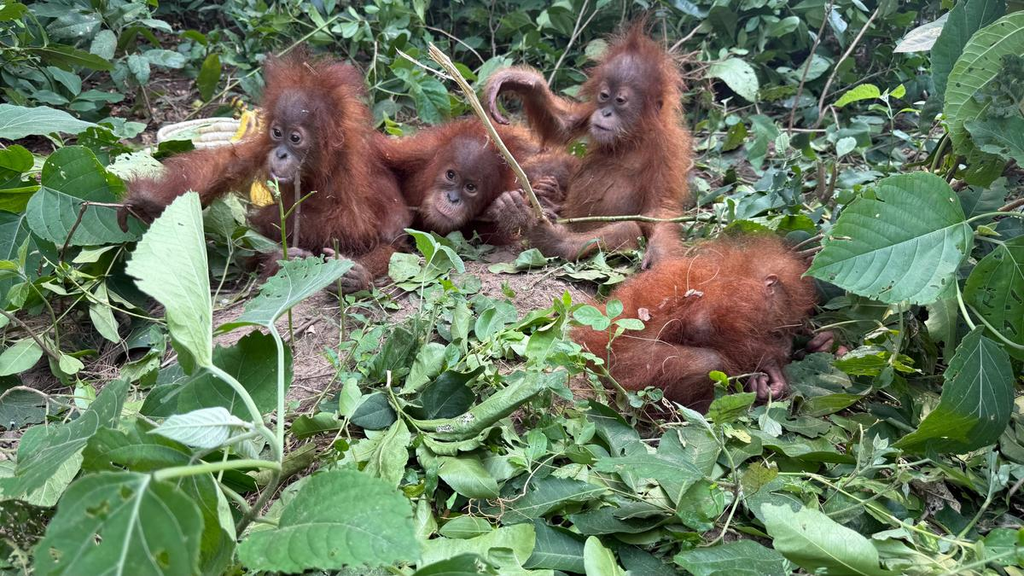
Key Facts About Orangutans:
- Orangutans are great apes, with no tails. They are the only non-human great apes native to Asia and the world’s largest predominantly tree-dwelling mammals.
- Name: “Orangutan” means “person of the forest” in Malay.
- Appearance: Reddish-brown hair, long arms and grasping hands and feet adapted to life in trees.
- Habitat: Tropical rainforests, including lowland, peat-swamp and hill forests.
- They are native to the rainforests of Indonesia and Malaysia. They are now found only in parts of Borneo and Sumatra. Three Species exist: Bornean orangutan, Sumatran orangutan and Tapanuli orangutan.
Behavioural Traits:
- Predominantly arboreal and diurnal: They spend much of their time in trees and are active during the day.
- Semi-solitary: Adult males generally range alone; the strongest social bond is between a mother and her dependent offspring.
- Intelligent tool users: They use sticks to catch insects or extract food and learn survival skills by observing others.
- Nest builders: They construct sleeping nests from branches and leaves in trees.
- Primarily fruit-eating: Fruits dominate their diet, supplemented by leaves, bark and insects.
- Prolonged maternal care: Young remain dependent on their mothers for several years, learning feeding, climbing and nest-building skills.
- Slow reproduction: Females generally produce one infant at a time, with births often spaced seven to nine years apart, which slows population recovery.
Ecological Importance, Major Threats and Conservation status:
- Ecological Importance: Orangutans disperse seeds through their fruit-rich diet, helping forest regeneration. Protecting their habitat also conserves tropical forest biodiversity and carbon stocks.
- Major Threats: Their principal threats include habitat loss, fragmentation, Illegal pet trade, hunting and conflict, forest fires, and slow population recovery.
- Protection Status:
- IUCN Red List: All three species are Critically Endangered, indicating an extremely high risk of extinction in the wild.
- CITES: Appendix I
- Wildlife (Protection) Act, 1972: Schedule IV (the schedule covering CITES-listed specimens under the amended Act)
Non-native endangered animals found in India warrant investigation of transboundary wildlife crime, international supply chains and domestic buyers. These animals should not be released into Indian forests; placement or repatriation must consider species identity, health, provenance and suitable habitat.
UPSC PYQ 2023
Q. Which one of the following makes a tool with a stick to scrape insects from a hole in a tree or a log of wood?
(a) Fishing cat
(b) Orangutan
(c) Otter
(d) Sloth bear
Answer: (b) Orangutan
UPSC Prelims Practice MCQ:
Q. With reference to orangutans, consider the following statements:
1. Their natural distribution is restricted to the islands of Borneo and Sumatra.
2. They are predominantly arboreal and build nests in trees.
3. Females generally give birth every year.
How many of the above statements are correct?
(a) Only one
(b) Only two
(c) All three
(d) None
Answer: (b) Only two
- Statement 1 is correct: Wild orangutans occur in Borneo and Sumatra, in parts of Indonesia and Malaysia.
- Statement 2 is correct: They spend much of their lives in trees and construct sleeping nests.
- Statement 3 is incorrect: Births are typically separated by several years, often around seven to nine years, making recovery from hunting and habitat loss slow.
Tell Google you want more of this.
Add Anantam IAS as a preferred sourceOne tap, and this site shows up more often in your own Top Stories, AI Overviews and AI Mode. Remove it any time.