Amrit Bharat Station Scheme: Reimagining India’s Railway Stations
Why in News?
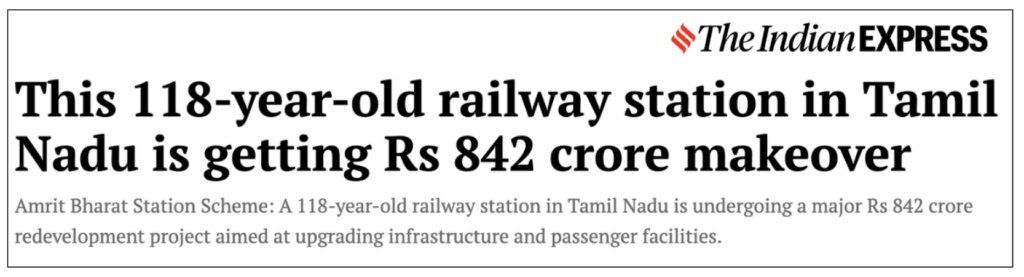
118-year-old Chennai Egmore railway station is getting a Rs 842-crore makeover, with a new multi-level parking block already opened and arrival-departure concourses under construction on both sides of the station. The terminal building, opened on 11 June 1908, is being upgraded while its heritage facade is retained.
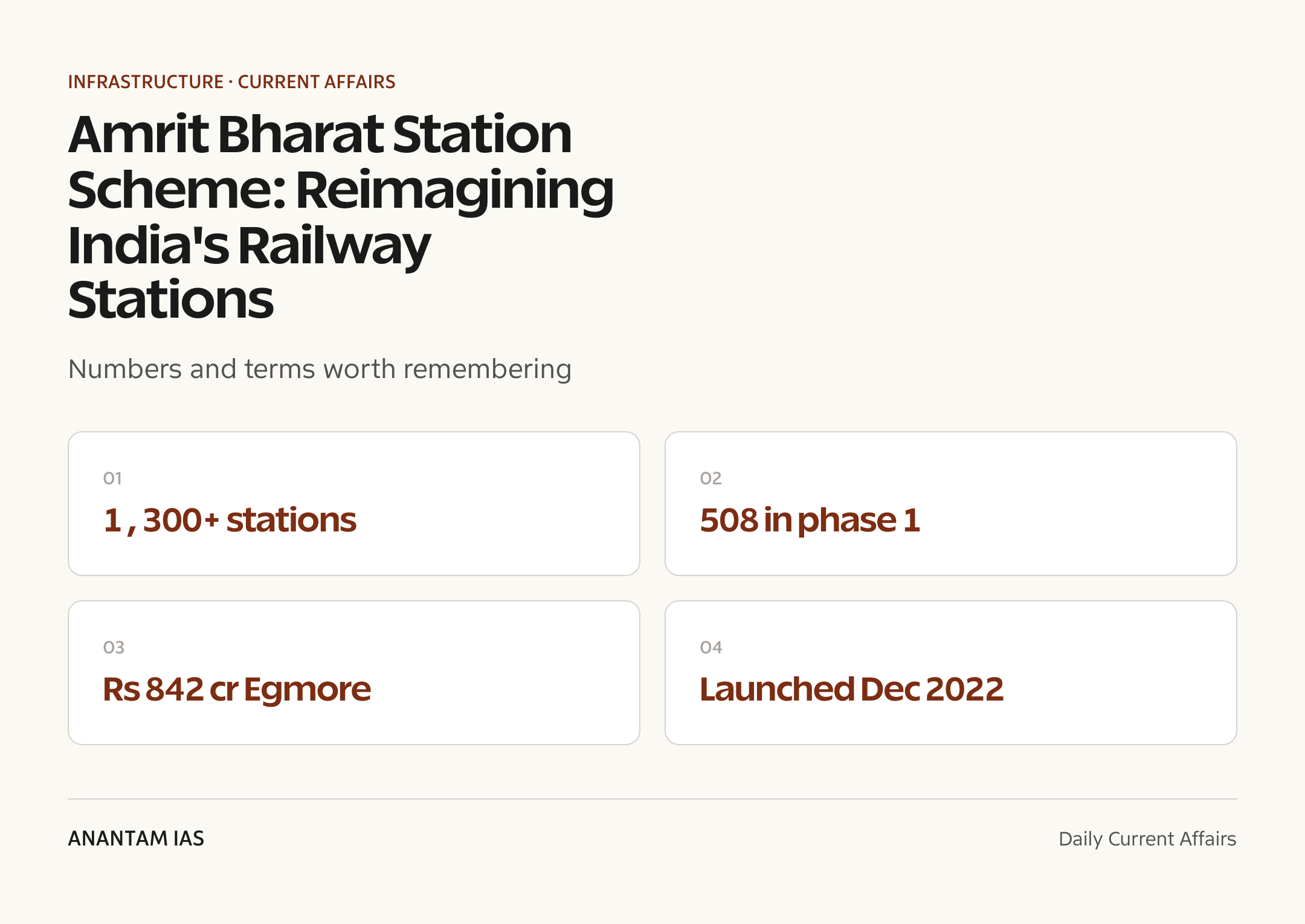
Egmore is one of more than 1,300 stations being rebuilt under the Amrit Bharat Station Scheme (ABSS), the Ministry of Railways’ flagship station-redevelopment programme that turns ageing stations into modern, accessible, multimodal hubs and long-term city centres.
- Project cost pegged at Rs 842 crore, with a target completion window of about 36 months.
- Scope includes G+3 station buildings on the Gandhi-Irwin and Poonamallee Road sides, new concourses, foot-over-bridges and a multi-level car park.
- Total built-up area of roughly 1,35,400 sq m, integrating the station with the city on both sides.
- ABSS was launched by the Ministry of Railways in 2022; foundation stones for the first 508 stations were laid in August 2023.
- The heritage Egmore terminal facade is conserved even as the precinct is rebuilt as a transport hub.
The development matters in the context of:
- Why this matters for urban mobility: stations are being reimagined as multimodal interchanges linking rail, metro, bus and last-mile transport.
- Why this matters for heritage: ABSS bundles conservation of colonial-era railway architecture with modern passenger amenities.
- Why this matters for infrastructure financing: large station portfolios raise questions of funding, phasing and asset monetisation.
UPSC Relevance
Prelims Relevance:
- Amrit Bharat Station Scheme was launched in 2022 by the Ministry of Railways. It is a long-term plan to improve railway stations across India in a step-by-step manner. Under this scheme, detailed plans are made for each station and the work is done in phases, based on what each station needs.
- First phase: 508 stations, foundation stones laid in 2023
- Overall coverage: more than 1,300 stations (around 1,309) across all states
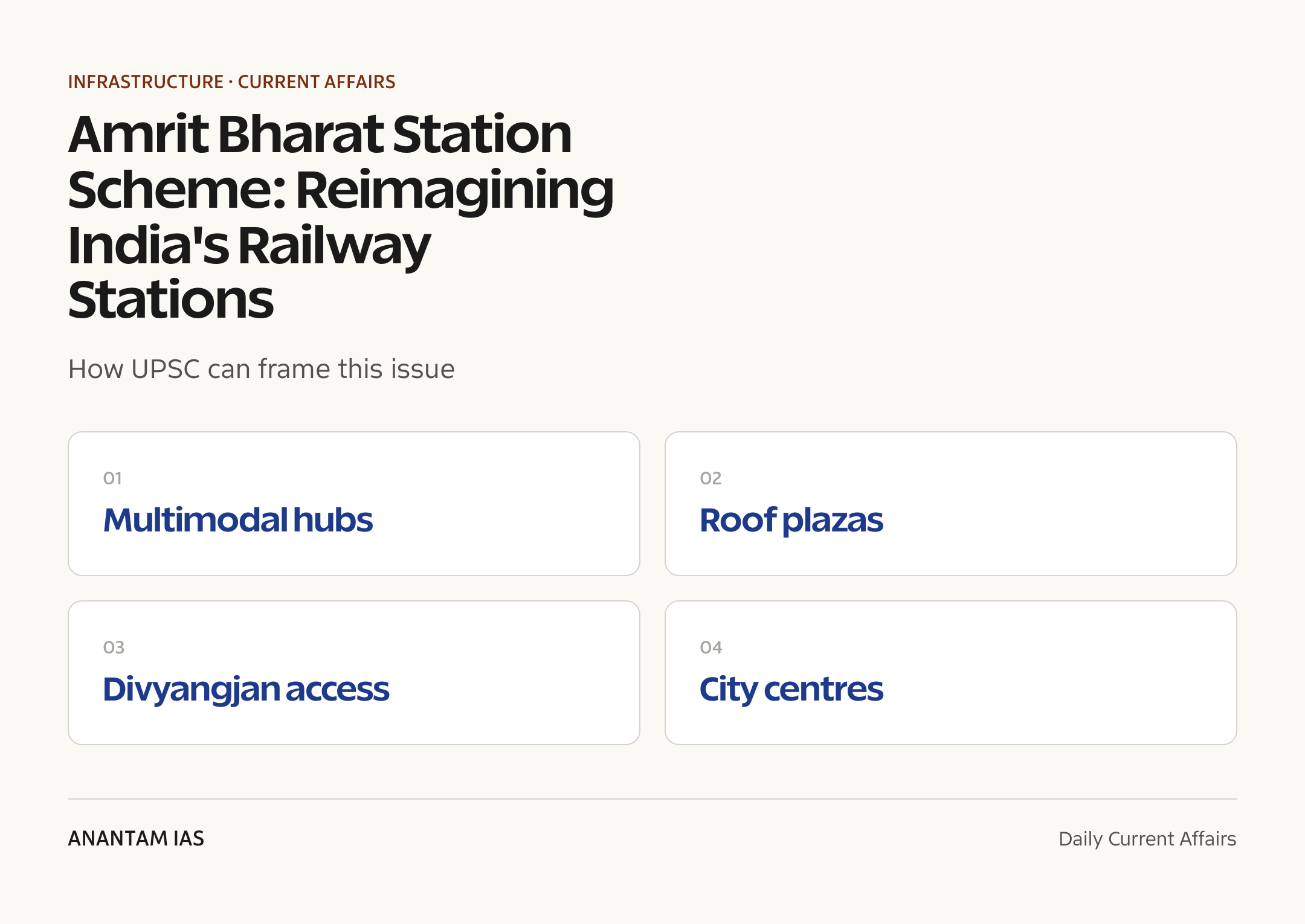
- Core features: roof plazas, city integration on both sides, multimodal integration
- Accessibility: amenities for Divyangjan (persons with disabilities)
- Long-term goal: developing each station as a city centre
- Sustainability: green buildings, ballastless tracks, energy-efficient design
- Chennai Egmore terminal opened on 11 June 1908; revamp cost Rs 842 crore
- ABSS replaces and subsumes earlier station-redevelopment efforts under Indian Railways.
Mains Relevance
GS Paper 3
- Infrastructure: station redevelopment as part of Railway modernisation and the National Infrastructure Pipeline.
- Investment models, financing, and phasing of large public infrastructure portfolios.
GS Paper 1
- Conservation of built heritage (colonial-era railway architecture) amid rapid urban redevelopment.
GS Paper 2
- Inclusive public infrastructure: accessibility and Divyangjan-friendly design as a governance commitment.
Essay
- Infrastructure is the spine of a developing economy; how India rebuilds its stations is a test of that ambition.
- Preserving heritage while modernising: can old and new coexist in India’s public spaces?
Background and Context
What is the Amrit Bharat Station Scheme?
ABSS is the umbrella programme for the continuous, long-term redevelopment of India’s railway stations.
- Launched by the Ministry of Railways in December 2022, it consolidated earlier station-upgrade schemes into a single framework and sits within the broader story of Indian Railways reform.
- It covers more than 1,300 stations (about 1,309) selected across every state, ranging from major terminals to district-level junctions.
- The first tranche of 508 stations began with the laying of foundation stones by the Prime Minister in 2023.
- It follows a master-planning approach: stations are upgraded in phases based on feasibility and footfall rather than a single big-bang rebuild, complementing the network-wide planning logic of PM Gati Shakti.
Core design principles
The scheme rethinks a station as a public hub, not merely a place to board trains.
- Roof plazas over the tracks create air-conditioned waiting concourses, retail, food courts and kids’ play areas.
- Multimodal integration links the station to metro, city bus, auto and taxi stands for seamless last-mile transfer.
- Stations are connected to the city on both sides, opening up access and easing congestion at a single entrance.
- Aesthetic facades, landscaping and improved signage aim for a consistent, world-class look.
- Each station is envisaged as a future city centre with commercial and civic activity around it.
Accessibility and sustainability
Inclusive, green design is built into the brief, not bolted on.
- Dedicated amenities for Divyangjan include ramps, tactile paths, accessible toilets and lifts.
- Wider concourses, escalators and clearer wayfinding improve flow for the elderly and for families.
- Energy-efficient lighting, water recycling and green-building norms target a lower operating footprint.
- Ballastless tracks at upgraded stations reduce maintenance and improve ride quality.
Chennai Egmore: the news hook
The Egmore makeover shows how a heritage terminal is being folded into the scheme.
- The terminal building opened on 11 June 1908, making it about 118 years old, and is a recognised piece of colonial railway architecture.
- Redevelopment cost at Rs 842 crore, with a multi-level car park already commissioned.
- New G+3 station buildings are rising on both the Gandhi-Irwin Road and Poonamallee Road sides, with separate arrival and departure concourses.
- Built-up area of roughly 1,35,400 sq m is being added while the historic facade is conserved.
- It demonstrates the ABSS balance: modern hub functionality wrapped around a protected heritage shell.
Heritage conservation in railway architecture
India’s stations are among its most-used heritage assets, and ABSS treats them as such.
- Terminals like Egmore, Chhatrapati Shivaji Maharaj Terminus in Mumbai and others embody Indo-Saracenic and Victorian styles.
- The scheme’s brief retains and restores heritage facades rather than demolishing them.
- Conservation keeps living heritage in active public use, blending old frontages with new concourses behind.
- It signals a shift from purely functional upgrades toward an identity-aware redevelopment of public space.
Financing and the bigger picture
Rebuilding 1,300-plus stations is a long, capital-heavy commitment.
- The first 508 stations alone carried a combined outlay of over Rs 24,470 crore.
- Station redevelopment sits within wider Railway modernisation and the National Infrastructure Pipeline.
- Commercial development of station land and air rights is one avenue to part-fund the rebuilds, echoing the asset-monetisation debate around the National Monetisation Pipeline.
- Phasing, contractor capacity and timely completion remain the practical challenges across such a large portfolio.
Way Forward
Deliver on time and on budget
- Tighten project monitoring so flagship rebuilds like Egmore meet their 36-month windows without cost overruns.
- Build contractor and design capacity to run hundreds of station projects in parallel.
Make multimodal real
- Co-plan station redevelopment with state metro, bus and city-transport agencies so the multimodal promise is physical, not notional.
- Integrate fare, ticketing and pedestrian links across modes at the redeveloped hub.
Conserve while modernising
- Embed heritage experts in the design loop wherever a station has architectural value.
- Treat the city centre vision as an opportunity for inclusive, well-regulated commercial use, not just retail.
Conclusion
The Rs 842-crore Chennai Egmore rebuild is a single, visible instance of a much larger bet: the Amrit Bharat Station Scheme aims to convert more than 1,300 ageing stations into modern, accessible, multimodal hubs that double as city centres.
Its success will be judged less by glossy roof plazas than by on-time delivery, genuine multimodal connectivity and the care with which heritage facades like Egmore’s are preserved. For UPSC, ABSS is a clean case study in linking infrastructure modernisation, urban mobility, accessibility and heritage in one programme.
UPSC Practice Questions
Prelims MCQ 1
With reference to the Amrit Bharat Station Scheme (ABSS), consider the following statements:
- It is implemented by the Ministry of Railways.
- It covers more than 1,300 railway stations across India.
- It mandates amenities for Divyangjan and roof plazas as part of its design brief.
How many of the above statements are correct?
(a) Only one (b) Only two (c) All three (d) None
Answer: (c) All three
Explanation:
ABSS is a Ministry of Railways scheme covering 1,300-plus stations, with Divyangjan amenities, multimodal integration and roof plazas built into its design principles. All three statements are correct.
Prelims MCQ 2
The Amrit Bharat Station Scheme is most directly associated with which sector?
(a) Rural drinking-water supply
(b) Railway station redevelopment
(c) Urban housing for the poor
(d) Renewable-energy generation
Answer: (b) Railway station redevelopment
Explanation:
ABSS, launched in December 2022, is the Ministry of Railways’ programme for redeveloping railway stations into modern multimodal hubs; the other options are unrelated schemes.
UPSC Mains Questions
- The Amrit Bharat Station Scheme reimagines railway stations as city centres rather than mere transit points. Examine its design principles and the challenges in delivering such a large station-redevelopment portfolio on time. (250 words)
- Modernising public infrastructure often collides with the need to preserve built heritage. Using the redevelopment of heritage railway terminals as an example, discuss how India can balance the two. (250 words)
- Discuss the role of multimodal integration in India’s urban mobility, drawing on recent railway station-redevelopment efforts. (150 words)
Sources: Indian Express and PIB, Ministry of Railways.
Frequently Asked Questions
What is the Amrit Bharat Station Scheme?
It is the Ministry of Railways’ flagship programme, launched in December 2022, to redevelop railway stations across India. It reimagines stations as modern, accessible, multimodal hubs with roof plazas, improved facades and city integration on both sides, and aims to develop them as long-term city centres.
How many stations does ABSS cover?
ABSS covers more than 1,300 stations (about 1,309) selected across every state. The first phase of 508 stations began in August 2023, when foundation stones were laid, and work has since extended to many more stations in subsequent phases.
Why is Chennai Egmore in the news?
Indian Express reported a Rs 842-crore makeover of the 118-year-old Chennai Egmore station under ABSS. A multi-level car park has opened, and new G+3 buildings with concourses are being built on both sides while the heritage facade is conserved.
What are the core features of ABSS?
Key features include roof plazas over the tracks, multimodal integration with metro and bus, connection to the city on both sides, amenities for Divyangjan, energy-efficient green buildings, ballastless tracks and a long-term plan to turn each station into a city centre.
How is heritage handled under the scheme?
Where a station has architectural value, the scheme retains and restores its heritage facade rather than demolishing it. New concourses and buildings rise behind or beside the historic frontage, keeping living heritage like the Egmore terminal in active public use.
Who funds and builds these stations?
Indian Railways funds the redevelopment, with the first 508 stations alone carrying an outlay of over Rs 24,470 crore. Work is executed by appointed contractors under master plans, and commercial use of station land and air rights is one avenue to part-fund the rebuilds.