Whether India grows at seven per cent or stalls at five often comes down to something unglamorous: whether the road, the rail line, the port and the power grid are ready before the demand arrives. Infrastructure is what lets labour and capital actually combine into output. Get it right and factories run, freight moves cheap, and cities work. Get it wrong and the whole economy pays a quiet tax on every transaction.
That’s why India’s headline ambitions — a developed economy by 2047, a far larger manufacturing base, cities that can absorb tens of millions more people — all rest on one build-out. The National Infrastructure Pipeline is the umbrella that organises it, and around it sits a whole machinery of newer institutions: PM GatiShakti to coordinate, the National Logistics Policy to cut costs, the National Monetisation Pipeline to recycle capital, and NaBFID to lend long. For UPSC GS Paper 3, the trick is to see how these pieces fit together — and to be honest about why the build-out still runs behind schedule.
Why Infrastructure Is the Binding Constraint
Start with the size of the problem, because it explains everything that follows. India is trying to do in a few decades what richer countries spread over a century: house a population that’s still urbanising, electrify and connect it, and move its goods cheaply enough to compete in world markets. The Economic Survey has pegged India’s infrastructure investment need at around 4.5 trillion dollars by 2040 just to sustain high growth. That’s not a wish list. It’s the cost of not falling behind.
Three pressures make the bill non-negotiable. The first is urbanisation. The World Bank expects India’s urban share to climb from roughly a third of the population today toward 40 per cent and beyond over the coming decades, and every percentage point means more housing, water, sanitation, transport and digital capacity to build. The second is the demographic window. India’s working-age share is still rising, and that dividend only pays out if those workers have the roads, power and connectivity to be productive — otherwise a young population becomes a liability, not an asset. The third is climate. Heatwaves, urban flooding and fiercer cyclones now make resilience a design requirement, not an afterthought, which is partly why India anchored the Coalition for Disaster Resilient Infrastructure in 2019.
And here’s the catch that makes infrastructure a uniquely hard public-finance problem. These assets cost enormous sums up front, take years to build, and only repay over decades. A highway or a metro line is a multi-year bet whose returns trickle in slowly and unevenly. So the question is never just “what to build” — it’s “who pays, over what horizon, and who carries the risk while the asset is half-finished and earning nothing.” That financing puzzle is the thread running through everything below.
The Pipeline and the Money Behind It
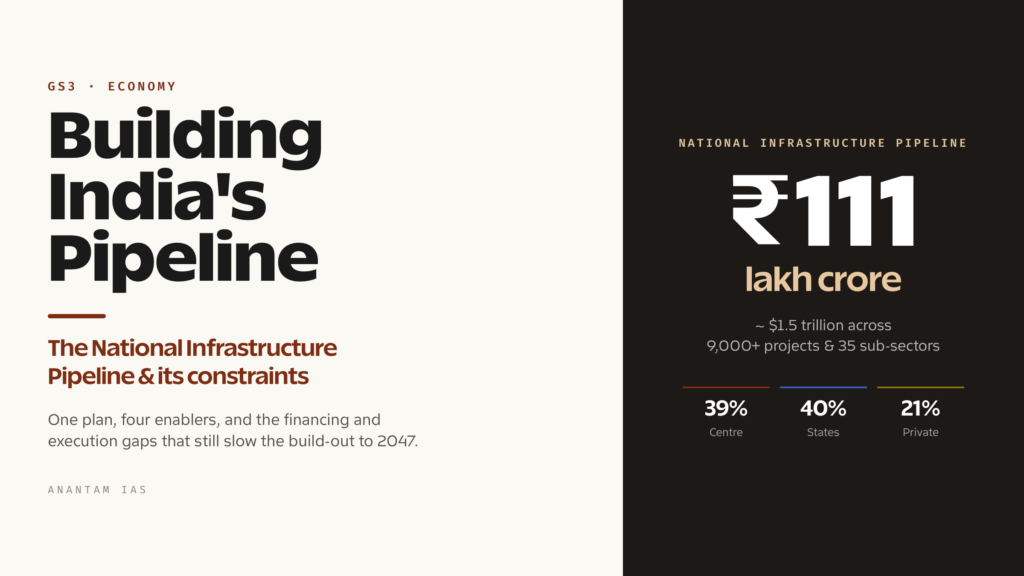
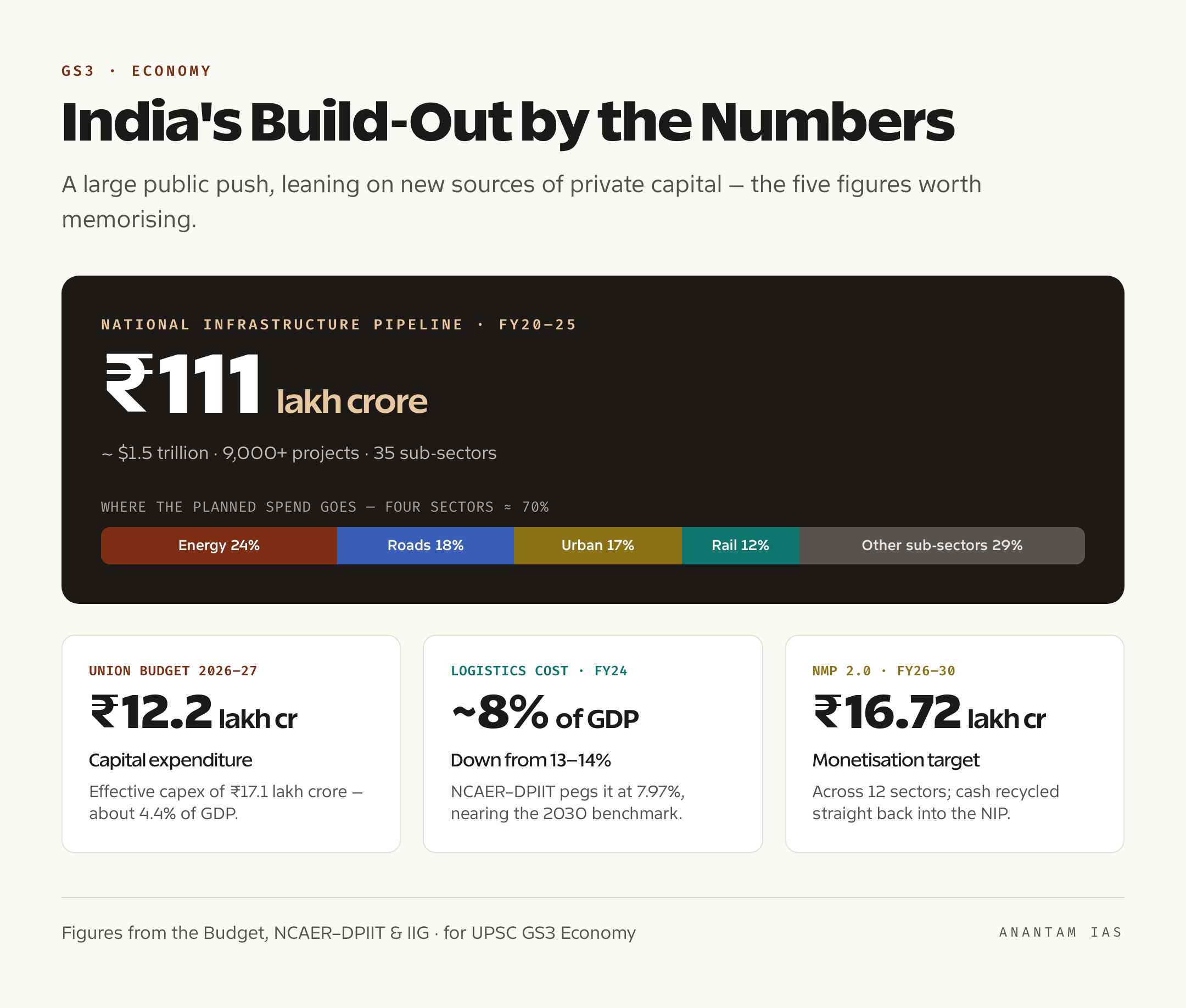
The National Infrastructure Pipeline, launched in 2019 on the recommendation of a task force chaired by Atanu Chakraborty, was the government’s answer to a long-standing complaint: that India built infrastructure project by project, with no single view of what was coming. The NIP changed that by aggregating projects worth about Rs 111 lakh crore — roughly 1.5 trillion dollars — for the FY20-25 period, spanning more than 9,000 projects across 35 infrastructure sub-sectors. Energy takes the largest slice at about 24 per cent, followed by roads at 18 per cent, urban infrastructure at 17 per cent and railways at 12 per cent — so four sectors alone account for around seven-tenths of the planned spend.
The money was meant to come from three pockets in near-equal measure. The original split had the Centre funding about 39 per cent, the states about 40 per cent, and the private sector the remaining 21 per cent or so. That last figure matters, because it’s where the plan has consistently struggled — more on that below. On the public side, the government has leaned hard into capital expenditure. The Union Budget for 2025-26 set capex at Rs 11.21 lakh crore, about 4.3 per cent of GDP, and the 2026-27 Budget pushed it further to Rs 12.2 lakh crore, with effective capital expenditure — adding the grants that states spend on assets — reaching Rs 17.1 lakh crore, or roughly 4.4 per cent of GDP. The Centre has also kept up a 50-year interest-free loan window of around Rs 1.5 lakh crore to nudge states into building too.
So the public engine is firing. But a pipeline of Rs 111 lakh crore can’t run on Budget money alone — the maths simply doesn’t add up, and that’s by design. The plan always assumed a fourth pocket: innovative financing that recycles capital already locked in completed public assets and channels long-term debt into new ones. That’s where the rest of the institutional stack comes in.
How the Institutional Stack Fits Together
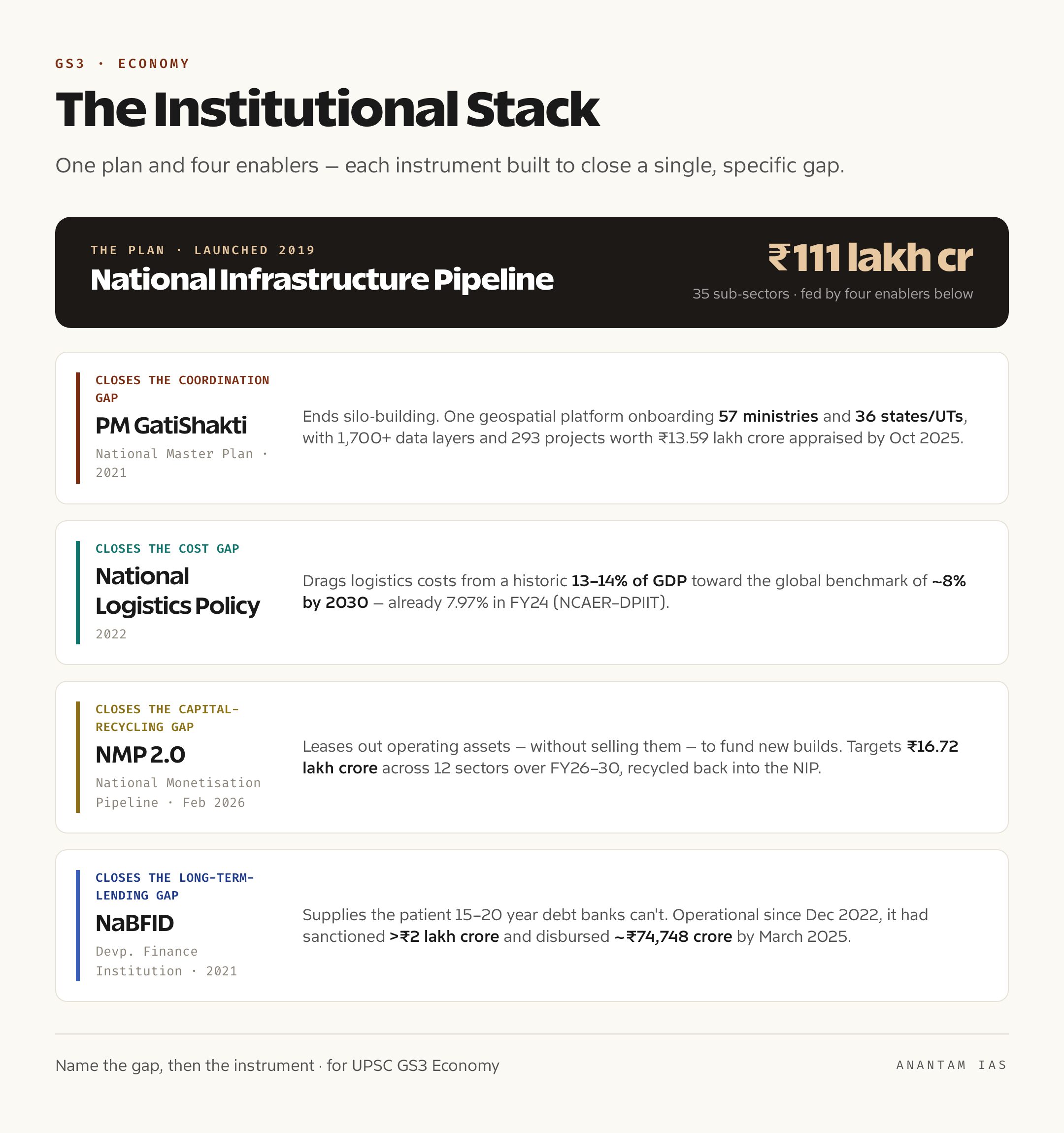
The pieces look like an alphabet soup of schemes, but each was built to close one specific gap, and they only make sense as a set.
PM GatiShakti, the National Master Plan launched in 2021, fixes the coordination gap. For decades, ministries built in silos — a port came up without the rail line to evacuate its cargo, a highway crossed a power corridor nobody had mapped, and approvals crawled because no single agency could see the whole picture. GatiShakti puts everything on one geospatial platform. By its fourth anniversary in October 2025, it had onboarded 57 central ministries and departments and 36 states and union territories, integrated more than 1,700 data layers, and run 293 large projects worth about Rs 13.59 lakh crore through its Network Planning Group for integrated appraisal. The point isn’t the map; it’s that clearances and intermodal links that once took months can now be planned in days.
The National Logistics Policy of 2022 attacks the cost gap. India’s logistics bill has historically run high — long quoted at 13 to 14 per cent of GDP, against single-digit levels in advanced economies — which is a hidden tax on every exporter and manufacturer. The policy, working alongside GatiShakti and the dedicated freight corridors, aims to drag that down toward the global benchmark of around 8 per cent by 2030. The progress is real: the first comprehensive NCAER-DPIIT assessment pegged India’s logistics cost at about 7.97 per cent of GDP for FY24, and the road transport ministry has talked of reaching single digits sustainably. Cheaper logistics is, in effect, infrastructure paying for itself in competitiveness.
The National Monetisation Pipeline closes the capital-recycling gap — the idea that the government shouldn’t leave value frozen in operating assets when that capital could build new ones. NMP 1.0, covering FY22-25, targeted about Rs 6 lakh crore by leasing out operating roads, railway lines, power transmission and the like to private operators for a fixed term, without selling the underlying asset — and it achieved close to 90 per cent of that target. The Finance Minister launched NMP 2.0 in February 2026, raising the ambition sharply to about Rs 16.72 lakh crore from 12 sectors over FY26-30, with highways, power, railways and ports the biggest contributors. Crucially, the cash raised is meant to flow straight back into the NIP.
And NaBFID — the National Bank for Financing Infrastructure and Development — fills the long-term-lending gap. Infrastructure needs patient debt of 15 to 20 years, but Indian banks fund themselves with short deposits, creating an asset-liability mismatch that left them burned after the lending boom of the late 2000s. Set up in 2021 as a dedicated development finance institution and operational since December 2022, NaBFID had sanctioned over Rs 2 lakh crore and disbursed about Rs 74,748 crore to infrastructure projects by March 2025, with its quarterly disbursements more than doubling year on year. It’s the institution India dismantled in the 2000s, rebuilt for a market that still can’t supply long debt on its own.
The Constraints That Slow It All Down
A plan this large meets the same hard ground every Indian infrastructure project has met for thirty years. Naming the constraints precisely is what separates a strong Mains answer from a generic one.
The deepest constraint is the financing mismatch I keep returning to. Projects with 20-year payoffs are still funded largely by banks built for short-term lending, the corporate bond market remains too shallow to absorb infrastructure paper at scale, and patient pools like insurance and pension funds allocate only a small share — by some estimates around 6 per cent — to the sector. That’s exactly the hole NaBFID, InvITs and bond-market reform are trying to plug, but the gap is still wide.
The second is the weak private appetite, and its history matters. The PPP boom of the mid-2000s collapsed after 2012 under stalled projects, stranded loans and a wave of disputes — the era that left banks with bad infrastructure debt. The Kelkar Committee diagnosed the wreckage in 2015 and warned, among other things, that more than half of PPP projects end up in renegotiation, which scares off serious private capital. Confidence has been slow to rebuild, which is why the 2026-27 Budget proposed a new Infrastructure Risk Guarantee Fund to absorb some of the risk private developers fear most.
The third cluster is execution on the ground. Land acquisition remains the single most common reason projects slip, tangled in title disputes, compensation fights and clearance backlogs. Environmental and forest clearances add their own delays. And the result shows up in the data: by mid-2025, government monitoring found hundreds of large central-sector projects running behind, with cumulative cost overruns of the order of Rs 5.7 lakh crore — roughly a fifth above original estimates — and average delays running into years. A pipeline is only as good as the rate at which projects actually leave it.
The fourth is dispute resolution and contract enforcement. Infrastructure contracts are long and complex, and India’s arbitration and judicial processes are slow enough that a single dispute can freeze a project for years, locking up capital and deterring the next bidder. The fifth is state capacity: states fund about 40 per cent of the NIP, but their ability to prepare bankable projects, manage contracts and maintain assets varies enormously, so the pipeline moves at the speed of its slowest implementers. And running underneath it all is the maintenance deficit — India is far better at cutting ribbons than at funding the unglamorous operations and upkeep that keep an asset alive, so hard-won capacity erodes faster than it should.
The Way Forward
The honest lesson of the last decade is that the binding constraint has shifted from planning to execution and financing. The pipeline exists; the coordination platform exists; the instruments exist. The work now is making them bite.
On financing, that means deepening the corporate bond market and the InvIT ecosystem so long-term debt doesn’t depend on stretched bank balance sheets, scaling NaBFID’s lending and credit-enhancement role, and pulling insurance and pension money into infrastructure with the right risk-sharing — the new Infrastructure Risk Guarantee Fund is a step in that direction. On private participation, it means honouring the spirit of the Kelkar reforms: fairer risk-sharing, faster and more credible dispute resolution, and renegotiation rules that are predictable rather than ad hoc, so capital that left after 2012 is willing to return.
On execution, the priorities are blunt and familiar — streamline land acquisition, use GatiShakti to compress clearances rather than just to map them, and build state-level project-preparation capacity so the pipeline doesn’t choke at the bottleneck of weak implementers. And on protecting what’s already built, the shift has to be toward genuine operations-and-maintenance budgets, asset monetisation that funds new capacity through NMP 2.0, and climate-proofing assets from the design stage. The era of judging success by the size of the pipeline is ending. The next test is throughput: how fast, how cheaply, and how durably India can turn that pipeline into working assets.
For Your Mains Answer
Infrastructure is a workhorse topic that sits squarely in GS Paper 3 under infrastructure, investment models and the mobilisation of resources, with a clear overlap into GS Paper 2 on government policies and their design and implementation. It also feeds Essay prompts on growth, the costs of delay, and the state-versus-market balance in development. Examiners reward candidates who treat the schemes as a connected system rather than a list, and who can name a constraint and its fix in the same breath.
How to Build the Answer
Open by framing infrastructure as the binding constraint on growth — the up-front cost, long gestation and slow payoff that make financing the core problem. Then lay out the pipeline (NIP, the funding split, the capex push), explain the institutional stack as a set of gap-fillers (GatiShakti for coordination, the Logistics Policy for cost, NMP for capital recycling, NaBFID for long debt), diagnose the constraints honestly, and close with a way forward that pivots from “planning” to “execution and financing.” The arc — frame, map, diagnose, prescribe — fits almost any infrastructure prompt.
Common Mistakes to Avoid
Don’t recite scheme names without linking each to the specific gap it closes — that’s the difference between a topper’s answer and an average one. Don’t ignore the post-2012 PPP collapse; it’s the historical reason private appetite is weak. Don’t quote the logistics figure as still stuck at 13-14 per cent — flag that it has fallen toward 8 per cent, since using stale data signals you haven’t read recently. And don’t end on pipeline size; the mature point is that execution and financing, not planning, are now the binding constraints.
A Compact Answer Spine
Infrastructure as the binding constraint (high cost, long gestation, slow payoff) → the NIP (Rs 111 lakh crore, 35 sub-sectors, the 39:40:21 funding split, the Rs 12.2 lakh crore capex push) → the institutional stack (GatiShakti, National Logistics Policy, NMP 2.0, NaBFID, each closing a gap) → constraints (financing mismatch, weak PPP appetite post-2012, land and clearances, stalled projects, dispute resolution, state capacity, maintenance deficit) → way forward (deepen bond and InvIT markets, risk-sharing for PPPs, faster dispute resolution, GatiShakti-led clearances, O&M and climate-proofing).
Diagram or Flowchart Idea
Draw a simple central box labelled “National Infrastructure Pipeline — Rs 111 lakh crore” with four arrows feeding into it: GatiShakti (coordination), National Logistics Policy (cost), NMP 2.0 (capital recycling) and NaBFID (long-term debt). A clean “one plan, four enablers” diagram shows the system at a glance and earns marks fast.
A Balanced-Conclusion Line
Something like: “India has solved the easy half of the infrastructure problem — it now has a pipeline, a coordinator and the right financing instruments; the harder half, turning that plan into assets quickly, cheaply and durably, will decide whether infrastructure carries the 2047 ambition or quietly caps it.”
How to Use Data Without Cramming
You need only a handful of anchors, each with its source named in the sentence. Memorise five: the NIP at Rs 111 lakh crore across 35 sub-sectors; capex of Rs 12.2 lakh crore in the 2026-27 Budget; logistics cost down to roughly 8 per cent of GDP (NCAER-DPIIT); NMP 2.0 targeting about Rs 16.72 lakh crore by FY30; and NaBFID disbursing close to Rs 75,000 crore by March 2025. Name the source, state the figure, and move on — five precise numbers beat fifteen vague ones.
FAQ
What is the National Infrastructure Pipeline (NIP)? The NIP is an umbrella framework launched in 2019, on the recommendation of the Atanu Chakraborty task force, that aggregates infrastructure projects worth about Rs 111 lakh crore across more than 9,000 projects and 35 sub-sectors for the FY20-25 period. Energy, roads, urban infrastructure and railways account for the bulk of the planned spend, and funding was meant to be split roughly between the Centre (39 per cent), the states (40 per cent) and the private sector (21 per cent).
How do PM GatiShakti, NMP and NaBFID relate to the NIP? They each close a different gap in the same build-out. PM GatiShakti is a geospatial platform that coordinates ministries and speeds up clearances. The National Logistics Policy works to cut logistics costs toward 8 per cent of GDP. The National Monetisation Pipeline recycles capital by leasing out operating public assets — NMP 2.0, launched in February 2026, targets about Rs 16.72 lakh crore by FY30 — and NaBFID is a development finance institution set up to supply the long-term debt the project pipeline needs.
What are the main constraints facing Indian infrastructure? The core ones are a financing mismatch (long-payoff projects funded by short-term bank money and a shallow bond market), weak private appetite after the PPP collapse of 2012, slow land acquisition and clearances, a large stock of stalled projects with heavy cost and time overruns, sluggish dispute resolution, uneven state-level capacity, and chronic under-funding of operations and maintenance.
Why did private participation in infrastructure weaken after 2012? The public-private partnership boom of the mid-2000s ran into stalled projects, stranded bank loans and a wave of contract disputes around 2012, leaving banks with bad infrastructure debt and developers wary. The Kelkar Committee of 2015 found that more than half of PPP projects end up in renegotiation, which deters serious investors. Rebuilding that confidence — through fairer risk-sharing, faster dispute resolution and tools like the proposed Infrastructure Risk Guarantee Fund — is central to the way forward.
Practice Questions
Prelims MCQs
- The National Infrastructure Pipeline (NIP) was launched in 2019 on the recommendation of a task force chaired by whom?
(a) Bibek Debroy
(b) Atanu Chakraborty
(c) Vijay Kelkar
(d) Nandan Nilekani
Answer: (b) — The NIP, aggregating projects worth about Rs 111 lakh crore across 35 sub-sectors, was launched on the recommendation of the task force chaired by Atanu Chakraborty. - Consider the following statements about PM GatiShakti:
1. It is a geospatial National Master Plan launched in 2021.
2. Its primary aim is to recycle capital locked in operating public assets.
3. It seeks to close the inter-ministerial coordination gap in infrastructure planning. Which are correct?
(a) 1 and 2 only
(b) 1 and 3 only
(c) 2 and 3 only
(d) 1, 2 and 3
Answer: (b) — GatiShakti is a 2021 geospatial platform that fixes the coordination gap; capital recycling is the job of the National Monetisation Pipeline, not GatiShakti. - The National Monetisation Pipeline (NMP) is best described as a mechanism that does which of the following?
(a) Sells public infrastructure assets outright to private buyers
(b) Leases operating public assets to private operators for a fixed term without selling them
(c) Provides long-term debt to greenfield infrastructure projects
(d) Coordinates clearances across ministries on a single platform
Answer: (b) — NMP leases out operating assets such as roads, railway lines and transmission to private operators for a fixed term, retaining government ownership; the cash raised flows back into the NIP. - With reference to NaBFID, consider the following statements:
1. It is a development finance institution set up to supply long-term debt to infrastructure.
2. It became operational in December 2022.
3. It was created to address the asset-liability mismatch faced by banks lending to infrastructure. Which are correct?
(a) 1 and 2 only
(b) 2 and 3 only
(c) 1 and 3 only
(d) 1, 2 and 3
Answer: (d) — NaBFID, the National Bank for Financing Infrastructure and Development, was set up in 2021 and made operational in December 2022 to provide patient 15-20 year debt and ease the asset-liability mismatch banks face. - As per the NCAER-DPIIT assessment cited for FY24, India’s logistics cost as a share of GDP stood at approximately which level, and what is the targeted benchmark?
(a) About 13-14%, targeting 8% by 2030
(b) About 7.97%, targeting 8% by 2030
(c) About 4.5%, targeting 2% by 2030
(d) About 17%, targeting 10% by 2030
Answer: (b) — The first comprehensive NCAER-DPIIT assessment pegged logistics cost at about 7.97% of GDP for FY24, against the historical 13-14% and the global benchmark of around 8% targeted by 2030.
Mains Practice Questions
- “Infrastructure is the binding constraint on India’s growth, and financing is the core of that constraint.” Critically examine this statement in the context of the National Infrastructure Pipeline. (15 marks, 250 words)
- The institutional stack around the NIP — PM GatiShakti, the National Logistics Policy, NMP 2.0 and NaBFID — is best understood as a set of gap-fillers. Explain the specific gap each instrument is designed to close. (15 marks, 250 words)
- “India has solved the planning problem in infrastructure but not the execution problem.” Discuss the constraints that slow the build-out of the National Infrastructure Pipeline. (15 marks, 250 words)
- Examine why private participation in Indian infrastructure weakened after 2012 and assess the measures proposed to revive it. (10 marks, 150 words)
- Asset monetisation and long-term financing have emerged as central to India’s infrastructure strategy. Evaluate the role of the National Monetisation Pipeline and NaBFID in bridging the infrastructure financing gap. (15 marks, 250 words)
Tell Google you want more of this.
Add Anantam IAS as a preferred sourceOne tap, and this site shows up more often in your own Top Stories, AI Overviews and AI Mode. Remove it any time.