Board a train at Kanyakumari and you can, in theory, stay on rails all the way to Jammu without your feet touching a road. That single fact captures what Indian Railways is: a 167-year-old public utility that still stitches the country together, carrying 741 crore passengers in 2025-26 and more than 1,600 million tonnes of freight a year across the world’s fourth-largest network. It is also among the largest civilian employers anywhere, with a workforce of roughly 12.5 lakh people.
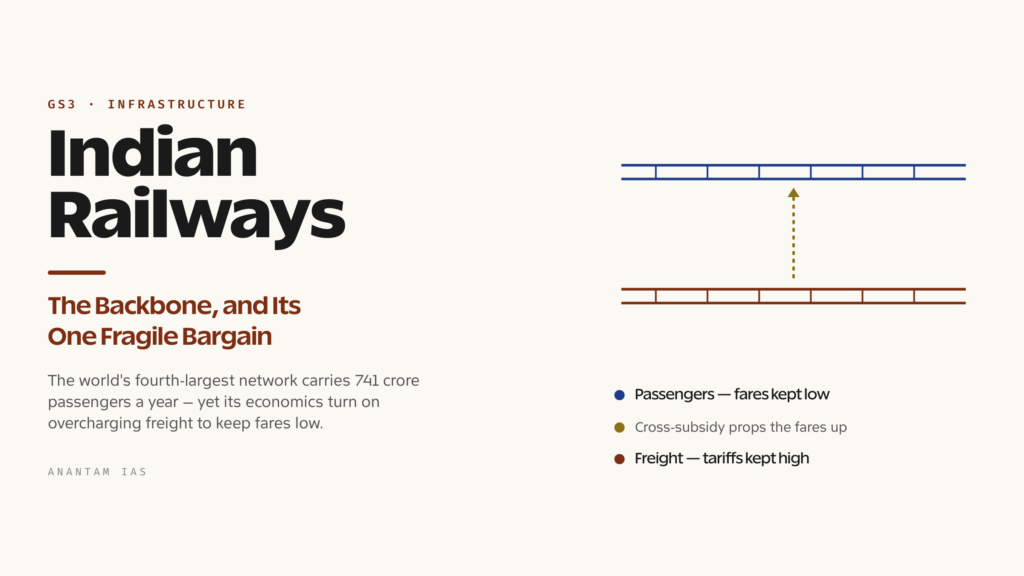
But scale has never been the railways’ problem. Economics has. For decades the system ran on a quiet bargain — keep passenger fares politically low, and recover the loss by overcharging freight. That cross-subsidy slowly pushed paying cargo onto the highways, starved the network of investment, and left safety and capacity to fray. For UPSC General Studies Paper 3, the railways story is where infrastructure, public finance, technology and logistics competitiveness meet, and the past decade has rewritten almost every line of it.
How Big Indian Railways Actually Is
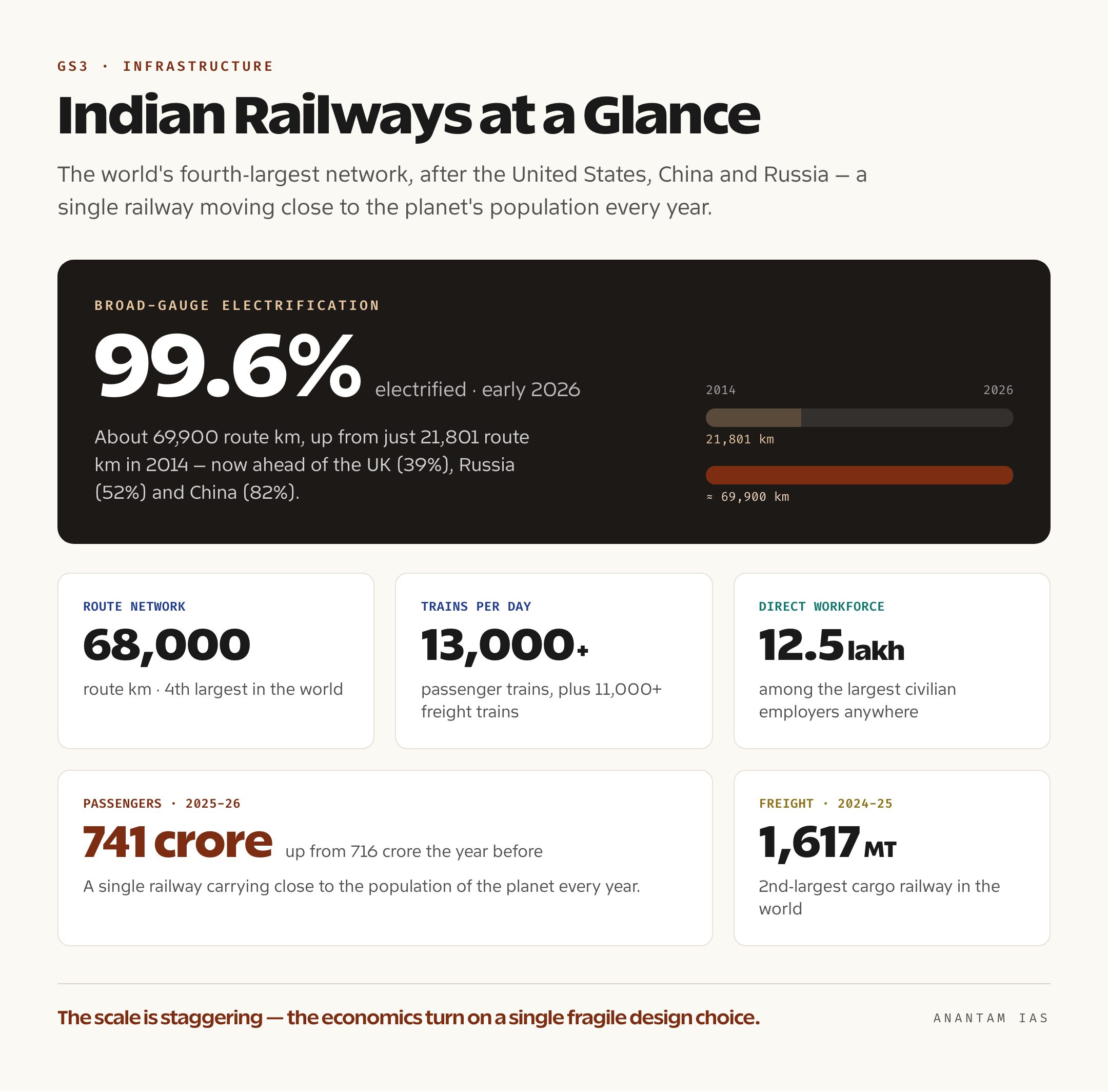
Start with the physical plant, because the numbers are genuinely hard to grasp. The network runs to roughly 68,000 route kilometres, ranking fourth in the world after the United States, China and Russia, and carries more than 13,000 passenger trains and over 11,000 freight trains on an average day. On that infrastructure, Indian Railways moved 741 crore passengers in 2025-26, up from 716 crore the year before — a single railway carrying close to the population of the planet every year.
Freight is the quieter giant. The Railways hauled around 1,617 million tonnes of goods in 2024-25, rising further in 2025-26, which makes it the second-largest cargo-carrying railway in the world. And it does this while employing about 12.5 lakh people directly, a workforce larger than the population of many countries. So when policymakers talk about the railways as the “backbone” of the economy, the metaphor is doing real work: the network touches almost every supply chain, labour market and city in the country.
The decade’s biggest physical change is invisible from a platform but enormous in effect. As of early 2026, about 99.6% of the broad-gauge network — close to 69,900 route kilometres — has been electrified, up from just 21,801 route kilometres in 2014. The Ministry of Railways notes that India is now far ahead of the United Kingdom (around 39%), Russia (52%) and even China (82%) on this measure. Electrification matters beyond engineering pride: it cut diesel use by roughly 180 crore litres and saved close to Rs 6,000 crore in fuel in 2024-25 alone, and it pulls the railways toward its pledge to become a net-zero carbon emitter.
Why the Freight Engine Keeps Stalling
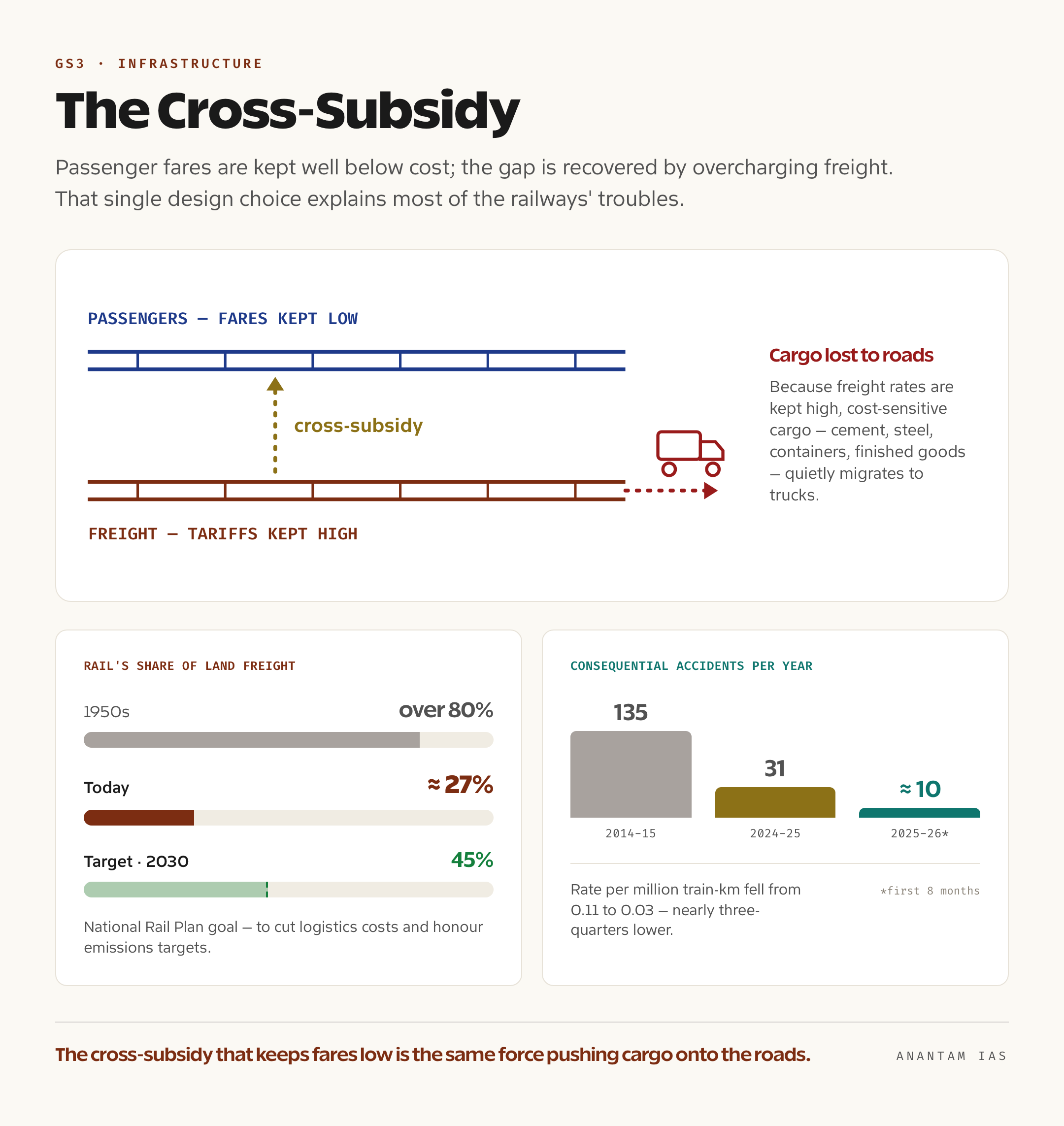
Here is the structural knot at the heart of the system, and it is worth understanding before any reform makes sense. Indian Railways keeps passenger fares well below cost — second-class travel is among the cheapest in the world — and plugs the gap by loading high tariffs onto freight. That single design choice explains most of the railways’ troubles. Because freight rates are kept artificially high to subsidise passengers, cost-sensitive cargo like cement, steel, containers and finished goods quietly migrated to trucks.
The result is a long, damaging slide in what economists call modal share. Rail carried more than 80% of India’s land freight in the 1950s; today it moves only about 27%. Roads now dominate, which is bad for the country on two counts. First, road freight is more expensive per tonne-kilometre over long distances, so a high road share keeps India’s overall logistics costs stubbornly high — a tax on every manufactured good. Second, trucks emit far more carbon than electrified trains, so a falling rail share works directly against India’s climate commitments.
A second weakness compounds the first: the freight basket is dangerously narrow. Coal alone still accounts for nearly half of freight revenue, which means a single commodity — and the pace of the energy transition away from it — can swing the railways’ finances. So the Railways is now actively courting containerised cargo, automobiles, cement and parcel traffic to diversify. The National Rail Plan, the government’s blueprint to 2030, sets the explicit goal of lifting rail’s freight modal share back to 45% by 2030, both to cut logistics costs and to honour emissions targets. Whether that target is met depends almost entirely on whether the next two sections of this story actually deliver.
Building Capacity: Freight Corridors and Faster Trains
So how do you fix a network where passengers and freight fight for the same congested tracks? You build separate roads for them. That is the logic of the Dedicated Freight Corridors (DFCs) — purpose-built, heavy-haul lines that take goods trains off the mixed-traffic routes and let them run faster and heavier.
Two corridors anchor the project. The Eastern DFC, running from Ludhiana in Punjab to Dankuni in West Bengal and carrying mostly coal and steel, was completed in October 2023. The Western DFC, from Dadri near Delhi to the Jawaharlal Nehru Port near Mumbai and built for containers, was commissioned in its final stretch by the close of 2025-26. Together they are designed to shift up to 70% of India’s goods trains off the old network. The effect is already visible in the traffic count: the corridors carried an average of 241 freight trains a day in 2023-24, jumping to 403 a day in 2024-25, with capacity to handle far more. They allow 25-tonne axle loads and freight speeds around 75 kmph — roughly double the crawl on congested mixed lines — which is exactly what is needed to win cargo back from trucks.
On the passenger side, the visible symbols are the new trains. By early 2026 the Railways was running about 162 Vande Bharat semi-high-speed services, with the first Vande Bharat Sleeper entering service on the Kamakhya-Howrah route in January 2026. Alongside them run around 60 Amrit Bharat trains — non-air-conditioned, affordable long-distance services built for migrant and working-class travellers, a deliberate signal that modernisation is not only for the premium segment. Underneath the trains, the stations are being rebuilt: the Amrit Bharat Station Scheme is redeveloping over 1,300 stations into modern transit hubs, and 103 of them were inaugurated together in May 2025. The headline project remains the 508-km Mumbai-Ahmedabad bullet train, India’s first high-speed rail line, being built by the National High Speed Rail Corporation; with civil work past the halfway mark, the first section between Surat and Bilimora is targeted for trial running in the coming period.
Safety, Kavach and the Accident Record
No discussion of the railways survives contact with the public memory of accidents — and the recent record is more encouraging than the headlines suggest. Consequential train accidents have fallen sharply, from 135 in 2014-15 to 31 in 2024-25, and to around 10 in the first eight months of 2025-26. Measured properly, as accidents per million train-kilometres, the rate dropped from 0.11 in 2014-15 to 0.03 in 2024-25, an improvement of nearly three-quarters. Spending on safety has roughly tripled over the decade.
But individual tragedies still puncture that trend, and they reveal the gaps. In June 2024, a freight train rammed the rear of the Kanchanjunga Express near Rangapani in West Bengal, killing about 11 people, with over-speeding and a faulty signal blamed. In January 2025, around 12 passengers who had stepped onto an adjacent track after a false fire alarm on the Pushpak Express near Jalgaon were struck by an oncoming train. Both incidents point to the same fix: a system that prevents human error from becoming catastrophe.
That system is Kavach, India’s indigenous Automatic Train Protection technology, which automatically applies the brakes if a driver passes a danger signal or two trains approach on the same track. The latest Kavach 4.0 has been commissioned across roughly 1,452 route kilometres on the busy Delhi-Mumbai and Delhi-Howrah corridors, and the Railways now aims to add 5,000 to 5,500 kilometres a year, with tenders out to fit the first 10,000 locomotives. Progress has been slower than the original deadlines — limited by a shortage of approved manufacturers — and the Mumbai-Delhi-Howrah rollout has slipped into 2026. The lesson for an answer is that good technology is necessary but not sufficient; execution capacity, vendor depth and timelines decide whether it actually saves lives.
Finances, Reform and the Way Forward
Behind every train sits a balance sheet, and the railways’ finances are best read through one number: the operating ratio, the amount spent to earn every Rs 100. It stood at 98.22% in 2024-25, a whisker better than 98.43% the year before. A ratio that high means the railways spends almost everything it earns just to keep running, leaving precious little to invest from its own pocket. So the capital comes from elsewhere — the Union Budget. The 2025-26 capex was set at about Rs 2.52 lakh crore, roughly nine times the level of a decade earlier, and nearly all of it is now financed by direct budgetary support rather than the railways’ own internal resources.
This is also where the long history of reform thinking matters for UPSC. The Bibek Debroy Committee on railway modernisation argued for separating the railways’ policymaking, regulatory and operational roles, creating an independent rail regulator to set tariffs, moving to commercial accounting so true costs become visible, focusing on the core job of running trains while divesting peripheral activities like schools and hospitals, and opening select segments to private operators. The Anil Kakodkar Committee on safety, written years before recent accidents, had already called for heavy investment in track renewal, the end of unmanned level crossings, and modern train-protection systems — effectively the case for Kavach. The reform agenda also folded the separate Railway Budget into the Union Budget in 2017, ending a 92-year-old colonial practice and freeing the railways from annual fare populism.
So what should the way forward look like? Finish and extend the freight corridors so rail can genuinely win cargo back and lift modal share toward the 45% target. Rebalance the fare structure gradually — narrowing the cross-subsidy and raising non-fare revenue from station commercialisation and land monetisation — so passengers pay a fairer share without political shock. Complete Kavach across the high-density network on a realistic timeline. Diversify freight away from coal. And, eventually, give the regulator real teeth so tariffs reflect costs rather than politics. The railways has spent a decade rebuilding its hardware; the harder, unfinished reform is the software of pricing, accounting and governance.
For Your Mains Answer
Indian Railways is a reliable, recurring theme in GS Paper 3 under infrastructure, investment models and the role of the public sector in growth. It also feeds GS Paper 3 economy questions on logistics cost, energy transition and Centre-state finance, and supplies ready data for Essay answers on infrastructure or sustainable development. Treat the railways as a case study in how a legacy public enterprise reforms itself — that framing scores higher than a list of schemes.
How to Build the Answer
Open with scale and significance, not schemes — the fourth-largest network, 741 crore passengers, the cross-subsidy. Then diagnose the core problem (declining freight modal share driven by the freight-passenger cross-subsidy and under-investment) before describing the response (DFCs, electrification, Kavach, finance reform). Close with a calibrated way forward. The arc — significance, structural problem, reforms, balanced outlook — fits almost any railways question.
Common Mistakes to Avoid
Don’t reduce the answer to a parade of train names. Vande Bharat and bullet trains are symbols; the substance is freight, finance and safety. Don’t claim accidents are “rising” — the consequential-accident rate has fallen sharply, even if individual tragedies continue. And don’t ignore the cross-subsidy; it is the single idea that explains the most.
A Compact Answer Spine
Fourth-largest network, 741 crore passengers, 12.5 lakh staff → core problem: freight modal share down from over 80% to about 27% because high freight tariffs subsidise low passenger fares → response: DFCs (Eastern done 2023, Western 2026), 99.6% electrification, Kavach 4.0, record Rs 2.52 lakh crore capex, merged rail budget → committees: Bibek Debroy (regulator, commercial accounting) and Kakodkar (safety) → way forward: lift modal share to 45% by 2030, rebalance fares, complete Kavach, diversify from coal.
Diagram or Flowchart Idea
Draw a simple two-track schematic: the top track labelled “passengers — fares kept low,” the bottom “freight — tariffs kept high,” with an arrow from freight to passengers labelled “cross-subsidy,” and a leaking arrow from freight to a truck labelled “cargo lost to roads.” It captures the entire structural problem in one glance.
A Balanced-Conclusion Line
“The past decade rebuilt the railways’ hardware — tracks, trains and corridors; the unfinished reform is its software of pricing, accounting and an independent regulator, and that is where the next gains in logistics competitiveness and fiscal health will be won.”
How to Use Data Without Cramming
Pick three or four anchors and use them precisely: 27% freight modal share (target 45% by 2030), 99.6% broad-gauge electrification, operating ratio near 98%, and consequential accidents down from 135 to about 11. Naming the source — the National Rail Plan, the Ministry of Railways, the Demand for Grants — reads as scholarship, not memorisation.
FAQ
Why is rail freight in India losing out to road transport? Because Indian Railways keeps passenger fares below cost and recovers the loss through high freight tariffs. That cross-subsidy makes rail freight expensive, so cost-sensitive cargo like cement, steel and containers shifts to trucks. Rail’s share of land freight has fallen from over 80% in the 1950s to about 27% today, which the National Rail Plan aims to lift back to 45% by 2030.
What are Dedicated Freight Corridors and why do they matter? DFCs are purpose-built heavy-haul lines that separate goods trains from passenger traffic. The Eastern Corridor (Ludhiana-Dankuni) was completed in 2023 and the Western Corridor (Dadri-Mumbai) by 2025-26. They allow heavier loads and roughly double freight speeds, decongest passenger routes, and are central to winning cargo back from the roads.
What is Kavach? Kavach is India’s indigenous Automatic Train Protection system. It automatically applies a train’s brakes if the driver passes a danger signal or if two trains approach on the same track, preventing collisions caused by human error. Kavach 4.0 has been commissioned on about 1,452 route kilometres on the Delhi-Mumbai and Delhi-Howrah corridors, with a target of 5,000-5,500 kilometres a year.
Is Indian Railways becoming safer? On the whole, yes. Consequential train accidents fell from 135 in 2014-15 to 31 in 2024-25, and the accident rate per million train-kilometres dropped from 0.11 to 0.03. Individual tragedies such as the 2024 Kanchanjunga Express crash still occur, which is why the full rollout of Kavach and continued track renewal remain priorities.
Practice Questions
Prelims MCQs
- With reference to the Dedicated Freight Corridors (DFCs) in India, consider the following pairs of corridor and primary cargo. Which is correctly matched?
(a) Eastern DFC — containers
(b) Western DFC — coal and steel
(c) Eastern DFC — coal and steel
(d) Western DFC — automobiles only
Answer: (c) — The Eastern DFC (Ludhiana-Dankuni) carries mostly coal and steel, while the Western DFC (Dadri-JNPT) is built for containers. - Consider the following statements about rail freight modal share in India:
1. Rail carried more than 80% of land freight in the 1950s.
2. Today rail carries about 27% of land freight.
3. The National Rail Plan targets lifting rail’s freight modal share to 45% by 2030. Which are correct?
(a) 1 and 2 only
(b) 2 and 3 only
(c) 1 and 3 only
(d) 1, 2 and 3
Answer: (d) — All three statements are accurate; the decline from over 80% to about 27% is the structural problem the 45%-by-2030 target seeks to reverse. - The term “Kavach” in the context of Indian Railways refers to which of the following?
(a) A station redevelopment scheme
(b) An indigenous Automatic Train Protection system
(c) A semi-high-speed train series
(d) A freight tariff rationalisation policy
Answer: (b) — Kavach is India’s indigenous Automatic Train Protection technology that applies brakes automatically if a driver passes a danger signal or two trains approach on the same track. - The “operating ratio” of Indian Railways, which stood at about 98.22% in 2024-25, best indicates which of the following?
(a) The share of the network that is electrified
(b) The amount spent to earn every Rs 100 of revenue
(c) The proportion of freight revenue from coal
(d) The ratio of passenger trains to freight trains
Answer: (b) — The operating ratio measures expenditure per Rs 100 of earnings; a figure near 98% means almost all earnings are consumed by running costs, leaving little to invest. - Which of the following committees is correctly associated with its recommendation on Indian Railways?
(a) Bibek Debroy Committee — track renewal and ending unmanned level crossings
(b) Anil Kakodkar Committee — independent rail regulator and commercial accounting
(c) Bibek Debroy Committee — independent rail regulator and commercial accounting
(d) Anil Kakodkar Committee — merging the Railway Budget with the Union Budget
Answer: (c) — The Bibek Debroy Committee recommended an independent regulator, commercial accounting and divesting peripheral activities; the Kakodkar Committee focused on safety, track renewal and train-protection systems.
Mains Practice Questions
- “The economics of Indian Railways turns on a single fragile design choice — overcharging freight to keep passenger fares low.” Critically examine how this cross-subsidy has shaped the railways’ freight modal share and finances. (15 marks, 250 words)
- Discuss how Dedicated Freight Corridors and the electrification drive are intended to restore Indian Railways’ competitiveness in freight. To what extent have they delivered? (15 marks, 250 words)
- “Modernisation of Indian Railways must be judged by freight, finance and safety, not by the launch of new trains.” Comment. (10 marks, 150 words)
- Examine the role of technology such as Kavach in railway safety, and explain why execution capacity rather than technology has become the binding constraint. (15 marks, 250 words)
- The Bibek Debroy and Anil Kakodkar Committees set out a reform agenda for Indian Railways. Evaluate how far this agenda has been implemented and what remains unfinished. (15 marks, 250 words)
Tell Google you want more of this.
Add Anantam IAS as a preferred sourceOne tap, and this site shows up more often in your own Top Stories, AI Overviews and AI Mode. Remove it any time.