Bering Strait Dam: The Geoengineering Idea That Wants to Stabilize the AMOC by Plugging the Arctic
The Bering Strait Dam is the kind of geoengineering proposal that sounds like science fiction until you read who’s taking it seriously. The basic idea is to build a barrier across the 85-kilometer-wide Bering Strait, between Alaska and the Russian Far East, and use it to manipulate the exchange of water between the Pacific and the Arctic Oceans. Why? Because changes in Arctic salinity and freshwater export are tightly coupled to the Atlantic Meridional Overturning Circulation (AMOC), and AMOC weakening is one of the most consequential climate tipping points humanity faces.
For UPSC aspirants, the Bering Strait Dam is a useful case study because it sits at the intersection of physical oceanography, climate science, geoengineering ethics, and global governance gaps. It’s the kind of topic that can show up under environment, science and technology, or international relations depending on the framing. And it forces a conversation that the climate policy community has been avoiding: at what point do we start considering planetary-scale interventions?
This piece walks through the proposal, the AMOC science behind it, the precedent of earlier Bering Strait dam ideas going back to the Soviet era, the IPCC’s careful posture on geoengineering, and the deep governance problems that any such intervention would surface.
Quick Facts at a Glance
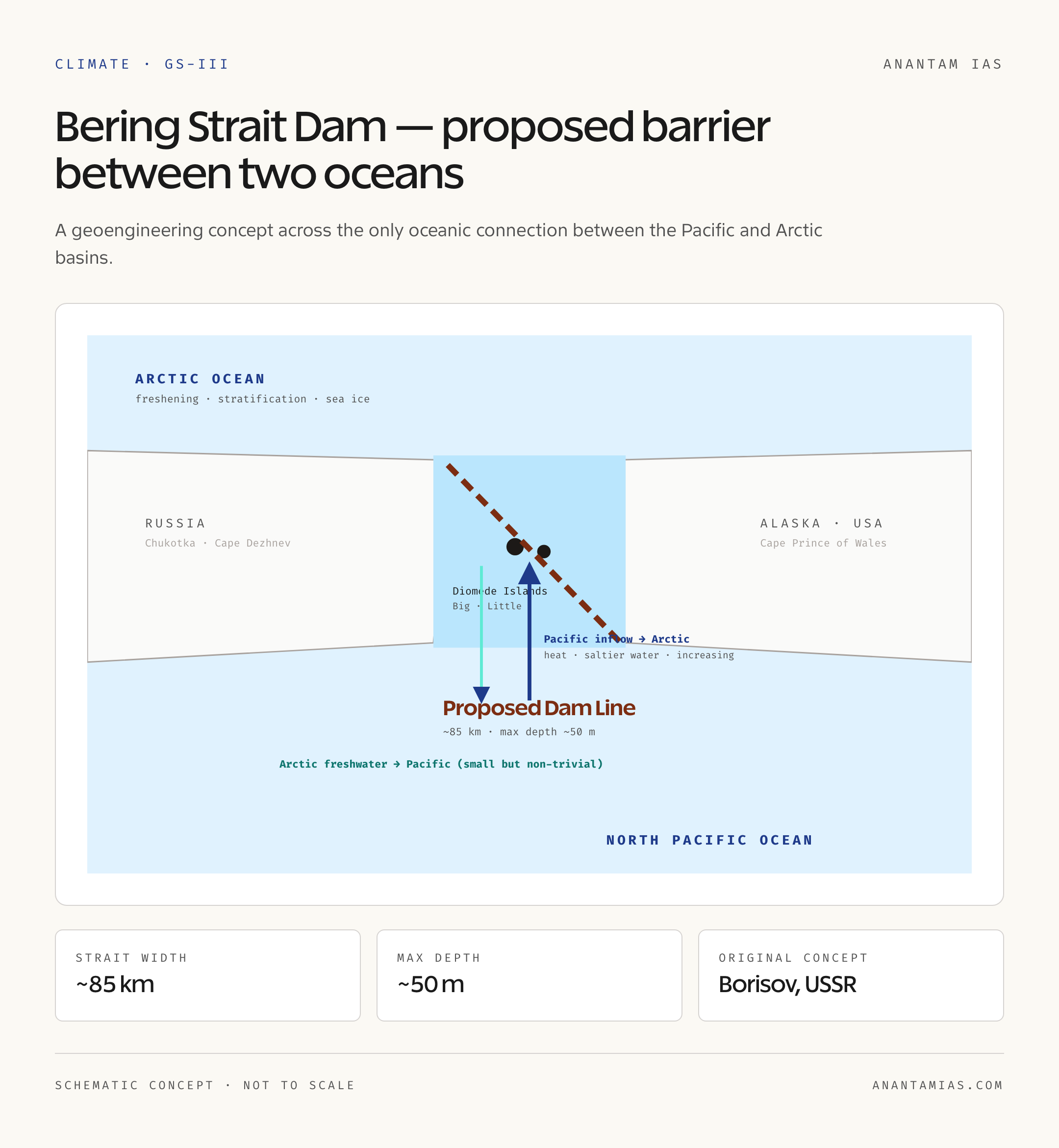
- Location: Bering Strait, between Alaska (US) and Chukotka (Russia)
- Width of strait: Approximately 85 km at its narrowest
- Maximum depth: Around 50 m (relatively shallow, which makes it engineering-feasible in principle)
- Climate purpose proposed: Stabilize the Atlantic Meridional Overturning Circulation (AMOC) by altering Arctic-Pacific water exchange
- Earlier proposals: Petr Borisov (Soviet engineer, 1960s) proposed a Bering Strait dam to warm the Arctic; concept revisited periodically since
- Modern proponents: Climate engineering researchers exploring Arctic-focused interventions
- AMOC status: Weakening as per latest available scientific assessments; exact magnitude debated
- Governance status: No binding international framework specifically covers ocean geoengineering at this scale
- IPCC stance: Cautious, treats geoengineering as a complement to (not substitute for) emission reductions
What Just Happened: Why the Bering Strait Dam Is Back in Conversation
The Bering Strait Dam concept resurfaced in late April 2026 as part of a broader policy conversation about climate tipping points and geoengineering responses. Recent oceanographic research has continued to flag AMOC weakening, with several studies suggesting that the circulation is in its weakest state in more than a millennium. As scientists and policymakers explore what intervention options might be available if AMOC moves toward collapse, the Bering Strait Dam has re-entered serious academic discussion as one of several Arctic-focused geoengineering proposals.
The idea is not new. Soviet engineer Petr Borisov proposed dams across the Bering Strait in the 1950s and 1960s, primarily as a way to warm the Arctic for navigation and agriculture. The modern revival inverts the goal: rather than warming the Arctic, the aim is to manipulate freshwater fluxes that affect AMOC stability.
Background and Historical Context
How the Idea Evolved
Petr Borisov’s mid-20th century proposal was driven by a Soviet vision of opening the Arctic for shipping and resource extraction. The plan was to dam the Bering Strait and pump cold Arctic surface water into the Pacific, allowing warmer Pacific water to flow north and melt the Arctic ice cap. The proposal had political support but never gained engineering traction.
In the post-Cold War period, the idea has been revisited from a climate perspective. American oceanographer Wallace Broecker, who coined the term “the great ocean conveyor” for the global thermohaline circulation, drew attention to AMOC vulnerabilities. As models started showing that AMOC weakening could be triggered by Arctic freshwater fluxes — including freshwater leaving the Arctic through the Bering Strait — the strait emerged as a potential intervention point.
The modern Bering Strait Dam concept proposes a barrier that could selectively allow or block water exchange. The intervention would aim to reduce the export of Arctic freshwater into the North Pacific (which is small but non-trivial) and, more importantly, control the Pacific water inflow into the Arctic that has been increasing as the Arctic warms.
Geographic Setting and Key Features
The Bering Strait sits between Cape Dezhnev in Russia and Cape Prince of Wales in Alaska. At about 85 kilometers across at its narrowest, with maximum depths around 50 meters, it’s one of the few oceanic chokepoints where a continental-scale dam is even theoretically buildable.
The strait is the only oceanic connection between the Pacific and Arctic basins. Water flows northward through the strait into the Arctic, carrying heat, freshwater, and biogeochemical signals that affect Arctic stratification and sea ice. The Diomede Islands sit roughly in the middle of the strait, with the international date line running between Big Diomede (Russia) and Little Diomede (US).
For climate purposes, two flux measurements matter most. First, the heat flux: warmer Pacific waters entering the Arctic contribute to Arctic warming. Second, the freshwater flux: the balance of saltier and fresher water passing through the strait affects Arctic salinity, which in turn affects the global density-driven ocean circulation that includes AMOC.
Why the Bering Strait Dam Matters
Three reasons. First, AMOC stability is genuinely consequential. A weakened or collapsed AMOC would mean cooler North Atlantic temperatures (counterintuitively, in a warming world), disrupted European weather patterns, sea level rise on the US East Coast, and shifts in monsoon systems including South Asia’s. Second, the proposal forces a serious conversation about geoengineering, which the climate policy community has tried to defer for decades. Third, the governance gap exposed by the Bering Strait Dam is a template for how the world handles all large-scale climate intervention.
Detailed Analysis
What the AMOC Actually Is
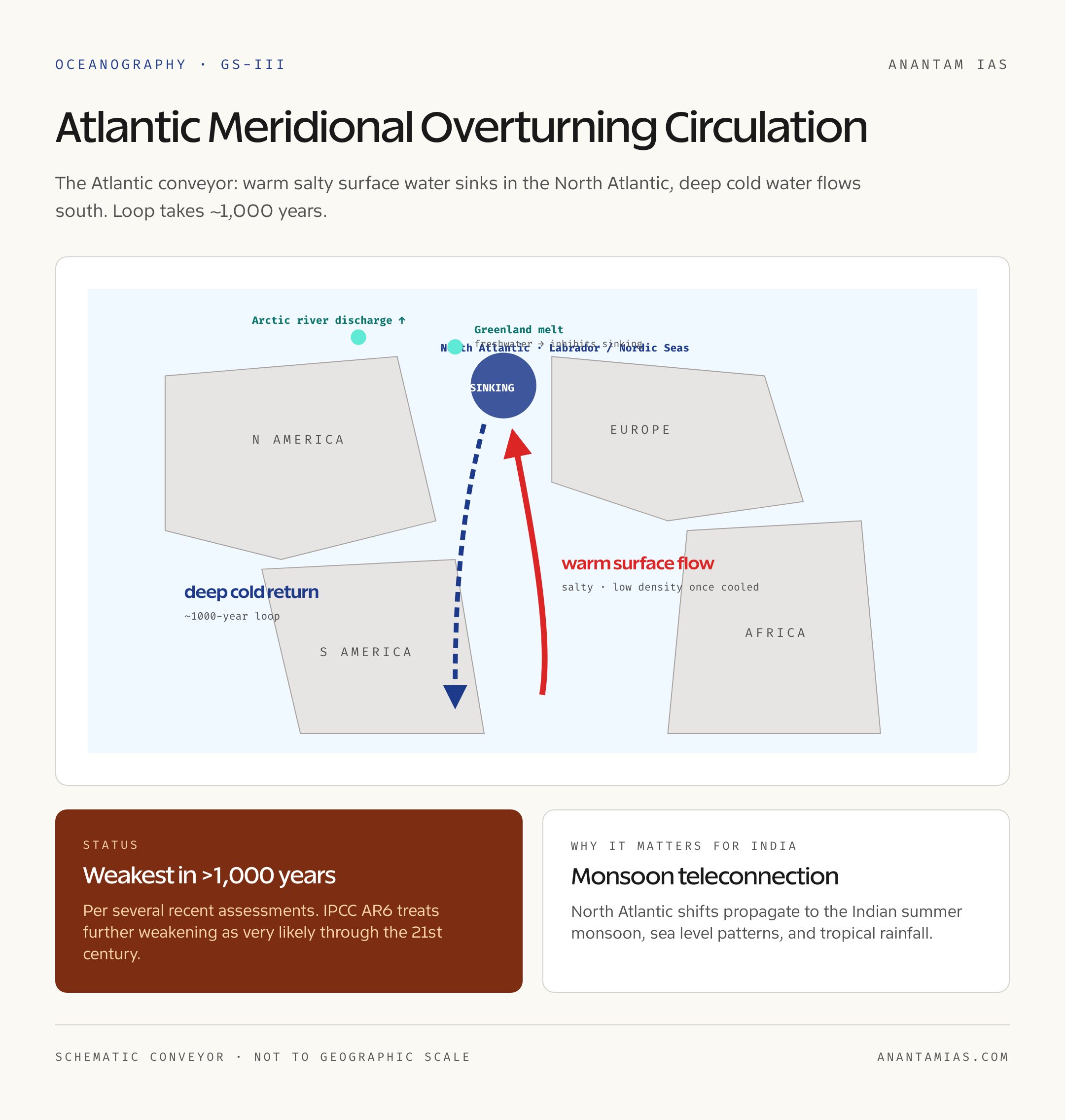
The Atlantic Meridional Overturning Circulation is the Atlantic-basin component of the global ocean conveyor belt. Warm, salty surface water flows northward through the tropics, releases heat into the atmosphere as it moves toward higher latitudes, becomes denser as it cools and saltifies, and sinks in the North Atlantic (in regions like the Labrador Sea and the Nordic Seas). The deep, cold water then flows southward, completing a loop that takes roughly a thousand years.
AMOC matters because it transports enormous amounts of heat northward, keeping Western Europe warmer than its latitude would suggest. It also moves carbon and nutrients in ways that shape global biogeochemistry.
Why AMOC Is Weakening
Climate change is adding freshwater to the North Atlantic from melting Greenland ice, increased Arctic river discharge, and altered precipitation patterns. Freshwater is less dense than salty water and inhibits the sinking that drives the circulation. As per latest available data, AMOC has weakened measurably over the past century, with some assessments calling it the weakest in more than a thousand years. The exact future trajectory is uncertain, but the IPCC AR6 assessment treats AMOC weakening as very likely through the 21st century, with low confidence in whether full collapse is possible within that window.
How the Bering Strait Dam Would Theoretically Help
A Bering Strait Dam would let humans modulate the freshwater and heat flux between the Pacific and Arctic. By controlling these flows, in principle, you could affect Arctic salinity in ways that propagate to the North Atlantic and influence AMOC. The modeling is genuinely complicated, and the results vary depending on assumptions, but several studies suggest non-trivial leverage on Arctic and North Atlantic conditions.
The catch is that any large intervention has cascading effects. Closing the strait could alter Arctic ice cover, affect Bering Sea ecosystems including major fisheries, change sea levels regionally on either side of the dam, and disrupt indigenous communities (especially the Inupiat and Yupik peoples) whose livelihoods depend on the strait.
Engineering Reality Check
Building a structure across 85 kilometers of open ocean in one of the harshest marine environments on the planet is non-trivial. The North Sea and similar engineering precedents handle far smaller spans. Cost estimates for any serious Bering Strait Dam exceed hundreds of billions of dollars, with construction timelines stretching across decades. Even with modern offshore engineering, the project would push the boundary of what’s been built before.
Governance and Ethics
This is where the proposal collides with the messy reality of international politics. The Bering Strait is bordered by the United States and Russia, two states with a difficult bilateral relationship. Any project would also affect global ocean systems, which means the rest of the world has stake. There is no binding international framework specifically governing large-scale ocean geoengineering. The London Protocol covers ocean dumping. The Convention on Biological Diversity has soft moratoriums on geoengineering. UNCLOS has provisions that touch on the issue. But there’s no comprehensive instrument.
The ethical questions are equally hard. Who decides? Whose interests count? What if intervention helps some regions and hurts others? What about reversibility? The IPCC’s careful framing on geoengineering treats it as a research area worth understanding but warns strongly against treating it as a substitute for emission reductions.
For broader environmental policy context, our piece on marine protected areas covers related themes around ocean governance.
Comparative Perspective: Other Geoengineering Proposals
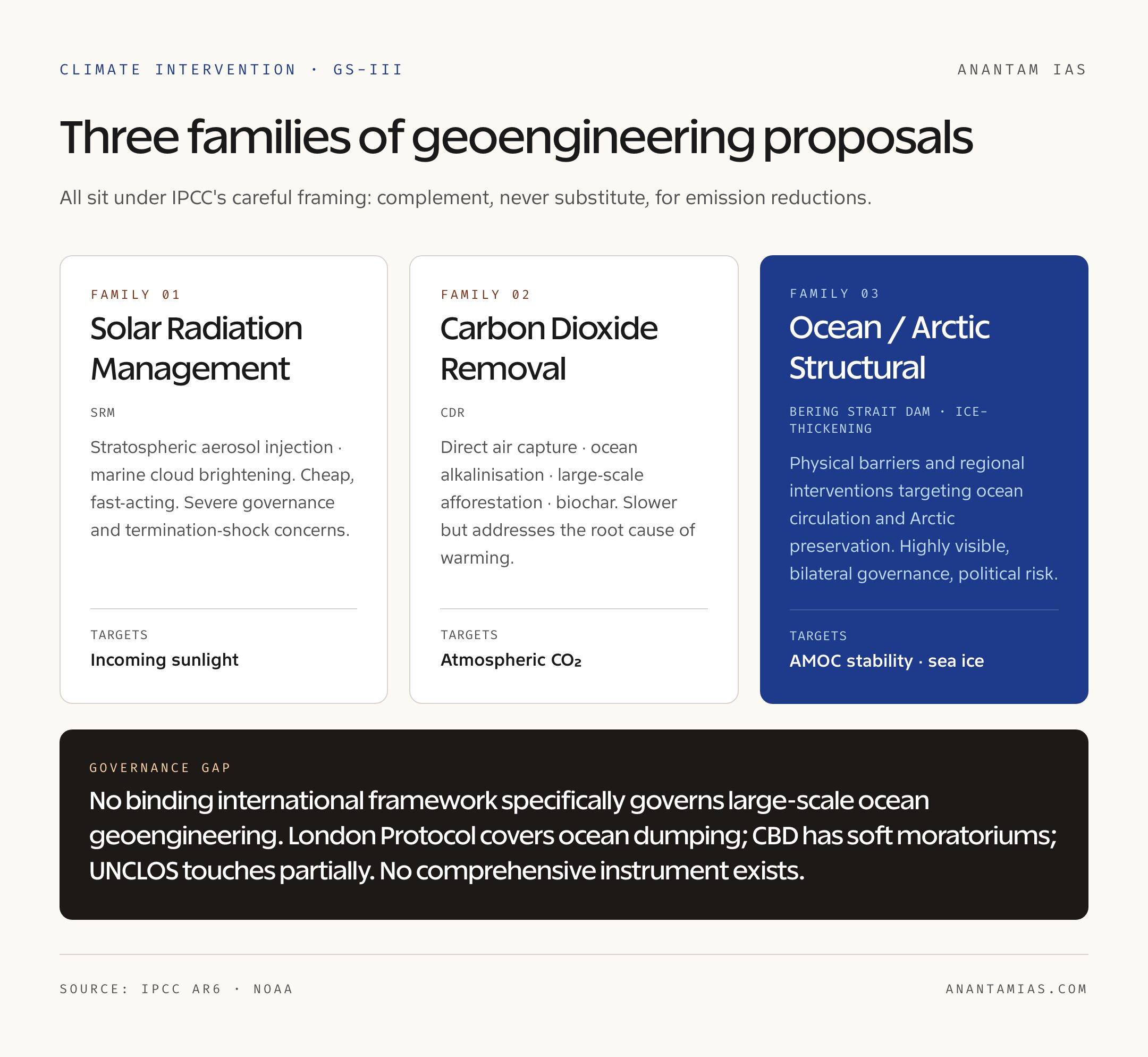
The Bering Strait Dam belongs to a category of large-scale climate intervention proposals.
Solar Radiation Management (SRM): Stratospheric aerosol injection, marine cloud brightening. The most-discussed solar geoengineering ideas. Cheap relative to other approaches, fast-acting, but with severe governance and termination-shock concerns.
Carbon Dioxide Removal (CDR): Direct air capture, ocean alkalinization, large-scale afforestation, biochar. Slower but addresses the root cause.
Arctic-focused interventions: Bering Strait Dam, ice-thickening proposals, glacial geoengineering at Greenland and Antarctic outlets, freshening or salinifying targeted ocean regions. Aimed at preserving specific climate features rather than reducing global temperature.
The Bering Strait Dam is unusual in that it’s a structural intervention (a physical barrier) rather than a chemical or radiative one. That makes it more visible, more bilateral in governance terms, and more vulnerable to political risk.
For an Indian-context piece on environmental engineering, see our explainer on graphene for materials-led climate solutions.
Challenges and Critiques
Four critiques dominate. First, scientific uncertainty: the modeling of how a Bering Strait Dam would actually affect AMOC is contested. Second, ecological cost: the Bering Sea fisheries, indigenous communities, and Arctic ecosystems would all be affected in ways that aren’t fully predictable. Third, moral hazard: pursuing geoengineering can reduce political pressure on emission reductions. Fourth, governance: no plausible international framework currently exists to authorize, monitor, and adjust such an intervention.
A more practical critique: the project’s physical and political feasibility may be so low that talking about it diverts energy from things that could actually help, like rapid decarbonization, methane reductions, and Arctic preservation through standard environmental measures.
UPSC Prelims Pointers
- The Bering Strait separates Alaska (US) from the Russian Far East
- Width approximately 85 km at its narrowest, depth around 50 m
- The Diomede Islands lie within the strait; the international date line runs between Big Diomede (Russia) and Little Diomede (US)
- The strait is the only oceanic connection between the Pacific and Arctic basins
- AMOC = Atlantic Meridional Overturning Circulation (part of the global ocean conveyor belt)
- AMOC is currently in a weakened state as per latest available data
- Petr Borisov proposed a Bering Strait dam in the mid-20th century to warm the Arctic
- IPCC AR6 treats AMOC weakening as very likely through 21st century, with low confidence on collapse timing
- Geoengineering is broadly classified into Solar Radiation Management (SRM), Carbon Dioxide Removal (CDR), and other interventions
- The London Protocol, CBD, and UNCLOS partially touch on geoengineering governance but no comprehensive framework exists
Mains Practice Questions
- GS Paper III: “The Bering Strait Dam proposal exposes the governance gap in international ocean geoengineering.” Discuss with reference to the AMOC weakening and existing international frameworks. (250 words)
- GS Paper III: Examine the science of the Atlantic Meridional Overturning Circulation. Why is its potential weakening considered a major climate tipping point with implications for India? (250 words)
- GS Paper II: Discuss the ethical, political, and scientific challenges of large-scale geoengineering interventions. Should India support international research on such technologies? (250 words)
- GS Paper III: Compare structural geoengineering proposals (like the Bering Strait Dam) with solar radiation management and carbon dioxide removal. Which approaches are most compatible with the precautionary principle? (150 words)
Way Forward
Three priorities make sense. First, rapid, deep emission reductions remain the only first-order solution; geoengineering is at best a complement. Second, the international community needs a serious governance framework for geoengineering research, with transparency, indigenous consent provisions, and a clear distinction between research and deployment. Third, AMOC monitoring (RAPID array, Argo network, Greenland mass balance studies) should be expanded so any future decision is informed by the best possible data.
For India, the Bering Strait Dam itself is a distant proposal, but the underlying issues — climate tipping points, geoengineering governance, monsoon system stability — are central. AMOC changes affect the Indian summer monsoon through teleconnections, and India’s stake in the climate intervention conversation is much larger than the geographic distance suggests. You can also explore our broader environment-focused content for related topics.
Frequently Asked Questions
What is the Bering Strait Dam?
It is a proposed geoengineering structure across the Bering Strait between Alaska and Russia, intended to alter Arctic-Pacific water exchange and influence climate, particularly AMOC stability.
What is AMOC?
AMOC stands for Atlantic Meridional Overturning Circulation. It is the Atlantic component of the global ocean conveyor belt that transports warm surface water northward and cold deep water southward, redistributing heat and shaping climate patterns including the European climate and global monsoons.
Who first proposed the Bering Strait Dam?
Soviet engineer Petr Borisov proposed dams across the Bering Strait in the 1950s and 1960s to warm the Arctic. The modern climate-focused revival of the idea emerged from oceanographic research over the past two decades.
Is AMOC actually weakening?
Yes, scientific assessments indicate AMOC has weakened over the past century, with some studies calling it the weakest in over a thousand years as per latest available data. The IPCC AR6 treats further weakening as very likely through the 21st century.
Why does AMOC weakening matter for India?
AMOC changes affect global teleconnections including the Indian summer monsoon, sea level patterns, and tropical rainfall distribution. While the magnitude is debated, India’s monsoon system is sensitive to North Atlantic conditions.
What is the governance gap for geoengineering?
No binding international framework specifically governs large-scale ocean geoengineering. The London Protocol, the CBD, and UNCLOS have partial provisions, but a comprehensive instrument with monitoring, consent, and reversibility rules does not exist.
What does the IPCC say about geoengineering?
The IPCC treats geoengineering as a research area worth understanding but warns that it cannot substitute for emission reductions. The framing is cautious, emphasizing scientific uncertainty, ethical complexity, and governance challenges.
Is the Bering Strait Dam likely to be built?
In the near term, no. The engineering scale, political complexity (US-Russia bilateral required at minimum), and ecological risk make actual construction extremely unlikely. The proposal is currently a thought experiment and research topic rather than an active project.