

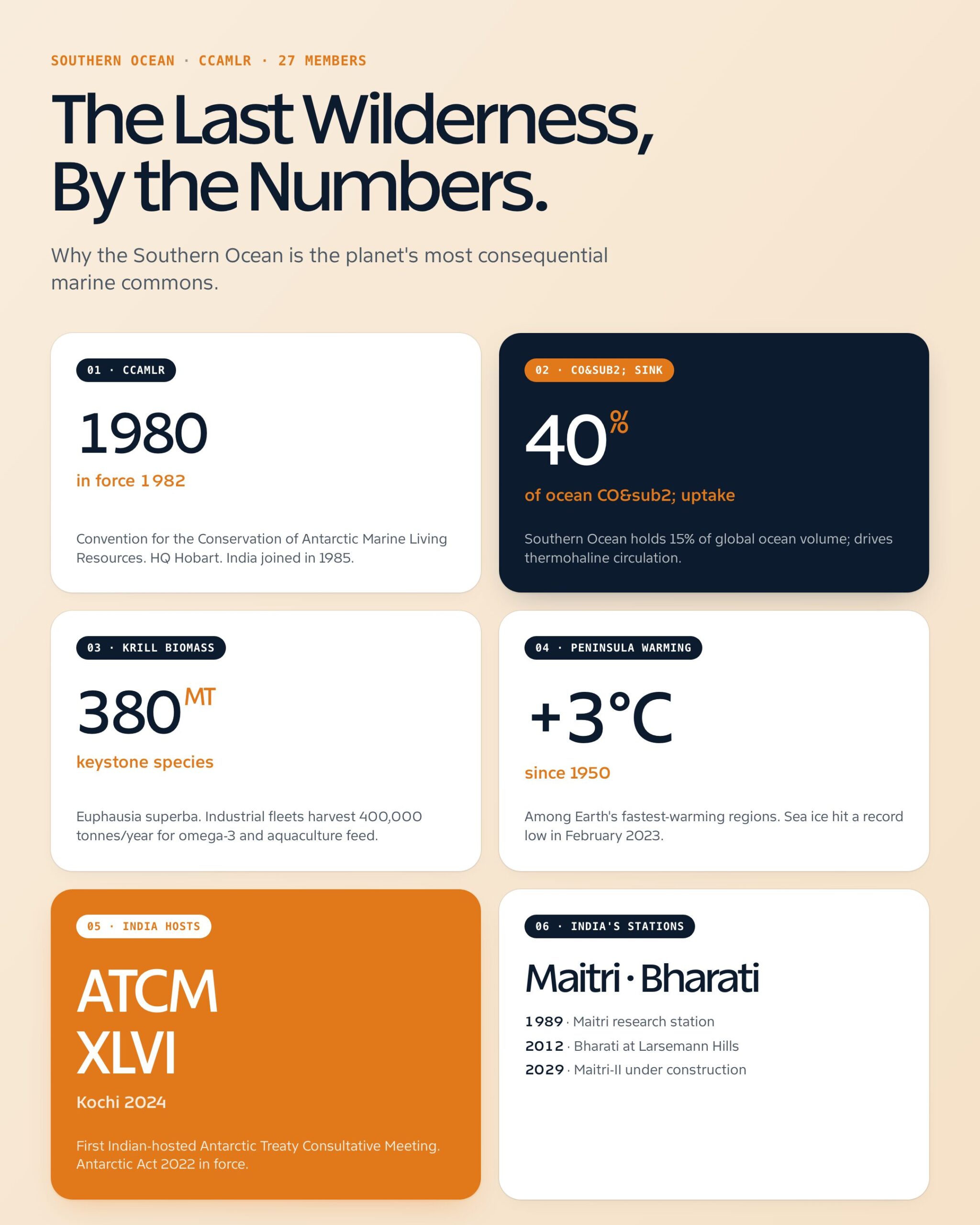
The Southern Ocean that rings Antarctica is the planet's last great wilderness. It holds nearly 15% of the world's ocean by volume, drives global thermohaline circulation, and absorbs roughly 40% of all human-emitted CO2 taken up by the seas. It is also the home of Antarctic krill — a finger-sized crustacean that anchors the food web for whales, seals, penguins and seabirds across the entire region.
Protecting this ocean is the work of Marine Protected Areas (MPAs) declared under the Commission for the Conservation of Antarctic Marine Living Resources (CCAMLR). India, a CCAMLR member since 1985, has consistently backed proposals for new MPAs. In 2023 and again in 2024, New Delhi formally supported the European Union and Australia's twin proposals for designating the East Antarctic and Weddell Sea as the world's next two marine protected areas. The proposals — first tabled in 2012 and 2016 respectively — remain blocked by Russia and China, who exercise veto power under CCAMLR's consensus rule.
For UPSC, Antarctic MPAs sit at the intersection of environmental conservation, international law, polar science and India's blue diplomacy. This guide explains what an MPA is, how CCAMLR works, why the Southern Ocean matters, and where the 2024–26 negotiations stand.
What is a Marine Protected Area?
A Marine Protected Area is a defined area of the sea where human activities are managed, restricted or completely banned to conserve the natural environment, biodiversity and cultural resources. The IUCN defines an MPA as "a clearly defined geographical space, recognised, dedicated and managed… to achieve the long-term conservation of nature."
MPAs vary in strictness:
- No-take zones — all extractive activity (fishing, mining, drilling) banned.
- Multiple-use MPAs — allow regulated, sustainable fishing, research and tourism.
- Seasonal MPAs — protection switches on during breeding, spawning or migration.
- General Protection Zones — restrict the most damaging activities.
Globally, MPAs cover roughly 8% of the ocean in 2025, against the 30% by 2030 target under the Kunming-Montreal Global Biodiversity Framework (GBF, 2022). Antarctic MPAs are central to closing this gap.
Why MPAs Matter
- Biodiversity insurance — protect breeding grounds, nurseries, migration corridors.
- Climate buffer — undisturbed seabeds store more carbon ("blue carbon").
- Fisheries spillover — fish populations rebuild inside MPAs and replenish nearby waters.
- Scientific reference — undisturbed waters serve as baselines for measuring climate change.
- Cultural and ecotourism value.
Existing MPAs in the Antarctic
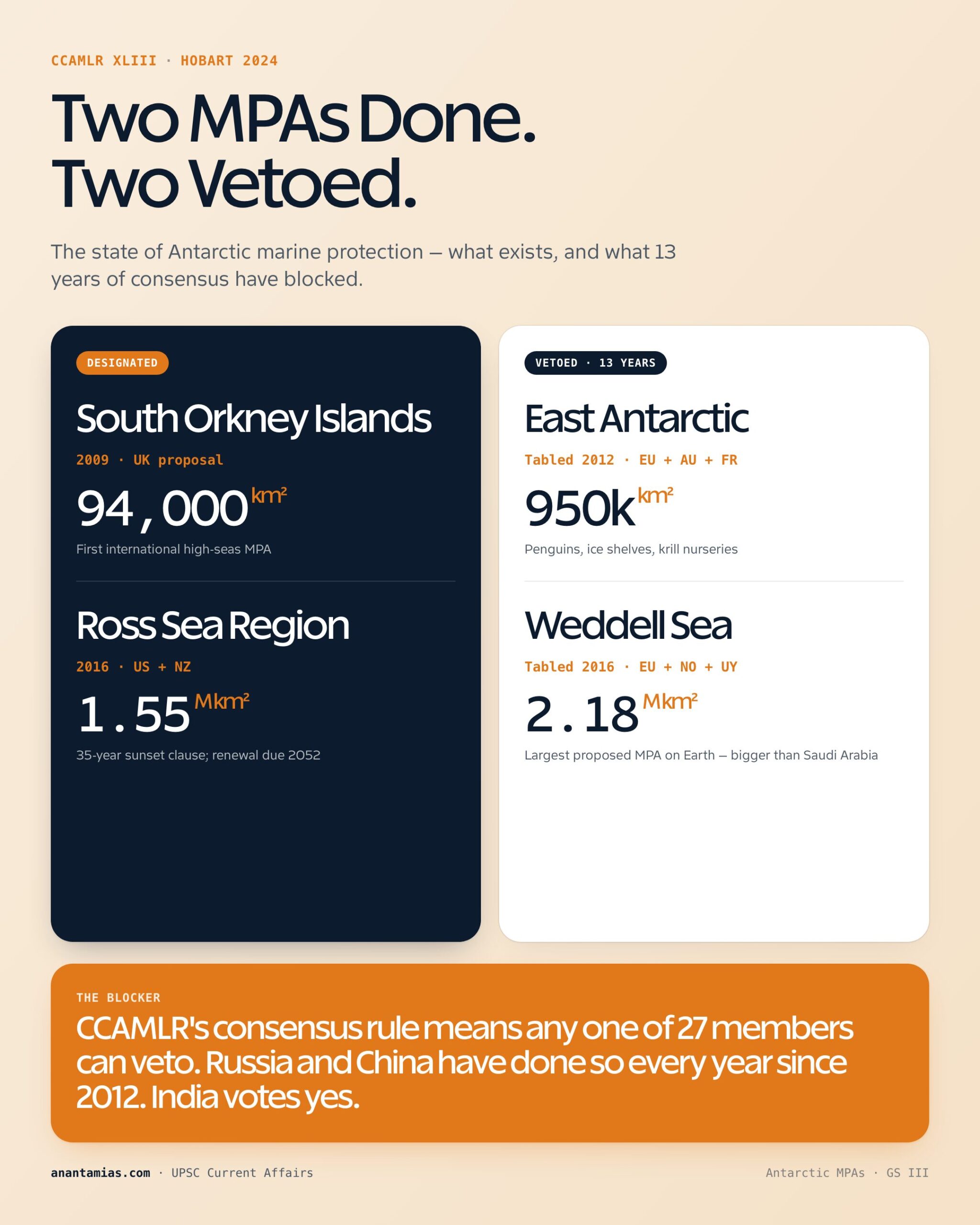
CCAMLR has so far designated only two MPAs, despite negotiations stretching back to 2002.
| MPA | Year Designated | Size | Significance |
|---|---|---|---|
| South Orkney Islands Southern Shelf MPA | 2009 | 94,000 sq km | World's first international high-seas MPA |
| Ross Sea Region MPA | 2016 (effective 2017) | 1.55 million sq km | Largest MPA in the world at the time of designation |
| East Antarctic MPA (proposed) | Tabled 2012 | 950,000 sq km | Krill, emperor penguins, ice shelves |
| Weddell Sea MPA (proposed) | Tabled 2016 (Phase I), 2020 (Phase II) | 2.18 million sq km combined | Largest proposed MPA on Earth |
South Orkney Islands MPA (2009)
Tabled by the United Kingdom, this 94,000 sq km no-take MPA lies on the southern shelf off the Antarctic Peninsula. It was a diplomatic landmark — the first MPA established beyond any nation's jurisdiction.
Ross Sea Region MPA (2016)
Often called "the Last Ocean", the Ross Sea is the most pristine large marine ecosystem left on Earth. The MPA was proposed jointly by the United States and New Zealand and finally agreed in 2016 after five years of negotiation. It covers 1.55 million sq km, of which 1.12 million sq km is a no-take zone. The MPA has a 35-year sunset clause, requiring renewal in 2052.
East Antarctic MPA (Proposed)
Tabled by the European Union, Australia and France in 2012, this MPA would cover 950,000 sq km off the East Antarctic coast. It targets penguin colonies, ice-shelf ecosystems and krill nursery grounds.
Weddell Sea MPA (Proposed)
The largest proposed MPA on Earth — over 2.18 million sq km combined across Phase I and Phase II, an area larger than Saudi Arabia. Tabled by the EU, Norway and Uruguay. The Weddell Sea hosts emperor penguin colonies, Weddell seals and is the engine of Antarctic Bottom Water — the cold, dense water mass that drives global ocean circulation.
CCAMLR — The Governing Body
The Commission for the Conservation of Antarctic Marine Living Resources is the legal framework that governs Antarctic MPAs.
- Established: 20 May 1980 by international convention; entered into force 7 April 1982.
- Origin: Concern over commercial krill fishing in the Southern Ocean and the historical collapse of seal, whale and finfish populations.
- Headquarters: Hobart, Tasmania, Australia.
- Membership (2025): 27 members — 26 countries plus the European Union. India joined in 1985.
- Other states: 10 acceding states that follow CCAMLR rules but do not vote.
Mandate and Approach
CCAMLR practises ecosystem-based management — the first international body to do so. It does not ban harvesting outright. Instead, fishing must be:
- Sustainable for the target species.
- Mindful of dependent species (e.g., krill harvest must consider penguin needs).
- Reversible if harm is detected.
The Consensus Rule
Every CCAMLR decision — including MPA designation — requires the consensus of all 27 members. This veto power has been used by Russia and China to block the East Antarctic and Weddell Sea proposals at successive annual meetings since 2012.
CCAMLR's Place in the Antarctic Treaty System
CCAMLR is one pillar of the Antarctic Treaty System (ATS), a suite of agreements that have governed Antarctica for over 60 years:
- Antarctic Treaty (1959, in force 1961) — the foundational treaty; freezes territorial claims, bans military activity, dedicates Antarctica to peaceful science.
- Convention for the Conservation of Antarctic Seals (CCAS, 1972) — protects six seal species.
- CCAMLR (1980/1982) — covers all marine living resources south of the Antarctic Convergence.
- Protocol on Environmental Protection (Madrid Protocol, 1991, in force 1998) — bans mining for at least 50 years; designates Antarctica a "natural reserve devoted to peace and science".
- Agreement on the Conservation of Albatrosses and Petrels (ACAP, 2001/2004) — protects 31 species of seabirds.
Threats to the Southern Ocean
Climate Change
Antarctic Peninsula has warmed nearly 3°C since 1950 — among the fastest-warming regions on Earth. Sea ice extent hit a record low in February 2023. Ice shelves like Larsen B, Larsen C and Thwaites are losing mass.
Krill Fishing
Industrial fishing fleets — especially from Norway, China and South Korea — harvest over 400,000 tonnes of krill annually. Krill is a keystone species; its decline cascades to whales, penguins, seals and seabirds. Krill is processed into omega-3 supplements, aquaculture feed and pet food.
Toothfish (Patagonian and Antarctic) Overfishing
Sold globally as "Chilean sea bass". Illegal, Unreported and Unregulated (IUU) fishing remains a problem.
Plastic and Chemical Pollution
Microplastics have been detected even in Antarctic snow. Persistent organic pollutants accumulate in penguin eggs and krill.
Tourism and Bioprospecting
Antarctic tourism has crossed 120,000 visitors a year (2024 IAATO data), raising biosecurity, oil-spill and disturbance risks.
India's Engagement with the Antarctic
India's polar programme is anchored by the National Centre for Polar and Ocean Research (NCPOR) in Goa.
India's Antarctic Stations
- Dakshin Gangotri (1983) — India's first station; abandoned, now a supply base.
- Maitri (1989) — operational research station.
- Bharati (2012) — modular research station in Larsemann Hills.
- Maitri-II — under construction; expected to be commissioned by 2029.
India's Treaty Memberships
- Antarctic Treaty: 1983 (consultative party since 1983).
- CCAMLR: 1985.
- Madrid Protocol: 1996.
Domestic Law
The Antarctic Act, 2022 is India's first domestic law on Antarctic activities. It regulates Indian expeditions, tourism and inspections, and gives effect to CCAMLR and Madrid Protocol obligations.
India's Position on MPAs
India has consistently supported the East Antarctic and Weddell Sea MPA proposals at CCAMLR's annual meetings (2014 onwards). India voted in favour at the 2023 and 2024 sessions, aligning with the EU, Australia, US and like-minded states.
Recent Developments (2024–26)
- CCAMLR XLIII (October 2024, Hobart) — Russia and China again blocked the East Antarctic and Weddell Sea MPAs for a 13th consecutive year. India, the EU, US, UK, Australia, Norway and 19 other members supported designation.
- Krill biomass review (2024) — CCAMLR Scientific Committee revised krill biomass estimates and tightened catch limits in Subarea 48.1 around the Antarctic Peninsula.
- Sea ice anomaly — Antarctic sea ice extent recorded its second-lowest minimum on record in February 2025, intensifying calls for precautionary protection.
- India's Maitri-II construction broke ground in early 2025; the new station will quadruple India's polar research capacity.
- Antarctic Treaty Consultative Meeting (ATCM XLVI, Kochi 2024) — India hosted the meeting for the first time, raising its diplomatic profile in polar governance.
- High Seas Treaty (BBNJ, 2023) — once ratified by 60 countries, it will create a parallel mechanism for high-seas MPAs that may complement CCAMLR.
- Krill super-trawler controversy (2024) — incidents of krill vessels operating close to penguin colonies in Subarea 48.1 prompted CCAMLR to fast-track spatial management measures.
Way Forward
- Break the consensus deadlock — explore voting reform or "qualified majority" pathways at CCAMLR.
- Designate the two pending MPAs — East Antarctic and Weddell Sea, even if phased.
- Strengthen krill management — expand spatial and temporal fishing closures around predator hot-spots.
- Integrate climate metrics into MPA management — adaptive thresholds for sea ice and SST.
- Operationalise BBNJ Treaty to complement CCAMLR for adjacent high-seas zones.
- Expand monitoring with satellites, autonomous underwater vehicles and acoustic networks.
- India should leverage ATCM hosting to push for consensus on MPAs and lead a "G77 + Polar" coalition.
- Curb Antarctic tourism footprint through binding IAATO-CCAMLR rules.
- Tighten Antarctic Act 2022 with criminal penalties for IUU fishing by Indian vessels.
Mains Hook
"The veto by Russia and China on Antarctic MPAs is a test of multilateral environmental governance. Examine the role of India in CCAMLR and suggest reforms to make Antarctic protection truly global." — GS III
"Discuss the significance of the Southern Ocean as a global commons and evaluate the adequacy of the Antarctic Treaty System in protecting it from 21st-century pressures." — GS III
Prelims Pointers
- CCAMLR: established 1980, in force 1982; HQ Hobart; 27 members (26 countries + EU); India joined 1985.
- Antarctic Convergence is CCAMLR's geographic boundary, not the 60°S latitude.
- South Orkney Islands MPA (2009) — first international high-seas MPA.
- Ross Sea Region MPA (2016) — was the world's largest MPA when designated; has a 35-year sunset clause.
- East Antarctic MPA: proposed by EU, Australia, France (2012).
- Weddell Sea MPA: proposed by EU, Norway, Uruguay; would be the largest MPA on Earth.
- Antarctic Treaty (1959) — bans military activity, freezes claims, dedicates the continent to science.
- Madrid Protocol (1991/1998) — bans mining for 50 years.
- India's Antarctic stations: Maitri (1989), Bharati (2012); Maitri-II under construction.
- India's domestic law: Antarctic Act, 2022.
- ATCM XLVI — hosted by India in Kochi, 2024.
- Antarctic krill (Euphausia superba) is a keystone species; biomass estimated at over 380 million tonnes.
- Kunming-Montreal GBF target: 30% MPA coverage by 2030 ("30 by 30").
Conclusion
Antarctic MPAs are a stress-test for global cooperation. The science is settled, the proposals are technically robust, and a clear majority of states are willing. What is missing is the political will to overcome two vetoes. For India, the path forward is to keep voting yes, to invest in polar science, and to use its 2024 ATCM hosting to lead the conversation. The Southern Ocean cannot be saved by any one country, but it can be lost if we wait too long.
Tell Google you want more of this.
Add Anantam IAS as a preferred sourceOne tap, and this site shows up more often in your own Top Stories, AI Overviews and AI Mode. Remove it any time.






